Showing posts with label Stephen Carl Porter. Show all posts

Thursday, January 18, 2018

A Mysterious Photographer

Not often do I speak historically of photography, but sometimes knowing something about period photography helps in understanding some of the mess I'm digging through. Recently, I was getting a few Ossman pictures together for a cartoon idea, but then I realized something about one of the pictures I was using. 
I opened this picture for the first time in a while, and noticed that it was not taken at the Edison studio in c.1898. I cropped this larger version of this crappy image from this:
Edison? What?
Nope. 
Okay, so the first thing that caught my eye and made me realize that this was not taken at Edison was that wallpaper. I've seen that wallpaper quite a few times in Columbia studio pictures. Just so you can all visually see that this wallpaper is most certainly Columbia's is through this picture here:
We know for certain that this group of musicians is the Columbia orchestra. Thanks to The Phonoscope, we can be assured that these are familiar musicians that we've seen before, such as the clarinetist and the piccolo player. Those two recognizable musicians are William Tuson and George Schweinfest, with any one of the cornet players probably being Tom Clark. The picture above is certainly Columbia's studio, as not only do we see familiar Columbia musicians, but we also see those distinct windows that were on that immense building that Columbia occupied in the late-1890's. You can't see those windows in that picture of the studio in 1898:
Unfortunately the picture was taken just so that you can't see those windows, but everything inside is the same as usual. You can see them here though:
There's those windows!
So anyway, now that we've got that sorted out, let's get back to that Ossman picture. 
We can now see that it was taken at the same place as this picture, according to the familiar wallpaper sheathing the background of every early Columbia picture:
there's that same wallpaper!
So with all of this evidence of Columbia being the location of that crude Ossman picture, what of it?
Well, it's not Edison as the note below it states. So, since I've gathered all of these early Columbia pictures from around the same time, this had led me to question something. 
What's with all these crude pictures?
It can seem curious to look through all these Columbia pictures and find a pattern. What I've noticed about these Columbia pictures is that they are nothing like the well composed Edison pictures from around the same time, and a little earlier. Even the earliest Columbia pictures have a period composition that were taken by a skilled photographer. The strange composition of these Columbia photographs is not typical to what I've seen in general from the time period. They're out of whack and uniquely composed. 

I mean, it would be hard to look at that Ossman studio picture and not see that it's weird. Just like the 1898 exhibition picture, it's clear someone was experimenting. Also, after doing some more digging through my studio pictures, I realized that the one picture of Estella Mann making records was also taken at Columbia...
That same wallpaper!
The composition of these photos is very strange, and I hope that you see why. Not often do we see in an 1890's photograph a picture like the Ossman one, likely taken down the hallway from the main recording room, leaving the door open and taking up half of the photo's composition. Being in an advanced placement art class, my teacher would give that image a funny look, since often photographers are advised to compose the image with balance, but that Ossman picture has not that at all. Even with my inner artiste talking, I love these strange Columbia photographs. They're especially unique, not just from the technical standpoint of noticing the same wallpaper, but also from the artistic standpoint of the weird composition. With all of Columbia's rotten corporate rules and atmosphere, they still had the most down-to-earth bunch of leaders on their recording staff. Another thing to keep in mind with these Columbia pictures is that they were all taken around the same time, within a two year time frame(or so). The time I mean here would be from 1897-1898. Even though I have not used the exhibition picture as an example, that picture also is included in this study. It be about time to use it again anyway:
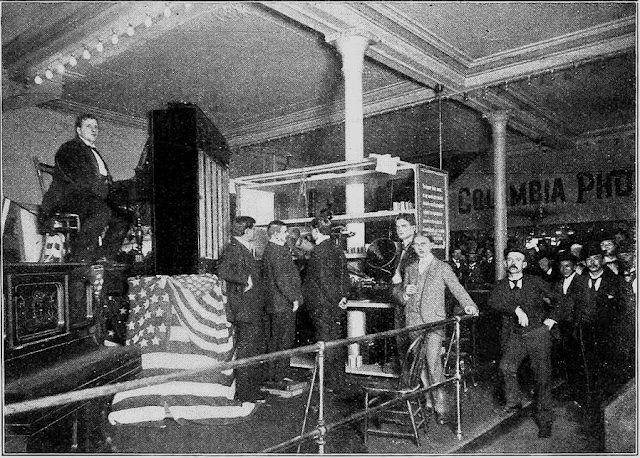
This image is composed similarly strange to the other ones. 
Really look at it. 
This image was likely taken at that rounded corner that we can see in the picture of the outside of the place in 1898. Since we can see all of this, here's the real question...
Who was taking all these pictures?
Of course since there's no "Columbia Archive" anywhere, we can't definitively see who took thee pictures, but we can have some good guesses. We know many of these Columbia recording stars were experimenting through their long recording careers, but the one specific guess I have would be Len Spencer. We know that in 1895-96, both Spencer's along with Steve Porter and Russell Hunting tried entering in the new film business. After that endeavor collapsed, Harry Spencer was left with all the equipment and connections they made, the remnants of this you can see in the earliest edition of The Phonoscope. Considering Spencer's relentless experimentation, it would be too surprising if he was part of the reason for those strange Columbia pictures. Since he did have an "artsy" side(being that he was naturally a lefty) he must have had an apt viewpoint when it came to taking photographs. Another reason I think it may be Spencer is because of who is missing in the exhibition photograph. We see Harry Spencer clearly identified, but no Len in sight. I'm not saying that I would always assumed the Spencer brothers to be together, but since the image above is of an exhibition, it would be very likely that Len was elsewhere in that chaotic scene. By elsewhere, I mean "experimenting" with a camera he had. When considering Spencer's nature to experiment, it wouldn't be surprising if he was responsible for that exhibition picture, or the strangely composed Ossman one from around 1897 or so. 
Let me reiterate that picture again, just so we can all see it again:
That's the stranger portion, where we're peeking into the recording room at Ossman while he makes records. It's a clever photograph really, even with the almost too wide door. 
The other seemingly random half of the picture here is this also interesting character:
Who's that?
When looking over this image once more, I almost immediately recognized that guy. He's got to be an Emerson brother. But which one exactly is the question...
Well, as I went to dig through all the pictures of those three brothers, I assumed first that it was the most obvious guess, Victor. We all know about Victor, with those intense eyes and red hair, with a stare that'll knock anyone cold(and not in a good way!). 
There he is...You can just see the evil in his eyes...
After looking at pictures of the three Emerson brothers, I saw that this figure was not Victor, but it was George. 
The handsomest of the Emerson boys, also the youngest. 
You can see that this mysterious engineer in the artsy Columbia picture is George for a few reasons. 
One...That's exactly the same mouth and lip structure.
Two...those distinct ears, that were slightly different from Victor's more pointy ones. 
Three...That curly, wavy hair. All three(there were four mind you) of the Emerson boys had this hair type, but it seems that George got the most prominent variation on this theme, and you can see it in the artsy picture, as can be observed in the picture directly above.

Another observation...if that's George Emerson in the Ossman picture(of whatever it is...), he looks older than his age. Lets say that picture was taken in 1898, so with that, Emerson would have been 22. He looks older than a young chap of 22. Thanks to The Phonoscope we know that he was the sporty one of the brothers. He got himself into tangles with wandering women, and it looks like he was a drinker as well, similar to Victor in a certain aspect. 


Anyway, it seems I've exhausted this topic for now, hopefully I can sometime see the originals of these images and get a much better scan of them, wherever they're kept hidden...


Hope you enjoyed this! 


Saturday, January 6, 2018

Some more studio politics

Now that the holidays are essentially over, hopefully I can get back to making more blog posts, since it's still been hard to find more interesting information to talk about. 

Recently while searching around for quartet records, I came across a very strange record that hadn't even a record number to be found. The performer listed in the announcement of the record was given by the familiar voice of this chap:
Steve Porter.
So the creation of this strange record seems to have been facilitated by Mr. Porter, though the leading voice in this so-called "Diamond Quartette" would most certainly be George Gaskin. This record is centered around a parody on the hit "I'd Leave my Happy Home for You", but on the record it is called "I'd Leave my Job to Vote for You"(haha). 
Porter's announcement begins with this, 
"republican campaign song..." 
after the announcement the lovely and unmistakable Ragged playing of Hylands lumbers through. 
Of course on this record, there's a mot more than just Hylands and that Quartette. It seems that in this quartette, there was Gaskin, Porter, Roger Harding, and George Hargraves. This witty parody is rallying for William McKinley's campaign in 1900, and throws William Jennings Bryan and the Democrats in the dust. Sorry, it's one of those records I can't share out of kind courtesy to the owner. 
So, in past digging, I had heard of such campaign songs and rallying done by a certain group at Columbia. Those "clan" members at Columbia(let's say Harding, Porter, Spencer, Gaskin, Emerson brothers, Hylands at this point in time) were most certainly prominent politicos in their time. And with that, it can further be proven by the first Phonoscope section I found regarding their prominence in the Republican Party of New York. 
I hate that these are so hard to read. What a politico Harding was! Harding did quite a lot of rallying. well there ya go, there's that exact group from that record I've described. It's amazing to see an actual written account regarding the group, and then later finding a rather "wild" record by the very same group. Of course when digging all of this up after listening to the record, this brought back the research I did on studio politics a little while ago. Also, while doing some random digging on something else last night, I stumbled across something else telling about a certain someone.
It's clear that I talk about Fred Hylands quite often, and finding new information on him has been very slim the past 6 months. One thing that's fascinating about Hylands however is that his political view and morals seemed to have changed somewhat after a certain point in time. This change was a gradual process, and it took a few years for him to transition. Luckily, that recording and Hylands' associations in the recording business can lead us to assume he was on the dominant Republican side of the Columbia staff(keep in mind not every one of the boys and few ladies was on the same political side). Despite Hylands' more popular relations, he(much like Scott Joplin believe it or not) around 1899-1900 began associating himself with some of the underground people's and political activists. By these terms, I mean Socialists. Those progressive outcasts that were dreaded by every factory and corporation, yes, Hylands began flirting with members of these groups. 
I've made it clear that Hylands switched to the other side by 1904-1905 by becoming a leader with the White Rats, but it seems that a few years before that he was pondering the ideas that his progressive friends told to him. I had assumed some of his actor friends like J. Grant Gibson would have swayed him over, but actually, come to find out it was someone else familiar. 
Well, this "ranting Bill" is Will J. Hardman. 
(cartoon by me!)
Just last night, I went digging for some early roots of Rag-Time on the Johns Hopkins sheet music website, but stumbled upon something fascinating. So what has Will J. Hardman to do with Hylands' socialist streak? Well it seems I found an indirect answer. 
(the date on this one is 1886)
There we go! It seems I found another source of influence for this transition. 
Of course! It makes so much sense now. Hardman was a gifted wordsmith, and now it seems that my hypothesis of his friendship with Hylands was in fact true! I had assumed by how many songs Hylands wrote with Hardman in such a short period of time that they had a bond outside of their music. So at a certain point, Hardman must have explained his world view to Hylands, and since Hylands was already somewhat fed up with Columbia, these new ideas from progressive Hardman must have been eyeopening. Unfortunately, I know nothing on Hardman at all, but because of the age of the other pieces I've dug up, he was most certainly older than Hylands, probably a decade older as far as I can guess. That would put him at around 38 by the time he met Hylands. Without a doubt, in 1900, Hylands was keeping his rebellion and disenchantment well hidden, since he had to participate in many of those political gatherings that Harding organized. By the time of the publishing firm with Spencer collapsed, Hylands was essentially outcasted from the tight pact that the Columbia staff had in the 1890's. With the shunning however, came Hylands' opportunity to go the way he desired, and head off to become a "Knight of Labor". We know his first try left all his old friends at Columbia a little frightened while also made him the laughingstock of Columbia and the Broadway community. This Socialist leaning left some of his old Columbia fellows concerned, and it must have made Len Spencer roll his eyes. 
Spencer after 1900 went a different direction as well, he was still a solid Roosevelt Republican, but his entering into the business aspect of vaudeville took something out of him. Spencer was unhappy with the progressives like Hylands and the other Union men, and this must have worsened over time when he had to deal with quite a few scrambles regarding union members and leaders. Of course, before his "falling out" with Hylands, Spencer would have seen bits of these progressives, as Frank P. Banta was part of a musicians' union, despite the contradictory nature of his employers. 
Since Hylands' relationship with Hardman was relatively close for enough time, it's likely that Hardman was part of Hylands' political transition. Another thing to note from that sheet music cover I found, notice the other titles listed under Hardman's name.
"For one day of Turkey there's six days of hash" 
well well Mr. Hardman, that's an amusing title certain. The words above the title are also interesting:
"an injury to one is the concern of all"
What a Socialist remark that is. Much like the cartoon above, I can envision Hylands being hypnotized by Hardman's ranting, since his lyrics were perfect with Hylands' weird often drug-induced Rag style.(think about the multiple meanings for "hash" in the title listed above). Keep in mind that Hardman's lyrics to Hylands' songs are very weird. They're strange even for the time period, and weirdly poetic all the same. 
Really listen to those lyrics, they're funny but really weird and have a few nearly unrelated lines. 
Of course one can wonder about how Hylands and Hardman became friends, and of course my mind goes directly to them both being den ramblers(essentially the opium equivalent to drinking buddies), who were both second grade musician/composers with unique talents. Hopefully, someone will dig something up on Hardman sometime soon, the suspense of learning little bits about him through his music is starting to get aggravating. 


Before I finish, I wanted to share the two record related finds I got for Christmas. The first thing I saw was an original Columbia box from 1897 or so, and when I opened the box, out popped a bunch of the soft fluff that record companies used to protect their records. I had always wanted one of those beautiful pre 1900 Columbia boxes, as they were colorful and elaborate, much like the late-1890's was in a nutshell. 
There's the pretty old box. 
Now the record on the inside was also really nice too, because it's Dan Quinn singing "put me off at Buffalo" from around 1898 or so. 
I'm looking forward to hearing the thing sometimes soon, as it will likely be a varied round of this take:
There's the record and the box. 
And my gloved hand holding it correctly. 
So far I've heard three different takes of Quinn singing this song all on Columbia brown wax. I wonder how many rounds he made of it for Columbia anyway. 
Other than that fantastic gift, I also unwrapped a piece of Hylands published sheet music. He did not write it, but it's another Hylands, Spencer, and Yeager piece, which is always worth my time and money. Of course it's not one with Dan Quinn or Spencer on the cover, but it's about the next best thing. 
there ya go. 
Another Hylands Spencer and Yeager piece is always welcome in my sheet music collection. Any time that certain lady is on a Hylands piece is always interesting to me. 
So I've seen her on three Hylands sheets now...the number seems to keep increasing, as does the evidence of a little fling there. I learned somewhat recently that she divorced her husband in 1900, the year that this piece was published with her picture on it. The charges of the divorce were impropriety. It's very tantalizing to read this, and it legitimately shocked me when I saw it. Maybe sometime I'll do a post on what evidence I have about this tantalizing coincidence....


Anyway...


Hope you all had an all-right holiday season!

Monday, February 20, 2017

A new Picture and quoting

Let's begin with a new image:
What a perfect image! Now that we've seen this amazing picture, let's get to identifying! 
I pretty much knew who everyone was when Charlie Judkins sent me the Ebay auction that this came from. Thankfully there was a picture also identifying everyone, to check my answers as to who they are! 
So close! Those damn Emerson's are always the hardest ones. 
It's only because I've only seen one of them(Victor). Oddly enough, I had guessed Georgie Emerson was a really young and handsome chap, assumed to be the best-looking of the Emerson boys, and what d'ya know! That was a complete wildcard guess, and it just happened to be true! At first glance, I thought Steve Porter was someone else(thought he was J. W. Myers...), because of that young and new mustache he's got. He looks very strange with facial hair, though he fits the "dandy" category even more than he regularly did. But one thing is for sure, we can now prove that one of the singers in that infernal pianist picture from 1897 IS Porter. Take a look:
That is certainly the same physique as Porter in the other picture. 

Now let's not kid ourselves, I really freaked out when I saw this new picture because of Spencer. Finally! A clear, full length image of Spencer. That's exactly what I needed. Spencer looks pretty much exactly as we would all expect him to look. Luckily, he's not hard to spot. Strangely enough, I drew a cartoon of Spencer last evening, and now that we've got comparison, I wasn't too far off! It's the strangest thing really, being able to educatedly guess the physique of a character and have drawn them many times, to only see fully what they looked like perhaps years after first learning of them. That's pretty much what happened with my cartoons of Spencer, and now they will be pristine in their accuracy! Now that I've seen this picture, I can actually picture Spencer making all those records.
Perfect. Now he can haunt me in my dreams.

Yep, it seems fitting now. Before seeing this image, I couldn't really set the strange face to the records, but now it's clear. This is going to make listening to Spencer records a whole lot more fun. He's just as much a dandy as expected, and how much of a stereotype is it to have Spencer right next to Ossman? That's almost to be expected of them. Never really thought that duo was the best, but maybe we're wrong. I have long assumed that Ossman's picky nature and short temper couldn't have gone over well with Spencer, but maybe they were the types that could go out for a drink after the studio day(like he and Hylands the year after this picture was taken). Speaking of that, this picture was taken in 1898, and the specific date can be seen in an edition of The Phonoscope, of which a section was published describing the exact event that this picture was taken. All the names were listed too, so that even better identifies everyone in the picture. This was a day where the leading Columbia talent(then where's Hylands?) went to the Berliner company to make some records, including unusual talent members like George Schweinfest and George Graham(!). 

How weird is it to see George Graham in another photo? Very much so. Going from completely mysterious and only one image, to a full-length image where he pretty much looks the same. Something so note, everyone looks pretty much how we've been told personality wise, as well as their appearance. Gaskin actually looks like he's relatively short, something a little unexpected, however, he certainly looks an Irish stereotype to the highest degree. Ossman, Spencer and Porter are dressed flashy, as expected. Gaskin is smoking, and so are Spencer and Ossman, but oddly enough, something about seeing Quinn with a cigar is a little unfitting. Everything about Hunting is fantastic, like every picture of him there is, even that funny-looking, slightly cockide tie and little jeweled drop on his chain. Schweinfest is pretty much exactly as we'd expect him to be, modest, squinting a little(no glasses though hmm...) with a somewhat serious face. Certainly looks the Issler orchestra member he was.
Looks like a guy you'd like to know. And he was!

He also looks a German stereotype, much like how Gaskin does with the Irish thing. It's also nice to really get an idea of height difference since that's really the hardest thing to perfect with my cartoons of these figures. Of course Spencer is the tallest, and Gaskin, Quinn, Schweinfest, and Clyde Emerson are the shorter ones, which is really helpful to see. It's actually great to see the height difference of Spencer and Ossman very clearly, since Ossman appears to be taller than some had previously thought. Ossman had lots of leg, and that's clear in the many images of him out there. This has been made clear by this image. Spencer had a long neck and lots hair, both of those things can be observed here(not really the hair thing, but kind of). 

Like most pictures of Quinn he looks a little awkward in this one, though that same smile he had in the 42 Edison artists picture is there. In fact, I think he even had the same hat in his hand. It looks like he has the same hat on in this new picture that he's holding in the 42 artists picture. Wow, that's strange. Victor Emerson doesn't look inviting at all, like he really was! The only Emerson here that's remotely welcoming is George, of course it doesn't help that he's the youngest one in the picture. He was surprisingly good-looking, almost on par with Fred Hager(Haga) respectfully. Georgie was practically a teenager when this image was taken(21-22). 

I could go on forever about this picture, since there's so much to take in. I will certainly be using that picture of Spencer very often though. It really does channel everything about him, including the slightly frightening eyes. Also the bit with George Emerson, since now we know what he looked like, and that he was the baby-faced young man, likely with red or blond hair. Soon I will have a better quality scan of this image to use more frequently. 


Now for some music quoting! 
An important part of the humor of the late-19th century is certainly knowing all the popular songs of the era. Something that was done as an indirect type of humor was quoting popular songs of the past and the present to continue a point or end a joke. This is something that musicians did all the time, and this is evident since the studio pianists were always doing this behind the singers. Something was know very well is that Hylands loved to quote other songs, and this is all over his written music. Just listen to his 1898 recording of "The Darkey Volunteer" with the Columbia orchestra:
There's quotes everywhere, and the second section is the main melody of "The Darkies' Dream", of which Ossman recorded with Hylands already by the time he wrote this piece. These are common quotes, ones that many pianists used in their pieces. How about more unusual ones? 
Take Denny's 1898 Columbia of "Time Is Money" for example, Hylands plays the piece straight throughout, until he plays that strange Rag-Time tag at the very end. This is no random improvisation of Hylands', he' quoting that popular Rag-Time song "Get Your money's Worth", which is really funny! Just to confirm this, here's his and Spencer's 1898 Columbia of it:
The melody in the chorus is exactly the same, just with Hylands playing it in that really ragged and slightly Les Copeland-like way. Oddly enough, that messy and scattered solo Hylands plays at the end of Denny's 1899 Columbia of "How'd You like to be the Iceman?" is actually a quote of "Get Your Money's Worth". Well, as messy as the cylinder gets at the solo part, I can still pick out that same melody. But to add to the unusual nature of quoting this song, we look to Denny's Edison of "How'd You Like to be the Iceman?":
(the transfer is played too fast, sorry about that...)
Banta also quotes "Get Your money's Worth" at the end! The way Banta took the melody and ran is really fantastic. That's essentially what he did with it on the Edison take. Hylands just made it weird in that way he did. 


Other strange Hylands quotes include these:

his not-so-great tag of "Telegraph My Baby" at the end of Johnson's "The Whistling Girl": https://archive.org/details/TheWhistlingGirl1898JohnsonandHylands

Playing "Mister Johnson, Turn me Loose" at the end of Johnson's "Laughing Song":
Now THAT  is ironic humor right there. Playing "Mister Johnson Turn me Loose" at the end of a George W. Johnson record. Wow Hylands...
(by the way, this is one of those great pantographed copies where you can actually hear the left hand chords Hylands plays)

and of course, playing "Mister Johnson" again behind Billy Golden in 1899:
(Banta did this too, playing it his way behind Golden in 1897)


Of course, with this humor being most of what he hear from Hylands, there are quotes that we cannot identify, such as what Hylands plays at the end of that infamous take of "The Laughing Song" by Johnson:
(it sounds like a quote, though it's likely an improvised tag of his)
This recording is still one of the best recordings of Hylands out there, and just general Rag-Time too. 

Another mystery quote is this end of one here:
Anyone know what it is? Everyone I've asked has no idea. But they do recognize it from somewhere, which means that it IS a quote, but we don't know of what. 
If you know what it is, PLEASE enter your input by commenting on this post! 


Well, that's all for to-day, hopefully I can get another post in before the Santa Cruz Rag-Time festival next weekend! Please continue to keep writing sections for the Our Tattler contest, the ones I have received so far have been great, and hope to receive more! 

*Congratulations on winning the picture Charlie! 


Hope you enjoyed this! 


Friday, January 6, 2017

Harding's publishing and Making good for Screw-overs

This evening, I stumbled across a fantastic article on Roger Harding, from the only collector who was an expert on him. Even Jim Walsh didn't know much about Harding, no matter how far he dug into the people who knew him. Unfortunately, this collector who wrote about Harding is now deceased as one of my friends told me a while back. This is also the case with a collector who possessed the best collection of Len Spencer recordings and odds and ends there ever was, and now the collection is split up unfortunately, with much of it ending up at the LOC. 
Harding is among my favourites of these early recording stars, other than Len Spencer, Fred Hylands, Vess Ossman, etc. So it wasn't all that surprising to see that I was mesmerized by this article, and completely hooked immediately upon seeing the article. The article was very well-written, and was full of not often read information on Harding. If you would like to read it yourself, here's the article in the link below:
Enjoy! 

The good thing that was detailed in the article in the link above is Harding's publishing endeavors, which began with his relation with Hylands and Steve Porter. Of course, we know very well that the whole "Knickerbocker" went though Hylands' ear and straight out the other. We know how that went. This must have made Roger a little disillusioned, and disappointed in Fred, with the trust he'd thrown him for this to actually happen, then it didn't. But of course, that didn't end anything with them, because the one rule that Columbia's studio seemed to have just as a mutual thing was that no grudges could be held between any staff members.
 Why? 
Well think about it, Hylands had "screwed over" many of the Columbia staff, even his bestest of friends like Harry Yeager and Len Spencer, which left them all frustrated with one another, however, they couldn't be for very long, because they all still had to make records, with no regards to the "baggage" that they had. This was so even later in time, such as when Collins and Harlan were first working together, because they disagreed rather often, probably more than most people have documented in fact. this happened all the time, Columbia talent disagreed, in fact, during the Johnson Murder trial, this was probably amplified by everyone's differing beliefs and opinions, despite them all siding with the defense(of course they did, because they had to). The point to this moral "rule" is that they all had to come back to work the next day and make records, no arguments or divas allowed. 

Luckily for Harding, he was a logical and optimistic man, wise to all of this, and never cause any fights amongst his fellow employees. He didn't hold a grudge against Hylands, because of the need for more recordings, but also because Hylands made good with him by writing some music for and with him. 
It's this kissing up to him that we get pieces like this one:

Ah yes, more of that infamous Hylands Spencer and Yeager music. 
Before I get into the strangeness of Mrs. Cal Stewart being on the cover, I must continue on Harding. 
Harding's relationship with Hylands didn't end with the Knickerbocker failure, despite what the article stated, as the pieces of music Hylands published with Harding continued:
Without a doubt Harding was still on the periphery of the publishing endeavor, because Hylands kept pulling his leg to publish more music of his:
Hey! It's Gaskin!
But of course, like anything like this, it really shocked me to see Harding AND Porter's names on music for composer credit, and the fact that the authorship looks reversed from our typical knowledge of Porter and Harding. Hylands really wanted to keep their trio together, even if the whole Knickerbocker thing blew to bits. Hmm, wonder why that is? The piece of music just above really says for it, because that's a later publication of Hylands', perhaps later 1899 rather than earlier(my piece in full colour above is a few months older, because of the two other publishing outpost location addresses not being present.) As Much as Spencer probably disliked Hylands for the amount of thing he pulled, there was not a way that they could split, Spencer dedicated himself to the firm, and he had created that gorgeous footer, so whenever he was questioning his commitment to Fred, it was just violently shushed by Fred the millisecond he began in on it.


 So... after Harding learned some of the publishing game(from not a very good role model), he began publishing himself since no one would bother to help him otherwise, setting up on the same block as where he worked(Columbia), and simply called it Roger Harding Publishing Company. One example was thus:
Now that's a familiar face! There were scores more on Harding's music, from Gaskin to George Schweinfest. Hylands probably saw this as a threat to his then-fading firm, since it was set up a block away from him, and for the same purpose, by one of his own co-workers. Harding was confident for a short period about this firm, though just like Fred's around the same time, it sunk quicker than the stock could handle all in one. Since Harding didn't see the end of the next year, his music was never sold to larger firms, which makes it even rarer than Hylands Spencer and Yeager music. It's actually a little surprising that Hylands didn't slip out Harding's stock after the firm went under and when be died, because that seems like something he would do, especially since his own firm was in a slow, painful decline. He didn't and the staff mourned Harding's death, much like when Frank Banta died, though this didn't seem as big a deal as Banta's death two years later. 


Now to return back to the "Kitty Clover" music farther above in this post. Now the many recognizable faces on Hylands' music can seem a pleasant surprise to unknowing collectors, and every time I see a new copy of one of those pieces, it gets me all excited. You never know if a famous recording star will be on a Hylands piece, which is why it's great to sift through them. That specific edition of "Kitty Clover" is a strange one, and gets me a little suspicious. One thing to keep in mind with Hylands is that everything he did came with benefits. By this, it is meant that anything he did came with some perk given to the other person or people involved. Take his praising advertisement from The Phonoscope, where he literally invites people over, in exchange for accommodating hospitality. It is because of this that we don't see any scathing reviews of his Broadway shows later, though they existed, regardless of what all of the sources we see state about him. Hylands probably offered each of those performers on his music something, whether it be percentage of the profits, or something else... ... ... 
It can be assumed by some wild theory that Hylands and Harding found Cal Stewart's wife gorgeous(well it didn't help that they were surrounded by other strange looking men all the time at work...). That's not impossible, because she does seem to be rather pretty, and it almost seems out of nowhere for her to be the dedicatee on the music of two men who knew her from the same source. 

I can see Fred's face light up when she came in with Cal one day at Columbia, same with Roger, except that Roger was probably a little less struck than Fred, since he was older, and a little more reserved it would seem. It seems like something that could be attached to Fred's character, or Roger's. 
Hmm, wonder if Cal had any notion? Hope so. 
It seems odd to tie anything like this to Cal Stewart, thinking of him as "Uncle Josh". But really, if you think it over, it's not too unusual, this is Columbia we're speaking of here, none of this would happen at Edison. 

Other than making all the ladies stars on his music, Fred also made up for wrongdoings by publishing artists' music and dedicating music he wrote to them. This went for Len Spencer, Vess Ossman, Harry Yeager, and Dan Quinn. All of those specific names in association to Fred seem a little suspicious. They all seem like artists that got in a tangle with him before he made up for it by publishing music. The only reason I think this is because he ended a few letters with 
I beg to remain yours respectfully,
FRED HYLANDS.

Also that he was thrown out of the White Rats union because he was tangling with other agents and going off doing what he wanted. All of these factors set up a figure who screwed over many fellows. Since this was such an issue with him, without a doubt this was so when he worked for Columbia. Hylands certainly had his reasons for dropping so many names on his music, probably each performer had a story as to why he did this. Even Ada Jones probably had a yarn with him, because she wasn't on just one of his covers. In this case his tale with Ossman would be an interesting one! Who knows what Ossman thought of dealing with Hylands, two musicians full of themselves is never a good thing, and that's exactly what that duo was. This new article was fascinating to read, especially coming at the Hylands Spencer and Yeager endeavor from Harding's point of view, which is very different from anyone else involved. Knowing what Victor Emerson thought of this whole employees as publishers thing would be the most interesting however, because he had nothing to do with it, yet in a way he was managing it, whether he wanted to or not. 


Before I end, I would like to satisfy some of my Hager "kick" recently, with a new record I found a few days ago. This is an early pre-paper label Zon-O-Phone from 1901 by John Terrell. 
Here's his 1901 Zon-O-Phone of "Tain't A'goin to Weep No More":
Not a big fan of Terrell, but Hager always makes up for it! The Rag-Time is not phenomenal as far as records go with his accompaniment, but it's interesting and Ragged nonetheless. The solo at the end is short, but has a very interesting melodic idea as far as Rag-Time goes. Hager was always an interesting pianist, even if his Ragged time was a little out of whack sometimes; this was certainly not true when he conducted his orchestra. I would go out on a limb and say that Hager's orchestra(and the Zon-O-phone orchestra) were the best house orchestra of the 1900's, they had the best musicians, best arrangements, and the slickest execution of all the house orchestras. And their arrangements weren't easy, they were the most complicated as well. They were arguably just as good as Sousa's and Arthur Pryor's bands. 

We've got to find more about Hager. 

I looked around in my many books on early recording to-day and didn't find too much on Hager, other than his obvious Zon-O-Phone leadership, and his publishing firm with J. Fred Helf in 1907-ish, and that he worked as a bandleader into the 1920's, but that's not really much for a man who died in 1953. There's literally an abyss of information missing on Hager, not just a gap. There's nothing out there on his piano playing, which is the most unfortunate thing, because he would have to be that unknown pianist on Zon-O-phone playing the most oblong, yet interesting Rag-Time style of all the regular studio pianists. 


Hope you enjoyed this! 
Batten down the hatches  for the storm out here in California! 

Thursday, December 29, 2016

A mystery Pianist and Columbia's Nonexistent Censorship

Who's that?
Exactly. 
That's all we know as of now. Hopefully by the end of this post, some of the mystery here will be sorted out. 
Now, while searching around the pages of Antique Phonograph Monthly this evening, I stumbled across this image:
Now it looks like any old studio picture that was made into a lithograph of some kind, much like those pictures from The Phonoscope. At first, the pianist I had assumed to be Hylands, just like most of the time, especially since the singer whose face we can see is Steve Porter. But that doesn't seem to look like Hylands... not nearly as... ...eh...stout as he was... 
But that profile... ... ...
That looks suspiciously like some other picture we know of:
Hmm... ... 
This is a real hard one. More so than any previous photographic findings. One thing that is for sure--that's Hylands' profile(the picture at the very top of this post).COME ON! This are his lips, they are both the same in that picture and the exhibition picture immediately above, same slicked back hair, chin and neck, intensely bright and reflective eyes, that distinctly nose, the overall height--it's all the strangest thing. I have not any idea of what to think of this, since it really does look like Hylands, but the weight is not there. It almost seems to me like the lithographer who drew out the image fixed around Hylands' figure, which seems unthinkable, but isn't impossible. Remember that retouching was a very common practice in photography in this time period, particularly in show business and entertainment. Of course, this seems just completely like a  far-fetched, outrageous, inconceivable theory, since most people who know of my almost obsession over Hylands would know that I'd chuck this sort of possibility immediately upon looking at the image. This is a special situation however. It seems weird of me to go off an say that this:
is Fred Hylands, but really, since it's a Lithograph, anything's possible. Also, if you really study the look of his clothing, you can kind of see a little more of Hylands in it. That's still not enough to prove it, it still seems laughable for me to even think that's Hylands. 
Come to think of it, it looks a little disproportionate if you really study the body structure of the figure, as well as the size of the upper arm.Who am I kidding, this is just a crazy theory, that probably none of you reading this believe. If you do think it's Hylands, PLEASE COMMENT ON THIS POST! I would love to hear other voices in this conversation, because there's no way I can figure this out on my own. 

Do note that the pianist is VERY tall. 

Whatever becomes of this, I REALLY  hope that's Hylands, because if so, he was better-looking than I thought!
*Again, PLEASE share your thoughts about the pianist in this image, they are mightily appreciated in this circumstance, more so than any other time I've asked for feedback*


Now to move to something also Columbia related! It's clear that Columbia had their own sort of "Clan" in the 1890's, with Russell Hunting as its leader and founder. Hunting was the king of the crass humor and little censorship that makes many early Columbia records charming and attractive to younger listeners, even in the modern terms. Many things slipped out on these early Columbia's, not only countless mistakes from the distracted piano player(Hylands), but well-hidden obscene humor, such as that of both Spencer's. Someone like Dan W. Quinn refused to let any of these things cause him trouble in the studio, and with that, many takes of his must have had to be redone. However, when we move to figures like Gaskin, that's a different story.
Gaskin is becoming an ever more interesting character than previously thought. Not only was he an advocate for George W. Johnson, but since he dealt with oppression of the Irish, he had time to become self-aware and wise about suffering and discrimination. Gaskin was poor Irish scum. Roger Harding was well-to-do Irish. That right there says everything about Gaskin's outlook, and how he was viewed by even his colleagues in the business. Gaskin pretty much personified all Irish stereotypes, from the weird and crooked speech with a thick dialect, to the firey red hair and steel blue eyes. Gaskin also didn't care a rap about messing up often on recordings, which seems strange to say since his records seem all fine when thinking that over at first, but there are a few recordings that could change our preconceptions of Gaskin. One record in particular caught my attention, and it was posted just this week. 
Before the analysis, here's Gaskin's 1898-ish recording of "Drill Ye Tarriers Drill"(with Hylands). This recording is very interesting(despite the fact that it's played too fast). Now this seems like just any crazy Columbia record from the late-1890's, with all of the aspects loud and clear, especially the piano! Not only is Hylands' playing really great, especially at the end when he plays his whole Irish jig thing that he used to do on many records by Quinn and Gaskin, but one thing Gaskin says really caught my attention. If you know about Gaskin's routine with this song, you'll know that he did the usual protocol when the singers said "hell" on recordings. Quinn exemplified this by always saying "h-well!", and Collins and Harlan never said the word flat out. You may notice that Gaskin on this take just above actually says the word. 

Oh--the boss was a fine man all around,
but he married a great big fat fall down.
She baked good bread, she baked it well,
---she baked it hard as the hearts of hell.

Yes folks, that is what Gaskin sings on this recording. That is what makes this take so unique, as the other takes by Gaskin have him not even saying "Hell" in the lyrics. On his famous Berliner you can hear this. 
He says on the Berliner:
she baked good bread, she baked it well,
she baked it hard, well I won't tell!

This small thing really says a whole lot about Columbia compared to other record companies. It backs up the fast that Columbia was a much more liberally run company that others of the time, and that Emerson didn't care about small ticks like this, despite the fact that Edison would overreact to things like this. A few recordings were deleted almost immediately from the Edison catalog because someone at the playback thought they heard "hell" in the lyrics, but really that's not what the singer(Will F. Denny by the way) actually said. Emerson probably couldn't care less about Gaskin or anyone saying that on recordings. It must be noted that Columbia released something called their "tough series" in 1899-1900, which included "The Side Show Shouter" and early takes of Spencer's "The Dog Fight". These recordings were along the lines of Gaskin carelessly saying "hell" on a recording, from around the same time. Even after Hunting went to prison, and went out overseas, the boys back at home still held on to the humor he helped influence. 


I hope you enjoyed this!