Showing posts with label Roger Harding. Show all posts

Saturday, January 18, 2020

A trip to the City

A few days ago, I got back from a five day trip to New York City. For many years i had been wanting so badly to visit New York to seek out all the important recording history locations that I write about so often here on this blog. This trip had been planned for a few months, and that gave me time to plan out what I was to do while there. 
In the weeks before leaving, I made a handwritten list of all the addresses to go and visit, to cross them off as I went. There were nearly 30 addresses on this list, and many of them got crossed off. 
Going to all these places was emotionally, and ultimately physically taxing for me. My first day there I was overanxious to start walking down Broadway to 1155 where the 1890's Columbia studio and offices were. I was trembling with excitement, all dressed up in a simple black and white dress dated to around 1901, and could hardly believe I was walking down this famous street, surrounded by all this history. 

Along the way to 1155 I saw a few other addresses on the list, one being 1180(1),where Roger Harding set up his short lived publishing firm in 1900-1901. When I got t0 1155, it was overwhelming. The address had changed so much, yet the number remained the same, and somehow the exterior of the building remained somewhat intact. It wasn't difficult to picture the place in its original state when all the recorders made their way in. 

Wanted to make sure I took a picture in front of the address with something that was sold there. I stood there for awhile, and after mustering up some courage, I approached two security guards standing by the front door. I commenced to lecture these young men about the unbelievable amount history that occurred right where we were standing. Showed them the supplement pictured above, and the several pictures taken inside the building in the 1890's. These young men were unusually curious about this history, and they seemed quite amazed that the columns on the inside of the building are still standing to this day. After lecturing for about 20 minutes, I headed to 28th street where the original "Tin Pan Alley" was. I heard of a recently finalized proposition to make these five or so intact buildings a historical landmark and have them somewhat restored. 
It was so nice to see these buildings, even though they are a bit beat up and sketchy looking as of now, thankfully that is scheduled to change soon. Here on this block and the next included the Witmark publishing, W. B. Gray, Hylands Spencer and Yeager, Helf and Hager, and several more over time. The one specific address I was most curious to see on this block was 55. 55 was where Ring and Hager published together in 1904, and where Helf and Hager first set up the next year. 
After  going to cross off a bunch more addresses in Tin Pan Alley, I set out to Hell's Kitchen where Frank P. Banta grew up. I wrote down the address that the Banta's lived in according to the 1880 census, so this is most likely where Frank and his siblings grew up. As I approached the number, my eyes started to tear up, as I was walking along the street that little Banta once did to go and tune pianos in the surrounding area. 
This building looks very much intact, and probably didn't look too much different when Banta lived there. The house number is even the same as it was in 1880. 


The next morning I returned to 28th street. I was waiting for some friends to meet with, was stupidly early, so I decided to sit on the steps of 55 until my friends showed up. 
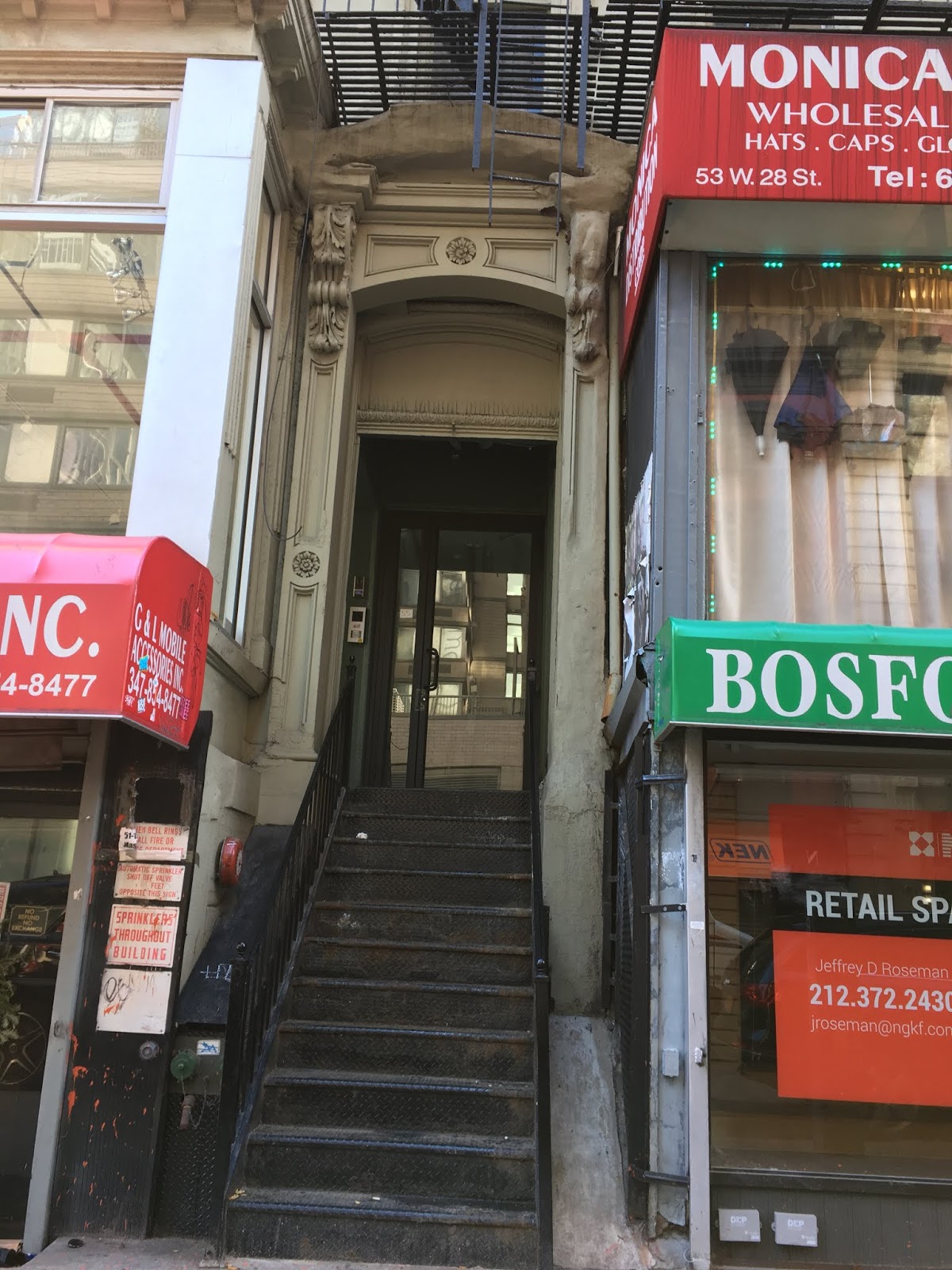
Sat there for over two hours, meditating on all the music that was first conceived there. Sat there in the cold and damp with my gloved hands running over the iron bars once held by so many musicians and writers, Ring and Hager being only two of perhaps hundreds. 
When my friends arrived we headed to 27th street where Hylands Spencer and Yeager were. This building appeared to be intact, though it was being worked on, so we couldn't get inside to poke around. Then we passed through where Dan W. Quinn lived in the late 1890's, and later where he lived from 1906 to his death in 1938. The later Quinn address is the one that he lived in when he was writing to Jim Walsh in the 1930's, and where he also operated a booking office. This address was also very nicely preserved, with lots of pretty marble carving and ceiling decoration. 
After we went by there, we headed to 14th street where all the 1880's and 90's theaters were. Before Tin Pan Alley reigned in the late-1890's and beyond, 14th street was where all the publishers and performers lived. Here we walked by the original site of Pastor's theater, where Ben Harney first introduced Rag-time, and where countless other performers played. Just two blocks farther along was 223, where Fred Hylands lived from 1896 to 1898. We were lucky enough to sneak in behind a resident, which just happened to be the first time any of us had gotten inside. The inside of the building looked to have been remodeled in the 1920's, but we could definitely tell it was an old seedy building that Hylands could easily be seen in. 
This apartment was definitely seedy, but in a charming sort of way. 
The stairs of this building were kind of awful, so I could see Hylands complaining about them often going and coming from work at the record lab or Pastor's. This building was where the "Darkey Volunteer" was published, and where Hylands trod in night after night of performing at Columbia's exhibitions. Performers like Burt Green, Max Hoffmann, and Mike Bernard likely also went up and down those stairs. 
As we started to head to a friend's house near Queens, we passed by where Antonin Dvorak lived in the 1890's. Thankfully there is a plaque dedicating the history of this address. On the plaque it states that he wrote his New World Symphony here in this apartment, which is pretty nice to see. 

The next morning I went to visit a famed broadway and vaudeville historian. This man's house is packed on the walls with posters of all kinds, dating from 1816 to the 1940's. Two examples:
There are hundreds more in this guy's collection. It really was a feast for the eyes to see all these gorgeous colorful posters. He told me that every few months he switches out the posters so there are different ones hanging on the walls. While I was there he pulled out two beautiful posters he had gotten from a recent trip to Paris, which included early art nouveau artwork much like the first poster pictured above. Next I went out with this collector/historian to find Frank P. Banta's grave. We got on the subway and headed to near Wall Street where I assumed it was, but ultimately wasn't able to find his grave there. It was way up in Harlem. I didn't want to spend another two hours going there and back to find his grave, that, as the cemetery directors stated, was in a very large cemetery. So with that I split with my new friend and headed to the Bowery to walk along the neighborhood of so much lore and history, and where Justin Ring grew up. 

After a decent trip on the subway, I turned a corner of Canal Street and was finally walking along the Bowery. The weather was perfect for setting the solemn mood I was in as I walked, it was 45 degrees and damp, with a blanket of clouds ready to drop rain at any moment. As I kept walking, I could really feel the intense weight of history on me, all the struggle and suffering of the many thousands of souls who lived in this area, all of it seemed to congregate as I scuffed the sidewalks. Had never felt such an intense feeling of unbelievable history before, everywhere I looked some image of the past seemed to appear. So much music, so much life, so much suffering, it seemed that walking along here was really where the spirit of the era I study came out. As I neared the street I was looking for, the area seemed to get a little seedier than where I got off, but that added to the atmosphere of the old Bowery I was immersing myself in. When I got to the short street where the Ringleben family once lived, it started to rain. The address looked very much reminiscent of the late-19th century, with so much of its original interior intact. The facade  of the building appeared to have been redone after the Ringleben's had moved out, but much of the older inside was perfectly intact. The building itself would have looked like the one next door when the Ringleben family lived there. 

My hand on one of the walls. 
There was even a beautiful mosaic tile floor still intact. 
I walked all the way up and down the stairs, and looked out a few of the windows to see such a lovely view. 
As I trod around the building I could almost hear the violin of young Justus as he was being taught, and his angry father writing out stock arrangements as his children learned how to write music. It was a lot to take in. 
It was getting dark by the time I started walking back to the subway, and it was raining. Another thing that so charmed me about being in New York was the subway. Lots of folks threw me mixed opinions about the subway before I went, but I was determined to witness the intense history of this old system. It felt like a time capsule, with all the mosaic tiling intact, and every time I stood on a platform the smell of 120 year old pneumatics filled my throat. That smell is entirely unique and old-fashioned. It's like being at an old train station but with no steam to be found. The inside of the subway is truly the smell of the past, with little change since its opening in 1904. There's nothing quite like the smell of 120 year old pneumatics that still heave and work every day. 

Well, wish i had more to say on this trip, but as I'm writing this I am still processing the emotional toll it took on me. Visiting all these places was very moving to me, as it was where all this history happened, and few few people know about it. Despite few knowing of these places, it seems that those who live and work around these places are somewhat curious, and that is hopeful. 
I apologize for not including any recordings in this post, as I usually like to do so. 
Within the next week I hope to start a project on Voss' 1st regiment band. This band has been a sources of mild interest for a few years now, after learning that all of Issler's orchestra performed in this band for many years. Based on this, it seems that this band gave us many of the earliest and most prominent studio orchestra musicians of the 1890's and 1900's. So with this in mind, it seems important to see what I can find on this group.

Before I close out here, I must say that some big news has come down! In the last few months I mentioned Hager's scrapbook and papers, well folks...
Now I have these things in my collection! 
Since they arrived in the mail a few weeks ago, it has been a lot of process, and I have been holding off doing a major post dedicated to this matter. Just to give you a sneak peek into what's in there, here's one of the more unusual pages from the scrapbook:
That's supposed to be Hager's orchestra in the background I guess, that's why he saved it. 
More to come! 

Hope you enjoyed this!


Wednesday, August 7, 2019

Back to 33 and Levels of Preservation

It's been awhile since I've written about Hylands, Spencer and Yeager. With all that I've written about them so far, I still haven't completely exhausted all there is to know about them. It would be good to spend some time speaking of them, as I have been so buried in Ring and Hager material for the last few months. 

So, we all remember them! 
In the last few days, I have spent a lot of time thinking back to the old stories I read about them in The Phonoscope and the brief mentionings of it throughout Jim Walsh's writing. 

I observed something very curious while doing this. 
I hadn't really thought long about how Roger Harding set up a publishing house across the street from Hylands in 1900. The more I spent thinking on it, the whole thing seemed more odd and interesting. 
So just to refresh, in 1899, Hylands and Harding were the main driving forces for the Hylands Spencer and Yeager firm. Harding was essentially the fourth name in the firm. Hylands and Harding collaborated on a few songs they published in 1899, and it seems that they were working together perfectly. But, in early 1900, Harding picked up and left Hylands and the crew to set up his own publishing firm across the street from the Columbia studio. 
Something odd happened. And in this last week, I really started thinking about how odd this was. Hylands and Harding abruptly split up, and considering what came about in the time succeeding this, whatever happened couldn't have been good. But! Harding wasn't the first to jump ship. In mid-1900, it seemed that all the tight knit Columbia studio community started breaking up, all jumping ship one by one. In the few 1900 editions of The Phonoscope that I have flipped through, I noticed that slowly it seemed a lot more the community who wrote for and were mentioned in that publication were starting to split up. One of the pieces I recall  from around mid-1900 stated that Hylands himself was beginning to take jobs elsewhere, and working in vaudeville again(as he had been doing before recording).  That particular statement seems odd to me. 
There's that section!
So the "big sales" thing doesn't seem to fit too well. By mid-1900, the publishing firm thing was starting to wind down, and it was doing so quite fast. It was in that time frame that Roger Harding picked up and left, and when folks were starting to become intrigued with the new fangled Zon-O-Phone. By fall of 1900, the fine Turkish carpet he had so hardly worked for had been torn from under Hylands. Everyone had abandoned him and the publishing firm. 

But why?

For a year, the Hylands Spencer and Yeager thing was booming, and Hylands had made his way up to the top from being the deadbeat rag-time pianist Columbia hired in 1897. Keep in mind that he was a nobody when he started at Columbia in 1897, in 1898 his significance became clear with the popularity of his signature rag-time accompaniments. Something devastating happened, and I have no idea what it was. It caused such important benefactors like Roger Harding and Steve Porter to quickly take their leave before the others. 
(Harding in 1895, from a friend's collection)
(Steve Porter at the recording horns in 1897)
Whatever it was that forced these close friends to all break up so quickly, it kept them apart. Hylands still worked at Columbia, as he had to, but a lot of the crew, like Steve Porter, Gaskin, Quinn, etc, didn't work together much after 1900. For example, the Imperial Minstrels records had stopped by 1901, no longer was the old crew working in big groups like that. Everyone started going off and doing other things, such as working for other companies and heading into recording management(George Schweinfest did the latter for example). Russell Hunting left in 1899, Steve Porter left for the far east in 1902, and Spencer started working for Lambert, Edison, Zono, and more. 
Something went seriously wrong with the publishing firm, and as I said, I have no idea why, and I don't really have any good solid guesses. 
One thing that came to mind however, is that this where Ring and Hager come in. Ring started working at Columbia right as the Hylands Spencer and Yeager thing was falling apart. So of course someone like him would have been so valuable at that point. The 25 year old Ringleben was as willing to work as Banta, had no place to live, was caring for an aged father, and willing to try anything to get decent money. The coming of Ring may also have helped out Hylands put out the fires that were still burning from the collapse of the publishing firm. 
 (most likely Hylands and Ring around 1902)
As Columbia was transitioning into the 20th century, it seemed that it was perfect timing for Ring and Hager to start making their way into the lab. Hager had his ambitions elsewhere, but Ring was working for the then orchestra director Thomas Clark, next Hager, then ultimately Prince. Hylands was taking jobs elsewhere by 1901, though he was still working regularly at Columbia. I suspect tensions were high when one of the old guard at Columbia had to work with Hylands then. Someone like Spencer would have been bitter working with Hylands after 1900, but it did happen, and luckily with the new talent acquisitions at that point, Spencer wouldn't have to work with Hylands as much. 
I believe I have mentioned that based on the sequence of studio pianists, each previous pianist was to mentor the next one, as it required very specific skills to become proficient as a phonograph accompanist. Hylands likely mentored Ring for a short period of time, this time being right after Hylands Spencer and Yeager.

Anyway, I'm starting to talk about something else, so I'll leave it at that.
Who knows what it was that split up the tight knit Columbia community in 1900...The fact that it happened so quickly is tantalizing, and because of this i will continue to look for hints. There's really no way to definitively find out why this happened, but there might be hints. I hope you recall that no one talked about Hylands in interviews. So all of this Hylands Spencer and Yeager nonsense was never well documented in the first place. Folks like Quinn and Porter didn't say a word of it, even though we know for certain they were part of it.


And that is a good transition to my next topic! 

Back to some Ring and Hager research!  One thing that has always fascinated me as a researcher of this very scant area of music history is how the characters involved in the history spoke of and interpreted it. Jim Walsh spoke with the last bunch of the original recording stars, Quinn, Joe Belmont, Byron Harlan, and Hager to name a few. Quinn's writings to Walsh are among the most extensive accounts of the earliest recording business. A long while ago I did a very detailed post where I pulled apart parts of Quinn's letters. As researchers now, we have everything laid out before us, but even with that being true, we have to spend many hours decoding all this information. A lot of things are mixed up and don't exactly go together the ways that the original participants stated. A few posts ago I detailed Hager's accounts of the OkeH field recordings of 1923-1925, and how his accounts are very valuable, but present issues. 

I just got an article on Justin Ring published, and it was a very difficult undertaking. It was this way for many reasons, and I don't even know some of them. I want to write a definitive article on Hager, but there's so much information on Hager, that a single article won't do. I ran into this problem with the Justin Ring project.

(Ring in 1903 and Hager in 1895 or so) 
I spent months getting frustrated about how I could find so little on Ring in that essential period after 1885 and before 1910. This is still proving true unfortunately. So as my mind works, I started asking the questions as to why it would be so difficult to find any information on Ring in general. Hager was easy to find information on, at this point I actually have a pretty good idea of what he was like as a person, and what interviewing him would have been like. With Ring, it has always been a dead end. 
So I keep going back and pouring through the primary sources(including Hager's own papers) to see if I could get some second handed hints. While doing this, it occurred to me how much Hager loved talking about his past and the projects he was part of. He probably had thousands of papers very meticulously organized in folders, and records and books too. This becomes very clear while flipping through Walsh's writings from Hager in his articles. When Walsh started writing to him in the 1940's, Hager realized that all his memories and written history would be important, and that's where he started gathering everything, and started to spend a good amount of time writing about the history he drove and witnessed. Soon he became consumed with the joy of reminiscence and digging through his papers and books. 

(a bit from Hager's writing published in the April, 1951 edition of Hobbies)
You can tell Hager loved going through his stuff. When Walsh reminded him of something, he would go and look for it, if he couldn't find it, he'd ask others who would probably have it. Hager had taken most of Cal Stewart's material by the time he was writing to Walsh, so much of the information we have on Stewart was from Hager's own very meticulous descriptions in his letters to Walsh. So, clearly Hager was very involved in and aware of his past. He knew that what he did was important. But what about Ring?
Hager wrote so much and very much enjoyed getting buried in his past, as he had a very carefully organized scrapbook to accompany the thousands of papers he kept regarding himself and others like Cal Stewart. When Walsh was writing to Hager, he mentioned his partner Ring a bunch of times, as even then it was difficult to separate them. 
(Walsh's September 1962 description of the photo below)
(from a friend's collection)
Even Walsh described them as inseparable. It's possible that Walsh wrote to the old Ring, but he didn't get anything back. Walsh unfortunately had the same situation happen with Arthur Collins. He wrote to Collins in 1932, but never got anything back. A few years later Collins' wife Anna wrote back and told Walsh that he received and pondered on his letter, but ultimately decided it wasn't worth it to write back. 
So I'm thinking that a similar situation may have happened with Ring. Now this is where Ring and Hager were opposites. Hager kept everything, and Ring kept nothing. This is the point I was getting to here. This may be why it is so difficult to find anything on Ring. So consider how he lived while working for Hager and Prince. He had no place to live, he wasn't married, and writing arrangements and playing accompaniments wherever he could. With that frugal lifestyle, there was no way he could have kept anything. He was constantly adapting to the times, so of course he had little interest in preserving the past. 

So consider this...
If you were to go and visit Hager for an interview in say, 1953, he would so very much enjoy talking to you about history. He would gladly answer every question, and would tangent on that to tell another story, and another...and...another. He would go and dig things out as you spoke. the amount of information would be invaluable, and there would be so much of it you'd either be there all day and night or you'd have to come back for more. So the point being, that Hager would be the ideal person to interview about this stuff. You'd probably leave with a few things of his too. 

So let's say you made the trip down to mid-eastern Florida in 1960 to visit Justin Ring. You'd get to his place, and one of his daughters would answer the door. You'd be kicked off his property. Ring would quietly be sipping tea listening to the radio or thumbing through Variety, with his glasses tipped down on his nose. It would all be there...everything...all the sounds, people, words, and memories, but they were never to leave his mind. He wouldn't talk about any of it. He preferred to leave it all behind,  and being the sole survivor of his family by then, he had no business thinking about all his dead friends. 

But like the last subject I wrote about in this post, why?

Who knows?
Considering the amount of things he did, and the kind of people he had to work for and with in those 50 years, he probably had good reasons to keep-a-movin. All the way back to Hylands in 1898, he saw everything, and probably escaped death several times while all his friends were dropping dead around him, starting with Frank P. Banta in 1903, and ending with his brother Franz in 1960. 
Ring is a lot like how I'd think Banta would have been if he had lived long. Banta was perfectly content being the quiet and obedient accompanist, and likely spent little time talking about work with those who weren't in the business. He was so buried in work that many other things in life were not important. So interviewing him about recording would he difficult. 

This is why I study the neglected accompanists. They saw everything, and despite their lower reputations in the musical community(excluding issler), they got the last word. And you know what? 

Ring got the last word. 

He may not have spoke it, but he got it all-right. 
The accompanists we hear on these records were not famous in their day as accompanists, and they weren't famous in general. We always hear about these big names like Ben Harney, Eddie Foy, Anna Held, even Mike Bernard, and they were so highly regarded in their day, but, with the exception of Bernard, they aren't the ones whose voices and legacies were immortalized. It's the ultimate payback, the most neglected and overworked performers in the early studios got the last word back then, and even now. I'm talking about the accompanists of course. Issler, Banta, Hylands, Ring and the rest got the last word, the last driving notes, after the main performers finish. The accompanists and studio workers are the ones we can get to know better than even the main performers, as we hear them on everything, not on just some things. 


So, anyway, this has been a hell of a case study! Before I close out I'd like to share a pair of records that I believe are arrangements by Justin Ring. Based on the composition style compared to his accompaniments, these arrangements line up to that style. I am also thinking that after Ring and Hager split up from 1906 to 1912 or so, Ring worked for Prince at Columbia. 


So there ya go folks! 


Hope you enjoyed this!


Friday, November 9, 2018

A Few Edits and Mr. Michaelis

Okay, to start, scratch all of that I said in the last post regarding the American Record company. Just a few days after I posted that thing, a few friends went on the dig for proving whether this was true or not, and well, as it turns out Hager was nowhere to be found. 
However! 
It is important to note that Hager may have indeed had a hand in it at some point. Though he may not have had his entire orchestra there at American, it's likely that he handed their bandleader some of his own arrangements, and likely a few musicians of his own in the process. The director of the regimental band of the republic was said to be a guy named Fred Wood. I know nothing of this Mr. Wood, and haven't done any digging just yet. It almost seems like Mr. Wood just popped up out of nowhere, as usually with these house orchestras we would usually see someone we know as the leader, a familiar face from a previous orchestra. It's a lot like how toward the very end of Zon-O-Phone's days(1909-1912) it has been said that Arthur Pryor led the orchestra. 

Since we know now that Hager wasn't responsible for the American record company's orchestra, what was he doing instead? Well, when I spoke with one of my friends about the matter, I felt terribly absent-minded when the reason was brought up. In mid-1906, Hager left Zon-O-Phone to go and work with J. Fred Helf in publishing. 
Durr...Of course, I have so many Helf and Hager sheets, I should have known! I am not entirely sure when Hager returned to recording, but it's likely that before the Rex endeavor he was associated with the other earliest American vertical cut labels. He and Justin Ring were likely introduced to the Vertical recording method very early on, possibly as early as 1910. 

So anyway, do excuse much of what I said in the last post about those blue American records. That orchestra was still outstanding, whoever they were. 


Well then!
It's been quite a month for my sheet music collection. In the last month I have sifted through two sheet music collections, both of which were fantastic, full of great valuable stuff. The first collection I went through got me copies of many Coon songs we know and love, including my very favorite of them: 
Yes indeed! It's also in really good shape too, which is nice. 
I also got these from this collection:
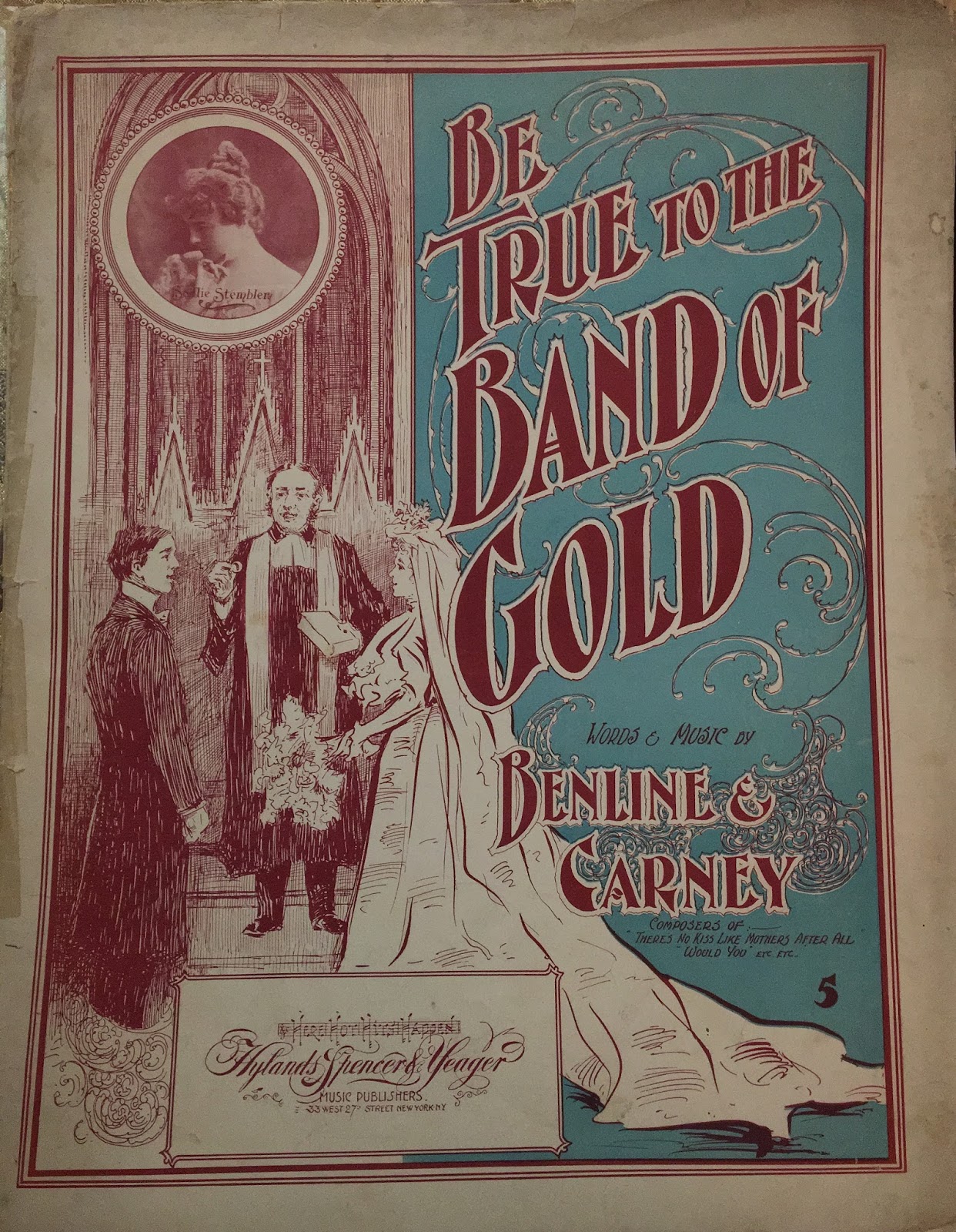
So here's something trippy about that Roger Harding piece. I have no idea who that is on the cover, and it's certainly not Harding. So some of you may have seen a different cover of that Harding piece, and about that you'd be right. 
Okay, so what the hell happened here?
Well, I guess that in 1896, Harding got the piece published as he did, and it was a hit with the recording community he'd just integrated into, but something went a little whacked when Fred Hylands scooped up the Columbia staff with the publishing firm. I would guess that the reason it was re-published was because Hylands wanted so desperately to grab the rights to Harding's work. I have no idea why it was published by different people two different times, but there is something whacked about Hylands putting his name on it in 1899. On the original edition, it even says "words and music by Roger Harding", which I would firmly believe. The 1899 edition is really strange, now that I can compare it with the original 1896 edition. 
Also, I finally got a sheet with a picture of Dan W. Quinn on the cover. I had seen so many of them in the decade or so I've been doing this and have always wanted to have one of them. The piece I got is titled "The musket and the sword", which is a tune Quinn did not record, but there was a very fine portrait of him on the cover:

All-right, that's officially the clearest portrait of Quinn I've ever seen. 
It's even better that the other versions I've seen online of this same picture. It's unbelievably crisp. What's curious about this particular sheet is that the very same cover was featured in the CD Archeophone put out on Quinn's records. I wonder if it's the exact same sheet? 

So, almost a month later, I was offered to sift through another collection of sheet music. Last week I went to a friend's house and sifted through around 500 pieces of sheet music, only about a quarter of them were the older large format sheets, or the good stuff. There were plenty of rare San Francisco and Los Angeles published pieces in this pile. I was able to grab a large pile of SF published music that I had never seen nor heard of, but other than the California rarities, there was one particular sheet that has caused a bit of buzz amongst the Rag-Time community. 
As I kept picking out all the good coon songs from this pile, there were lots of generic looking sheets from the early 1910's, some I took, some I put back, but there was this one that caught my eye.

Wait a second, is that who I think it is? Let me zoom in a bit...
There he is! Ben M. Jerome. Jerome wrote some hot rag medleys in the late-1890's, and continued to write better than average coon songs after 1900, such as "Melancholy Mose". In case you aren't aware of his rag medleys, here they are:
https://www.youtube.com/watch?v=2G4RoWQJrTE
https://www.youtube.com/watch?v=g_BE-UOe0Zk
So after the word got around that I have this sheet, I decided to try a little bit of digging on this mysterious early rag pianist. Since the beginning of my time studying rag-time, I have always wondered about Jerome, since his "A Bunch of Rags" medley is definitely one of the best of those early rag medleys. Clearly Jerome had something right in his style for it to sound so accurate. In fact, many of us Rag-Timers thought that Jerome was a black man, as his rags were so accurate to the black pianists of the era. But all of that was debunked when I saw that picture. 
So with all of that in mind, i attempted to do some digging on Jerome. When I looked him up on the NYPL, looking for some of his pieces, I saw that his profile stated that he lived from 1881 to 1938. Well that's nice and all, but if he were truly one of those early rag pianists, as he was, he would have to have been born at least as late as 1875. I just cannot fully believe that he would have been 17 writing his slamming medley "A Bunch of Rags". Only someone with quite a few years of experience and study in the rag-time community would have written out the longest rag medley of the era. So as it turns out, as I did some digging, some of these things became a bit clearer. 
First of all, it was unreliable to search Ben M. Jerome on Ancestry. So the initial start of the dig was no help. It took a few more days until one of my friends sent me a newspaper clipping containing some curious information. This clipping stated that he was divorcing his wife Florence and having issues with the custody of their two children, Jesse and Sanford. Not only was this there, but it also stated that his name was Bernhardt Michaelis. 
Heh?
What a name! So of course when I looked up that name on Ancestry it became very clear which one was him. I found him in the 1900 and 1910 census, which was exactly what I was hoping for. In 1900 he was working as a musician, but in 1910 he's listed as a composer, which entirely makes sense. Also, the most itching thing I wanted to know about Mr. Michaelis came to the light, the fact that he was born most likely in 1876. Okay, that's a much more reasonable date for one of these hot early rag pianists; being 20 at the beginning of the rag fad must have been quite the time! Considering Jerome's lady issues, I am getting some Mike Bernard vibes from him, if you know what I mean...

So on my newspaper dig for Jerome, I found some curious stuff. As I kept digging, I found lots of sections that mention him in Variety, usually related to songs and musicals he was writing and directing. So basically he was a less aggressively weird version of Hylands, and was certainly more popular. His name is on a lot of musical folios, similarly to Max Hoffmann who hung around  Broadway doing the same thing. 
Damn, he was a good looking guy, even in this crappy newspaper clipping...
I found a little clipping that confirms the 1938 death date, which is great! In that clipping, it becomes clear that he was known mostly as a composer, not as a pianist necessarily. Despite that, he must have been a hell of a pianist, as he's got those extremely detailed rag medleys to prove that. Surely he was an outstanding pianist, aside from all the popular musicals he wrote for. 
So now that I have a basic outline for Ben Jerome, I can now use his style for comparison between all these early rag pianists. That was ultimately the goal of all this digging on him, because his medleys sound so much like Fred Hylands' playing and Max Hoffmann's as well. 


I hope all's well with you folks! It's been a hard few weeks for me emotionally, despite all the goodies I've been snagging from old clothing to Spencer and Ossman brown waxes. I really wanted to do this post editing the things I said about those blue American records days after I learned all that new stuff, but couldn't get myself up to it. 

Hope you enjoyed this! 

Saturday, January 6, 2018

Some more studio politics

Now that the holidays are essentially over, hopefully I can get back to making more blog posts, since it's still been hard to find more interesting information to talk about. 

Recently while searching around for quartet records, I came across a very strange record that hadn't even a record number to be found. The performer listed in the announcement of the record was given by the familiar voice of this chap:
Steve Porter.
So the creation of this strange record seems to have been facilitated by Mr. Porter, though the leading voice in this so-called "Diamond Quartette" would most certainly be George Gaskin. This record is centered around a parody on the hit "I'd Leave my Happy Home for You", but on the record it is called "I'd Leave my Job to Vote for You"(haha). 
Porter's announcement begins with this, 
"republican campaign song..." 
after the announcement the lovely and unmistakable Ragged playing of Hylands lumbers through. 
Of course on this record, there's a mot more than just Hylands and that Quartette. It seems that in this quartette, there was Gaskin, Porter, Roger Harding, and George Hargraves. This witty parody is rallying for William McKinley's campaign in 1900, and throws William Jennings Bryan and the Democrats in the dust. Sorry, it's one of those records I can't share out of kind courtesy to the owner. 
So, in past digging, I had heard of such campaign songs and rallying done by a certain group at Columbia. Those "clan" members at Columbia(let's say Harding, Porter, Spencer, Gaskin, Emerson brothers, Hylands at this point in time) were most certainly prominent politicos in their time. And with that, it can further be proven by the first Phonoscope section I found regarding their prominence in the Republican Party of New York. 
I hate that these are so hard to read. What a politico Harding was! Harding did quite a lot of rallying. well there ya go, there's that exact group from that record I've described. It's amazing to see an actual written account regarding the group, and then later finding a rather "wild" record by the very same group. Of course when digging all of this up after listening to the record, this brought back the research I did on studio politics a little while ago. Also, while doing some random digging on something else last night, I stumbled across something else telling about a certain someone.
It's clear that I talk about Fred Hylands quite often, and finding new information on him has been very slim the past 6 months. One thing that's fascinating about Hylands however is that his political view and morals seemed to have changed somewhat after a certain point in time. This change was a gradual process, and it took a few years for him to transition. Luckily, that recording and Hylands' associations in the recording business can lead us to assume he was on the dominant Republican side of the Columbia staff(keep in mind not every one of the boys and few ladies was on the same political side). Despite Hylands' more popular relations, he(much like Scott Joplin believe it or not) around 1899-1900 began associating himself with some of the underground people's and political activists. By these terms, I mean Socialists. Those progressive outcasts that were dreaded by every factory and corporation, yes, Hylands began flirting with members of these groups. 
I've made it clear that Hylands switched to the other side by 1904-1905 by becoming a leader with the White Rats, but it seems that a few years before that he was pondering the ideas that his progressive friends told to him. I had assumed some of his actor friends like J. Grant Gibson would have swayed him over, but actually, come to find out it was someone else familiar. 
Well, this "ranting Bill" is Will J. Hardman. 
(cartoon by me!)
Just last night, I went digging for some early roots of Rag-Time on the Johns Hopkins sheet music website, but stumbled upon something fascinating. So what has Will J. Hardman to do with Hylands' socialist streak? Well it seems I found an indirect answer. 
(the date on this one is 1886)
There we go! It seems I found another source of influence for this transition. 
Of course! It makes so much sense now. Hardman was a gifted wordsmith, and now it seems that my hypothesis of his friendship with Hylands was in fact true! I had assumed by how many songs Hylands wrote with Hardman in such a short period of time that they had a bond outside of their music. So at a certain point, Hardman must have explained his world view to Hylands, and since Hylands was already somewhat fed up with Columbia, these new ideas from progressive Hardman must have been eyeopening. Unfortunately, I know nothing on Hardman at all, but because of the age of the other pieces I've dug up, he was most certainly older than Hylands, probably a decade older as far as I can guess. That would put him at around 38 by the time he met Hylands. Without a doubt, in 1900, Hylands was keeping his rebellion and disenchantment well hidden, since he had to participate in many of those political gatherings that Harding organized. By the time of the publishing firm with Spencer collapsed, Hylands was essentially outcasted from the tight pact that the Columbia staff had in the 1890's. With the shunning however, came Hylands' opportunity to go the way he desired, and head off to become a "Knight of Labor". We know his first try left all his old friends at Columbia a little frightened while also made him the laughingstock of Columbia and the Broadway community. This Socialist leaning left some of his old Columbia fellows concerned, and it must have made Len Spencer roll his eyes. 
Spencer after 1900 went a different direction as well, he was still a solid Roosevelt Republican, but his entering into the business aspect of vaudeville took something out of him. Spencer was unhappy with the progressives like Hylands and the other Union men, and this must have worsened over time when he had to deal with quite a few scrambles regarding union members and leaders. Of course, before his "falling out" with Hylands, Spencer would have seen bits of these progressives, as Frank P. Banta was part of a musicians' union, despite the contradictory nature of his employers. 
Since Hylands' relationship with Hardman was relatively close for enough time, it's likely that Hardman was part of Hylands' political transition. Another thing to note from that sheet music cover I found, notice the other titles listed under Hardman's name.
"For one day of Turkey there's six days of hash" 
well well Mr. Hardman, that's an amusing title certain. The words above the title are also interesting:
"an injury to one is the concern of all"
What a Socialist remark that is. Much like the cartoon above, I can envision Hylands being hypnotized by Hardman's ranting, since his lyrics were perfect with Hylands' weird often drug-induced Rag style.(think about the multiple meanings for "hash" in the title listed above). Keep in mind that Hardman's lyrics to Hylands' songs are very weird. They're strange even for the time period, and weirdly poetic all the same. 
Really listen to those lyrics, they're funny but really weird and have a few nearly unrelated lines. 
Of course one can wonder about how Hylands and Hardman became friends, and of course my mind goes directly to them both being den ramblers(essentially the opium equivalent to drinking buddies), who were both second grade musician/composers with unique talents. Hopefully, someone will dig something up on Hardman sometime soon, the suspense of learning little bits about him through his music is starting to get aggravating. 


Before I finish, I wanted to share the two record related finds I got for Christmas. The first thing I saw was an original Columbia box from 1897 or so, and when I opened the box, out popped a bunch of the soft fluff that record companies used to protect their records. I had always wanted one of those beautiful pre 1900 Columbia boxes, as they were colorful and elaborate, much like the late-1890's was in a nutshell. 
There's the pretty old box. 
Now the record on the inside was also really nice too, because it's Dan Quinn singing "put me off at Buffalo" from around 1898 or so. 
I'm looking forward to hearing the thing sometimes soon, as it will likely be a varied round of this take:
There's the record and the box. 
And my gloved hand holding it correctly. 
So far I've heard three different takes of Quinn singing this song all on Columbia brown wax. I wonder how many rounds he made of it for Columbia anyway. 
Other than that fantastic gift, I also unwrapped a piece of Hylands published sheet music. He did not write it, but it's another Hylands, Spencer, and Yeager piece, which is always worth my time and money. Of course it's not one with Dan Quinn or Spencer on the cover, but it's about the next best thing. 
there ya go. 
Another Hylands Spencer and Yeager piece is always welcome in my sheet music collection. Any time that certain lady is on a Hylands piece is always interesting to me. 
So I've seen her on three Hylands sheets now...the number seems to keep increasing, as does the evidence of a little fling there. I learned somewhat recently that she divorced her husband in 1900, the year that this piece was published with her picture on it. The charges of the divorce were impropriety. It's very tantalizing to read this, and it legitimately shocked me when I saw it. Maybe sometime I'll do a post on what evidence I have about this tantalizing coincidence....


Anyway...


Hope you all had an all-right holiday season!