Showing posts with label George "Georgie" Emerson. Show all posts

Monday, July 30, 2018

Digging for Emerson's and Draft Cards

Yesterday evening I spent several hours digging around on ancestry for any amount of new information on Georgie Emerson. Unfortunately i didn't find too much on Georgie specifically, though in the 1900 census his disposition is rather interesting. 
So in 1900, it seems that Georgie is living nowhere near brothers Victor and Clyde back at Columbia in New York. In 1900, Georgie was living alone in a boardinghouse in Denver, Colorado, but working as a phonograph agent. It seemed rather random to find him so far out west, but since was was still closely associated with Columbia in 1900, it would make some sense why he was doing work for them out west. The next source of information on him came from the New Jersey state census in 1905. In this source it is stated that he is living with his wife Helen, his two daughters, and his old mother Elvira. In this his occupation is listed as "phonograph". 
heh?
That's kind of funny. Just phonograph. No specifics. In 1900 he was listed as "clerk phonograph" which makes sense. 
After doing some more painstaking and frustrating digging, I found him in the 1910 census as well. Unfortunately it seems that by 1910 Georgie was on his own, and by that I mean that he wasn't working with the phonograph under the shadow of his successful brother Victor. in 1910 his occupation is listed as working with factory machinery. Well then! What a step in a different direction! 
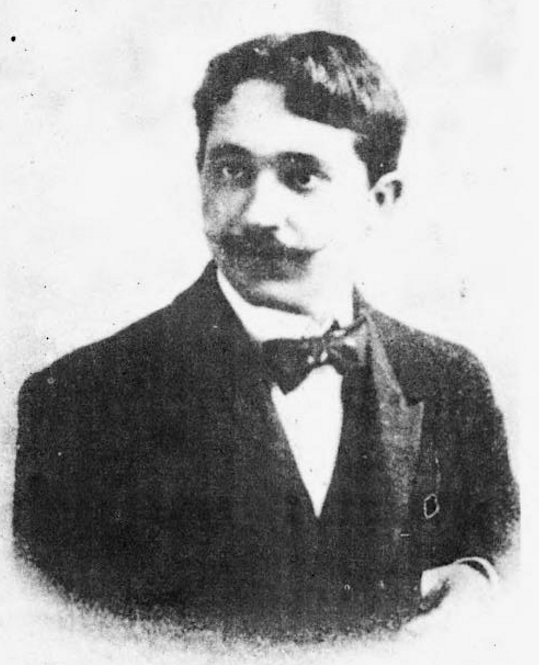
Even with all this changing around with Georgie, I still assume him to be the one who rambled around and looked real rough. He looked like he had some hard times, even in that picture of him at the mere age of 22! In that picture of him above it almost looks like that left eye of his is black. Those poked in flushed cheeks are also not a positive sign... The more i look at that picture detail of Georgie the more I think that this picture is of him:
Yep. That really looks like the same worn young face in that picture detail. 
Even though we still don't really know anything about Georgie, the little bits and pieces we have regarding him are tantalizing. He looks just as troubled as Victor, if not more so, judging by the amount of extra detail we can see on that face in the small cameo portrait above. Georgie also looked just as slim as a broom-handle, similarly to Victor, but with Georgie it's ever more exaggerated by his tall stature and slim face. All those features scream drug addict to me, which wouldn't come as a surprise in this era. But aside from all this, I still have no idea how long he lived, though we have a birthdate of May 1876, which is nice to save for now. We know Victor lived until 1926, but that would mean nothing when attempting to find how long Georgie lived. 
Speaking of Victor, while on my dig for Georgie, I did come across Victor's passport application from 1922, and a picture came with it!
There they are, Victor and Kittie. 
And you thought brother Georgie looked rough!
Like most of these old phonograph freaks, Victor did not age well at all. You can even see bits of freckles all over his face, which always catches my attention. I'm pretty sure Victor had some kind of red in his hair, though it must have been darker red, as in no pictures of him does his hair look light and shiny. His brother Georgie was the one with the vibrant red hair, and it can well be seen in the two pictures of him we know of. 

All-right then!


Before looking around for Emerson's, I started last evening looking for more draft cards of familiar faces. Of course while doing this I had to make sure I looked up those who were born after 1872. That proved rather difficult! Most of the early recording stars we love were born in 1872 or before that, so it proved rather pressing to think up those who missed that cutoff. Eventually a few names came up and I did find a few curiosities along the way. Finding James Hager's draft card was a great source of happiness for me, so imagine my reaction upon finding brother Fred's!
He was just 2 years younger than the cutoff! 
That physical description is a bit unexpected, much like his brother James'. It's funny though that it's basically exactly the same as his brother's. 
Tall, stout, brown eyes, and graying brown hair.
Well then!
Certainly he had gone beyond his idealistic beauty by 1918. 
There's that pretty, distinct signature of his at the bottom! 
(from the LOC manuscript collection)
While digging for Fred Hager's I also found Justin Ring's, just keeping with the Hager pattern, as they worked together for an awfully long time. 
A little while ago I was able to find Justin in the 1880 census, and it stated that his parents were Prussian immigrants. Ain't that something! Prussian! Now I still have the suspicion that Ring could potentially be an important missing link in the area of the earliest studio pianists. If there was ever one of these guys who could have been a Zon-O-Phone pianist, Ring is it. Of course I would have nowhere to start really in attempting to extract his style from the other Zon-O-Phone pianists. Anyhow, here's his draft card:
I like that he never even attempted to write out his full name on most things, and even attempted to reason with whoever was taking down his name. His full name was Justus Ringleben; not quite your easily written American name at that time. 
Now that we know what he looked like, it's time to get drawing! What a lucky guy he was, with those bright blue eyes and blond hair, and supposedly those great piano skills that we have yet to dissect. 

Now here's something curious, it seems that Hager and Ring died at exactly the same age, 87. Hager died in 1958, and Ring in 1963(whew that's quite a lifespan!). 

While on this dig, I also found Joe Belmont's draft card, which was rather unexpected. 

I couldn't have imagined Belmont with blue eyes and dark blond hair. Well then, I guess that's it for that, I'm all set for drawing Belmont if I need to in the near future. There he is. 


Before I end this post, I want to share one of the recent acquisitions of my record travels. 

This record is prized to me now. Ain't no one taking this from me anytime soon.

When I got the thing, I had no idea that Hager was the violinist, so imagine the heightened joy it brought me upon playing it when getting home after the quest. Immediately I knew that was Hager, no way could that have been the skilled and peerlessly slick Charles D'Almaine. I had listened to the few Hager violin solos buried out there on the internet, particularly finding his Columbia's the most attractive, as Fred Hylands must have been the pianist. This particular record is outstanding in that way, and comes through surprisingly clear for being a spotty record condition wise. 
Here's the transfer: 
It's such a lovely record. The sound of the piano paired with the echo of the recording room is just as charming as the violinist being matinee idol Fred Hager. This record combines the talents of my two absolute favorite early recording stars, and they pair together rather out-of-whack, which is to be half-expected, but it's what especially attracts me to it. Rarely do we get such nice crossovers like this. There are such a thing as crossover movies and Television shows, but this is what I would call a crossover record! It combines the two different worlds of the early recording business in such a graceful and unique way. All this is so while at the same time not being an outstanding record musically. Hager wasn't the best violinist, and Hylands wasn't the best pianist either, but when together these things cancel out. 


The next post should be more about recent record acquisitions, as I found too much on the Emerson's and similar recording stars yesterday to pass up a post on that. The Hager record find was really nothing less of a miracle. There's this junk shop/antique store I've been frequenting for the last few months, and one time I went there were albums and albums worth of 78s. They were sitting outside in the hot sun catching excessive amounts of heat, which worried me as I began thumbing through them. I just about screamed when I saw that Columbia. 
I thought "could it be? Hager? A Hager? No way in hell..."

It seemed too good to be true. But indeed, that's what it was. 
The story of these records I got at this one antique store is miraculous really, and it's one for the books. All the items i found were really the strangest coincidence. In the next post I'll get into detail about all that. 


Hope you enjoyed this!


Sunday, May 27, 2018

Picture analysis and deconstructing Frank Banta's style

Now that we have a much clearer picture of Fred Hylands, it be time to go back and look at the studio pictures with unknown pianists and pick him out. That infamous Columbia picture now makes much more sense because of that clear picture of Hylands, because we can now all come together in seeing that the pianist in the background is indeed Hylands. 
Despite now being able to fully see that the pianist is Hylands, we still can't yet answer how he changed so much from that time to the time of the exhibition picture: 
Even with that rather amazing change, we still cannot answer the question of how. I guess we can call this dilemma one of the many Rag-Time mysteries that us record scholars and Rag-Timers have to solve. We know that he looked pretty rough toward the end of his life, thanks to the two new pictures, and I guess such awful times while at Columbia would be a reason for this. More and more we are realizing that Hylands was truly an 1890's character, despite the "second-wind" he caught in the 1900's performing on Broadway and in Vaudeville. We know also that this second go around he had after 1900 slimmed him out over time, which is good, but this slimming down was forced on him by illnesses and constant touring(he toured in the mid west starting in 1905 and ended around 1909). It must have been a great help that he was a theater director in this period of time as well. 
Just to really get into finally proving this thing once and for all, here's a detail of the picture:
Now that we're pretty certain his hair was vibrant red, we now look to the more minute details. 

Notice the same long sloped ears on both pictures(it's hard to see in the c.1897 picture...)
Take note of the flushed areas around the cheekbones, there appears to be that in both pictures. In the 1897-ish picture the shadows are at just about the line where these flushed cheeks would be visible, and despite those dark shadows, we can still see signs of variation in color. One thing I've been trying to figure out in the handful of weeks I've had this new picture drawing new cartoons of Hylands, is whether those flushed cheeks were speckled with freckles, which they may very well have been, but thanks to re-touching we can't tell. 
It's been a part of my descriptions of Hylands since the beginning, that crooked mouth he had, and it truly was a sight to behold it turns out(it's especially weird in the exhibition picture for some reason).The few times he spoke on records he was hard to understand, and since he did do some singing(if you at all are skeptical of this, think of his role as a Broadway performer, this would require that he sing, and occasionally do some tricky footwork believe it or not), his voice(the one we assume to be his)carried surprisingly well for an early recording star. In the 1897-ish picture we see the "better side" of that weird mouth, but if you really look at both pictures it's the same awkward structure. This really leads me to think he had some kind of Winston Churchill like speech impediment, especially if one side, as can be observed, drooped downward. It's rather funny actually how clearly that droopy side of his mouth can be seen in the exhibition picture in exactly the same way in the 1912 picture. 
Now I don't think I need to say anything about that curious nose, it pretty much explains all that needs to be said in the pictures. I must say though, that curious nose of his looks much better in profile(1897 picture). Again, he had a really weird profile. Of all these performers I draw in cartoons, his profile is the weirdest looking of them all, I have yet to see a profile as magnificent as well as comical as Hylands'. 
Thanks to the picture of his sister Etta, we know that those pleading droopy eyes ran in the family.
Etta had a little bit of that weird mouth thing, but at least it manifested rather gracefully on her, rather than a little out of whack with Fred. 
It's still hard to beat those desperate looking eyes, even though they look made to wear strong gold pince-nez glasses. He looks like his eyesight was crap. Not often do people look like that have bad eyesight, but when you can see it, you know it. With Hylands, it appears his bad eyesight was ever visible. With those likely ocean blue eyes sunken in shadows, usually they would be exaggerated by glasses, as for example the way they are in the exhibition picture. You can see the shadows over those wide eyes in the 1897 ish picture that are ever present in the other pictures definitively identified as Hylands. 
I guess there's no more need to debate who that pianist is in that 1897-ish studio picture, even with the baggage of change of his figure from that to the exhibition picture, we can now be assured that he worked for Columbia some time in 1897. Now that we are assured this, we can go on to say that he worked at Columbia during the day and did his shows and management at Pastor's theater by night. Recall that he lived across the street from Pastor's in 1897 and 1898, so he was conveniently located for sure. 


Now to move to a similar subject matter, Frank P. Banta. 
Such a kind and warm face...
Within the past week or so, I've been digging into Santa Barbara's new transfers, as there are so many new ones it's entirely overwhelming. There's one in particular that has been sparking new ideas about Banta's playing. I've said a lot about Banta's style in the past, since he's more well known, and has a distinct style that's near as outstanding as Hylands'. Before I get into the analysis, here's the specific record I'm talking about: 
It's an outstanding example of brown wax rag-time, just need to get that out first. This record is a classic example of Banta's entirely solid and well-founded syncopated style. It helps that the performer is Billy Golden, so then it is assured that the song will be folksy and full of itinerant aspects. This particular selection brings out the weirdest of Banta, and not would I have thought I'd be saying that about Banta. According to most records we've heard with Banta's accompaniment, they're pretty restrained and not nearly as wild as those rough folk characteristics of Hylands. This particular record is outstanding from other Banta records because of a significant mistake he makes. 
WHAT! 
Yes indeed, Banta makes a few significant mistakes here. 
These mistakes are actually the same issue had more than once. Only three times have I heard Banta make this mistake he makes on this record. On this record, he completely gets stumped by Golden's adding and subtracting of measures. This is no a bad thing however, it's not something to look at in a negative light. This sort of thing is what adds eccentricity and uniqueness to Banta's playing, even though(in this case), it may be the fault of Golden rather than of Banta. The song itself is really simple with melodies, and has little variation in chord changes and melodic progression, so that already is a sign of its folk classification, and Banta luckily does nothing but enhance the nature of this song. The first half of the record is not nearly as interesting as the second half. Most interesting part is perhaps what Banta does in the extended vamp between the whistling solo and the second verse. This is where the big mistake lies. Banta had likely assumed the vamp would only go for a certain number of bars, an even amount, but Golden elongates it and audibly throws Banta off at 1:40-1:45. Notice how the melody and chord changes are different this time around from the first time. There's the mistake. It's unintended variations, but if you sit down and really try to dissect it, it's actually really interesting, despite the jarring break in the nice steady rhythm. Also note how Banta plays non-syncopated riffs in his extended vamp before the melodic mistake, and how he stays on a "drone note" in the bass. That means that he's only playing a single note throughout the beats of the entire vamp. I have heard Banta do this before, which is curious, because it somewhat corresponds with his written music. This "drone note" concept is something that was unique to Banta, in terms of studio pianists, and it's a really telling characteristic. I'm not exactly sure where he would have acquired this odd habit, but it's likely a manifestation of the long-standing banjo imitation paired with his entirely itinerant musical upbringing. 
Take his "Ragged William" for example. There are hints of his "drone note" tendency in the piece, as well as his weird counting of rhythm and measures. So could it be possible that Banta was, at his musical core, more itinerant than Hylands? They all said that Banta was truly gifted(Dan W. Quinn for example), with perfect pitch and the ability to play anything having heard it once, and in any possible key. These are characteristics that yield a natural musical talent that would require little training from the start. Yes, Banta must have had some training, but in his case, he likely had little of it and he refused to rid of oddly acquired habits. Where's another example of this?
Just to point out another example of this extra measure nonsense, here's a 1901 example with Arthur Collins: 
The issue is at exactly the same place as the Golden record, the vamp between the first verse and the chorus. 
Now this whole thing may just be an example of the singer and accompanist just disconnecting for a moment, but the combined nature of Banta's overall music writing and common tendencies, it actually opens up many more possibilities that we normally wouldn't think about with Banta. 
In keeping with the theme of hot Banta records, Santa Barbara recently put up another great take of "Go Way Back and Sit Down" by Denny:
Both takes are absolutely fantastic, but the second one is the new transfer recently put up online. In this new alternate take, it seems Banta almost embodies the slightly exaggerated and pushy melodic style that was characteristic of Hylands and his Indiana style. Now it seems that like Hylands, Banta's style could change here and there, and why that is I would be afraid to say. Unlike Hylands, Banta wasn't an alcoholic. Banta was clean living as far as anyone knows. With the amount of respect I have for Banta, I'd hate to throw around any theories assuming such habits. This is especially so when considering his horrid asthma and weak stature. If anyone has any ideas as to why Banta's playing varied here and there, please throw in your input in the comments! 

As much as we know about Banta, he's still pretty mysterious in many aspects. We have no idea what he was like as a person. And there are no hints either. At least with Hylands we have a few letters and quotes to work with to piece together a hyper-intelligent eccentric who was rather egotistical, or a typical theatrical-artistic type if you will. With Banta there is nothing to work with, all we have are technical descriptions of the guy, and hundreds of records with only accompaniment. That sweet smile of his though must be a hint that he was a pretty kind and loving man, and this can be supported with the amount of praise studio workers had for him and how much open mourning there was when he died. He was obviously well respected, and someone like Edward Issler would have found much merit and charm in him, especially in the both of them being part of musicians' unions. 

Before I close out, I'd just like to say that it's interesting that Banta and Hylands had those inward poking cheeks. Usually when I see that I think back to that picture of Georgie Emerson, looking all beat-up and drug ridden. 
Usually such a characteristic leads me to assuming a bit of a drug dependency. With Hylands was know this is true, as he died at 40 for a reason. Banta was already not well-built physically, so maybe Banta needed something to mellow out that rigid intensity...

Sit on that for a while.


Hope you enjoyed this! Sorry it's been a month since the last post...Summer has begun, so hopefully that means more posts.

Saturday, October 14, 2017

A Death date and Spencer's relationship with Columbia

well, I'm still here everyone, those fires are far enough away. But you know, it's been a disaster that's really got me depressed and unmotivated to do any work I usually do and and am assigned. The one thing I for some reason have the motivation to do is a blog post. It seems the death date of this weekend is so important to motivate me to write a post. In honor of such dates as always, I wore all black and burnt incense. 
of course, some of you may already know whose death date it is, those of you who follow my Facebook page know this. 
104 years ago today, Fred Hylands died in a suburb of Liverpool in Britain. For some reason he left a pile of obscure sheet music while spending his final weeks in Britain. It seems strange that this is so, but there's a bunch of his music at a library in Britain, and it's either because of his investments there while a publisher with Len Spencer, or he had a bunch of sheets with him on his tour when he died. It will forever be strange to me why a bunch of very rare(some not copyrighted) pieces of his music. 
However that happened, hopefully I will sometime be able to see those sheets. 

Hopefully we all understand the circumstances and sequencing that led up to his death, and I have explained it in many previous blog posts. Of course it's hard for us to really know about all of that that led to his death, but one thing is for sure, he was sickly before he died. 
Here's three images of him in various years to compare, and so you'll see what I mean here: 
Early 1897.
Mid-1898.
1913. 
Contrary to what some might assume, Hylands became rather sickly and looked similar to how he did in 1897(kinda). But we know it's obvious that he didn't take care of himself, and it comes through rather well when just looking through the few images we have of him (so far). as expected, some are still shocked to see such the change, or transformation rather, he went through at the beginning of his time at Columbia. i still can't really believe it too well, but that unknown pianist in that 1897 Columbia picture can't be anyone else. Also keep in mind that he was 41 when he died. That's less than ten years older than the age that Banta was when he died. when calculating and analyzing the median age these recording stars died, Hylands was on the low end of the spectrum(the median age seems to be 56). Uunfortunately, it seems he forced himself to live a hard life, even with all the supposed good money coming in from working at Columbia between 1897 and 1903-1904 ish(notice that we are beginning to debate the time he was dropped from Columbia again, this has returned as an item of discussion). By this, I mean that he didn't make his life any easier, he stuck his already injured foot into every snake pit he encountered. He joined in toxic partnerships(like with Len Spencer), and messed with unstable and risky communities and endeavors, this including his job at Columbia. His job at Columbia was risky, even if it was relatively stable the first few years, the Climax/Zon-O-Phone/Victor feud proved a death scare for everyone. After all of that, he toyed with the Socialist community, and that was never proved to be stable, nor was it well-organized. By that, I mean the usual friendly neighborhood socialists, but also the mean and bitter union leaders and crowd. He joined in and helped to better organize the White Rats Actors' Union, since Columbia had been mean to him(they actually were...no joke or pun intended), and his first attempt at becoming socialist failed miserably. He soon rose up the ladder real quick and became a leading member of the White rats, and from 1905 on that's what he pledged his allegiance to. of course being the way he was he couldn't keep all those commitments and was soon breaking rules that he pledged to in the first place. In 1912, he was thrown out for being defiant and disloyal to the rules he helped to create and enforce. Hylands was dragged into court for his defiance, and was forced to testify, as indicated in a few papers I've read on the very trial, it seems that a few members of the union were tried in court that day for similar perpetrations. 
With this trial, Hylands was no longer a "chief rat" as they called him, and he was no longer able to speak at gatherings of the union. And just after then, he joined with Wilbur Held, with whom he performed until his death supposedly caused directly by diabetes. There's probably more that went into his cause of death, since it's obvious that he didn't take care of himself while at Columbia. That directly led to his issues years later, and it can easily be seen, this is not just some wild theory. 

So for the honoring of his death date, I not only wore black, but I also did something else that I will have become a ritual from now on. 
I first got some incense, then wrapped a picture of Hylands with a little note on it around the incense, lit it on fire, let the two things burn, and once it was burnt down, I grasped all the ashes and blew them into the breeze, then out in the world. 
I took pictures in sequence. 
Someone suggested that I do this, and I found it a really sweet and thoughtful way of remembering. From now on, this is going to be my ritual on important death dates. Next month comes Banta's, so that will be another good time to do this, and hopefully I can get my symbolic violet incense for him. 

Anyway...
Rest well Fred. You are not forgotten.


Now to move onward...
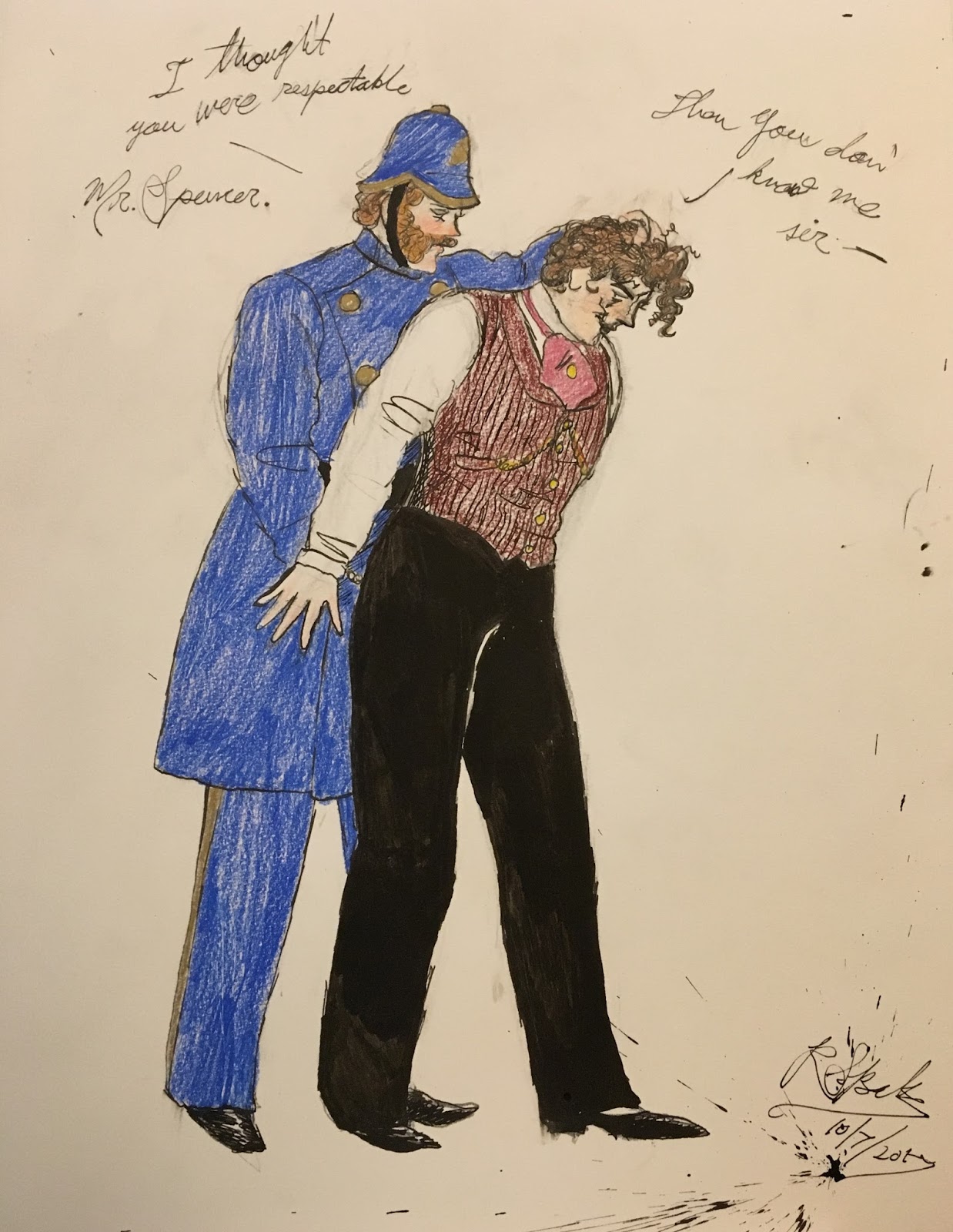
Last weekend I got to discuss some interesting matters with Charlie Judkins, and with that, we got into something that I had not previously considered. We discussed the interesting relationship that Len Spencer had with Columbia and U.S., and it appears to be more complicated than most of us might think. 
It's starting to become clear that Spencer was a common face amongst the men in blue all over New York and in Newark. 

Yes indeed.
Many policemen probably knew his face, or had heard his name as a "deadbeat" or something of that type in social terms. 
Now what has this to do with anything? 
well...It seems his relationship with Columbia and U.S. wasn't all peaches and cream(haha, Spencer and Jones pun). We all want to assumed that he was on great terms with Columbia, which is true without a doubt, but there were strange aspects to his relationship with U.S. and Columbia. We know that he began with Columbia in 1888-1889, and soon rose up the ladder from just a local dork with a golden ticket of a surname. He was soon a well-respected money maker for Columbia, even though in 1893, he was forced into some sketchy business with them...
Okay, so it seems that we may have a hypothesis as to why he used that strange pseudonym of "Gary Allen" on early Columbia and U.S. records. He was involved in some patent and law breaking activity with Columbia and U.S., and this can be proven through newspaper digging. In 1894, Spencer was tried in court for doing essentially the same thing he did while at U.S. in 1897(remember a few posts ago when I talked about the "midnight crooks"?), for stealing records from one company and bringing them to the next, and for doing who knows what else... 
tsk tsk Mr. Spencer...
So he was dropped from Columbia almost entirely in that sketchy period from 1893 to 1897, but after pledging to U.S. under Victor Emerson, he made some deal with Columbia under the table, and hence the reason that we get that jarring headline of him getting at last arrested for stealing those records with Georgie and Clyde Emerson. The second time it was the reverse, he was stealing records from U.S. to smuggle to Columbia, rather than stealing records from Columbia and smuggling them to U.S. Now what can we analyze from this? well, after discussing this recently, we can see Emerson(Victor) had those expected intentions with Spencer. He and the Management at Columbia, like Master Edward Easton, thought of Spencer as a so-called(excuse my language) "attention whore", and by this, I mean that Spencer was always wanting attention from the public for his work in the studio, and was pretty cocky about it. Hmm, from all this, we're getting a better image of Spencer for certain. Emerson and Easton as they were all getting Columbia set up in New York were looking for talent to hire with their new fresh start, and who was likely one of their first thoughts--Spencer. Right, he's nair-do-well, how about we get him to do some of our bidding. And so that's exactly as Spencer did, some deal was made, and he with the "lesser" Emerson brothers raided U.S. for the sake of pledging alliance secretly to Emerson at Columbia, though they weren't yet allowed to, since U.S. had not completely decimated at that point. All of this is making Columbia seem even more sleazy and like pirates. Edison called them "pirates" for a reason, and it may or may not be because of Spencer(well, now there's that possibility, so that makes this even more hilarious). 

So to sum up this about Spencer, it seems that Columbia saw him as a privileged deadbeat who could do anything for money and cocky bragging rights, so that's why we see him getting into trouble more than once with both of the companies he worked for before 1897. Now we can see why he used that strange pseudonym too, that's good to have cleared up. Hopefully we get to actually hear records from this fabled era sometime.


Hope you enjoyed this!


Saturday, September 9, 2017

Mid-night crooks and "The Voice in Time"


Who are these three funny guys? 
Well, we ought to know that first guy(Len Spencer), but the other two could stump some of us. The second is George Emerson, and the third is Clyde Emerson. These three rough-and-tumblers seem to have pulled off an interesting heist back in 1897, one that has been causing all sorts of buzz among the brown wax community this past week. This heist of a sort was pulled off in early 1897(just as the U.S. Phonograph company was collapsing), and in fact, speaking of the U.S. company, it seems that this was part of what led to their demise. So after reading the other record blog that was all read, it seems that Russell Hunting wasn't the only one of these studio stars who was arrested in the 1890's. Len Spencer and those infernal Emerson's were also taken out of that studio by the men in blue. 

The three of them crooks went to their U.S. Company headquarters in Newark(I hope late at night!) and took a hundred records as it says(around 100 would be my guess, keep in mind that it's just three guys...) from that company and brought them to be sold to a company of "rival concern",which is probably Columbia at this point of time. The case was brought to court, with them three handed $2,500 in bail(hot damn that's a lot of money!), but were soon discharged upon having no strong stance on the case. 

So that's it?
Yes, essentially with all the evidence. 

But hold on! There's more to it...This is clearly an inside job, a very complicated story, much more so than it lends itself to be. This is one of those things that just can't be a small thing, with a bail set over the amount that Victor Emerson put aside for George W. Johnson, something ain't right to me...As with anything Emerson or Columbia related, there's some really tangled up backstory that involves several recording stars, as well as deals between rival companies. The U. S. Company was a sinking ship in 1896-97,and everyone had to get their way off into the water. Spencer was in an uncomfortable position for sure, since he had such strong and long lasting ties to U.S., but was being led on a string back to Columbia, since that's where he started, and that's where they wanted him. A similar story must have been attached to Edward Issler, though Issler was not nearly as valuable to the management(he would be the most valuable if managers really cared about musicians), however, he did have an important role at U.S. that succeeding pianists hadn't, the knowledge of the technical aspect. Everyone eventually were saved by Columbia, but it was a long and almost deadly process, as it always was with Columbia during any transition. Spencer just after this heist had pledged his services to Columbia, which is also a little fishy. Come on, you can't just see this as being a smoothly moving thing that just happened. Spencer got busted for it, and so did the two "lesser" Emerson brothers. Victor Emerson may not have been charged, but it's got to be for certain that he had some hand in this late-night raid. 
(a cartoon I did parodying this heist)
Even with the lack of names(unlike the Johnson trial), there must have been at least a dozen other sleazy hustlers involved in this raid, they just sent out the best hustlers to go and steal the records themselves to be sold. I'm sure brother Harry(Spencer) had a piece of this too, since Harry at this point wasn't fully set as a recording artist solely. Recall that at this time (early-1897) Harry was more of a salesman and repairman than a recording artist. It would seem in this case that everyone we might think who would have a hand in this probably did. Considering Columbia's rampant legal squad, they were sure to brush this off quick no matter what happened. Hopefully we'll be able to learn more about his rather hilarious bust with Columbia. It's always fun to read about these stars getting into trouble like this, whether it has to do with recording or not.


Now to move to Fred Gaisberg!
We all have grown to love this crazy guy, and I have most certainly done so, along the course of reading this lovely book:
(Thanks Charlie!)
At this point, I am over half way through the thing, and the first night I started reading it got through 90 pages. I already have written about the first two to three chapters in a previous blog post, but this time, since I've the book right here, I will get to quoting some of Gaisberg's priceless and utterly snobbish remarks about those he met places he went. 
Here's one of the first lines from chapter three:

The man finally selected[to manage Berliner's London outpost]for this task was William Barry Owen, a legal assistant to Frank Seaman...
"Berliner could have selected no finer agent than Owen to exploit his invention. He was an opportunist of quick decision and a bold gambler...You would always find him sitting at the stiffest game of poker in the smoking room...and his eyes would bulge as he laid a full house on the table...He brought to London an infectious enthusiasm and energetic leadership which I believe was quite new to the conservative English city man of that day."

That's most certainly Gaisberg's writing at it's finest...his descriptions and diction were just fantastic to every degree. When he wasn't describing a type of foreign music with his European eye, the images he painted through words otherwise were unbiased and nicely structured, giving us a very real and somewhat raw vision into the early recording business. 
His description of the old man Giuseppe Verdi was just as intriguing as his vibrant imagery of his first visits to Milan and Rome:

I often saw the venerable Verdi, who would regularly take an afternoon drive in an open landau drawn by two horses. People would stand on the curb and raise their hats in salute as the carriage proceeded down Via Manzoni to the park. A frail, transparent wisp of a man, but the trim of his pure white beard so corresponded with the popular picture of him that one could not fail to identify him. 

That pretty much sums up Verdi. Gaisberg and Willie Darby were utterly overwhelmed by the culture and constant vigor of Milan the first and few times they went. Being ever surrounded by lovely art, music, and people seemed to overwhelm Gaisberg at first, though after a little while he grew used to the culture.
I hate to move a little out of chronological order, but this book keeps opening to other important pages with Gaisberg's unequalled descriptions, here is his rather cute description of Alfred Clark around 1897:

He was, I remember, a youth big an well-proportioned, perfectly dressed in a tailor-made suit which, in those days of "off-the-peg" clothes[what does that mean?] (which I and even Berliner wore) struck a note of distinction. Further, his dark eyes and curly brown hair set off by a boyish blush whenever he spoke, made him irresistible[hmm mmm...interesting choice of words there], quite apart from the shadow of the great Edison.[That's where he worked before then]

That's a lovely description, and makes me laugh, since he and Clark lived adjacent one another above Berliner's studio from 1896 to 1897, and went to all sorts of shows and got plenty of bonding time in, whilst also learning of the business and local culture in Washington and in Philadelphia. 

Gaisberg's time from August 17th and 18th of 1899 is one of the absolute best two days in sequence throughout his entire years of travel. In these two days, he was traveling with Darby in Spain to France:

Thursday Aug. 17th 99. Plaza de Montesino, Valencia...
Here again the terrible uncertainty of whether to proceed to Libson or return to Madrid seized us, and for two hours we sat discussing the pros and cons. Our fate was decided when we discovered out luggage was already placed on the relief train and we sprung aboard...[then] the station-master informed us no connections for Libson would be made that day, but if we waited for MaƱana('tomorrow') connections would surely be made. 
Already knowing that a Spaniard's 'tomorrow' means 'never'[haha], we quickly had our luggage transferred to the Madrid train and at 7 o'c p.m. we re-journeyed over the same ground travelled last night--sad, tired and provoked. However, before starting we invested 9p. in a sausage three rolls, and a bottle of wine. This we tackled with great relish, as we were nearly famished. 
The night was awfully close, and as these European railroad carriages give no draft9as there is no vestibule) we suffered awfully from the heat and thirst caused by the salty sausage

Friday Aug. 18th 99.
We entered Madrid at 8 in the morning...arriving at the station we finally accomplished the difficult task of registering trunks, and tried to find a place in the coach--but they were full. At last, finding an empty seat, I jumped in and sat down just as a fat matron with a bitter tongue claimed it. I refused to move, and she plumped down in my lap and there remained, while Darby on the outside frantically ram about looking for me. At last I gave her a push and slipped out from beneath her and she fell back into the seat with a jar. Then Darby got in, and as the fat woman got out of the car to give the seat to her daughter for whom she was preserving it, Darby slapped himself into it, and immediately two men and the old woman yelled and pulled and tugged and punched at him. Finally he had to give it up, and with a long face squeezed himself in a place opposite, and then it was my turn to laugh[indeed so Fred!].
Well, the ride was the worst I ever endured. This was our third successive night on a train--and that in a car so crowded that one had to sleep as in a strait-jacket.

What a trip! Hot damn that sounds absolutely awful, but it's genuinely a hilarious story that sums up most of their journeys together. 

Many of us can get to wondering about Fred's love life, and luckily, there's a lot of it scattered throughout this book, and it seemed impulsive of him to be describing the women around him any time they were met. Of course, he knew that he's never actually settle with a lady, and with his constant state of moving from place to place, his status of bachelor seemed inevitable, no matter how long the traveling with Darby lasted. Here's a particularly interesting little affair from Feb. of 1900 while back at home base in London:

25th, Sunday...
I went to take Miss Waite's package to Miss Edell's, and there spent a delightful afternoon, at the same time taking tea with them. Returning to town. I dropped in at the Horse Show, and to my great surprise who should I see sitting there but Henrietta. I hardly recognised her at first. She looked entirely prosperous, and decked out in fine dressed an jewels. She tried to urge me to enter old associations with her, but I stoutly resisted the magnetism of her beautiful brown eyes. She waxed most furious. What an uncontrollable passion this spoilt beauty has!
26th. Monday
After work Henrietta met me at the office, where we had a short dance and singing[aww...what a cute picture...].Then after supper we went to the gallery of the Savoy theater to see The Rose of Persia on Newton's invitation. She followed me me all the way to my Kensington lodgings, where I abruptly left her.


How interesting. It really fascinated me to read such writings of his, since we would normally never hear this side of him. He seems confused in this whole love matter...but at the same time all mad about it. It's truly charming to gather his feelings about being kinda in love. He hadn't the best of luck with this matter it seems. 

Here's an interesting picture from just a few months later. This was taken of the family when he visited for Christmas:
I'm sure you can guess where Fred is. 
Their long and grueling trips to Russia were chock full of mockery for Gaisberg. He reveled in how ignorant the Russian opera audiences were, cheering madly at a single performer who wasn't even adequate(at least to what Gaisberg had experienced). But after a horridly busy week of recording and traveling in Russia, this horrid mess befell them in their room:
About 2 a.m...
We were awakened by a terrible battering on our door. The porter and three or four others wanted to know what terrible happenings were going on, the room below was all dripping with what might be blood or something deadly, and was falling on the face of the sleeping occupant. We went into our 'lab' and to our dismay found a bucket filled with old acid had sprung a leak, and the floor was flooded...The bright red fluid dripped through the ceiling on to the sleeping guest; when his body began to smart[interesting word choice there...]he roused the hotel. We had the disagreeable task of sopping it up in our nightshirts, and expecting the manager up every moment to pitch us out bag and baggage. 

What a horrid thing! That would have freaked me out if I had been that other hotel occupant. Certainly I would have been convinced it was blood a-dripping on my face! 

Oh how there's so much more to write here from this lovely book, but there's no way I could quote everything  that was curious, since his descriptions of eastern music and instruments  are very interesting, while at the same time also strongly judgemental. He wasn't easy with his words on eastern music and instruments. He didn't revel as much being in Japan as he ought to have. His time in India and the middle east especially was curious to him. It seemed he took a great fascination with these nations, and took many candid pictures of the street people and musicians. This book is an overload of information and quotes, since Gaisberg lived a fuller life than anyone I have ever studied. Such the amount of travel he did is more than anyone would hope to travel in an entire lifetime, and he did that much travel in 10 years, or even less. He seemed to have most enjoyed Milan throughout his time of travel, since he revisited the place very often, and spoke the highest of everything there. He seemed to have disliked the long grueling trips to Russia, and seriously disliked the music of Japanese opera. His tastes dramatically changed from his days back at Columbia in 1889! Never would he have guessed he'd be in the studio with the masters of Italian opera just 15 years later...

Over time, I will use quotes from this book, since there are so many more, and I have to finish reading it of course. Remember, I'm only just over halfway through!

Hope you enjoyed this!