Showing posts with label Will J. Hardman. Show all posts

Saturday, June 16, 2018

Revisions and More new Transfers

All right, scratch most of what I said about Hardman in the last post. 
This thing is becoming much more frustrating than expected. 
So let's say that this guy wasn't the funny British man. 
After going back at the handful of examples of his music, the two things don't seem to fit together. 
Think back to the post where I first used that sheet above to talk about Mr. Hardman, when I used all the comical imagery and union talk. 
This is who the guy was. More of the influence of socialism on Hylands than anything. Thinking back to the music he wrote in the 1880's, he likely had a similar background to Hylands, particularly thinking of songs like this:
That's curious. Didn't someone we know literally live in the same decade under similar circumstances?
Hylands!
Yes indeed. In 1887 Hylands' father Charles opened a grocery store in Fort Wayne, Indiana. This sort of thing is rather midwestern, which would place Hardman likely in a similar upbringing to Hylands. Take that combined with the Union song from the same time and we have a similar story to Hylands, but realized a little earlier. Of course we still have no idea how old he was, or where exactly he came from, but we do have little hints from the handful of published music that's out there. So even with all this digging and learning yesterday, we are still in the same place as before unfortunately. Just like last time, we can associate imagery like this with Hylands and Hardman's relationship:
It still makes the most sense, and with a midwestern background to tie them together, we can assume that's what got them together under the talk of reviving their music writing skills. 
So please disregard most of what I said in the last post about that book at such. Not everything I've said about him is entirely wrong, but let's just revert to what we had before the last post. 


So now that that's done, it's time to listen to some more new transfers! As per usual, I've been checking the vast archive of Santa Barbara every day for new transfers, unearthing new ones almost every day. Luckily, there is a new Issler transfer up, and those are always guaranteed to impress. 
There he is, looking all official and whatnot. 
We know very well of Issler's outstanding capability to play syncopation in his music, which is evident throughout his recording career. This new transfer is no exception to this. 
Here's the new transfer:
The first section of this quadrille has an overtly syncopated section that sounds an awful lot like cake-walks published around the time this was recorded. This record was made likely around 1895, as are the bulk of Issler's records that we hear out there. The syncopation on this particular record sounds like a typical cake-walk from a few years later actually. What sections like this would have been called in the early and mid 1890's would be "buck and wing" or just
wing dance", which is another direct ancestor to Rag-Time. Here are two published examples of "wing dances", published before 1899:
Think of a weird combination of Irish reels and black folk dances. That's essentially what we're dealing with here. 
Another good example of one of these is actually Monroe Rosenfeld's widely recorded "Virginia Skedaddle". These pieces encompass a lot of the distinct characteristics of American music throughout the 19th century. This is why hearing Issler play this stuff on records is valuable. We get an entire summing up of American(and not just North America I mean, I'm also referring to the West Indies and southern America) music in a few recordings of 2 to three minute songs. In speaking of songs like this, Santa Barbara has a curious record listed by the Columbia orchestra with an interesting title:
"Wing dance",that ought to be just what we're looking for. And with that, the piece could possibly be an older piece that was carried over to the Columbia Orchestra from Issler in the early and mid-1890's. This particular record is of interest to Rag-Time scholars because of the primitive and jig like melodic lines, the ones that were distinct of the earliest minstrel show songs(like "Turkey in the straw"!). This is exactly where the primitive rag name "jig-piano" comes into the picture. This record overall is a standard example of the earliest Columbia orchestra, with half the musicians being Issler's, and the other half being prestigious Gilmore's band musicians. Since this particular record is from that issue-ridden gray area for Columbia(1897), it's hard to tell who the pianist in the orchestra would be. 

This next record is quite different from the last one in term of content. 
It's been a little while since J.W. Myers has had a significant mention, so here you go:
Myers around 1893. 
This new Myers transfer is just interesting enough to keep me listening. Normally I am drawn to coon songs and funny popular songs, rather than what this record is. Here you go with John Philip Sousa's "The Man Behind the Gun":
http://cylinders.library.ucsb.edu/search.php?queryType=@attr+1=1020&num=1&start=1&query=cylinder17164

You will notice how loud and clear this record is. In fact, it's so clear and well recorded, that a friend and I discussed the possibility of this record being and original(directly recorded to cylinder, with no copying process). My friend stated how original records were sold(by Columbia) in the brown wax era, but were more expensive and the standard 60 cent Columbia record. With Edison records this wasn't the same process, Edison was known to sell originals all around for the same price. Anyway, what stands out about this record is that Myers of course was a great singer, but the piano accompaniment. Hylands is playing pretty typical accompaniment stuff, but the quality of which we hear it is outstanding. We can distinctly hear the very chord inversions he's playing, down to every single note coming through nice and clear. Hearing records like these reminds us how even though the process of recording was frustrating and sanded away at the lives of those who made them, the outcome was often loud and clear. With that, we can all live that moment in time, no matter what take it was, or what time of the day it was. 

This last record is one that I've been anxiously awaiting its transfer since the moment they listed it online. Of course all of the overt Coon songs Spencer did that are listed are gradually being put up to be listened to, and this one is just another great example of them. 
This particular one is another popular May Irwin hit from 1897, as are most of the better coon songs that Spencer recorded with Hylands accompaniment. The original transfer that was put up on Santa Barbara was far too fast, so slowing it down to a more respectable speed was of order. Just to get the comparison, here's the original transfer:
http://cylinders.library.ucsb.edu/search.php?queryType=@attr+1=1020&num=1&start=1&query=cylinder14535
It's hard to listen to honestly, so here's the better slowed down transfer, where the piano accompaniment comes through much better:
https://drive.google.com/file/d/0By7WuiOUrg7YdldGc2ZWMW9WWmIyeDJrZ1YycWg1Y2h4Ymg0/view?usp=sharing
It's much more tolerable now, and sounds perfectly ragged. Yes, this isn't a great example of Spencer's singing(this is my perfect pitch coming through...), but the piano accompaniment far exceeds the rather out-of-tune singing of Spencer. This sort of Spencer record is exactly what I look for in terms of great examples of pre-1900 rag-time. This record and his "Get Your Money's Worth" from around the same time are among the best examples of their collaborations from pre-1900. These records are the zenith of recorded rag-time at the height of the first rag era(1893-1903), it really doesn't get much better than this folks. 
All the significant Hylands characteristics are present in this new transfer. You get the walking bass notes, pushy rhythmic syncopation, and out of whack following of the singer. It's records like these where we're reminded of how hard it must have been to accompany Spencer. Spencer was known for distinct pauses and little talking sections in the middle of records, and therefore made life for the accompanist very difficult. With other performers and singers, Hylands didn't naturally do the weird pause thing and aggressive speeding up of verses and choruses, but with Spencer, this was essential. This makes Spencer hard to follow, even if you're someone who understands what he did very well, he still did more of talking through songs than actually singing them. There isn't a thing wrong with this habit, it just gets us thinking about how hard Hylands' job was. I'm sure even Banta would have found Spencer to be rather difficult to accompany. Banta at least didn't have to deal with too many singers like Spencer at Edison and Victor(exceptions being Billy Golden and Silas Leachman). Keep in mind that Banta did indeed accompany Spencer on Victor and on Spencer's early Edison records. 


All right then. I should end it here, I was going to talk about Ruby Brooks in this post, but there seems to be enough to do an entire post on him, so that will be next!


Hope you enjoyed this!


Wednesday, June 6, 2018

A Mystery Partially solved and words from Banta

Thanks to the help of Charlie Judkins and Mason, it seems we now have at least an idea of who Will J. Hardman was. 
The reason that is had been a dead end every time anyone looked for any traces of Hardman is because he was English! It makes so much sense now why there was next to nothing out there on him in terms of finding the basic biographical information. What's more, Hardman wrote a book in 1884 called A Trip to America which is an endlessly entertaining read. Just today I was sent the link to the book and powered through 80 pages of it since it quickly captivated me. 
If you want to start reading the thing, here's the link:
Don't get sucked in too far!
I'm not entirely certain whether or not to connect these lines yet, if that's the same guy. It's got to be though, since he can be found in public records around the late 1880's living in Brooklyn as a printer/bookbinder. At least that clears up why he would be of use to Hylands and Spencer. After reading a lot of that book, it's really nice to get a well founded idea of what the guy was like, and that it oddly corresponds to the strange and poetic lyrics that he wrote with Hylands. Though Hardman is basically exactly the opposite kind of person I had long guessed. You can't get them all turns out... 
Hardman was described in the book as "Aggressively English"(which is a hilarious term I will now appropriate). But oddly enough he was also described in a similar way physically to Hylands, which also would be an object of attraction for Hylands. It's very clear that Hardman was a very educated man, who loved books more than anything. This is very much evident throughout the book's chapters and vibrant descriptions of New York in 1883 and of the entirety of the U.S. in that time. There's quite a bit of humor throughout his descriptions of travels, which mirrors that of his work with Hylands. Even though Hardman had been writing music here and there in the 1880's and 1890's, it still seems strange to find a man so intelligent and greatly invested in literature to reach the low point of working with such a hustler as Fred Hylands. In his 1884 book he describes the common character of old New York, the "confidence man" who so often scammed new travelers and unknowing street people. Hardman himself was taken by the arm of a few of these scammers, and they turned out to be famous lottery brokers, who tinkered with the numbers and players. To assume Hylands in a similar position, Hardman would only think of Hylands in a similar way, especially with his faux background in economic studies as a teenager. Surely Hardman was wise to the ways of Hylands, of course after he got to know the studio rambler(Hylands). Likely from the convincing grin and genuine business intellect of Len Spencer, Hardman was swayed to revive his musical talent and write with Hylands. Again, after reading through that book, he doesn't actually seem too different from what we can piece together about Hylands. 
Yes now that we know all this, it's all fine and dandy, but the basic questions still haven't been answered. We don't know how old he was, when he died, or anything else like that. I would guess he was born around the same time as Silas Leachman(1859), since he said that he was married in 1883. He seemed to have a particular fondness for the theater and the music that was played, as evident in the chapter in his book regarding New York theater society. This remains another hint at why he connected so well with Hylands over a decade later. 
What's also rather humorous is how much he had to say about New York Hotel food. He spoke of the subject matter in such great detail, and with such admiration whilst also exhibiting his clear astonishment of the portions and perfection. Such a thing hints more at similarities to Hylands. Wink wink...

We may not have the basic information we would need to piece together Mr. Hardman, but at least we know why, and how and why he was of such value to Hylands, Spencer, and Yeager. Now that I've had the chance to read a bunch of his writing, his strange lyrics to "You Don't Stop the World from Going Round" makes much more sense, and its curious origins are much clearer. 


Now to move to something that relates to the last post. In the last post I broke down Frank P. Banta's most eccentric characteristics in terms of accompaniment. 
This time we actually have words from Banta!
I mentioned in the last post that there aren't any hints to Banta's personality, but now there's a tiny little glimpse that sums him up pretty well. 
There's a newspaper article from June of 1893 regarding the newest realm of recording for the North American phonograph Company. When reading over the little article on the dense page, it takes a little while to see the words "Mr. Frank Banta" written on the page.
https://chroniclingamerica.loc.gov/lccn/sn83030272/1893-06-25/ed-2/seq-5/

Banta in a nutshell:
"Oh that doesn't matter...just hum it over once and I'll catch it."

Yep, that's pretty much how Dan W. Quinn described Banta. Quinn praised Banta's perfect pitch and ability to play a song entirely through after once hearing it. This very quote above to the fullest extent supports Quinn's claims regarding Banta, and why all the studio workers enjoyed working with him so much. In this situation of having a Banta quote, I should most certainly dig out that record by Banta's orchestra that likely has the voice of Banta himself in the announcement. 
http://cylinders.library.ucsb.edu/search.php?queryType=@attr+1=1020&num=1&start=1&query=cylinder11738
That voice at the beginning has got to be him. Never has a voice so perfectly matched the appearance of a studio star. 
Also, I think that's Banta's voice because I've heard a similar one on Edison records later on records that are of sketches, such as ones by Len Spencer. 
An example of this is here:
http://cylinders.library.ucsb.edu/search.php?queryType=@attr+1=1020&num=1&start=1&query=cylinder7434
One of those laughing voices is certainly Banta. The timing would indicate that he's there, as well as the little bit of piano accompaniment there is on the record. The thing about those laughing voices on this record is that there's this one that particularly sticks out at the very end. It's really exaggerated, but it has that same sort of weird twang that the voice at the beginning of the Banta's orchestra record has believe it or not. 
You can hear that same voice here too:
http://www.tinfoil.com/cm-9911.htm#ch0410


So now with that input, really try to imagine that twangy New Yorker voice speaking those words from the Sun article. 
Not often do the voices of these recording stars match their appearance, but it seems Banta's does. 
That voice suits that look surprisingly well, as do the very words that we have immortalized in that newspaper article. 


Before I finish, I'd like to share a new Santa Barbara transfer that is worth mention. Us Rag-Time scholars are on the hunt for records of early Hylands, which means recorded for Columbia for certain in 1897. This record I'm sharing is one of these so important records. 
here's the record:
Just to clear it up, the title they have listed is not the correct one. 
This tune was a popular one of 1896, originating from May Irwin's outstanding and renowned performance in The Widow Jones. 
There we go. 
The name of this early coon song is "I Want'cher Ma honey". 
This particular Hylands and Spencer record is very well recorded, and that means we can hear that piano loud and clear as ever. It can also be observed that the piano being played sounds rather awful. It's not out of tune so much as it's rather beat up and in rough shape. The accuracy of the piano's tuning is hard to tell because Spencer's singing was always questionable. But one thing is for sure, that piano had seen better days. Luckily(and unfortunately), this particular record allows for this to be heard with great clarity, particularly in the solo after the first chorus. That single note that Hylands plays to end the solo is really more like a thump than a tonal note. This is a time where we can be thankful that Edison's piano always sounded good, and there's a reason for it. Banta had experience in tuning pianos and the general mechanics that go into the piano. Hylands didn't know a thing about piano tech. Without this knowledge, and no Banta to tend to the thing, their piano at Columbia sounded the way it does in this 1897 record. What's odd however is the fact that Columbia's piano sounded okay after 1898. It's only in 1897, and not even the entirety of that year in fact, that their piano sounded thumpy and stripped of most dynamic capability. This fact does help us date records such as this early Rag-Time record by Spencer, but it leads one to question why this was true. Of course there is no way to definitively know why Columbia's piano sounded to awful in that short period of time, but the fact that Edison's piano always sounded good must have something to do with Banta's constant presence. 

Technology was not Hylands' specialty, and a crappy sounding piano can be a piece of evidence for this. 
But aside from that, the crappy sounding piano rather adds to the aesthetic of the record, as Hylands does play some banjo imitation riffs and a piano that sounds like that can often evoke such a banjo sound that's more realistic. 


Hope you enjoyed this! 

Saturday, January 6, 2018

Some more studio politics

Now that the holidays are essentially over, hopefully I can get back to making more blog posts, since it's still been hard to find more interesting information to talk about. 

Recently while searching around for quartet records, I came across a very strange record that hadn't even a record number to be found. The performer listed in the announcement of the record was given by the familiar voice of this chap:
Steve Porter.
So the creation of this strange record seems to have been facilitated by Mr. Porter, though the leading voice in this so-called "Diamond Quartette" would most certainly be George Gaskin. This record is centered around a parody on the hit "I'd Leave my Happy Home for You", but on the record it is called "I'd Leave my Job to Vote for You"(haha). 
Porter's announcement begins with this, 
"republican campaign song..." 
after the announcement the lovely and unmistakable Ragged playing of Hylands lumbers through. 
Of course on this record, there's a mot more than just Hylands and that Quartette. It seems that in this quartette, there was Gaskin, Porter, Roger Harding, and George Hargraves. This witty parody is rallying for William McKinley's campaign in 1900, and throws William Jennings Bryan and the Democrats in the dust. Sorry, it's one of those records I can't share out of kind courtesy to the owner. 
So, in past digging, I had heard of such campaign songs and rallying done by a certain group at Columbia. Those "clan" members at Columbia(let's say Harding, Porter, Spencer, Gaskin, Emerson brothers, Hylands at this point in time) were most certainly prominent politicos in their time. And with that, it can further be proven by the first Phonoscope section I found regarding their prominence in the Republican Party of New York. 
I hate that these are so hard to read. What a politico Harding was! Harding did quite a lot of rallying. well there ya go, there's that exact group from that record I've described. It's amazing to see an actual written account regarding the group, and then later finding a rather "wild" record by the very same group. Of course when digging all of this up after listening to the record, this brought back the research I did on studio politics a little while ago. Also, while doing some random digging on something else last night, I stumbled across something else telling about a certain someone.
It's clear that I talk about Fred Hylands quite often, and finding new information on him has been very slim the past 6 months. One thing that's fascinating about Hylands however is that his political view and morals seemed to have changed somewhat after a certain point in time. This change was a gradual process, and it took a few years for him to transition. Luckily, that recording and Hylands' associations in the recording business can lead us to assume he was on the dominant Republican side of the Columbia staff(keep in mind not every one of the boys and few ladies was on the same political side). Despite Hylands' more popular relations, he(much like Scott Joplin believe it or not) around 1899-1900 began associating himself with some of the underground people's and political activists. By these terms, I mean Socialists. Those progressive outcasts that were dreaded by every factory and corporation, yes, Hylands began flirting with members of these groups. 
I've made it clear that Hylands switched to the other side by 1904-1905 by becoming a leader with the White Rats, but it seems that a few years before that he was pondering the ideas that his progressive friends told to him. I had assumed some of his actor friends like J. Grant Gibson would have swayed him over, but actually, come to find out it was someone else familiar. 
Well, this "ranting Bill" is Will J. Hardman. 
(cartoon by me!)
Just last night, I went digging for some early roots of Rag-Time on the Johns Hopkins sheet music website, but stumbled upon something fascinating. So what has Will J. Hardman to do with Hylands' socialist streak? Well it seems I found an indirect answer. 
(the date on this one is 1886)
There we go! It seems I found another source of influence for this transition. 
Of course! It makes so much sense now. Hardman was a gifted wordsmith, and now it seems that my hypothesis of his friendship with Hylands was in fact true! I had assumed by how many songs Hylands wrote with Hardman in such a short period of time that they had a bond outside of their music. So at a certain point, Hardman must have explained his world view to Hylands, and since Hylands was already somewhat fed up with Columbia, these new ideas from progressive Hardman must have been eyeopening. Unfortunately, I know nothing on Hardman at all, but because of the age of the other pieces I've dug up, he was most certainly older than Hylands, probably a decade older as far as I can guess. That would put him at around 38 by the time he met Hylands. Without a doubt, in 1900, Hylands was keeping his rebellion and disenchantment well hidden, since he had to participate in many of those political gatherings that Harding organized. By the time of the publishing firm with Spencer collapsed, Hylands was essentially outcasted from the tight pact that the Columbia staff had in the 1890's. With the shunning however, came Hylands' opportunity to go the way he desired, and head off to become a "Knight of Labor". We know his first try left all his old friends at Columbia a little frightened while also made him the laughingstock of Columbia and the Broadway community. This Socialist leaning left some of his old Columbia fellows concerned, and it must have made Len Spencer roll his eyes. 
Spencer after 1900 went a different direction as well, he was still a solid Roosevelt Republican, but his entering into the business aspect of vaudeville took something out of him. Spencer was unhappy with the progressives like Hylands and the other Union men, and this must have worsened over time when he had to deal with quite a few scrambles regarding union members and leaders. Of course, before his "falling out" with Hylands, Spencer would have seen bits of these progressives, as Frank P. Banta was part of a musicians' union, despite the contradictory nature of his employers. 
Since Hylands' relationship with Hardman was relatively close for enough time, it's likely that Hardman was part of Hylands' political transition. Another thing to note from that sheet music cover I found, notice the other titles listed under Hardman's name.
"For one day of Turkey there's six days of hash" 
well well Mr. Hardman, that's an amusing title certain. The words above the title are also interesting:
"an injury to one is the concern of all"
What a Socialist remark that is. Much like the cartoon above, I can envision Hylands being hypnotized by Hardman's ranting, since his lyrics were perfect with Hylands' weird often drug-induced Rag style.(think about the multiple meanings for "hash" in the title listed above). Keep in mind that Hardman's lyrics to Hylands' songs are very weird. They're strange even for the time period, and weirdly poetic all the same. 
Really listen to those lyrics, they're funny but really weird and have a few nearly unrelated lines. 
Of course one can wonder about how Hylands and Hardman became friends, and of course my mind goes directly to them both being den ramblers(essentially the opium equivalent to drinking buddies), who were both second grade musician/composers with unique talents. Hopefully, someone will dig something up on Hardman sometime soon, the suspense of learning little bits about him through his music is starting to get aggravating. 


Before I finish, I wanted to share the two record related finds I got for Christmas. The first thing I saw was an original Columbia box from 1897 or so, and when I opened the box, out popped a bunch of the soft fluff that record companies used to protect their records. I had always wanted one of those beautiful pre 1900 Columbia boxes, as they were colorful and elaborate, much like the late-1890's was in a nutshell. 
There's the pretty old box. 
Now the record on the inside was also really nice too, because it's Dan Quinn singing "put me off at Buffalo" from around 1898 or so. 
I'm looking forward to hearing the thing sometimes soon, as it will likely be a varied round of this take:
There's the record and the box. 
And my gloved hand holding it correctly. 
So far I've heard three different takes of Quinn singing this song all on Columbia brown wax. I wonder how many rounds he made of it for Columbia anyway. 
Other than that fantastic gift, I also unwrapped a piece of Hylands published sheet music. He did not write it, but it's another Hylands, Spencer, and Yeager piece, which is always worth my time and money. Of course it's not one with Dan Quinn or Spencer on the cover, but it's about the next best thing. 
there ya go. 
Another Hylands Spencer and Yeager piece is always welcome in my sheet music collection. Any time that certain lady is on a Hylands piece is always interesting to me. 
So I've seen her on three Hylands sheets now...the number seems to keep increasing, as does the evidence of a little fling there. I learned somewhat recently that she divorced her husband in 1900, the year that this piece was published with her picture on it. The charges of the divorce were impropriety. It's very tantalizing to read this, and it legitimately shocked me when I saw it. Maybe sometime I'll do a post on what evidence I have about this tantalizing coincidence....


Anyway...


Hope you all had an all-right holiday season!

Wednesday, November 16, 2016

The Search for Will J. Hardman and More fixed transfers

After spending a little time to-day searching on sheet music archive websites, I finally came across a few pieces by Lyricist Will J. Hardman, who was Hylands' lyricist in 1899 and 1900. After so much time wondering about anything that would be traced on him, I finally found some more music of his! What I found was nothing like the songs he wrote with Hylands though, in fact it was much older than the other music he wrote with Hylands. It seems he was one of those composers who began writing music earlier than expected, like Monroe Rosenfeld. The oldest piece of his I was able to trace was from 1885, 14 years before he was writing music with Hylands. The piece that was closest in date to 1899 was this one here:
Wow, what a bleak subject matter in contrast with his lyrical genius of "You Don't Stop the World from Goin Round". Without a doubt, Hardman was a genius when it came to language and diction, and this has been made ever clearer by seeing more of his music, both in the sense of lyrics and in music. One thing that is for certain now, is that Hardman was probably born in the 1860's, or just generally older than Hylands, and that debunks my preconception that he was the same age or around that of Hylands. Maybe he was Gaskin's age?(born 1863), that wouldn't be too unreasonable. Until I see census records there will only be guesses of his age. I understand now why Hylands probably had him as his lyricist, and it was because of his longer experience and previous success in the matter, though Hylands didn't publish any instrumental music of Hardman's, which is a little strange, yet somewhat telling. 
It is a little strange though that he was writing very emotional songs in the 1880's and even the 1890's, but then once Hylands had pulled on his leg long enough, Hardman was writing Rag-Time songs with him. That leap to the other side of popular songs seems really interesting to me, and must be noted in studies of Hardman. He seems like a very interesting character, as it seems like that had to be a requirement to be one of Hylands' friends, since that's a trend with those who Hylands associated himself with. 

Hylands probably took notice to Hardman's talents around the time that he was a music director at Pastor's(in 1897), since his music had been laying around in piles of music at his office, and being a music director, of course he came across Hardman's music! Since he took an interest in Hardman's music, he probably tracked him down, and he wasn't too far, since he last piece was published not far away from where Hylands worked in the next year(1898). It even could have been something as random as Hylands commuting to work sometime in 1898 and stumbling into Hardman's direction, and them getting to at last praise each other's music, instantly forming a solid friendship. According to The Phonoscope , things like this did happen when some of the recording stars were commuting to and from work(such as the horrific cable car crash of September 1898). Just to give this thoery some credibility, Hylands' commute from where he lived to Columbia would have been passing the address of the publishing firm in the music pictured above, though not every day he would have passed by it however. 

Just as a side note, Hylands lived really close to Union Square in 1898, but really far away from Columbia, just to put that into perspective. This is exactly why he moved to 33 W. 27th street in 1899, a block away from Columbia. All of you collectors out there who still aren't sure if Hylands worked at Columbia after 1898, this little blurb is the evidence.

 If he worked on 14th street, that's where he lived, if he lived on 27th street, that's where he lived, it's not that hard to comprehend. 

However they first met, he and Hardman must have become good friends quick, as it was much like his relationship with Spencer, though he didn't work in the studio with Hardman. Alright, it seems I'm able to piece together the people who worked with Hylands in his publishing firm who weren't the names in their gorgeous footer:
Here are some of the names:
Roger Harding, Burt Green, Will C. Jones, his sister Etta, Rollin Wooster, Georgie Emerson, Steve Porter, Will J. Hardman, and George Gaskin.

There are others, but these are the ones who helped him directly under Spencer and Harry Yeager, and there are probably more who we have yet to discover. Some fraternity it was! 


Now it's time to listen to some music! The endeavor of slowing down these records scattered about the Internet has been slowing down, since we're getting ready for the West Coast Ragtime Festival this weekend, and finding records played at the wrong speed is becoming harder to find, though there is so much more we can do. One record that we recently slowed down is Gaskin's 1903 recording of "The Bassoon", which is certainly played far too fast on the website it came from. 
An image of Gaskin from c.1895 that makes him look innocent and sweeter than others out there. Something about Gaskin's singing is very pleasant, but his thick dialect is often what makes it not nearly as perfect in the pleasant factor for me. I guess that's why I can never really love Gaskin's records. He seems to have been a more influential figure in the early recording business than previously thought, with his advocacy for George W. Johnson, he certainly earns some points for that, as well as throwing in a whole lot of money to the fund for his defense team in 1899. 
Without further ado, here's the original transfer of the record:
http://cylinders.library.ucsb.edu/search.php?queryType=@attr+1=1020&num=1&start=1&query=cylinder4724
Far too fast and screechy, here's the newly slowed down version:
https://archive.org/details/BassoonbyGaskinwHylands1903
So much better. 
Like a breath of fresh cool air. 

Another record that we fixed involved many things to be done to the original transfer in order for it to sound as is does now. It is a record by:
John Yorke AtLee. 
For a long time, I knew that he recorded a few coon songs with whistling choruses, and one had been put up on the Santa Barbara cylinder website for not too long, but it was completely mis-labeled as a cylinder by Billy Golden, just because it was a coon song with whistling, which was Golden's specialty. Nope, this was even stranger record, it was one of two or three coon songs that AtLee recorded in 1897-1899. Here's his take of "Whistling Yaller Dinah":
https://archive.org/details/WhistlinDinahAtLeelate90s

This record has origins that are very hard to trace, since it is one of those independent recording companies, possibly one of the original masters of records that AtLee sold under his own company in 1898-1900. I only know of one other example of an AtLee original from that period, and it's his "Our Whistling Servant Girl", with a hard to trace date. Much like that one, the newly slowed down AtLee record is hard to trace when it comes to putting an accurate date on it. The "Whistling Servant Girl" cylinder comes from Tinfoil.com, and the company is said to be the U. S. Phonograph company, and is dated at 1900, though that doesn't make any logical sense. That company fell completely by the middle of 1897, and it had a pitiful and ugly end, dissolving to nothing in just a few weeks. 

Now the question of these two recordings comes to the piano accompaniment. Who does the pianist sound like? Well, none of the studio pianists. It just sounds like Gaisberg a little bit, but it's not, as the dates would be in the range that he was still in the United States, even though I think they're probably from 1898. After digging around in the go-to source for possible information on this, The Phonoscope, it seemed that there was a little section in the September 1898 issue that hints at a pianist playing behind him. This section stated that AtLee was at a recent phonograph demonstration(connected with Columbia, durr...), and he sung three songs accompanying himself on the piano. WHAT! REALLY? That's amazing, and raises suspicion of who might be playing piano on these two records, since they're not strictly Columbia's, with Hylands or Gaisberg on piano for certain, it makes some sense that he be playing piano on his self-made records. Keep in mind that this only applies to the records he made on his own in 1897 to 1900, not his records for Columbia in 1897 and 1898, nor his records from 1891-1894 with Fred Gaisberg. 

He had an interesting piano style if he's playing piano on these two records! 


It says in one advertisement for AtLee's records that he recorded "The Whistling Coon". Now that's a record I hope exists somewhere. 

Hope you enjoyed this! 

Sunday, October 2, 2016

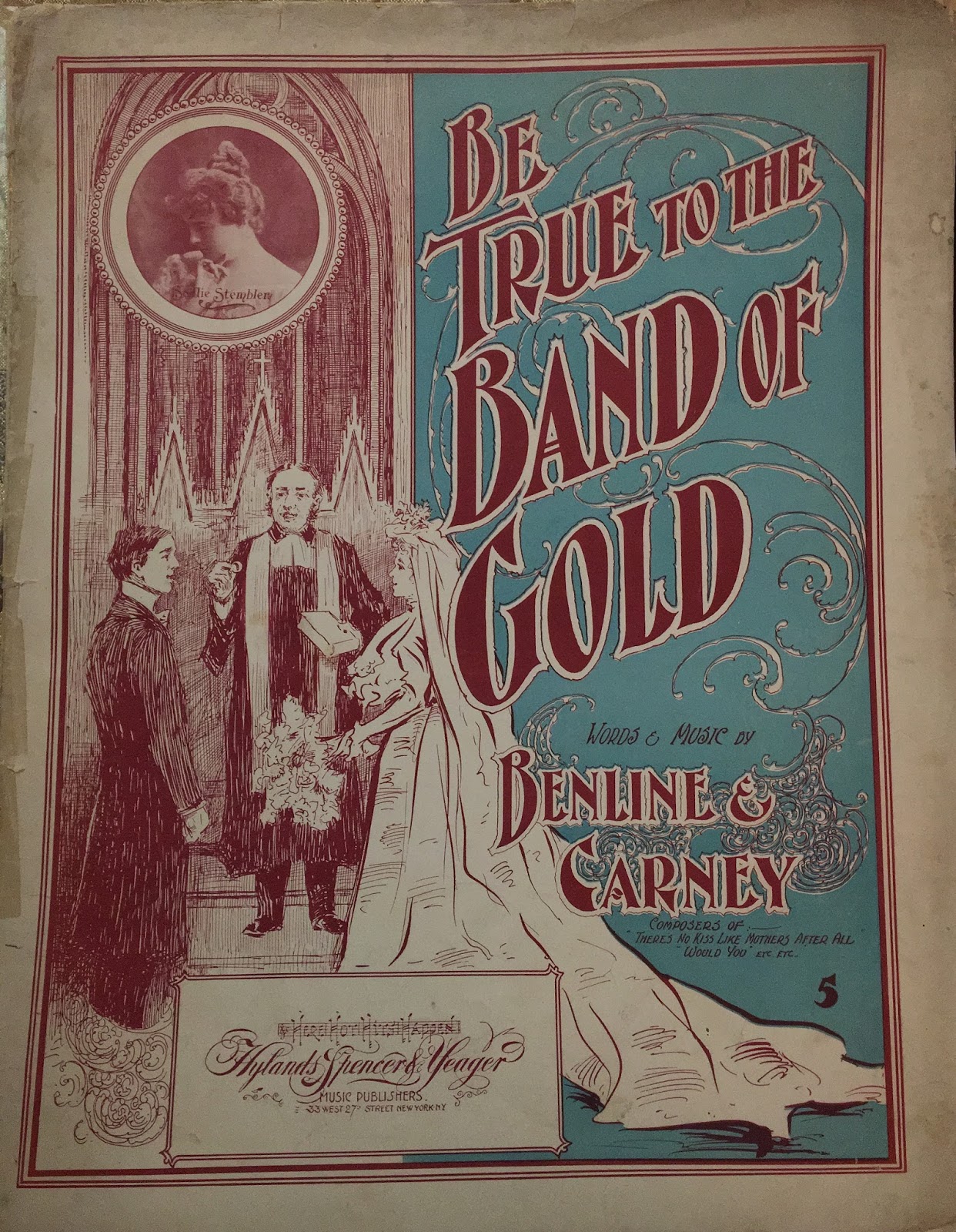
Sallie Stembler and other thoughts and theories

This lovely lady was one of Fred Hylands' women pictured on many of his sheet music covers in 1899 and 1900. Amid her time within the affairs of Fred Hylands and Len Spencer, she was highly praised in a few sections in The Phonoscope, stating that she introduced a few of Hylands' relatively few publications. In fact, the image just above of her came from one of these music covers. To make matters more interesting, this lovely lady left the Hylands affairs and remained in show business for ten years before deciding to make records. It is unclear if Hylands perhaps dropped the idea of her making records when she was affiliated with him, but it probably happened at some point and was refused. She made a few records for Edison ten years after this endeavor, and still sounded like one of Fred's lady friends. What I'm trying to say is that she sounded like someone that Fred would have really approved of as far as lady singers go. With her great talent, it's unfortunate that she didn't make more records, as she would have been a fantastic edition to the Columbia staff back in the late 1890's. She actually might have been and Ada Jones type before Jones created a sort of monopoly among the early lady singers in the studio. Enough bluffing, here's one of her records:
http://cylinders.library.ucsb.edu/search.php?queryType=@attr+1=1020&num=1&start=1&query=cylinder3570
She is genuinely the more fun and upbeat than many of these early studio ladies, even a bit more so than Ada Jones in some respects(who was also a cover-girl for Hylands' music at the same time). She's no May Irwin, but she's got a playful essence in her voice similar to Marie Dressler, who was another fantastic lady of this era, and my favourite as far as the Rag singers go. Just for your information, Dressler was in a fantastically funny silent film with Charlie Chaplin in 1914, of which you have to see if you haven't already! 
That's her in c.1909. Just a fantastic picture in all aspects. 
Speaking of Dressler, just for fun, here's my favourite of her records:
http://cylinders.library.ucsb.edu/search.php?queryType=@attr+1=1020&num=1&start=1&query=cylinder0857
(that other voice at the sketch in the middle of the record is Ed Meeker by the way)

With all of this, we can assume that Fred's wife Marie probably sounded similar to Sallie Stembler or Dressler, since it seems that he preferred the talents of ladies who could sing hilarious and raucous Rag-Time songs, as they all were in the late-1890's(also going into this category are songs like the one listed above by Sallie Stembler). Marie Dressler and May Irwin were the best of the best when it comes to the early female singers of Rag-Time. 


Speaking of these lovely Rag-Time ladies, these last few days have been eventful in my dealings with the kind great nieces of Fred Hylands, in the area regarding Etta Hylands of course. I have explained in previous posts that Etta's children, particularly her oldest daughter Ethel, were popular stage attractions along with their mother. Etta seemed to have constantly been competing with Fred, as she was taking all of these pit orchestra jobs at the same times that Fred was, but at other times was working in the same business with him, in the same publishing firm or union in fact. She also ran her own pit orchestra playing for silent films at the same time that Fred was accompanying silent films(which was in 1909). Even with all of this obvious competition, it seemed Fred remained more popular in show-business than Etta for the most part, and that is what the kind descendants of Fred and Etta claimed upon asking them. The doings that went along within the past few days involved a few images and newspaper clippings being sent to me through them. They all had to do with Etta of course, but that is just as interesting on anything regarding Fred, since there's less known about her, and the more I learn, the more revolutionary and independent of a lady she becomes. She seems to have been rather progressive for her time, which is always welcome in my studies! 
Her daughter "Baby Ethel" as she was called on the stage, was the most popular of Etta's children, since she was a talented young mimic and singer, seeming like a Shirley Temple type in many ways, in fact she even had that essence about her! 
Here is one of the priceless images of her the descendants shared with me:
I had told my friend Charlie Judkins of this image, and he stated that she looked a little like her uncle:
Hmm. I kind of see it. Charlie specifically stated that she had his nose, which is kind of true, and made me laugh. The point is that she did  look like Fred an awful lot, and that gives me hints for future cartoons regarding Fred. Keep in mind that we still haven't dug up a really clear image of Fred, so all of the cartoons I have done of him are still my best guesses as to how he looked. The glasses are still there, that feud has passed, Fred wore glasses, no arguments. His glasses looked much like these here:
These Prince-Nez style spectacles were worn by most dandies of the 1890's including Fred Hylands for that matter(I'd classify him as a dandy in case you're wondering), and seemed a little less practical than the kind that George Schweinfest wore:
(Schweinfest in 1894)
I plan on getting a pair of these strange glasses that Hylands wore to use for comedic affect in my seminar regarding him in November. I will set them on only when reading a quote of Hylands' words, to create a more realistic atmosphere when it comes to his own words. 


Someone that I have been trying to dig up some information on lately has been Hylands' lyricist Will J. Hardman. Hylands had a slue of lyricist friends throughout his music writing career, beginning with Bill Hardman, and later J. Grant Gibson, and almost nothing on these mysterious men can be traced, especially Hardman. At least Gibson has been able to be tracked, and we know of why and how he became Fred's friend. Gibson was a behind-the-scenes man with Fred's musical productions in 1904 to 1907, and they had built a friendship further through the White Rats Union in 1905. Hardman remains interesting to Charlie Judkins and I solely for his true talent in writing lyrics for Fred's popular songs in his days publishing with Len Spencer. He wrote a few songs with Hylands in 1899 and 1900, which, according to the relatively small catalog they had as a firm, is quite a few. Most of the coon songs that Hylands wrote as a publisher at this time had the lyrics by Hardman, which is certainly something to get one suspicious. The partnership began with "You Don't Stop the World from Going 'Round", of Hylands' biggest success in terms of all the music he ever wrote(according to sheet music covers of his from the early 1910's), then three more popular and rare coon songs followed, many of which were advertised in The Phonoscope. With all of this, Hardman seems like an interesting character, since his lyrics were so masterfully executed accompanying Fred's strange and melodic music. It seems almost like Fred and Will were friends much like how Fred was with Spencer, except that they weren't studio partners. They seem like the pair of friends who would go out for a smoke after Fred's day in the studio was done, and amid their smoke plumes was where the song ideas were first composed. That's a funny thing to imagine, because it's not entirely inaccurate to tell the truth. It just seems suspicious that they wrote so many tunes together in such a short period of time, more than Fred wrote with Roger Harding, which is saying quite a lot. It seems Fred had many intertwining friendships during the time he was a publisher with Spencer, which makes the entire endeavor ever more interesting, and more complicated. 


*Once again, I cannot thank you enough Anna for the amazing images you shared with me! I hope for more in the future.*


Hope you enjoyed this! 


Friday, September 2, 2016

The Silent man--Rollin C. Wooster

The name Rollin Chappell Wooster has only been known for a relatively short period of time, since it wasn't until someone like Tim Brooks wrote Lost Sounds, that his name was more accessible and read by people that weren't just record collectors. Of course, only real geeks and historians own that amazing book Lost Sounds, of which almost too much can be taken from it. If you have any sort of interest in this subject matter, I highly suggest the book to you, as there's so much I have taken from it and used it for in essays I have written for school, seminars I've done, and even many posts on this blog! 

Didn't mean to be an advertisement for a moment, I just want more people to have the chance to read that book. 

Not much is known about this mysterious silent man, but it is interesting and both suspicious that Wooster was silent in not just one affair. His first big matter of study(as far as we know, it could be something earlier...) was the murder trial of George W. Johnson. I did a very detailed post about this trial back in May, so I won't get into specific detail about the trial itself. It remains unclear if Columbia hired him for the case or if Fred Hylands did, as it would have worked either way. According to Tim Brooks, Wooster was a young and hot attorney for Columbia in the late-1890's, who knew all of the sleazy dealing that was going on at Columbia(from being an associate of Hylands'), from managers having domestic woes to the studio talent beginning their own businesses. If you wanted to know anything about Columbia in that time, it seems that Wooster was the one to go to. This status must have almost immediately caught Hylands' attention, since to start his new publishing ventures involved a legal advisor(that wasn't just Len Spencer). In this case, he needed someone who really knew law and knew Columbia's doings better than even Vic Emerson did, and Emerson had been the studio manager since 1897.


After doing some digging on him to-day, with the help of Charlie Judkins, we found that Wooster was a very respectable man in his day, certainly someone that Columbia's management would have instantly fallen in love with. He was from Connecticut, a wasp in all respects, but that's not all, he was a law graduate from Yale, which was what must have earned him so much love and respect from Columbia's legal associates. His status and high education earned him a place as one of Columbia's special attorneys in the late-1890's. It remains unknown how Columbia encountered him, and first took an interest in him, but it might have something to do with Fred Hylands. 
Hylands had taken him under his publishing umbrella in 1899, as a legal advisor and publicist. At this, Fred might have recommended Wooster to the Columbia staff, or maybe he didn't have anything to do with Columbia and it was all Hylands. It's very hard to know, Tim Brooks doesn't really indicate in Lost Sounds that Wooster was already an attorney associated with Columbia or if he was part of the Johnson trial only. It's near impossible that we'll ever know what his association to Columbia was, but it's likely that Hylands threw him in the pit that was Columbia's legal department(or violently shoved him in with trembling hands that is). Wooster had the deepest and most well-organized file of the case. 

He knew everything. 

No matter what everyone asked him, he kept his lying trap shut. When came the day of the trial, after weeks of study and discussing the matter over with the Hylands Spencer and Yeager crew(everyone involved in the firm, even Roger Harding, Burt Green, and Will J. Hardman) he knew the case inside and out. The boys at the firm probably all gave him hugs and handshakes securing their burning trust in him the day that he went into that courtroom(some of them probably came to the court that day anyway...). The entire time, he kept his mouth shut, watching the entire thing go by without a word. After Johnson was acquitted, on the front steps of the court, the New York Sun reported these words from Wooster:

Johnson is what you call a good coon[nice drop of racism there]. He is too good-natured to have ever killed that woman. We're going to take him to a hotel tonight or to Mr. Emerson's home and give him a good dinner, sitting right down at the same table as him. I am glad that I was the first to shake hands with him after he was discharged. He can earn $35 to $100 a week singing and whistling.

All of that seems kindly convincing(except the first thing he said). After that interview, I can see Hylands coming up to him and giving him a hug, or something of that nature. Master Fred was pleased, and so was everyone else at Hylands Spencer and Yeager. The whole thing about going out to eat after the trial with Johnson seems a little weird, since they wouldn't have really gotten in to most eating establishments with a black man in the mix, or maybe they would after some explanation. It's unlikely that they did that afterward, even though that sort of thing seems stereotypical for those Columbia "thugs" like Len Spencer and Fred Hylands. The white side of the spectrum went out to paint the town after the trial, without Johnson adding a little colour to the pallet. They were all breathing deep sighs of relief at the acquittance of Johnson, and much like Russell Hunting's return from Comstock and prison in 1896, Wooster was revered as a hero and respectable man in the Columbia community, and at Hylands Spencer and Yeager. With this success, Fred probably begged Wooster to remain involved with the firm, which he probably did, since it was still running strong by the middle of 1900 as reports said. 


After the firm fell, Wooster went on to become a district attorney, and work as a congressman's private secretary. By 1905, he was a Baptist minister, seemingly jumping from the left of the pond to the right in his views, no longer defending less-than-moral men like Fred Hylands and Len Spencer. He had moved out of the New York area by 1910, as he died in 1917 out in Georgia, where his obituary stated he had been for a few years by then. Much of the background information on him came from that very obituary from 1917. It seems that his later doings were of much more respect from most people, since as far as we could find, there's nothing yet on the entire Johnson trial or his association with Hylands, Spencer, and Yeager The absence of all of that is very interesting, yet seems pretty strange in many ways. 


Before I finish the post, I must make something right that has been an issue for years now. A descendant of John Yorke Atlee wants me to make it clear that his birthdate is 1853, not 1842 as most sources say out there. The 1842 date comes from someone finding the grave of one of John's older siblings, his brother in fact. I hope more record sources take this up, since I find it very important to fulfill the wishes of family members of these great performers. 


Hope you enjoyed this!