Showing posts with label Collins and Harlan. Show all posts

Thursday, January 17, 2019

Mr. Pryor and connecting Herbert to Hager and Ring

A few nights ago as I was in a moment of full concentration playing Arthur Pryor's "Southern Hospitality", I realized something curious. Recently I heard a rag from 1916(quite late!) that was published in the state that Arthur Pryor came from, Missouri, and it seemed to get deeper than that. 
I played through all the Arthur Pryor rags I know, and realized that this one rag I had heard from 1916 was in exactly the same style as Pryor's rather unusual rags. 
I went back and checked the publishing location of the sheet, and lo and behold, the piece was published in the town that Pryor was born in! Pryor came from Saint Joseph Missouri, a very distinct location musically and in terms of stylistic regions. That very location is in the upper left corner of the state, right by Kansas, Nebraska, and Iowa. Missouri-Arkansas rag style is perhaps one of the most folksy and most recognizable of all the American regions. This is the style that Joplin grew up in, as were James Scott, Arthur Marshall, and many other of our "classic" Rag-Time composers. 

In this distinct style that Pryor had, there's a lot going on with the left hand, in fact there's almost equally as much going on with both hands in this style. Here's the "Alison Rag", the piece from 1916 that triggered my discovery regarding Pryor's style:
https://www.youtube.com/watch?v=-U9O_VZV0pA
It made so much sense once I looked at the location of where this piece was published, as it just happened to be the very town in Missouri that Pryor came from. 
This photo came from a Conn catalog, c. mid-1890's. 
So why does this matter? Why would this be significant in terms of rag-time and recording history?
Well, as I have been digging more into the band leaders of the early recording days, their influence and impact on the material that was recorded was quite significant. It also just so happens that many of these band leaders were pianists featured on records before 1905, Arthur Pryor included. Save for Fred Hylands, most of these other studio pianists were band leaders of some kind inside and out of the studios where they worked. Starting with with the first studio pianist, Issler, these pianists had to know how to herd the cats that these studio band musicians were, it seemed as though it was part of the job. Of course this is only so because Issler set the precedent regarding this. 

Now back to the Pryor thing. 
To further illustrate this point regarding his regional characteristics, I place two standout pieces of his that have a lot of identical characteristics. The first piece is a Pryor rag from 1899 entitled "At An Arkansaw[sic] Huskin Bee", and it is played here by Gilmore's Band in 1901-02:
The ever running trombone lines in the second strain and trio are exactly what those quick octaves in the "Alison rag" translate to. Also, just a side note, the second strain of the Pryor piece is a quote of an old standard shout called "There's-a going to be a barbecue this mornin"(or something like that), I only noticed that after listening to a section of a 1902 Edison by the Invincible quartette( Arthur Collins, Byron Harlan, George Lennox, and Frank C. Stanley). 
And perhaps the most telling of Pryor's rags, is his 1899 masterpiece in rag-time "Southern Hospitality". 
The very odd and exaggerated syncopation paired with the constant running of the bass, whether it be octaves or entire chords in the treble, is exactly what went into Pryor's playing style and musical mindset. This mindset just happens to correspond with rags that were published near or in the very town he came from. Isn't it nice when these things line up? 
Remember! We still have yet to hear Pryor's 1900 piano solo of "A Cork Dance" recorded for Victor. That very solo, if it's ever found, will probably clear up a lot of confusion surrounding Berliner and Victor piano accompaniments. Also, who wouldn't want to hear a Pryor piano solo? With all those curious Missourian characteristics, any amount of piano playing from him would be fascinating to study for Rag-Time and early recording scholars alike. 


So this brings me to another pair of band leaders/studio pianists. 
Fred W. Hager and Justin Ring. 
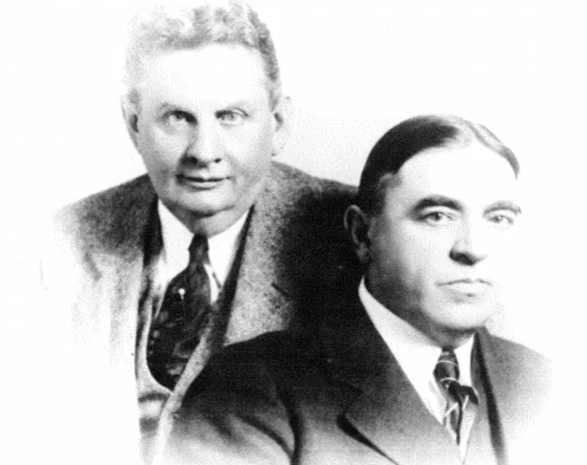
These two handsome men have become much more significant in my recording studies in the last few months, as their employment at Zon-O-Phone remains a fascinating story. In the last few weeks I have spent a lot of time listening to many Zon-O-phone records to attempt to really get to the bottom of this mystery of these two pianists.
As far as we know, Hager and Ring were almost certainly accompanists for Zon-O-Phone. I am certain Ring was a Zon-O-Phone accompanist, thanks to that picture description that literally states thus when identifying Ring:

Accompanist of [Hager's] band, a clever writer and arranger

This bit was written in the long description to accompany(pun intended) that large panoramic photo of Hager's entire orchestra. 
I still think Hager's looking over at Ring. 
So attempting to distinguish these two sweethearts has become very difficult(I'm pretty sure I've already said that same line in previous posts), as the more music I hear by them, the more similar they sound. It makes sense why they were featured somewhat interchangeably on many sheets of music, as it's so difficult to find distinct differences in their written pieces. Despite that, I can assure you now that their touches to the piano were very different, though they had similar tendencies. This last week I listened to many Zon-O-Phone records back to back with pieces they composed, to directly compare the accompaniments to which of the two I think it might be. This proved to be a great way to finally gain some ground in this perplexing matter. It also helps that recently I have taken to learning Ring's early rags(the ones he wrote while at Zon-O-phone), which has also jump started this investigation. 
I was going though a lot of the Zon-O-Phone's I have access to this last week, and two particular pieces I kept going back to were proving themselves well. 
the two pieces I used for solid reference in this comparison were Ring's "Sweet Potatoes", and Hager's "Handsome Harry". 
These two pieces provide a good groundwork for what their piano accompaniments would sound like. So after a lot of studying of Ring's pieces, "Sweet Potatoes" and "Jovial Joe" particularly, I realized something significant. Ring's pieces follow a folk rag format. They have a lot of the same chord progressions and chord inversions of folk rags from Kansas or New Orleans, and that's quite strange. There's no reason that Ring should have those characteristics in his playing, as he was just a regular old New York city boy who just happened to grow up with a musician father. He must have heard a lot of music growing up, and not just the kind of music heard in polite white society. In fact, I would wager that, based on his rags and accompaniments, he heard a lot more of the rough and ragged music that was in its early years when he was growing up. So with this all in mind, which pianist is Ring?
Well, of the about 30 Zon-O-Phone records I studied, I can now definitively say that Ring was the pianist with the very pushy and bluesy feel on many later Zono records. A good example is this Zono here:
(transferred a bit too fast unfortunately, but you get the point)
And yes, if you listened close enough to the last chorus, the accompanist plays a very quick 32nd note chromatic thing, and that characteristic I have now come to associate with Ring, and not Hager. Another record with that same accompanist is this Collins and Harlan Zono from around the same time: 
Wow. The more I listen to that accompanist(who is probably Ring), the more I am astounded by the bluesy and folksy characteristics. Very quick and seemingly erratic, almost more forceful than Hylands' accompaniments could get with Len Spencer. So if that's Ring, which is Hager?
Well, a few posts ago I went on a whole spiel about how Hager's playing would, according to his associations, most closely resemble Victor Herbert's playing. In that post I used Herbert's 1901 rag "Panamericana" and compared it to a few Zono records with that very similar attack that is somewhat notated in the piece itself. Perhaps one of the best examples I've heard, even compared to all the outside sources I have access to, is this 1903 Zono with Arthur Collins:
This particular record has been used often and spoken of for decades by rag-time and record scholars(I believe it was featured in a few LPs a few decades ago), and when you listen, it surely lives up to its reputation. The breakdown the pianist plays in the final chorus is outstanding, so much is going on, yet the steady and rocking rhythm remains the same. The very light and airy attack on those rollicking octaves is definitely reminiscent of Victor Herbert's piano pieces, "Panamericana" included. The rhythm is particularly astounding to me, as it remains almost the same throughout the record(much like Issler's accompaniments), even with all the difficult risks being taken with the improvisations. This accompaniment is on quite a majority of etched label Zon-O-phone's, which leads me to think that with these Zono's it's important to really listen to the accompaniment, as it could be either Ring or Hager. This isn't like 1898-1900 Columbia's where the pianist is almost always Hylands. Even when thinking that Hager is on most of the etched Zono's, I have heard a few of those that have that Ring style accompaniment on them(see what I mean with them seeming to be interchangeable?).
I made sure to go back and forth between Hager and Ring accompaniments, to see if I could get them both straight at the same time, so as to create less confusion with the styles. The light and airy accompaniments I associate now with Hager, as according to the notation of a few Victor Herbert piano pieces, as I would assume the pianist here to be Hager:
That record sounds to be an etched Zono from early 1902 or late 1901, with that distinct very clear and sharp but somewhat distant piano sound. The more precise and light touch is Hager's, and the aggressive bluesy touch is Ring's. 

But even with knowing all of this an sorting it out pretty well, I still have questions regarding their early written music. Their pieces are so damn similar, with even a lot of the same end tags and similar rhythms. I know they spent so much time together in the studio, but in reality they simply couldn't sound so similar. Take Hager's "Handsome Harry"(or Handsome Hager as I call it). You an hear it in the raw here: 
(There's that comical silhouette!)
That end tag at 2:18, it's a familiar rag-time tag, but it's also something that runs rampant in Hager-Ring pieces. Ring's piece "The Virginia Two-step" uses exactly the same tag, you can hear a crisp piano roll of it here:
That same tag, there it is. 
That same end tag is also in Ring's "Sweet Potatoes". But don't be fooled, I have heard a few really nice Zon-O-Phone records with that same tag in the solos where the pianist has those Hager characteristics, not the Ring ones. So this is starting to get confusing isn't it? I have gotten to the point where I think that Hager himself wasn't too great at writing his own music, so Ring took hold of it and arranged it in his very slightly varied way. The reason this may be true is because on the inside of the cover of Hager's "laughing water", there's this curious little thing:
(from my collection)
Ring even notated a lot of the expression that is characteristic to Hager's accompaniments on those earlier Zon-O-Phone's. So this is where it gets most puzzling to me, how interchangeable were they? And why was Ring arranging Hager's pieces? Why would he need to do this when they already sounded so similar?

Who knows.

I've been trying to find answers to these questions, but the answers are not clear in any way. Certainly Ring was the more eccentric and erratic accompanist, and Hager the light and airy but precise accompanist, but I am still trying to understand why these two were so close and why their music was so damn similar. I'm sure hearing more of Ring and Hager's music would help to get somewhere with these questions. I'll keep listening to Zon-O-Phone's. 


Anyhow!


I'll be taking a trip to UCSB during the first week of February, so I will definitely be writing a long post about that trip. Let's see if a few new things get transferred!


Hope you enjoyed this! 


Friday, January 6, 2017

Harding's publishing and Making good for Screw-overs

This evening, I stumbled across a fantastic article on Roger Harding, from the only collector who was an expert on him. Even Jim Walsh didn't know much about Harding, no matter how far he dug into the people who knew him. Unfortunately, this collector who wrote about Harding is now deceased as one of my friends told me a while back. This is also the case with a collector who possessed the best collection of Len Spencer recordings and odds and ends there ever was, and now the collection is split up unfortunately, with much of it ending up at the LOC. 
Harding is among my favourites of these early recording stars, other than Len Spencer, Fred Hylands, Vess Ossman, etc. So it wasn't all that surprising to see that I was mesmerized by this article, and completely hooked immediately upon seeing the article. The article was very well-written, and was full of not often read information on Harding. If you would like to read it yourself, here's the article in the link below:
Enjoy! 

The good thing that was detailed in the article in the link above is Harding's publishing endeavors, which began with his relation with Hylands and Steve Porter. Of course, we know very well that the whole "Knickerbocker" went though Hylands' ear and straight out the other. We know how that went. This must have made Roger a little disillusioned, and disappointed in Fred, with the trust he'd thrown him for this to actually happen, then it didn't. But of course, that didn't end anything with them, because the one rule that Columbia's studio seemed to have just as a mutual thing was that no grudges could be held between any staff members.
 Why? 
Well think about it, Hylands had "screwed over" many of the Columbia staff, even his bestest of friends like Harry Yeager and Len Spencer, which left them all frustrated with one another, however, they couldn't be for very long, because they all still had to make records, with no regards to the "baggage" that they had. This was so even later in time, such as when Collins and Harlan were first working together, because they disagreed rather often, probably more than most people have documented in fact. this happened all the time, Columbia talent disagreed, in fact, during the Johnson Murder trial, this was probably amplified by everyone's differing beliefs and opinions, despite them all siding with the defense(of course they did, because they had to). The point to this moral "rule" is that they all had to come back to work the next day and make records, no arguments or divas allowed. 

Luckily for Harding, he was a logical and optimistic man, wise to all of this, and never cause any fights amongst his fellow employees. He didn't hold a grudge against Hylands, because of the need for more recordings, but also because Hylands made good with him by writing some music for and with him. 
It's this kissing up to him that we get pieces like this one:

Ah yes, more of that infamous Hylands Spencer and Yeager music. 
Before I get into the strangeness of Mrs. Cal Stewart being on the cover, I must continue on Harding. 
Harding's relationship with Hylands didn't end with the Knickerbocker failure, despite what the article stated, as the pieces of music Hylands published with Harding continued:
Without a doubt Harding was still on the periphery of the publishing endeavor, because Hylands kept pulling his leg to publish more music of his:
Hey! It's Gaskin!
But of course, like anything like this, it really shocked me to see Harding AND Porter's names on music for composer credit, and the fact that the authorship looks reversed from our typical knowledge of Porter and Harding. Hylands really wanted to keep their trio together, even if the whole Knickerbocker thing blew to bits. Hmm, wonder why that is? The piece of music just above really says for it, because that's a later publication of Hylands', perhaps later 1899 rather than earlier(my piece in full colour above is a few months older, because of the two other publishing outpost location addresses not being present.) As Much as Spencer probably disliked Hylands for the amount of thing he pulled, there was not a way that they could split, Spencer dedicated himself to the firm, and he had created that gorgeous footer, so whenever he was questioning his commitment to Fred, it was just violently shushed by Fred the millisecond he began in on it.


 So... after Harding learned some of the publishing game(from not a very good role model), he began publishing himself since no one would bother to help him otherwise, setting up on the same block as where he worked(Columbia), and simply called it Roger Harding Publishing Company. One example was thus:
Now that's a familiar face! There were scores more on Harding's music, from Gaskin to George Schweinfest. Hylands probably saw this as a threat to his then-fading firm, since it was set up a block away from him, and for the same purpose, by one of his own co-workers. Harding was confident for a short period about this firm, though just like Fred's around the same time, it sunk quicker than the stock could handle all in one. Since Harding didn't see the end of the next year, his music was never sold to larger firms, which makes it even rarer than Hylands Spencer and Yeager music. It's actually a little surprising that Hylands didn't slip out Harding's stock after the firm went under and when be died, because that seems like something he would do, especially since his own firm was in a slow, painful decline. He didn't and the staff mourned Harding's death, much like when Frank Banta died, though this didn't seem as big a deal as Banta's death two years later. 


Now to return back to the "Kitty Clover" music farther above in this post. Now the many recognizable faces on Hylands' music can seem a pleasant surprise to unknowing collectors, and every time I see a new copy of one of those pieces, it gets me all excited. You never know if a famous recording star will be on a Hylands piece, which is why it's great to sift through them. That specific edition of "Kitty Clover" is a strange one, and gets me a little suspicious. One thing to keep in mind with Hylands is that everything he did came with benefits. By this, it is meant that anything he did came with some perk given to the other person or people involved. Take his praising advertisement from The Phonoscope, where he literally invites people over, in exchange for accommodating hospitality. It is because of this that we don't see any scathing reviews of his Broadway shows later, though they existed, regardless of what all of the sources we see state about him. Hylands probably offered each of those performers on his music something, whether it be percentage of the profits, or something else... ... ... 
It can be assumed by some wild theory that Hylands and Harding found Cal Stewart's wife gorgeous(well it didn't help that they were surrounded by other strange looking men all the time at work...). That's not impossible, because she does seem to be rather pretty, and it almost seems out of nowhere for her to be the dedicatee on the music of two men who knew her from the same source. 

I can see Fred's face light up when she came in with Cal one day at Columbia, same with Roger, except that Roger was probably a little less struck than Fred, since he was older, and a little more reserved it would seem. It seems like something that could be attached to Fred's character, or Roger's. 
Hmm, wonder if Cal had any notion? Hope so. 
It seems odd to tie anything like this to Cal Stewart, thinking of him as "Uncle Josh". But really, if you think it over, it's not too unusual, this is Columbia we're speaking of here, none of this would happen at Edison. 

Other than making all the ladies stars on his music, Fred also made up for wrongdoings by publishing artists' music and dedicating music he wrote to them. This went for Len Spencer, Vess Ossman, Harry Yeager, and Dan Quinn. All of those specific names in association to Fred seem a little suspicious. They all seem like artists that got in a tangle with him before he made up for it by publishing music. The only reason I think this is because he ended a few letters with 
I beg to remain yours respectfully,
FRED HYLANDS.

Also that he was thrown out of the White Rats union because he was tangling with other agents and going off doing what he wanted. All of these factors set up a figure who screwed over many fellows. Since this was such an issue with him, without a doubt this was so when he worked for Columbia. Hylands certainly had his reasons for dropping so many names on his music, probably each performer had a story as to why he did this. Even Ada Jones probably had a yarn with him, because she wasn't on just one of his covers. In this case his tale with Ossman would be an interesting one! Who knows what Ossman thought of dealing with Hylands, two musicians full of themselves is never a good thing, and that's exactly what that duo was. This new article was fascinating to read, especially coming at the Hylands Spencer and Yeager endeavor from Harding's point of view, which is very different from anyone else involved. Knowing what Victor Emerson thought of this whole employees as publishers thing would be the most interesting however, because he had nothing to do with it, yet in a way he was managing it, whether he wanted to or not. 


Before I end, I would like to satisfy some of my Hager "kick" recently, with a new record I found a few days ago. This is an early pre-paper label Zon-O-Phone from 1901 by John Terrell. 
Here's his 1901 Zon-O-Phone of "Tain't A'goin to Weep No More":
Not a big fan of Terrell, but Hager always makes up for it! The Rag-Time is not phenomenal as far as records go with his accompaniment, but it's interesting and Ragged nonetheless. The solo at the end is short, but has a very interesting melodic idea as far as Rag-Time goes. Hager was always an interesting pianist, even if his Ragged time was a little out of whack sometimes; this was certainly not true when he conducted his orchestra. I would go out on a limb and say that Hager's orchestra(and the Zon-O-phone orchestra) were the best house orchestra of the 1900's, they had the best musicians, best arrangements, and the slickest execution of all the house orchestras. And their arrangements weren't easy, they were the most complicated as well. They were arguably just as good as Sousa's and Arthur Pryor's bands. 

We've got to find more about Hager. 

I looked around in my many books on early recording to-day and didn't find too much on Hager, other than his obvious Zon-O-Phone leadership, and his publishing firm with J. Fred Helf in 1907-ish, and that he worked as a bandleader into the 1920's, but that's not really much for a man who died in 1953. There's literally an abyss of information missing on Hager, not just a gap. There's nothing out there on his piano playing, which is the most unfortunate thing, because he would have to be that unknown pianist on Zon-O-phone playing the most oblong, yet interesting Rag-Time style of all the regular studio pianists. 


Hope you enjoyed this! 
Batten down the hatches  for the storm out here in California! 

Saturday, November 12, 2016

An important Birthday and new discoveries

Some of you may already know what important birthday is to-day, and if you don't, it's this great performer:
Bert Williams. 
love that look on his face

Most of us know of him, with his signature song "Nobody", and other song hits, including a few Broadway shows with full Black casts, many years before Sissle and Blake's Shuffle Along of 1922. Williams and his stage partner George Walker were really the ones who helped begin the "rag" fad in 1896, by performing Ernest Hogan's "La Pas Ma La", and in 1896 show A Trip to Coontown only to later become among the best of the "coon song" writers, in many ways, more prestigious than many of the white composers. Their status in the early "rag" fad was higher than May Irwin's, but not as high as Ben Harney, because everyone was convinced that he invented and begun the fad, but let's not go there... ...
Williams' signature singing style was not much singing at all really, it was more of rhythmic talk, and sketches being accompanied by orchestras. Even if this was a common style in the era, he was really the one who has long been known for it, though it's hard to know if he was the first one to do this. Many of us record collectors will fight to the death over Williams and Walker's early Victors, since they are rare and astronomically valued to all record collectors, regardless of specific likes. They are priceless examples of true black vaudeville, and it's believed that Williams played piano on all of those Victors they made. Just to get across the reasoning, here's my favourite of their early Victors:
http://adp.library.ucsb.edu/index.php/matrix/detail/2000000445/Pre-matrix_B-987-I_dont_like_that_face_you_wear
This one is announced by Williams, which is unusual, because usually their Victors were announced by Victor's regular announcer(whose name has still not been uncovered).
This song is also hilarious, and it helps that it was written by Ernest Hogan. This tune was also in many of the early Rag medleys, such as Ben Jerome's "A Bunch of Rags"(which has nothing to do with Vess Ossman's medley of the same title from the same year). Williams' piano playing wasn't the best, but it's great to know that he's on piano, so that saves any pianist debate that would come along with that. Something to note, George Walker sounds like Ben Harney, which is a little backward and strange, but if you really listen closely, it can be noticed. 
Every one of their Victors is amazing, and really interesting to listen to, since they are really a balancing and musical mess, so each one is very different, but again, there aren't very many of them. 
My favourite of Williams' recordings are among that large batch he made in 1919, his "Everybody Wants the Key to My Cellar". It really has everything that was great about Williams, even though the records where he played piano really had a certain charm that his orchestra accompanied Columbia's don't have. It must have been a big deal in the recording business when Eldridge Johnson recorded Williams and Walker, since no on had bothered to go at it before for some reason, and after that, all we get are dozens of versions by the white recording stars of the songs they recorded, such as "Good Morning, Carrie", and "All agoin Out and nothin Comin In", which seems like a response to Johnson recording them in 1901. The recordings of those songs in particular came after they recorded them. When In Dahomey took over Broadway in 1903, all of the songs from that revolutionary show were recorded by all the white recording stars, such as Dan Quinn and Arthur Collins.
Here are two scenes from In Dahomey:
(the cake-walk of course)
Both of these were featured in The Theatre magazine in 1903. 
You can see that this was a fantastic show. Wish I could have seen it! 

As one of Williams' songs went, Let it alone! and don't try to mess with these great old records and songs! 


Now for the second part of this post. Amid these past few days, and this excruciatingly hard week, I had some time to dig through some of those magazines about early recordings in the 1970's and 80's and booklets by Tim Brooks and Tim Gracyk. While digging through these, I stumbled across many images of these performers I had never seen before, some that were earlier than others found. The one of all these images I found that will be the most useful in the posts ahead will certainly be this one:
Who's that?
Why, it's Fred Gaisberg in c.1897! 
Yay, a great picture of him finally
That's a really good picture of him, in fact, it's the best one I have ever seen compared to the other ones that people use when speaking of him. In addition to this one, I found a picture of him from c.1920:
Still has that great smile of his. 
One thing that I have noticed about the pictures of Gaisberg out there is that there are quite a lot of them with him smiling, much like the one just above. There's a channel that we get on our TV out here called the Arts channel, and they show clips of musical performances, parts of documentaries, and excerpts of classic films, and they have a short documentary about Caruso's first recordings. Oddly enough, guess whose face was pictured----
Gaisberg! 
They had a fantastic picture of him with a big smile showing lots of teeth, which as could be gathered, is a little more comical than the one just above. Wish I could dig that picture they used of him up, but I don't know who has it, because I would use it all the time when I mention him, since there aren't too many pictures of these performers so funny and strange as that one. It was so different in fact, that I wasn't sure if that was Gaisberg! It looked too comical to be him, but it was indeed him. 

Another image I found is this one here:
Hey, it's Collins and Harlan! 
This struck me as a very unusual and early image of them, and together to make matters better. Since this looks like c.1902-1903, it is likely the oldest image of Collins I have ever seen, since that one that everyone uses:
is specifically dated at 1904. 
That new image of them is certainly earlier than the Collins picture just above, since Collins is younger, and maybe just a few years younger, which makes the date work logically. It's just interesting to look at the early one compared to their later pictures together, like this one from c.1919:
Ha! Collins pretty much has exactly the same look on his face. 
Never realised how beady Collins' eyes were, weird. 
Just because we're on the subject of Collins and Harlan, here's a fun cartoon I did of them with Hylands from around the time that new-old picture of them would be from:
This is making fun of Hylands' social bias toward liking Harlan more, because of the whole publishing firm thing. 

The other images I found will be used in up coming posts, these ones are just the highlights of those that I found, and were the more unusual of the bunch. 
Here's my favourite Collins and Harlan with Hylands record to end the post:

http://cylinders.library.ucsb.edu/search.php?queryType=@attr+1=1020&num=1&start=1&query=cylinder6868

SMASH! Indeed Hylands. 


Hope you enjoyed this! 

Wednesday, August 10, 2016

Underhanded Music Dealing in the 1890's

The name Fred Hylands is mentioned very often on this blog, as he was not only a prominent studio pianist at the prime of the early Rag-Time era, but was also an important part of the comedic side of early Broadway. His name and influence fits into many subjects that go into this line of study. One of these subjects is the title of this post. The under-the-table dealing of music in the 1890's is a very understudied topic, as it simply wasn't written about often. One of these strategies that we have all heard of is handing a singer or performer an advance copy before the music is published, and surprisingly, this happened more than most people think. There weren't specific publishing firms that were begun by recording stars to unite the two parts of the music business, early on in the 1890's that is. 

One famous composer-phonograph singer friendship was
Monroe Rosenfeld and
Len Spencer.
Most people don't know about this friendship, since it was well-hidden, but advertised occasionally in earlier editions of The Phonoscope. We know of many composers that Spencer endorsed early on, but one of the first would logically be Rosenfeld and also Barney Fagan. Rosenfeld came first, since his early "negro dances" were so popular, he also wrote lyrics to these pre-ragtime pieces, many of which Spencer became well-known for recording. Many of Rosenfeld's pieces from the 1880's were minstrel songs with slightly syncopated melodies, and with that, Spencer was bound to make hundreds of rounds of any of them. When speaking of this, I mean early on in Spencer's recording days, in the era where he worked regularly with Issler's Orchestra, 1892 to 1896 that is. The solos he made during this time were done under pseudonyms for the most part, but he was still known as the prime coon song singer on phonograph records. With this fame, the composers and publishers took an interest in Spencer, and kept their ears open for a time to hand him an advance copy of a new song. This probably happened with Spencer a few times in the mid-1890's, though it's not well-documented, according to others in the business, it did happen with Dan Quinn and J. W. Myers. Quinn stated in some of his letters to Jim Walsh that publishers handed him songs before they were published to singer before all the others got to it,he claimed to be the first one to sing 

This great early Rag song with a very racist cover(typical for 1896...)
I'm not sure whether to believe that Quinn was handed an advance copy of this in 1896, but it's not impossible. I would believe it more if he said that Spencer was the one who got it first. I have seen so many advertisements that mention Spencer's record of "The Bully" as being one of his best records, and the most popular as far as his individual records go.  This had to be so, since it was reported that Spencer was making rounds of this tune into early 1898. I don't know who was handed the advance copy first, even if Quinn stated that he was the one who got it first, not everything he said is to be trusted, remember. Other than Quinn's "Bully Song" statement, there wasn't much early music dealing in the era before 1897, though there was probably more than what we are presented in this matter. 

It took until the "rag" fad to spread in 1896 for music publishers and composers to take more of a direct interest in recording stars. New publishers such as Joseph Stern took in some of the most popular studio stars under Russell Hunting's obliging with the Universal Phonograph Company. Many of their advertisements are in editions of The Phonoscope, here is their earliest one:
This came from the January 1897 issue of The Phonoscope
Their ads were often in pieces of music published by Jos. Stern in 1897, of which I have one of these buried in my sheet music collection. They were usually small triangle-shaped things that said simply that the song this is on can be found on records made by the Universal Phonograph Company. That's perfect in illustrating this point of publisher and recording artist, so early on in the era as well. 1897 would be toward the beginning of this idea of uniting the two aspects of the music business, as most people think of this happening in the 1910's and 1920's, but in reality, it began in the late-1890's. The Universal Phonograph Company didn't last to see the end of 1897, but it proved that a publisher could join with a record company to sell music and make records. This quick venture for the Columbia staff got everyone thinking about beginning something else like that, but they needed a better publisher for the job.
Composers still remained friends of many studio stars, such as Barney Fagan and Len Spencer or Quinn and May Irwin. It took until Columbia threw out their old pianist in mid-1897 for this idea to resurface. Fred Hylands was not yet a publisher as we know, but the ideas were formulating. There weren't any reports of music being dealt under-the-table in 1897 and 1898 at Columbia and Edison, but by early late-1898 and early 1899, the staff had begged Hylands enough to begin a publishing firm, and so he did. He was exactly the kind of publisher that Columbia's staff wanted and needed, since he worked there, it all seemed to work perfectly. 

No one saw their finish of course. 

But that doesn't matter just yet, it was the perfect everything for Columbia. If you really want to talk about some severe under-the-table music dealing, Hylands Spencer and Yeager is the firm to study. 
Pretty much everything that Hylands published was given to someone as an advance copy before he published it. This was especially so with anything he wrote(durr...). The instrumental music was given out after publication, but not the vocal pieces. Hylands handed his "You Don't Stop the World from Goin Round" to Len Spencer before he published it, so they could record it first, then sell the music, and he also did this with his "Prize Cake-Walker is Old Uncle Sam", and he gave that one to Dan Quinn of all people(that's kind of strange if you think about it). The ladies that Fred took a liking to eventually were ones who got music before it was published, such as Ada Jones, Sallie Stembler, and some of his wife's friends in the performing business. As the firm began to fade by early 1900, Hylands stopped handing out advance copies, as someone might have told him to end his habit of doing that, or something else, I really don't know, but it seemed that he stopped doing that after the end of 1899. It was around this time that everyone involved saw their finish, or Fred's in this case since he was the one who was going to take the harshest blow after it fell through. After the firm's end in November 1900, the idea of publisher and recording star lost its novelty, and all the old Columbia stars didn't bother to associate themselves with specific publishers or composers any more after that. 
The second wave of studio stars adopted some of these ways, as many collectors are aware of the Collins and Harlan friendship with Theodore Morse, which lasted over a decade. Harlan had been part of Hylands' publishing firm, but after about five more years, Harlan was working not only with Collins, but found Theodore Morse a better asset than Hylands, which is many ways was a smart move on Collins and Harlan's part. This 1890's tradition carried on into the 1910's, 20's and even the 1930's in fact, and it seemed to become a much less hidden subject as the decades went on, making it not as sleazy and interesting as it was early on. 


*I just want to take a moment to send my love and regards to Tom Brier and his family, as he was recently in an awful car accident and will take many months to recover. We will miss you at Sutter Creek this weekend! Some of the soul of the festival is lost without Brier there.*


Hope you enjoyed this! 


Saturday, July 30, 2016

Odds and Ends in piano accompaniment--Leeds and Busy Bee

These strange record labels are not often considered musically and material-wise to many collectors I know, only because they were infamous for their not very good record quality, as when they're in bad condition, they sound unbearable to listen to. Their sound quality was actually pretty good for the time period, many of them being in bad shape is what has earned them the bad reputation. They are the strangest and most interesting of all the early disc labels to listen to, as their mysterious management let the strangest things pass. Of all the record companies of the early era, Leeds had the easiest rules when it came to anything recorded in their studio, as many selections done by these popular studio stars were only found on Leeds records. They basically took masters and titles from other labels that the big companies didn't find useful. 

There are so many things we will never know about Leeds records, as nothing of their ledgers are left, and their record labels are not really the most informative all the time. Leeds records must have had some connections with Columbia, and it must have been rooted in the late-1890's in fact, since that's when they began making cylinder records. Those Leeds workers must have used late-1890's Columbia technology, and improved upon it, as their gold foil records sounded fantastic. The future Leeds studio workers probably originated at late-1890's Columbia, who later went out to Talk-O-Phone in Ohio, which was where the headquarters for the company that Leeds was owned by. With the roots in the "Clan era" at Columbia, they had their eyes(and ears), on the good musicians and studio stars there. While Leeds sold cylinders in 1900 to 1903, they watched from their high perch all of the strange and brutal legal doings and show-biz drama at Columbia, Climax, Victor and Lambert, they were figuring out who and what they'd be able to reap from the remains of these bouts. By early 1903, their era of making cylinders had come to an abrupt end, but they were making discs at this time, in fact, making those famous gold foil label records. These records were the most "anything goes" types of recordings ever made at that time, even more so than late-1890's Columbia records. 

The management at Leeds must have seized the moment when Hylands was all fired up about his union bust in 1902, Hylands was infrequently at Columbia after that, so the Leeds people must have made a contract with some Columbia staff members. Since there were loopholes in many of the rules and contracting guidelines, Leeds was alright to make records for the time being, and snatch Columbia's discontented pianist at a moment of dying embers in the man's flames of hate. 
Around the end of 1903, the Busy Bee label did the same, for the same reason that Leeds did. With these strange new labels attaining Hylands finally, after observing him from a long distance, they turned him loose in their studios. They probably told him something like this at Leeds and Busy Bee:

"We've seen that you're such a great studio worker and pianist, so we'll just allow you to take over the orchestra."

They didn't realise how much of a bad idea that was. It is not really noticeable to most people who listen to these Leeds or Busy Bee records, but if you're paying attention somewhat to the music, most of those Leeds records with piano accompaniment or piano in the orchestra, they sound broken. This must have been a similar story to those Zon-O-Phone records I spoke of in earlier posts, where the studio workers enjoyed Hylands in their studio while he remained there. Of course, they probably didn't take it to mind at first that Hylands was a problematic alcoholic sometimes, but they soon learnt of their mistake.
 Getting into this reminds me of a recording that my friend Craig once played for me. This was a Busy Bee record from 1905, by the Invincible Quartette, and it was them performing the popular coon song "Shame On You". The singing wasn't very good to start, but to make matters worse, the piano playing wasn't good either. The piano was not in time with the singing as I recall now, and much of the sketch part of the record was very strange and didn't sound right. I wish I could share a transfer of the record here, but it's been several years since I heard it. I only mention it because it's a good example of a very bad take issued by Busy Bee, with Hylands not playing very well on the piano behind them. There were many more records they issued that had a similar story. 
Another thing to point out about Busy Bee records is that their house orchestra was not very good, and they have a similar tale to the Leeds orchestra, which includes the same pianist. I don't know what Busy Bee and Leeds did with balancing, but one thing is for sure, they almost always had that piano very loud and oftentimes consuming the other instruments in the orchestra. I heard one recently from 1905 by Collins and Harlan where the orchestra doesn't really sound very good, but the rhythm and sense of time is very good, and makes up for the out-of-tune cornet and violin. The piano was once again consuming, as it usually was on Busy Bee records. Since Busy Bee records were essentially Leeds masters most of the time, it is very likely that Hylands more often than not on that very loud and overpowering piano. 

Here is an example: "The Whirlwind Polka" by Bohumir Kryl on Busy Bee A-88
This record exhibits everything I was talking about. Since it was recorded in 1905, it helps that it's still within the range of Hylands still doing studio work somewhat. The issue with many of these later Leeds masters is that they are recorded in 1905 and in the years after that, so that doesn't mean that any one of these well-known studio pianists were on piano. When I say that I mean records like Ossman's 1907 Leeds take of "Dill Pickles". It's far too late to be any of the early studio pianists, though it sounds like one of them in many ways. Maybe we're underestimating Leeds in this sense, in the sense that maybe they had some sort of "deal" with Hylands that lasted longer than when he was dropped from Columbia. It's not impossible, but it's strange. 

The only records that Leeds made where it's certainly Hylands on piano are the early Gold foil records from 1903. All of those have all of the Hylands characteristics, and it made their house orchestra sound a little like the Columbia orchestra, which is a little weird.  I have't really heard too many of these Gold Foil Leeds records, but from what I've heard, the management there must have had a special deal or contract with Hylands. They probably told him they'd pay him a certain amount that he really liked, so he found their business just as good, if not better than Columbia's. It must have been better at the time it happened, since Columbia's orchestra was becoming a partnership that threw Hylands out of most discussion. By this, it is meant that Charles Prince was taking over, and was creating and orchestra with less piano, and entering in more musicians that weren't old favourites. At Leeds, it seemed that Hylands was the leader man, which was just what he needed when Prince was gradually creating the new Columbia orchestra. During his term at Leeds, Hylands was making their records interesting, and it's where we get records like these:
https://www.youtube.com/watch?v=-JKCK12kEQ4

https://www.youtube.com/watch?v=cbkP0rNj8IY

https://ia802300.us.archive.org/31/items/ArthurCollins_part2/ArthurCollins-TheGooGooManCoonSong.mp3

Yes I know all three of these records are by Collins, didn't really mean for that to happen. 
All three of these examples exhibit Hylands attributes, and what's more, they exhibit different ones! The first one listed even has the amazing added bonus of walking bass octaves in the interlude at the beginning and at the very end of the record! The second one has some of the strange rhythmic patterns that are kind of syncopated much like on many Columbia's. It's clear that Leeds had some kind of deal with Columbia when they were making those gold foil records. 

The final Leeds record I would like to showcase it one that is owned by one of my friends in collecting, and in fact, there's a good picture of the label as well!
It is a little hard to read, which is somewhat common with those Gold Foil Leeds records. 
The information given is not very complete, as all they give as the performer is"S Q and O." which to someone who doesn't really well know these records would be a sort of dead end at first sight. Without further ado, here is that record:

It is just the strangest thing, with the most unusual unknown origins. The Spencer quintette? Who the hell was in that? Other than Len Spencer obviously, all the other voices are very hard to pick out, but I have a feeling that somewhere in the cheers and singing, Fred Hylands can be heard(since he's on piano). I do think I hear both Spencer's here, which would logically make sense, but at the same time is very weird. Any one of Spencer's friends could be here, so the guesses are limitless with this record. I'm not entirely sure of the premise of this descriptive selection either, which is odd, because usually we can figure out what it is with descriptive selections of the Spencer's making. As said in the video description in the link, it is the Len Spencer party record, and that is so in all senses of the term. It confirms much of what I've hypothesized about Spencer and his friends, and it's not a Columbia record! I cannot start throwing around guesses as to who I think is on this record, and I'll leave that to you to comment and leave your guesses. 

Before I finish, the picture of that label just above came from an interesting and informative post here:
Enjoy! 


*It must be noted that the strangest thing about Leeds having Fred Hylands as their pianist, is that Columbia was one of the disc record companies who found Leeds to be an illegal and pestering issue while Columbia held those patents, so Leeds might have done something even more hidden and deceiving than just grabbing Hylands by the collar to record in their studio. Essentially, this was the only time that Hylands was working for an enemy of Columbia, and probably agreed to that just to piss off the Columbia management.*


Hope you enjoyed this!