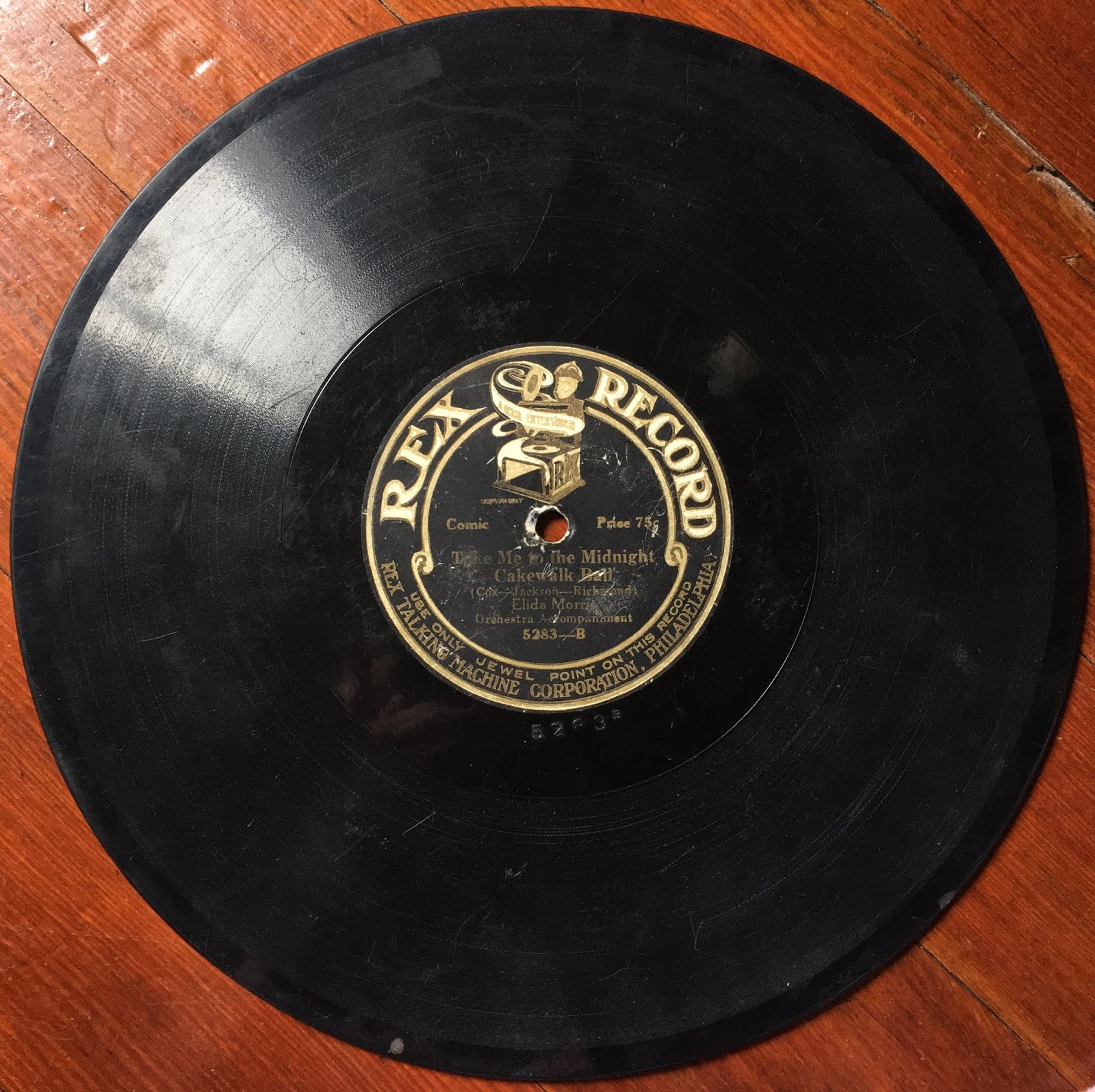
Well, what a week it's been!
Hot damn this has been quite a week for records on my end. Whew!
This last Thursday, I took a trip over to my favorite antique store, thinking there may be something there, as I hadn't gone in about a month. I usually like to go to this place once a month or more if there are interesting lots of things to pick through. Never could I have anticipated the sort of things I'd be picking up that day...
This place I go to is one that I have frequented rather often for the last 6 months or so, grabbing piles of records and other old things of interest. I have gotten a ridiculously good stash of records overall from this place, but of course the only records I was getting, or ever saw from this place were disc records. I was just grabbing all the records, asking no questions and remaining modest and quiet when digging and later buying them. Since I've been going so often to this place, the proprietors have become familiar with the the sort of old things I'm looking for.
After 6 months of stacking up the disc records from this place, with all colors and rarities of the phonographic rainbow, I finally asked the owner if there were any cylindrical records. The moment he told me there were some stashed up in the house(away from the customers poking around), he made me wait a little while. He had to go drop something off for one of the local customers, but with the promise he made, I was so anxious it was hard to maintain my antique store poker face. I waited about 20 minutes poking around mindlessly, as this was after I combed through all the usual spots here. When he came back, he went upstairs to grab a box of cylinders.
I still was able to keep my cool as I opened the box and saw a few curious French brown waxes that weren't Pathé's. I inspected those thoroughly, and was interested, but of course I had no idea of their value, but I planned to buy them anyway.
As I kept digging in this box, there were layers of records stacked on one another. There was a curious old looking case right under these French rarities, it looked to be from the 1890's. I was still keeping my poker face pretty constantly at this point, but it broke in a snap when I opened that old box.
When I saw what was inside I just about screamed, I threw my hands up and nearly tore the 110 year old sleeves on my coat.

That's what was inside.
All brown wax, and only one of them was so moldy it can barely be saved. Unfortunately, as I started digging through all the slips and inspecting each record, a percentage of them were broken. But! despite that, I became passionately determined to take them all. That includes every last shard and piece of brown wax I could find. All the old slips were scattered around in the box and I kept looking over those to get some sort of idea of what was in this box. There were some interesting titles there. All the titles were handwritten in pen, in an almost familiar Spencerian script. The most tantalizing slip I saw in the batch was this one here:

Yep, that's definitely a good sign.
A brown wax with that title could either have been and original Hunting or a later Jim White take. That writing looks familiar doesn't it?
When I finally got through the box, I took 7 of them home with me after paying the owner. I was too afraid to grab them all at once, as I had a long and somewhat bumpy ride back home.
I wasn't originally going to do anything the following day, but I became so bubbly over what sort of titles were in the first batch of 7. So the next day I got up early and got over to the place earlier than usual, to grab the rest of the old box of records and go. I spent no extra time this go around, the records needed to get home to be played and correctly identified. Don't get too worried, I only played the announcements and maybe a little more to get what they were and stored them back in their cozy 1890's box. Every one of these beauties was covered in dust, but under the dust, there's no mold or anything, just flawless recordings all from a very specific period of time.
So after I finally spent several hours trying to get all of these correctly paired with the matching old slips, I got more into the strange circumstances of this almost flawless box of brown wax.
So here are a few interesting things about this box:
-They are all Columbia's
-All from 1895-1899
-All the slips are written in pen
-there are two of each artist(almost)
-there's a lot of Len Spencer related selections
-no mold anywhere
-all the same shade of brown wax
-there's quite a variety of selections, from sacred to hot rag-time
-all the titles on the slips are abbreviated like Columbia studio slips I've seen
This box was carefully put together. Someone had quite varied tastes in records. These records were originally sold by Allen Koenigsberg, probably over a decade ago to this collector in Berkeley. The collector's name was on lots items I had previously picked up from this place, so without a doubt these brown wax beauties belonged to him at some point.
Funny accompanying story, when I bought that batch of Berliners and Zon-O-Phone's from this place, I noticed that most of them were kept in distinct yellow sleeves from Kurt Nauck. With that, I contacted Mr. Nauck about these records, and he promptly told me to whom he sold the records. This collector in Berkeley died a few years ago, so it seems that all of these extremely valuable records were dropped off at this antique store I frequent.
Funny accompanying story, when I bought that batch of Berliners and Zon-O-Phone's from this place, I noticed that most of them were kept in distinct yellow sleeves from Kurt Nauck. With that, I contacted Mr. Nauck about these records, and he promptly told me to whom he sold the records. This collector in Berkeley died a few years ago, so it seems that all of these extremely valuable records were dropped off at this antique store I frequent.
So the fact that these brown waxes came from Koenigsberg would make sense, since they are so outstanding and prime examples of mid-1890's recordings.
So all of this is great without a doubt, but what was in the mystery box? I spent hours attempting to grab all the titles on these records, and match the slips with the proper record, as they seemed to have been scattered when I found them. At the current time I still have not gotten all the slips to match every single record, as I do not have a very good phonograph to present them in a decent fashion. I have only an 1898 Columbia Q that is definitely not a high quality machine, but I can play brown wax on it safely. So do not expect any transfers from me soon...
The first one I was anxious to play when I got home was of course the "Casey" sketch. That record was far more intriguing and valuable than I could have ever expected. Hunting's records alone are very rare, especially the brown waxes he made. But one thing is for sure, his pre-1897 cylinders are the most desirable of them. Well it turns out that this one in the mystery box was one of them. This cylinder was recorded probably in late-1895 or early 1896, before he got arrested with Charlie Carson for the smut cylinder scandal. It's got that same pristine sound quality as the few Original Hunting's that are online, such as this one:
https://ia802308.us.archive.org/4/items/RussellHunting/RussellHunting-CaseyattheTelephone.mp3
Now think about this, the record I got was recorded right there with Hunting. It was made under his own supervision, it was in the recording room with him, and he recorded directly onto that surface that I can now hold and handle.
This is exactly why brown wax is so intriguing in a way that no other recordings are. If the record is old enough, it was likely recorded directly on by the recording star who's on it. The record witnessed the musicians and performers in person, and depending on the performer may have been handled by that very performer. This adds a level of personal touch that later records from this time just don't have. This is exactly why this Hunting record in the mystery box is so valuable to me in particular.
There were several records by Len Spencer in this box. There were as follows:
"What Shall the Harvest Be" from 1896-97
"My Gal is a High Born Lady" with Ossman, 1897
"Crappy Dan" with Ossman, 1897
"-----Honey Boy" with Hylands 1898(I couldn't get the title of this one very well but it's likely something called "Lucinda Does you Love yer Honey Boy?")
Of course since these records are all Columbia's from around the same time, as to be expected, there are quite a few of them with Len Spencer announcements, which is perfectly fine for me!
There were two standout Edward M. Favor records in this box. Usually the Edward Favor records that collectors have are his Zon-O-Phone's from 1900-1903, and his Edison records from the late-1900's. But I assure you these two Favor's were the rarest and most desirable of all the kinds he made. Both of these Favor records are from 1896. They both had that distinct "...of New York City" announcement(as 80 per cent or so of these records have) and that beautiful clear piano accompaniment that was on those Columbia's he made in 1896. The two records sound exactly like this record here:
http://cylinders.library.ucsb.edu/search.php?queryType=@attr+1=1020&num=1&start=1&query=cylinder11859
Same pianist, same recording room, and overall beautiful quality.
The titles unfortunately I could not make out just yet, and they are hard to match with the remaining slips.
There was a Gaskin, Steve Porter, and a surprisingly clear Will F. Denny record.
The Gaskin is a really pretty love song titled "Answer", with that pristine mid-1890's Columbia recording quality. The Steve Porter is an unusual one titled "She Lives on the Same Street with Me". The Denny is a very distinctly early 1897 Columbia titled "Then and Now".
There were two Clarinet solos by William Tuson which really got me excited! I have a lot of love for those Issler soloists, as they were fantastic musicians that really stood out from the rest of the musicians in the orchestras.
The two Tuson's were "Southern Plantation Echoes" from 1897 and "Old Black Joe" from 1897-98. Both of these records are online, but the ones I got in the mystery box are definitely different takes. There are some distinct differences between my takes and the ones I've heard online, which is great! To give you an idea, here are the two Columbia takes of these online:
"Old Black Joe"
"Southern Plantation Echoes"
My take of "Southern plantation echoes" is the longest one of the takes I've heard. It hovers right around the three minute mark and there's another chorus of the Tapioca played at the end. The clarinet and piano also alternate playing the Tapioca toward the end which is a really nice added touch. This take also sounds really nice, even on my crappy cheap old Columbia.
There were a few Columbia orchestra records in the box too, such as an 1897 take of "Ecstasy Waltz"(with a cornet solo by Tom Clark!), and a curious recording of an unnamed "lanciers".
There was also a super nice early 1897 take of "Stars and Stripes forever" by Sousa's Band, which added a nice touch to all the obscurities in the box.
I know I'm missing a few to describe here, but I really want to get to the next part of this post. I will do another post once I know what everything is and when I know I can get decent electric transfers of them. I have already been given and offer to get them transferred!
All-right then!
Yesterday I had a serious aha! moment. Amid a moment of thoughtless listening(this is usually how is goes...), I realized something big.
Many collectors try to grab those Blue American records when they can, as they're very attractive records that stand out from all others in pre-1910 recordings. I have quite a stack of them myself, this hot one included:
 I am always amazed at their beauty.
(in case you're wondering, this curious record is basically like one of Spencer's brown waxes with Hylands but half a decade later!)
Last night I went back and listened to the handful of American records that are online, and was reminded of how hot and tight their house orchestra was. Their orchestra was called the regimental band of the republic, which is quite a generic name for a studio ensemble. No one really knows who they were, as this company was shrouded in secrecy, but for good reason. They were started by a few sketchy Edison employees in 1904, but somehow these sketchy Edison workers managed to create the best sounding records of the era. Their records boom in ways that others just didn't! And how their orchestra did just that, and more!
so as many have been long wondering, who was the regimental band of the republic? Well, you know what, I may have come to a possible answer.
That orchestra was just absolutely outstanding to all the other studio groups, with familiar sounding musicians. Who do they sound like the most?
Hager.
Of course! It made so much sense once I started thinking through ways that could prove this idea. Before I go forth with the explanation, here are a few of their records:
Perhaps the hottest ever, "a Southern Belle(Cake-walk)"
"Cocoanut Dance"(written 1891)
"Princess Pocahontas"(buck dance)
Hager's own "Handsome Harry"
"1863 medley"
So why would it make sense that Hager could have led this this orchestra? They recorded "Handsome Harry" to start, which is Hager's piece from 1904. Of all the record insiders Hager would make the most sense in terms of having his hand in this mysterious and dreaded record company. Hager was part of the Climax scramble in 1901-1902, as he was working for Columbia-Climax-Zonophone when the tensions were boiling hot, but he was taking his orchestra to the more reliable and better quality Climax and Zon-O-Phone instead of Columbia. He managed to escape the battles over patents and record talent unscathed, but he gained ever more knowledge of the recording ropes and where the best fortune would be. With this heightened knowledge, Hager would have seen the great opportunities that American possessed.
The sound of the orchestra on American nearly mirrors Hager's Zon-O-Phone orchestra from the same time period. This frame of 1904-1907 is also when Hager was working the most overall, so maybe this American notion went into his crowded work schedule.
Also, I may add that the "1863 Medley" listed above sounds like many of hager's arrangements that were written down and the ones that were played at Zon-O-Phone around the same time. By this I'm meaning a tune of his like this one:
https://www.youtube.com/watch?v=QrdarM0xKgs
Indeed so.
Now all of this is very tantalizing indeed, but it's just a possibility. No one really knows what was the deal with those American records, and another thing that particularly intrigues collectors of them is that orchestra announcer. That announcer was always so unenthusiastic and not theatrical about the announcements. It's a very familiar voice though, very recognizable to those who own some of these American records. That announcer very well could be someone in the band. But think about who would be right there with no instrument to keep his mouth shut...
Anyway, I think I'll end it here. I really want to do another blog post this week but I'll be traveling for a week, back this following Tuesday. When I return however, I will be giving a lecture on Hager! Let's hope that turns out all-right, there's quite a lot to cover with his long story...
So all of this is great without a doubt, but what was in the mystery box? I spent hours attempting to grab all the titles on these records, and match the slips with the proper record, as they seemed to have been scattered when I found them. At the current time I still have not gotten all the slips to match every single record, as I do not have a very good phonograph to present them in a decent fashion. I have only an 1898 Columbia Q that is definitely not a high quality machine, but I can play brown wax on it safely. So do not expect any transfers from me soon...
The first one I was anxious to play when I got home was of course the "Casey" sketch. That record was far more intriguing and valuable than I could have ever expected. Hunting's records alone are very rare, especially the brown waxes he made. But one thing is for sure, his pre-1897 cylinders are the most desirable of them. Well it turns out that this one in the mystery box was one of them. This cylinder was recorded probably in late-1895 or early 1896, before he got arrested with Charlie Carson for the smut cylinder scandal. It's got that same pristine sound quality as the few Original Hunting's that are online, such as this one:
https://ia802308.us.archive.org/4/items/RussellHunting/RussellHunting-CaseyattheTelephone.mp3
Now think about this, the record I got was recorded right there with Hunting. It was made under his own supervision, it was in the recording room with him, and he recorded directly onto that surface that I can now hold and handle.
This is exactly why brown wax is so intriguing in a way that no other recordings are. If the record is old enough, it was likely recorded directly on by the recording star who's on it. The record witnessed the musicians and performers in person, and depending on the performer may have been handled by that very performer. This adds a level of personal touch that later records from this time just don't have. This is exactly why this Hunting record in the mystery box is so valuable to me in particular.
There were several records by Len Spencer in this box. There were as follows:
"What Shall the Harvest Be" from 1896-97
"My Gal is a High Born Lady" with Ossman, 1897
"Crappy Dan" with Ossman, 1897
"-----Honey Boy" with Hylands 1898(I couldn't get the title of this one very well but it's likely something called "Lucinda Does you Love yer Honey Boy?")
Of course since these records are all Columbia's from around the same time, as to be expected, there are quite a few of them with Len Spencer announcements, which is perfectly fine for me!
There were two standout Edward M. Favor records in this box. Usually the Edward Favor records that collectors have are his Zon-O-Phone's from 1900-1903, and his Edison records from the late-1900's. But I assure you these two Favor's were the rarest and most desirable of all the kinds he made. Both of these Favor records are from 1896. They both had that distinct "...of New York City" announcement(as 80 per cent or so of these records have) and that beautiful clear piano accompaniment that was on those Columbia's he made in 1896. The two records sound exactly like this record here:
http://cylinders.library.ucsb.edu/search.php?queryType=@attr+1=1020&num=1&start=1&query=cylinder11859
Same pianist, same recording room, and overall beautiful quality.
The titles unfortunately I could not make out just yet, and they are hard to match with the remaining slips.
There was a Gaskin, Steve Porter, and a surprisingly clear Will F. Denny record.
The Gaskin is a really pretty love song titled "Answer", with that pristine mid-1890's Columbia recording quality. The Steve Porter is an unusual one titled "She Lives on the Same Street with Me". The Denny is a very distinctly early 1897 Columbia titled "Then and Now".
There were two Clarinet solos by William Tuson which really got me excited! I have a lot of love for those Issler soloists, as they were fantastic musicians that really stood out from the rest of the musicians in the orchestras.
The two Tuson's were "Southern Plantation Echoes" from 1897 and "Old Black Joe" from 1897-98. Both of these records are online, but the ones I got in the mystery box are definitely different takes. There are some distinct differences between my takes and the ones I've heard online, which is great! To give you an idea, here are the two Columbia takes of these online:
"Old Black Joe"
"Southern Plantation Echoes"
My take of "Southern plantation echoes" is the longest one of the takes I've heard. It hovers right around the three minute mark and there's another chorus of the Tapioca played at the end. The clarinet and piano also alternate playing the Tapioca toward the end which is a really nice added touch. This take also sounds really nice, even on my crappy cheap old Columbia.
There were a few Columbia orchestra records in the box too, such as an 1897 take of "Ecstasy Waltz"(with a cornet solo by Tom Clark!), and a curious recording of an unnamed "lanciers".
There was also a super nice early 1897 take of "Stars and Stripes forever" by Sousa's Band, which added a nice touch to all the obscurities in the box.
I know I'm missing a few to describe here, but I really want to get to the next part of this post. I will do another post once I know what everything is and when I know I can get decent electric transfers of them. I have already been given and offer to get them transferred!
All-right then!
Yesterday I had a serious aha! moment. Amid a moment of thoughtless listening(this is usually how is goes...), I realized something big.
Many collectors try to grab those Blue American records when they can, as they're very attractive records that stand out from all others in pre-1910 recordings. I have quite a stack of them myself, this hot one included:

(in case you're wondering, this curious record is basically like one of Spencer's brown waxes with Hylands but half a decade later!)
Last night I went back and listened to the handful of American records that are online, and was reminded of how hot and tight their house orchestra was. Their orchestra was called the regimental band of the republic, which is quite a generic name for a studio ensemble. No one really knows who they were, as this company was shrouded in secrecy, but for good reason. They were started by a few sketchy Edison employees in 1904, but somehow these sketchy Edison workers managed to create the best sounding records of the era. Their records boom in ways that others just didn't! And how their orchestra did just that, and more!
so as many have been long wondering, who was the regimental band of the republic? Well, you know what, I may have come to a possible answer.
That orchestra was just absolutely outstanding to all the other studio groups, with familiar sounding musicians. Who do they sound like the most?
Hager.
Of course! It made so much sense once I started thinking through ways that could prove this idea. Before I go forth with the explanation, here are a few of their records:
Perhaps the hottest ever, "a Southern Belle(Cake-walk)"
"Cocoanut Dance"(written 1891)
"Princess Pocahontas"(buck dance)
Hager's own "Handsome Harry"
"1863 medley"
So why would it make sense that Hager could have led this this orchestra? They recorded "Handsome Harry" to start, which is Hager's piece from 1904. Of all the record insiders Hager would make the most sense in terms of having his hand in this mysterious and dreaded record company. Hager was part of the Climax scramble in 1901-1902, as he was working for Columbia-Climax-Zonophone when the tensions were boiling hot, but he was taking his orchestra to the more reliable and better quality Climax and Zon-O-Phone instead of Columbia. He managed to escape the battles over patents and record talent unscathed, but he gained ever more knowledge of the recording ropes and where the best fortune would be. With this heightened knowledge, Hager would have seen the great opportunities that American possessed.
The sound of the orchestra on American nearly mirrors Hager's Zon-O-Phone orchestra from the same time period. This frame of 1904-1907 is also when Hager was working the most overall, so maybe this American notion went into his crowded work schedule.
Also, I may add that the "1863 Medley" listed above sounds like many of hager's arrangements that were written down and the ones that were played at Zon-O-Phone around the same time. By this I'm meaning a tune of his like this one:
https://www.youtube.com/watch?v=QrdarM0xKgs
Indeed so.
Now all of this is very tantalizing indeed, but it's just a possibility. No one really knows what was the deal with those American records, and another thing that particularly intrigues collectors of them is that orchestra announcer. That announcer was always so unenthusiastic and not theatrical about the announcements. It's a very familiar voice though, very recognizable to those who own some of these American records. That announcer very well could be someone in the band. But think about who would be right there with no instrument to keep his mouth shut...
Anyway, I think I'll end it here. I really want to do another blog post this week but I'll be traveling for a week, back this following Tuesday. When I return however, I will be giving a lecture on Hager! Let's hope that turns out all-right, there's quite a lot to cover with his long story...
Hope you enjoyed this!