Now that the holidays are essentially over, hopefully I can get back to making more blog posts, since it's still been hard to find more interesting information to talk about.
Recently while searching around for quartet records, I came across a very strange record that hadn't even a record number to be found. The performer listed in the announcement of the record was given by the familiar voice of this chap:

Steve Porter.
So the creation of this strange record seems to have been facilitated by Mr. Porter, though the leading voice in this so-called "Diamond Quartette" would most certainly be George Gaskin. This record is centered around a parody on the hit "I'd Leave my Happy Home for You", but on the record it is called "I'd Leave my Job to Vote for You"(haha).
Porter's announcement begins with this,
"republican campaign song..."
after the announcement the lovely and unmistakable Ragged playing of Hylands lumbers through.
Of course on this record, there's a mot more than just Hylands and that Quartette. It seems that in this quartette, there was Gaskin, Porter, Roger Harding, and George Hargraves. This witty parody is rallying for William McKinley's campaign in 1900, and throws William Jennings Bryan and the Democrats in the dust. Sorry, it's one of those records I can't share out of kind courtesy to the owner.
So, in past digging, I had heard of such campaign songs and rallying done by a certain group at Columbia. Those "clan" members at Columbia(let's say Harding, Porter, Spencer, Gaskin, Emerson brothers, Hylands at this point in time) were most certainly prominent politicos in their time. And with that, it can further be proven by the first Phonoscope section I found regarding their prominence in the Republican Party of New York.

I hate that these are so hard to read. What a politico Harding was! Harding did quite a lot of rallying. well there ya go, there's that exact group from that record I've described. It's amazing to see an actual written account regarding the group, and then later finding a rather "wild" record by the very same group. Of course when digging all of this up after listening to the record, this brought back the research I did on studio politics a little while ago. Also, while doing some random digging on something else last night, I stumbled across something else telling about a certain someone.
It's clear that I talk about Fred Hylands quite often, and finding new information on him has been very slim the past 6 months. One thing that's fascinating about Hylands however is that his political view and morals seemed to have changed somewhat after a certain point in time. This change was a gradual process, and it took a few years for him to transition. Luckily, that recording and Hylands' associations in the recording business can lead us to assume he was on the dominant Republican side of the Columbia staff(keep in mind not every one of the boys and few ladies was on the same political side). Despite Hylands' more popular relations, he(much like Scott Joplin believe it or not) around 1899-1900 began associating himself with some of the underground people's and political activists. By these terms, I mean Socialists. Those progressive outcasts that were dreaded by every factory and corporation, yes, Hylands began flirting with members of these groups.
I've made it clear that Hylands switched to the other side by 1904-1905 by becoming a leader with the White Rats, but it seems that a few years before that he was pondering the ideas that his progressive friends told to him. I had assumed some of his actor friends like J. Grant Gibson would have swayed him over, but actually, come to find out it was someone else familiar.

Well, this "ranting Bill" is Will J. Hardman.
(cartoon by me!)
Just last night, I went digging for some early roots of Rag-Time on the Johns Hopkins sheet music website, but stumbled upon something fascinating. So what has Will J. Hardman to do with Hylands' socialist streak? Well it seems I found an indirect answer.

(the date on this one is 1886)
There we go! It seems I found another source of influence for this transition.
Of course! It makes so much sense now. Hardman was a gifted wordsmith, and now it seems that my hypothesis of his friendship with Hylands was in fact true! I had assumed by how many songs Hylands wrote with Hardman in such a short period of time that they had a bond outside of their music. So at a certain point, Hardman must have explained his world view to Hylands, and since Hylands was already somewhat fed up with Columbia, these new ideas from progressive Hardman must have been eyeopening. Unfortunately, I know nothing on Hardman at all, but because of the age of the other pieces I've dug up, he was most certainly older than Hylands, probably a decade older as far as I can guess. That would put him at around 38 by the time he met Hylands. Without a doubt, in 1900, Hylands was keeping his rebellion and disenchantment well hidden, since he had to participate in many of those political gatherings that Harding organized. By the time of the publishing firm with Spencer collapsed, Hylands was essentially outcasted from the tight pact that the Columbia staff had in the 1890's. With the shunning however, came Hylands' opportunity to go the way he desired, and head off to become a "Knight of Labor". We know his first try left all his old friends at Columbia a little frightened while also made him the laughingstock of Columbia and the Broadway community. This Socialist leaning left some of his old Columbia fellows concerned, and it must have made Len Spencer roll his eyes.
Spencer after 1900 went a different direction as well, he was still a solid Roosevelt Republican, but his entering into the business aspect of vaudeville took something out of him. Spencer was unhappy with the progressives like Hylands and the other Union men, and this must have worsened over time when he had to deal with quite a few scrambles regarding union members and leaders. Of course, before his "falling out" with Hylands, Spencer would have seen bits of these progressives, as Frank P. Banta was part of a musicians' union, despite the contradictory nature of his employers.
Since Hylands' relationship with Hardman was relatively close for enough time, it's likely that Hardman was part of Hylands' political transition. Another thing to note from that sheet music cover I found, notice the other titles listed under Hardman's name.
"For one day of Turkey there's six days of hash"
well well Mr. Hardman, that's an amusing title certain. The words above the title are also interesting:
"an injury to one is the concern of all"
What a Socialist remark that is. Much like the cartoon above, I can envision Hylands being hypnotized by Hardman's ranting, since his lyrics were perfect with Hylands' weird often drug-induced Rag style.(think about the multiple meanings for "hash" in the title listed above). Keep in mind that Hardman's lyrics to Hylands' songs are very weird. They're strange even for the time period, and weirdly poetic all the same.
Really listen to those lyrics, they're funny but really weird and have a few nearly unrelated lines.
Of course one can wonder about how Hylands and Hardman became friends, and of course my mind goes directly to them both being den ramblers(essentially the opium equivalent to drinking buddies), who were both second grade musician/composers with unique talents. Hopefully, someone will dig something up on Hardman sometime soon, the suspense of learning little bits about him through his music is starting to get aggravating.
Before I finish, I wanted to share the two record related finds I got for Christmas. The first thing I saw was an original Columbia box from 1897 or so, and when I opened the box, out popped a bunch of the soft fluff that record companies used to protect their records. I had always wanted one of those beautiful pre 1900 Columbia boxes, as they were colorful and elaborate, much like the late-1890's was in a nutshell.

There's the pretty old box.
Now the record on the inside was also really nice too, because it's Dan Quinn singing "put me off at Buffalo" from around 1898 or so.
I'm looking forward to hearing the thing sometimes soon, as it will likely be a varied round of this take:

There's the record and the box.

And my gloved hand holding it correctly.
So far I've heard three different takes of Quinn singing this song all on Columbia brown wax. I wonder how many rounds he made of it for Columbia anyway.
Other than that fantastic gift, I also unwrapped a piece of Hylands published sheet music. He did not write it, but it's another Hylands, Spencer, and Yeager piece, which is always worth my time and money. Of course it's not one with Dan Quinn or Spencer on the cover, but it's about the next best thing.
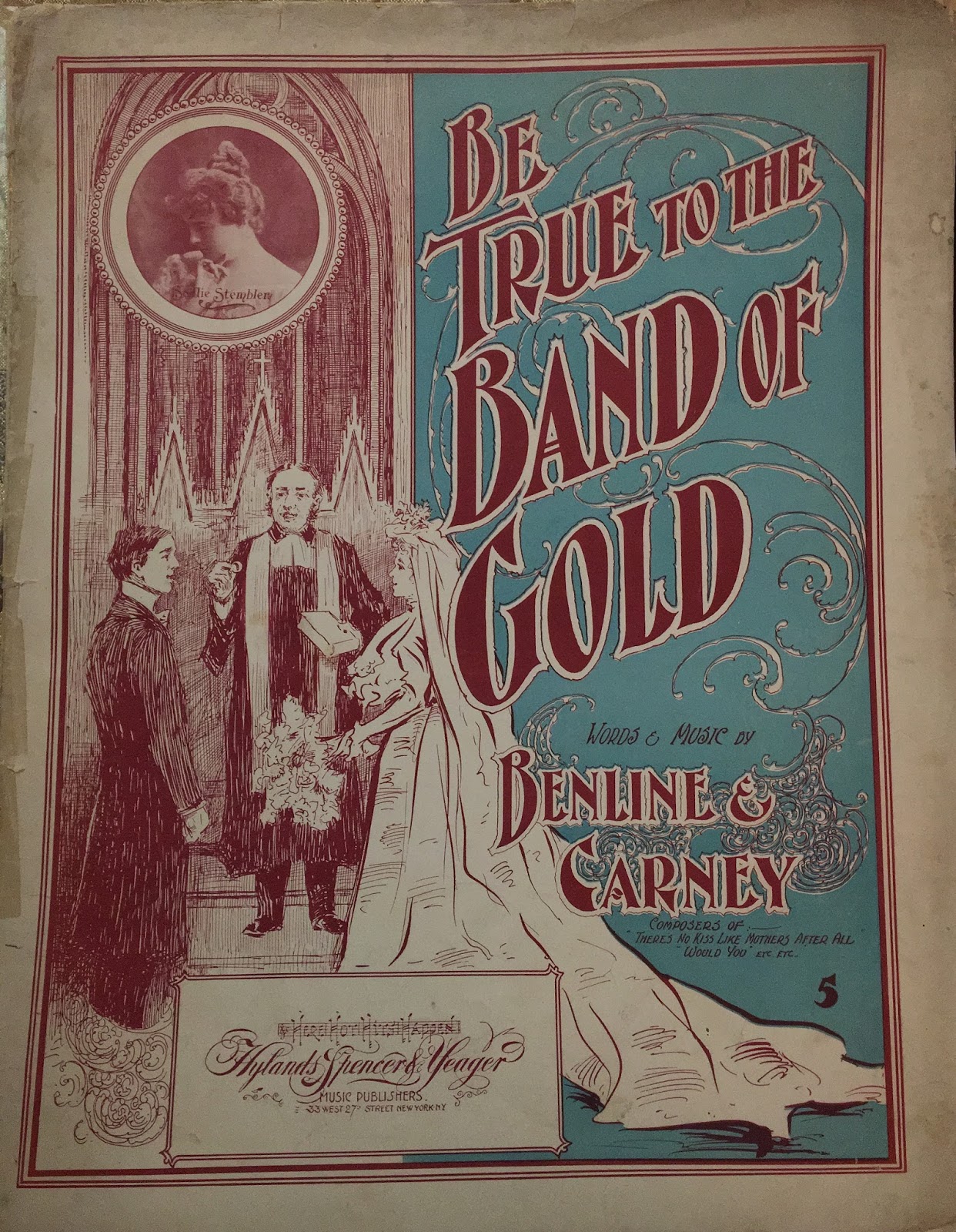
there ya go.
Another Hylands Spencer and Yeager piece is always welcome in my sheet music collection. Any time that certain lady is on a Hylands piece is always interesting to me.

So I've seen her on three Hylands sheets now...the number seems to keep increasing, as does the evidence of a little fling there. I learned somewhat recently that she divorced her husband in 1900, the year that this piece was published with her picture on it. The charges of the divorce were impropriety. It's very tantalizing to read this, and it legitimately shocked me when I saw it. Maybe sometime I'll do a post on what evidence I have about this tantalizing coincidence....
Anyway...
Hope you all had an all-right holiday season!

