Showing posts with label Thomas Clark. Show all posts

Wednesday, August 7, 2019

Back to 33 and Levels of Preservation

It's been awhile since I've written about Hylands, Spencer and Yeager. With all that I've written about them so far, I still haven't completely exhausted all there is to know about them. It would be good to spend some time speaking of them, as I have been so buried in Ring and Hager material for the last few months. 

So, we all remember them! 
In the last few days, I have spent a lot of time thinking back to the old stories I read about them in The Phonoscope and the brief mentionings of it throughout Jim Walsh's writing. 

I observed something very curious while doing this. 
I hadn't really thought long about how Roger Harding set up a publishing house across the street from Hylands in 1900. The more I spent thinking on it, the whole thing seemed more odd and interesting. 
So just to refresh, in 1899, Hylands and Harding were the main driving forces for the Hylands Spencer and Yeager firm. Harding was essentially the fourth name in the firm. Hylands and Harding collaborated on a few songs they published in 1899, and it seems that they were working together perfectly. But, in early 1900, Harding picked up and left Hylands and the crew to set up his own publishing firm across the street from the Columbia studio. 
Something odd happened. And in this last week, I really started thinking about how odd this was. Hylands and Harding abruptly split up, and considering what came about in the time succeeding this, whatever happened couldn't have been good. But! Harding wasn't the first to jump ship. In mid-1900, it seemed that all the tight knit Columbia studio community started breaking up, all jumping ship one by one. In the few 1900 editions of The Phonoscope that I have flipped through, I noticed that slowly it seemed a lot more the community who wrote for and were mentioned in that publication were starting to split up. One of the pieces I recall  from around mid-1900 stated that Hylands himself was beginning to take jobs elsewhere, and working in vaudeville again(as he had been doing before recording).  That particular statement seems odd to me. 
There's that section!
So the "big sales" thing doesn't seem to fit too well. By mid-1900, the publishing firm thing was starting to wind down, and it was doing so quite fast. It was in that time frame that Roger Harding picked up and left, and when folks were starting to become intrigued with the new fangled Zon-O-Phone. By fall of 1900, the fine Turkish carpet he had so hardly worked for had been torn from under Hylands. Everyone had abandoned him and the publishing firm. 

But why?

For a year, the Hylands Spencer and Yeager thing was booming, and Hylands had made his way up to the top from being the deadbeat rag-time pianist Columbia hired in 1897. Keep in mind that he was a nobody when he started at Columbia in 1897, in 1898 his significance became clear with the popularity of his signature rag-time accompaniments. Something devastating happened, and I have no idea what it was. It caused such important benefactors like Roger Harding and Steve Porter to quickly take their leave before the others. 
(Harding in 1895, from a friend's collection)
(Steve Porter at the recording horns in 1897)
Whatever it was that forced these close friends to all break up so quickly, it kept them apart. Hylands still worked at Columbia, as he had to, but a lot of the crew, like Steve Porter, Gaskin, Quinn, etc, didn't work together much after 1900. For example, the Imperial Minstrels records had stopped by 1901, no longer was the old crew working in big groups like that. Everyone started going off and doing other things, such as working for other companies and heading into recording management(George Schweinfest did the latter for example). Russell Hunting left in 1899, Steve Porter left for the far east in 1902, and Spencer started working for Lambert, Edison, Zono, and more. 
Something went seriously wrong with the publishing firm, and as I said, I have no idea why, and I don't really have any good solid guesses. 
One thing that came to mind however, is that this where Ring and Hager come in. Ring started working at Columbia right as the Hylands Spencer and Yeager thing was falling apart. So of course someone like him would have been so valuable at that point. The 25 year old Ringleben was as willing to work as Banta, had no place to live, was caring for an aged father, and willing to try anything to get decent money. The coming of Ring may also have helped out Hylands put out the fires that were still burning from the collapse of the publishing firm. 
 (most likely Hylands and Ring around 1902)
As Columbia was transitioning into the 20th century, it seemed that it was perfect timing for Ring and Hager to start making their way into the lab. Hager had his ambitions elsewhere, but Ring was working for the then orchestra director Thomas Clark, next Hager, then ultimately Prince. Hylands was taking jobs elsewhere by 1901, though he was still working regularly at Columbia. I suspect tensions were high when one of the old guard at Columbia had to work with Hylands then. Someone like Spencer would have been bitter working with Hylands after 1900, but it did happen, and luckily with the new talent acquisitions at that point, Spencer wouldn't have to work with Hylands as much. 
I believe I have mentioned that based on the sequence of studio pianists, each previous pianist was to mentor the next one, as it required very specific skills to become proficient as a phonograph accompanist. Hylands likely mentored Ring for a short period of time, this time being right after Hylands Spencer and Yeager.

Anyway, I'm starting to talk about something else, so I'll leave it at that.
Who knows what it was that split up the tight knit Columbia community in 1900...The fact that it happened so quickly is tantalizing, and because of this i will continue to look for hints. There's really no way to definitively find out why this happened, but there might be hints. I hope you recall that no one talked about Hylands in interviews. So all of this Hylands Spencer and Yeager nonsense was never well documented in the first place. Folks like Quinn and Porter didn't say a word of it, even though we know for certain they were part of it.


And that is a good transition to my next topic! 

Back to some Ring and Hager research!  One thing that has always fascinated me as a researcher of this very scant area of music history is how the characters involved in the history spoke of and interpreted it. Jim Walsh spoke with the last bunch of the original recording stars, Quinn, Joe Belmont, Byron Harlan, and Hager to name a few. Quinn's writings to Walsh are among the most extensive accounts of the earliest recording business. A long while ago I did a very detailed post where I pulled apart parts of Quinn's letters. As researchers now, we have everything laid out before us, but even with that being true, we have to spend many hours decoding all this information. A lot of things are mixed up and don't exactly go together the ways that the original participants stated. A few posts ago I detailed Hager's accounts of the OkeH field recordings of 1923-1925, and how his accounts are very valuable, but present issues. 

I just got an article on Justin Ring published, and it was a very difficult undertaking. It was this way for many reasons, and I don't even know some of them. I want to write a definitive article on Hager, but there's so much information on Hager, that a single article won't do. I ran into this problem with the Justin Ring project.

(Ring in 1903 and Hager in 1895 or so) 
I spent months getting frustrated about how I could find so little on Ring in that essential period after 1885 and before 1910. This is still proving true unfortunately. So as my mind works, I started asking the questions as to why it would be so difficult to find any information on Ring in general. Hager was easy to find information on, at this point I actually have a pretty good idea of what he was like as a person, and what interviewing him would have been like. With Ring, it has always been a dead end. 
So I keep going back and pouring through the primary sources(including Hager's own papers) to see if I could get some second handed hints. While doing this, it occurred to me how much Hager loved talking about his past and the projects he was part of. He probably had thousands of papers very meticulously organized in folders, and records and books too. This becomes very clear while flipping through Walsh's writings from Hager in his articles. When Walsh started writing to him in the 1940's, Hager realized that all his memories and written history would be important, and that's where he started gathering everything, and started to spend a good amount of time writing about the history he drove and witnessed. Soon he became consumed with the joy of reminiscence and digging through his papers and books. 

(a bit from Hager's writing published in the April, 1951 edition of Hobbies)
You can tell Hager loved going through his stuff. When Walsh reminded him of something, he would go and look for it, if he couldn't find it, he'd ask others who would probably have it. Hager had taken most of Cal Stewart's material by the time he was writing to Walsh, so much of the information we have on Stewart was from Hager's own very meticulous descriptions in his letters to Walsh. So, clearly Hager was very involved in and aware of his past. He knew that what he did was important. But what about Ring?
Hager wrote so much and very much enjoyed getting buried in his past, as he had a very carefully organized scrapbook to accompany the thousands of papers he kept regarding himself and others like Cal Stewart. When Walsh was writing to Hager, he mentioned his partner Ring a bunch of times, as even then it was difficult to separate them. 
(Walsh's September 1962 description of the photo below)
(from a friend's collection)
Even Walsh described them as inseparable. It's possible that Walsh wrote to the old Ring, but he didn't get anything back. Walsh unfortunately had the same situation happen with Arthur Collins. He wrote to Collins in 1932, but never got anything back. A few years later Collins' wife Anna wrote back and told Walsh that he received and pondered on his letter, but ultimately decided it wasn't worth it to write back. 
So I'm thinking that a similar situation may have happened with Ring. Now this is where Ring and Hager were opposites. Hager kept everything, and Ring kept nothing. This is the point I was getting to here. This may be why it is so difficult to find anything on Ring. So consider how he lived while working for Hager and Prince. He had no place to live, he wasn't married, and writing arrangements and playing accompaniments wherever he could. With that frugal lifestyle, there was no way he could have kept anything. He was constantly adapting to the times, so of course he had little interest in preserving the past. 

So consider this...
If you were to go and visit Hager for an interview in say, 1953, he would so very much enjoy talking to you about history. He would gladly answer every question, and would tangent on that to tell another story, and another...and...another. He would go and dig things out as you spoke. the amount of information would be invaluable, and there would be so much of it you'd either be there all day and night or you'd have to come back for more. So the point being, that Hager would be the ideal person to interview about this stuff. You'd probably leave with a few things of his too. 

So let's say you made the trip down to mid-eastern Florida in 1960 to visit Justin Ring. You'd get to his place, and one of his daughters would answer the door. You'd be kicked off his property. Ring would quietly be sipping tea listening to the radio or thumbing through Variety, with his glasses tipped down on his nose. It would all be there...everything...all the sounds, people, words, and memories, but they were never to leave his mind. He wouldn't talk about any of it. He preferred to leave it all behind,  and being the sole survivor of his family by then, he had no business thinking about all his dead friends. 

But like the last subject I wrote about in this post, why?

Who knows?
Considering the amount of things he did, and the kind of people he had to work for and with in those 50 years, he probably had good reasons to keep-a-movin. All the way back to Hylands in 1898, he saw everything, and probably escaped death several times while all his friends were dropping dead around him, starting with Frank P. Banta in 1903, and ending with his brother Franz in 1960. 
Ring is a lot like how I'd think Banta would have been if he had lived long. Banta was perfectly content being the quiet and obedient accompanist, and likely spent little time talking about work with those who weren't in the business. He was so buried in work that many other things in life were not important. So interviewing him about recording would he difficult. 

This is why I study the neglected accompanists. They saw everything, and despite their lower reputations in the musical community(excluding issler), they got the last word. And you know what? 

Ring got the last word. 

He may not have spoke it, but he got it all-right. 
The accompanists we hear on these records were not famous in their day as accompanists, and they weren't famous in general. We always hear about these big names like Ben Harney, Eddie Foy, Anna Held, even Mike Bernard, and they were so highly regarded in their day, but, with the exception of Bernard, they aren't the ones whose voices and legacies were immortalized. It's the ultimate payback, the most neglected and overworked performers in the early studios got the last word back then, and even now. I'm talking about the accompanists of course. Issler, Banta, Hylands, Ring and the rest got the last word, the last driving notes, after the main performers finish. The accompanists and studio workers are the ones we can get to know better than even the main performers, as we hear them on everything, not on just some things. 


So, anyway, this has been a hell of a case study! Before I close out I'd like to share a pair of records that I believe are arrangements by Justin Ring. Based on the composition style compared to his accompaniments, these arrangements line up to that style. I am also thinking that after Ring and Hager split up from 1906 to 1912 or so, Ring worked for Prince at Columbia. 


So there ya go folks! 


Hope you enjoyed this!


Sunday, October 21, 2018

The Mystery Box and Blue American records

Well, what a week it's been! 

Hot damn this has been quite a week for records on my end. Whew!
This last Thursday, I took a trip over to my favorite antique store, thinking there may be something there, as I hadn't gone in about a month. I usually like to go to this place once a month or more if there are interesting lots of things to pick through. Never could I have anticipated the sort of things I'd be picking up that day...
This place I go to is one that I have frequented rather often for the last 6 months or so, grabbing piles of records and other old things of interest. I have gotten a ridiculously good stash of records overall from this place, but of course the only records I was getting, or ever saw from this place were disc records. I was just grabbing all the records, asking no questions and remaining modest and quiet when digging and later buying them. Since I've been going so often to this place, the proprietors have become familiar with the the sort of old things I'm looking for. 
After 6 months of stacking up the disc records from this place, with all colors and rarities of the phonographic rainbow, I finally asked the owner if there were any cylindrical records. The moment he told me there were some stashed up in the house(away from the customers poking around), he made me wait a little while. He had to go drop something off for one of the local customers, but with the promise he made, I was so anxious it was hard to maintain my antique store poker face. I waited about 20 minutes poking around mindlessly, as this was after I combed through all the usual spots here. When he came back, he went upstairs to grab a box of cylinders. 
I still was able to keep my cool as I opened the box and saw a few curious French brown waxes that weren't Pathé's. I inspected those thoroughly, and was interested, but of course I had no idea of their value, but I planned to buy them anyway. 
As I kept digging in this box, there were layers of records stacked on one another. There was a curious old looking case right under these French rarities, it looked to be from the 1890's. I was still keeping my poker face pretty constantly at this point, but it broke in a snap when I opened that old box. 
When I saw what was inside I just about screamed, I threw my hands up and nearly tore the 110 year old sleeves on my coat. 
That's what was inside. 
All brown wax, and only one of them was so moldy it can barely be saved. Unfortunately, as I started digging through all the slips and inspecting each record, a percentage of them were broken. But! despite that, I became passionately determined to take them all. That includes every last shard and piece of brown wax I could find. All the old slips were scattered around in the box and I kept looking over those to get some sort of idea of what was in this box. There were some interesting titles there. All the titles were handwritten in pen, in an almost familiar Spencerian script. The most tantalizing slip I saw in the batch was this one here: 
Yep, that's definitely a good sign. 
A brown wax with that title could either have been and original Hunting or a later Jim White take. That writing looks familiar doesn't it?
When I finally got through the box, I took 7 of them home with me after paying the owner. I was too afraid to grab them all at once, as I had a long and somewhat bumpy ride back home. 
I wasn't originally going to do anything the following day, but I became so bubbly over what sort of titles were in the first batch of 7. So the next day I got up early and got over to the place earlier than usual, to grab the rest of the old box of records and go. I spent no extra time this go around, the records needed to get home to be played and correctly identified. Don't get too worried, I only played the announcements and maybe a little more to get what they were and stored them back in their cozy 1890's box. Every one of these beauties was covered in dust, but under the dust, there's no mold or anything, just flawless recordings all from a very specific period of time. 
So after I finally spent several hours trying to get all of these correctly paired with the matching old slips, I got more into the strange circumstances of this almost flawless box of brown wax. 
So here are a few interesting things about this box:
-They are all Columbia's
-All from 1895-1899
-All the slips are written in pen
-there are two of each artist(almost)
-there's a lot of Len Spencer related selections
-no mold anywhere
-all the same shade of brown wax
-there's quite a variety of selections, from sacred to hot rag-time
-all the titles on the slips are abbreviated like Columbia studio slips I've seen

This box was carefully put together. Someone had quite varied tastes in records. These records were originally sold by Allen Koenigsberg, probably over a decade ago to this collector in Berkeley. The collector's name was on lots items I had previously picked up from this place, so without a doubt these brown wax beauties belonged to him at some point. 

Funny accompanying story, when I bought that batch of Berliners and Zon-O-Phone's from this place, I noticed that most of them were kept in distinct yellow sleeves from Kurt Nauck. With that, I contacted Mr. Nauck about these records, and he promptly told me to whom he sold the records. This collector in Berkeley died a few years ago, so it seems that all of these extremely valuable records were dropped off at this antique store I frequent. 

So the fact that these brown waxes came from Koenigsberg would make sense, since they are so outstanding and prime examples of mid-1890's recordings. 

So all of this is great without a doubt, but what was in the mystery box? I spent hours attempting to grab all the titles on these records, and match the slips with the proper record, as they seemed to have been scattered when I found them. At the current time I still have not gotten all the slips to match every single record, as I do not have a very good phonograph to present them in a decent fashion. I have only an 1898 Columbia Q that is definitely not a high quality machine, but I can play brown wax on it safely. So do not expect any transfers from me soon...
The first one I was anxious to play when I got home was of course the "Casey" sketch. That record was far more intriguing and valuable than I could have ever expected. Hunting's records alone are very rare, especially the brown waxes he made. But one thing is for sure, his pre-1897 cylinders are the most desirable of them. Well it turns out that this one in the mystery box was one of them. This cylinder was recorded probably in late-1895 or early 1896, before he got arrested with Charlie Carson for the smut cylinder scandal. It's got that same pristine sound quality as the few Original Hunting's that are online, such as this one:
https://ia802308.us.archive.org/4/items/RussellHunting/RussellHunting-CaseyattheTelephone.mp3
Now think about this, the record I got was recorded right there with Hunting. It was made under his own supervision, it was in the recording room with him, and he recorded directly onto that surface that I can now hold and handle. 

This is exactly why brown wax is so intriguing in a way that no other recordings are. If the record is old enough, it was likely recorded directly on by the recording star who's on it. The record witnessed the musicians and performers in person, and depending on the performer may have been handled by that very performer. This adds a level of personal touch that later records from this time just don't have. This is exactly why this Hunting record in the mystery box is so valuable to me in particular. 

There were several records by Len Spencer in this box. There were as follows:
"What Shall the Harvest Be" from 1896-97
"My Gal is a High Born Lady" with Ossman, 1897
"Crappy Dan" with Ossman, 1897
"-----Honey Boy" with Hylands 1898(I couldn't get the title of this one very well but it's likely something called "Lucinda Does you Love yer Honey Boy?")
Of course since these records are all Columbia's from around the same time, as to be expected, there are quite a few of them with Len Spencer announcements, which is perfectly fine for me!

There were two standout Edward M. Favor records in this box. Usually the Edward Favor records that collectors have are his Zon-O-Phone's from 1900-1903, and his Edison records from the late-1900's. But I assure you these two Favor's were the rarest and most desirable of all the kinds he made. Both of these Favor records are from 1896. They both had that distinct "...of New York City" announcement(as 80 per cent or so of these records have) and that beautiful clear piano accompaniment that was on those Columbia's he made in 1896. The two records sound exactly like this record here:
http://cylinders.library.ucsb.edu/search.php?queryType=@attr+1=1020&num=1&start=1&query=cylinder11859
Same pianist, same recording room, and overall beautiful quality. 
The titles unfortunately I could not make out just yet, and they are hard to match with the remaining slips. 
There was a Gaskin, Steve Porter, and a surprisingly clear Will F. Denny record. 
The Gaskin is a really pretty love song titled "Answer", with that pristine mid-1890's Columbia recording quality. The Steve Porter is an unusual one titled "She Lives on the Same Street with Me". The Denny is a very distinctly early 1897 Columbia titled "Then and Now". 
There were two Clarinet solos by William Tuson which really got me excited! I have a lot of love for those Issler soloists, as they were fantastic musicians that really stood out from the rest of the musicians in the orchestras. 
The two Tuson's were "Southern Plantation Echoes" from 1897 and "Old Black Joe" from 1897-98. Both of these records are online, but the ones I got in the mystery box are definitely different takes. There are some distinct differences between my takes and the ones I've heard online, which is great! To give you an idea, here are the two Columbia takes of these online:
"Old Black Joe"
"Southern Plantation Echoes"
My take of "Southern plantation echoes" is the longest one of the takes I've heard. It hovers right around the three minute mark and there's another chorus of the Tapioca played at the end. The clarinet and piano also alternate playing the Tapioca toward the end which is a really nice added touch. This take also sounds really nice, even on my crappy cheap old Columbia. 
There were a few Columbia orchestra records in the box too, such as an 1897 take of "Ecstasy Waltz"(with a cornet solo by Tom Clark!), and a curious recording of an unnamed "lanciers". 
There was also a super nice early 1897 take of "Stars and Stripes forever" by Sousa's Band, which added a nice touch to all the obscurities in the box. 
I know I'm missing a few to describe here, but I really want to get to the next part of this post. I will do another post once I know what everything is and when I know I can get decent electric transfers of them. I have already been given and offer to get them transferred!


All-right then!

Yesterday I had a serious aha! moment. Amid a moment of thoughtless listening(this is usually how is goes...), I realized something big. 
Many collectors try to grab those Blue American records when they can, as they're very attractive records that stand out from all others in pre-1910 recordings. I have quite a stack of them myself, this hot one included:
I am always amazed at their beauty. 
(in case you're wondering, this curious record is basically like one of Spencer's brown waxes with Hylands but half a decade later!)
Last night I went back and listened to the handful of American records that are online, and was reminded of how hot and tight their house orchestra was. Their orchestra was called the regimental band of the republic, which is quite a generic name for a studio ensemble. No one really knows who they were, as this company was shrouded in secrecy, but for good reason. They were started by a few sketchy Edison employees in 1904, but somehow these sketchy Edison workers managed to create the best sounding records of the era. Their records boom in ways that others just didn't! And how their orchestra did just that, and more!
so as many have been long wondering, who was the regimental band of the republic? Well, you know what, I may have come to a possible answer. 
That orchestra was just absolutely outstanding to all the other studio groups, with familiar sounding musicians. Who do they sound like the most?

Hager. 

Of course! It made so much sense once I started thinking through ways that could prove this idea. Before I go forth with the explanation, here are a few of their records:
Perhaps the hottest ever, "a Southern Belle(Cake-walk)"

"Cocoanut Dance"(written 1891)

"Princess Pocahontas"(buck dance)

Hager's own "Handsome Harry"

"1863 medley"

So why would it make sense that Hager could have led this this orchestra? They recorded "Handsome Harry" to start, which is Hager's piece from 1904. Of all the record insiders Hager would make the most sense in terms of having his hand in this mysterious and dreaded record company. Hager was part of the Climax scramble in 1901-1902, as he was working for Columbia-Climax-Zonophone when the tensions were boiling hot, but he was taking his orchestra to the more reliable and better quality Climax and Zon-O-Phone instead of Columbia. He managed to escape the battles over patents and record talent unscathed, but he gained ever more knowledge of the recording ropes and where the best fortune would be. With this heightened knowledge, Hager would have seen the great opportunities that American possessed. 
The sound of the orchestra on American nearly mirrors Hager's Zon-O-Phone orchestra from the same time period. This frame of 1904-1907 is also when Hager was working the most overall, so maybe this American notion went into his crowded work schedule. 
Also, I may add that the "1863 Medley" listed above sounds like many of hager's arrangements that were written down and the ones that were played at Zon-O-Phone around the same time. By this I'm meaning a tune of his like this one:
https://www.youtube.com/watch?v=QrdarM0xKgs
Indeed so. 

Now all of this is very tantalizing indeed, but it's just a possibility. No one really knows what was the deal with those American records, and another thing that particularly intrigues collectors of them is that orchestra announcer. That announcer was always so unenthusiastic and not theatrical about the announcements. It's a very familiar voice though, very recognizable to those who own some of these American records. That announcer very well could be someone in the band. But think about who would be right there with no instrument to keep his mouth shut...


Anyway, I think I'll end it here. I really want to do another blog post this week but I'll be traveling for a week, back this following Tuesday. When I return however, I will be giving a lecture on Hager! Let's hope that turns out all-right, there's quite a lot to cover with his long story...


Hope you enjoyed this!


Friday, June 17, 2016

More on the Mystery cylinder

After some brief comment section discussion this morning and telephone conversation last evening, it would seem that this mystery cylinder from my last post has some more interesting theories about it. After listening to this cylinder many times, it would seem that this cylinder might be the inevitable possibility that I spoke of yesterday. Of the many possible theories, this cylinder could be an exhibition souvenir, which would date it to 1898 exactly, and that would make sense considering the song the was recorded, and the musicians possibly involved. 

Here's the cylinder just to refresh:

It's still very strange to me, as there's so many things that aren't right about this cylinder. The balance is really awful on it, the room sounds very strange and unusual for recording, and the announcer is very far away. Also, the fact that there isn't any identification of a company anywhere is also very weird. It really sounds like the setup seen in these two pictures: 

The setup is a little harder to see in the first picture, but it's the same as is in the latter. It's just very strange and amazing that any sort of exhibition-made cylinder would survive, but anything is possible. I have held records from this period in my hands that aren't supposed to exist, so if that just happens to be what this cylinder is, well, there ya go! 
The balance of the piano sounds like it is in the second picture just above, as it's not on the same side as it usually would be at Columbia. Usually, if you're in the perspective of the horn(s), the piano would be left, with it tilted at an angle similar to the picture just above, just reversed. The balance on this record sounds like it is just above, with the piano on the right and tilted the other way, also higher up off the ground. Hylands is at least four feet from the floor in the picture above, whereas in usual sessions, he would be at about three feet up. 

It must be noted that the announcer is at least six or seven feet away from the horns, which is very far away for an announcer, and that the piano is much louder than the announcement, which is very strange. 
I now have the feeling that Hylands might be at that piano, and the only reason is because of how pushy the rhythm is in that odd minor section(which is in none of the other 1890's recordings of this song...), and also by the overall rhythm, which is too good for it to be Fred Gaisberg. It has a sort of Hylands "feel" to it, even if it's the farthest thing from Rag-Time. 

The rhythm at the minor section of this is really where that "feel" comes through very well, and the sound of the piano is very "1890's", as pianos in studios after 1900 just didn't have that sound for some reason. This record has a very distinctly Columbia sound, and does not at all sound like an Edison cylinder to me. 
The slight fading at the end of the cylinder also makes me think it's a Columbia of some kind, as Tom Clark often did that fading thing at the end of his cornet solos with the Columbia orchestra in the late-1890's, such as on their 1898 takes of "Schubert's Serenade". Notice! The sound of the piano on the takes, it's similar to the mystery cylinder, though it's more so on the second one listed. 

Well, there's not much more I can say here, but I am still looking out for some guesses! This is really an interesting and strange recording, that maybe we will get to the bottom of it some day! 


Hope you enjoyed this! 


Sunday, May 29, 2016

Character Studies--The Columbia orchestra(1897-1905)

That's half of the Columbia orchestra. 

I just know that doing a post on this group solely would be hard. Despite that, I will try my hand at it anyway. Now before I get into the describing, I must point something out that I did not notice until a few minutes before I began this post. 

See that chair the trombone player is sitting in? Right here:
(that's David Dana by the way!)
That chair looks like a familiarly queer-looking one from a picture I recognise:
 Which chair? 
That obviously miserable chair. 

Hmm, I wonder whose idea it was to give Fred that chair for the exhibition hall of all places at Columbia's Broadway address? There's a strong possibility that Fred obliged. That chair is very different from all the other ones, I wonder what its specific use was? It wasn't just Fred's chair, as David Dana can be seen in that picture(with Hylands!) sitting in that strange chair. 


Anyhow, sorry to get side-tracked, back to the Columbia orchestra. This group, as I have explained, was formed by all of the leftover musicians from the fall of the U. S. Phonograph company in early 1897, and unfortunately, Edward Issler was filtered out after this transition, which meant the end of Issler's orchestra at Columbia. Without Issler, the members of his orchestra blossomed in this new group of musicians. 


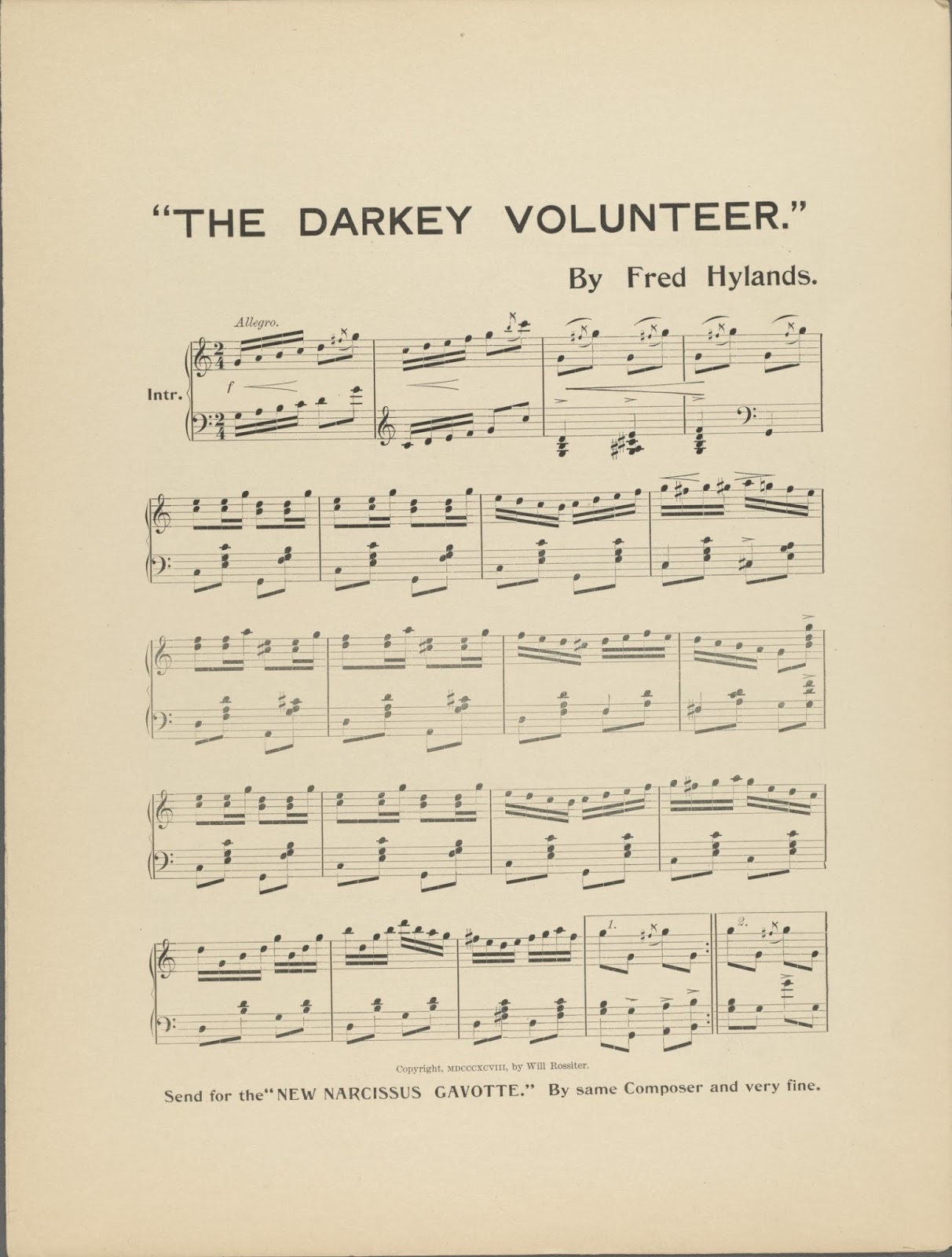
The Columbia house orchestra was a stew of musical misfits, from confident and classical William Tuson, to ragged and rough Fred Hylands. They were all selected by the bewitching hands of Master Edward Easton himself, each getting his approval one-by-one, so it's assured that they were well-liked musicians among the picky management. Most of them were Germans, with some odd sprinkles of English and Bohemian here-and-there, so they were a mix of European stew. Much of their repertoire before Fred Hylands came along was popular music, with the arrangements made by Tom Clark, and older ones that were handwritten by Issler. Many more soloists were recorded with the Columbia orchestra in their earliest days, as for some reason, this idea faded away as the years went on. Though Len Spencer was not one of the musicians in the orchestra, he was a member regardless, as he did all of the sound effects, many announcements, and even sung some choruses on the popular vocal selections they recorded in 1897-1899. Hylands was not the first pianist under this new orchestra in 1897, as it was originally Issler, but after about a month or two, they got their new trial-pianist some work, by playing in their house orchestra. Leader man Tom Clark found Hylands a complicated character, and did not like a lot of his habits, as did many who worked at Columbia during Hylands' term. Hylands made some of the arrangements they recorded in 1898, though Clark was the one who did the arrangements, Hylands still did many of them, and his arrangement of "The Darkey Volunteer(s)" was a real doozy. After an exhibition one night in July 1898, Hylands came in the next morning exhausted and hungover, but with something new written down for the orchestra. The first to see it was Clark, who at once got out his cornet to try and play this piece as written. It was fully of comical quotes, and had runs of notes practically spilled in long streams in the melodies. This piece was:
Yes indeed. 
Everyone else in the orchestra looked at it with unsure scowls, as when they got to practicing the piece, it sounded very strange to them, but Hylands yelled out to them and stopped them when something wasn't right. When they recorded Hylands' tunes, he owned the room, and all the people in it. There were few times when it was hard for the musicians in this group to stay together, but when recording this tune, this was very much a problem. 
Here's the band recording of it(with Hylands on piano): 
Recorded in 1898(not sure who the announcer is...)
It's like the man was messing with them. The tune is already hard enough to play on piano, then try to get twelve musicians to stay together playing it. He must have told Clark, "Oh no, it's not too difficult. It will sound perfect!" In the orchestra recording of it, George Schweinfest and William Tuson can be heard very well playing those ridiculous lines in unison. 1898 was the peak year for the Columbia orchestra, as they had all their best musicians playing great always, and they could play anything they Mr. Clark picked out from the old pile or created new ones. In many recordings of Rag-Time they did, oftentimes Hylands was wanting to play a different rhythm than the one chosen, so everything sounded all weird, such as on their take of Monroe Rosenfeld's "The Virginia Skedaddle" from 1898(begins at 8:05!). The rhythm sounds all out of whack at some points here. From what I can hear, it's the piano that's causing this. but of course, nothing was as bad as their 1899 take of "Smokey Mokes" from 1899(begins at 57:48!). I don't think it could get as bad as that one. At many points, Hylands is a measure behind them. He might have counted off wrong, or he wasn't paying attention to the rest of the orchestra. It's especially bad toward the beginning, but he remains a little out-of-whack throughout. The rest of the orchestra is fantastic though despite Hylands' strange ignorance. The problem is that the piano is so loud on this one, that it's hard to avoid. This was a problem that leader man Clark ran into when learning how to manipulate stubborn Hylands, and the evidence in clearly stated. After 1900, some special recordings with vocalists and the Columbia orchestra began to show up more, such as Dan Quinn singing "Pretty as a Picture" in 1900, and Spencer singing Hylands' "You Don't Stop the World from Goin Round". After 1901, they were recording many instrumental Rag-Time pieces, and re-recording some older takes as well, such as their 1902 recording of "The Darkey Tickle"(from 1892!), and their 1901 take of "The Darkey's Dream". They also took on the classic Rag-Time cake-walk "Creole Belles" recorded in 1902, and this strange recording of an oriental dance called "Obaja" recorded in 1904. They also recorded "Peaceful Henry" in 1903, but the people who put that up took it down from their site, which is really frustrating, because that was a masterful piece of early Rag-Time. By 1903, their specialty for "descriptive selections" was beginning to fade, as they were not as popular to record buyers by then, though they did come up with a few new ones, along with recording old ones. Here's Len Spencer's specialty with the Columbia orchestra called "The Levee Scene" from 1903. They ran out of time at the end, and this time is was a bad failure, before their last chord, the record cuts out. As we know, the Columbia orchestra had been known for their variety of fun "descriptive selections" since the formation in 1897, with a strange mix from "Charge of the Rough Riders"(hear Hylands sing!), to their "The Village Orchestra". The spark of playfulness that was had when they made these had faded by 1903 and 1904. They still had many of the same musicians, but they were not exclusively in the Columbia studio by that time, so these selections were not as much needed. By 1904, they were mostly recording popular dance numbers, such as many popular marches and songs such as "Hiawatha".  By 1905, the Columbia band led by Charles Prince was taking over the old orchestra spot. Only a handful of columbia orchestra selections were offered in 1905 and 1906, and with many of the original musicians dropped by the end of 1905, it was inevitable that the group would end by 1906. They were a unique and fantastic group of musicians who we now have the absolute pleasure to hear on hundreds of records from 1897 to 1905. Many of their selections were unique to only Columbia's orchestra, not any others, like the Peerless orchestra, or the Edison orchestra.

Here are two of their great selections from every year they made records:

1897:  "The Jealous Blackbird" with George Schweinfest
"I thought I Was a Winner" with Len Spencer

1898: "Jolly Fellows Waltz"
two takes of "Schubert's Serenade"

1899:a recording with the Imperial Minstrels(listen for that yell at 35 seconds in!)
"Upon the Golden Shore" with the Imperial Minstrels(Hylands is kind of out of sync again...)

1900:Ethelbert Nevin's " Narcissus" 
"The Santiago Waltz"
1901: "Kentucky Jubillee Singers Scottiche" announced by Dan Quinn
"The Sea Flower Polka" by Tom Clark and the Columbia orchestra

1902: their re-recording of "La Serenata Waltz"
"Smokey Mokes" played a little too slow on the trasnfer

1903: Their re-recording of "The Darkey's Dream"
a hot piece of Rag-Time called "The Dixieland March

1904: a hot "Slow Drag Cake-walk" called "Jovial Joe"
their re-recording of their famous descriptive selection "The Bugler's Dream"

1905: This is the last one I have found with Hylands still on piano in the orchestra, "Selections from 'The Yankee Consul'''
The other ones I have found from '05 don't have the piano accompaniment, and that was actually a very important aspect of their unique sound. 


Hope you enjoyed this! 


Saturday, May 28, 2016

Character Studies--George Schwienfest (c.1862-1949)

in c.1898
in 1894

This Issler "dropout" as I call Issler's orchestra performers who literally dropped out of that group for the Columbia orchestra, began working under the obliging of Edward Issler in 1889 for Edison's phonograph company, then in only a few months, he and the rest of the group were all working for North American, then later Columbia, and so forth. One of the first prominent things that Schweinfest ever did in ways of recording was making a handful of piano solos and duets with Issler in 1889. It's strange to think that they had so much trust and friendship in each other, but the fact that they specifically chose to make these duets shows an element of trust in them. 

To begin with Schweinfest, it is unknown where or what his origins were, but one thing is for sure, he had the same origins that Issler did, as they probably met around 1886, or many a few years before that. It must have been the ideas of Schweinfest and Issler that began their orchestra in 1888. Issler was a first generation American in his family, as both his parents were born in Germany, and he was the first to be born in the U.S., with this, Schweinfest probably had the same situation within his family. Schweinfest was a fantastic musician, with the ability to play at least five instruments; piccolo, flute, violin, piano, clarinet, and maybe more. It is not known what he began playing on first, though violin is a likely possibility. He must have been a very good man as far as the early recording stars go, very musically focused, cooperative, and patient. As from these traits, it earned him a long life, and many music directors wanting him. He was well-liked among the record staff, and Issler used him as an important tool of his, as on the many recordings by Issler's orchestra, you can hear Schweinfest playing different instruments, possibly changing in the middle of a take. With this cooperative nature, all the studio pianists liked him, but they all had to respect him, since he was one of their subs, and back-up pianist if one of them was out for a day, to a few days, to a week, or even if the inevitable happened--one of them died. He knew all the studio pianists, from Gaisberg to Bachmann, even if they didn't work at the same company, he still would have known them, and built kind relations with them, as he was no Fred Hylands. His times in the studio were always a breeze, save for the times when he apologized for his piccolo being horridly out of tune, as at Columbia it would be Hylands complaining about that of course. When he worked for Victor, his records were well made always, save for some times when the pianist was not playing the correct chords or just right notes. That, as we know was not Schweinfest's fault, that was Banta, Hylands or Bachmann's problem. He never missed a note, all of the notes he ever played on those solos were right, nothing was missed, ever. If you go through any multitude of his recordings, the conclusion might be made that he never missed any note anywhere. With that being said, it can amplify any mistakes the pianist makes behind him. Once Issler dropped his orchestra from Columbia's catalog, all his musicians weren't exactly sure of what he was going to be doing, so he told them that they were part of the Columbia orchestra from there onward. With this change, we get recordings like this one here:
"The Jealous Blackbird" by Schweinfest and the Columbia orchestra(1897)
As we know, Issler didn't disappear from there, though he wasn't leading his orchestra at Columbia anymore. 
That left Schweinfest, Tuson, and Dana under the rule of Thomas Clark, who was a different man than Issler. First of all, he wasn't German, and that immediately rid of many traditionally Germanic ideals and ways of musicality. Secondly, Clark wasn't a pianist primarily, so that also created differing viewpoints. Schweinfest was perfectly fine with this transition, as he quickly came to befriend the new director and pianist. Clark was fond of Schweinfest, as he was not only a great soloist, but also a fantastic player in a group, and  had that great sense of rhythm that must have come from working with Issler for so long. Hylands was a different tale. Schweinfest was on of the pianists that was replaced by Hylands, which created something there. He wasn't angered over this, as he was one who understood why Master Easton and Vic Emerson chose a low-life Rag-Time pianist to be their main pianist at that point in time. Despite all of this agreeing, he did have to get used to Hylands being there, with all his "baggage", and social issues. Being a member of the Columbia orchestra meant that Schweinfest had to attend things like this:
This is that section I use from The Phonoscope with the ridiculous amount of spelling mistakes. 
Anyhow, the Columbia orchestra is listed, Tom Clark is specifically listed as the orchestra director(of the few times he was!), and Fred Hylands is listed(love it!). As I have explained before, Master Easton held two of these gatherings, one in 1898 and the other in 1899, and considering the circumstances, they must have been very expensive to host, but at least the performers got to perform for their boss at the most expensive hotel in New York City at the time, and probably got some of the most exquisite courses of food they got for a while. Schweinfest had to go to both of these, as he is listed in both of them, not just inevitably part of the Columbia orchestra, but also as a soloist. Schweinfest remained making records as a soloist and with the Columbia orchestra after 1900, though his work outside of the studio remains a mystery to this date. He probably remained working with Issler after 1900, as there's not a doubt in my mind that the two remained friends until Issler died in 1942. He worked with Hylands primarily after 1900, as all of his solo records have Hylands still on piano behind him which probably was not an issue with him. Hylands was still Hylands, even if it wasn't 1898 anymore. It is not known what happened to Schweinfest after he ended recording solos, though he may have remained in some studio orchestra a few years after that. Which studio orchestra? I don't know, but I hope that it was Hager's orchestra! 
Whatever Schweinfest decided to do after he ended recording, it surely did him well, as he lived to be 87, and that's pretty much outliving everyone he knew in the earliest days of recording. He didn't out live Clark though, Clark was 89 when he died, and that makes him the oldest of the all the earliest studio stars, though Schweinfest lived the longest into the 20th century. 

It's amazing to think that Schweinfest outlived pretty much everyone in the Columbia orchestra(from Hylands to David Dana), and everyone in Issler's original ensemble. He also outlived most of the regular studio singers, Len Spencer, Edward Favor, Myers, Dan Quinn, Steve Porter, Russell Hunting, Edward Easton, Vic Emerson, and even Frank Dorian(who lived from 1869 to 1940). 

He even outlived all his managers and bosses. Heh, that's great. 


Hope you enjoyed this!