Showing posts with label Charles Carson. Show all posts

Tuesday, March 3, 2020

Hager as a character and the dilated stare

In the last few weeks, a few interesting things have come along in my research. About a week and a half ago, a descendant of Charlie Carson contacted me, and they sent along a bunch of really nice pictures that he and his friends took. Before i get into the Hager story here, I must talk about a single picture that opens up a lot more discussion about Fred Hylands. 
Since becoming immersed in this Ring and Hager project, a lot of my research on Fred Hylands has been put off to the side. Occasionally I do dive back into the Hylands project to add things and revise some information, but this picture has gotten me even more curious about his relationship with his Columbia co-workers. 
So here's the picture:
 Yeah that really does look like someone we know. So before I did any analysis on this being Hylands, I initially thought that it could be Hylands, Cal Stewart, Byron Harlan or Clyde Emerson. After ruling out Stewart and the others, I decided to stick with Hylands. Okay, it REALLY does look like Hylands. Yes, in the past I have gone on rants about other pictures of guys who look similar to Hylands, such as that other studio picture from 1897. I mean this one here:
Okay, I know now that that pianist is not Hylands, that's actually one of the engineers sitting in the piano chair for the shot. 
So that slim guy at the piano may not be Hylands, but that one exhibited first in this post IS. from what I can see in that picture of Hylands, he's wearing quite ill-advised cuts for his shape(this coming from someone who draws him often), and he looks like a rough mess overall. 
 The one thing that really put me over the top thinking it's Hylands was that stare. The one eye that is very visible through the blur is just as piercing and dilated as the other pictures I have of him. I compared the picture back to back with all the other confirmed portraits of him and everything seemed to line up. The hands, shallow but angled shoulders, collar and tie, leg structure, ears, nose, up-curled brows, crooked mouth, feet, smokers' cheeks, and especially those eyes all matched the other portraits. The moment I saw the picture the first time I thought that large tall man was Hylands. He even had a smile similar to that of Etta Hylands. 
Those legs look very similar, having the same structure and shape as the Carson picture. When I did my comparison I also noticed how the trouser legs gathered in exactly the same places as the one other confirmed picture of him standing. The trouser legs wrinkled at the knee and unevenly gathered at the ankles, creating a slight inward curve(the guy had interesting legs). See folks, this is how advanced and detailed my study in appearances has become. If you ever wondered how seriously I take my photo identification process, this is a perfect example. I have come a long way from that picture of Steve Porter at the recording horn with that slim "accompanist" behind him. At this point I am really studying the smallest details, and oddly enough the leg and feet aspect of this new Hylands picture proved very crucial, as the face is difficult to decipher from the suddenness of the snapshot. This picture was taken in front of the Columbia lab(1155 Broadway, exactly where I stood nearly two months ago), and it is entirely candid, completely unposed unlike the other early lab pictures. This snapshot was not taken for a phonograph publication, so it is very much a scene from life. With this in mind, it is fascinating to see Hylands without any theatrical air about him. He's looking like a stereotypical rag-time pianist would in the late-1890's(the picture was taken between 1897 and 1900), though he isn't wearing a waistcoat. One thing I noticed about his clothes in the picture is how much it looked like this here:
(The portrait of Hager on the cover of his Handsome Harry)
That is completely unrelated to this but it did remind me of that, and we know that Hylands and Hager worked together at Columbia from 1901 to 1903. 
I literally spent hours staring at that Carson picture, making sure that what I was seeing was indeed Fred Hylands. It's lucky that Hylands was captured right at the very second before these two random guys zipped by the photographer(you can kinda see them in the cropped version listed above). That does however make it a bit creepier than Hylands already was. Everything else is in motion while he's staring right into the viewer's soul. Anyway, that's about all I got on that topic. Hopefully more will come of this picture find, as it's really extraordinary to see Hylands in a family history still left intact. He can be found nowhere else, but Carson and his family kept that picture of where he worked, and Hylands just happened to be there. 


Moving on!


Yesterday I received a book in the mail. Only last week did I hear of this book's existence. last week was the 100th anniversary of Mamie Smith's first records, so naturally the 78 records Wordpress blog posted about it. If you are curious to see it(which I highly recommend reading and subscribing!), here you go:
So, I read the article, and I was intrigued by this book that was quoted, Born with the Blues. With this burning curiosity, I asked a few friends about this book, whether it would be worth my time and money to grab a copy. Those I spoke to about it recommended that I go get it. With the best of luck, there was a first edition copy on ebay for pretty cheap. I snagged it, and got the book yesterday. I immediately started pouring through it for the Hager story. To my surprise, Hager wasn't just some background figure in the story of getting Mamie Smith on record. For once Hager wasn't mentioned once and moved on from. This book is Perry Bradford's autobiography and his perspective of the transitional era from the black America of reconstruction to the Harlem renaissance. I read Nat Shilkret's book last year, and when doing so was overwhelmed with so much information that I am still attempting to work through it all. Bradford's book is very similar in this way, but it is a little better organized. I read only the chapter about Bradford's association with Okeh, but even that on its own was dense.
 So...Bradford had lots of difficulty getting Mamie in the recording lab and getting though the management. This isn't surprising, but he went to Columbia first around 1917 attempting to get his stage partner Jeanette a deal, but this didn't work. With the rise in recording authentic black southern blues, the white record boys were starting to feel the pressure to take action. Columbia in 1917 had just recorded several sides by W. C. Handy's Memphis orchestra, and with that, they were starting to dabble in the idea of recording more black artists playing authentic blues melodies(even though I have heard exceptional examples of pianists like Justin Ring play authentic 12 bar blues before 1905, but that's beside the point). Here is the beginning of his adventure in getting his dream realized:

After Columbia gave Jeanette the works, I contacted Mr. King[Eddie King]. the Victor top man. he wasn't so hard on us and set a recording date for Jeanette, but we went out of town to do some vaudeville dates. As soon as we came back I doubled back to see Mr. King again, not for Jeanette, but for Mamie Smith who sang in the show Made in Harlem. Mr King let Mamie make a test record of "That thing Called Love" with me playing piano for her, but it was never released. 
...
 I told Joe[a record store owner in Harlem], that [Wilbur] Sweatman tried Columbia first and Mamie Smith made a test record for Victor of "That Thing Called Love" and was turned down, but Joe countered with , "I've had a long discussion with the Victor salesman about you working with some other colored girl for the Victor Company." Then Joe suggested that I go back and see Mr. King, which I did, and Mr. King played the test record of "That Thing Called Love"and admitted that Victor had a better recording of the song than Okeh, but that Victor just couldn't lower their prestige by following these small companies. 
Then I went over to Bert Williams' office, where he and Will Vodery listened to the two records. Mr. King had loaned me the Victor test to let Bert hear them both. Instead of Bert Williams commenting on the records, he told me about the treatment Victor had put on him before he finally started making records for Columbia; how he made a test record and was refused. "Now you realize what I told you would happen," were Bert's parting words. 

So this is where Hager comes into the story. 

So I woke up on a cold February morning in 1920 and put on my lead-sheet(meaning my topcoat), because I'd hocked my overcoat(what the actors called--my full orchestration), and walked from 135th street in Harlem to Ford's saloon at 40th street and 8th avenue downtown. There I had all the free lunch I could devour and was feeling nonchalant, so I strolled aroun' to the Okeh studio at 145 west 45th street to see Mr. Fred Hager again, with the intention of making my last stab at trying to sell  a colored girl singing on records. All other attempts had failed, I'd walked out two pairs of shoes going from one studio to another, and my friends were begging and pleading with me to give up my fantastic dream and go back on the stage where I could always "mess-up" some plates every day, even if I had to stand off the restaurant man for my meals. 
Just as I showed my head in the door of Mr. Hager's office, before I could say good morning, I was confronted with the same old stock answer of:"Leave your name and address, if anything turns up, we will notify you."
No one except a fellow who has been in the same fix can realize how it feels when you're getting a square meal not and then, mostly then, to hear those "disappointing blues" sung to him everywhere he goes. 
 Seeing that I had been given the run-aroun' and I had been pestering Mr. Hager's secretary for a whole month and could never get past her desk, I finally did get a chance to see him(the only recording manager I seemed able to reach) and we had a "heart-to-heart" conversation and he admitted that his hands were tied. With all these setbacks i was slowly making uo my mind to throw in the sponge and call it quits, when Bill Tracy, the white writer of "Play that Barbershop Chord", gave me the key which opened up the prejudice door to my thorny problem.

So there's already a lot to take in here. Eddie King was at least kind to Bradford's offers, though ultimately he was little help. As Bradford elaborates on Hager, he paints him to be a sympathetic good hearted country boy. Applying his extraction to this descriptor portrays him to be a considerate and oddly thoughtful executive. I am unsure how much of that to believe, considering that Hager was aggressively selfish and ambitious, even in his middle and old age. Here is more of the story before I dig deeper into my analysis:

Here's how it happened. I'd kept on "gum-beating" in the C.V.B.A. club every night that something ought to be done to crack that solidly entrenched recording monopoly wide open, until it seemed to be getting on the members' nerves. But as soon as I mentioned Mr. Hager's name, Chris Smith told me, "I've known him for a long time and he's a regular guy." Then Bill Tracy, a song writer, butted in with these words, "next time you talk with Fred Hager, tell him I asked that he give you an audition for your colored girl singer."
As Tracy's "Barbershop Chord" had been published by the Helf and Hager's music firm, that's how I got to see him this time. Because when I entered his office, I told the information girl, "Don't worry, I know there's nothing today, " but I shouted out loud, "I have a message for Mr. Hager from Bill Tracy." And right away Mr. Hager poked his head out the door and wanted to know, "What's that about Bill Tracy?" After telling him that Chris Smith and Bill Tracy had given him a big build up by saying he's a regular guy and would give a struggling songwriter a break, then I spread this new approach. "There's fourteen million Negroes in our great country and they will buy records if recorded by one of their own, because we are the only folks than can sing and interpret hot jazz songs just off the griddle correctly."
 ...
What really got the butter and sold Mr. Hager was the big surprise of hearing about that big Southern market that no one up North had ever thought of. So he asked, "What songs have you in mind?" I showed him "That Thing Called Love" and "You Can't Keep a Good Man Down". After reading the lyrics and the music, he okayed them and promised an early recording if i would take them over to Sophie Tucker and tell her Okeh would record the two songs if she would sing them for us; because nobody could so justice to this material like she could. ...

Bradford went to Tucker with the songs, but she was contracted to Vocalion at the time, so she was to record them there instead of at Okeh. Bradford went back to Hager at Okeh and told him of Mamie, praising her so highly. This was Hager's reaction:

...Mr.Hager got a far off-look in his eyes[folks who have been following my Ring and Hager project can probably imagine this vividly as I do] and seemed somewhat worried, because of the many threatening letters he had received from some northern and southern pressure groups warning him not to have any truck with colored girls in the recording field. If he did, Okeh products--phonograph machines and records-- would be boycotted. 

And so this is where his praises for Hager begin. When considering this perspective in this topic, it must have been a difficult decision for old Hager. He had already made so much history and done a lot of people right and wrong to get where he was, but he ultimately took a chance on such a heated topic as this. Never have I seen such aggressive praise for Hager. Even with all of this I do wonder about what significance Hager actually thought this decision had in his own history. I cannot find any scrap of this story in Hager's papers(they may have been thrown out with the rest). 

May God bless Mr. Hager, for despite the many threats, it took a man with plenty of nerve and guts to buck those powerful groups and make the historical decision which echoed aroun' the world...
So I shall remember Mr. Fred Hager as long as there is any breath left in my old carcass.   

That is indeed some very rather religious praise there if I've ever seen some. The one question I had going into reading this book was exactly what angle Bradford took to move Hager's ego. Of course, not so surprisingly, it took some massaging of that ego to get the ball rolling. He took it from the Helf and Hager angle, which seems like the perfect way to get his ears perked up. While reading this dense chapter, I literally threw my hands up when a certain Mr. Ring was mentioned. He's also mentioned in conjunction with Hager. 

Clearly I'm not the only one who sees this Ring and Hager thing. 

Anyhow, there is more on this topic to write about, but there's already so much here. I'll have to cut if off here. I have only read though this chapter once since getting the book in the mail, so I will have to go through it a few more times to really get a better analysis together. Reading this chapter really has been making me think about the entirety of Hager's personality. I think that he must have been a slimy sort of executive to get where he was by the 1920's. Without a doubt he had to be a serious hustler with freak ambition to get to that position, though I have often wondered how he was once he got to those high ranks. This chapter does shed some light on what he was like to deal with as a businessman and executive. i will have to think about this some more as I go back through Hager's papers that I have. One thing that is very much solidified from reading this chapter was that his massive ego was the key to him. I had guessed that before based on the content of what remains in his papers, and how he dealt with Walsh and poor old Ring. 


Nothing new to report in the world of new transfers, which is unfortunate, but hopefully I'll get to hear some new interesting stuff soon. All these Ring and Hager discoveries are burying me in their music and I'm starting to get tired of Hager's simple composition style and Ring's experimentation. 


Hope you enjoyed this! 


Friday, July 27, 2018

The Brothers Hager

As stated in the last post, I promised to do a post on the Hager's, so here goes.

When that big panoramic picture of Hager's orchestra was sent to me almost a year ago, it shocked me at the amount of detail there was in the description. Every single person was identified, even the recording engineers. Even the mysterious Charlie Carson was identified in the picture(he was Russell Hunting's right hand man with the smut cylinders in the 1890's). 
Just to give you an idea, here's the picture in its entirety:
That looks like a fun group!
Hager is stated as being no. 10, right in the center. 
There he is! ❤
A lot of Hager's musicians were part of Victor Herbert's orchestra(what a surprise!) and many were also symphonic musicians. Of course Hager had the most diverse orchestra in terms of each musician's extraction, in considering his wide range of friendships and partnerships. He knew everyone in the Symphonic and operatic community to the highest regarded vaudeville performers. Hager clearly knew what's up, in terms of music that is. So in considering this, we would assume he got the best percussionist he could find. 
Well, that turned out to be his brother. 
Yes indeed folks, that "James Hager" that is listed behind Fred Hager is indeed Fred's brother. Those two looked too similar for them not to be related, so after I did a little digging on Ancestry, it turns out that James was the youngest of the Hager's. Fred was the oldest, and James was the youngest. There were four Hager's:
Fred(b. 1874)
Lena(b.1878)
Georgina(b. 1880)
James(b. 1882)
Fred couldn't find a better percussionist? Well, I guess it's always good to get a sibling some work. 
There they are! They so look like brothers!

So there you have it, Fred's brother James is that percussionist on all those records. For years I had wondered who that weird percussionist was, since they weren't always great, but when they were it formed perfectly to the orchestra. Fred started the orchestra in 1896, and it seems likely that he wouldn't have forced brother James to play all their gigs until at least 1898. Rather than having him join at 14, waiting until he was 16 seems a little better. Or maybe I'm wrong, maybe Fred got him to join just as he started high school in 1896! Of course to illustrate this I have a cartoon!
Yep. 
I was thinking back to those stories that Fred Van Eps recalled to Jim Walsh about him pulling Frank Edgar Banta out of high school to make records and play gigs with the Van Eps trio. The Hager thing reminded me of the Van Eps-Banta story. 
There's some sort of gratification now going back and listening to all those Hager's orchestra(and Zon-O-Phone orchestra) records, knowing that the percussionist is Fred's brother James. To make things a bit more interesting, James Hager is listed on a few Edison records around 1903, which is around the time of that panoramic picture, and when the Edison catalogs were raving over Hager taking over their orchestra. Here's the most popular example:
It's funny that the Edison people were consistent with the "James W." in identifying him, even though that's not really what his middle initial was. That must have been used to closely place both Hager's, and maybe make it more assumed that they were related. 

When going back and listening to those Zon-O-Phone records by Hager's orchestra, it becomes clear that brother James improved as the years went on. 
By 1909, James was playing spot on with the group:
When we dig back to 1900 however, it's still a little bit out of whack, but of course still far surpassing all the other studio groups at the time:
And to think in 1900 the Columbia orchestra still sounded out of whack because of Hylands! 
I'm sure with the exciting motivation of making records brother James was determined to improve, and make the records sound much better, which they did by 1906 or so. With this in mind, Fred wrote many arrangements that were heavy on the percussion, and it seems evident why this was so now. 
His pieces were strange, but very fun and complicated at the same time. Recently I got a two sided mint condition Columbia of two Hager pieces played by Prince's band. 
Here's the more famous Hager piece side:
His tunes are deceiving, they sound solely novelty and playful, but are endlessly complicated and require a skilled percussionist! (no sitting around back there counting!)
Here's the flipside:
This particular side was a modern marvel of its time. It clearly exhibits how advanced the quality of recording was by 1915, and it shows also that Hager had tried everything to create a symphonic natured recording without an entire symphony. Hager wrote these highly descriptive pieces around 1907, and it would make sense that he did. Being a dad with three young daughters, it would seem almost expected of him to write such sweetly novel pieces as these. It also makes sense now why there's so much percussion on these; to exhibit the talents of his brother James, and to show off all the weird sound effects they had dug up after almost two decades of recording. 

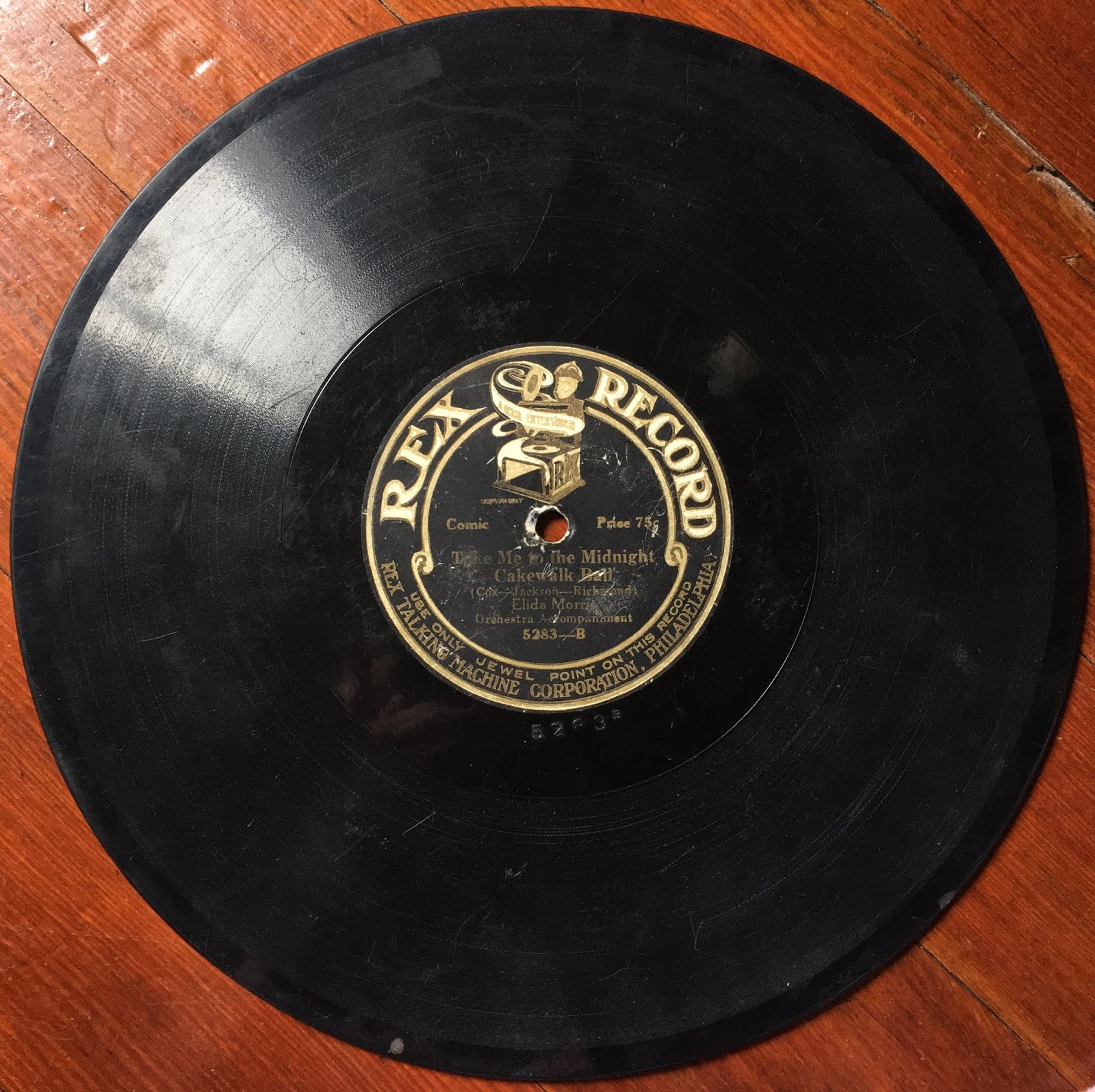
In keeping with the Hager subject, I have been on the lookout for some of his illusive Rex records. Those records were essentially the first of their kind, the first very successful American vertical cut records. Here's a nice example floating around on the internet:
These records sounded particularly nice in their day, and they seemed to have had the strangest titles associated with them. This label shows Hager's true colors, very expansive and diverse. The Rex label recorded everything from Grand Opera to Rag-Time piano solos by Roy Spangler who learnt them by ear.
Don't Believe me? Well here you go:


How about that?
Just like he did with Zon-O-Phone ten years before, Hager made sure the widest range of music was recorded, and recorded well for that matter. I have a single Rex record, and it sounds okay, but of course without the proper apparatus to play it it's bound to sound crappy. 
I don't have transfers yet, but here are the pictures:
That is the later edition of the Rex label, from 1915. 
The music is really nice on these though, as expected of Hager, the orchestra accompaniment is definitely more interesting than other studio groups of the time. Since it's 1915, the accompaniment is a pseudo-"Jass"style, which makes it particularly interesting. This is more so on side B however. As it turns out, these records are very uncommon, which is strange considering the circumstances of which I found the Rex record I have. I stayed in Los Angeles a few years ago and went to the Amoeba records in Hollywood and found that record buried in the old timey section at the back of the store. 
I was just in LA this last week and found nothing nearly as nice as that Rex record this time at Amoeba. I have gotten some nice Zon-O-Phone and Ossman records there in the past and recently, but the Rex record is the sole standout find from there. 

With that, I return to the Hager's. Unfortunately, it will take a lot more digging to find more on James Hager. On the entry for Fred, everything is there, but the information on the rest of the family is very vague. However, when I did a little more deeper digging I eventually found his WWI draft card! You can imagine how happy I was to find it, and definitely be assured that it was the right guy. 
Here you go:
How about that?
Tall, Stout, and brown eyed. 
Hmm.
That's quite different from how his matinee idol brother Fred looked. I do find it curious that his hair is stated as being already somewhat gray by age 36. Usually thats an indicator of red hair, but let's not get too set on that idea. Just keep that in mind with him. Finding this card also proves a much more exact birthdate for him, as well as that he was working as a musician long after the Zon-O-Phone era with Hager's orchestra. 


Anyhow...
I wanted to do a section here on the new phonograph I just got, but I will have to save that for the next post. I have a handful of really nice records to play and eventually get transferred. The machine I got is a really early Columbia Q with some nice eartubes to go with it. The discussion of the records will also be done in the next post, as there's quite a lot to talk about surprisingly. 


Hope you enjoyed this! 


Monday, September 4, 2017

Recording on Brown wax and new items of interest

I'm back! 
Again,  I apologize about the long times in between postings, but things have kept me away from the joy of writing so often...It's been very rather eventful around here and emotionally consuming for me, but that's okay...I'm young, and need times as such to live fully. 
Of the events that came down in recording and record world, I got to record on a brown wax cylinder! Thanks to my good friend Ryan Wishner, we made a deal where I would bring my pristine Amberol copy of "The Preacher and the Bear" by Collins(the famous take with the announcement at the beginning!), and he would give me the recording we made of me on brown wax. We managed to get a few cylinders recorded while at the Sutter Creek Rag-Time festival on August 11. As of just today, the cylinder looks like this:
Mine turned out to be the best blank to record on, since there were little to no issues, and the recording itself turned out wonderful, was the best in the batch I may add. 
I wrote out the title abbreviated on the slip just like I've seen Spencer do on a few of his brown waxes. 
To add to how lovely this record turned out, you can actually hear it!
Here you go folks:
I sent the recording to a few people without any description, and they were fooled into thinking it was actually by one of the studio pianists, or Hylands himself. This is not including the announcement of course. You know you've done it when people think you're the real deal! I've done it before, and would be happy to give lectures where I end up playing a transcribed solo of one of the studio pianists, and end up playing a brown wax of me playing and they wouldn't know the difference! The three of us who recorded brown waxes later performed at a set later at night where we actually played the records for the lucky people who attended the set. That absolutely mesmerized people, much like it would back in the 1890's. 
There's Ryan presenting the machine and one of the recordings, in his 1900's vest. That's a photocopied Columbia catalog on the table. 
The whole experience with the brown wax was completely worth it, and understanding the struggle of those studio pianists helps us better understand what they went through every day at work. To add to this new found understanding of recording, yesterday I spent six or seven hours recording for a CD I'll be releasing in the near future. After recording yesterday, I understood to a certain extent how tired Hylands must have been after every day at work. And to think that he would have to do that nearly every day, and for several hours longer than I recorded. He would usually have to be there at 8am and record until 3 in the afternoon, then a few hours later perform at an exhibition. What a life he lived...
I just couldn't imagine having to do that almost every day, and the days he didn't go to the studio, he'd be going to a few shows at other places in and around NYC. 

Another thing to move to in the items of interest is that very catalog that was seen in the picture above. One of my friends sent me a very nice high quality photocopy of an 1898 Columbia catalog that he had recently acquired. 
In the past, I have used a listing from 1900:
This catalog is rather nice, however, the photocopy of this one was not nearly as outstanding as the other catalog from two years earlier. The older catalog not only has a simpler cover, but the inside is must more tantalizing to even someone who wouldn't know much about the complicated nature of the company of Columbia. 
 That's the cover.
But the inside of the cover was a sweet surprise! There was an interesting-looking version of the very contract that most of the Columbia stars signed in 1898.
Now that's an interesting group of signatures. 
Will F. Denny's signature looks weird and as though it took a while to write out. Just as expected, Russell Hunting's looks lovely and efficient, almost as much as Spencer's always did. It is very curious that Denny's and Ossman's look unexpectedly strange. It seems we've got three potential lefties here...Ossman, Denny, and George W. Johnson. Hmm. How interesting...Of course that's just another one of my crazy theories, but there's always that possibility. In fact, if I was to guess who might be lefties in this group, I'd actually guess those three anyway, even without not knowing what their signatures looked like. 
All over this catalog are titles that we'd all love to hear, and hope they exist somewhere. One of these is the "Tapioca Polka" which would be an elongated arrangement of the tune the Columbia orchestra plays at the end of this interesting descriptive selection. This tune "Tapioca" must be a civil war era jig, judging by the melodies of the piece, and how it's quick one. There are countless other titles that would be gems for sure. Also in this catalog, each performer whose name is on the inside of the cover is given a section with titles they've recorded. Of course, Spencer's section is very specific, with his Negro songs having the most specific categories from "Picanniny songs" to "old man negro songs", it's very complicated, more than we'd ever expect from such a subject of "Negro songs". 
How specific need we get? Very it seems.
So his 1895 record of "Laugh You little Niggers" could be classified as a "picanniny song" which makes sense now. Since I could only see Spencer like the cartoon below while hearing him sing that song.
How lovely. What a beautiful sight it must have been to see him in such a costume. 
(remember folks, this is satire at its best, I am not trying to be meaningfully offensive to anyone)
Anyway, we still have to await until many of these desired titles turn up on those unmarked brown waxes. A few of them are indeed making themselves be known, such as George Schweinfest playing "The Belle of Koon-Tucky", which you can hear at this link here. We will get to hear some of these selections, though it is inevitable that any may not exist, at least anymore. 
Let me take a moment to say how wonderful that record in the link just above is...it's an outstanding example of true cake-walk music on brown wax, and it's an obscure but really strong and catchy piece, one that is arguably just as good as the Kerry Mills pieces from the same time. See, this is likely what will come out of digging up these cylinders. This is why we will continue to look. 


While I was gone, I was able to read one of the many famous letters Quinn sent to Jim Walsh. 
(Quinn in 1898)
His letter was rather short, only two pages long, but full of the usual of what to expect from reading only bits of his letters. Much of what he says includes lots of song references, some of which I actually haven't been able to understand! There's some slang, not too much to be really noticeable, and also very complicated and articulate phrasing. That sums him up pretty well, even for writing those letters when he was an old man with a fading memory. We of course already know that he was somewhat self-centered, from the way he phrased a lot of his writing, and how he talks about some of his old friends, but he was genuinely in love with what he did in the past, even though there seems to be something there to contradict that. In Quinn, after reading his letters(bits of others, and a single one the whole way through), I see a bit of repression, repression of things he did in the past, especially because he turned to a more religious point of view and didn't drink later in life. He had some shame in his past, despite speaking of his time in the studio fondly in his letters. There's certainly something there that we're not getting when we read his letters. It must have been interesting to know, whatever it was. 

Speaking of letters...I also heard details about the LOC also housing letters that Charles Carson wrote while he was on his Eastern travels, which must be just as interesting as Gaisberg's travels in the same places. What I have heard to far about Carson's travels to China and Japan are rather funny to me. Somehow the idea of him complaining about his conditions while traveling is rather funny. It have this connotation because of Carson being the man who was thrown in jail with Hunting in 1896, and remained his friend until they were old and long retired. He remained in the east from 1904 to 1907, writing back and forth to Columbia and to his friends back home, which must have been great to read his complaints. It's so pointless of him to complain so much, since it was inevitable that conditions would be different in Asia than what he saw on the East coast, and later when he was in San Francisco(wait what! He was near where I am? Hot damn! that's great!). I'm sure he got used to it over time, he was there for three years, and almost as soon as he got back to the U.S., he quit recording altogether, which remains hilarious to me. He quit all recording to become a poultry farmer! How strange...I guess when you've had enough--you've had enough. Carson still remained an advisor to his friends at Columbia after then, since he lived another 40 or so years after that. From what I've heard about his letters, they must be fascinating to read, especially since they must be scattered with scathing language, since he had the right to be bitter about the supposedly crap records he was getting out of the equipment the Columbia boys shipped to him in Shanghai. He had the right to complain about the equipment issues, since he was the man who invented the pantographing machine in 1892, along with his buddy Russ. And he made all those smut cylinders as well as getting thrown in prison for it, and managed hundreds of recording sessions at Columbia from 1896 to 1900. Remember...his name was stamped on many hundreds of record slips. He had experience that was envied by 1900, so he had some reason to complain, since he set his own standards very high from the start of his time in recording with one of the most important recording devices since the phonautograph. With all of this new found curiosity in Carson, I would love to see a photograph of him if there is one anywhere. And of course, more importantly I would love to see those very letters that he wrote to Columbia while in China and Japan. I'd also like to know more about his relationship with Russell Hunting, since they remained good friends for their entire lives, it would be interesting to know how they fared while doing all the smut cylinder business from 1892 to 1896. Their trust must have been monumental for to be together for so long. They seem like a fantastic pair in that progressive era!


I don't want to keep rambling on about new stuff, but I ought to say that my next post will be on that great book A Voice in Time which is the biography of Fred Gaisberg that isn't his memoir. Since August 10, I have gotten over halfway through the book and am still captivated by the amount of stories and anecdotes from Gaisberg's travels. What an eventful life that man lived! Though it's interesting to see him evolve from a shy and less-than-confident teenager to a musically refined snob and intellectual. I would highly recommend the book! The detailed comments will be written in the next post. 


Okay, this time I mean it, i'll be getting back to normal by writing  every day to few days, since there's so much more new information to gather and write detailed posts about, with that, I hope you enjoyed this! 


Thursday, February 23, 2017

Studios in the Public eye

Ofttimes, it would strike us collectors to wonder what the general public perceived of the strange place that was the Phonograph studio. In the timer period, it actually isn't too hard to find sections from magazines and newspapers about this strange new industry. Much like how electricity was such a nationwide fascination in the 1880's and 1890', the recording business could be categorized in such a way as other new inventions and novelties were. These magazine and newspaper articles often tried to not impose any bias to record companies in their articles, as that would often spark some uneasiness between the competing companies. Unlike The Phonogram and Phonoscope, the unbiased nature of these sections was essential, an this is why we get infernal images like this one: 
Ones like this that haven't any labels or anything to go along with it, the damn articles leave us hanging to fight over who the pianist and singers are(to most it would be the singers, the pianist means nothing to most collectors...). The dodging of bias is all-right when considering magazines like The Phonoscope, but it's frustrating because we end up with unlabeled images. Now that section that the infamous image above came from was obviously talking about Columbia more than anything else, since it used Columbia images for the article. Keep in mind that the image on the cover page of the article is this one: 
Now we know that image can't be of the Edison studio. That pianist is obviously Fred Hylands. It doesn't help that both of the images have the same interesting wallpaper behind all the musicians and such. In fact, it's likely that these pictures were taken in EXACTLY THE SAME room, which is very odd, but if you really study the images, you can see it. 

Now what did the general public think of the studio? Let's stick with Columbia here, since most of the papers who wrote about studios were indirectly writing about Columbia rather than Edison(come on, everyone knew about Edison already...). Well, to start, the papers used to say it was much like a cross between "the rear of a theater and a machine shop", which does sum it up rather well, but that's only the appearance. They missed much of the odd social atmosphere that came along with this new community. The public generally saw these studio workers as eccentrics(which wasn't inaccurate), this is the record talent I'm referring to here. The studio laborers, such as engineers like Charles Carson and Georgie Emerson, were the more respectable of the bunch, since they worked with machinery and were often products of telegraph and telephone jobs in the 1880's. The record talent were, as we know, a weird bunch of freak musicians and performers, that were often questioned about what they thought of the business, and why they worked there in the first place. Of course, the lovely and infamous exhibition is where the freaks of the studio and the public were able to converse. 
There are countless articles and stories published in the pages of The Phonoscope about interactions between all sorts of people and the exhibitors. This seemed to be a popular subject in The Phonoscope, for the entirety of its existence. Without a doubt, these little stories about exhibitions are among the most interesting examples of writing in the magazine, most of them being in the Our Tattler column. Some of them(many of them actually) are somewhat racist, portraying Black and Asian people in stereotypical ways for the era, but are still funny by the humor that is being projected, despite the racism. The reactions of those described are really what the correspondents and writers for The Phonoscope were intending to sketch. One thing that would have been really funny to do is if they asked each of the recording stars(including engineers and pianists) what their first experience with the phonograph was like. That would prompt some interesting and exceedingly diverse points of view, certainly would make for some good reading! There are little hints of what these stars did in their earliest days in the business, but not exactly stories of how they started. From knowing Dan Quinn's first experience with the phonograph, this ought to spark curiosity of other stories. 

Of course, the only time that regular people got the chance to see Columbia in action was at exhibitions, and this gave a unique viewpoint to the public. It made Columbia seem more like a theater than a recording studio, especially since they had a specific bill for the evenings, with certain performers featured. It didn't help that the pianist(Hylands) was dressed in semi-formal clothes for many of these(he would certainly have needed one of those three electric fans in the dead of Summer...) as though he were going to Pastor's again to play in the pit. 

Yep. 
Of course, how could you have missed this brightly gleaming studio at 1155 Broadway, with supposedly 800 electric lights contributing to the spectacle. Certainly that bright place was hard to miss, and this was stated in the July, 1897 issue(really meant to be dated at January or so) of The Phonoscope where the still relatively new headquarters was described in detail as something that "attracts the notice and excites the admiration of every stroller on Broadway", which isn't too inaccurate, as it's likely that big celebrities dropped in on the exhibition parlor, like Diamond Jim Brady and Lillian Russell(that would have certainly caused a stir!). 

Oddly enough, describing what people would have thought of all this reminds me of the hilarious descriptive selection the Columbia Orchestra did called "On the Midway", because it kind of sums up 1890's Columbia in a nutshell, even for someone who wasn't a regular Columbia customer or enthusiast could have understood their atmosphere when listening to this record alone: 
The fact that they spend almost a minute on the "hoochie coochie" dance part is really funny, because the Issler original from 1894 didn't even do that. The vibe of the 1898 recording is certainly looser, and much more playful. By 1898, people got a very different view of Columbia than if they had gone to an exhibition of the U.S. Phonograph Company(remember that they essentially fell and became Columbia in 1897) in 1895, or even as late as 1896. Just because I'm listening to it as I'm writing this section, here's the original 1894 Issler's orchestra recording of "On the Midway": 
Also, I didn't notice this until listening to is now, but there's some audible humming of the tune at the dance part at the end, and it sounds like it's probably Issler! Wow, something about that image is very strange. What's funny is that if Issler and his orchestra ever performed this sketch and all dressed up for it, Issler would have genuinely looked Arab. 
Yep, he could have fooled the audience as an Arab just as well as Spencer did as a dandy black man. 
Imagining the rest of the orchestra dressed up for this is just as funny. Just go back and look at that picture from the record catalogs showing images of all the Issler members around 1894. 
Include Len Spencer in this as well, since he did all the sound effects! 
Anyway, with all of this, it's safe to assume that the general public was fascinated with the early recording studio, as well as those who worked there, from the earliest days. Though in the earliest days(1888-1895), the public wasn't really able to fully immerse themselves in the world that was recording, since in that time only large scale demonstrations were done, rather than just exhibitions at the studios themselves. Of course, Edison never did such a thing(invite regular people in the studio to observe the recording process), even when doing this was fully in style. The fact that Columbia did this in their studio is another reason why they really were the company of the people, and were more inviting than Edison. Despite an incompetent recording manager(Vic Emerson), Columbia was the place where musicians were better treated, and had more freedom, thanks to Emerson being musically ignorant and tone-deaf, we get all sorts of strange takes with mistakes all over the place, of which we continue to find 120 years later. We must keep in mind that we are much more aware of the inner workings of the business than the general public was in the era itself, so we are not nearly as nearsighted they the listeners when the records were new. When you get right down to it, we know more about what we're hearing than most did who heard the records when they were new. 


Now to move to something a little different. Last evening, while listening to some records with Charlie Judkins, we listened to a bunch of Zon-O-Phone's with Hager on piano, since those are always fit when talking about early recorded Rag-Time. But other than that, we also came across a FANTASTIC 1905 Columbia with Lew Dokstader singing! 
(Geo.Primrose is seated and Dockstader is standing, image dated 1898)
Most of us have stumbled across sheet music with Dockstader on the cover, since he was on countless coon song covers, and have read often of his famous minstrel troupe. Many famous early rag pianists held the place of Dockstader's pianist, such as Mike Bernard and Les Copeland, but often us studio pianist scholars would wonder if any of the studio pianists held this place, well, we're in luck! 
This 1905 Columbia(also issued on Standard as I've heard) by Dockstader of "Everybody Works but Father" is a prime example of not just Dockstader, bu also of Hylands when he accompanied stage stars(solely stage stars, not minor ones like Quinn or Ossman, ones who were so famous not to be regulars in the studio). Dockstader was one of these huge celebrities in performing at this time, and luckily, he left a few recordings along the way like May Irwin and Clarice Vance. Before I get into detail, here's the 1905 Columbia: 
You can easily tell that Dockstader was really loud, hence the reason he's standing rather far away from the horn. 
This is one of those records where Hylands must have gotten all warm and fuzzy to accompany such a celebrity on a recording. He had likely already worked with Dockstader, so it must have been like when Hylands and Harlan were reunited in the studio in 1901, though of course meeting Dockstader again was a little less than the more casual atmosphere of seeing Harlan once more.

 The recording above is certainly one of the best examples of true minstrel show performance, since Dockstader had been in minstrel shows since the 1870's(according to The Monarchs of Minstrelsy), and he had spend many a  year perfecting the style of the classic minstrel performers in the years prior to the civil war. Despite the modern material, Dockstader sets the old-fashioned mood with his vocal style, and of course Hylands tops it off with his already archaic and folksy playing style. Though the record is pairing the old guard with the "young'un" so to speak, the duo ends up surprisingly well composed, despite Dockstader being nearly 20 years older than Hylands. Just goes to show that even Hylands wasn't the most progressive of the early studio pianists, and could replicate the Appalachian folk style of the mid to late 19th century better than even Edward Issler, who was just as forward thinking musically as Fred Hager and Banta were, despite the significant age gap. 


Hope you enjoyed this!