Showing posts with label Rex records. Show all posts

Sunday, July 7, 2019

The studio pianist speaks and more new transfers

In the last week, I got a few interesting items in the mail. I had some issues with Ebay a few months ago, so I spent a bit of a hiatus away from Ebay. The sheet music market proved quite fertile in my time away, as I kept hearing of wonderful pieces of sheet music and records for sale. Nothing soul shaking for me luckily. Nothing like a pristine copy of "The Darkey Volunteer" or "Handsome Harry". 

So, I finally have gotten back into getting things on Ebay, and this last few weeks' items are very interesting. For a little while now, there have been a few postcards from the 1900's featuring song lyrics floating around on Ebay. recently, it was brought to my attention that a few of these cards had a particular publisher's name at the bottom. 
A few of these cards were published by Helf and Hager!
(well yes of course I chose that one)
I had no idea that these were made! Imagine my surprise upon seeing this. So, with this new found knowledge, I am wondering which songs of theirs were used for these cards. Recently I went digging through copyright records to see what oddities could be found, and should keep the eyes peeled for. There were lots of interesting pieces present, including some unexpected names!

To go on a bit of a tangent for a moment, my theory of Hager always having an arranger is closer to being proven. Just from all the digging through copyright records, there seems to have been an arranger for at least 90% of his pieces I have seen so far. I still have more things to dig through to definitively prove this, but it's looking good so far. While on this recent dig, Herbert Clarke made a few appearances as Hager's arranger! That got me curious about Hager's connection with Victor. Thanks to bits of Hager's own scrapbook(I do not own it), he saved a few clippings regarding his special trips to Victor in Spring of 1903. So we know he stuck around at Victor until at least the late fall of 1903, but how connected did he really become with Victor? Maybe when he became a publisher all the record companies jumped at him. His already high status must have been heightened when he became Mr. Helf's secretary. 

Anyway, i hope to snag some more of those Helf and Hager cards. Now that I know they exist, I'll be looking through most piles of old postcards at antique stores until I find another. 


So what's the highlight of the recent finds? Well, it's definitely an OkeH record! Now that I have been studying bits of Hager's personal collection, I have been anxiously searching around for OkeH and Rex records. There's actually a lot of material I find interesting and fit for my collection on OkeH, especially now that I own the physical evidence of Hager's involvement in the field recording projects of 1923 to 1925. So what is this record I got? It's a record I have heard about for awhile actually. Before all the deeper digging into OkeH and such, I saw this record listed and wondered what it would sound like. Well here ya go:
Seems simple enough. 
I had no idea what to expect from this. The performer listed is what is most attractive here, as it is something that is uncommon, though it paints Ring out to be the star. Well, considering my ever growing love for Justin Ring, this record seemed a perfect addition to my collection. 
But holy crap! When I played this thing I just about passed out! I couldn't believe my ears. That voice...the voice at the beginning. It can't be...but it must be! 
The pianist speaks! Yes indeed folks, that is the voice of Justin Ring. 
(Ring in 1903 courtesy of Jason Sanders)
Now this record other than Ring's(quite pleasing I might add) voice at the beginning, isn't too special. Most of it is a celeste solo, which is pleasant, but not outstanding. But of course because this is my collection we're talking about, this record is invaluable. It holds the loud and clear words of Justin Ringleben, a significant rag-time pianist and composer, and important background figure on thousands of recordings. 

So how could this be used in relation to other records? 

The first thing that came to mind was that 1902-ish piano solo on Columbia. You know, that one I highlighted in a post a little while back? 
So after a few more months of studying Zon-O-Phone's and Columbias back and forth, I think I may have unlocked the mystery. When I did the post on this record awhile back I really was thinking the pianist was Hylands. But after more close examination of Hylands' whereabouts and Ring's invariable presence at Columbia, this is seeming more of a confusing mess. The most important thing to note about the 1902 record(0ther than the piano playing) is that announcer. In the post about this Columbia piano solo, I broke down the announcement, word by word, with the dialect dissected. 
Here's the record to refresh the mind of it:
That announcer really stands out. It's not someone recognizable to a collector of Columbia's of this period. It's not Harry Spencer, Joe Belmont, Tom Clark, or Quinn. Now that I have a very clear example of Ring's voice, I have been doing comparisons like mad to try and figure it out. I am really not sure what to say, as the announcer is almost definitely the performer. This has been itching at me or the last few days, as these two records should technically have the same voice at the beginning, but I am really not sure at all. This has been a great source of conflict, now that the perfect example of Ring's voice is in my hands. 

Anyway, if any of you have input about the comparison between the 1902 and the 1922 records, please comment! I'd love to read your input. 


After that OkeH came in the mail, I went searching for more example of Justin Ring's playing on that label. There's a fair amount of it that was issued luckily. The more I dig for them, the more I seem to find. It seems that later in his days in the studios, he became a better accompanist. He evolved, and that's a good thing. His odd sense of time became smoother as times changed. One particular record captured my heart. It's been awhile since I fell in love with a record in such a way, but this one did it. It seemed so generic, but it was heavenly. (I'm learning this is a pattern with the OkeH records I am going after).


Luckily they really had some of the best recording technology there, so the piano comes through astonishingly well. Ring's old sentimental style comes through on this one. Compare with this 1900 Zono:
His sweet playing remained the same, which is nice for me studying his accompaniment style. What's interesting is that his rhythmic playing was still just a little bit out of whack in the early 1920's. Not nearly as eccentric as his early records for the Zon-O-Phone, but the soul is still there. 


Anyway, before I close, I'd like to share another new transfer. This one is another Spencer and Hylands! Yes I have been face deep in Ring and Hager studies, but I still return to the classic Rag-Time pair of Spencer and Hylands when Ring's eccentricities prove too much for me. 
This particular record is an early one for Spencer and Hylands, 1897 in fact. These early ones are the most essential for pinpointing when Hylands began working for Columbia. 
The piano sound is that signature terrible tone of 1897-1898 Columbias. There are some interesting bits the accompanist plays here, including bass heavy inversions of chords in the left hand at the vamps. Naturally, I would assume that in itself to be a Hylands characteristic, and logically it would be, as I have heard him play that often. In my last post I highlighted a 1902-ish take of "the Laughing song" by Johnson, and how the vamps are lumbering, as they were on previous takes by Johnson, and this is similarly present on this 1897 Columbia. 
Here's that 1902-ish Columbia from the last post:
Similar accompaniment style overall. And I am CERTAIN that the pianist is Hylands on that 1902-ish "Whistling Coon". Despite all that I have been learning about Ring and Hager's involvement at Columbia around that time, Hylands was still there occasionally. Of course when that happened he thundered in and pushed aside Ring and Hager with a domineering heave, as they were slowly taking his place. 
Anyway, that 1897Spencer and Hylands is fascinating, even though there isn't a piano solo at the very end. 


Hope you enjoyed this! 


Tuesday, October 9, 2018

Victor Herbert, Hager and Justin Ring

In the last few weeks, after doing that last post on the Hager brothers, I have been digging into trying to really create a definitive piano style to use to identify Hager. It seems that I have finally gotten a baseline for what piano style is Hager's, and it actually came to me in a flash. 

I have been searching around for a compositional style that could be connected to and sound a lot like Hager's, based on the orchestra records and piano accompaniments, and amid a moment of idle listening, it hit me, this piece transcribes out that very Zon-O-Phone pianist style:

Victor Herbert! Of course. It made so much sense after thinking it through for a little while. So why does this make sense? Well, think of all those "Victor Herbert's Band" records from around 1900-1903, those were directed by Hager. As noted from that panoramic portrait of Hager's orchestra, it's clear that Hager plucked most of Herbert's musicians for his own studio ensemble. With that in mind, I did a playful mocking cartoon of this:
Of course, Hager's all decked out for Mr. Herbert's Babes in Toyland, showing his unbound respect for Herbert. 
I have no idea how Hager got to know Herbert, and what he had to do to get so many of his musicians to record with him. With that aside, Hager was close friends with Herbert, and now that I've studied a bunch of Herbert's piano music, I would be assured enough to say that they were such close friends that Herbert's style rubbed off on Hager. Now to get into some of the technical aspects of this connection, take a good listen to that version of "Panamericana" in the link above. Much of what I've previously described about Hager's piano playing corresponds very well with that piece. The quick and jumpy octaves in the right hand, the dense chords in the left hand, and more bass heavy inversions of chords in the left hand as well. Do take into consideration the exotique rhythm that the piece takes on, it's similar to the daring, advanced "west Indian" style rhythm that I have heard played on many early Zon-O-Phone's. Much like Hager's musical mindset, Herbert's very complicated orchestral outlook comes through in his piano pieces. There's a lot going on at any given time, and there's just enough space left for unusual rhythms and really rather jagged syncopation. Herbert's "Panamericana" is really what ties Herbert's and Hager's styles together, as every characteristic is there, and it combines an older musical mindset with the modern syncopation idea. 

So this all makes sense when taking into consideration Hager's upbringing musically, as he wasn't really from too far west to have a very distinct piano style, and being much younger than the older rag-timers and minstrel performers he knew, his style was really neutral to start with, though maybe having traces of the Indiana-Ohio style, being that he was from rural Pennsylvania. Being as curious and open-minded as he was musically, it would make sense that he become so infatuated with someone like Victor Herbert or John Philip Sousa(in this case thinking more of his comic and operetta works). Hager was also a music student, taught in the New York conservatories with a full scholarship to get him through, so he was basically exposed to everything. What Hager heard was likely twice the diversity of what Hylands or Banta heard throughout the first 20 years of their lives. But like Herbert, Hager had an especial affinity for the more taboo syncopated negro music. That was something he was likely told to stay away from while in music school, as he was studying violin under Antonín Dvorăk, despite obviously studying syncopation, it could have only been looked down upon in that environment. 
To provide another good example of Herbert's and Hager's crossover styles, here's another characteristic dance by Herbert:
https://www.youtube.com/watch?v=AoJ-w5FcZSE
I'm pretty sure this one was recorded around 1905. But anyway, seriously take a close listen to all the distinct characteristics in the piece. They are quite similar to that early Zon-O-Phone style that I am rather certain of being Hager's. 
Here are a few Zon-O-phone records with that accompaniment style, just to give you a refresher on this:
https://ia800609.us.archive.org/34/items/CollectedWorksOfJohnTerrell/TaintAGoinToWeepNoMore1902_64kb.mp3

https://www.youtube.com/watch?v=qi8K8iKZyXM

https://www.youtube.com/watch?v=X59v3OASjVg

This brings me to the next part of this post, Justin Ring. 
On my digging ventures for Ring and the Hager brothers, I noticed how similar Ring and Fred Hager were. Their relationship starts around 1900 or so, as Jim Walsh used to write(the picture above of them was a little vignette in one of his articles). Even with Walsh dropping that early date of them being together, I am still not entirely sure when they got together. Though, it is likely however that they got together around 1899, thinking of the starting of Zon-O-Phone. I would guess that at the beginning of Zon-O-Phone, Hager dragged in the young and fresh Ring, along with his 17 year old brother James. With Ring stuck at Zon-O-Phone, Hager got him to work  as the pianist for his studio orchestra. On records as early as the beginning of 1900, such as this one here:
https://ia800604.us.archive.org/7/items/CollectedWorksOfTheZonophoneOrchestra/DarkiesJubilee1900_64kb.mp3
It's highly likely that Ring is that pianist we're hearing. In 1900 it wouldn't surprise me if that's the case, as this picture was taken only a year or so later:
(I have come to the assumption that this picture is from 1901-1902 because the description states that they're in the Columbia studio, which at that time would have been Climax-Columbia-Zonophone, etc)
There's Ring, the young hot dandy of the orchestra. 
Other than his recording history, I know nothing of Ring. I know he was a composer his entire life and married rather late, but not much more. Overall, it seems Ring followed Hager wherever he went in the recording and publishing business, but that's not a bad thing in this case! Ring started at Zon-O-Phone with Hager, tagged along until the bitter end in 1912, then went to Rex right after, and after the fall of Rex stuck with Hager until Okeh let them go around 1922. 
(that's Justin Ring with the baton! This is the Okeh studio around 1920)
So what about his piano style?
Well, that's where it gets a bit sketchy. Now that I have a pretty good understanding of Hager's style, I need to figure out what any other different pianist sounds like on Zon-O-Phone. Luckily, I know of a few records that contain suspiciously different accompaniment styles than the dense and complicated Hager style. The first one that comes to mind is this Zon-O-Phone from 1903:
https://archive.org/details/MustYou1903DanwQuinn
This has vey different accompaniment from say, the "Bill Bailey" take a bit above. Now this pianist on this particular record is very precise but also loose at the same time, similar to Hager, but much less daring with improvisation. Though I must admit that this pianist is very outstanding as an overall accompanist, much to the likeness of Edward Issler actually, and that's quite a high comparison. Despite the little technical hiccups throughout the record, the pianist has exceptional rhythm, keeping constant the entire record, just like Issler did a decade before. This constance with the accompaniment definitely shows quite a dramatic contrast to the more rowdy and dense style that Hager played on early etched label Zon-O-Phone's. Something that ties these styles together is the preference to play more bass heavy chords in the left hand, which ties together Hager, Ring, and  Victor Herbert's styles. This slight characteristic is all over the place in Hager's written music, and even in Ring's rags as well. 
So let's say this more tame but musically outstanding pianist is Ring. It would most certainly make sense according to the logic, and taking into consideration the things that tie the styles together. I do not know about Ring's musical background, and of course knowing something would be helpful in trying to figure this out. I do know that Ring was the son of a musician, so he had been playing music earlier than Hager most definitely. what that has to do with his piano style, I cannot say. I know Ring didn't attend music school, unlike Hager, who did and studied under great masters form Europe and the U.S., so in this case I would assume Ring to have more natural talent musically. Usually almost perfect to perfect rhythm yields the highest natural ability musically(0ther than perfect pitch, that's what Banta had!)
So let's listen to Ring's rags, just to get some kind of foundation for this style:
 https://www.youtube.com/watch?v=UvbqEUoZS-Y

https://www.youtube.com/watch?v=d3Vaj_YEloY
One thing is for sure, there are definitely some quirks in that style. 
Like Hylands' and banta's styles, Ring's was just enough quirky and weird to well be distinguished, and this is purely from the sheet music! In Ring's style there's also a mix of all the styles on records in the brown wax era, which makes sense, considering his age and propensity for music. 
When I listen to a lot of these piano accompaniment, I often switch who I think is who on these records, since I really have no idea which feel goes with which. Though, as I'm writing this I'm starting to get a strong feeling that this pianist is Ring:
https://www.youtube.com/watch?v=aBZLwO5P7jM
https://www.youtube.com/watch?v=aaTarCSS6gc
I hear very unusual eccentricities in those accompaniments, the kind that are scattered all over his "Sweet Potatoes". I have assumed the slightly more bluesy style on many Zon-O-Phone's, as the one I associate with Hager is much more classical and controlled.  I have heard some early Zon-O-Phone's with pretty strange and whacked accompaniments, full of small mistakes and unusual bits of syncopation, more so than the dense Hager accompaniments. One thing is for sure about these Zon-O-Phone accompaniments, there is definitely more than one pianist scattered on their records, and it seems to really only be two distinct styles throughout, which makes narrowing down who they might be much easier. 
Keep in mind that I do not know which pianist is Hager and which one is Ring, and sometimes I switch the style with the guy, maybe because of something I heard, but what I explained here is overall what I think Hager and Ring were in terms of piano accompaniments on Zon-O-phone's. 

One thing that I've always found rather funny about Hager and Ring is that they seemed inseparable to the end. Even after they went their own ways after the studios in the mid-1920's, they still lived rather close afterward, eventually both moving to places in close proximity in Florida for retirement. Though Hager died before Ring, they were exactly the same age when they died, 87. 


Since I've exhausted this topic so much, I promise that I will speak of my recent sheet music acquisitions and my meeting with John Levin in the next post. I promise I'll stay away from pianist analysis in the next post! Before I close out, here's an outstanding Arthur Pryor piece played by Gilmore's band in 1902. This is a recent addition to the Santa Barbara website, and how it's great:
http://cylinders.library.ucsb.edu/search.php?queryType=@attr+1=1020&num=1&start=1&query=cylinder17130
Whats's especially great about this piece is that Pryor's stylistic extraction is exactly the style that this piece is imitating. Pryor's regional style was of Missouri-Arkansas, which is one of the most dense and authentic styles out there. This piece has a lot of trombone action going on(well durr...of course it does), and some really nice syncopation, executed very well by the peerless Gilmore band. 


Hope you enjoyed this! 


Friday, July 27, 2018

The Brothers Hager

As stated in the last post, I promised to do a post on the Hager's, so here goes.

When that big panoramic picture of Hager's orchestra was sent to me almost a year ago, it shocked me at the amount of detail there was in the description. Every single person was identified, even the recording engineers. Even the mysterious Charlie Carson was identified in the picture(he was Russell Hunting's right hand man with the smut cylinders in the 1890's). 
Just to give you an idea, here's the picture in its entirety:
That looks like a fun group!
Hager is stated as being no. 10, right in the center. 
There he is! ❤
A lot of Hager's musicians were part of Victor Herbert's orchestra(what a surprise!) and many were also symphonic musicians. Of course Hager had the most diverse orchestra in terms of each musician's extraction, in considering his wide range of friendships and partnerships. He knew everyone in the Symphonic and operatic community to the highest regarded vaudeville performers. Hager clearly knew what's up, in terms of music that is. So in considering this, we would assume he got the best percussionist he could find. 
Well, that turned out to be his brother. 
Yes indeed folks, that "James Hager" that is listed behind Fred Hager is indeed Fred's brother. Those two looked too similar for them not to be related, so after I did a little digging on Ancestry, it turns out that James was the youngest of the Hager's. Fred was the oldest, and James was the youngest. There were four Hager's:
Fred(b. 1874)
Lena(b.1878)
Georgina(b. 1880)
James(b. 1882)
Fred couldn't find a better percussionist? Well, I guess it's always good to get a sibling some work. 
There they are! They so look like brothers!

So there you have it, Fred's brother James is that percussionist on all those records. For years I had wondered who that weird percussionist was, since they weren't always great, but when they were it formed perfectly to the orchestra. Fred started the orchestra in 1896, and it seems likely that he wouldn't have forced brother James to play all their gigs until at least 1898. Rather than having him join at 14, waiting until he was 16 seems a little better. Or maybe I'm wrong, maybe Fred got him to join just as he started high school in 1896! Of course to illustrate this I have a cartoon!
Yep. 
I was thinking back to those stories that Fred Van Eps recalled to Jim Walsh about him pulling Frank Edgar Banta out of high school to make records and play gigs with the Van Eps trio. The Hager thing reminded me of the Van Eps-Banta story. 
There's some sort of gratification now going back and listening to all those Hager's orchestra(and Zon-O-Phone orchestra) records, knowing that the percussionist is Fred's brother James. To make things a bit more interesting, James Hager is listed on a few Edison records around 1903, which is around the time of that panoramic picture, and when the Edison catalogs were raving over Hager taking over their orchestra. Here's the most popular example:
It's funny that the Edison people were consistent with the "James W." in identifying him, even though that's not really what his middle initial was. That must have been used to closely place both Hager's, and maybe make it more assumed that they were related. 

When going back and listening to those Zon-O-Phone records by Hager's orchestra, it becomes clear that brother James improved as the years went on. 
By 1909, James was playing spot on with the group:
When we dig back to 1900 however, it's still a little bit out of whack, but of course still far surpassing all the other studio groups at the time:
And to think in 1900 the Columbia orchestra still sounded out of whack because of Hylands! 
I'm sure with the exciting motivation of making records brother James was determined to improve, and make the records sound much better, which they did by 1906 or so. With this in mind, Fred wrote many arrangements that were heavy on the percussion, and it seems evident why this was so now. 
His pieces were strange, but very fun and complicated at the same time. Recently I got a two sided mint condition Columbia of two Hager pieces played by Prince's band. 
Here's the more famous Hager piece side:
His tunes are deceiving, they sound solely novelty and playful, but are endlessly complicated and require a skilled percussionist! (no sitting around back there counting!)
Here's the flipside:
This particular side was a modern marvel of its time. It clearly exhibits how advanced the quality of recording was by 1915, and it shows also that Hager had tried everything to create a symphonic natured recording without an entire symphony. Hager wrote these highly descriptive pieces around 1907, and it would make sense that he did. Being a dad with three young daughters, it would seem almost expected of him to write such sweetly novel pieces as these. It also makes sense now why there's so much percussion on these; to exhibit the talents of his brother James, and to show off all the weird sound effects they had dug up after almost two decades of recording. 

In keeping with the Hager subject, I have been on the lookout for some of his illusive Rex records. Those records were essentially the first of their kind, the first very successful American vertical cut records. Here's a nice example floating around on the internet:
These records sounded particularly nice in their day, and they seemed to have had the strangest titles associated with them. This label shows Hager's true colors, very expansive and diverse. The Rex label recorded everything from Grand Opera to Rag-Time piano solos by Roy Spangler who learnt them by ear.
Don't Believe me? Well here you go:


How about that?
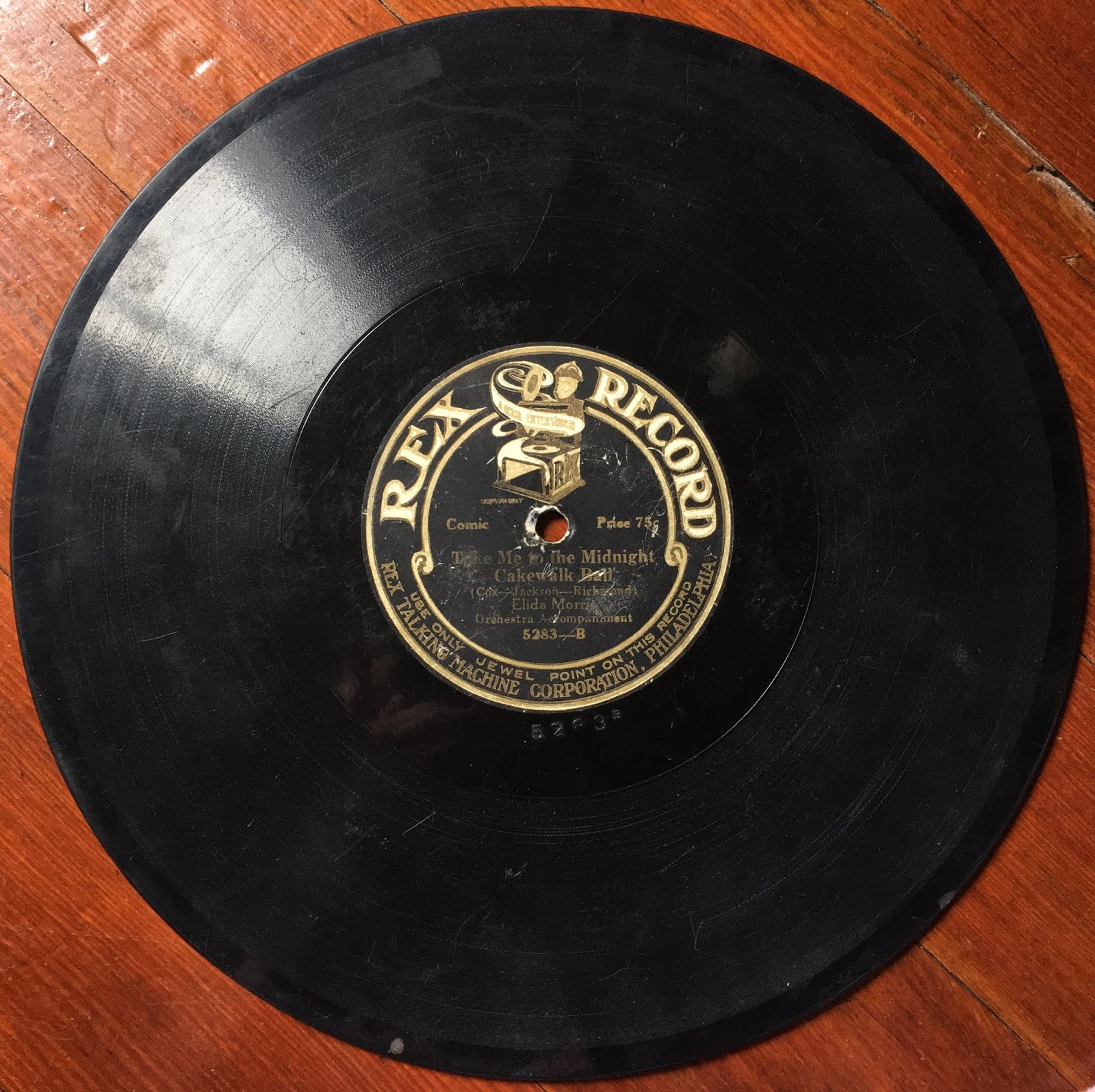
Just like he did with Zon-O-Phone ten years before, Hager made sure the widest range of music was recorded, and recorded well for that matter. I have a single Rex record, and it sounds okay, but of course without the proper apparatus to play it it's bound to sound crappy. 
I don't have transfers yet, but here are the pictures:
That is the later edition of the Rex label, from 1915. 
The music is really nice on these though, as expected of Hager, the orchestra accompaniment is definitely more interesting than other studio groups of the time. Since it's 1915, the accompaniment is a pseudo-"Jass"style, which makes it particularly interesting. This is more so on side B however. As it turns out, these records are very uncommon, which is strange considering the circumstances of which I found the Rex record I have. I stayed in Los Angeles a few years ago and went to the Amoeba records in Hollywood and found that record buried in the old timey section at the back of the store. 
I was just in LA this last week and found nothing nearly as nice as that Rex record this time at Amoeba. I have gotten some nice Zon-O-Phone and Ossman records there in the past and recently, but the Rex record is the sole standout find from there. 

With that, I return to the Hager's. Unfortunately, it will take a lot more digging to find more on James Hager. On the entry for Fred, everything is there, but the information on the rest of the family is very vague. However, when I did a little more deeper digging I eventually found his WWI draft card! You can imagine how happy I was to find it, and definitely be assured that it was the right guy. 
Here you go:
How about that?
Tall, Stout, and brown eyed. 
Hmm.
That's quite different from how his matinee idol brother Fred looked. I do find it curious that his hair is stated as being already somewhat gray by age 36. Usually thats an indicator of red hair, but let's not get too set on that idea. Just keep that in mind with him. Finding this card also proves a much more exact birthdate for him, as well as that he was working as a musician long after the Zon-O-Phone era with Hager's orchestra. 


Anyhow...
I wanted to do a section here on the new phonograph I just got, but I will have to save that for the next post. I have a handful of really nice records to play and eventually get transferred. The machine I got is a really early Columbia Q with some nice eartubes to go with it. The discussion of the records will also be done in the next post, as there's quite a lot to talk about surprisingly. 


Hope you enjoyed this!