Showing posts with label Frank Edgar Banta. Show all posts

Friday, March 29, 2019

A Portrait of Frank P. Banta

Today we celebrate the birthday of Frank P. Banta, perhaps the most beloved studio musician of the entire acoustic era. 
It's hard to begin with this guy. 
I guess I could just write out an affectionate bio on him, just because I have gathered more information about him since the last biographical post on him. Well, here goes. 


Frank P. Banta was born on March 29th, 1870, the middle child of five. His father John was a woodcarver, a noble profession in Victorian New York, but perhaps more interesting is his mother's story. His mother  Fannie Darrow married first around 1863, but her first husband died quick, so she remarried an old man named John(Frank's father). Fannie was a rich girl, from a prominent old Dutch family of New Amsterdam. Her many sisters married prominent New York men of money, but she married a poor woodcarver in his middle age. Frank was the only musical child in the family, and it began to show quite early in his life. As a young child, Frank began to take up piano tuning, as his perfect pitch rendered him a skilled tuner. He started tuning pianos in factories, before they were sent off for sale. It was in this line that he began to develop a talent for playing the piano. His mother likely took notice of this tendency soon afterward, and got him some piano lessons. Though, it is likely that he didn't remain under the rule of a teacher for long, as his distinct style developed later proves for little training and more natural ability. 

Frank likely kept tuning pianos in his teen's to get some extra money, and also played some gigs here and there too. By 1888, his name was starting to appear in the papers as a specialty accompanist and arranger. His praises were already being sung before he was even 20. By 1890, he was playing in vaudeville houses all over New York, accompanying singers and instrumentalists of all kinds. Around 1892, Banta became associated with banjoist Vess L. Ossman. 
Ossmand and Banta advertised together, 1893. 

Somehow, in that same year, Banta was plucked out of the vaudeville houses to work for the three year old North American Phonograph Company. It's possible that Edward Issler recommended Banta to the North American/Edison management. Banta spent a few months of 1892 getting the training of phonograph accompaniment. Likely under the rule of Issler, Banta learned the phonograph ropes, and by 1893 was ready to work for them regularly. Other than working regularly with singers and other performers, Banta was often brought into the studios by special request of Vess Ossman, as they were still engaged together as an act at that point. Ossman as many recalled, was a very difficult man to work with. Someone as quiet and modest as Banta likely clashed with him often. Despite that, some of Ossman's best recordings have Banta's accompaniment, as they worked together perfectly in spite of their extreme differences. Banta likely learned how to work with these sort of performers by touring with Ossman, and it would inevitably come in handy as his years in the studios went on. 
Around 1895, Banta formed his own orchestra, a small parlor orchestra of about 6 musicians at most. Considering his close partnership with Issler, he formed this group to the striking likeness of Issler's orchestra. Banta's orchestra even recorded many of Issler's arrangements, such as "The virginia skedaddle", and "Her golden hair was hanging down her back". You can hear one of them below:
Banta is of course the announcer and the pianist. 
Banta' orchestra faded away from record catalogs by 1896, but at that point Banta was secured with Edison. 
By 1896, Banta was with Edison all the time, playing accompaniments for all who worked there, but of course it didn't take long for other companies to jump at him. As his praises continued to be sung by all, the Berliner gramophone company grabbed him in 1897 to replace the increasingly absent Fred Gaisberg. Berliner promised Banta more variety, and his own orchestra again. At Berliner, Banta led the Metropolitan orchestra, or at least sometimes. 
Banta was working for Edison and Berliner at the same time in 1898, seeming to equally balance his time at both. 
He had left the majority of his performing behind at this point, slaving away in two studios seemingly day and night. Some say that during his time recording, Banta was on half the recordings that Edison issued. Half. 

Half would mean thousands, perhaps more than that considering how early he started. 
In 1900, Banta, Arthur Pryor, Christopher Booth, Noble McDonald, and a few more Berliner musicians joined the newly formed Victor company. Each of these musicians made a piano solo for them in 1900 or in the few years afterward. Banta replaced his engagement with Berliner with that of Victor, working at Victor almost as much as he was at Edison. His distinct and steady accompaniments can be heard extremely well on Victors and Edison records during this time. he played everything from classical accompaniments to red hot rag-time. Here are two contrasting examples both from 1901:
His accompaniments are unmistakable, very steady, dynamic, and full of self taught eccentricities. 
His accompaniments influenced many of his fellow jealous recording pianists. Fred Hager and Justin Ring took especial liking to his pieces. 

This oddity of Banta's was only recorded by Hager's orchestra as far as I can find. 
Hager and Ring even mimicked Banta's smooth style of syncopation and dense chord choices in their own accompaniments. 
He continued to somehow balance all that work for Edison and Victor until 1903, where he had nearly completely exhausted himself with this work. 
During his later time at Edison, it was said that Banta's wife Liz worked in the studio as well. Liz was a studio secretary while Frank played accompaniments until he dropped. Frank and Liz married in late 1895, and their first child was the later famous novelty pianist Frank Edgar Banta. Somehow Frank was able to fit in time for another child in 1901, a daughter named Prudence(maybe that's somewhat related to that illusive middle initial of Frank's). 
Frank's children did not get to know him too well. As he was gone more than most men even in that time. Working for two record companies at once wasn't a family friendly concept in those days. 
Only when he became physically weak and ill from all that work did Frank realize this. In mid 1903, Frank was very weary of all this work, but his constant and determined personality dictated his place in the studios. he continued to show up to work every day he could, even though his asthma was getting worse, and time had already aged him quick, even at merely 33. 
Banta at one of Edison's Shoninger pianos, c.1899.

Banta came into work at Edison until the very day before he died. The day before he died in November of 1903, everyone expected him at work the next day as usual, not giving it much thought. But he died early the next morning. 
His absence rendered the piano at Edison silent that day. Legend has it at the Edison studio that no one came to work that day to mourn his death. 

But his story doesn't end there. When Jim Walsh corresponded with Dan W. Quinn in the 1930's, Quinn continued on to praise Banta. It seemed no one was so fond of Banta than Quinn. Quinn even named his youngest child after him. Now that's respect! 
It's Quinn's kind words and recollections about Banta that kept his reputation around, and it was carried on when Frank Edgar Banta was interviewed in the 1940's. Frank Edgar did not know his father well, he regretfully admitted this when asked about it. He recalled little of his father, but he did remember that his father was very humorous, rather quiet, and unfortunately ardent with work. He did recall his father inviting over many friends from work to play new songs(he didn't drop any studio names, but Quinn was almost certainly one of them, as was Ossman). His father would also sit with him at the piano to show him a few things, but these barely made it into his later developed style. 

Frank Edgar was 7 when his father died, and his sister Prudy only 2. 
Liz did not remarry after Frank died, but she continued to work into her old age. 


Well, with that, how about a few records he's on? His story is quite dramatic and somewhat depressing toward the end, so maybe some of his records could lighten the mood a bit here. 


(remember, Banta's name is on the original "Laughing song", he's listed as the arranger)
Banta was likely also responsible for this piece too. 


Happy listening! 


Hope you enjoyed this! 


Friday, July 27, 2018

The Brothers Hager

As stated in the last post, I promised to do a post on the Hager's, so here goes.

When that big panoramic picture of Hager's orchestra was sent to me almost a year ago, it shocked me at the amount of detail there was in the description. Every single person was identified, even the recording engineers. Even the mysterious Charlie Carson was identified in the picture(he was Russell Hunting's right hand man with the smut cylinders in the 1890's). 
Just to give you an idea, here's the picture in its entirety:
That looks like a fun group!
Hager is stated as being no. 10, right in the center. 
There he is! ❤
A lot of Hager's musicians were part of Victor Herbert's orchestra(what a surprise!) and many were also symphonic musicians. Of course Hager had the most diverse orchestra in terms of each musician's extraction, in considering his wide range of friendships and partnerships. He knew everyone in the Symphonic and operatic community to the highest regarded vaudeville performers. Hager clearly knew what's up, in terms of music that is. So in considering this, we would assume he got the best percussionist he could find. 
Well, that turned out to be his brother. 
Yes indeed folks, that "James Hager" that is listed behind Fred Hager is indeed Fred's brother. Those two looked too similar for them not to be related, so after I did a little digging on Ancestry, it turns out that James was the youngest of the Hager's. Fred was the oldest, and James was the youngest. There were four Hager's:
Fred(b. 1874)
Lena(b.1878)
Georgina(b. 1880)
James(b. 1882)
Fred couldn't find a better percussionist? Well, I guess it's always good to get a sibling some work. 
There they are! They so look like brothers!

So there you have it, Fred's brother James is that percussionist on all those records. For years I had wondered who that weird percussionist was, since they weren't always great, but when they were it formed perfectly to the orchestra. Fred started the orchestra in 1896, and it seems likely that he wouldn't have forced brother James to play all their gigs until at least 1898. Rather than having him join at 14, waiting until he was 16 seems a little better. Or maybe I'm wrong, maybe Fred got him to join just as he started high school in 1896! Of course to illustrate this I have a cartoon!
Yep. 
I was thinking back to those stories that Fred Van Eps recalled to Jim Walsh about him pulling Frank Edgar Banta out of high school to make records and play gigs with the Van Eps trio. The Hager thing reminded me of the Van Eps-Banta story. 
There's some sort of gratification now going back and listening to all those Hager's orchestra(and Zon-O-Phone orchestra) records, knowing that the percussionist is Fred's brother James. To make things a bit more interesting, James Hager is listed on a few Edison records around 1903, which is around the time of that panoramic picture, and when the Edison catalogs were raving over Hager taking over their orchestra. Here's the most popular example:
It's funny that the Edison people were consistent with the "James W." in identifying him, even though that's not really what his middle initial was. That must have been used to closely place both Hager's, and maybe make it more assumed that they were related. 

When going back and listening to those Zon-O-Phone records by Hager's orchestra, it becomes clear that brother James improved as the years went on. 
By 1909, James was playing spot on with the group:
When we dig back to 1900 however, it's still a little bit out of whack, but of course still far surpassing all the other studio groups at the time:
And to think in 1900 the Columbia orchestra still sounded out of whack because of Hylands! 
I'm sure with the exciting motivation of making records brother James was determined to improve, and make the records sound much better, which they did by 1906 or so. With this in mind, Fred wrote many arrangements that were heavy on the percussion, and it seems evident why this was so now. 
His pieces were strange, but very fun and complicated at the same time. Recently I got a two sided mint condition Columbia of two Hager pieces played by Prince's band. 
Here's the more famous Hager piece side:
His tunes are deceiving, they sound solely novelty and playful, but are endlessly complicated and require a skilled percussionist! (no sitting around back there counting!)
Here's the flipside:
This particular side was a modern marvel of its time. It clearly exhibits how advanced the quality of recording was by 1915, and it shows also that Hager had tried everything to create a symphonic natured recording without an entire symphony. Hager wrote these highly descriptive pieces around 1907, and it would make sense that he did. Being a dad with three young daughters, it would seem almost expected of him to write such sweetly novel pieces as these. It also makes sense now why there's so much percussion on these; to exhibit the talents of his brother James, and to show off all the weird sound effects they had dug up after almost two decades of recording. 

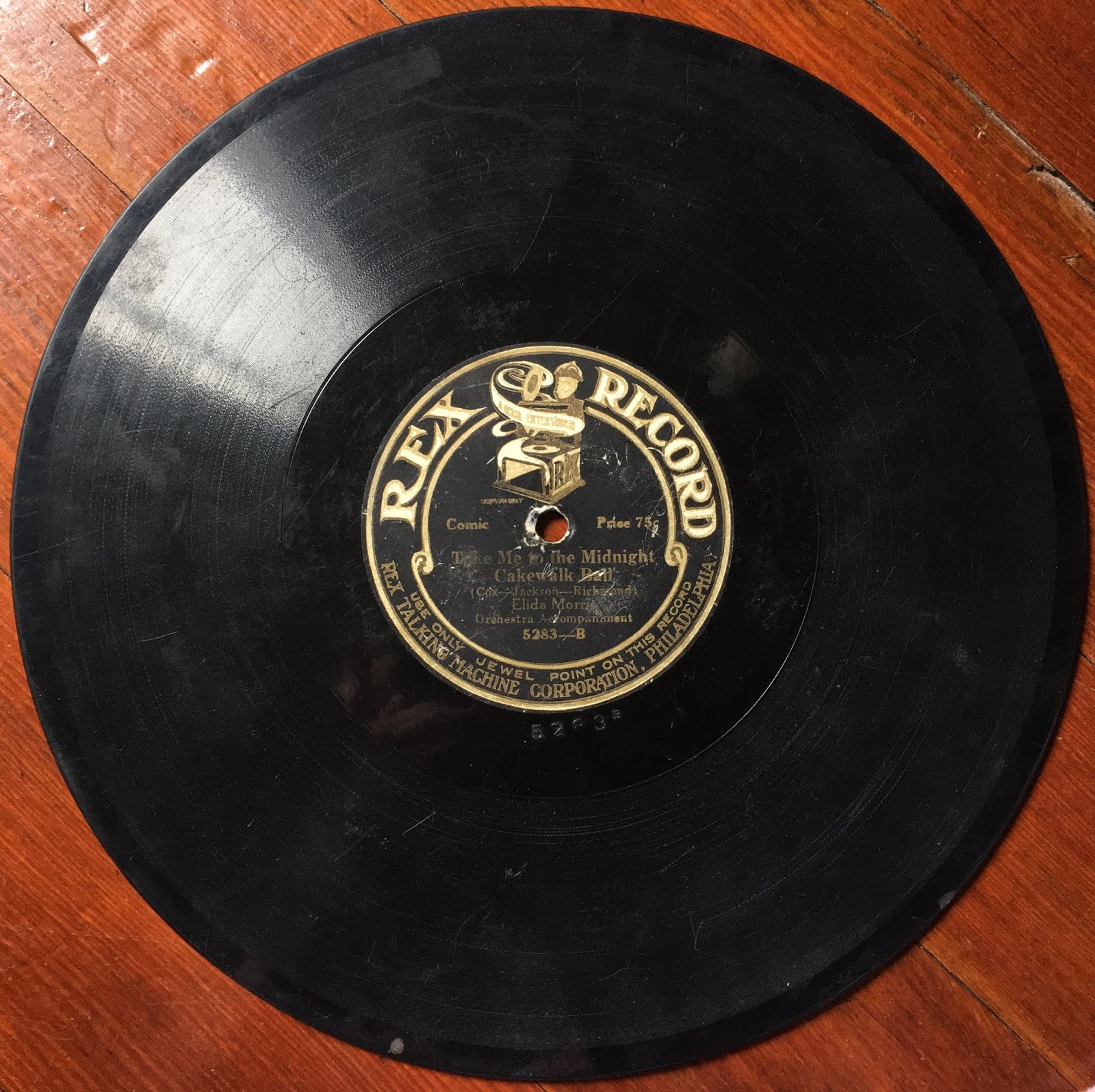
In keeping with the Hager subject, I have been on the lookout for some of his illusive Rex records. Those records were essentially the first of their kind, the first very successful American vertical cut records. Here's a nice example floating around on the internet:
These records sounded particularly nice in their day, and they seemed to have had the strangest titles associated with them. This label shows Hager's true colors, very expansive and diverse. The Rex label recorded everything from Grand Opera to Rag-Time piano solos by Roy Spangler who learnt them by ear.
Don't Believe me? Well here you go:


How about that?
Just like he did with Zon-O-Phone ten years before, Hager made sure the widest range of music was recorded, and recorded well for that matter. I have a single Rex record, and it sounds okay, but of course without the proper apparatus to play it it's bound to sound crappy. 
I don't have transfers yet, but here are the pictures:
That is the later edition of the Rex label, from 1915. 
The music is really nice on these though, as expected of Hager, the orchestra accompaniment is definitely more interesting than other studio groups of the time. Since it's 1915, the accompaniment is a pseudo-"Jass"style, which makes it particularly interesting. This is more so on side B however. As it turns out, these records are very uncommon, which is strange considering the circumstances of which I found the Rex record I have. I stayed in Los Angeles a few years ago and went to the Amoeba records in Hollywood and found that record buried in the old timey section at the back of the store. 
I was just in LA this last week and found nothing nearly as nice as that Rex record this time at Amoeba. I have gotten some nice Zon-O-Phone and Ossman records there in the past and recently, but the Rex record is the sole standout find from there. 

With that, I return to the Hager's. Unfortunately, it will take a lot more digging to find more on James Hager. On the entry for Fred, everything is there, but the information on the rest of the family is very vague. However, when I did a little more deeper digging I eventually found his WWI draft card! You can imagine how happy I was to find it, and definitely be assured that it was the right guy. 
Here you go:
How about that?
Tall, Stout, and brown eyed. 
Hmm.
That's quite different from how his matinee idol brother Fred looked. I do find it curious that his hair is stated as being already somewhat gray by age 36. Usually thats an indicator of red hair, but let's not get too set on that idea. Just keep that in mind with him. Finding this card also proves a much more exact birthdate for him, as well as that he was working as a musician long after the Zon-O-Phone era with Hager's orchestra. 


Anyhow...
I wanted to do a section here on the new phonograph I just got, but I will have to save that for the next post. I have a handful of really nice records to play and eventually get transferred. The machine I got is a really early Columbia Q with some nice eartubes to go with it. The discussion of the records will also be done in the next post, as there's quite a lot to talk about surprisingly. 


Hope you enjoyed this! 


Monday, December 12, 2016

Banta, Hylands, and Hager--the premiere Rag pianists of early recording

When speaking of these recordings, most people forget about the pianists behind the singers, but of course, there's a reason for this to be so widespread. It's simply because of no credit being given to the pianists. Even if you dig through the very complete Victor ledgers, you will only come across a handful of recordings with pianist accreditation. But it is certain that Frank P. Banta worked for Victor, as it helps that in their earliest catalogs that they list Banta specifically as the leader and pianist of the Metropolitan orchestra, the first house orchestra for Victor. When the pianist is listed, then we won't have any frustration and confusion of trying to dig out a style and attach it to the pianist on the recording. 
This is why Banta is the easiest of the early studio pianists to identify.
(Banta at Edison's piano in c.1902)
He's got a very distinct style, and he was the best-identified of the early studio pianists, this is exactly why record collectors know his name in regards to pianists. But it is because of this fact that collectors don't know of the other pianists. This is something that is the fault of his son, just because his son was a popular pianist just like his father, this kept the name around in music for longer than the other pianists. His father's death was such a tragic and sudden thing for the whole of the recording community, this earned him scores of  admirers and mourners. This is why he is remembered the most by record collectors. 
Of course, other than all of that, there's also his Rag-Time, which is another reason why collectors recognize his name in catalogs and in research on these early recordings. His style was very strange, combining several technical yet very itinerant characteristics all the same. Much of his style was very oddly similar to another recording star of the era, this chap:
Vess Ossman.
 Really, if you think about it, Banta was essentially the pianist equivalent of Vess Ossman. Banta was not nearly as much a perfectionist when it came to keeping time as Ossman was, but in many ways, their styles are the same combination of characteristics, both well-trained, yet sound as though they weren't. Recall that Ossman's first instrument was the violin, but he was completely self-taught on the banjo, keep that in mind when listening to him. Banta's view of Rag-Time was essentially the same as Ossman's, and it helps that he had the chance to build up a taste for syncopated music while working with Ossman from c.1892-1896. With this experience, Banta went into 1897 a pioneer, already aware of how to play syncopated music. This is why his Rag-Time has that distinct late-1890's sound to it. It's not nearly as folksy as other pianists, but it's certainly strange in its own way. The fact that he played fifths in his left hand is the most unusual characteristic of his style, since corresponds in no way at all with his stylistic upbringing and origin, and says something about his regional style that modern Rag-Time pianists have long preconceived incorrectly. For a primarily self-taught pianist, he had a stew-full of styles mashed into one, more so than Fred Hylands even! Sometimes Banta played a little like Mike Bernard, getting so consumed in playing quick and showy syncopation that the rhythm dramatically is rushed. 

For an example of this, listen to Billy Golden's 1903 Edison of "Turkey in the Straw" with Banta. His solo between the choruses is a very Mike Bernard-like way, and it's the way that I just described. Now that you've heard that, listen to Bernard's 1913 Columbia of "Maori". Not too different overall. As he nears the end of the recording, much like Banta's solos on "Turkey in the Straw", the playing gets more intense and rapid. Banta did this often, such as on his accompaniment behind Denny on "The Change Will Do You Good", and his accompaniment behind Denny on "Go Way Back and Sit Down" from 1901. The second recording exhibits this characteristic better, and it is overall one of the best recordings I've ever heard of Banta, and yes, it is better than his 1903 recording of "violets" in my opinion. It's this very characteristic that not only ties him to other popular star accompanists, but it's also what defines him as a pianist, and as a character. Banta was an intense man, wide-eyed and focused. The speeding up and added stiffness is what easily gets the point across that he was an intense guy, and deeply consumed in the music when he could be. It's just what separates him from the other studio pianists, his accommodating nature, stiffness, looseness, and intensity. This must have carried over for him as an orchestra leader, since he led many house orchestras from 1893 to 1903, from one of his own to the studio orchestras of Edison, Berliner and later Victor. His arrangements were very good, and he was able to keep the Edison crew in line extremely well, even when he was playing all the offbeats. A good example of this is The Peerless orchestra's 1899 recording of "My Babe from Boston". In the last two strains, Banta's playing great rag-time under the band playing it a little syncopated as well. It's exceptionally well executed for a relatively conservative orchestra. The Peerless orchestra was only not conservative because of Banta, without him, it would be just as boring to hear them play Rag-Time as it is to hear that by Prince's Band. One thing about Banta that must have angered some of the studio musicians was his choice of keys for them to play in. Sometimes he chose awful band keys like E and B, such as he did for this record here. Makes me think he had perfect pitch, being able to play any song in any key, and be able to tune pianos, those are all signs of a pianist with perfect pitch. 
Before moving to the next part of this post, here's one more fantastic example of Banta's Rag-Time:
http://cylinders.library.ucsb.edu/search.php?queryType=@attr+1=1020&num=1&start=1&query=cylinder2453
The solo at the end is phenomenal! 


We know about Fred Hylands, yes indeed, but of course, for many years this was not a universal state. 
(detail from a cartoon I did of Hylands)


(oh those signature long legs of his! Haha!)

It took until Jim Walsh briefly mentioned Hylands in a few articles on Len Spencer to keep his name somewhat in the knowledge of a few collectors. Though really it was Tim Brooks mentioning him in his A Directory To Columbia Recording Artists of the 1890's, other than that, that was pretty much it with Hylands identification until now. Despite well-advertised sections and frequent mention in The Phonoscope , few older collectors will recognise his name if dropped somewhere. Of course, all of that extra endorsement from Russell Hunting and Charles Carson was a fantastic thing for Hylands, since it must have been a big deal when Columbia hired him. Taking in Pastor's music director as one of their accompanists was something that hadn't been done before by record companies, as the studio pianists weren't really supposed to already be huge stars when they were hired to work in the studio. Issler was an everyday musician when he began working for Edison, just a piano teacher and a leader of a small parlor orchestra. Banta was a little more famous, because he was Ossman's accompanist, but other than that there's really nothing. Hylands had a reputation already when Columbia began considering him as a studio accompanist. I don't really know what his reputation was before he became a recording, but I wish I did know, since it must have been interesting. His playing was certainly something to draw attention away from the main performer on a recording, more so than Banta's playing. It's pure vaudeville piano playing, absolutely fit for accompanying cake-walkers in a Vaudeville show, as that's what he was likely doing when he was performing at Theaters before 1898. This must have been part of his reputation, as this is certainly something that would have been told to the Columbia management when auditioning this new pianist. 

Hylands' style was very distinct, yet confusing at times, luckily, he had very good rhythm and sense of good tempos, so singers wouldn't have to worry about that aspect when working with him. With Hylands, there was no dramatic rhythmic problems like there is on this cylinder here from 1898-ish. Of course, this wasn't a problem only when Hylands wasn't sleep-deprived, hungover, or slightly high on something. These were all problems with Hylands, since he was the type who didn't take very good care of himself, and especially since he was such a busy worker, he barely had enough time to sleep well. The exhibitions the Columbia management made him go to didn't help his already busy schedule. 
It's important to keep all of this in mind when listening to records Hylands is on, since that creates a more realistic view of the man and his work habits. Hylands' playing on recordings from 1898 are the prime examples to listen to as good representations of his playing style, and his habits. Much of this leads to recordings with lots of mistakes, such as  this take of "The Laughing Song" by Johnson with Hylands. He's pretty scattered on this recording, though despite this, it's a very nice example of his Rag-Time playing, since he breaks into it at the last chorus. It's not the best overall recording is his playing, since there are so many good examples out there. Because of this, there really isn't a definitive example of his playing, but that's what makes Hylands so great! Luckily for Hylands, he worked for more labels than just Columbia after 1900, whereas Banta only worked for Edison and Victor. After 1900, Hylands worked for Climax, Zon-O-Phone, and Leeds, all of whom Columbia was in fierce competition with when he worked there. It is particularly surprising that Hylands was even able to work for Leeds, since Columbia's management hated Leeds with passion, since they tried to sell them out of business perhaps five times, but it never seemed to work until 1909. Hylands worked for them during the short time Leeds made those gorgeous gold foil labels. Wish there was a way to know how and why he started working there in the first place, but it's interesting nonetheless. 
Here are two Leeds records where he's on piano:
https://ia802300.us.archive.org/31/items/ArthurCollins_part2/ArthurCollins-TheGooGooManCoonSong.mp3

https://www.youtube.com/watch?v=mIYitsz8glA

Hearing a Columbia pianist on Leeds could certainly catch the attention of some collectors, since it really is a little strange. 
There's a reason that I drew this cartoon of Hylands with those pesky Leeds people. 
Certainly Leeds made a deal with him, maybe they accepted his stubborn work habits, and strong will to unionize. That was really the worst of Hylands' baggage when having him work for a company. Everything else was able to be borne by the management to a certain extent. Of course, everything you could think of was effecting Hylands' playing in the studio, as Charlie Judkins and I discussed yesterday, it wasn't just drinking as we had long assumed that had him. Anything that could have gotten to him certainly did. As said a little above, sleep-deprivation was a big one with him, as well as being hungover, drinking, and being physically tired from anything just preceding the recording day. As Charlie had stated, it seems that Hylands was a spacey kind of chap, constantly thinking about other things while making records, so this is another reason why there are recordings such a horrid mess like the Columbia orchestra's 1899 recording of "Smokey Mokes"(skip to 57:50 for the transfer). Still can't get over how awful that take is, and the fact that Hylands doesn't attempt to stop and reset himself at the same tempo as the rest of the orchestra. This is exactly what we're talking about! This sort of thing was never a problem with Banta in the studio, and this is why Banta was so highly regarded by the studio stars. Hylands zoning out so much couldn't have been a good thing for the singers. 
The fact that he did that though makes him ever more interesting and comical as a studio star.


The final pianist to speak of here is one that almost no other collector I know has ever mentioned as a possible pianist. 
Frederick Hager.(taken in 1898)
He was the youngest of all the early studio pianists, and was 24 when he was first hired to work in the studio at Edison, he was the youngest since Fred Gaisberg at Columbia to take the job. Not much is known of his piano work, if anything, but that pianist that we all thought might have been Hylands on all those early Zon-O-Phones is actually Hager! The playing style sounds too much like a hybrid of all the studio pianists to be one of the previous regulars that we know. That style that we now are starting to associate with Hager would work with who he was as a musician, and the fact that he really knew how to orchestrate extremely difficult and complicated Rag-Time arrangements, such as his "Dill Pickles" that can be heard on this list here. They seem like they're not that hard, until you really dissect them, and try to play them out yourself. That's the beauty of Hager's arrangements, particularly his Rag-Time arrangements. His arrangements of Rags are the best of the era, as far as early recordings go, since they are very "tight", well thought-out, and masterfully executed. Not one instrument was out of place or out of tune, whereas with the Columbia orchestra, all of these things were an issue, many at the same time in fact. Hager wouldn't settle for an orchestra like Columbia's, he wanted something a hundred times better, and threw harder arrangements at his musicians all the time. His recording of "Chocolate Drops" is phenomenal, as it combines everything that's great about Hager's orchestra, and nothing falls out of line at any point, despite the very hard arrangement.  
Also, on many of Hager's orchestra recordings, there's a drummer, and the drummer was never missing a beat, which is very unusual for house orchestras of that time, since most of them had announcers who weren't musicians play the percussion, which wasn't really a good idea, but was the default. 

The fact that Hager is on all of those early Zon-O-Phones really saves so much confusion that many of us have had for a while, since I know collectors who pile up their collection of early Zono's because of the great piano accompaniment, and it seems we've put a more accurate name to that pianist who isn't Fred Hylands or Frank P. Banta. This means that the strange and very ragged early Zon-O-Phone(I can't share the transfer of) of "The Nigger Fever" by Frank Mazziotta has Hager on piano! This also means that he's on many of the very early recordings Edward Favor made for them as well, such as these fantastic recordings:
https://ia801406.us.archive.org/25/items/EdwardMFavor/EdwardMFavor-EverythingatReillysMustbeDoneinIrishStyle.mp3

The most wild of wild Denny recordings:
https://www.youtube.com/watch?v=n0u8HiXdrtI

https://www.youtube.com/watch?v=1ITot33CDuo

Hager's Rag-Time is very interesting, and it sounds like a strange mix of Hylands and Banta, with the fifths in the left hand paired with the heavily syncopated right hand---that's literally a cross between Hylands and Banta! This pairing can be very well heard on the last link listed above. Luckily for Hager, he had the best sounding label to work with and show off his piano chops, so there's not much we can't hear--ever. All of this about Hager only applies to pre-paper label Zon-O-Phones, as in 1902 and 1903, Hylands began working for them, since recordings like this one and this one, are certainly not that cross between the two star pianists. The one thing to notice about the paper-label Zono piano playing, such as that of the "Billy Bailey" recording in the second link, is the overall rhythm, and the technically excellent playing(such as the fantastic rollicking octaves at the beginning of the second chorus). The rhythmic aspect of the later Zon-O-Phone records is better than the earlier ones, but the creativity that went into Hager's playing was hard to beat. 


As of now, we are still trying to find more on Hager as a pianist, everything else he did(which is a whole lot!) you can find on all sorts of websites and in many early recording books. There's nothing about his piano playing however. 


Hope you enjoyed this! 


Saturday, February 6, 2016

Why is Fred Hylands forgotten but Frank Banta isn't?

Fred Hylands
Why is one of these studio pianists forgotten(as with the majority of record collectors), while the other one isn't? 
It be a hard question to answer, and as of now, there is not a straight answer to it. I just had a conversation this evening with my dear friend Marty Eggers about this unsolved mystery. It's some thing that can get suspicious when examining the surviving examples of interviews and magazine sections. Many will speak very highly and kindly of Frank P. Banta, with everything about his certainly "easy" and pleasing personality present, about him working at Edison. But hmm...nothing about the pianist who worked at Columbia. A little strange isn't it? 
Yes indeed. That Edison pianist was so well praised for his talent, abilities, silence, modesty, and work ethic. Why was he the more acknowledged? Well, let's just first take into consideration that Columbia's ledgers were destroyed in the 1970's, but other than that, there has to be other reasons why Hylands isn't mentioned in the interviews that survive of the artists from that time. Why is that so? It's a very bizarre thing, and thinking of it this way can really start to spark quite a lot of theories. Some of the theories I have heard range from Hylands being simply not being in the studio very much after 1898 to some like Hylands being a varying character in complexity in the studio, and that was not easy on the management. It's varying. 
One of my opinions about this would lean more toward the slightly bi-polar nature of Hylands. When I say this, I mean that Hylands was described sometimes(most of the time if you find anything on Hylands, it will most likely say this) as a very fun character, who made friends wherever he went, as he was a man who won everyone over with his charm. Something like this from 1900:
(sorry it's so small...)

 However, take a moment to recall that he complained about working there, saying that the managers worked him too much:
 That pretty much reveals his feeling of importance over at Columbia. He said that he is ordered to play piano, get his pay for it, and even with all that, he still has to work here. That give us a hint into the side of Fred Hylands that was never written down. This could mean that he could sometimes be a person that the studio managers didn't want to deal with. Maybe when he was drunk in the studio he was like this. The sort of character Hylands could have been sometimes was the reason that the managers sometimes considered getting rid of him often between 1899 and 1904. 

Why was Hylands absent from all the interviews and letters? 
That's the real part of this mystery. There has to be a reason that he wasn't mentioned anywhere in Jim Walsh's articles(I dare you! go on the Library of Congress Website, type Jim Walsh into the search bar and look through the collection list, you won't find him listed anywhere!) What was it about Hylands that forced Walsh to not mention him anywhere? It could be that since Walsh didn't say anything provocative or controversial in his articles about any of these artists, which is respectable. However! I have been told by my friend Craig that Walsh did indeed hear quite a lot of scandalous information about many of these great artists, he heard everything about all of these figures, but he did not want to specify. Of course, this information could be about anyone in the business, but could this at all contribute to the absence of mentioning Fred Hylands? It's possible, as Hylands was a hard person to work with on some fronts, as his firm collapsed rather quickly after just over a year and half in 1900, due mostly to his frustration in Len Spencer, and somewhat with Harry Yeager. 
Hylands would be "two-faced" if you will, sometimes. I bet in the studios when he came in at 8 in the morning, he was kind and warm most often, but by the evenings, he was a broken mess who would come back home and yell at his father and wife. Probably would moan about the amount the Columbia people worked him as it would seem that he did indeed do that, hence the image from The Phonoscope above. It's all just fascinating. 

Yes indeed, we do know that Frank P. Banta is remembered because of his son Frank Edgar:
He fondly remembered his father in the 1940's, and his account of his father is what kept Frank P. Banta from being forgotten. 
Whatever it was that is hidden about Hylands' personality, it's probably one of the contributing factors to why Hylands is forgotten as a studio pianist now. 
Who was it spoke of Hylands long ago? It is obvious that someone spoke of him many years ago in an interview or letter, but who was it? It's clear that Hylands was listed in obscure record anthologies in the 1970's and 1980's. It's hard to know who it was. 


I hope you enjoyed this! 


Sunday, January 10, 2016

Forgotten Early Studio History

I hope I've made it clear enough on this blog that I find the old studio pianists and house musicians very important to the whole of the history of recorded sound. Their work and (sometimes reluctant)commitment to the early studios are overlooked by most collectors out there, only because they weren't specifically listed in most of the surviving record ledgers. Their names are known, regardless of the unlisted accreditation. The few collectors who know of them do not know of their hardship under the managers, and their quiet complaints, but those who don't, have a hell of a lot to learn. Yes, naturally, the singers were meant to be the main sound on the records, and the piano always came second, as it still does to most, but it is always important(*if the pianist is known*), to acknowledge their part on the record. It is fully understood that not all who have these records can hear the differences for identification, but those who can, could certainly pay a good deed to those studio pianists. Since these records were made just before musicians in unions worked in the studios, these musicians were worked until they physically couldn't work any more. Frank P. Banta was in a musician's union, but they did not interfere with his recording, as that was too new of a business for the members to get involved with reasonably. This is also why Fred Hylands helped found a union the year  Columbia dropped him.  

Frank P. Banta is only known the most of these studio pianists because of his son Frank Edgar, who was a very popular pianist in the 1920's. His son recalled his father vaguely in the 1940's, recalling him being a pianist for Edison, and recalled that he was a shorter man with a slight figure, rather introverted, with a very thoughtful sense of humor. Banta in known more to-day because the Edison ledgers are still complete and very much do exist now. This is the same for the surviving Victor ledgers, which to list Banta in many areas as well(*but don't list Hylands*). 

Imagine if you will for a moment that the ledgers existing were reversed, by this I mean that say all of Columbia's ledgers weren't burned or destroyed, and all of Edison's were gone. That would mean that we'd be guessing  all of these Edison cylinders just like we do with Columbia's. That would also mean that Fred Hylands would be known by many more pianists, and record collectors alike. Assuming that Columbia kept very complete notes on everything they recorded, this would solve many mysteries that have gone unsolved, and all of their experimental devices wouldn't have been destroyed, meaning that we would all know what Columbia's staff was really doing in the late-1890's and early 1900's. More of the Climax/Columbia/Zon-O-Phone/Victor scandal of 1901 would be complete in its already fascinating story. It would make for a very different view on the early recording business, very different than knowing the complete history of Victor and Edison. The issues of The Phonoscope are only a small peek into Columbia's doings in the late-1890's. 

The fact that I have been able to find who Columbia's main pianist(was there more than one? I don't know) was in the piano accompaniment era(from the beginning to about the end of 1905), is amazing in itself, since all of their ledgers are gone. 
Speaking of that, Cliff Kennedy told me what happened to those ledgers and masters back in November. Cliff told Ryan Wishner and I that those ledgers, matrixes, tests, unissued masters, experimental machines and records, were burned and destroyed. Just before they were, a few luckiest collectors were able handpick and choose what they wanted from the warehouse laden with the now-forgotten history. They chose some unissued masters, machines, rare records, wax matrixes---but not the books of dates and pay records. One sheet of records must have had some information that is now gone. If I were part of these selected few, I would bring several large bags, and put all of the paper ledgers I could in them, because the ledgers themselves are worth more than all of the records that survive. This is a reason why Len Spencer's pocket notebook kept by the Library of Congress probably wasn't just a personal reminder pad of his, it also contained recording date notes, cash records,  personnel notes, and who knows what else!(if anyone has gone to the LOC and had had the chance to read any of Spencer's notebook, please comment on this post!!). 
Columbia's ledgers had to be very complete, yet complicated, because of how much recording work that was being done in the late-1890's, and the artists themselves must have also contributed, by writing down all the information needed(such as Spencer using his notebook). Keeping track of all the recording work going on could not have been done by a single person, or even by two or three people for that matter. It's surprising that none of Fred Rabenstein's cashbooks exist, because he was interviewed by Jim Walsh in the 1930's and 40's. 
Also, if the main studio pianists(Fred Hylands, Frank P. Banta and Edward Issler) had all lived at least another twenty-five years(no one actually knows how long Issler lived), their views on the early recording business would have been shared, and the perspective all collectors have on the business probably would be very different. In a sense, it was the death of Frank Banta that ended the piano accompaniment era on records, even if it lasted a little longer at Edison, and two more years at Columbia, it wasn't the same without Banta. By 1903, Hylands had become terribly weary from all the work he did, and very stressed from having to be there 7 or more hours nearly every day for the past five years, as well as keeping a pit orchestra job, all while being short on money from his failed publishing firms and union. If the studio pianists had lived long enough for Jim Walsh to find them, they would have been pretty broken from living hard lives, but would probably have been willing to discuss with Walsh. Banta would probably have lost much of his money in the crash of 1929, but would have similar financial stability to Arthur Collins. Hylands would have lost everything without a doubt. Somehow, the hints of gambling, irresponsibility, and anxiety from Hylands, tells me that he would have probably been in so much hard luck during the Depression that he would have committed suicide. I know, that's a very disturbing and sinister thing to say on many fronts, but if you ponder Hylands' mindset, he had already been through so much by the time he died in 1913(though he was slimmer by 1913...), and if he had lived longer, it would have further exacerbated his troubles. 
Banta would probably have survived a few years of the depression, and would have recalled his recording days very much if anyone had bothered to send letters to him like Walsh did with Dan Quinn. 

Banta would probably have written a book later in life, much like Dan Quinn fantasized about doing in the 1930's. It would be somewhat similar to Fred Gaisberg's book, that many people use sections from in articles and biographies of artists that Gaisberg knew of. The amount of information Banta could have given is limitless, same for Fred Hylands or Edward Issler. Issler would have given a full picture of the earliest commercial recordings made, as he was involved in the business starting in 1889, and he was the pianist that all the record companies wanted until Gaisberg came along in 1893. He would have had all sorts of stories that other artists, even fellow studio pianists would never have endured. Issler would have seen the court battle between Edison and North American in 1894 first hand, as he must have been a witness in the courtroom discussion, being the main pianist who worked for both companies. He would have also seen the fall of the U. S. phonograph company in 1896-97. Issler(probably speaking still with a German dialect), would have been a fantastic source to know what being a studio pianist was like, and how complicated and "dirty" the earliest recording business was like, he would have had more knowledge about this than Banta or Hylands had. 

If only Columbia's ledgers weren't destroyed. And Banta, Hylands, or Issler had lived longer. Then this wouldn't be such a mysterious area of study. Also, those who got to pick and choose from the Columbia ledgers, are beginning to die out, further making the history of Columbia's company lost. 


 Even with all of those flames, this building does still stand however:
Back in 1889:


I hope you enjoyed this!