Showing posts with label Fred Van Eps. Show all posts

Saturday, February 16, 2019

The Eccentric and Extraordinary Eddie King

In the last few weeks, I have become quite fascinated with a guy named Eddie T. King. I have mentioned him here and there in previous blog posts, more recently I have attempted to place his name in studio pianist research, but so far nothing on that has produced much. 
As I have become ever more intrigued with this eccentric Eddie King, many people have shared odd stories regarding him. From the dozen or so stories that have been shared with me regarding him, it is evident that no one really liked him too much, and that he was a classic eccentric. 

In the 8 years of record research I've done, King's name has come up here and there, never seeming to completely escape the research process. I might add that that's quite a difficult thing to pull off, but since King was lurking around literally everywhere, it really isn't much of a surprise. When I was starting out on my Hylands digging back in 2012, King's name came up a few times as a pianist alternative to Hylands(if the whole Hylands thing didn't end up working out!). But why would King's name be added to the mix with Hylands? Well, according to most sources, King worked at Columbia in the late-1890's and into the early 1900's, but what exactly he was doing there I do not know. I cannot confirm what he was doing at Columbia in the late-90's, but I would firmly believe he was there somehow. Recently I went on a dig on ancestry for Mr. King, and only found him in the 1900 census so far, but, I know it's the right guy! The record indicates he was born around 1868, which is quite early! 
Just to give you an idea, King was older than Banta and Hylands. 
So...In considering his age, it would make sense that he would be poking around at Columbia in the era of the Hylands accompaniments. 
It's quite possible that King traded off with Hylands playing piano accompaniments, but I have no way to know that just yet. 
King worked for Columbia through 1903, and around then he ended up as Hager's percussionist, making a few xylophone solos and regularly appearing as Hager's drummer(I do not know what happened to James Hager when King stepped in). King supposedly remained at Zon-O-Phone until their end in 1912, and then he was off to Victor until the mid-1920's. After Victor he returned to Columbia to supervise many famous Jazz and popular sessions. 

So that's the sequence of his employment, but there's a lot more to this story. The tales people have been telling me about him are larger than life. Naturally, I drew several cartoon involving him and his eccentricities. Oddly enough, he actually seemed to be an eccentric in a way similar to Hylands, the kind that everyone in the studio made fun of and mocked constantly behind his back. From the tone of the stories, it seems that's all they did. When they were all in the studio with him they had to act quite well, as when he was lurking around he'd raise hell and kick everyone's butts around if they didn't behave. Since I have known about Mr. King, I have never seen a picture of him, but from the very detailed descriptions of his appearance I feel like I have. There's a section on him in Nat Shilkret's autobiography, and he's also mentioned a few times in more than one book about Bix Beiderbecke's Paul Whiteman sessions. The boys in Bix's band provided a very colorful description of his appearance, it went something like this(I am entirely paraphrasing here!):

He had the head of a bull. He was a short man with a very large waist and bottom, but delicate hands. 
Also he was very short tempered, easily triggered by small things. 

Yep, how about that for a colorful description! That immediately got me thinking, I needed to draw a few cartoons to poke fun at this, but of course he probably wasn't so grotesque looking in the 1900's and 1910's(sounds a lot like another Columbia studio pianist).  Since I have not seen a picture of him, I am only going off of these comical descriptions, here's my first  cartoon of him:
Of course this combines the detailed description as well as his relationship with Hager and Justin Ring. This is poking fun at how he likely changed quite a lot after Hager "left" Zon-O-Phone in 1906 and left Eddie to tend to his orchestra and musicians on his own. By 1914-15, Eddie was playing on many of the Fred Van Eps-Felix Arndt Victor's, beating on the drums to the discontent of Van Eps and Arndt. King's aggressive and somewhat antiquated drumming made for some odd sounds on these particular records. I quite like this particular record of his:
He's playing very straightforward percussion, sometimes sticking to the melody and other times not. The physical descriptions make for some elevated humor in the listening of any records he's on, particularly the Van Eps records. Now that I know about King being on them, I am glad to own a few of them. I can almost feel the cringe of Van Eps and Arndt on those records, having to deal with King's queen-like bossy rule, then having no choice but to allow him to be their percussionist. Just for the fun of it, here's another Van Eps record he's on, this time he plays some more pieces of the percussion! 
All the stories come together into one when I listen to records I know he's on, it becomes hard to keep a straight face at that point. 

The second cartoon I drew of King was illustrating one of the Nat Shilkret stories. In Shilkret's book, he told several stories about King, but one in particular is too great not to share. He told that after King's second wife died, he insisted upon performing a séance to contact her spirit. When he did this, he absolutely insisted that Harry MacDonough sat next to him(a little suspicious, but okay), and he was entirely passionate and confident about the result he got from the thing. The others he invited did funny little things to help get Eddie's goat and lead him to believe all that he was intending on. I did not draw him in the 1920's, but I did draw him with Hager and Ring again of course:
(I drew most of this waiting for the train in Santa Barbara)
So, if you are observant enough, you could see that the spirit he's attempting to contact is Banta's, as by 1905 Banta had been gone for almost two years. 
So this story was where I really understood that he was a classic eccentric, as only a true weirdo of the times would insist on grabbing a few friends to perform a legitimate séance, particularly at the beginning of the 20th century. 

No one liked working with Eddie King. He was bossy, aggressive, constant, and a serious grump. But despite all of these negatives, he was one of the most valuable people in the studios in his day, as he was a very well educated musician, and he played all the vital instruments for the foundation of a recording lab at that time. He played piano, all percussion, organ, and was a great studio manager. So it makes sense why he remained in the studios for so long, even with all his eccentricities and drawbacks.  Just as I'm writing this, I dug up an interesting record from 1920, where you can hear the voice of Eddie King quote clearly, and it's actually a familiar voice:
(right at the very end is where it's the best)
That voice is all over Zon-O-phone's in the early 1900's, doing all sorts of calls and shouts on Hager's orchestra records. So that's what he sounded like. 
The most unrelated cartoon I drew involving Eddie King was themed for Valentine's Day, but it also includes Justin Ring once again:
So from King's connections to early Columbia and Zon-O-phone,  it can be almost guaranteed that he knew both Hylands and Justin Ring quite well. The parallels between King and Hylands are quite astounding, as all the studio boys tried pulling pranks on him when they could, and spoke of him quite dirty all the time, a similar story to what we can gather from how Hylands was portrayed in The Phonoscope


In my last post, I used the statement two(or three)Zon-O-Phone pianists more than once, and there is a reason I did. There are two different pianists I hear on most Zon-O-Phone(and Climax) records from 1899-1907, but sometimes there are Zon-O-phone's I hear that don't fit into the dichotomy. So in this mission I'm on to unlock the mysteries of Zon-O-Phone, the three names I have as accompanists are Fred Hager, Justin Ring and Eddie King. Eddie King would likely be on Zono around post-1902, as he was still working at Columbia by then as far as I know. Unfortunately, I haven't heard enough of his accompaniments to decipher a distinct style, but hearing more of his drum attack is helping. This record here is about as good as it gets in terms of his accompaniment:
I have been listening to this record a lot lately to attempt to pull something out of the accompaniment, but so far I only have little fragments that don't tell me much. However! A collector told me recently that in one of the Bix books, the boys in the band described his playing as antiquated, exaggerated, and well founded. Yes, that's helpful, but doesn't really tell me much. He naturally would have sounded like that, considering his age and high musical education. The only thing I can gather from his accompaniments is that he was a good accompanist, but aggressive and pushy, similar to the Hylands attack, but don't take that as an important characteristic here. In no way did King have the Cincinnati Swing that distinguished Hylands' accompaniments like a pin to the finger. King had the same aggressiveness in his accompaniments(not just on piano, but also his drumming) that would push around the performers, and create an extra amount of swing in the overall rhythm of the record. 

Well, that's about all I got on Eddie King for now, hopefully I can dig up some more on him in the near future, as the odd stories keep piling up, as do the cartoon ideas. No matter what I study in this recording world, his name will always pop up, as his name is on the most Victor records in their ledgers, just to give you an idea of his significance. He was obviously an important figure, despite his eccentricities, because he remained working in studios from the 1890's to nearly 1930!


To close out, here's a Hager's orchestra record I know he's doing the calls on(as well as beating away on the woodblock throughout):


I really wanted to get this Eddie King post in before I forget, that's why I'm doing it so close in time to the previous post. I was so anxious to share this, as I have never been so tantalized by a character I have never seen and know hardly anything about. 


Hope you enjoyed this! 


Friday, July 27, 2018

The Brothers Hager

As stated in the last post, I promised to do a post on the Hager's, so here goes.

When that big panoramic picture of Hager's orchestra was sent to me almost a year ago, it shocked me at the amount of detail there was in the description. Every single person was identified, even the recording engineers. Even the mysterious Charlie Carson was identified in the picture(he was Russell Hunting's right hand man with the smut cylinders in the 1890's). 
Just to give you an idea, here's the picture in its entirety:
That looks like a fun group!
Hager is stated as being no. 10, right in the center. 
There he is! ❤
A lot of Hager's musicians were part of Victor Herbert's orchestra(what a surprise!) and many were also symphonic musicians. Of course Hager had the most diverse orchestra in terms of each musician's extraction, in considering his wide range of friendships and partnerships. He knew everyone in the Symphonic and operatic community to the highest regarded vaudeville performers. Hager clearly knew what's up, in terms of music that is. So in considering this, we would assume he got the best percussionist he could find. 
Well, that turned out to be his brother. 
Yes indeed folks, that "James Hager" that is listed behind Fred Hager is indeed Fred's brother. Those two looked too similar for them not to be related, so after I did a little digging on Ancestry, it turns out that James was the youngest of the Hager's. Fred was the oldest, and James was the youngest. There were four Hager's:
Fred(b. 1874)
Lena(b.1878)
Georgina(b. 1880)
James(b. 1882)
Fred couldn't find a better percussionist? Well, I guess it's always good to get a sibling some work. 
There they are! They so look like brothers!

So there you have it, Fred's brother James is that percussionist on all those records. For years I had wondered who that weird percussionist was, since they weren't always great, but when they were it formed perfectly to the orchestra. Fred started the orchestra in 1896, and it seems likely that he wouldn't have forced brother James to play all their gigs until at least 1898. Rather than having him join at 14, waiting until he was 16 seems a little better. Or maybe I'm wrong, maybe Fred got him to join just as he started high school in 1896! Of course to illustrate this I have a cartoon!
Yep. 
I was thinking back to those stories that Fred Van Eps recalled to Jim Walsh about him pulling Frank Edgar Banta out of high school to make records and play gigs with the Van Eps trio. The Hager thing reminded me of the Van Eps-Banta story. 
There's some sort of gratification now going back and listening to all those Hager's orchestra(and Zon-O-Phone orchestra) records, knowing that the percussionist is Fred's brother James. To make things a bit more interesting, James Hager is listed on a few Edison records around 1903, which is around the time of that panoramic picture, and when the Edison catalogs were raving over Hager taking over their orchestra. Here's the most popular example:
It's funny that the Edison people were consistent with the "James W." in identifying him, even though that's not really what his middle initial was. That must have been used to closely place both Hager's, and maybe make it more assumed that they were related. 

When going back and listening to those Zon-O-Phone records by Hager's orchestra, it becomes clear that brother James improved as the years went on. 
By 1909, James was playing spot on with the group:
When we dig back to 1900 however, it's still a little bit out of whack, but of course still far surpassing all the other studio groups at the time:
And to think in 1900 the Columbia orchestra still sounded out of whack because of Hylands! 
I'm sure with the exciting motivation of making records brother James was determined to improve, and make the records sound much better, which they did by 1906 or so. With this in mind, Fred wrote many arrangements that were heavy on the percussion, and it seems evident why this was so now. 
His pieces were strange, but very fun and complicated at the same time. Recently I got a two sided mint condition Columbia of two Hager pieces played by Prince's band. 
Here's the more famous Hager piece side:
His tunes are deceiving, they sound solely novelty and playful, but are endlessly complicated and require a skilled percussionist! (no sitting around back there counting!)
Here's the flipside:
This particular side was a modern marvel of its time. It clearly exhibits how advanced the quality of recording was by 1915, and it shows also that Hager had tried everything to create a symphonic natured recording without an entire symphony. Hager wrote these highly descriptive pieces around 1907, and it would make sense that he did. Being a dad with three young daughters, it would seem almost expected of him to write such sweetly novel pieces as these. It also makes sense now why there's so much percussion on these; to exhibit the talents of his brother James, and to show off all the weird sound effects they had dug up after almost two decades of recording. 

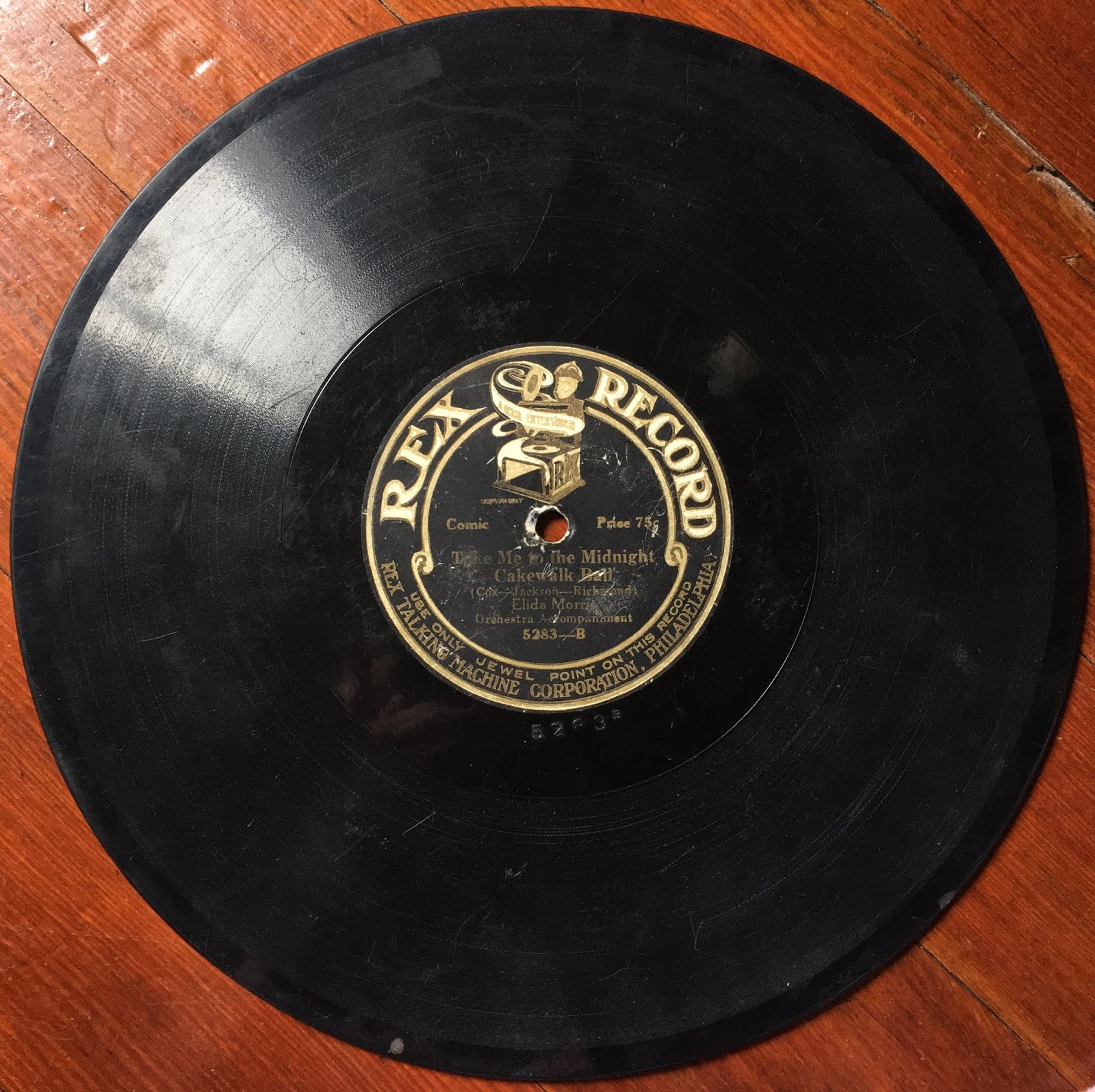
In keeping with the Hager subject, I have been on the lookout for some of his illusive Rex records. Those records were essentially the first of their kind, the first very successful American vertical cut records. Here's a nice example floating around on the internet:
These records sounded particularly nice in their day, and they seemed to have had the strangest titles associated with them. This label shows Hager's true colors, very expansive and diverse. The Rex label recorded everything from Grand Opera to Rag-Time piano solos by Roy Spangler who learnt them by ear.
Don't Believe me? Well here you go:


How about that?
Just like he did with Zon-O-Phone ten years before, Hager made sure the widest range of music was recorded, and recorded well for that matter. I have a single Rex record, and it sounds okay, but of course without the proper apparatus to play it it's bound to sound crappy. 
I don't have transfers yet, but here are the pictures:
That is the later edition of the Rex label, from 1915. 
The music is really nice on these though, as expected of Hager, the orchestra accompaniment is definitely more interesting than other studio groups of the time. Since it's 1915, the accompaniment is a pseudo-"Jass"style, which makes it particularly interesting. This is more so on side B however. As it turns out, these records are very uncommon, which is strange considering the circumstances of which I found the Rex record I have. I stayed in Los Angeles a few years ago and went to the Amoeba records in Hollywood and found that record buried in the old timey section at the back of the store. 
I was just in LA this last week and found nothing nearly as nice as that Rex record this time at Amoeba. I have gotten some nice Zon-O-Phone and Ossman records there in the past and recently, but the Rex record is the sole standout find from there. 

With that, I return to the Hager's. Unfortunately, it will take a lot more digging to find more on James Hager. On the entry for Fred, everything is there, but the information on the rest of the family is very vague. However, when I did a little more deeper digging I eventually found his WWI draft card! You can imagine how happy I was to find it, and definitely be assured that it was the right guy. 
Here you go:
How about that?
Tall, Stout, and brown eyed. 
Hmm.
That's quite different from how his matinee idol brother Fred looked. I do find it curious that his hair is stated as being already somewhat gray by age 36. Usually thats an indicator of red hair, but let's not get too set on that idea. Just keep that in mind with him. Finding this card also proves a much more exact birthdate for him, as well as that he was working as a musician long after the Zon-O-Phone era with Hager's orchestra. 


Anyhow...
I wanted to do a section here on the new phonograph I just got, but I will have to save that for the next post. I have a handful of really nice records to play and eventually get transferred. The machine I got is a really early Columbia Q with some nice eartubes to go with it. The discussion of the records will also be done in the next post, as there's quite a lot to talk about surprisingly. 


Hope you enjoyed this! 


Sunday, November 15, 2015

Character Studies--Vess L. Ossman(1868-1923)


"I am the banjo king! Ruby Brooks could get hanged and I wouldn't give a rap!"
is what Vess Ossman thought of his banjo competitor Ruby Brooks. 

Ossman was truly one of the more complicated personalities of the early recording business, with not only a convoluted studio presence, but also a tangled personal life. He made hundreds of records, with thousands of takes before the end of the 'round era in 1898, and worked for every active record company in his day, from 1893 to 1917. His skill on the banjo kept him employed everywhere, both in the studios, and on all the stages and vaudeville houses. 

Vess was a complicated man. He had a personal life that no one at the studios but Fred Hylands  and Frank Banta knew about(as the pianists always heard everyone's stories). He had a very productive relationship with his wife Eunice, who sometimes came in to Columbia to see and hear him make a few of those thousands of records. She and him were madly in love, and clearly by how they acted toward each other, this was certainly true. Those few staff members who were actually invited to his home were sure to remember his family life, and also his home.  He had eight children in all with his wife, but many of them died young or were miscarriages. This fact got some of the staff members curious, and therefore, some rumours were spread. Before he was a recording fiend, he was winning all the banjo competitions, and out getting into odd trouble. In 1890, he disappeared with a 15-year-old girl(who would later be his wife), and returned to the stage scene in mid-1891 with his pregnant wife, who miscarried a month or so later. That was always mysterious to the staff members, especially Frank Banta, as Banta had started working with Ossman not too long after all of this happened. In 1893, he teamed with Frank Banta, who was an up-and-coming young pianist and bandleader, who found Ossman to be a pretty reasonable match with his piano style. Ossman and Banta were an act by 1894, with Banta as his official accompanist. This is where Banta first gets his job at Edison. Ossman was rather tall, unexpectedly so in some ways, as he had very long hands, long slim legs, and a face that was a true mixture of German and Irish. He had all the prettiest aspects of both nationalities, with that very photogenic face of his, he must have loved getting his picture taken. Being Ossman's accompanist was a real pain, as he was always very specific of what the pianist should play, and how they ought to play it, without playing too much. This was easy for Banta, but when Ossman began working with Hylands, there was certainly some conflict. Ossman and Hylands made for an unexpectedly great duo, even if Hylands was always calling for attention behind the star of the performance, no matter who it was at front. Ossman and Hylands' egos must have just fused together perfectly. When Ossman walked into any studio, he was in charge, no matter what the accompanist would say. Ossman owned the room, even if the engineers would have to move things around like they always did, he would still speak out against them often.  He would take the most specific and longest time to get his banjo tuned up, he wanted everything to be perfect always, and it started with him getting tuned up. If a string would break, all hell would break loose. It was bad luck among the singers and accompanists to be in the room with Ossman when he broke a string. It didn't help that it was either very warm or cold in the North Eastern seasons, as well as it being humid. He would explode when he broke a string, or someone wasn't cooperative with him, and it was not a pretty sight to see from a distance. He was rough, and how he would eat up anyone he was yelling at. His temper was terrible, he really let the Irish temper of his out, and all the staff members knew of this very well. Sometimes they would want to laugh, but couldn't, because he would blacken their eyes for sure, and maybe crack some bones if he had the nerve. Ossman hated people who bossed him around, which were very few people not surprisingly. He worked with the Dudley brothers from 1904 to 1907, and that was an interesting experience for both Vess, and also the Dudley's. Ossman had never worked in a group of musicians before, and having to share the profits and fame with two other people was hard for him. He did not like having to share his success with the Dudley's, even if he enjoyed them as people. Ossman working as an accompanist was never a good idea, as he was always the star, just like Fred Hylands' logic. After the Dudley brothers split with Vess in 1907, he took a bit of a dive in popularity, and he decreased. His popularity decreased significant amounts each year after 1908, even though he was still continuing to get engagements everywhere. By 1912, it was really Fred Van Eps who had taken Vess' place in the recording business, which angered Vess greatly, as for years he had built a a hatred for Van Eps, but it was inevitable that Van Eps would eventually take his spot. Van Eps was really in many ways a better banjoist, but the king of them all was Fred Bacon, the man who had been on the scene all along, but hid in the shadows for years from all the nasty competition. Ossman went on tours after 1916, after he formed his own band, and was getting engagements. He was not to be found in New York after 1917, as the record companies dropped him in that year. He was still getting "gigs" out in the mid-west, as that was where he died, and where his son, Vess Jr., died as well. He was on tour when he suffered a heart attack in early December of 1923, he was later brought to St. Louis, where his son was living at the time. Even if "the Banjo King" wasn't the kindest individual, he was still great at what he did, and was called that for a reason. 

For some interesting sounds, here are a few of Vess' records.

Here is his wonderfully done version of "Whistling Rufus" with Fred Hylands, from December of 1899:https://ia802303.us.archive.org/10/items/VessLOssman/VessLOssman-WhistlingRufus.mp3
Here is his fantastic"Sounds from Africa" from 1898, with Fred Hylands:http://cylinders.library.ucsb.edu/search.php?queryType=@attr+1=1020&num=1&start=1&query=cylinder15464
Here is his "Salome Intermezzo" with Fred Hylands, from 1901:
https://ia802303.us.archive.org/10/items/VessLOssman/VessLOssman-OrientalIntermezzoSalome.mp3
(Listen closely to the piano at around 1:50 in that minor part! SO HOT! Those fifths are really audible!)
This next one is one of many Victors where Ossman announced himself as "The Banjo King", here is his and Fred Hylands' version of Leslie Stuart's "Tell Me Pretty Maiden", from 1901:
http://adp.library.ucsb.edu/index.php/matrix/detail/100002190/Pre-matrix_B-3049-Tell_me_pretty_maiden

And to close off here is Ossman and Len Spencer's wonderful take of "Hot Time in the Old Town" from late 1897:
https://ia902606.us.archive.org/1/items/LenSpencerVessOssman/LenSpencerVessOssman-AHotTimeintheOldTown.mp3
Ossman was begging for attention behind Spencer always.


I hope you enjoyed this! Getting ready for the West Coast Ragtime festival has really been consuming my time lately! 


Sunday, September 13, 2015

Russell Hunting with some advice and Liberal thinking

Russell Hunting, 1897(from my own art)

Among the genius things that Russell Hunting did for the recording business, he started up The Phonoscope in November of 1896, and when he started this up, he wrote some very funny and informative sections when he had a larger role in the magazine's actual content and publication. Hunting was a very liberal thinker, and always had the future and the latest of things on his mind. He was one of the few earliest recording artists who knew that the records he made would last for 100 years, and maybe even more. When I  am reminded that Hunting thought this, the only thing I can think about when I listen to the few surviving smut cylinders he made is that in the back of his mind, he knew someone would be listening to his voice uttering those nasty words generations after he made it. 
Since his voice had several different shades and sides to it, he could disguise his voice easily, even when he used pseudonyms. But of course, there were certain ways he said things that gave it away. It gave away that it was Mr. "Michael Casey" who was speaking. His smut cylinders were popular, but they all knew who it was speaking the words. His voice was too distinctive:
https://archive.org/details/TheOldManAndJimByRussellHunting1894
The people who didn't know of him just knew him as "The Original Casey", not Russell Hunting. 
The man was a genius, he knew that he would eventually get in legal trouble for his cylinders, but it lasted longer than he probably would have thought(which must have been a kick for him!). After all that legal trouble, he returned a hero after three months in prison. 
What Hunting did on records was what he really was as a person, not giving a rap whatsoever of what the big politicians and people who ran the country wanted. He made records for the people, the majority of people, in America, and all over the world(later he did). Hunting didn't really give too much advice in The Phonoscope, but his sections are really the best of the best when it comes to that magazine. He gave out lots of advice to exhibitors of various talking machines, and since he's in this picture:
We can very well assume that this exhibition went very well and was very successful. Whenever Hunting was at an exhibition, you knew it was going to be a good one. 
His advice looked a lot like these sections here:

The first one is exhibtor advice, the second one is general advice. Other than this, there were stories he recalled from his earliest days in the recording business, which funny lines in them, such as this one:
In this section, he was recalling when he was first starting out in the business and began experimenting with his own horns, which as the quote above suggests, were made of those things. 
He wasn't in the business for the frivolous things like sacred songs and old minstrel music(like Steve Porter and Len Spencer were!), he was in the business for creation, new ideas, realistic thinking, new music, and comedy. Even after a decade of traveling in Europe and beginning a new century, he was still formulating those new progressive ideas he always had. By 1916, he was back in the U. S. as the manager of all the Pathe company, which was no small thing. In 1916, a new style of music came to the public's ears, "jass" as it was called. Before the big explosion of "Jass" in 1917, Hunting did one small thing in '16 that was just as jazzy as he could be. Fred Van Eps spoke in the 1940's of Russell Hunting allowing a saxophone player in Van Eps' trio, only because John MacDonald(Harry MacDonough) just didn't find the idea attractive enough. How Hunting got a big score on that. MacDonald felt ashamed by this and immediately allowed the Sax player just after their first Pathe was released. It was not only forward thinking of Van Eps, but also of Hunting, as within a year, Jazz became an official style everywhere, with the saxophone as one of the style's most important instruments. 

This didn't end Hunting's great decisions though, in 1918 and 1919, many collectors may notice a handful of records by James Reese Europe's band. All of these records are Pathe's. So we know who the person who decided to have this was, Russell Hunting. The members of the 369th infantry band were invited several times in early 1919 to Pathe to make their many famous records, under the obliging and supervision of Russell Hunting. This was the best thing he did in my opinion, it really doesn't get better than that.  The Jim Europe band was the best black band of its day, and Hunting gladly hosted them at Pathe, and paid them all very well, probably just as much as all the prestigious white artists. They really are the most groovy records of early jazz, here is my favourite of them:
https://www.youtube.com/watch?v=gftl8zClfUQ
Pathe was really the only compny who could accommodate the whole band and get a decent sound, as Hunting did all these weird and progressive tricks to make their recording room the best of its kind. 

Hunting still did shows and talks occasionally after his term in the managing chair at Pathe ended in 1926. They were mostly for benefits of other things than recording, though he did do some things like that occasionally, some of which even included reviving his "Casey" character.
He is a figure in the early recording business who should never be forgotten for all that he did, even if he is still pretty obscure to-day, and disliked for his policial views and his few surviving records. 


I hope you enjoyed this!