Showing posts with label Hager's Orchestra. Show all posts

Tuesday, November 17, 2020

The Tale of Milo and Rega

  In the last post I hinted at what I'd be writing for this one, and I will do so. 

I never thought I'd have the privilege to go through the prized photographs and papers Justin Ring kept, and after being able to do so, not a lot of what was there was quite surprising. Hager is an essential part of Ring's story, and this has become even clearer after seeing all this stuff. 

Two posts ago I quoted Ring's late-in-life essay, "Gift of Love", more specifically the portion where he mentions Hager, just as a refresher, I will quote it again to start this look into their relationship though photographs. 

Here is what he said of Hager throughout the essay: 


"I continued to play at Ebling's Casino where I met Fred Hager, another musician who was to play a very important role in my future life. Fred played violin. Some nights after work[the recording labs] we would gather the boys for a jam session and they would not go home until morning. 

...

In the summer of 1904[probably a few years earlier] Fred Hager, the promoter, I called him, decided to try the record business which was just coming into being...I saw Fred from time to time as he progressed in his song business. Each time we met, he would try to get me to come in with him and start a recording company."


And that is all he said about Hager. 

Despite it being rather minimal, it is essential to understanding their story. As with Hager's side of the story, Ring also downplayed the closeness of their relationship. He writes about Hager in a way that only suggests a business partnership, but the mere mention of him in this essay is noteworthy. The fact that he takes up almost an entire page on Hager speaks volumes. Ring wrote this essay to tell his story through only his family, yet he takes up significant space for Hager, who wasn't blood related. He didn't grow up with Hager. They would have met, based on Hager's writing(quoted two posts ago), at the end of 1898 or very early 1899. 

(Ring, c.1897, photo courtesy of Tricia Wentz SirLouis)

Ring was 22--going on 23, an assistant to the New York philharmonic, sent to work in the amateur cabaret halls of the lower east side. he had also much potential, and by that time it was likely that he was acquainted with the phonograph. he also likely knew musicians like Frank P. Banta and Edward Issler, who were prominent early members of the new musician's union(0f which Ring was one of the youngest members). It must have caught him off guard to suddenly feel a delicate hand on his back that one night at the casino. 

(Hager, around the time he met Ring)

Hager was 24, just married, and right out of music school. He was looking for talent, as he was assigned by Frank Seaman and the other founders of the Zon-O-Phone to pluck musicians out of their dives and put them into an orchestra he had been forming since at least 1896. He was considered the youngest competent bandleader at the time. He was just kicking around all the dives on the east side, and he just happened to come into Ebling's, likely for some nice dinner and entertainment---and there he was. 

Clearly there was something about that pianist, something about him was different than the other accompanists he knew(like Fred Hylands and Frank P. Banta). His attack was intense but somehow controlled. He could listen but also add on to the accompaniments perfectly. Something was special about him. 

From that moment that Hager came up to him, both of their paths changed forever. The long nights of jam sessions must have gone over well, and stuck so fondly in their hearts that the records they made proved to be exceptional. So much so that Hager kept his write up on them in his scrapbook until he died. Whatever it was between them, that at this point seems very likely to be more than professional as Ring implied, it blossomed in 1901 and 1902. Their relationship was so close and seemingly intimate by the middle of 1902 that they decided to take a few pictures together at a photographer a few blocks down from the Columbia lab. These pictures were so dear to both of them, they they both kept copies of them until they both died. 

Remember this picture? Well, the copy you are seeing here is the one that Ring kept for decades. 

On that same day, they took a few more pictures together, but only two 0f them survive. Ring kept another of the two of them that seems more intimate than the one above. 

 (The writing on the print is Ring's)

I nearly cried upon first seeing this picture. It is so perfect-- it captured their personalities quite well. Another thing I noticed about the picture just above is that they have matching collars and shirts. It is also rather uncommon to see the two of them looking right at the viewer, as the both of them were rather awkward in different ways. Ring's eyes were very bright(difficult to photograph correctly) and he was generally a bit reserved and awkward. Hager's eyes were uneven and the composition of his social skills was questionable. 

Based on the timing of these pictures, they were taken at what I've observed was the zenith of their relationship. They were writing many songs together, working together everyday in more than one recording lab, and spending weeks living together writing and publishing their own music. As Ring said in his essay, "life was good to me" and that it seems in this case.

With Hager gaining more success in the publishing and recording world, he could bring Ring up with him, and that is exactly what he did. They were promoted to publishing with a larger firm in the middle of 1902. This is where Ring's name for Hager, "The promoter" comes into play. Thanks to Ring being brought up as musical nobility, he hadn't much need to push his own talents to others, so such aggressive hustling wasn't part of his nature or vocabulary. If Hager was good at anything, it was his hustling skills. He got to where he was through charisma and manipulation. He wasn't necessarily the best musician, and a decent composer, but his true forte remained in his expert manipulation to rise up the musical food chain. This is also where the term "inseparable" could be implemented with their relationship. As Hager rose up and gathered all the recording lab contracts he could, he took Justus with him no matter what. It was guarantee that blond headed blue eyed Justus would be by his side, and everyone was becoming familiar with this. Naturally, their fellow orchestra men came to know this sooner than the other Tin Pan Alley writers. 

(half of Hager's orchestra, 1902)

"Inseparable" is how Jim Walsh described Ring and Hager in 1962, just weeks before Ring died. I still have yet to know whether it was Ring or Hager who described their relationship in that way to Walsh. After poking through both of what remains of their papers, it is difficult to tell which of them said the word. No matter who said it, they both handled the relationship very differently, and it impacted how they lived for decades. 

When Hager met Ring, he had been married since the end of 1897, and he had one daughter by early 1899. He was a respectable young father, with seemingly no funny business going on, and an already successful career. In mid 1900, his second daughter Florence was born, and by then it seemed he had cemented his normal family life, but something wasn't right. He was spending most of his time at two recording labs, and he was getting to know this mysterious Justus Ringleben. By the middle of 1902, Hager was spending barely any time with his wife and kids. He lived days and weeks at a time with Ring, who at this time wasn't married. These good times with Ring proved to be consequential in the years to come, as Hager's older daughters wanted nothing to do with their father's legacy. It was because of the youngest daughter Ethel that any of Hager's papers survive. Ethel was born after all the initial funny business with Ring had passed(late 1905). She got to see her father much more than Clara and Florence had. Hager made sure to pay much more attention to Ethel, as he wrote many child-themed and novelty pieces when she was growing up. When his daughters were in their teen's all three of them left the house for substantial jobs, giving Fred more time at work and more time with Ring of course. 

Amid some recent research, I realized that Ring and Hager may have reunited in the early 1910's. Ring married in 1909, and spent a few years out of sight of his old friends, occasionally writing songs with Ed Farran and making some records with Eddie King, but more often he was spending time getting to know his in-laws. His in-laws, the Patz family, lived in Fitchburg Massachusetts, and old father Gustav had been in the Boston symphony for years by then. He went to visit the in-laws often when he was getting to know Elsie better, likely spending holidays with them in Boston. 

(Elsie with her parents, sister, nephew, niece, and her daughter Vera, its likely that Ring took the picture. taken c.1911)

On these trips to visit the in-laws, Ring likely set aside some time to visit Hager at the phono-cut lab, or socialize with the Boston Symphony musicians that Hager hired to make records. 

After the Phono-cut disbanded, Ring spent more time with his wife, kid, and dog. He probably had little to do with Hager's operation at Rex, therefore not meeting up with him again until at least 1916. 

They were back together when the Okeh company was founded in 1918, and this time it seems they were going to stay together. The novelty and nostalgia of their time together nearly two decades before must have been part of the reason they got back together so quickly. Just as before, they were writing music and arrangements once again. Hager also had quite a good amount of disposable income at the time, so he had the bright idea to buy a very expensive motorboat. The first boat he purchased didn't work out so well:


 Well after almost killing all the Okeh management, he decided to get another one, as he apparently had the money to do so. 

He kept the second boat for much longer than the first. According to a 1936 local paper article, Hager named this boat Kathryn. Why? I do not know. Ring seemed to enjoy Hager's boat, as within the dozens of photos Ring kept, there were a few of them on that second boat. 


Never have I seen such a happy Ring. 

But of course, there's one picture that sums up everything I've said about them, and it seems quite fitting that it was taken on Hager's boat. 

Yes indeed folks. 
That's Ring and Hager out at sea in what looks like the middle 1920's. It's difficult to date, but it looks to be from before 1930. There's so much about this picture that is informative to their characters and relationship. Hager is wearing actual shorts, and Ring is wearing linen trousers neatly cuffed. They are wearing matching shirts, as I mentioned in the earlier part of this post with that other picture. Hager really looks like an old burnt out executive, but Ring happily has some life in him. There are so many little nuances about this picture that are important to note. Being an artist, this picture helps me understand a lot more about how they looked, from Hager's rounded shoulders to Ring's gentle but sturdy hands. Never have I laughed so much with joy about a picture as I did upon seeing this one. I am so grateful that Ring kept this picture, and that his descendants kept it intact. 


Anyhow, they remained close into the 1930's and 40's, continuing to write music together. They both headed to work on radio shows in the 1930's, as Hager wrote to a local reporter in 1936. Hager, being always ambitious and energetic, slipped on ice and broke his ankle in early 1936. Here is the local write up on it: 

Funny stuff. 
So of course with Ring's kind heart, he had the courtesy to come and visit Hager while he was stuck in bed. Justy as Hager called him. Even at age 60, they still cared for each other greatly. 

They wrote lots of music together in the 1940's, but after the war they both took some form of retirement. Ring officially retired around 1947, but Hager kept going with his paperwork in publishing into the 1950's. Being contacted by Jim Walsh reinvigorated old man Hager, and it might have done so for Ring a bit, but he was reluctant to attend the gatherings that Walsh and John Bieling hosted. Hager told perhaps hundreds of stories to Walsh and other young collectors at the time, and all he wanted to do was give them things from his past. Ring may have given Walsh a few things, but we have yet to find out exactly what he was willing to tell to Walsh, and if Ring even wrote back. 

They may have been split at Hager's death in 1958, but their time together remains set in stone by the many photos that Ring and his loving descendants preserved for decades. So that's the tale of Milo and Rega. 


Whew! Honestly I never thought I'd be able to tell their story in a way such as this. It seems much clearer now after thoroughly examining both their papers. Oddly enough, Ring's papers seem more complete than Hager's, though Hager's may have been extensive at one time. 

I know I promised I'd get back into some more of my new records in this post, So I'll post a few links to crappy transfers I did of the ones I didn't in the last post. 

https://drive.google.com/file/d/1H-Pp9dCyofDAepn2VBIlhmSY75y_J7kp/view?usp=sharing

This one is "uncle Jefferson" by Arthur Collins and Ring on a Zon-O-phone. For years I've had a transfer of this record for its phenomenal accompaniment, but never would I have dreamt I'd have such a pristine copy. 

Any version of this song is good to me, so naturally a Collins version is just as good as any of Billy Golden's. I appreciate that Ring played his accompaniment in a way that slightly imitates how Fred Hylands played it. Just to get the point across, here's Golden's 1897 Columbia of it with Hylands:

http://cylinders.library.ucsb.edu/search.php?queryType=@attr+1=1020&num=1&start=1&query=cylinder11728

This record here is still one of the best concrete examples of rag-time in its earliest form. It's rare that we can hear real live syncopation as it was actually played, and this record shows it to us clear as a bell. 


https://drive.google.com/file/d/19c5lO-VjPrWP84MWdxXKWR_CCwInVCfa/view?usp=sharing

I heard a Climax record of this piece last year and fell in love with it. I was hoping to come across a copy of that very Climax record someday, but this great little 7 incher will suffice for the moment. 

It features some classic very expressive and slightly frivolous Hylands accompaniment. Such is always welcome to my regular listening. It's quite unassuming, and I haven't much to say about it, as it's just a great record. 


Anyhow, I'll have to end it off here, just so the post isn't too long. I've also exhausted a lot of information and mind power on this post. Believe it or not, I actually have another topic in the pipeline for the next post, as I have been getting into more percussion on early disc records. In the next post I'll be exploring the bass drum effect on early discs and the connections between Frank P. Banta and trombonist Arthur Pryor, stay tuned! 


Hope you enjoyed this! 


Friday, February 7, 2020

The Scrapbook

In the last post I mentioned the recent news regarding the Hager scrapbook, so it seems fit to do a post solely on this matter. 

After spending several years of knowing about its existence, I had been so anxious to at least one day see what was in it. Never would I have expected to own it. Not only do I have Hager's scrapbook, but I also have what is left of his papers. 
When Jim Walsh contacted Fred Hager in the mid 1940's, he had no idea what he'd be getting himself into. Since the late 1930's, Hager had once again teamed up with Ring to write some music and do some radio work. When the war was over Ring finally decided to retire, and leave the intense side of the music business entirely. Hager didn't want to abandon his life's work just yet, though after the war it seemed dire. Luckily, not long afterward Walsh contacted him, and this sprung Hager back to life, giving him a sense of blossoming hope. With this correspondence with Walsh, Hager became determined to preserve his legacy as well as the other history that he had been part of. Walsh was mostly inquiring of Hager regarding Cal Stewart and of other recording stars he knew(of which he knew them all at some point). 
In the decades prior, Hager kept a scrapbook, with the little spare time he had to do so. He started it around 1900, and kept it pretty consistent until about 1907, from there he hadn't the time to keep it up. Despite not keeping his scrapbook from that point onward, he did keep lots of important papers on himself and of his friends, Cal Stewart and Byron Harlan being two. By the time Walsh was contacting him, Hager had amassed a very complete and vast collection of papers and other ephemera from his fifty years in the business. Hager's writings to Walsh were clearly very passionate and rosy, as you read some of Hager's writing to Walsh, one could easily picture him going on about the past as he looked for things through folders and bound booklets(of which I have a few). You could easily see Hager so fondly going through his scrapbook.  

So what about the scrapbook? Well, I mentioned how Hager was so excited about Walsh and other young collectors like Quentin Riggs being so interested in early recordings that he made, so Hager presented himself to be one of the most generous of the old guys. After a life of aggressive selfishness, Hager wanted to give it all away to those who would appreciate it most(because his family didn't), and for generations to come. With this in mind, he took out many pages from his scrapbook, and gave away dozens of other papers to Walsh and Riggs. So, what's left in the scrapbook is curious. Most of what Hager took out was related to recording, so what's left is everything else regarding his live performances and publishing from 1900 to 1907. 

Hager died in 1958. He moved out of NY to Florida in 1956, and it was at that time that he was forced to rid of a good majority of his papers, but he kept that scrapbook till the day he died. When going through the pages, there are very minor tears at the bottoms of most pages where he grabbed it with his fingers. So he definitely handled the book a lot. He must have gone back and fondly reminisced the past often, wishing that Justin hadn't left the business when he did. 
Remember how Ring didn't attend any of the gatherings hosted by Jim Walsh in the late 40's and 50's? Ring became secluded after 1946, and he refused to write to Walsh(and we know that Walsh wrote to him many times). 

So what exactly was it what Hager was so fond of to leave in the scrapbook?
Well here's an overview...
What the front cover looks like. It's pretty unimpressive. Unlike scrapbooks such as Louis Armstrong's, this one is quite messy and not professionally organized. It was likely better organized when Hager had it, but even then it wasn't anything too special(its literally just a small notebook from the late 1890's). 
The first page:
So...there are dozens of these programs in this scrapbook. Each one does give us a pretty good idea of what his orchestra was playing live, and that what they did play mirrored their Zon-O-phone and Columbia records of this era. 
There's no way I could list out all of these in the scrapbook, but each of them includes interesting selections. This one includes Banta's "Ragged William". At another one of these concerts they played Banta's "Halimar". 
Someone who unexpectedly shows up often in the scrapbook is Bert Morphy. 
(from my collection)
Bert Morphy was known for singing with Sousa's band, and apparently, Hager's as well. No one has any idea where he came from, but he started making records around 1895, and remained a somewhat popular baritone on records until about 1902, then he disappears from there. He didn't disappear from music however. He stopped recording in 1902, but he remained a popular attraction with Sousa and other bands as late as 1913. 
Here's one of his records: 
https://www.youtube.com/watch?v=E2R0wislt0Q
So he shows up often in the scrapbook. As he was a popular singer but his catch for the musicians was that he was an excellent and renowned cook. 
This is one of about 6 clippings where he is mentioned. 
Before I move on to more about the scrapbook, here's one of my absolute favorite cartoons of the period(from the 78 records wordpress blog)
I have drawn Sousa only this way after seeing this cartoon(because it's brilliant and just the right amount of grotesque). 
So, not surprisingly, there are many portraits of Hager in this scrapbook(which is nice for me). He was very much proud of his looks, so it doesn't come as a surprise that he kept several nice portraits of himself in this book. 
Here are a few:
(those beautiful eyes *faints*) As you could probably guess, I stared at this page an awful lot when I got it.
and here's the least flattering one:
Anyway, you get the point, the man was quite vain. If it wasn't clear before all this, it sure is now. 
Here are a few more great odds and ends from various pages:
There are many pages dedicated to clippings on "Laughing Water". 
Shared this in the last post, but it deserves to be shared again. 
Before seeing the scrapbook, I had seen this particular piece. In the near future I hope to do a post on "Handsome Harry", as in the last month and a half or so, I came to discover that this particular term means more than just a popular Hager hit. Stay tuned for that!
The very last page of the scrapbook includes some of Hager's scribbles from who knows when. A particular name is mentioned here that I am interested in. 

So this begs the question, is Ring all over the scrapbook? Well, the answer is yes. As I had suspected, Ring is everywhere in the scrapbook. The thing that is quite striking about what Hager left in the scrapbook is what little there is on anyone other than himself. So of course someone he so admired would be given a full two pages, and from the marks of wear on those two pages, Hager opened to it often. These two pages are this: 
 *rolls eyes*
Gee no surprise there. At this point in time I still stand by my opinions about the two of them, in fact, the evidence keeps piling up. This is no exception to the mound of evidence regarding their relationship. Hager couldn't let go of Ring, though Ring had moved on when he knew it was time to. Hager kept this portrait of Ring to the day he died, something about it must have especially captured Ring's personality and spirit, at least to what Hager thought. 

Anyhow, I'll leave it there for now. There is a lot more to discuss within the scrapbook, but I should split up the information to a few posts, as I'm still currently processing it all, even a month after getting it all. There are bits of Zon-O-phone and Columbia catalogs buried within the pages, which is especially nice. I had never seen an early Zono catalog before seeing the scrapbook, as they are so uncommon. If there is anything in particular you'd like to see or wonder if it's in Hager's papers, do contact me here in the comments, I'd be happy to dig it out. 


Hope you enjoyed this! 


Saturday, February 16, 2019

The Eccentric and Extraordinary Eddie King

In the last few weeks, I have become quite fascinated with a guy named Eddie T. King. I have mentioned him here and there in previous blog posts, more recently I have attempted to place his name in studio pianist research, but so far nothing on that has produced much. 
As I have become ever more intrigued with this eccentric Eddie King, many people have shared odd stories regarding him. From the dozen or so stories that have been shared with me regarding him, it is evident that no one really liked him too much, and that he was a classic eccentric. 

In the 8 years of record research I've done, King's name has come up here and there, never seeming to completely escape the research process. I might add that that's quite a difficult thing to pull off, but since King was lurking around literally everywhere, it really isn't much of a surprise. When I was starting out on my Hylands digging back in 2012, King's name came up a few times as a pianist alternative to Hylands(if the whole Hylands thing didn't end up working out!). But why would King's name be added to the mix with Hylands? Well, according to most sources, King worked at Columbia in the late-1890's and into the early 1900's, but what exactly he was doing there I do not know. I cannot confirm what he was doing at Columbia in the late-90's, but I would firmly believe he was there somehow. Recently I went on a dig on ancestry for Mr. King, and only found him in the 1900 census so far, but, I know it's the right guy! The record indicates he was born around 1868, which is quite early! 
Just to give you an idea, King was older than Banta and Hylands. 
So...In considering his age, it would make sense that he would be poking around at Columbia in the era of the Hylands accompaniments. 
It's quite possible that King traded off with Hylands playing piano accompaniments, but I have no way to know that just yet. 
King worked for Columbia through 1903, and around then he ended up as Hager's percussionist, making a few xylophone solos and regularly appearing as Hager's drummer(I do not know what happened to James Hager when King stepped in). King supposedly remained at Zon-O-Phone until their end in 1912, and then he was off to Victor until the mid-1920's. After Victor he returned to Columbia to supervise many famous Jazz and popular sessions. 

So that's the sequence of his employment, but there's a lot more to this story. The tales people have been telling me about him are larger than life. Naturally, I drew several cartoon involving him and his eccentricities. Oddly enough, he actually seemed to be an eccentric in a way similar to Hylands, the kind that everyone in the studio made fun of and mocked constantly behind his back. From the tone of the stories, it seems that's all they did. When they were all in the studio with him they had to act quite well, as when he was lurking around he'd raise hell and kick everyone's butts around if they didn't behave. Since I have known about Mr. King, I have never seen a picture of him, but from the very detailed descriptions of his appearance I feel like I have. There's a section on him in Nat Shilkret's autobiography, and he's also mentioned a few times in more than one book about Bix Beiderbecke's Paul Whiteman sessions. The boys in Bix's band provided a very colorful description of his appearance, it went something like this(I am entirely paraphrasing here!):

He had the head of a bull. He was a short man with a very large waist and bottom, but delicate hands. 
Also he was very short tempered, easily triggered by small things. 

Yep, how about that for a colorful description! That immediately got me thinking, I needed to draw a few cartoons to poke fun at this, but of course he probably wasn't so grotesque looking in the 1900's and 1910's(sounds a lot like another Columbia studio pianist).  Since I have not seen a picture of him, I am only going off of these comical descriptions, here's my first  cartoon of him:
Of course this combines the detailed description as well as his relationship with Hager and Justin Ring. This is poking fun at how he likely changed quite a lot after Hager "left" Zon-O-Phone in 1906 and left Eddie to tend to his orchestra and musicians on his own. By 1914-15, Eddie was playing on many of the Fred Van Eps-Felix Arndt Victor's, beating on the drums to the discontent of Van Eps and Arndt. King's aggressive and somewhat antiquated drumming made for some odd sounds on these particular records. I quite like this particular record of his:
He's playing very straightforward percussion, sometimes sticking to the melody and other times not. The physical descriptions make for some elevated humor in the listening of any records he's on, particularly the Van Eps records. Now that I know about King being on them, I am glad to own a few of them. I can almost feel the cringe of Van Eps and Arndt on those records, having to deal with King's queen-like bossy rule, then having no choice but to allow him to be their percussionist. Just for the fun of it, here's another Van Eps record he's on, this time he plays some more pieces of the percussion! 
All the stories come together into one when I listen to records I know he's on, it becomes hard to keep a straight face at that point. 

The second cartoon I drew of King was illustrating one of the Nat Shilkret stories. In Shilkret's book, he told several stories about King, but one in particular is too great not to share. He told that after King's second wife died, he insisted upon performing a séance to contact her spirit. When he did this, he absolutely insisted that Harry MacDonough sat next to him(a little suspicious, but okay), and he was entirely passionate and confident about the result he got from the thing. The others he invited did funny little things to help get Eddie's goat and lead him to believe all that he was intending on. I did not draw him in the 1920's, but I did draw him with Hager and Ring again of course:
(I drew most of this waiting for the train in Santa Barbara)
So, if you are observant enough, you could see that the spirit he's attempting to contact is Banta's, as by 1905 Banta had been gone for almost two years. 
So this story was where I really understood that he was a classic eccentric, as only a true weirdo of the times would insist on grabbing a few friends to perform a legitimate séance, particularly at the beginning of the 20th century. 

No one liked working with Eddie King. He was bossy, aggressive, constant, and a serious grump. But despite all of these negatives, he was one of the most valuable people in the studios in his day, as he was a very well educated musician, and he played all the vital instruments for the foundation of a recording lab at that time. He played piano, all percussion, organ, and was a great studio manager. So it makes sense why he remained in the studios for so long, even with all his eccentricities and drawbacks.  Just as I'm writing this, I dug up an interesting record from 1920, where you can hear the voice of Eddie King quote clearly, and it's actually a familiar voice:
(right at the very end is where it's the best)
That voice is all over Zon-O-phone's in the early 1900's, doing all sorts of calls and shouts on Hager's orchestra records. So that's what he sounded like. 
The most unrelated cartoon I drew involving Eddie King was themed for Valentine's Day, but it also includes Justin Ring once again:
So from King's connections to early Columbia and Zon-O-phone,  it can be almost guaranteed that he knew both Hylands and Justin Ring quite well. The parallels between King and Hylands are quite astounding, as all the studio boys tried pulling pranks on him when they could, and spoke of him quite dirty all the time, a similar story to what we can gather from how Hylands was portrayed in The Phonoscope


In my last post, I used the statement two(or three)Zon-O-Phone pianists more than once, and there is a reason I did. There are two different pianists I hear on most Zon-O-Phone(and Climax) records from 1899-1907, but sometimes there are Zon-O-phone's I hear that don't fit into the dichotomy. So in this mission I'm on to unlock the mysteries of Zon-O-Phone, the three names I have as accompanists are Fred Hager, Justin Ring and Eddie King. Eddie King would likely be on Zono around post-1902, as he was still working at Columbia by then as far as I know. Unfortunately, I haven't heard enough of his accompaniments to decipher a distinct style, but hearing more of his drum attack is helping. This record here is about as good as it gets in terms of his accompaniment:
I have been listening to this record a lot lately to attempt to pull something out of the accompaniment, but so far I only have little fragments that don't tell me much. However! A collector told me recently that in one of the Bix books, the boys in the band described his playing as antiquated, exaggerated, and well founded. Yes, that's helpful, but doesn't really tell me much. He naturally would have sounded like that, considering his age and high musical education. The only thing I can gather from his accompaniments is that he was a good accompanist, but aggressive and pushy, similar to the Hylands attack, but don't take that as an important characteristic here. In no way did King have the Cincinnati Swing that distinguished Hylands' accompaniments like a pin to the finger. King had the same aggressiveness in his accompaniments(not just on piano, but also his drumming) that would push around the performers, and create an extra amount of swing in the overall rhythm of the record. 

Well, that's about all I got on Eddie King for now, hopefully I can dig up some more on him in the near future, as the odd stories keep piling up, as do the cartoon ideas. No matter what I study in this recording world, his name will always pop up, as his name is on the most Victor records in their ledgers, just to give you an idea of his significance. He was obviously an important figure, despite his eccentricities, because he remained working in studios from the 1890's to nearly 1930!


To close out, here's a Hager's orchestra record I know he's doing the calls on(as well as beating away on the woodblock throughout):


I really wanted to get this Eddie King post in before I forget, that's why I'm doing it so close in time to the previous post. I was so anxious to share this, as I have never been so tantalized by a character I have never seen and know hardly anything about. 


Hope you enjoyed this! 


Friday, July 27, 2018

The Brothers Hager

As stated in the last post, I promised to do a post on the Hager's, so here goes.

When that big panoramic picture of Hager's orchestra was sent to me almost a year ago, it shocked me at the amount of detail there was in the description. Every single person was identified, even the recording engineers. Even the mysterious Charlie Carson was identified in the picture(he was Russell Hunting's right hand man with the smut cylinders in the 1890's). 
Just to give you an idea, here's the picture in its entirety:
That looks like a fun group!
Hager is stated as being no. 10, right in the center. 
There he is! ❤
A lot of Hager's musicians were part of Victor Herbert's orchestra(what a surprise!) and many were also symphonic musicians. Of course Hager had the most diverse orchestra in terms of each musician's extraction, in considering his wide range of friendships and partnerships. He knew everyone in the Symphonic and operatic community to the highest regarded vaudeville performers. Hager clearly knew what's up, in terms of music that is. So in considering this, we would assume he got the best percussionist he could find. 
Well, that turned out to be his brother. 
Yes indeed folks, that "James Hager" that is listed behind Fred Hager is indeed Fred's brother. Those two looked too similar for them not to be related, so after I did a little digging on Ancestry, it turns out that James was the youngest of the Hager's. Fred was the oldest, and James was the youngest. There were four Hager's:
Fred(b. 1874)
Lena(b.1878)
Georgina(b. 1880)
James(b. 1882)
Fred couldn't find a better percussionist? Well, I guess it's always good to get a sibling some work. 
There they are! They so look like brothers!

So there you have it, Fred's brother James is that percussionist on all those records. For years I had wondered who that weird percussionist was, since they weren't always great, but when they were it formed perfectly to the orchestra. Fred started the orchestra in 1896, and it seems likely that he wouldn't have forced brother James to play all their gigs until at least 1898. Rather than having him join at 14, waiting until he was 16 seems a little better. Or maybe I'm wrong, maybe Fred got him to join just as he started high school in 1896! Of course to illustrate this I have a cartoon!
Yep. 
I was thinking back to those stories that Fred Van Eps recalled to Jim Walsh about him pulling Frank Edgar Banta out of high school to make records and play gigs with the Van Eps trio. The Hager thing reminded me of the Van Eps-Banta story. 
There's some sort of gratification now going back and listening to all those Hager's orchestra(and Zon-O-Phone orchestra) records, knowing that the percussionist is Fred's brother James. To make things a bit more interesting, James Hager is listed on a few Edison records around 1903, which is around the time of that panoramic picture, and when the Edison catalogs were raving over Hager taking over their orchestra. Here's the most popular example:
It's funny that the Edison people were consistent with the "James W." in identifying him, even though that's not really what his middle initial was. That must have been used to closely place both Hager's, and maybe make it more assumed that they were related. 

When going back and listening to those Zon-O-Phone records by Hager's orchestra, it becomes clear that brother James improved as the years went on. 
By 1909, James was playing spot on with the group:
When we dig back to 1900 however, it's still a little bit out of whack, but of course still far surpassing all the other studio groups at the time:
And to think in 1900 the Columbia orchestra still sounded out of whack because of Hylands! 
I'm sure with the exciting motivation of making records brother James was determined to improve, and make the records sound much better, which they did by 1906 or so. With this in mind, Fred wrote many arrangements that were heavy on the percussion, and it seems evident why this was so now. 
His pieces were strange, but very fun and complicated at the same time. Recently I got a two sided mint condition Columbia of two Hager pieces played by Prince's band. 
Here's the more famous Hager piece side:
His tunes are deceiving, they sound solely novelty and playful, but are endlessly complicated and require a skilled percussionist! (no sitting around back there counting!)
Here's the flipside:
This particular side was a modern marvel of its time. It clearly exhibits how advanced the quality of recording was by 1915, and it shows also that Hager had tried everything to create a symphonic natured recording without an entire symphony. Hager wrote these highly descriptive pieces around 1907, and it would make sense that he did. Being a dad with three young daughters, it would seem almost expected of him to write such sweetly novel pieces as these. It also makes sense now why there's so much percussion on these; to exhibit the talents of his brother James, and to show off all the weird sound effects they had dug up after almost two decades of recording. 

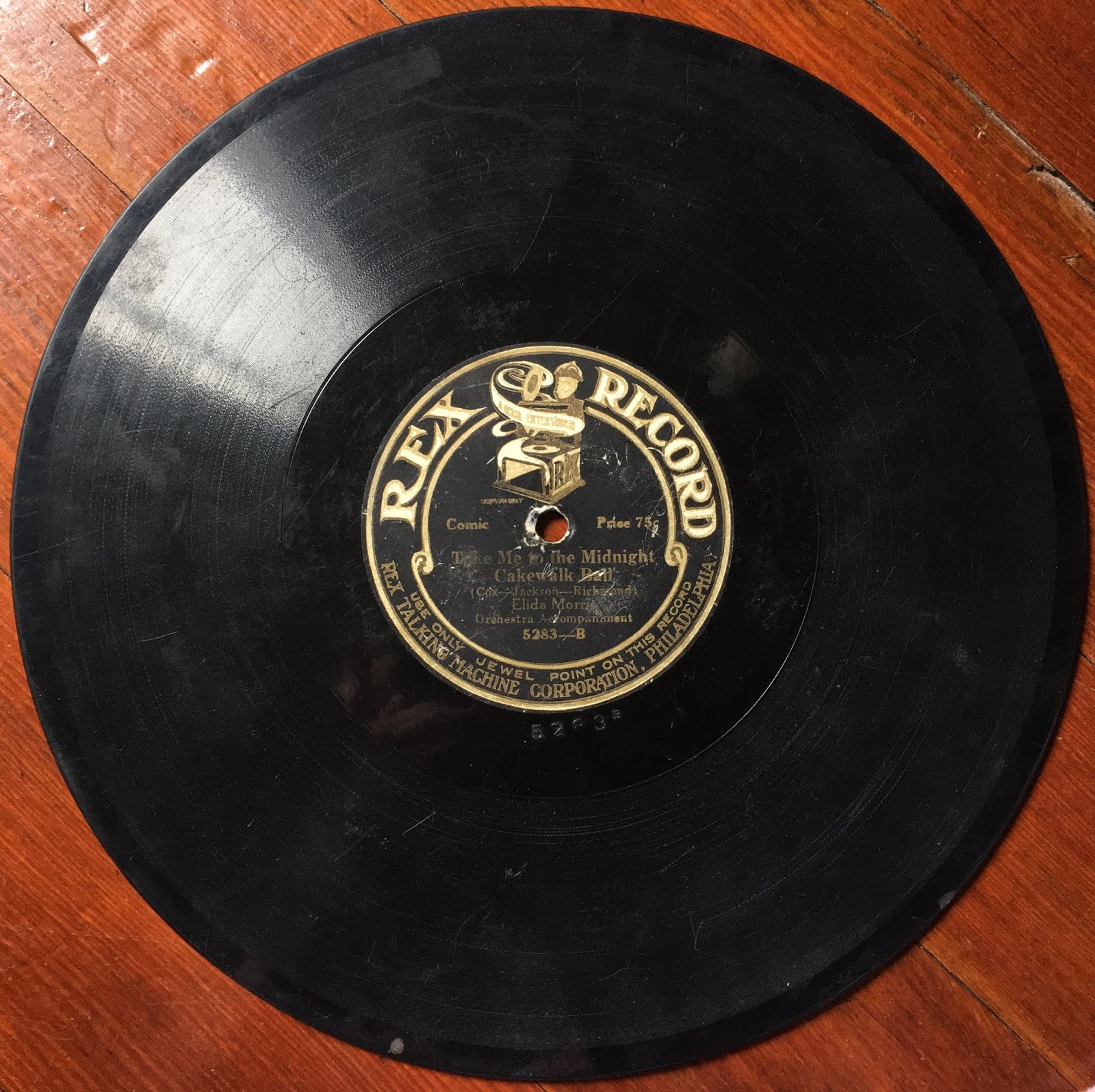
In keeping with the Hager subject, I have been on the lookout for some of his illusive Rex records. Those records were essentially the first of their kind, the first very successful American vertical cut records. Here's a nice example floating around on the internet:
These records sounded particularly nice in their day, and they seemed to have had the strangest titles associated with them. This label shows Hager's true colors, very expansive and diverse. The Rex label recorded everything from Grand Opera to Rag-Time piano solos by Roy Spangler who learnt them by ear.
Don't Believe me? Well here you go:


How about that?
Just like he did with Zon-O-Phone ten years before, Hager made sure the widest range of music was recorded, and recorded well for that matter. I have a single Rex record, and it sounds okay, but of course without the proper apparatus to play it it's bound to sound crappy. 
I don't have transfers yet, but here are the pictures:
That is the later edition of the Rex label, from 1915. 
The music is really nice on these though, as expected of Hager, the orchestra accompaniment is definitely more interesting than other studio groups of the time. Since it's 1915, the accompaniment is a pseudo-"Jass"style, which makes it particularly interesting. This is more so on side B however. As it turns out, these records are very uncommon, which is strange considering the circumstances of which I found the Rex record I have. I stayed in Los Angeles a few years ago and went to the Amoeba records in Hollywood and found that record buried in the old timey section at the back of the store. 
I was just in LA this last week and found nothing nearly as nice as that Rex record this time at Amoeba. I have gotten some nice Zon-O-Phone and Ossman records there in the past and recently, but the Rex record is the sole standout find from there. 

With that, I return to the Hager's. Unfortunately, it will take a lot more digging to find more on James Hager. On the entry for Fred, everything is there, but the information on the rest of the family is very vague. However, when I did a little more deeper digging I eventually found his WWI draft card! You can imagine how happy I was to find it, and definitely be assured that it was the right guy. 
Here you go:
How about that?
Tall, Stout, and brown eyed. 
Hmm.
That's quite different from how his matinee idol brother Fred looked. I do find it curious that his hair is stated as being already somewhat gray by age 36. Usually thats an indicator of red hair, but let's not get too set on that idea. Just keep that in mind with him. Finding this card also proves a much more exact birthdate for him, as well as that he was working as a musician long after the Zon-O-Phone era with Hager's orchestra. 


Anyhow...
I wanted to do a section here on the new phonograph I just got, but I will have to save that for the next post. I have a handful of really nice records to play and eventually get transferred. The machine I got is a really early Columbia Q with some nice eartubes to go with it. The discussion of the records will also be done in the next post, as there's quite a lot to talk about surprisingly. 


Hope you enjoyed this!