Showing posts with label Character Studies. Show all posts

Thursday, January 12, 2017

Character Studies--Fred Hager(1874-1958)

Now that we know Hager was one of those famed Rag-Time pianists on early recordings, it seems inevitable for more posts to be centered around him and Zon-O-Phone in general. Despite a yearning to learn more about him, there's not too much on him out there, everything there is about him is from later on in his career as a bandleader and arranger, from about 1907 to the 1920's, bit after that there's a huge gap of time before then and after that. Soon, we hope to dig up all of this information on him, much like we did on Edward Issler. We hope that these gaps will be filled at least somewhat, so a trajectory will be known to some extent.

Now for Hager's background and upbringing. This at least gets us an idea of how highly regarded he was from such a young age. He was born in Susquehanna County Pennsylvania in 1874, and from a very young age joined local regiment bands, as this state was known for such a thing at this time.  In 1895, Hager was given a full scholarship to attend the New York Music school that had just been set up by the famous Czech composer Antonin Dvorak. He was sent here to study the violin, likely in his case under Dvorak himself, which is very strange yet amazing all at once! Once at the music school,he gained a reputation as a violin virtuoso, and a blossoming musician all around, playing brass and piano as well. By 1897, he had formed his own band, and this was given many awards as one of the top bands of all New York State, which is no small thing. He was soon invited to make records for the relatively small firm of Harms, Kaiser, and Hagen(as stated in The Phonoscope), and the next year, 1898, he was making violin records for Edison. Oddly enough, this caused some competition for Charles D'Almaine, who was then working for Edison and Columbia. It was around this time that Hager became a pianist for Edison, adding to their already three pianists on staff. Of course, just like with D'Almaine, Frank Banta must have unexpectedly entered competition when he  came along, not aware at first of Hager's curiosity in playing Rag-Time. But Banta and Benzler underestimated Hager's curiosity and rather surprising skill when it came to actually playing the style. He didn't surpass Banta in this, but he came pretty close to doing so, in a rather short period of time, since by 1898, Hager was also playing Rag-Time accompaniments for Edison, to compete with that horrid mess of a pianist at Columbia. Edison had two Rag pianists to essentially equal one Hylands. 
the equation was simple:
two Rag pianists:
Banta and Hager= equals one Hylands. Good.
That's Walter Miller's(Edison's Victor Emerson) logic for Rag-Time at Edison.

Anyway, Hager worked at Edison into 1899 and 1900, but it was around the latter that he became associated with the scandalous new company Zon-O-Phone. With this new company, he essentially was working with a clean slate, since this company had no history or baggage with any other company(save for Victor after 1900), and the orchestra was his to piece together. That's exactly what he did, and by 1901, he had created Zon-O-Phone's famed house orchestra, with some of his own musicians, and occasionally plucked out musicians from other studio orchestras. The end result was the best house orchestra of the era, and his arrangements made them ever better. Of course, since he was the orchestra leader, it seemed inevitable for him to become Zon-O-Phone's main studio pianist. He took his time at Edison as a trial for his piano skills to develop, and once he had Zon-O-phone's studio, he allowed this to be his time to really improve his piano playing, particularly his Rag-Time. His style of Rag-Time was very unusual, and it sounded like a cross between Hylands and Frank Banta, and all the other Edison pianists of the late-1890's. Luckily, that's why it wasn't too hard to put Hager's name on that style in the first place. His style was still very odd, combining the straight-laced and classically trained background with a very syncopated and rhythmically superior nature. Oddly enough, he played fifths in his left hand, and combined this with whacky yet syncopated right hand. Oftentimes his right hand was out of whack, but the rhythm in the left hand was always on point. It sounded like Hager had been to performances with Hylands accompaniment, or someone like that, such as Ben Harney, or Max Hoffmann. Wherever his inspiration came from, the style he created was unique and very interesting, obviously taking from Hylands. By 1902, he was eclipsed by his own competitor in Rag-Time, Fred Hylands, because once Hylands became horribly fed up with Columbia in 1902, he entered into Zon-O-Phone's studio and was welcomed by the management. Luckily, this relatively short period became the prime of Hager's orchestra, since he wasn't always going to be the pianist when Hylands was there. Between 1902 and 1904, the best of Hager's orchestra was recorded, you can notice a spike in Hager's Orchestra performances on Zono in this time period, and the overall sound was just as great as it had always been, if not a little better in this period. By the end of the piano accompaniment era(1905) Zon-O-Phone still held on to their piano accompaniment until the end of that year, much like Columbia did, for what seems the same reason. Hager wasn't dropped like Hylands however, he was given leadership of pretty much all the Zon-O-phone sessions, still keeping his orchestra there as the accompaniment, and for occasional band recordings. They were still a superior orchestra, with the superior sound quality that was a signature for the label. By the end of Zon-O-phone as we know it, Hager was thrown out, just like everyone else who worked there. But he feared not, his orchestra became what Issler's did, an old-style orchestra who got a surprising amount of work after recording. Hager was still young by 1912, so his orchestra didn't become archaic until the 1920's. Hager wasn't able to transition to Jazz, just like Issler, but by the late-1920's, Hager had joined the radio business. In the 1930 census, Hager is listed as "program manager-broadcasting", which proves this statement. He was doing just what he did for Zon-O-Phone, just for the radio studios. It seems that by 1940, he had left this line, and retired as a music writer, and general musician. Performances by his orchestra date as far along as 1952! That's dedication. Hager's orchestra must have sounded real old-time by the 1930's, and to think that he was performing twenty years after that! He died in 1958 at the age of 84.

Hager made sure that his family didn't seem unusual for the time period, and this can be well observed in census records. In November 1897, he married Clara Decker, and soon had two little girls, none of whom entered in the music business unfortunately. Not much of his personality is easy to put together, but it's certain that he was an agreeable musician, since he was able to work for many record companies, and not create any baggage with any of them. Record companies probably fought quietly over him, and it was likely that Columbia became envious of the perfect pianist and orchestra leader Zon-O-Phone had, since none of their own staff was as extraordinary all around as Hager. Another thing that kept Hager always well liked was that he was the best-looking of the studio pianists, not seeming to fit the pianist stereotype that Banta and Issler personified to the highest degree. Hager was tall, thin, had dark blond hair, long stick-like legs, well-sloped slightly feminine shoulders, and a gloriously classical profile, with a perfectly shaped forehead to fit this. His good looks and agreeable nature were hard to refuse to the record managers, and he earned respect and admirers from this. 

Hager was a whole lot better-looking that most of these early recording stars. 
Just saying. 

Now for some records with Hager on piano! 

Here are a few examples with Hager's interesting and distinct style:
what a wild record!


Well, there you go! Finally information on Hager! Thanks go out to Charlie Judkins for helping in finding all of this, some of the information also came from articles by Tim Gracyk and conversation with Craig Ventresco. 

Hope you enjoyed this! 


Sunday, May 29, 2016

Character Studies--The Columbia orchestra(1897-1905)

That's half of the Columbia orchestra. 

I just know that doing a post on this group solely would be hard. Despite that, I will try my hand at it anyway. Now before I get into the describing, I must point something out that I did not notice until a few minutes before I began this post. 

See that chair the trombone player is sitting in? Right here:
(that's David Dana by the way!)
That chair looks like a familiarly queer-looking one from a picture I recognise:
 Which chair? 
That obviously miserable chair. 

Hmm, I wonder whose idea it was to give Fred that chair for the exhibition hall of all places at Columbia's Broadway address? There's a strong possibility that Fred obliged. That chair is very different from all the other ones, I wonder what its specific use was? It wasn't just Fred's chair, as David Dana can be seen in that picture(with Hylands!) sitting in that strange chair. 


Anyhow, sorry to get side-tracked, back to the Columbia orchestra. This group, as I have explained, was formed by all of the leftover musicians from the fall of the U. S. Phonograph company in early 1897, and unfortunately, Edward Issler was filtered out after this transition, which meant the end of Issler's orchestra at Columbia. Without Issler, the members of his orchestra blossomed in this new group of musicians. 


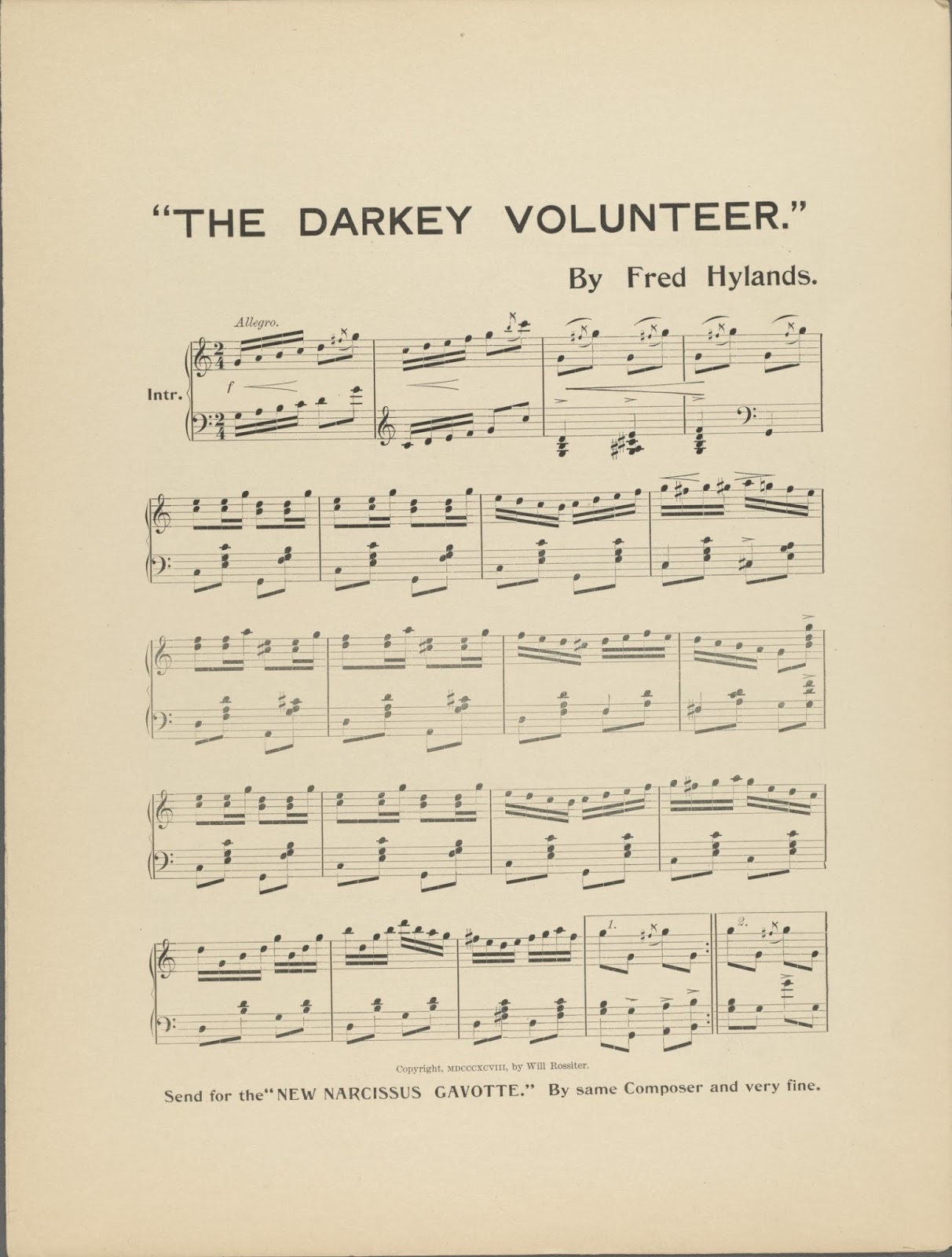
The Columbia house orchestra was a stew of musical misfits, from confident and classical William Tuson, to ragged and rough Fred Hylands. They were all selected by the bewitching hands of Master Edward Easton himself, each getting his approval one-by-one, so it's assured that they were well-liked musicians among the picky management. Most of them were Germans, with some odd sprinkles of English and Bohemian here-and-there, so they were a mix of European stew. Much of their repertoire before Fred Hylands came along was popular music, with the arrangements made by Tom Clark, and older ones that were handwritten by Issler. Many more soloists were recorded with the Columbia orchestra in their earliest days, as for some reason, this idea faded away as the years went on. Though Len Spencer was not one of the musicians in the orchestra, he was a member regardless, as he did all of the sound effects, many announcements, and even sung some choruses on the popular vocal selections they recorded in 1897-1899. Hylands was not the first pianist under this new orchestra in 1897, as it was originally Issler, but after about a month or two, they got their new trial-pianist some work, by playing in their house orchestra. Leader man Tom Clark found Hylands a complicated character, and did not like a lot of his habits, as did many who worked at Columbia during Hylands' term. Hylands made some of the arrangements they recorded in 1898, though Clark was the one who did the arrangements, Hylands still did many of them, and his arrangement of "The Darkey Volunteer(s)" was a real doozy. After an exhibition one night in July 1898, Hylands came in the next morning exhausted and hungover, but with something new written down for the orchestra. The first to see it was Clark, who at once got out his cornet to try and play this piece as written. It was fully of comical quotes, and had runs of notes practically spilled in long streams in the melodies. This piece was:
Yes indeed. 
Everyone else in the orchestra looked at it with unsure scowls, as when they got to practicing the piece, it sounded very strange to them, but Hylands yelled out to them and stopped them when something wasn't right. When they recorded Hylands' tunes, he owned the room, and all the people in it. There were few times when it was hard for the musicians in this group to stay together, but when recording this tune, this was very much a problem. 
Here's the band recording of it(with Hylands on piano): 
Recorded in 1898(not sure who the announcer is...)
It's like the man was messing with them. The tune is already hard enough to play on piano, then try to get twelve musicians to stay together playing it. He must have told Clark, "Oh no, it's not too difficult. It will sound perfect!" In the orchestra recording of it, George Schweinfest and William Tuson can be heard very well playing those ridiculous lines in unison. 1898 was the peak year for the Columbia orchestra, as they had all their best musicians playing great always, and they could play anything they Mr. Clark picked out from the old pile or created new ones. In many recordings of Rag-Time they did, oftentimes Hylands was wanting to play a different rhythm than the one chosen, so everything sounded all weird, such as on their take of Monroe Rosenfeld's "The Virginia Skedaddle" from 1898(begins at 8:05!). The rhythm sounds all out of whack at some points here. From what I can hear, it's the piano that's causing this. but of course, nothing was as bad as their 1899 take of "Smokey Mokes" from 1899(begins at 57:48!). I don't think it could get as bad as that one. At many points, Hylands is a measure behind them. He might have counted off wrong, or he wasn't paying attention to the rest of the orchestra. It's especially bad toward the beginning, but he remains a little out-of-whack throughout. The rest of the orchestra is fantastic though despite Hylands' strange ignorance. The problem is that the piano is so loud on this one, that it's hard to avoid. This was a problem that leader man Clark ran into when learning how to manipulate stubborn Hylands, and the evidence in clearly stated. After 1900, some special recordings with vocalists and the Columbia orchestra began to show up more, such as Dan Quinn singing "Pretty as a Picture" in 1900, and Spencer singing Hylands' "You Don't Stop the World from Goin Round". After 1901, they were recording many instrumental Rag-Time pieces, and re-recording some older takes as well, such as their 1902 recording of "The Darkey Tickle"(from 1892!), and their 1901 take of "The Darkey's Dream". They also took on the classic Rag-Time cake-walk "Creole Belles" recorded in 1902, and this strange recording of an oriental dance called "Obaja" recorded in 1904. They also recorded "Peaceful Henry" in 1903, but the people who put that up took it down from their site, which is really frustrating, because that was a masterful piece of early Rag-Time. By 1903, their specialty for "descriptive selections" was beginning to fade, as they were not as popular to record buyers by then, though they did come up with a few new ones, along with recording old ones. Here's Len Spencer's specialty with the Columbia orchestra called "The Levee Scene" from 1903. They ran out of time at the end, and this time is was a bad failure, before their last chord, the record cuts out. As we know, the Columbia orchestra had been known for their variety of fun "descriptive selections" since the formation in 1897, with a strange mix from "Charge of the Rough Riders"(hear Hylands sing!), to their "The Village Orchestra". The spark of playfulness that was had when they made these had faded by 1903 and 1904. They still had many of the same musicians, but they were not exclusively in the Columbia studio by that time, so these selections were not as much needed. By 1904, they were mostly recording popular dance numbers, such as many popular marches and songs such as "Hiawatha".  By 1905, the Columbia band led by Charles Prince was taking over the old orchestra spot. Only a handful of columbia orchestra selections were offered in 1905 and 1906, and with many of the original musicians dropped by the end of 1905, it was inevitable that the group would end by 1906. They were a unique and fantastic group of musicians who we now have the absolute pleasure to hear on hundreds of records from 1897 to 1905. Many of their selections were unique to only Columbia's orchestra, not any others, like the Peerless orchestra, or the Edison orchestra.

Here are two of their great selections from every year they made records:

1897:  "The Jealous Blackbird" with George Schweinfest
"I thought I Was a Winner" with Len Spencer

1898: "Jolly Fellows Waltz"
two takes of "Schubert's Serenade"

1899:a recording with the Imperial Minstrels(listen for that yell at 35 seconds in!)
"Upon the Golden Shore" with the Imperial Minstrels(Hylands is kind of out of sync again...)

1900:Ethelbert Nevin's " Narcissus" 
"The Santiago Waltz"
1901: "Kentucky Jubillee Singers Scottiche" announced by Dan Quinn
"The Sea Flower Polka" by Tom Clark and the Columbia orchestra

1902: their re-recording of "La Serenata Waltz"
"Smokey Mokes" played a little too slow on the trasnfer

1903: Their re-recording of "The Darkey's Dream"
a hot piece of Rag-Time called "The Dixieland March

1904: a hot "Slow Drag Cake-walk" called "Jovial Joe"
their re-recording of their famous descriptive selection "The Bugler's Dream"

1905: This is the last one I have found with Hylands still on piano in the orchestra, "Selections from 'The Yankee Consul'''
The other ones I have found from '05 don't have the piano accompaniment, and that was actually a very important aspect of their unique sound. 


Hope you enjoyed this! 


Saturday, May 28, 2016

Character Studies--George Schwienfest (c.1862-1949)

in c.1898
in 1894

This Issler "dropout" as I call Issler's orchestra performers who literally dropped out of that group for the Columbia orchestra, began working under the obliging of Edward Issler in 1889 for Edison's phonograph company, then in only a few months, he and the rest of the group were all working for North American, then later Columbia, and so forth. One of the first prominent things that Schweinfest ever did in ways of recording was making a handful of piano solos and duets with Issler in 1889. It's strange to think that they had so much trust and friendship in each other, but the fact that they specifically chose to make these duets shows an element of trust in them. 

To begin with Schweinfest, it is unknown where or what his origins were, but one thing is for sure, he had the same origins that Issler did, as they probably met around 1886, or many a few years before that. It must have been the ideas of Schweinfest and Issler that began their orchestra in 1888. Issler was a first generation American in his family, as both his parents were born in Germany, and he was the first to be born in the U.S., with this, Schweinfest probably had the same situation within his family. Schweinfest was a fantastic musician, with the ability to play at least five instruments; piccolo, flute, violin, piano, clarinet, and maybe more. It is not known what he began playing on first, though violin is a likely possibility. He must have been a very good man as far as the early recording stars go, very musically focused, cooperative, and patient. As from these traits, it earned him a long life, and many music directors wanting him. He was well-liked among the record staff, and Issler used him as an important tool of his, as on the many recordings by Issler's orchestra, you can hear Schweinfest playing different instruments, possibly changing in the middle of a take. With this cooperative nature, all the studio pianists liked him, but they all had to respect him, since he was one of their subs, and back-up pianist if one of them was out for a day, to a few days, to a week, or even if the inevitable happened--one of them died. He knew all the studio pianists, from Gaisberg to Bachmann, even if they didn't work at the same company, he still would have known them, and built kind relations with them, as he was no Fred Hylands. His times in the studio were always a breeze, save for the times when he apologized for his piccolo being horridly out of tune, as at Columbia it would be Hylands complaining about that of course. When he worked for Victor, his records were well made always, save for some times when the pianist was not playing the correct chords or just right notes. That, as we know was not Schweinfest's fault, that was Banta, Hylands or Bachmann's problem. He never missed a note, all of the notes he ever played on those solos were right, nothing was missed, ever. If you go through any multitude of his recordings, the conclusion might be made that he never missed any note anywhere. With that being said, it can amplify any mistakes the pianist makes behind him. Once Issler dropped his orchestra from Columbia's catalog, all his musicians weren't exactly sure of what he was going to be doing, so he told them that they were part of the Columbia orchestra from there onward. With this change, we get recordings like this one here:
"The Jealous Blackbird" by Schweinfest and the Columbia orchestra(1897)
As we know, Issler didn't disappear from there, though he wasn't leading his orchestra at Columbia anymore. 
That left Schweinfest, Tuson, and Dana under the rule of Thomas Clark, who was a different man than Issler. First of all, he wasn't German, and that immediately rid of many traditionally Germanic ideals and ways of musicality. Secondly, Clark wasn't a pianist primarily, so that also created differing viewpoints. Schweinfest was perfectly fine with this transition, as he quickly came to befriend the new director and pianist. Clark was fond of Schweinfest, as he was not only a great soloist, but also a fantastic player in a group, and  had that great sense of rhythm that must have come from working with Issler for so long. Hylands was a different tale. Schweinfest was on of the pianists that was replaced by Hylands, which created something there. He wasn't angered over this, as he was one who understood why Master Easton and Vic Emerson chose a low-life Rag-Time pianist to be their main pianist at that point in time. Despite all of this agreeing, he did have to get used to Hylands being there, with all his "baggage", and social issues. Being a member of the Columbia orchestra meant that Schweinfest had to attend things like this:
This is that section I use from The Phonoscope with the ridiculous amount of spelling mistakes. 
Anyhow, the Columbia orchestra is listed, Tom Clark is specifically listed as the orchestra director(of the few times he was!), and Fred Hylands is listed(love it!). As I have explained before, Master Easton held two of these gatherings, one in 1898 and the other in 1899, and considering the circumstances, they must have been very expensive to host, but at least the performers got to perform for their boss at the most expensive hotel in New York City at the time, and probably got some of the most exquisite courses of food they got for a while. Schweinfest had to go to both of these, as he is listed in both of them, not just inevitably part of the Columbia orchestra, but also as a soloist. Schweinfest remained making records as a soloist and with the Columbia orchestra after 1900, though his work outside of the studio remains a mystery to this date. He probably remained working with Issler after 1900, as there's not a doubt in my mind that the two remained friends until Issler died in 1942. He worked with Hylands primarily after 1900, as all of his solo records have Hylands still on piano behind him which probably was not an issue with him. Hylands was still Hylands, even if it wasn't 1898 anymore. It is not known what happened to Schweinfest after he ended recording solos, though he may have remained in some studio orchestra a few years after that. Which studio orchestra? I don't know, but I hope that it was Hager's orchestra! 
Whatever Schweinfest decided to do after he ended recording, it surely did him well, as he lived to be 87, and that's pretty much outliving everyone he knew in the earliest days of recording. He didn't out live Clark though, Clark was 89 when he died, and that makes him the oldest of the all the earliest studio stars, though Schweinfest lived the longest into the 20th century. 

It's amazing to think that Schweinfest outlived pretty much everyone in the Columbia orchestra(from Hylands to David Dana), and everyone in Issler's original ensemble. He also outlived most of the regular studio singers, Len Spencer, Edward Favor, Myers, Dan Quinn, Steve Porter, Russell Hunting, Edward Easton, Vic Emerson, and even Frank Dorian(who lived from 1869 to 1940). 

He even outlived all his managers and bosses. Heh, that's great. 


Hope you enjoyed this! 

Thursday, May 5, 2016

Character Studies--Spencer and Hylands

Hylands.
Spencer. 
Since I have been beginning a part of the "character studies" format speaking of two people, if found it appropriate to analyze and dig into the partnership and friendship of Fred Hylands and Len Spencer. 
It's been a while since I have delved into this friendship, though every time I do, something new is added into the mix of oddities that went into this partnership. As I have explained before, Hylands and Spencer probably met not long after Hylands began his trial at Columbia for a few months in 1897. In fact, Spencer might have even approached Hylands while he was waiting his turn to be judged by the managers. Whenever it was that Spencer approached Hylands for the first time, a connection was immediately made, no matter what kind of conversation came about. 

Hylands and Spencer were like no other pair in Columbia's 27th and Broadway studio. Spencer was loud and expressive, acting as though he were in his minstrel clothes more than half the time in the studio with Hylands. Len was noted for calling Hylands, "Freddy" the most often, and he called him that all the time when they made records. Between some takes later in the day, the both of them would sniff up snuff on counts of three, same with drinking some harsh liquor, all brought by Hylands most of the time. Hylands would get all excited when Len came in, as it was always a fun time when he came, rather than J. W. Myers, or Vess Ossman. Hylands took favourites once he got to know everyone he worked with in the studio, and he knew who to look forward to, and who to not be as much with. Part of the reason that Hylands was chosen for Columbia's piano chair in the first place was due to the fact that they wanted to stay absolutely up-to-date, and since it was 1897, they wanted a Rag-Time pianist. Hylands just happened to be perfect for Columbia's needs, and wants. It didn't take long for the artists to cling to Hylands' style, both Rag-Time and not, and of course, Len Spencer did this more than anyone else, as their senses of Rag-Time were practically identical. It's no surprise that Spencer was immediately drawn to Hylands. Of course, Spencer didn't exactly know of the "baggage" that Hylands had with him as a person, it took many days of recording to finally somewhat understand how that piano man worked. It took until early-1899 for Spencer to build up enough trust in Fred to want to begin a publishing venture with him. Out of this studio trust came Hylands, Spencer and Yeager. Hylands and Burt Green ran Fred's flat, whereas Spencer would only come later in the evenings, after making records and such. When they were all at the flat late at night is when the antics would begin, with Fred's father occasionally coming in to yell at them to be quiet. This is where new music was made, ideas were created, drinks were taken, and drugs were sniffed. It was the most mirthful of times for all of them, and it was much more free than when in the studio, and also the stage that Burt Green worked at. Hylands lived the best while running this firm, and it was with Spencer that many of these deals were made, and many of these "coon songs" were published. After all, it is no surprise that Hylands' so-called "baby" "You Don't Stop the World from Going Round" had Len Spencer as the featured performer on the cover for six to eight editions of the tune. The friendship between Spencer and Hylands lasted well into 1900, though as the firm was beginning to slowly wind down, Fred was becoming frustrated with Spencer, as he almost never came in to tend to any duties, or even pick up the piles of mail Fred would receive for him. In angry fits, Fred would take the piles of mail and pour them on Len as he walked by the building on his way to the studio some mornings. "Here's yer mail!" Fred would snap. With this flame of animosity ever being fueled by Len, Fred was forced to sell all of his stock to the larger firms that had become associates of his. This slight tension between Len and Fred remained for many years, but it did not keep them from still being friends and great studio partners. 


Their records were truly some of the best that came out of the late-1890's especially their very dynamic and popular pieces of Rag-Time. 

Here are a few of them:
http://cylinders.library.ucsb.edu/search.php?queryType=@attr+1=1020&num=1&start=1&query=cylinder10662

http://cylinders.library.ucsb.edu/search.php?queryType=@attr+1=1020&num=1&start=1&query=cylinder14245

http://cylinders.library.ucsb.edu/search.php?queryType=@attr+1=1020&num=1&start=1&query=cylinder6709


Hope you enjoyed this! 

Monday, May 2, 2016

Character studies--Issler and Hylands(1897-98)

A caricature I did contrasting Ed. Issler and Fred Hylands.

The reason I am putting these two in a post together is because of how different they both were, though they worked the same job in just about the same time frame. Issler was the pianist just before Hylands was hired for Columbia, doing his job in the dreaded "round" era of the 1890's. Issler had it much worse than Hylands ever had, having to stay put for full days dedicated to only two or three songs, over and over, until the manager would give a slight nod, and enough rounds were made for the day, only to come back the next day and make another hundred rounds.  

Issler had been working for Edison since 1889, and Columbia since 1893, working solely for the record companies, which did not allow for many public performances of by his parlor orchestra, those were saved for the studios. He was a genius man, with balancing of instruments, there was no better man for the job than Issler. This is why the recordings by his orchestra are among the best that were made in the acoustic era, even beating some of the later recordings of twenty years later. Issler was always there in the studio, much like the members of his orchestra, William Tuson, George Schweinfest, David Dana, and even Len Spencer. Issler was extremely well-trained, however he was, his rhythm was superior, and his sense of melody was just as well, far better than the Fred Gaisberg who came before him at Columbia.With his orchestra beginning to fade in early 1897,  Issler began to see some changes being made around at 27th and Broadway. He saw the emergence of studio manager Victor Emerson, and the move to that frivolous new studio. He saw the beginning of the new exhibition format, which was nothing like how it had been before. It was much more of a spectacle than how he experienced it back at Edison, and in the earlier years of Columbia. Around March of 1897, Vic Emerson approached him one day in a lull toward the end of a recording day, and warned him of a possible handful of tests in the next week at the studio. These weren't going to be just any tests, they would be for a new pianist. This might have been specified to him, or it may not have. Just as Issler was tried for the Edison staff in 1889, and was the fifth pianist they tried, Columbia did a similar sequence of choosing. It would certainly be curious to know who else Columbia tested in mid-1897, but it must have been at least six different pianists. Hylands must have been at the back of the line, smoking a cigarette, waiting impatiently for his time up the stairs and in the big studio room. Issler probably was not present in the very room that the tests were being made, but he was probably on close watch, listening with that freakishly sharp ear of his. Most of the pianists were too shaky, nervous, and swift-handed. Easton and Emerson found them all to be too eccentric, frivolous, and too much like Fred Gaisberg, which was something they wanted a change from. Once they were growing tired of the strange bevy of pianists, in came an ever anomalous figure, a real different-looking specimen than the rest. At least a foot taller than all the others, bright blue-green eyes blurred by gold rimmed spectacles, pumpkin-orange hair, freckles, red-burnt face, small bits of acne, crooked full lips, laden with accumulated girth all over, long slim hands--it could only be Fred Hylands. Master Easton had heard of this Hylands fellow beforehand from mutters around by the staff members. He had heard that Hylands was good, but not much else. How they were shocked by how skillful he was, yet he was merely a child. At 25, he was the youngest of all the pianists tested that day. They knew he was the right one, from how he consumed the room, took his bow, and his overwhelmingly charming demeanor and smile. Issler knew from there that he was going to be leaving Columbia soon, but the exact time was only later to be revealed. The time was coming though. In this slim amount of time from the middle of 1897 to early 1898, Issler continued to work for Columbia regularly, but sometimes, Hylands came to charm everyone with his childish ways. Issler only rolled his eyes at Hylands' insolent nature, and found him to be an amateur, only to later find out that he was genuinely a musical genius. Issler found Hylands' "Rag Time" to be too broken and unstructured, far too much to be considered legitimate music. The fact that Hylands was a real "professor" also was something that Issler detested, as he had spent years in training to fully have a good knowledge of music, and Hylands hadn't, yet he was so musically mature. He would refuse to admit it, but by the end of 1897, Issler had become dreadfully jealous of Hylands, and it was clear, since all the regular studio artists were practically pulling on his leg to be there every day they made records, that Issler was going to be dropped within the next few months, or even in the next month. Issler was not far off, by December 1897, he was dropped from Columbia for the time being, for Hylands. Issler did not come back to Columbia, as he was keeping his orchestra together with only a single hair of string, still making records until 1900. After 1900, Issler vanished, and was not known of again. Hylands on the other hand, we know how it went for him at Columbia for the next 8 years, aging out of his insolent ways gradually as the years went on in publishing and studio days. 

These two early studio pianists can be heard on thousands of recordings from 1889 to 1905(the entire span of the piano accompaniment era). Issler was heard on all the earliest commercial recordings with piano accompaniment, no matter what company, Issler was on them, slaving away behind the singers at the plight of the "round" era. You can hear Issler on these early cylinders here:

The original "Commodore" Edward M. Favor sings his famous tune "The Commodore Song" in 1893

"March of the Marines" by Issler and his orchestra, with Len Spencer on bells, c.1893

Monroe Rosenfeld's Walk-around, "The Virginia Skedaddle" with shouts by Len Spencer, c.1895

Hylands can be heard even more so, because he was on more recordings that survive now, and because he began at the end of the round era. The examples:

John Yorke Atlee whistling Verdi's " Anvil Chorus" in 1898

Len Spencer singing Barney Fagan's big hit "My Gal is a High Born Lady" in late 1897-early 1898

Spencer and Roger Harding sing "Larboard Watch" with some uncalled for Rag-Time by Hylands in early 1899


Hope you enjoyed this! 


Friday, March 25, 2016

Character Studies--Edward Issler(1856-1942)

Issler, c.1894
that's also Issler(no arguments! I'm 100% sure this time!)

Edward Issler was a much more brilliant and versatile studio worker than history has allowed. He has only really been said to have been a pianist in the earliest days of recording, which he was, but he was more than that. Now, Issler's origins are still awaiting to be uncovered, but one thing is clear, that he was very well trained, and was a truly "Victorian trained" pianist. What I mean by this is that when you hear him playing anything on those cylinders, you are hearing truly Victorian music played by a pianist who was trained in the 1860's and 1870's. Issler was no member of the up-and-coming "punk" movement of its time, "Rag Time".  Issler was a special case of Victorian pianist however, most Victorian or "Romantic era" playing was actually very jagged in rhythm, and was not accompanied with a strictly "straight" rhythm that we well know of to-day. Just for a good example, listen to this cylinder here from 1897 of Johann Strauss's "Pizzicato Polka" as an example of this:
(they can't understand the announcement on this website, but Len Spencer says "Pizzicato Polka, played by Gilmore's Band...")
The Polka was all the rage, beginning in the 1840's, and throughout the rest of the 19th century. It had a very unsteady yet playful rhythm to it, and Strauss' polkas are among the finest there are. The "Pizzicato Polka" was written in 1867 by the way. 
Anyhow, back to Issler. Issler's was trained in the era of the polka and mazurka, when straight rhythm was considered a true gift, and a sort of rare genetic mutation. Issler had fantastic rhythm. He was far better than his comrade Fred Gaisberg, and was cherished by the record companies for this, among other things. In many ways, Issler had better rhythm than Fred Hylands, though Hylands was at a disadvantage because of his terrible drinking habit. Issler's days before recording are unknown, and it is hard to know how Edison's small staff in 1887-88 took an interest in him in the first place. All we know is that Walter Miller found Issler to be the most important and life-saving employee they found in the earliest years of Edison's company, as Miller was forced to play piano on test recordings they did before he found Issler. When he officially became a member of their staff, he was always needed there, as he was the only pianist they had employed at the time. It didn't take too long for Columbia to take an interest in him, and the Edison workers over at North American as well. In 1892 and 1893, he was working for Edison regularly, Columbia, and North American. 

Issler was a man of average height, with a full beard, hair always slicked back, pointy ears, and somewhat long hands. He was not freakish-looking chap, save for the very Germanic feature of the beard(he did much look like Bohemian composer Antonin Dvorak!). He didn't exactly speak with a German dialect, unlike a few of his parlor orchestra members. He always dressed modestly when coming to work in the studio, which served him well in the varying weather conditions. He would always be ready to make records, and when his gang of musicians came along with him, he was always keeping them in-line with sound balancing and what was going to be played for the day. He always fixed the piano so it sounded supreme on every recording he made with his orchestra. The amazing sound of the piano he made even dazzled the members of the band, Schweinfest, Tuson, and Dana alike. Issler was not one who was too extroverted, which helped when making records, but not when people asked him how he did it at exhibitions, his sound effects man Len Spencer did that for him. Issler formed his parlor orchestra around 1886-87, and they were just a small performance group who did house concerts and some performances around the Washington D.C. area. By 1893, Issler's orchestra was a very popular group to play on phonographs everywhere, as they were the elite of the studio groups in that time, and nothing really as great as them ever succeeded. Issler kept up with the company lawsuits of 1894 through 1896, and was probably a witness in some of the court hearings. The the height of his orchestra's fame, 1895 and 1896, they were making thousands of rounds a months for Columbia, New Jersey Phonograph Company,the U. S. Phonograph Company(no more North American by this time...), but for some reason, they weren't making records for Edison anymore. I never knew why Edison dropped Issler from their staff in 1895 or 1896, guess it was because of his disloyalty by working out at all the Columbia associated companies, we know who took his place from there(Frank P. Banta and Bachmann). Issler remained making records with his orchestra until early 1897 when some major changes at Columbia were made. He had still been the usual accompanist over at Columbia for the entire time that he worked there making records with his orchestra, and even a little bit after the group was dissolved. Issler faded away slowly as the year 1897 progressed forth, and his "axing" from the staff was even closer on the horizon when a new "hot-shot" Rag-Time pianist captivated Messrs. Easton and Emerson---Fred Hylands. It's almost completely unknown after 1900 what became of the studio genius Issler, though it's very possible that he started his own band sometime after his studio orchestra morphed into the Columbia Orchestra in 1897. The genius of Edison's early studio faded away and did not return to the business ever again, and vanishing from all who knew him. It's unfortunate really, as Issler was a very underrated star of the earliest recording business, who was overshadowed by  the pianists who worked alongside him and also the one who succeeded him at Columbia in 1897. 

Anyhow, to close off this post on Issler, I will have two examples of his orchestra, then I will have one record of each of his famed soloists:

*Just for some weird information, I just learned this evening that a "Yorke" is actually a kind of late-Victorian dance, much like the Mazurka or Schotticshe, and I don't know anything about the "Yorke", if anyone knows anything about it, please comment on this post!*

Ricard Wagner's "Evening Star" played by David B. Dana in 1895:
https://archive.org/details/EveningStarByDavidB.Dana1895(announcement by a young Len Spencer, and Issler is probably on piano here)

Schweinfest playing "The Jealous Blackbird" in mid-1897 with the other two musicians listed above, but with their master thrown out, instead Fred Hylands is on piano(I think, I did  post a while back on the mounds of debate that come with this cylinder...): http://cylinders.library.ucsb.edu/search.php?queryType=@attr+1=1020&num=1&start=1&query=cylinder8792
 (announcement by Harry Spencer)


I hope you enjoyed this! 


Tuesday, February 9, 2016

Character Studies--Victor Emerson(1866-1926)

That's Emerson in 1917.
 and that's Emerson in c.1898-99
(I figured out this picture! It's not Steve Porter, but it's Victor Emerson! see the similarities now?)

Now this man as always had mixed opinions surrounding his leadership at Columbia. Some say he was a very "formal and charming man"(said John MacDonald in 1904), but others had said that Emerson was the one who owed half their life to them. He wasn't the "CEO" of Columbia, but the fact that he was the studio manager is enough to know what his job was at Columbia. He was indeed that chap who began the Emerson record company in the mid-1910's, and watched it fall downward in the early 1920's. He was the one who witnessed much of the wild Columbia antics of the late-1890's and was the "boss-man"(pardon my crass historical reference...) of the studio "wage-slaves"(which included everyone on salary there!).


Emerson was not trained musically at all, therefore he was practically tone-deaf and had not an ear for music. That really explains pretty much everything about late-1890's Columbia. Emerson became the studio manager in 1897 at Columbia, and it took some getting used to. 1897 was a very big transition year at Columbia, and Emerson was right in the middle of it, from the studio manager, pianist, orchestra director, "contracted" staff, and even location, all of these things were changed in 1897. Emerson was a seemingly kind an quiet studio manager at first, seeing George Schweinfest, Ed Issler, Russell Hunting, Len Spencer, and all the regulars in '97 come in was not discomforting to him. But in later 1897, a new threat came to him----Fred Hylands. 
Ooh! How Hylands must have been intimidating to Emerson! It couldn't have been Emerson that hired Hylands, there's no way the he'd be in that sort of mindset to drag him by the collar into their studio. Emerson must have enjoyed Steve Porter though(who came in around the same time as Hylands), as Porter was a similar man to Emerson in many ways. Porter's tantalizing accumulated wealth also kept him of interest to Emerson, and his fellows in management at Columbia(like Edward Easton for example). Emerson was said to be a demanding man in the studio, standing oftentimes just behind the mouths of the horns off to the right corner of the room. You'd never be able to see him when coming in to the big recording room, as he'd be hidden, like a hawk, being the source of surveillance behind the back of the piano. Whenever  one of the artists walked in, they oftentimes poked their heads through the main door of the studio to see if Emerson or Easton was there, if not just yet, then they could come in safely without any comments from Emerson. Some of his comments would be similar to,"How you made so many great takes of (place song title here) last week!", or something like, "You should re-do that song", or even like, "I shouldn't like to think that your take of (place song title here) was very good, so you should do some other ones." He would give out all sorts of lousy suggestions to the staff members, as though he actually gave a rap about the music that he was managing. He really didn't care about the music, he was all about the technical and business side of the field he was in. He tried to become one of the "Columbia clan" but his far too conservative and harsh ways could not get him "initiated" into the clan. Emerson's figure was easy to identify at Columbia. Someone like Fred Hylands was probably told in secret about how to talk to and charm Emerson not long after he began working on salary. Emerson was about 5'5 or 6, with hair tinted bronze blond, thin eyebrows, bent nose, and a slightly crooked mouth, that looked very often like it was naturally a frown. The thing about him were those strictly blue eyes, which were like a hammer on an anvil when he gave a stare to one of the staff members. His eyes being the hammer, and when they bolted at the other eyes of a staff member, the hammer struck the anvil. He was a nuisance to much of the Columbia clan and their doings in the late-90's, and this can be proven by the fact that he was not invited to Porter's yacht races in the summers of 1898 and 1899, which only the clan were invited to. Many of them did buy him lavish gifts to show a feigned sense of affection and invitation into the "clan", though they were surely used as distractions from all their faults from working in Emerson's studio. He remained high in Columbia's management well after 1900, and saw all of the Climax feud of 1901-02, managing to escape the battle without any wounds. As the clan began to disband after 1902, Emerson began to make the artists work more and more, which was the opposite of what was needed to be done after the universal change to the gold moulded process. After many years at Columbia, he left them in c.1913, under unsolved and/or uncertain circumstances, but one thing is for certain, he began the Emerson label a few years after that. In 1915, he finally had the first Emerson records put out on the market, of which they were first very small 5-inch records with a fanciful label adorned with an image of a steamboat. One of which you can see here:
(from my collection)
 Emerson records started to become very popular by 1917, which is the first year that they began making 10-inch vertical cut records. Emerson was aware of the competition he was up against at this time, including his old friend Russ Hunting over at Pathe. They were actually alright records, that sounded alright on the machines that were available at the time, but they were still not the most popular records selling during The Great War. His sales dropped steadily from 1919 to 1923, which was about the time that he ended sales of "Little Wonder" records, and not long after that, the Emerson record company also fell. He only lived another three years, dying at age 60. 

I got a whole bunch of information on this post from this link here:
Enjoy the knowledge treasure trove!
(no mentioning of of Fred Hylands as a Columba pianist though...)


I hope you enjoyed this! 

Saturday, January 16, 2016

Character studies--George J. Gaskin(1863-1920)

"I was the zenith. Not a doubt could defeat that claim!" is similar to what George J. Gaskin claimed about his voice and popularity in the early recording business. 

Since to-day is Gaskin's birthdate, I thought it would be very appropriate to complete a post on him to-day. 
He believed he was the most popular recording star of the recording business in the 1890's, which, in many ways, he actually was, but that's partially just his ego talking mush. He recorded the most of the songs that many people who aren't record nerds remember now, which is a big plus on his part. Len Spencer made more records, but he didn't record some of the most easily remembered songs(ahem! most of them were coon songs!). Gaskin was very popular no doubt, as a phonograph singer and a general singer on the stage as well, which didn't always work with these studio singers. Gaskin was an interesting character in this mix of interesting and odd studio performers. Just as most of them were. For some reason, there's much mystery about Gaskin, even if he was one of the most popular recording artists of the 1890's. Just to put this into perspective, we know more about Dan W. Quinn and Len Spencer more than Gaskin, and Gaskin is sometimes regarded as being more popular than those two. There are also many "studio stories" that surround Gaskin's history, some true, and some not. 

Gaskin was a very vain chap, and his flamboyant personality could be seen in everything he did. He was a striking fellow, with dark auburn hair, always slicked in one direction, bright steel-blue eyes, light eyebrows, and a crooked mouth that affected his speech greatly. He seemed careless in the studios sometimes, and this is where the rumor that he chewed tobacco in the studio rooms spread. One person said that they recalled Gaskin as a singer who would chew tobacco in the studios, and spit it into the horns, or on the floor somewhere near. That tale only spread because of how they all knew he was flamboyant and eager for attention. It's more than likely to not be true, but it's funny anyhow, whoever it came from. He wasn't picky about what what Issler and Gaisberg should play when he was back at North American and Edison, early on, in fact, he really grew to like Columbia's and Berliner's pianist Fred Gaisberg. He began working for Berliner in 1894, the year that he first came to the U.S. to make records commercially. Gaskin was chosen along with Russ Hunting, Billy Golden, A. C. Weaver, and David Bangs. He was hard to work with when Berliner himself was in the room, as Gaskin would drink, chew tobacco, and act as he did, in front of the inventor of the machine he was singing to. In 1894, Gaskin also began to record regularly for Columbia(though he did make some cylinders for them in 1893), and this was when he split ties with Edison's company, as North American vanished in '94, and that was part of Edison after that. After happily being himself in the studios, working with Gaisberg and George Schweinfest, at Columbia and Berliner, along came Fred Hylands in 1897. Gaskin liked Hylands' sense of humor and playing style, and his willingness to work with everyone, but Gaskin must not have been fond of  how big a personality he was, and he was just the pianist! It was a slight battle of attention any time Gaskin came in and Hylands was there. He thought of himself so great, that he thought he could sing anything that he wanted, even though his renditions of "Coon Songs" were infamously disliked by record buyers, but were bought mostly as "gags"(everyone knew Len Spencer's were better!). He was told by his fellows in the studio to not sing "coon songs", and to stick to singing popular songs and Irish songs. He refused to listen to everyone, and he still recorded anything that he was told was new, or that the other artists were singing. He still thought he was the best of the Irish tenors, even by 1900 and 1901 when he was beginning to fade in the business. He was working only for Columbia and Zon-O-phone by then, and occasionally for Leeds when 1903 came along. He still preferred the piano accompaniment at Columbia, even if it just happened to still be Fred Hylands there. By 1903, he must have known somewhat that he was going to be ending his recording career soon, even if he must have acted as though he denied it. By 1904, he was out of the business, much like Dan Quinn was within the next two years. It is unknown what he did in the time he was gone, but it has been said that he stayed in vaudeville and performing for the rich. In 1917, he returned for a brief time to make a few records, much like Dan Quinn did. He must have known that his style was a gone fad, that only the older generation could enjoy. He couldn't adapt, and he didn't want to either. He must have known that he wouldn't live much longer, as he died three years later in 1920. 

Even though he made thousands of records between 1891 and 1904, his records are still rather hard to find to-day, so they are almost certain to be pricey when searching around for them. 
Happy birthday Gaskin! 


I hope you enjoyed this!