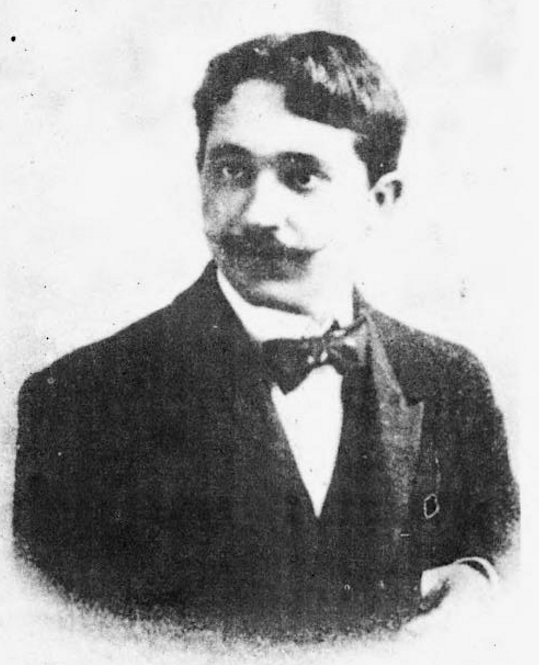
Showing posts with label Christopher Henry Hudson Booth(C. H. H. Booth). Show all posts

Friday, March 29, 2019

A Portrait of Frank P. Banta

Today we celebrate the birthday of Frank P. Banta, perhaps the most beloved studio musician of the entire acoustic era. 
It's hard to begin with this guy. 
I guess I could just write out an affectionate bio on him, just because I have gathered more information about him since the last biographical post on him. Well, here goes. 


Frank P. Banta was born on March 29th, 1870, the middle child of five. His father John was a woodcarver, a noble profession in Victorian New York, but perhaps more interesting is his mother's story. His mother  Fannie Darrow married first around 1863, but her first husband died quick, so she remarried an old man named John(Frank's father). Fannie was a rich girl, from a prominent old Dutch family of New Amsterdam. Her many sisters married prominent New York men of money, but she married a poor woodcarver in his middle age. Frank was the only musical child in the family, and it began to show quite early in his life. As a young child, Frank began to take up piano tuning, as his perfect pitch rendered him a skilled tuner. He started tuning pianos in factories, before they were sent off for sale. It was in this line that he began to develop a talent for playing the piano. His mother likely took notice of this tendency soon afterward, and got him some piano lessons. Though, it is likely that he didn't remain under the rule of a teacher for long, as his distinct style developed later proves for little training and more natural ability. 

Frank likely kept tuning pianos in his teen's to get some extra money, and also played some gigs here and there too. By 1888, his name was starting to appear in the papers as a specialty accompanist and arranger. His praises were already being sung before he was even 20. By 1890, he was playing in vaudeville houses all over New York, accompanying singers and instrumentalists of all kinds. Around 1892, Banta became associated with banjoist Vess L. Ossman. 
Ossmand and Banta advertised together, 1893. 

Somehow, in that same year, Banta was plucked out of the vaudeville houses to work for the three year old North American Phonograph Company. It's possible that Edward Issler recommended Banta to the North American/Edison management. Banta spent a few months of 1892 getting the training of phonograph accompaniment. Likely under the rule of Issler, Banta learned the phonograph ropes, and by 1893 was ready to work for them regularly. Other than working regularly with singers and other performers, Banta was often brought into the studios by special request of Vess Ossman, as they were still engaged together as an act at that point. Ossman as many recalled, was a very difficult man to work with. Someone as quiet and modest as Banta likely clashed with him often. Despite that, some of Ossman's best recordings have Banta's accompaniment, as they worked together perfectly in spite of their extreme differences. Banta likely learned how to work with these sort of performers by touring with Ossman, and it would inevitably come in handy as his years in the studios went on. 
Around 1895, Banta formed his own orchestra, a small parlor orchestra of about 6 musicians at most. Considering his close partnership with Issler, he formed this group to the striking likeness of Issler's orchestra. Banta's orchestra even recorded many of Issler's arrangements, such as "The virginia skedaddle", and "Her golden hair was hanging down her back". You can hear one of them below:
Banta is of course the announcer and the pianist. 
Banta' orchestra faded away from record catalogs by 1896, but at that point Banta was secured with Edison. 
By 1896, Banta was with Edison all the time, playing accompaniments for all who worked there, but of course it didn't take long for other companies to jump at him. As his praises continued to be sung by all, the Berliner gramophone company grabbed him in 1897 to replace the increasingly absent Fred Gaisberg. Berliner promised Banta more variety, and his own orchestra again. At Berliner, Banta led the Metropolitan orchestra, or at least sometimes. 
Banta was working for Edison and Berliner at the same time in 1898, seeming to equally balance his time at both. 
He had left the majority of his performing behind at this point, slaving away in two studios seemingly day and night. Some say that during his time recording, Banta was on half the recordings that Edison issued. Half. 

Half would mean thousands, perhaps more than that considering how early he started. 
In 1900, Banta, Arthur Pryor, Christopher Booth, Noble McDonald, and a few more Berliner musicians joined the newly formed Victor company. Each of these musicians made a piano solo for them in 1900 or in the few years afterward. Banta replaced his engagement with Berliner with that of Victor, working at Victor almost as much as he was at Edison. His distinct and steady accompaniments can be heard extremely well on Victors and Edison records during this time. he played everything from classical accompaniments to red hot rag-time. Here are two contrasting examples both from 1901:
His accompaniments are unmistakable, very steady, dynamic, and full of self taught eccentricities. 
His accompaniments influenced many of his fellow jealous recording pianists. Fred Hager and Justin Ring took especial liking to his pieces. 

This oddity of Banta's was only recorded by Hager's orchestra as far as I can find. 
Hager and Ring even mimicked Banta's smooth style of syncopation and dense chord choices in their own accompaniments. 
He continued to somehow balance all that work for Edison and Victor until 1903, where he had nearly completely exhausted himself with this work. 
During his later time at Edison, it was said that Banta's wife Liz worked in the studio as well. Liz was a studio secretary while Frank played accompaniments until he dropped. Frank and Liz married in late 1895, and their first child was the later famous novelty pianist Frank Edgar Banta. Somehow Frank was able to fit in time for another child in 1901, a daughter named Prudence(maybe that's somewhat related to that illusive middle initial of Frank's). 
Frank's children did not get to know him too well. As he was gone more than most men even in that time. Working for two record companies at once wasn't a family friendly concept in those days. 
Only when he became physically weak and ill from all that work did Frank realize this. In mid 1903, Frank was very weary of all this work, but his constant and determined personality dictated his place in the studios. he continued to show up to work every day he could, even though his asthma was getting worse, and time had already aged him quick, even at merely 33. 
Banta at one of Edison's Shoninger pianos, c.1899.

Banta came into work at Edison until the very day before he died. The day before he died in November of 1903, everyone expected him at work the next day as usual, not giving it much thought. But he died early the next morning. 
His absence rendered the piano at Edison silent that day. Legend has it at the Edison studio that no one came to work that day to mourn his death. 

But his story doesn't end there. When Jim Walsh corresponded with Dan W. Quinn in the 1930's, Quinn continued on to praise Banta. It seemed no one was so fond of Banta than Quinn. Quinn even named his youngest child after him. Now that's respect! 
It's Quinn's kind words and recollections about Banta that kept his reputation around, and it was carried on when Frank Edgar Banta was interviewed in the 1940's. Frank Edgar did not know his father well, he regretfully admitted this when asked about it. He recalled little of his father, but he did remember that his father was very humorous, rather quiet, and unfortunately ardent with work. He did recall his father inviting over many friends from work to play new songs(he didn't drop any studio names, but Quinn was almost certainly one of them, as was Ossman). His father would also sit with him at the piano to show him a few things, but these barely made it into his later developed style. 

Frank Edgar was 7 when his father died, and his sister Prudy only 2. 
Liz did not remarry after Frank died, but she continued to work into her old age. 


Well, with that, how about a few records he's on? His story is quite dramatic and somewhat depressing toward the end, so maybe some of his records could lighten the mood a bit here. 


(remember, Banta's name is on the original "Laughing song", he's listed as the arranger)
Banta was likely also responsible for this piece too. 


Happy listening! 


Hope you enjoyed this! 


Tuesday, January 1, 2019

More Studio pianist Digging and Hager's

In the last post I talked about the style crossover between a few of the early studio pianists, but in the short time since that last post I have found a few new things regarding studio pianists. When we get right down to listing the names of all the known studio pianists, it can get confusing when attempting to match the sound with the name. In case you're wondering, here's a list of all the pianists I have kept in mind in this process(in chronological order in which they started):

Theodore Wangemann(1888)
Henry Giesemann(1888)
Fred Gaisberg(1889)
Edward Issler(1889)
George Schweinfest(1889)
Frank P. Banta(1892)
 Noble McDonald(post 1894)
Christopher Booth(1897)
Fred Hylands(1897)
Fred Bachmann(c.1898)
Albert Benzler(c.1898)
Fred Hager(1898)
Justin Ring(1899)
Arthur Pryor(c.1900)

So that's about it for now, but there are very likely to be more names found in the near future. Some of these names should be familiar to the readers of this blog, Banta and Hylands included, but there are a few that are still very mysterious to me and other studio pianist scholars. Recently a copy of one of Mr. Noble McDonald's solos sold on ebay, who was one of the three Berliner pianists of pre-1898. I know nothing of Mr. McDonald, but he is likely the other pianist than Banta on many of those 1898 Berliners with rag-time piano accompaniment. I would place his name on many Berliners from 1897-98 that don't necessarily sound like Banta, but are still interesting to dissect. His style was likely the very mild one that we can hear on many Berliners around 1897, when Gaisberg was getting phased out as their main pianist. 
Soon we may be able to hear that piano solo by Noble McDonald, how that would definitely solve a lot of our issues with the Berliner accompaniments. Just like the succeeding company, Victor, Berliner's are a great source of frustration with me, as it's rather complicated with them after Gaisberg left in 1898. With Berliner, we keep seeing names pop up at accompanists, so at a certain point it becomes very odd and much more confusing than it should be. 
With Berliner between 1897-1899, about 6 different pianists' names have shown up, but only four of them have been confirmed as regular studio workers. 

Above I mentioned George Schweinfest, and I actually have come to realize something in the last few days regarding him. 
Schweinfest in 1898
For awhile now I have assumed Schweinfest to be one of the Columbia pianists other than Hylands. In 1889, Schweinfest and Issler made a handful of piano duets for North American, none of which are known to survive. Despite this tragedy, we can piece together a few things in terms of what Schweinfest did in the studio after Issler. While working with Issler, Schweinfest played piccolo, flute, and violin, but did not often take over Issler's chair. But after the orchestra broke up in 1898 or so(I know there are later ones from around 1899 of Issler's orchestra, but for the sake of keeping things in order, let's keep the idea that they broke up in 1898 or so at Columbia), Schweinfest remained at Columbia, even though Issler didn't. Schweinfest continued to make solo records for Columbia(as did the other Issler musicians, Tuson and Dana) until around 1903, but where did he go from there?

Actually, I don't think he went anywhere. Recently I saw a record listed that genuinely surprised me. 
There's a piano solo by Schweinfest floating around out here, and it's not one of the handful he made in 1889. Around 1905, Schweinfest made a piano solo of "Yankiana Two Step" for Columbia(it was issued on a 6 inch Columbia "twentieth century" cylinder). 

Wait what?

You heard me right. 
So I guess that Schweinfest didn't leave Columbia in 1903. So let's say that he hung around that changing Columbia crowd for a few more years, playing the latest piano accompaniments that we hear on Columbia. I don't think that Schweinfest is on those strange 1905 Columbia's of the 3000 series, but some of the others I would wager his presence. When you look up Schweinfest on findagrave, in his little bio there is an obituary from 1949 that states that he was a long time musical director for Columbia, beginning around the time that he stopped making solo records(c.1905). But what about those "20th century" records? Clearly he still worked for Columbia by then, doing more than just accompaniments and solos. With all that in mind, Schweinfest was also likely in the Columbia orchestra. 

I do not know how long Schweinfest was at Columbia, though his obituary stated that he was there into the early 1920's, which is quite late for an old-timer as him. 
So here's something curious, I was recently flipping through an 1898 Columbia catalog that was reprinted by a friend, I found myself looking whether Hylands' "Darkey Volunteer" was recorded that early. Turns out it was, but I found it rather curious who recorded it first(according to the catalog listings that is). Well it seems that Schweinfest was the first to record it. 
That was rather odd to see, as I always thought Ossman's take of it was the first one, a the piece was dedicated so highly to Ossman:


So with this in mind, and considering the amount of exceptional records Schweinfest made with Hylands, it would make sense that Schweinfest be one of the first musicians that Hylands befriended when he joined Columbia in 1897. Schweinfest may have been Hylands' studio mentor, as Issler was for Banta back in 1892-93. Even though we know Issler was still present at Columbia in 1897, Schweinfest is proving to have been more present toward the end of the 1890's after Issler left Columbia. 
Going through all of this begs the question, which pianist is Schweinfest?

Well, I do not really know yet. But I have a sneaking suspicion that this pianist may be him here:
http://cylinders.library.ucsb.edu/search.php?queryType=@attr+1=1020&num=1&start=1&query=cylinder5349
The only reason I think it may be Schweinfest is because of the obvious quoting of the piccolo part at the end of the record. The year that this was recorded also helps, as it was most certainly recording 1897, with the loud and clear announcement by Len Spencer as they were. On any of those 1897 Columbia's where the piano playing is very good but generic sounding(not too much going on to distract from the main performer), I would bet that that's Schweinfest. Of course hearing one of his c.1905 Columbia piano solos or one of the 1889 piano duets would really solve this mystery, and until we have one of those to hear, we just won't know. 


Just before Christmas, I got a copy of Noble McDonald's 1897 piano solo "Little Nell", and luckily I made a crappy transfer of it very soon afterward. McDonald's playing is very similar to how Banta played a swung schottische, with bits of syncopation and more, here you go:
https://drive.google.com/file/d/1iKbEjOLtfsHpWxA9sIXKRrNMWrtM8nZE/view?usp=sharing
It's quite a step up from the musicianship of Gaisberg's "Honeymoon March" and "Little Kicker" solos, also recorded on Berliner. 
For comparison, here's the record from c.1895:
https://archive.org/details/TheHoneymoonMarchByUnknownPianist1890s
Here you can also hear Gaisberg's "Little Kicker":
https://m.box.com/shared_item/https%3A%2F%2Fapp.box.com%2Fs%2F6c4x0tenjw1xc7ssw6fvwty0eb5d1vdl
It's quite fitting that I speak of Mr. Gaisberg on this particular day, which just happens to be his birthday! 
Before I move on, here's my favorite picture of professor Gaisberg:
Happy birthday Mr. Gaisberg!


So now to move on to Hager's. 
Since digging up all that information on Fred Hager's brother James, I have come to wonder what his role was exactly with his brother's orchestras and such. 

Fred and James Hager. 
Obviously we can assume from that big portrait of Hager's entire orchestra that brother James was working for Fred in the orchestra around 1902(the approximate year of the picture above). But at some point Eddie King got into the orchestra and took brother James' place. When that happened I don't entirely know. From what I have gathered regarding this matter, and from lots of listening to records, Eddie King became the accompanist for Hager's orchestra around 1904. The later years of his orchestra on Zon-O-Phone had King's percussion, and the earliest years went to brother James. 
So if this is true, where did James go from c.1904-1913(he returned to work for his brother again for Rex)? 
Recently I went digging again for James on ancestry, but wasn't able to find anything between 1900 and 1913, just as the last time I did that. So unfortunately I wasn't able to find anything on him in that essential period, though we know he was working for Zon-O-phone as late as 1904. 
When I searched for him on the DAHR website, there were a handful of records that included his name, most of them were from 1918-1926, far removed from his young days at Zono with his brother. He was playing traps, drums, chimes, and xylophone, just as he was listed playing in the c.1902 picture of Hager's orchestra. James made his way to Okeh in the earliest days of their existence. That's funny to note because on his draft card around the same time it says that he's an independent music contractor. Rather than having the Okeh name sprawled in the employer section, his draft card has a generic employer's name. Later than same year he was working for Okeh, as the ledgers indicate. 
So with all this in mind, we can safely assume that James Hager is that funky percussionist on the earliest Hager's orchestra and Zon-O-phone orchestra( and concert band) records. 
So here we should be able to hear James Hager playing the percussion:
https://www.youtube.com/watch?v=CdrCRA6XVug
This record is from 1901, which fits perfectly into the period that James would be in the orchestra. 
So this record would have Eddie King's percussion:
https://www.youtube.com/watch?v=BHSm1YTCzxo

After listening to a few records from the 1910's with Eddie King's percussion, I can really hear his playing and understand it better, here are two good examples of him with the Van Eps trio:
https://adp.library.ucsb.edu/index.php/matrix/detail/200014888/B-14589-Chinese_picnic
(Van Eps quotes the old Ossman piece "Sounds from Africa at the beginning of this medley!)
https://adp.library.ucsb.edu/index.php/matrix/detail/700000083/C-15093-Old_folks_rag

King's percussion was a little bit out of whack sometimes, but it's definitely good. From what I've heard of James Hager, he was quite talented as well, considering he was basically forced into musicianship by his brilliant brother. Keep in mind that Fred would have been teaching brother James to be prepared for the orchestra job when he was around 14(c.1896). 


Well, I have more things to share, but I don't want this post to get too hectic and complicated. So with that I will end it here. 


Hope you enjoyed this! Happy new year everyone! 


Tuesday, September 25, 2018

Tracking those pianists and questions

Since I've become so dedicated to studying and identifying all those early studio pianists, I've come to the realization of how frustrating it's become to keep track of them all. Now that the major parts of my Hylands studies have passed and I can now utilize, it's become ever frustrating to keep track of where Hylands was at different times and when he was and wasn't in the studio. 
Hylands will always be a source of madness for me, that's just inevitable. 

So, as of now, here's a list of the pianists and potential ones in date order(by the time they started making records) that I have to study and keep track of:
Edward Issler(1889)
(1889)
Fred Gaisberg (1889)
Frank P. Banta(1892)
Fred Hylands (c.1897)
Fred Hager(1898)
and Justin Ring(c.1899)
I must admit that this list isn't everyone, but I do also study Christopher Booth, as he is an essential component of those early studio pianist styles, as he's on so many early Victor records and was so well respected among the other pianists. 
As I dig deeper into identifying these pianists, the definitive understanding becomes much less clearer; that's rather the opposite of what I'd like to happen as I learn more. 
Of course, understanding Frank P. Banta's recording history is the easiest of this group. We know now that Banta started in 1892 at North American/Edison, under the training and supervision of Edward Issler. After the fall of North American in 1894, Banta remained at Edison and recorded for more regional labels with his orchestra, as this is where we get records like these:
In 1896 Banta returned solely to Edison, but soon he took a sub job at Berliner and remained on and off with them until 1900. In 1900 Banta, along with Arthur Pryor, joined the newly formed Victor company, and he took his Metropolitan orchestra from Berliner to Victor with him. Until 1903 Banta remained at Edison and Victor only, until he died in November of that year. 

Pretty direct isn't it! Banta's rather easy to identify in terms of piano styles, and his lineage in record companies entirely makes logical sense depending on what was the most stable at the present time. Banta was a union musician, so many of his moves from company to company follow a unionist mindset.Even with this very straightforward information, I still have a few essential questions recording Banta. 
Why is it that "Banta's orchestra" that recorded in the mid 1890's sounded outstanding, but Banta's "Metropolitan orchestra" sounded so awful?
Really take a listen to those Banta's orchestra records, they're really really good! He had some great musicians in the mid-1890's, seems he really took after his studio teacher Issler. Here's another one from around the same time as the above example:
Now that you've heard that, here's one of the worst Metropolitan orchestra examples I know of:
What happened?
Who knows...It's one of the greatest mysteries to me regarding the brown wax era. 
also...
Did Banta write the music to "The Laughing coon"?
Banta was another one of those studio sharks who came to George W. Johnson's side when he needed it. But unlike Spencer and Gaskin, Banta stayed out of the serious issues like his abusive home life. Banta was wise to stay only in the music, but this begs the above question. In Tim Brooks' book Lost Sounds, he makes it very vague where the "Laughing Coon" came from, though he does make it very clear that Banta's name was on Johnson's original "Laughing Song". This is no small thing. As record collectors, and general enthusiasts of acoustic recording music, we see the many hundreds of versions of Johnson's "Laughing song" scattered all over the internet, and it can become annoying after awhile. The amount of takes of that song is quite tiresome for me to be completely honest, so I only listen to three specific versions on occasion. Even with all this, the tragedy and history that surround this bugbear of a song is worth noting. The fact that it was written down by Banta is quite significant. Sometime I really need to sit down with the original sheet music and see if there are any curious characteristics in the written accompaniment that are fit for Banta. This piece proves Banta's standing in the Edison studio, and that he reached out to Johnson in a way that was unique, in comparison to the more capitalistic approaches of Gaskin and Spencer. I would definitely say that the evidence leans toward Banta writing down "The Laughing Coon", as it's got the same kind of structure melodically as "The laughing song", and the takes I've heard by Banta are very clean and definitive, as though he wrote it out exactly the way that he's playing it. The exact arrangement is also very similar to the earliest Banta accompaniments we know of, such as the strange 1893 ish record I was raving about for its swung syncopation:
So with this in mind, I would guess that Banta wrote down the arrangement of "The Laughing Coon" around the same time he did the "Laughing song", 1894. In thinking of these questions about Banta, I'm really hoping to sometime find out that he wrote out the music for "The Laughing Coon". Another piece of evidence to lean toward this is the fact that at Edison other artists like Cal Stewart took on this song with Banta's accompaniment, but this didn't happen at Columbia. 


The most difficult pianists to identify at this time are definitely Hager and Ring. With Hager I have some kind of foundation as to what his piano characteristics were, with Justin Ring however, there's very little to almost nothing. One thing is for sure though, those two sounded similar, no matter which style belongs to whom. Luckily with these pianists, I can group them together based on the record company overlap and time frames. Issler and Banta go together with Schweinfest, and Hager and Ring go together. Hylands is a stand out from the rest of course... There are a few Ring compositions floating around out there on records, to give us some kind of idea of his character in terms of rhythm and how he saw music fit together. Luckily with Hager, there are many more examples of written music and orchestra arrangements to help piece together a very dense and educated style. 
Hager's style was a crazy quilt of all the pianist styles on records in the 1890's. He clearly listened long and hard to all those pianists, and fully took advantage of his access to records from his connections in the business. He likely heard a lot of those nickel-coiners in the early and mid-1890's when they were the hottest ever, and became fascinated with them and the music that he was hearing. By 1896 he eased his way into a few regional east coast record companies, eventually by 1898 making his way to being a gold ticket for those who read and wrote for The Phonoscope. He rose up the recording food chain faster and higher than Fred Hylands ever did. Without doubt, Hager had the charisma that not even Banta could have, and that's really saying something, considering all the kind words the old studio stars had for Banta. Hager bridged the worlds of Rag-Time and opera with his style, with those very dense chords that sound really awful on some records, and the very quick technical strains of octaves to embellish the singers. For a rural Pennsylvanian son of a locomotive engineer he had quite a hot style. Occasionally his style outdid Banta's and Hylands'. 
With Hager we get everything, just like how he lived his life in music, always changing with the times and seeing beauty in everything. We get the hot stuff like these:


Around the same time we also get painfully beautiful violin solos of his like this one(with Hylands!):
I'm going to be completely honest, the first time I heard this record it made me cry. 
But there's also really upbeat and ear-worm inducing operatic gems he recorded on piano:
I've awakened from sleep with this stuck in my head multiple times, thanks Hager!

It's the same pianist folks! This is the wonder of Hager, his ability to remain distinct throughout styles from the lowest of low down to the highest of high class. 
What about Justin Ring?
Well, that's where it gets a little more complicated. One thing I know about Ring's style without even having much to piece together sonically, is that it's weird, and rhythmically similar to Hager's. Ring's rags are very unique and melodically ramble sometimes, but that's not a bad thing like it usually would be. What's clear from Ring and Hager's music is that they definitely were playing a lot of the more obscure and underground rag-time of the day. By this, I would mean Scott Joplin pieces, and other mid-western rag composers(by saying this in regards to Joplin I am not attempting to demean his musical standing or composition in any way, I'm putting this in the context of what was being recorded before 1906, before "Maple leaf Rag" was recorded and other Joplin pieces were recorded in the years afterward. Joplin's Texas-Missouri style was not often played in the East before 1910). In considering this, it was Hager and Ring that decided to record such hot rag-time rarities as Joplin's "Wall Street Rag", "Jungle Time", and "Possum Hall Rag". Clearly these guys got their rag-time from the source, and didn't shy away from good music, regardless of the circumstances of its publication. Considering this background in true hot rag-time, Ring's rags reflect bits of that, as well as his classical background as the son of a musician:
I know little about where Ring was outside of the Zon-O-Phone studio (at least before 1910), though since he and Hager were virtually inseparable it seems, it wouldn't surprise me if the two of them were stuck in the studio almost all the time while working at Zon-O-Phone. 

I still need to find more information about Ring's work outside the Zon-O-Phone studio, but for now, he seems to have been stuck there much like Banta was at Edison in the late-1890's. In the picture above, Ring is labeled as the orchestra accompanist, meaning that he's that pianist on most of those Hager's orchestra records, at least as long as Hager had a pianist in the orchestra. I'll just keep listening to those Zon-O-Phone's to try and figure out the two distinct styles of Hager and Ring, i still haven't heard enough of them to completely piece together two styles. So far, I only have one partially completed, thanks to the reasonable amount of Climax records that are floating around online. This particular record is a perfect Hager example:
https://www.youtube.com/watch?v=KvNiWY1Cj3c

The piano playing on this can help define that point I made earlier about Hager and Ring digging out and playing some of the most authentic and detailed rags(like "Maple leaf Rag" and "Jungle Time" by E. Philip Severin).

With all this written here, it's clear I still am figuring out all this pianist stuff, though I have been focusing more on Hager and Ring lately, as that's where more needs to be uncovered and understood. 


Anyway...
Before I close out, I'd like to share a mediocre transfer I made of my most prized brown wax. back in July, I finally got a phonograph to play my cylinders on; a machine that was made for brown wax of course!
With that machine I got a late-1897 early 1898 Columbia of Gaskin singing "Drill ye Tarriers Drill", and it's definitely not a take that's online anywhere. Here you go:
https://drive.google.com/file/d/1Tvo7CNJ-j1twYEyWwLyuzDvQpp39Owcm/view?usp=sharing
This cylinder was unmarked when I first picked it up, so of course I wanted to know what it was, to know whether it was worth my money. Damn well it was! It has two chips on the surface, but it plays just finely otherwise. This particular take features not only Hylands playing interesting cake-walk accompaniment with a syncopated jig at the end, but it features Russell Hunting speaking just after the 2 minute mark. I have heard a similar record to this one online, in fact it may have been recorded on the same day or close in time to this one, here's the twin record:
https://ia801409.us.archive.org/12/items/GeorgeJGaskin/GeorgeJGaskin-TheBestintheHouseisNoneTooGoodForReilly.mp3
That's part of where I got a better grasp of the date for this record. These two sound awfully similar, and definitely have the same pianist on both. 
In my next post I will exhibit another brown wax of mine, just as interesting and unusual, if not more so than this Gaskin gem. I will speak of my very productive meeting with John Levin in the next post, as there was quite a lot to process from that meeting...


Hope you enjoyed this! 


Saturday, August 25, 2018

A Mystery piano solo

This afternoon I went digging on the Santa Barbara website for new things I had not heard. While on this dig, I came across a piano solo. 
On Santa Barbara's site, there are quite a few piano solos buried on there. Without doubt these records are interesting, but none so far have been perfect contenders for being possible test recordings for pianist auditions. 
This one particular piano solo is pretty boring, and is something that I would usually skip over if I saw it on a list of records. 
The title is boring, but the circumstances of the record are too interesting to pass.
So here's the thing...It's a brown wax era Columbia piano solo, with no performer mentioned or a record number. All of these strange circumstances correctly align with the possibility of a Columbia piano solo. Even by the time that this record was made (1900-1903), Columbia was still making records to fill specific orders Of course by 1902 much of that portion of the recording business had passed, but a piano solo recording even as late as this wouldn't be surprising.  At this time Edison issued the brown wax version of "Violets" by Banta, and around the same time Victor issued Banta's "Hello my Baby" piano solo, and Christopher Booth's "Creole Belles". I have still heard neither of those solos, but as usual I am still on the lookout, as are many other record scholars. 
So here's the record that's the subject of this post:
To think that we may have a Hylands piano solo on our hands! 

This solo is really astounding, despite the deceptive title, and unusual extraction. So, unfortunately there aren't too many telling characteristics in the playing that point to a particular pianist, but there are a few things that lean toward Hylands.

Hylands, c.1912.

Much of this solo is a harp imitation. Yes, a harp imitation. In reality, a harp imitation isn't too different from a banjo imitation. In certain aspects, the strings are plucked in a similar way on both instruments. And very often Hylands' solos on records have string-like effects to them, which stems from his background as a violinist. 
Secondly, the rhythm at the waltz section is exaggerated very nicely, similarly to how Hylands played accompaniment to sweet songs such as this one. Also later in the accompaniment there are walking bass octaves, of course not in the way that Hylands used them in rag-time, which are significant to note. 
Also, take note of the announcer. That voice is unlike any that was recorded for Columbia. It's so distinct, and has a very particular twang to it that most voices on early records don't typically have. 
The dialect sounds very mid-western, as the way that announcer says "piano", is very telling. With all these things lining up, I had to listen to a few records from around the same time as this piano solo, just to get an idea of a year, and to see if the pianist is similar. 
To begin with the comparison, one record struck me as having a similar sound, this Arthur Collins Columbia: https://ia800209.us.archive.org/16/items/ArthurCollins_part1/ArthurCollins-MoonMoonCoonSong.mp3
It sounds very similar, and the characteristics are all there. 
Well, it doesn't help that they're both in the same key. 
On this Collins record, the pianist(likely the same one on the solo) plays a banjo imitation rather than a harp imitation. With that, we know that Hylands was known for playing accurate banjo imitations, as this was stated in a 1909 newspaper article. While 1909 would be a bit late for banjo imitations, he was still playing them that late, and rather well as reporters commented. 

Well then, One thing is for sure, that pianist isn't Banta, Issler, or Booth. The pianist easily could be any of these pianists:
Fred Hylands, Charles Prince, Fred Hager, Justin Ring, or even someone as out of the circle as Burt Green. 
But since this was likely a late made-to-order Columbia, it's more likely a solely Columbia employed pianist. 
And I know what some of you may be thinking...This could very well be a fake! It could have been made long after the brown wax era, but this is one time where I assure you that pianist knew how to make records. The playing is very balanced, and styled very specifically to the ability of the phonograph, with no speeding up of the song, and a preference for the higher treble. This record was clearly made by a pianist who had skill in the record business, and the balancing would indicate a professionally made recording, not a strange out-of-whack home recording. There are lots of crappy home recordings of piano solo's on Santa Barbara's website, here's one just to contrast the professionally made Columbia solo:
Quite different, and not in a good way. 

There's also this one, that's much better recorded and a more pleasant listen as well:
This record is more like what those Issler/Schweinfest solos probably sounded like. Those solos were made in 1889, and we all continue to await the day when one of them is finally found. It may never happen...

Anyway, in no way am I definitively saying who the pianist is on that mystery cylinder, I just did this post to share it with everyone, and provide some insight as to who it may be, and why it's worth looking into for Rag-Time pianists and recording scholars alike. Once I gather more information on the record I will write some more on it in a succeeding post. 


That's all I got to-night folks! This record was really peeving me today so I just had to write a little post on it. 
Hope you enjoyed this!


Sunday, July 10, 2016

The Zon-O-Phone and Berliner Dilemma

It has been established before on this blog that the hardest recordings for pianist identification happens to be Zon-O-Phone records and Berliners, as they were the least known of as far as ledgers go, and they didn't bother to offer some of the best identification on their labels sometimes(this is more so with Zon-O-Phones). Berliner at least tried to make an effort to make their labels clear with all the ledger information that we all was to know, like specific dates, take numbers, the singer or performer, and the accompanist on the rarest occasion. Zon-O-phone's sometime were lacking in many of these, sometimes even the identification of the singer or performer. Oftentimes, they would just say "Banjo solo", or "Baritone". It doesn't at all help when that is all that's given. Since I have been listening to more Zono's lately, I have been able to find that the etched label ones are the harder to tell with the piano accompaniment. I had hypothesized that before, but now I have really started to notice it. 

The etched Zono's are harder to tell because they more often had varying pianists on them, which makes for always interesting listening, but more problems when trying to listen for a certain piano style. More styles are being thrown at the listener when digging through etched Zono's. It's not the same three pianists that we hear most often on Edison and Columbia. We can hear them on Zon-O-phone's though, you just have to find which ones. 

Most etched Zono's I've heard have pianists that are either Frank P. Banta, or have a similar style to his, which makes sense, since Hylands was working regularly at Columbia from 1900 to late-1901. As I have been hearing though, there are anomalies. I heard one that is an etched label Zono that clearly has Hylands on piano, as it has pretty much all of his stylings, from the walking octaves in the bass, to the sneaked fifths in the left hand. It really is strange to hear Hylands on an etched Zon-O-phone though, but it does make sense. 


Whomever was running Zon-O-phone from their beginning to 1903 really must have been all-right with anything from the pianists, since they really did play some of the best and most wild Rag-Time that was recorded in the second half of the piano accompaniment era. Columbia's late brown waxes cannot even top the amount of phenomenal examples of Rag-Time from Zon-O-phone records from 1901-1904. Even the band and orchestra Rag-Time was exceptional, since this chap was running their house orchestras:
youngster Fred Hager.
(from the September, 1898 issue of The Phonoscope)

Hager was an extraordinary bandleader, and remained in the business longer than any of his late-1890's colleagues. Since he was part of the "Rag-Time Generation", he understood the style of music very well, and this is why the recordings by his orchestra are almost always guaranteed to be good, especially the Rag-Time. He wasn't the one running that studio though, allowing that wild Rag-Time piano accompaniment to pass. Whatever manager that was at Zon-O-phone, they were just as up-to-date as Russell Hunting was in 1916! Along these lines, it would seem that Zon-O-phone had more of an "anything goes" type of atmosphere than Columbia did in 1899! That is really saying a lot in this case. 

One we get to 1902, the piano accompaniment is not as confusing on these Zono's. That is because we begin to hear a more distinctly and familiar style, one that is not from Banta, Issler, Bachmann or C.H. Booth. It's Hylands this time. I have explained before why Hylands was more frequently in Zon-O-phone's studio. I will go through it once more to clearly tie this together. 


In early 1902, Hylands had grown far too cross with the Columbia management, even if he had been this way since 1898 something must have made him snap one of these days. It took until early 1902 for him to become vocal about beginning a union. So that's exactly what he did, he began this union around March of that year, and the Columbia management were furious about this, and in their anger they told him to leave for a short while until this fire burnt out. While he was infrequently working for Columbia, he went to Zon-O-phone where they had welcomed him before, but this time it was for a more desperate matter. They took it to enjoy Hylands in their studio, as he was much more interesting than Banta was before. To their amusement, he was interesting both in his playing, and in his behavior that varied from day to day, so it was certainly a mirthful few months for studio workers there. During this period, we are given the most amazing examples of piano Rag-Time accompaniment, just as good as those late-1890's Columbia cylinders, well, since they're by the same pianist it helps. Just goes to show you that when those theater managers said Hylands was one of the best accompanists of the day, they really meant it. 
This period sparked by discontent gave us records such as these here: 
https://www.youtube.com/watch?v=TEI6K0esFj4

https://ia802300.us.archive.org/31/items/ArthurCollins_part2/ArthurCollins-TheManWhoPlayedtheTamborin.mp3

The piano accompaniment on these is phenomenal. Both of these recordings have Hylands playing the accompaniment, playing all sorts of his usual tricks that can easily be heard on Columbia records from the same time and a little bit before then as well. 

Of course, like everything Hylands got his hands into, it failed within two months, so the union thing didn't last, and he understood very well that it didn't work and was destined to from the start. Even after the union bust, he still worked for Zon-O-phone and Columbia, as he can be heard in 1903 still playing there behind Collins, Ossman, Denny, and everyone else that was featured there. 
There are still plenty of amazing Zon-O-phone's from 1902-04 with piano accompaniment that I have yet to hear, but after hearing some more lately, it is becoming ever more complicated with every new one I hear. 


Hope you enjoyed this!