Thursday, March 24, 2016

The Art of the Descriptive Selection(1892-1905)

The descriptive selection is a forgotten art. It is much like the monologue with orchestra accompaniment. The descriptive selection was a sort of recording made primarily in the late-1890's that described a scene from life or a scene of anything really. They described everything from a telephone conversation to a battle against the Cuban army. The exact purpose of these records has not exactly been determined, but part of the reason they were sold was to illustrate scenes that people from far away could never experience, or people that had great imagination. they really were a trend that died out all too quickly, as it was a true art while it lasted. The idea of selling descriptive scenes on records came to record company owners around 1892, one of the first popular descriptive selections was "The Night Alarm". As many record nerds might be able to notice, this selection was really never dropped out of any of the record catalogs until about 1905, as it was re-recorded countless times by all the house orchestras from 1892 to 1905. To begin, I will go through many popular descriptive selections and fully describe the sequence with extra information if needed. A sample of each one will be given.

The Night Alarm(written by David Wallis Reeves) other variants of the title include" Midnight Fire Alarm": A scene describing a fire department being awakened in the night from their capers to go out to a fire, and the band strikes up as they ride off to the fire accompanied by horse clops on the groups until a single flute sounds they put out the flames. They all sing together at the end in celebration for the flames put out, while the band plays. 

example recording: http://cylinders.library.ucsb.edu/search.php?queryType=@attr+1=1020&num=1&start=1&query=cylinder10482

Charge of Roosevelt's Rough Riders(written by Tom Clark, Fred Hylands, George Schweinfest and the Columbia orchestra):  A well-planned scene beginning with the the assembly of the troops and then the bugle calls sounding for "to arms" then another call sounds, "forward march!". Then begins the charge of the brigade. The band plays a quick paced march until the troops set up in their trench and the calls of the bugle return, "Commence firing!" The dogs of war are then set free, and the firing fills the field, with madness falling everywhere. Once the firing passes, the troop celebrate with "A Hot time in the Old Town" with all the band playing and singing joyfully after the battle. (Fred Hylands is very audible when they all sing at the end)

example recording: http://cylinders.library.ucsb.edu/search.php?queryType=@attr+1=1020&num=1&start=1&query=cylinder9828

On the Midway(probably written By Edward Issler and his orchestra, later adapted by Len Spencer): First begins the Irish Village, to come and see them and their Shillelagh in the dance with their jigs. Then a little farther down the path you'll find the German village with their steins of fine, come and get your sandwich and beer here! Farther downward, you'll find the Leopard boy! This year the boy is white, but next year, the boy will be black! One dollar for to see him! The creature is unveiled and the crowd is dazzled by the white leopard -like skin, and anxiously awaits to see him turn black. Now then you'll see the "Hoochie-Koochie" dancing girls with the "pearl of the harem" in their dance, they'll do all the work boys! Guaranteed! Admission is one dollar! While the girls begin their very scandalous dance, the band begins to play an oriental air while all the beads and pearls shake around like snakes as the girls dance. The band plays with drums and tambourines.(Hylands and Spencer audibly hum the tune as they play it on the later take, and Issler is probably the one who hums it on the 1894 take), the crowd is dazzled once more! 

example recording(s): http://cylinders.library.ucsb.edu/search.php?queryType=@attr+1=1020&num=1&start=1&query=cylinder8101(recorded in 1894)
http://cylinders.library.ucsb.edu/search.php?queryType=@attr+1=1020&num=1&start=1&query=cylinder7941(recorded in 1898)
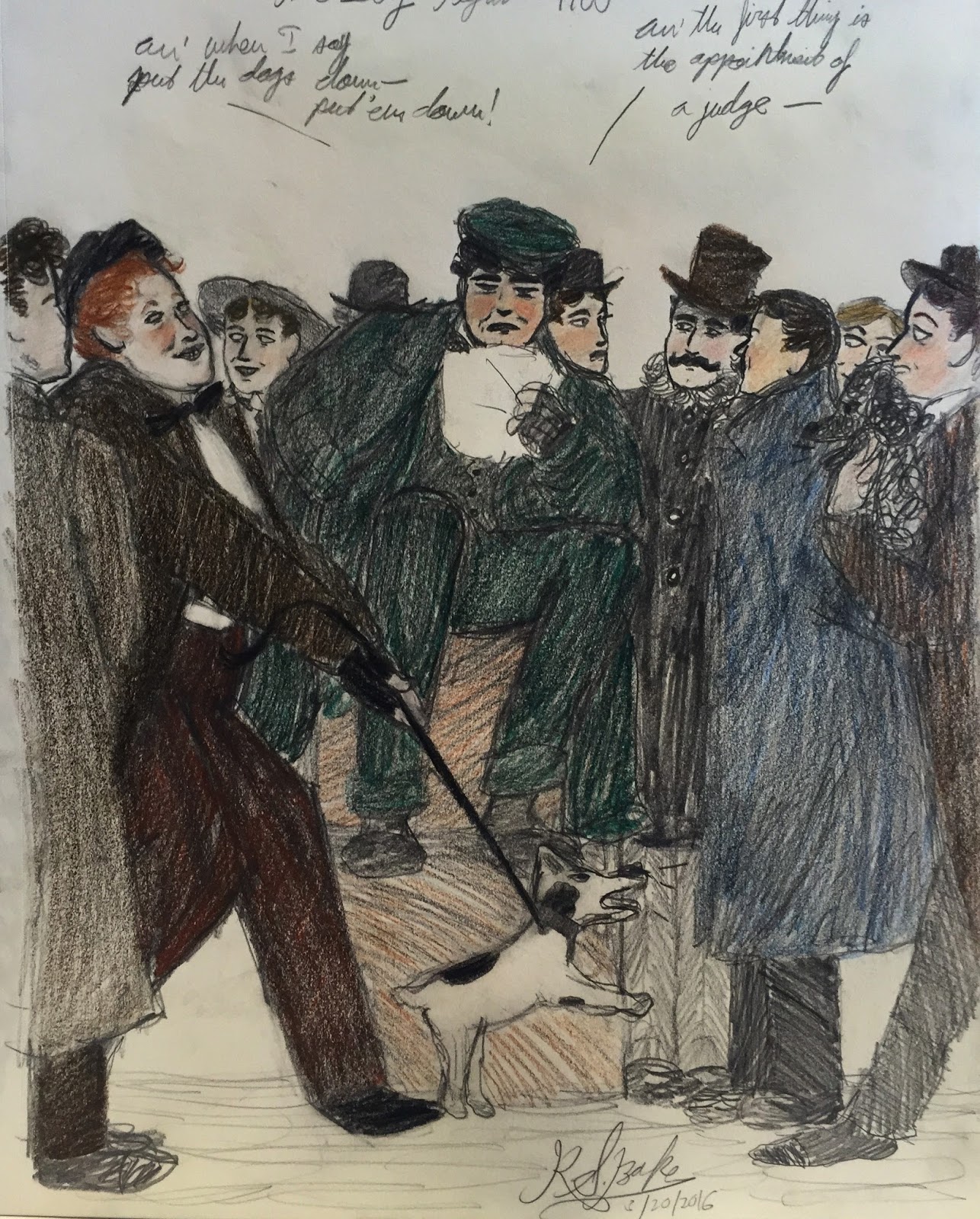
A drawing I did of one of the scenes depicted on the cylinder:


The Virginia Skedaddle(written by Monroe Rosenfeld in 1891), adapted by Edward Issler and his orchestra: A descriptive selection in disguise, as it is describing a "dance in Darktown" with a band of "Nigger Musicians"(pardon the language, that is what it was called, listen to what Spencer calls them at the beginning). This act is one that is meant to describe a "cake-walk" in 1892, with the playful dancers loving the rhythms of the band playing, you can hear the clicks of shoes done by Spencer throughout the record. This was likely one that was performed at the shows of Spencer's Columbia minstrels, or at those lavish gatherings held at the Waldorf by the Easton's. They were listed as taking part in these performances as according to The Phonoscope. 

example recording(s): https://ia600404.us.archive.org/13/items/CollectedWorksOfIsslersOrchestra/20-TheVirginiaSkedaddle1899_64kb.mp3(recorded in c.1894)

http://cylinders.library.ucsb.edu/search.php?
queryType=@attr+1=1020&num=1&start=1&query=cylinder5225(recorded in 1900)

The Levee Scene(Len Spencer/Tom Clark?): This one is a little bit more explanatory for itself. It's a steamboat wharf in New Orleans, with the boat full of cotton bales arriving at the shore. All the strong workers throw off the cotton bales, and sing while the work goes on, while the band plays quick to imitate the movement. After the work is done, all the boys have a hot time when the band comes along to play their levee dance, and everyone joins in with the dance and singing.(they ran out of time at the end!)

example recording: https://archive.org/details/LenSpencerwithColumbiaOrchestra(recorded in 1903)

*Just an interesting note about the record just listed above, the number on that one is no. 1551, and if any of you know about no. 1555, and 1556, those are both Rag-Time numbers, 1555 being "Peaceful Henry" and 1556 being "Dixie Girl". Just really interesting to think that these were probably recorded within the same week of later 1903. 

The Bugler's Dream(probably written by Tom Clark): The dream of a war hero, though it's just a bugler. The first part of the queer dream is the band playing "Just Before the Battle, Mother", then the brigade assembles at the line, "To arms!" sounds, then the bugle blows to begin the battle. All hell breaks loose! All his comrades go off to the field and many are killed on the spot, but those who survive to the final call of the bugle are victorious! The final song played by the band begins as "Nearer, My God, to Thee" and it ends the dream of the battle. 
The actual description: The Spencer's had to do an awful lot of balancing to get this the way that it is, and we can clearly hear it by how everything is placed, and how all of the shouts and cheers are not really that well balanced. The 1898 take is especially rowdy, as you can clearly hear by the part where they begin the firing of the cannons. You can even hear how far away from the horn Tom Clark is, as he's well over a few feet away by the echo of the room(it's their big room by the way). Hylands is very close to the horns, as he's  very prominent in the recording, and he can be heard swinging around one of those God-awful wooden clicker things, as are most of the performers in the room. It's an amazing recording really! Both takes! 

example recording(s): http://cylinders.library.ucsb.edu/search.php?queryType=@attr+1=1020&num=1&start=1&query=cylinder8930(recorded in 1898)
/search.php?queryType=@attr+1=1020&num=1&start=1&query=cylinder8235(recorded in 1903)

Children's Games Lanciers(unknown composer/arranger): This is a very odd one. This one is like many of its kind, the "Lanciers" records of the 1890's were very popular selections describing dances of various kinds. These Lanciers were actually danced done by large groups of couples, much like a Cake-Walk, just without the raucous Rag-time and high-stepping. Tom Clark leads this one, and all the children are dancing to the band playing, all in their pretty bright clothes, and joyfully cherishing their friendships. The announcement in the middle is just like usual, with the leader of the band making an announcement to the children that his little girl will be having a birthday party next week, and all the kids are invited to the party. The band continues to play just after mister leader man announces the next part of the lanciers and it trails to the end. 

example recording: http://cylinders.library.ucsb.edu/search.php?queryType=@attr+1=1020&num=1&start=1&query=cylinder8173 

Scene at and Irish Ball(unknown composer/arranger): This is a descriptive selection from 1895 illustrating a ball out on the Bowery, full of Irish wit and might. One of the dancers calls out to the Professor(Frank Banta that is...), and Mister leader man calls out to the band to play "Gems of Ireland Quadrille". After the "let 'er go!" the band strikes up the quadrille. The calls are given out to the dancers until someone yells out that someone took their watch! A fight breaks out! just as it continues, another yells,"play up an overture professor, someone has lost a watch!". They tune up quickly and then play the next half of the quadrille, and dance continues just as planned, until the end of the cylinder. 

http://cylinders.library.ucsb.edu/search.php?queryType=@attr+1=1020&num=1&start=1&query=cylinder10472(recorded in 1895 in Chicago)


The Village Orchestra(Unknown composer): This is one that not all people who listen to it will understand what the point happens to be. It's describing an orchestra in a small town or village playing for their villagers. The first part consists of them warming up and getting tuned up, kind of. Once they get going, they begin playing a somewhat patriotic tune, that then leads to playing "Pop Goes the Weasel". After that is played, mister leader man(Fred Hylands) yells "Encore! Encore!" They then strike up "Annie Laurie", playing it in that most pathetic way that did do. It falls apart practically by the end of the tune, and once they get through, the villagers are all happy with their smart instrument men, especially mister leader man(Fred Hylands in this case). Someone yells,

 Tom Clark/ George Schweinfest: "Say, do ya fellows know 'Annie Laurie'? 
Fred Hylands:"Why, that was Annie Lau-rrrie" 
Tom Clark/ George Schweinfest: "Aww, well, can't beat ya no how!" 

example recordings: https://ia800305.us.archive.org/3/items/ColumbiaOrchestra/ColumbiaOrchestra-TheVillageOrchestra.mp3(recorded in 1899)

this take is a little different: https://www.youtube.com/watch?v=TILb7LjRcHg(recorded in 1901)


Well, there are so many of these descriptive selections out there that I didn't list, mainly because of the fact that they are not digitized online for all to hear just yet, but there are more online than those I listed here. Go out in the internet or into your record collections and dig out some of them! You won't be sorry!  The descriptive selection was a fantastic marketing scheme, but it was more than that, it was a great way for everyone to imagine what scenes were being described, and to encourage creative thinking. I would even categorize the minstrel records of the 1890's and 1900's as descriptive selections, as they were fully describing a minstrel show, something that now everyone could afford to go to or want to go to. With all of these bizarre scenes illustrated, they are actually a fantastic and rare look into what the 1890's was truly like, not just what we all hear about it now, what could be better than hearing how it was from a voice that actually witnessed it go by them! It's a very unique way to peak our heads into the 1890's for just under three minutes. 


I hope you enjoyed this! I took me several days to write this post, sorry about that...


Sunday, March 20, 2016

Some interesting titles and Visualizing

When looking through a listing of Columbia cylinders, there are always some very fun and interesting-looking titles all over the page, but of course, not all the needed specifics are given, for reasons I have explained before. Last evening, I was looking through the listing you can find here:
All of the brown wax listings are amazingly helpful, with many titles listed  would make record geeks want to go right out and search for in their collections of brown wax, and check on Ebay if any of them are for sale somewhere. Really, what I'm saying is that there are listings of cylinders that we all hope are still out there in some way, shape, or form. In conditions good enough to play, is what is really what is needed. Of the many fascinating sections of listings, the 11000 series is always an interesting one, because that was the number system that had all of their special talking records, which, not surprisingly included the "scenes from life" series put out by the Spencer brothers. There are even more that are listed on this page than in the 1900 catalog that had the section of "scenes from life". As you can see only three of them here:
Yes, all of these are hilarious, but gruesome and morbid in their own special ways. Yes indeed, very much akin to the late-1890's doings of these strange Columbia employees. But of course, as expected from the Spencer's, Steve Porter, Roger Harding, Russell Hunting, and Fred Hylands, the "scenes from life" records didn't end with only the above three. You may notice that the numbering of these three cylinders are scattered, and are not exactly numerical, as they weren't exactly beside one another in the catalog. What was 11022? Well, a little something called "The Cock Fight". Ooh. That must be a gruesome one. When I saw that one, I cringed a little, as Spencer always went for "descriptive selections" that were realistic in all the ways they could be. Cock fights were always said to have been brutal(not that "The Dog Fight" isn't a similar story) in a way that dog fights weren't. Think of Spencer describing a fight to the death between two chickens, and getting many of his friends in the studio involved(much like on "The Side Show Shouter"). 
Just to get an idea, here are all three of the selections listed above:
No. 11021(you can hear an earlier different take Here!)
and No. 11024(featuring Collins and Harlan!)

I haven't heard the earlier take of "The Dog Fight" in a long while, and it's very interesting to compare the two takes. The older one has many more people involved, and it's much more casual. By this, it is meant that there's much more talking throughout, and you can hear these two things when they're all talking at the beginning, and when they all cheer. I can pick out Hylands still, even if this one isn't as clearly transferred. I can't really point him out on the post here, because it really is pretty hard to, but I found him. All I can say here is, he can be heard at the beginning after the announcement by Spencer, and toward the end when they let go the dogs for the battle. He probably got all of his studio friends at Columbia together to do this one, more specifically, the older take. Heh, the only problem I have with hearing these "descriptive selections" is that I don't see what it meant to be by Spencer, I see what it actually looked like. I'm referring to how I see all of them in the studio making the cylinder, crammed in weird places and crowded around the horns, yelling and cheering from wherever they are. He must have placed them all over the room, sitting on tables, standing on chairs, and Hylands probably sitting on the edge of the piano's raised platform. Ryan Wishner and I don't see "The Dog Fight", we see them making  "The Dog Fight". 
Here's a sketch of kind of what I see:

Imagine about twenty-five or so people crowded into this room:
And yes, both takes of "The Dog Fight" were made in that room. And also the other two "Scenes from Life" listed. 

Back to some of those fascinating titles and visualizing of them. I'd love to hear "The Cock Fight", though it makes me cringe seeing it alone, as I know that it would be another fantastic "descriptive selection" by Len Spencer. Now, some other interesting titles that are all over this catalog include "The Dime Museum Lecturer", which sounds fascinating, as it's probably by Harry Spencer. Both the Spencer's had been to Huber's Dime museum, as that's most likely the inspiration for that cylinder. Another is "The Talking Machine Exhibitor". Now, that one I have actually heard before! In fact, to share the knowledge, you can hear it here:
Does anyone know who that is?  I have not an idea! This one could be really anyone on the Columbia staff, Russell Hunting, Harry Spencer, George Graham, Len Spencer, or someone even as exclusive as Victor Emerson. It's fascinating nonetheless, filled with some quick comedic lines, and very truthful statements having to to with how Columbia exhibitions were done. Now they didn't have that at Edison! This cylinder is just very bizarre, as I cannot exactly figure out what the purpose of this cylinder was. Was it to advertise(not really)? To describe a scene from life? Well, whatever was its intended purpose, it's a fantastic look into the fun that went on at the Columbia exhibitions. 

Some more fun titles seem to be "The Bureau"(which was by Russell Hunting undoubtedly), and also Hunting's "Hamlet's Soliloquy", which must have also been fantastic. Now to move to the list of the 15000 series, which was the list of the Columbia orchestra. We know of many of the strange descriptive selections that the rowdy Columbia orchestra did in 1898, but what about some of the obscure songs they did in that time? Well, among those included:

 "The New Bully Medley", "The Jolly Coppersmith", "Pomona Waltz" ,"The Jealous Blackbird", "The Alabama Walk-Around", "A Trip on the Broadway Cable"(which is probably a "Descriptive selection"), "Sambo At the Cake-Walk", "Mexican Dance--La Media Noche", "The Village Orchestra", "Poor Jonathan Waltz", "The Darkey Volunteer(s) March"(though it's actually a Rag in a sense),"Charge of the Rough Riders", "The Bugler's Dream"(a descriptive selection), "Hello, Ma Baby", " "On the Midway","My Honolulu Lady", "The Oriental Coon", "Dewey's Return", and of course "You Don't Stop the World from Going 'Round".

Wow, what a list! That's not even close to everything that was listed. For fun, here are a few of those listed above:
"The Jealous Blackbird", recorded mid or late-1897
"The Jolly Coppersmith" recorded in the middle of 1898(with coppersmith effects by Len Spencer)
"The Village Orchestra", recorded in early 1899(featuring Fred Hylands as mister leader man)
"On the midway" recorded in earlier 1898
"The Bugler's Dream" recorded in earlier 1898(featuring bugle calls by Tom Clark)
"Charge of the Rough Riders", recorded in the middle of 1898(featuring bugle calls by Tom Clark, and vocals by Fred Hylands)

By the repertoire that the Columbia orchestra had, it is certain that they reflected the mindset of those who worked there. Not exactly the management, but the employees. Edison was a reflection of its management. The list that I had a link to at the beginning of this post is an amazing way to discover more about the forgotten files of the Columbia phonograph Company, even though the specifics are missing. The long lists of titles by Dan Quinn and George Gaskin are just as interesting, as they are full of comic songs, and popular love songs of the day. There are plenty of these "descriptive selections" that we all hope exist in someone's collection, as every one of them are very weird, complicated in balancing, and full of 1890's mirth! 


I hope you enjoyed this! 


Friday, March 18, 2016

A Nasty Trial and Items of interest

This evening, I have been reading through a little bit of Variety, looking for more Hylands information, or anything else that is of interest. One of the items of interest relating to Hylands is actually a fascinating court case(well kind of a court case) where Hylands was "axed" (expelled in a sense)from the White Rats Actors' Union directors in 1912. That is absolutely fascinating! Now the basic background of this trial began with a chap named Val Trainor, who had violated several of the "articles" that this union ran by. He had been in trouble for some time before this whole thing went down, and it was inevitable that he was going to be dropped from the union sooner or later, but he still testified to the board of directors. The board of directors included Hylands in fact, but after Trainor testified to them, Hylands had to take his stand, and they "axed" him. Why? Well the article that explained this whole mess stated:

The objection sets forth Hylands is now engaged in making a livelihood as a musician, and is only eligible as a non-member of the organization. Under article 5, section 2 of the by-laws, and not entitled to a voice in the administrative affairs of the order. 

Damn, they really did behead him. He must have been trying to avoid this sort of prosecution for years, as we know very well that he had been a musician solely for a while before that. I would guess that this came to bite him because he joined the union under the intention that he was a vaudeville performer and Broadway performer. Of course, not being able to stay with his commitment, he abandoned the whole Broadway show jag by 1910. He must not have realised how much of a bad decision that was until a little while after he did so, as then the union kept close watch on him, probably watching his every move from 1910 to 1912. That's a little disturbing to ponder, but such a thing was probably true, as the directors of this unions were rough(as he was!) and were constantly watching everything that went on by all of its members, and if anything slipped or was revealed, they would be thrown out quick. Hylands probably knew how bad the consequences were, as a so-called "Note Rat" from 1908 to 1912, though he must have diverted these for a long while. Though come to think of it, he was a blunt and dreaded official for them. 

Hmm... This is starting to become a pattern, Hylands saying one thing to the management, in his rather high position at first, but then after a while, he tires of it and becomes much more candid and blunt with his attitude. Hmm. Sounds terribly similar to how he was at Columbia thirteen years before this whole trial. That's very strange... 
Refer back to this:
Yes indeed. But then if you were to ask how he though of working with Len Spencer, Roger Harding, Will J. Hardman(his lyricist in 1899-1900), or Burt Green, he'd light up and change his whole demeanor about working at Columbia. Wow. Awfully two-faced isn't it. How that man was very strange. And the more I learn about him, the more bizarre he seems. 


Speaking of Burt Green, I think I have a theory as to how Hylands actually met him for the first time. Now something tells me that Hylands had become acquainted with Green prior to 1899, as he was a prominent Rag-Time pianist and dancer in 1897-98. 
(that's Green in c.1908)
(a sketch of him I did)

He was known in New York vaudeville as a Ben Harney imitator, who also probably did sorts of parodies on Harney's dancing style, but imitated his playing style with respect and skill. So pretty much whenever you are hearing one of those five or six recordings of him playing piano behind Irene Franklin, you are hearing a mirror of Ben Harney and Fred Hylands. Green fared better than Hylands because of his good looks and not-as-complicated personality, and it is clear that this was so, as he ran the publishing firm while Fred was gone, and I'm sure that those performers who came over were much more pleased to see that it wasn't that chap that was described to them beforehand(he wasn't that six foot tall, 300 pound redhead). 
While Hylands was music director at Pastor's famous theater, he flooded in all the Rag-Time related acts in 1897, which got Harney and Green plenty of work. At this, Green probably was hired by director Hylands, but before that, he had to meet the man. Their encounter must have been perfect, two like-minded Rag-Time pianists. How it couldn't have been better! Hylands probably knew that from the first time meeting Green, that this was the beginning of a long friendship. Of course, this friendship did not really become clearer until 1899, but the fact that Hylands specifically chose another Rag-Time pianist to be his substitute during the days that he was filling his obviously more important commitment in Columbia's studio, is certainly more than just a little suspicious. Seeing Hylands and Green's names listed directly next to each other is very strange. Hmm. Irene Franklin's second husband next to Columbia's longest-serving studio pianist, very mystifying. 
It gets me every time I read it. So funny. 
"All mail cheerfully forwarded"(by Burt Green that is...).
Every sentence of this advertisement is fantastic. Inviting over random local performers, pleading for mail, putting those two Ragged young chaps together for song instruction, asking for boarders, and selling music of course. Great, it's just great. How Burt Green must have been an interesting fellow as well. 


I hope you enjoyed this! 


Thursday, March 17, 2016

Some Irish performers for March 17th

Well, since it's St. Patrick's day, I thought it would be fit to do a post on many of the Irish singers and performers in the earliest days of the recording business. Many of these performers were either half Irish of were full-blooded as such. One of these half Irish performers is:
Vess Ossman. 
Yes, I know, his name is fully Dutch-Germanic, but the Irish comes from his mother. He did not often acknowledge his Irish ancestry, but many knew it was there, and often made jokes about how his terrible temper came from his side of him. As a stereotype of the Irish, his temper fit this very well, firey and quick. Much like the rumors of his accompanist Banta being Jewish, the Irish temper of Ossman's spread like wildfire, and since he practically worked with everyone, it was hard to be avoided. Ossman did not really record too many Irish songs, again referring back to how he did not well recognise the Irish in him. Even with his reluctance to acknowledge it, he did look like a true mix of the two nationalities that created him-- German and Irish. 

Now to begin with some records, not really getting to the Irish ones just yet.
Here are a few good and fun Ossman records: 


recorded in 1898 with Fred Hylands(played a little too slow though...)
The tune just above "The Tyro Mazurka", also has the alternative title called "The Climbing Rose Mazurka". 

Ossman and Hylands' "Whistling Rufus" is among one of the best recordings of Banjo Rag-Time from before 1900(just barely before 1900...) in my opinion, as you not only get a classic in Rag-Time as the piece, but both performers are Rag-Time eccentrics. It is played extremely well also, Ossman is perfect, and even Hylands is flawless!(which as we all know is very unusual!). 

Now to begin with the most famous of the Irish singers on early records:
Dan W. Quinn. 
Yes indeed, he was the most Irish of the early singers, that wasn't an Irish tenor. More like an Irish baritone! Quinn was Irish on both sides of his family, and what's so great about him is that when he sang, he genuinely sounded Irish, no dialect needed. It wasn't thick and hard to understand like George Gaskin, but it was slight to the point of where sometimes it couldn't be noticed. The only way to really catch his Irish dialect is to be listening just enough to how he pronounced certain words when he sang. He was pretty much the more authentic version of Edward M. Favor. By this it is meant that Quinn was actually Irish, and did many Irish songs very well, but Favor was not actually not Irish at all. That was a very strange thing to me when
I first learned of that, as I knew of Favor as the one who popularized "Who threw the Overalls in Missus Murphy's Chowder", and many more Irish songs, but he was actually of French descent. Quinn's Irish songs were much more authentic, in more ways than just the Irish part of it. 

To begin with the records by Quinn, I won't start with the Irish songs outright, just to save that for a little later. The first one I have here is one that is dear to my heart in many ways, because it was the first 1890's tune that I learned after hearing the cylinder. "Put me Off at Buffalo" by Quinn with Hylands, 1898.
When I first heard this cylinder three years ago, I was captivated by the piano accompaniment behind Quinn. The song was hilarious, and I enjoyed the lyrics very much, but the piano was really the thing that caught the attention of my ears first. At that time, that was when I was really wanting to know who that pianist was. Didn't know at the time, and didn't think I ever would. Well, I know that it's Fred Hylands now, and that he was probably tipsy by the time that this take rolled around. Yes indeed, and you can clearly hear many of his mistakes, and this time, they're not really very well obscured(like that one at 1:54. Ooh! That's a painful one!). Furthermore, Quinn's Irish dialect can be heard easily on this one. 

This next one is not exactly an Irish song, but as Quinn did, he pretty much made anything he sang that way, just by how he was. Now this one was actually one that Quinn was, and still is apparently, known for singing. Here's "Glorious Beer" by Hylands and Quinn, recorded in 1899. Yep, this was recorded right smack in the middle of Hylands running that publishing firm. Hylands just goes absolutely wild on this one. I don't really know how to put it into words, but he's playing as many notes as he possibly can in a single few bars. I think. Well, he attempts to at least. The ironic thing about Quinn singing this is that he was a prominent supporter of the temperance movement. Wow. That's very weird. Also it's comical to take into consideration that the pianist behind him is probably drunk, or drugged of some kind(his playing is awfully fast and anxious...). This fact adds to the paradox that surrounds the circumstances of this cylinder. Hylands probably enjoyed recording this song. 

Now onto Quinn's Irish songs. Now we known that he made many of them, including the one that Edward Favor was known for(that I said before in this post), and many others of that kind. The first one I would like to showcase is Quinn's "Nothing's Too Good for the Irish" with Fred Hylands on piano, recorded in 1898. This was probably recorded within the same week or few weeks of "Put Me Off at Buffalo". Why? Well, listen to how similar the piano sounds on this one compared to his cylinder of "Put Me Off at Buffalo", though the piano is quite a bit more out of tune on this one. It's almost painfully out of tune on this one. I really love Hylands' accompaniment on this one, even if the piano is VERY out of tune here. The "Irish jig" solo at the end is particularly funny and really playful. It just goes to show that Hylands was a true Vaudeville pianist, and could play all of the corny vaudeville riffs we think of for that era. 

Another song that Quinn was famous for was recording "And the Band Played On", which is, as I have heard, still a popular song that is representing of the spirit of the 1890's. You can hear his version of this with the piano accompaniment by Fred Gaisberg, recorded in November 1895. This is a classic, hands down. Both in terms of Irish songs and just recordings in general, it's as such.
This last Irish song by Quinn is actually one of the earliest examples of his recordings that I know of. It's called "Oh Missus O'Flaherty, What Did You Mean Be That?" recorded in 1893, with Fred Gaisberg once more. What an obscure one! It's very rare, and strange in the range of Quinn's repertoire. Quinn was known for songs exactly  like this one, Irish comic songs, as being Irish, he made any song full of Irish wit, regardless of the circumstances. 

The next two Irish singers I would like to showcase are jointly going to be showcased, George J. Gaskin and Arthur Collins.
Gaskin(c. 1894)
Collins(c.1904-05)

To begin with Gaskin, he was actually claimed to be the most popular 1890's recording artist. That fact has been debunked since the 1930's, as it's certain that there's really no way to know who made the most records in that time, Gaskin, or Len Spencer(though I am convinced that Spencer made more records and was more committed to making records...) Gaskin was a singer who worked as a carpenter before Edison's men discovered him, and since old man Edison had a nitch for Irish tenors, Gaskin was golden to him. This was back in 1891, and for some reason, his voice was perfect for the phonograph. He was immediately considered one of the best recording artists in the business, and by 1895, he was making Berliners and Columbia cylinders like mad, as the record buyers often came to exhibitions solely to buy Gaskin's records. Now, to begin with some of his Irish songs, which he did many of(not surprisingly...). 
Here is his version of "My Wild Irish Rose" with Fred Hylands, recorded in 1898. Again, Hylands is probably tipsy when they recorded this, as there's this one thing that he plays in the solo at the beginning. Hm. What? It's very strange, and it doesn't really make any sense, much like how he played behind Quinn on "Glorious Beer". All that needs to be said it that there are too many notes. Anyhow, Gaskin is fantastic on this one, not too showy, and not too modest. Just the right amount of Irish dialect. 

This next one is also a famous one that Gaskin recorded, as well as about a handful of other recording stars at the same time. Here is a take of "Bedelia". Now that you've heard that one, here is a different take of it:
Both of these have Hylands on piano, doing completely different things on both of them. They are both fantastic records nonetheless, the best takes of the song in my opinion. 

This next one is a rarer one by Gaskin, but it's an Irish song for sure. Here you go: https://ia601409.us.archive.org/12/items/GeorgeJGaskin/GeorgeJGaskin-TheBestintheHouseisNoneTooGoodForReilly.mp3 This is a very odd one, but it's also a very interesting configuration of people. Why? Well, if your ears are good enough, you probably might recognise one of the other voices in this cylinder. Yes indeed, it's Russell Hunting! The two voices cheering on this cylinder are Russell Hunting and Fred Hylands. Hunting was also another Irish performer(not really being Irish though...) as we all know that he was known as "The Original Michael Casey", which was a character that a whole generation of people grew up with. Much like how Spongebob Squarepants is an icon of the younger generation now, the "Michael Casey" character was like this as well. 

Before I get to Collins, I should probably have a Hunting "Casey" sketch listed here, as those are all iconic in Irish humor. Just for giggles and genuine satirical comedy, here's Hunting's famous "Casey At the Telephone" recorded around February of 1896(this was recorded before he went to jail). This is funny every time I hear it. It's truly the genius of Hunting at work, though it might seem like simple vaudeville, it's actually amazing in many respects, as it's before he was sent to prison, and he uses many kinds of balancing techniques just for his voice. Since this was recorded before he was sent to prison, his humor is very slightly crass, which makes it even more charming, and realistic. 

Anyhow, here are a few Irish Collins records. This first one is one that Steve Porter was more known for(who was also an Irish singer, but wasn't Irish). Here you go with Collins and Hylands' "Armful of Kittens and a Cat" recorded in 1901. Hylands is good on this one! So is Collins, with his not-the-best Irish dialect. Collins was half-Irish, but was very much raised in a Catholic household, as the 10 children and Irish mother can say all for itself. Collins recorded many Irish songs solo before teaming with Byron Harlan in 1902, including many with the accompaniment of Frank P. Banta, not just Hylands. 

Now, this next one is actually the most politically-incorrect of any of the Irish songs that I have had here on this post. For some reason, I have the sheet music for this tune, anyhow before I get to that story I have with that music, here's the cylinder:
"The Mick Who Threw the Brick" by Collins with Frank P. Banta, recorded in 1900. For some reason the piano sounds a little bit like a banjo at some points of this cylinder. 
Anyhow, I have a very strange story in sheet music collecting with this song. I got the music to "The Mansion of Aching Hearts" at a sheet music giveaway three years ago, and I long thought it was just that tune that I got. Until about a year after I got the music, I was looking through my album of music, and I saw it once more, so I slid it out of the sleeve, and found that there was another piece attached to it. Guess what it was... ... "The Mick Who Threw the Brick" from 1899. WHOA! That was very bizarre! The cover of the music was not there, but all the rest of it was, and I didn't know that I had it until then. 

Now to end this post, because this post could go on for a VERY long time, I would like to end the St. Patrick's Day festivities with the descriptive selection by Banta's Popular orchestra called "Scene at and Irish Ball" recorded in 1895. Now this cylinder explains quite a lot about Banta's doings in Chicago in the mid-1890's, as this was recorded for the Chicago Talking machine Company around the time that W. H. Krell was getting to the top, and when Fred Hylands was a prominent director at that time. Well, it's a fantastic cylinder nonetheless, with all sorts of fun antics, that probably include Banta speaking at some point(not sure where though...). 
For a fun extra, here's Spencer singing a very strange but funny Irish song in 1903:
(not sure who the pianist is, though it's probably Hylands since it's Spencer singing...)


I hope you all had a great St. Patrick's Day! 


Sunday, March 13, 2016

Studio pianos from 1891 to 1905

I had a nice long talk with my dearest friend Ryan Wishner last evening, and we discussed for a brief period of time the possible dynamic of the oldest studio pianos. Now I have an ad on a piece of sheet music from 1890 that advertises a brand of piano being used by the North American Phonograph company.It was this piece in fact:
I did not at all notice that that very piece of music had that endorsement until many months after I got it. I picked it up randomly out of a pile of music somewhere, without having to pay any money for it, just because it was a march endorsing  piano brand. The added bonus was the ad praising the brand for being a favourite of the Edison phonograph and North American companies. In fact, it is in this picture here:
(from Tinfoil.com)
You can see two of those Shoninger pianos that Edison supposedly bought in 1890(though they aren't uprights). That is extraordinary! How often does that come up? Almost never. Here is the ad I was talking about:
Here's the back page:
Amazing, right? 
I'm surprised that Columbia never did any piano endorsing(that I know of, there might be some out there...).  Edison was not nearly as weird of a place as Columbia, as I have explained before, and probably it didn't really occur to them that having a single piano company supply them was a good idea. This certainly is a good idea, as Rag-Time festival managers of to-day well know about that venture. Edison knew that having them endorse that piano company was a good thing for both companies. Well, I don't really know if Columbia had many of the same brand of piano, but it isn't really likely. 
Does anyone know what brand that piano is just to the left of the camera? 
(If you do, PLEASE COMMENT!)
 Yes, that thing closest to the camera is a piano, a very strange-looking one though. Hmm, now that I study the picture a little bit, they look like they might be the same kind of piano. Hm. They have the same kind of key-cover on them. One that just stays upward on the piano in a tilted direction(I have a German piano from 1925 that has that same kind of cover on it). Maybe they were German pianos? Maybe not. It is certain that the Edison pianos advertised on that sheet music were made in Germany. Hmm... You know what, those two pianos might actually be two of the same kind, because I  just noticed that the design on the one seen on the floor(closest to the camera) has that weird carved thing that has a specific shape, and look at the piano Hylands is at. It has that same kind of design, as you can see the pleats on the wood that are on that one closer to the camera. They also have the same kind of key-cover as you may notice. Does that piano on the floor have another cover on the bottom half of it? I mean over the part just below the keyboard, or not, it could just be the beams that are connected to the pedals. It's very hard to tell, even if the picture is very sharp.

I swear, if Columbia had Shoninger pianos there... (Beheaded Emerson!)
Probably not by 1898 though, as they had become very split from Edison by then. Earlier on in its existence they probably had the same pianos, but later on they must have diversified. We all remember this story:
Uh yes. That one. Hunting's "Bureau" story is actually hilarious, and it really is kind of what is described here, here is a take by Hunting of it from about 1920:
Ha! Love it.Very funny in that typical Russell Hunting way.

It really was Spencer trying to get one of their pianos probably into the exhibition hall, and it flopped over, probably from a wrongful grip, as he was not a piano mover. He thought he could be, but we know how that turned out. Heh. I wonder if he and Hylands tried to move it at some point again after that. That would be a great picture. As Hylands probably would have confidently agreed to doing the thing, until it came to actually getting his hands on the piano. He probably wussed out on it and set his hands up at the last second as Len got a good grip on the thing, and the same flop over would have happened. Hm, maybe the reason Columbia's piano in later 1897 sounded so out of tune was because of that fail by Len Spencer? That would make some sense. Just for some examples, here are some cylinders of Columbia's very out-of-tune piano from 1897 and 1898:
https://archive.org/details/colnyp-3420(announced by Harry Spencer)

"Schubert's Serenade" by Clark and Hylands, recorded in later 1897.(the piano is significantly bad on this one)


Now this one here, is the worst sounding one in my opinion:
The piano is so out of tune with the bells, it's really almost painful to listen to. So I wouldn't be at all surprised is that is the piano that flopped over on Spencer, and if so, probably not long after it happened. And better yet, it's Hylands playing it. Heh, probably a little tipsy as well.  For an interesting comparison, here's another take of the same selection:
This take sounds like the same circumstances as the other one, but either done on a different piano, or the same one just after it was tuned. After Hylands complained about it that is. Hylands sounds a little more tired or drunk on the take with the in-tune piano for some reason, he misses more notes is really what I'm meaning to say. 
I heard a take of  George Rosey's "The Handicap Race" by Dan Quinn recently, that has that same out-of-tune early 1890's piano, and since it was recorded in Columbia' "bigger Room", by that it is meant to being this one:
the wires of the piano and untuned strings can be heard even more. 
While at Columbia in the late-1890's, they probably had their main studio pianos tuned every few months, which is why when he hear many Columbia brown waxes, sometimes they sounds like they were recorded with different pianos, when really they were just the same two pianos getting tuned up and down because Hylands was such a beast on them, also from them getting moved every once in a while, with a fail here and there. They must have had their pianos tuned more often after 1900 for some reason, as it's not as common to hear Columbia's piano extremely out of tune after 1901. It still happened, though occasionally.  Here are a few from 1901-04 that have the piano a little out of tune:

(always had the belief that this was probably recorded in the afternoon or early evening, as they both sound broken up and tired)


(this one is particularly noticeable)


All of these have a similar story, and in fact, if your ears are good enough, you might be able to notice that the same piano that is on Collins and Hylands' "Bill Bailey" is exactly the same one that Hylands played back in 1898 behind Billy Golden on "Turkey in the Straw". The reason I caught that is because of the sound of bass notes, they are exactly the same kind of out-of-tune and wire-like that the same notes are on "Turkey in the Straw" from four years before that. Since both records have Hylands on them, it makes even more sense that they would sound the same. The different recording rooms could throw off the effects of the sound though, as "Turkey in the Straw" was recorded in their "bigger room", and "Bill Bailey" was recorded in a different, smaller room. 

By 1905 however, Columbia still used their "bigger room" when making records, as they made only about a handful of records with piano accompaniment in 1905, but all of them were made in their big room, because of the effectiveness of all the 1890's records they made in that room, with piano accompaniment of course. one of them included this one here:
Still the same old Hylands playing his usual Rag-Time, even seven years after first digging his hands into that rugged old piano. Well, after seven years, that piano became old and rugged. 


I hope you enjoyed this!