Showing posts with label Descriptive selection. Show all posts

Saturday, July 30, 2016

Odds and Ends in piano accompaniment--Leeds and Busy Bee

These strange record labels are not often considered musically and material-wise to many collectors I know, only because they were infamous for their not very good record quality, as when they're in bad condition, they sound unbearable to listen to. Their sound quality was actually pretty good for the time period, many of them being in bad shape is what has earned them the bad reputation. They are the strangest and most interesting of all the early disc labels to listen to, as their mysterious management let the strangest things pass. Of all the record companies of the early era, Leeds had the easiest rules when it came to anything recorded in their studio, as many selections done by these popular studio stars were only found on Leeds records. They basically took masters and titles from other labels that the big companies didn't find useful. 

There are so many things we will never know about Leeds records, as nothing of their ledgers are left, and their record labels are not really the most informative all the time. Leeds records must have had some connections with Columbia, and it must have been rooted in the late-1890's in fact, since that's when they began making cylinder records. Those Leeds workers must have used late-1890's Columbia technology, and improved upon it, as their gold foil records sounded fantastic. The future Leeds studio workers probably originated at late-1890's Columbia, who later went out to Talk-O-Phone in Ohio, which was where the headquarters for the company that Leeds was owned by. With the roots in the "Clan era" at Columbia, they had their eyes(and ears), on the good musicians and studio stars there. While Leeds sold cylinders in 1900 to 1903, they watched from their high perch all of the strange and brutal legal doings and show-biz drama at Columbia, Climax, Victor and Lambert, they were figuring out who and what they'd be able to reap from the remains of these bouts. By early 1903, their era of making cylinders had come to an abrupt end, but they were making discs at this time, in fact, making those famous gold foil label records. These records were the most "anything goes" types of recordings ever made at that time, even more so than late-1890's Columbia records. 

The management at Leeds must have seized the moment when Hylands was all fired up about his union bust in 1902, Hylands was infrequently at Columbia after that, so the Leeds people must have made a contract with some Columbia staff members. Since there were loopholes in many of the rules and contracting guidelines, Leeds was alright to make records for the time being, and snatch Columbia's discontented pianist at a moment of dying embers in the man's flames of hate. 
Around the end of 1903, the Busy Bee label did the same, for the same reason that Leeds did. With these strange new labels attaining Hylands finally, after observing him from a long distance, they turned him loose in their studios. They probably told him something like this at Leeds and Busy Bee:

"We've seen that you're such a great studio worker and pianist, so we'll just allow you to take over the orchestra."

They didn't realise how much of a bad idea that was. It is not really noticeable to most people who listen to these Leeds or Busy Bee records, but if you're paying attention somewhat to the music, most of those Leeds records with piano accompaniment or piano in the orchestra, they sound broken. This must have been a similar story to those Zon-O-Phone records I spoke of in earlier posts, where the studio workers enjoyed Hylands in their studio while he remained there. Of course, they probably didn't take it to mind at first that Hylands was a problematic alcoholic sometimes, but they soon learnt of their mistake.
 Getting into this reminds me of a recording that my friend Craig once played for me. This was a Busy Bee record from 1905, by the Invincible Quartette, and it was them performing the popular coon song "Shame On You". The singing wasn't very good to start, but to make matters worse, the piano playing wasn't good either. The piano was not in time with the singing as I recall now, and much of the sketch part of the record was very strange and didn't sound right. I wish I could share a transfer of the record here, but it's been several years since I heard it. I only mention it because it's a good example of a very bad take issued by Busy Bee, with Hylands not playing very well on the piano behind them. There were many more records they issued that had a similar story. 
Another thing to point out about Busy Bee records is that their house orchestra was not very good, and they have a similar tale to the Leeds orchestra, which includes the same pianist. I don't know what Busy Bee and Leeds did with balancing, but one thing is for sure, they almost always had that piano very loud and oftentimes consuming the other instruments in the orchestra. I heard one recently from 1905 by Collins and Harlan where the orchestra doesn't really sound very good, but the rhythm and sense of time is very good, and makes up for the out-of-tune cornet and violin. The piano was once again consuming, as it usually was on Busy Bee records. Since Busy Bee records were essentially Leeds masters most of the time, it is very likely that Hylands more often than not on that very loud and overpowering piano. 

Here is an example: "The Whirlwind Polka" by Bohumir Kryl on Busy Bee A-88
This record exhibits everything I was talking about. Since it was recorded in 1905, it helps that it's still within the range of Hylands still doing studio work somewhat. The issue with many of these later Leeds masters is that they are recorded in 1905 and in the years after that, so that doesn't mean that any one of these well-known studio pianists were on piano. When I say that I mean records like Ossman's 1907 Leeds take of "Dill Pickles". It's far too late to be any of the early studio pianists, though it sounds like one of them in many ways. Maybe we're underestimating Leeds in this sense, in the sense that maybe they had some sort of "deal" with Hylands that lasted longer than when he was dropped from Columbia. It's not impossible, but it's strange. 

The only records that Leeds made where it's certainly Hylands on piano are the early Gold foil records from 1903. All of those have all of the Hylands characteristics, and it made their house orchestra sound a little like the Columbia orchestra, which is a little weird.  I have't really heard too many of these Gold Foil Leeds records, but from what I've heard, the management there must have had a special deal or contract with Hylands. They probably told him they'd pay him a certain amount that he really liked, so he found their business just as good, if not better than Columbia's. It must have been better at the time it happened, since Columbia's orchestra was becoming a partnership that threw Hylands out of most discussion. By this, it is meant that Charles Prince was taking over, and was creating and orchestra with less piano, and entering in more musicians that weren't old favourites. At Leeds, it seemed that Hylands was the leader man, which was just what he needed when Prince was gradually creating the new Columbia orchestra. During his term at Leeds, Hylands was making their records interesting, and it's where we get records like these:
https://www.youtube.com/watch?v=-JKCK12kEQ4

https://www.youtube.com/watch?v=cbkP0rNj8IY

https://ia802300.us.archive.org/31/items/ArthurCollins_part2/ArthurCollins-TheGooGooManCoonSong.mp3

Yes I know all three of these records are by Collins, didn't really mean for that to happen. 
All three of these examples exhibit Hylands attributes, and what's more, they exhibit different ones! The first one listed even has the amazing added bonus of walking bass octaves in the interlude at the beginning and at the very end of the record! The second one has some of the strange rhythmic patterns that are kind of syncopated much like on many Columbia's. It's clear that Leeds had some kind of deal with Columbia when they were making those gold foil records. 

The final Leeds record I would like to showcase it one that is owned by one of my friends in collecting, and in fact, there's a good picture of the label as well!
It is a little hard to read, which is somewhat common with those Gold Foil Leeds records. 
The information given is not very complete, as all they give as the performer is"S Q and O." which to someone who doesn't really well know these records would be a sort of dead end at first sight. Without further ado, here is that record:

It is just the strangest thing, with the most unusual unknown origins. The Spencer quintette? Who the hell was in that? Other than Len Spencer obviously, all the other voices are very hard to pick out, but I have a feeling that somewhere in the cheers and singing, Fred Hylands can be heard(since he's on piano). I do think I hear both Spencer's here, which would logically make sense, but at the same time is very weird. Any one of Spencer's friends could be here, so the guesses are limitless with this record. I'm not entirely sure of the premise of this descriptive selection either, which is odd, because usually we can figure out what it is with descriptive selections of the Spencer's making. As said in the video description in the link, it is the Len Spencer party record, and that is so in all senses of the term. It confirms much of what I've hypothesized about Spencer and his friends, and it's not a Columbia record! I cannot start throwing around guesses as to who I think is on this record, and I'll leave that to you to comment and leave your guesses. 

Before I finish, the picture of that label just above came from an interesting and informative post here:
Enjoy! 


*It must be noted that the strangest thing about Leeds having Fred Hylands as their pianist, is that Columbia was one of the disc record companies who found Leeds to be an illegal and pestering issue while Columbia held those patents, so Leeds might have done something even more hidden and deceiving than just grabbing Hylands by the collar to record in their studio. Essentially, this was the only time that Hylands was working for an enemy of Columbia, and probably agreed to that just to piss off the Columbia management.*


Hope you enjoyed this! 


Thursday, March 24, 2016

The Art of the Descriptive Selection(1892-1905)

The descriptive selection is a forgotten art. It is much like the monologue with orchestra accompaniment. The descriptive selection was a sort of recording made primarily in the late-1890's that described a scene from life or a scene of anything really. They described everything from a telephone conversation to a battle against the Cuban army. The exact purpose of these records has not exactly been determined, but part of the reason they were sold was to illustrate scenes that people from far away could never experience, or people that had great imagination. they really were a trend that died out all too quickly, as it was a true art while it lasted. The idea of selling descriptive scenes on records came to record company owners around 1892, one of the first popular descriptive selections was "The Night Alarm". As many record nerds might be able to notice, this selection was really never dropped out of any of the record catalogs until about 1905, as it was re-recorded countless times by all the house orchestras from 1892 to 1905. To begin, I will go through many popular descriptive selections and fully describe the sequence with extra information if needed. A sample of each one will be given.

The Night Alarm(written by David Wallis Reeves) other variants of the title include" Midnight Fire Alarm": A scene describing a fire department being awakened in the night from their capers to go out to a fire, and the band strikes up as they ride off to the fire accompanied by horse clops on the groups until a single flute sounds they put out the flames. They all sing together at the end in celebration for the flames put out, while the band plays. 

example recording: http://cylinders.library.ucsb.edu/search.php?queryType=@attr+1=1020&num=1&start=1&query=cylinder10482

Charge of Roosevelt's Rough Riders(written by Tom Clark, Fred Hylands, George Schweinfest and the Columbia orchestra):  A well-planned scene beginning with the the assembly of the troops and then the bugle calls sounding for "to arms" then another call sounds, "forward march!". Then begins the charge of the brigade. The band plays a quick paced march until the troops set up in their trench and the calls of the bugle return, "Commence firing!" The dogs of war are then set free, and the firing fills the field, with madness falling everywhere. Once the firing passes, the troop celebrate with "A Hot time in the Old Town" with all the band playing and singing joyfully after the battle. (Fred Hylands is very audible when they all sing at the end)

example recording: http://cylinders.library.ucsb.edu/search.php?queryType=@attr+1=1020&num=1&start=1&query=cylinder9828

On the Midway(probably written By Edward Issler and his orchestra, later adapted by Len Spencer): First begins the Irish Village, to come and see them and their Shillelagh in the dance with their jigs. Then a little farther down the path you'll find the German village with their steins of fine, come and get your sandwich and beer here! Farther downward, you'll find the Leopard boy! This year the boy is white, but next year, the boy will be black! One dollar for to see him! The creature is unveiled and the crowd is dazzled by the white leopard -like skin, and anxiously awaits to see him turn black. Now then you'll see the "Hoochie-Koochie" dancing girls with the "pearl of the harem" in their dance, they'll do all the work boys! Guaranteed! Admission is one dollar! While the girls begin their very scandalous dance, the band begins to play an oriental air while all the beads and pearls shake around like snakes as the girls dance. The band plays with drums and tambourines.(Hylands and Spencer audibly hum the tune as they play it on the later take, and Issler is probably the one who hums it on the 1894 take), the crowd is dazzled once more! 

example recording(s): http://cylinders.library.ucsb.edu/search.php?queryType=@attr+1=1020&num=1&start=1&query=cylinder8101(recorded in 1894)
http://cylinders.library.ucsb.edu/search.php?queryType=@attr+1=1020&num=1&start=1&query=cylinder7941(recorded in 1898)
A drawing I did of one of the scenes depicted on the cylinder:


The Virginia Skedaddle(written by Monroe Rosenfeld in 1891), adapted by Edward Issler and his orchestra: A descriptive selection in disguise, as it is describing a "dance in Darktown" with a band of "Nigger Musicians"(pardon the language, that is what it was called, listen to what Spencer calls them at the beginning). This act is one that is meant to describe a "cake-walk" in 1892, with the playful dancers loving the rhythms of the band playing, you can hear the clicks of shoes done by Spencer throughout the record. This was likely one that was performed at the shows of Spencer's Columbia minstrels, or at those lavish gatherings held at the Waldorf by the Easton's. They were listed as taking part in these performances as according to The Phonoscope

example recording(s): https://ia600404.us.archive.org/13/items/CollectedWorksOfIsslersOrchestra/20-TheVirginiaSkedaddle1899_64kb.mp3(recorded in c.1894)

http://cylinders.library.ucsb.edu/search.php?
queryType=@attr+1=1020&num=1&start=1&query=cylinder5225(recorded in 1900)

The Levee Scene(Len Spencer/Tom Clark?): This one is a little bit more explanatory for itself. It's a steamboat wharf in New Orleans, with the boat full of cotton bales arriving at the shore. All the strong workers throw off the cotton bales, and sing while the work goes on, while the band plays quick to imitate the movement. After the work is done, all the boys have a hot time when the band comes along to play their levee dance, and everyone joins in with the dance and singing.(they ran out of time at the end!)

example recording: https://archive.org/details/LenSpencerwithColumbiaOrchestra(recorded in 1903)

*Just an interesting note about the record just listed above, the number on that one is no. 1551, and if any of you know about no. 1555, and 1556, those are both Rag-Time numbers, 1555 being "Peaceful Henry" and 1556 being "Dixie Girl". Just really interesting to think that these were probably recorded within the same week of later 1903. 

The Bugler's Dream(probably written by Tom Clark): The dream of a war hero, though it's just a bugler. The first part of the queer dream is the band playing "Just Before the Battle, Mother", then the brigade assembles at the line, "To arms!" sounds, then the bugle blows to begin the battle. All hell breaks loose! All his comrades go off to the field and many are killed on the spot, but those who survive to the final call of the bugle are victorious! The final song played by the band begins as "Nearer, My God, to Thee" and it ends the dream of the battle. 
The actual description: The Spencer's had to do an awful lot of balancing to get this the way that it is, and we can clearly hear it by how everything is placed, and how all of the shouts and cheers are not really that well balanced. The 1898 take is especially rowdy, as you can clearly hear by the part where they begin the firing of the cannons. You can even hear how far away from the horn Tom Clark is, as he's well over a few feet away by the echo of the room(it's their big room by the way). Hylands is very close to the horns, as he's  very prominent in the recording, and he can be heard swinging around one of those God-awful wooden clicker things, as are most of the performers in the room. It's an amazing recording really! Both takes! 

example recording(s): http://cylinders.library.ucsb.edu/search.php?queryType=@attr+1=1020&num=1&start=1&query=cylinder8930(recorded in 1898)
/search.php?queryType=@attr+1=1020&num=1&start=1&query=cylinder8235(recorded in 1903)

Children's Games Lanciers(unknown composer/arranger): This is a very odd one. This one is like many of its kind, the "Lanciers" records of the 1890's were very popular selections describing dances of various kinds. These Lanciers were actually danced done by large groups of couples, much like a Cake-Walk, just without the raucous Rag-time and high-stepping. Tom Clark leads this one, and all the children are dancing to the band playing, all in their pretty bright clothes, and joyfully cherishing their friendships. The announcement in the middle is just like usual, with the leader of the band making an announcement to the children that his little girl will be having a birthday party next week, and all the kids are invited to the party. The band continues to play just after mister leader man announces the next part of the lanciers and it trails to the end. 

example recording: http://cylinders.library.ucsb.edu/search.php?queryType=@attr+1=1020&num=1&start=1&query=cylinder8173 

Scene at and Irish Ball(unknown composer/arranger): This is a descriptive selection from 1895 illustrating a ball out on the Bowery, full of Irish wit and might. One of the dancers calls out to the Professor(Frank Banta that is...), and Mister leader man calls out to the band to play "Gems of Ireland Quadrille". After the "let 'er go!" the band strikes up the quadrille. The calls are given out to the dancers until someone yells out that someone took their watch! A fight breaks out! just as it continues, another yells,"play up an overture professor, someone has lost a watch!". They tune up quickly and then play the next half of the quadrille, and dance continues just as planned, until the end of the cylinder. 

http://cylinders.library.ucsb.edu/search.php?queryType=@attr+1=1020&num=1&start=1&query=cylinder10472(recorded in 1895 in Chicago)


The Village Orchestra(Unknown composer): This is one that not all people who listen to it will understand what the point happens to be. It's describing an orchestra in a small town or village playing for their villagers. The first part consists of them warming up and getting tuned up, kind of. Once they get going, they begin playing a somewhat patriotic tune, that then leads to playing "Pop Goes the Weasel". After that is played, mister leader man(Fred Hylands) yells "Encore! Encore!" They then strike up "Annie Laurie", playing it in that most pathetic way that did do. It falls apart practically by the end of the tune, and once they get through, the villagers are all happy with their smart instrument men, especially mister leader man(Fred Hylands in this case). Someone yells,

 Tom Clark/ George Schweinfest: "Say, do ya fellows know 'Annie Laurie'? 
Fred Hylands:"Why, that was Annie Lau-rrrie" 
Tom Clark/ George Schweinfest: "Aww, well, can't beat ya no how!" 

example recordings: https://ia800305.us.archive.org/3/items/ColumbiaOrchestra/ColumbiaOrchestra-TheVillageOrchestra.mp3(recorded in 1899)

this take is a little different: https://www.youtube.com/watch?v=TILb7LjRcHg(recorded in 1901)


Well, there are so many of these descriptive selections out there that I didn't list, mainly because of the fact that they are not digitized online for all to hear just yet, but there are more online than those I listed here. Go out in the internet or into your record collections and dig out some of them! You won't be sorry!  The descriptive selection was a fantastic marketing scheme, but it was more than that, it was a great way for everyone to imagine what scenes were being described, and to encourage creative thinking. I would even categorize the minstrel records of the 1890's and 1900's as descriptive selections, as they were fully describing a minstrel show, something that now everyone could afford to go to or want to go to. With all of these bizarre scenes illustrated, they are actually a fantastic and rare look into what the 1890's was truly like, not just what we all hear about it now, what could be better than hearing how it was from a voice that actually witnessed it go by them! It's a very unique way to peak our heads into the 1890's for just under three minutes. 


I hope you enjoyed this! I took me several days to write this post, sorry about that...


Sunday, March 20, 2016

Some interesting titles and Visualizing

When looking through a listing of Columbia cylinders, there are always some very fun and interesting-looking titles all over the page, but of course, not all the needed specifics are given, for reasons I have explained before. Last evening, I was looking through the listing you can find here:
All of the brown wax listings are amazingly helpful, with many titles listed  would make record geeks want to go right out and search for in their collections of brown wax, and check on Ebay if any of them are for sale somewhere. Really, what I'm saying is that there are listings of cylinders that we all hope are still out there in some way, shape, or form. In conditions good enough to play, is what is really what is needed. Of the many fascinating sections of listings, the 11000 series is always an interesting one, because that was the number system that had all of their special talking records, which, not surprisingly included the "scenes from life" series put out by the Spencer brothers. There are even more that are listed on this page than in the 1900 catalog that had the section of "scenes from life". As you can see only three of them here:
Yes, all of these are hilarious, but gruesome and morbid in their own special ways. Yes indeed, very much akin to the late-1890's doings of these strange Columbia employees. But of course, as expected from the Spencer's, Steve Porter, Roger Harding, Russell Hunting, and Fred Hylands, the "scenes from life" records didn't end with only the above three. You may notice that the numbering of these three cylinders are scattered, and are not exactly numerical, as they weren't exactly beside one another in the catalog. What was 11022? Well, a little something called "The Cock Fight". Ooh. That must be a gruesome one. When I saw that one, I cringed a little, as Spencer always went for "descriptive selections" that were realistic in all the ways they could be. Cock fights were always said to have been brutal(not that "The Dog Fight" isn't a similar story) in a way that dog fights weren't. Think of Spencer describing a fight to the death between two chickens, and getting many of his friends in the studio involved(much like on "The Side Show Shouter"). 
Just to get an idea, here are all three of the selections listed above:
No. 11021(you can hear an earlier different take Here!)
and No. 11024(featuring Collins and Harlan!)

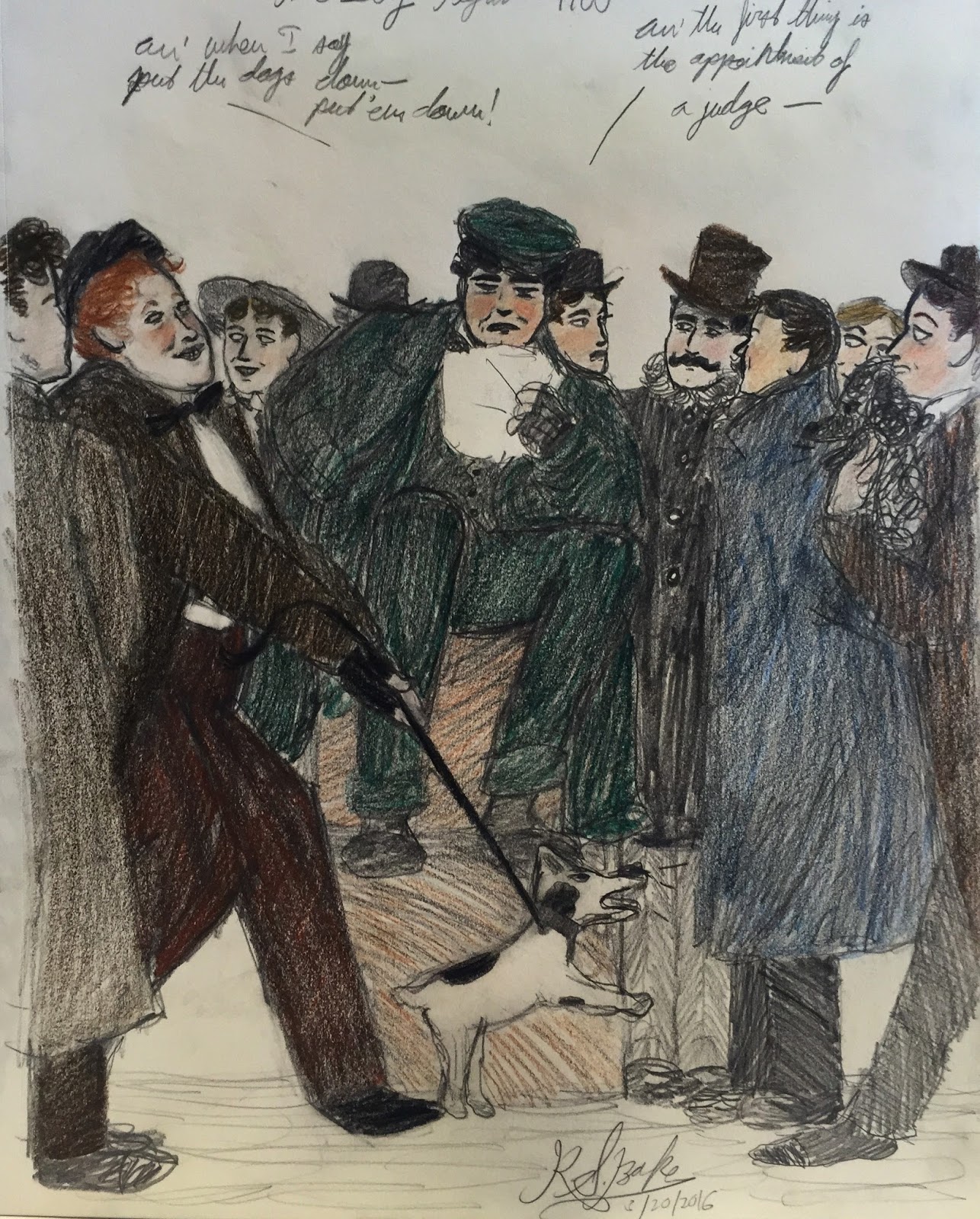
I haven't heard the earlier take of "The Dog Fight" in a long while, and it's very interesting to compare the two takes. The older one has many more people involved, and it's much more casual. By this, it is meant that there's much more talking throughout, and you can hear these two things when they're all talking at the beginning, and when they all cheer. I can pick out Hylands still, even if this one isn't as clearly transferred. I can't really point him out on the post here, because it really is pretty hard to, but I found him. All I can say here is, he can be heard at the beginning after the announcement by Spencer, and toward the end when they let go the dogs for the battle. He probably got all of his studio friends at Columbia together to do this one, more specifically, the older take. Heh, the only problem I have with hearing these "descriptive selections" is that I don't see what it meant to be by Spencer, I see what it actually looked like. I'm referring to how I see all of them in the studio making the cylinder, crammed in weird places and crowded around the horns, yelling and cheering from wherever they are. He must have placed them all over the room, sitting on tables, standing on chairs, and Hylands probably sitting on the edge of the piano's raised platform. Ryan Wishner and I don't see "The Dog Fight", we see them making  "The Dog Fight". 
Here's a sketch of kind of what I see:

Imagine about twenty-five or so people crowded into this room:
And yes, both takes of "The Dog Fight" were made in that room. And also the other two "Scenes from Life" listed. 

Back to some of those fascinating titles and visualizing of them. I'd love to hear "The Cock Fight", though it makes me cringe seeing it alone, as I know that it would be another fantastic "descriptive selection" by Len Spencer. Now, some other interesting titles that are all over this catalog include "The Dime Museum Lecturer", which sounds fascinating, as it's probably by Harry Spencer. Both the Spencer's had been to Huber's Dime museum, as that's most likely the inspiration for that cylinder. Another is "The Talking Machine Exhibitor". Now, that one I have actually heard before! In fact, to share the knowledge, you can hear it here:
Does anyone know who that is?  I have not an idea! This one could be really anyone on the Columbia staff, Russell Hunting, Harry Spencer, George Graham, Len Spencer, or someone even as exclusive as Victor Emerson. It's fascinating nonetheless, filled with some quick comedic lines, and very truthful statements having to to with how Columbia exhibitions were done. Now they didn't have that at Edison! This cylinder is just very bizarre, as I cannot exactly figure out what the purpose of this cylinder was. Was it to advertise(not really)? To describe a scene from life? Well, whatever was its intended purpose, it's a fantastic look into the fun that went on at the Columbia exhibitions. 

Some more fun titles seem to be "The Bureau"(which was by Russell Hunting undoubtedly), and also Hunting's "Hamlet's Soliloquy", which must have also been fantastic. Now to move to the list of the 15000 series, which was the list of the Columbia orchestra. We know of many of the strange descriptive selections that the rowdy Columbia orchestra did in 1898, but what about some of the obscure songs they did in that time? Well, among those included:

 "The New Bully Medley", "The Jolly Coppersmith", "Pomona Waltz" ,"The Jealous Blackbird", "The Alabama Walk-Around", "A Trip on the Broadway Cable"(which is probably a "Descriptive selection"), "Sambo At the Cake-Walk", "Mexican Dance--La Media Noche", "The Village Orchestra", "Poor Jonathan Waltz", "The Darkey Volunteer(s) March"(though it's actually a Rag in a sense),"Charge of the Rough Riders", "The Bugler's Dream"(a descriptive selection), "Hello, Ma Baby", " "On the Midway","My Honolulu Lady", "The Oriental Coon", "Dewey's Return", and of course "You Don't Stop the World from Going 'Round".

Wow, what a list! That's not even close to everything that was listed. For fun, here are a few of those listed above:
"The Jealous Blackbird", recorded mid or late-1897
"The Jolly Coppersmith" recorded in the middle of 1898(with coppersmith effects by Len Spencer)
"The Village Orchestra", recorded in early 1899(featuring Fred Hylands as mister leader man)
"On the midway" recorded in earlier 1898
"The Bugler's Dream" recorded in earlier 1898(featuring bugle calls by Tom Clark)
"Charge of the Rough Riders", recorded in the middle of 1898(featuring bugle calls by Tom Clark, and vocals by Fred Hylands)

By the repertoire that the Columbia orchestra had, it is certain that they reflected the mindset of those who worked there. Not exactly the management, but the employees. Edison was a reflection of its management. The list that I had a link to at the beginning of this post is an amazing way to discover more about the forgotten files of the Columbia phonograph Company, even though the specifics are missing. The long lists of titles by Dan Quinn and George Gaskin are just as interesting, as they are full of comic songs, and popular love songs of the day. There are plenty of these "descriptive selections" that we all hope exist in someone's collection, as every one of them are very weird, complicated in balancing, and full of 1890's mirth! 


I hope you enjoyed this! 


Friday, March 4, 2016

The Edison Orchestra and Columbia Orchestra

Sorry it's been so many days, it's been a little hard to stay on a single subject for a  post, and it's been busy around here. I have been listening to many of the "descriptive selections" that were recorded by the Columbia, Peerless, and Metropolitan orchestras, and just regular selections by these groups. The differences between these three studio ensembles are much more so than many would think, as of course, they did indeed have different people in the groups, and they were under different management by the record companies, and as I have explained before, makes a big difference. The Peerless orchestra was the Edison studio group, regardless or their Edison Concert band, which essentially served exactly the same purpose. The one who led this orchestra was:
Yes indeed, that chap. 
Banta led this group by writing out most of the arrangements, and counting them off, and all else he had to do while leading this group. He must have been aware of the fact that the Columbia orchestra was doing all of the same material at the same time, but with a much looser bound string of rules surrounding their sessions. According to capitalist logic, Banta had to try to compete with those fellows at Columbia for better arrangements and better balancing techniques. Banta encouraged all of the Rag-Time we hear and see listed in the Edison catalog from that time, and that's why there was so much of it. Banta is where we get some of those great Rag-Time arrangements like these: 


These are all great examples of Banta's leadership, and even the selections that aren't Rag-Time are just as great, such as the descriptive selections and other popular songs. Two descriptive selections are here:

Now as you might expect, these "descriptive selections" were very popular among the record buyers. Edison orchestra also recorded the extremely popular one called "The Night Alarm", which you can find countless versions of all over the place on records from the late-1890's. I don't exactly know why it was so popular in its day, but it was certainly a fun one regardless, you can hear the earliest example of it I know of here(from 1892!):
It is unknown how it began to circulate among the record companies, but there are at least 12 different recordings of it I know of. That's really saying something! 
The Peerless orchestra was never known to go out and do any performances, unlike the Columbia orchestra, who was all over the place at exhibitions and performances of Spencer's minstrels, or at lavish affairs at the Waldorf-Astoria. Since Edison didn't really have those fun sort of exhibitions that Columbia had, they didn't invite a handful of artists to come and demonstrate. Though, since Arthur Collins can be heard at the beginning of all but one of the Peerless Orchestra cylinder listed above, he probably had some sort of role in these Edison exhibitions. Collins was essentially at Edison just like how Len Spencer was at Columbia, and later what Ed Meeker became after 1902 at Edison. 

While Banta was getting sick and running the Edison orchestra with all he could to make them better, in a sort of serious way, minus Collins' comical introductions, the Columbia orchestra was wailing away at their antics they were known for. Many of the "descriptive selections" that the Columbia orchestra did in 1898-1900 were actually specific just to them. Such as their rowdy mess called "Charge of the Rough Riders". Now that one is a real kick! This is because of how wild and rowdy it seems, but yet how organised it is. It's one of the most symbolic of all the Columbia orchestra's selections, as it represents everything they were, all they did, and their attitude toward making records and music. You can hear a take here:
"Forward March!"
Yes indeed Mr. Clark. 
It's just such a contrast to the selections by the Peerless orchestra from the same year. They also had some weirder ones, like "Children's Games Lanciers", as you can hear that here:
Ha! they're all cheering like little kids! Hilarious. 
They also had one called "The Capture of Santiago", which is again referring to Roosevelt and the Rough Riders charging into Cuba. I haven't heard this one yet, but I have seen it listed in several places around the same time as their "Charge of the Rough Riders". The one in the link above is certainly a strange one in the mix, but then again I am not surprised about that, as Columbia's people certainly had some more odd ones in their files. They were hard to compete with, so at this, it left Banta a little at a disadvantage when trying to make his orchestra at Edison better. In reality, the Columbia orchestra had better musicians in its personnel, but the Edison studio orchestra had a mix of just as talented musicians. The thing about Columbia's orchestra is that their musicians had been in the business of recording for at least 7 or 8 years by 1898. They had status. By this I mean that with musicians like David Dana, George Schweinfest, and William Tuson, they were already known as soloists on records by the time the Columbia orchestra was formed in 1897. In fact, you can see all three of these musicians here:
I was studying this picture a few days ago and noticed that Dana is there! The only reason I know this is because of that wonderful picture that was put up on Tinfoil.com recently, this one to be more specific:
Yep, see it now? 
Taking a good look at Dana here was how I figured that he was in that Columbia orchestra picture. It makes sense really, since was was one of those members of Issler's orchestra who dropped out in 1897. As all three of the musicians picture just above were the main three who did this. So in that picture of the Columbia orchestra(actually, that is not everyone in the group! There would be at least four more people if they had the usual amount of instruments that would be on their records) We know that Hylands is there at the piano, looking out to everyone else with those expressive eyes behind those glasses, and with Tom Clark(maybe, I'm not exactly sure, I've never seen a picture of him) holding his right hand up(I don't know why...). Now that is actually why my father and I have come to the conclusion that this was a "staged" picture. What it meant by that? Well, the photographer was getting everything set up in there, and they actually weren't in the middle of making records when it was shot. And actually, much of the setup in realistic with the chairs on tables and such, but not exactly what they would be doing when making records. It's much like many of the studio pictures from that time, in fact I would be confident in saying that all of those studio pictures are "staged". Even the ones from the 1910's and 1920's have a similar story. The only so-called "Studio" picture that isn't really staged is this one here:
They didn't spend fifteen minutes trying to get everyone in the right place for this one. It can be seen clearly. The photographer probably had to yell while he already had his flasher in the air, as the exhibitions were loud and rowdy. He couldn't stand there and fix anything, so at that, what you see here is very candid, no tricks were done like in that other studio picture. Now another thing that's unique about the Columbia orchestra is the fact that they carried much of Issler's arrangements over from the earlier 1890's, such as "On the Midway", which you can hear the 1898 version here:
http://cylinders.library.ucsb.edu/search.php?queryType=@attr+1=1020&num=1&start=1&query=cylinder7941

The Issler's orchestra take from 1894 is here:
http://cylinders.library.ucsb.edu/search.php?queryType=@attr+1=1020&num=1&start=1&query=cylinder8101

They are a little bit different, but it's funny to think that most of the same musicians were on both of these takes. I forgot to mention that Len Spencer was another Issler dropout, as he was their announcer and sound effects man(though he's not on the 1894 take just above...).  So as you can hear, Spencer is on the 1898 version of "On the Midway", and also if you listen closely, you can hear Hylands kind of singing along with the "Hoochie Koochie" song at the end. Yep, that's him you can hear.

Now saying that brings me to the next part of this post I wanted to discuss. I have mentioned a few times before that there are times on cylinders where you can pick out the voice of Fred Hylands among the mix of other voices(other than the one above). Now the Spencer brothers, Len and Harry, did a series of three records in the late-1890's advertised as "Scenes from life", all of them you can see listed here;
Nothing is said about "The Dog Fight", but that makes sense, as it pretty much is what is said in the title. Yes! Two dogs fighting to the death. Yep, this is 1898. 
Now to begin in finding Hylands, here is Spencer and Gilbert Girard's "The Dog Fight" recorded in c. 1903. Where's Hylands? Well, that voice that's yelling:


"ALL-RIGHT JIMM'EH!"

Yep, that's him alright. 
Why is that Hylands? Well listen to the slight dialect, and how powerful the voice is. It's also a voice that I have heard before on Columbia records, so that is a great indicator. That raspy voice is one that you can hear on this one as well, Harry Spencer's "Side Show Shouter" from 1898. I have explained before where you can hear Hylands on this one(0ther than him playing the organ), but just to refresh this, you can hear him at the beginning, in the middle saying, "I've seen bigger dwarf's 'en 'im!" (It's hard to write how he actually says that...), and he's also yelling at the end being the cops coming up on them. 

I played this cylinder for my former history teacher Mr. Rotenizer this Thursday, and he actually caught one of the things that Hylands yells at the beginning. He caught that Hylands yells "HOT TAMALES!"(in that slightly Chicago dialect) at a lull in what Spencer's yelling at the beginning after the announcement! THAT is hilarious! Also, I think that part of the reason that no one can understand what Hylands is saying at the beginning is because he's pretty drunk. Yep, that really makes sense now doesn't it. Also by how he does that laugh in the middle, oohh... Yep, he's pretty tipsy. Also by how it is very hard to understand what he says at the end acting as the constable, all I can understand is something like:

"Hey!! Ah'll catch ye-o rollahers(?)!"(while swinging around one of those clicker things)

I can't understand him. Well, he's obviously pretty drunk, so that makes some sense. It's still Fred Hylands' voice! 


I hope you enjoyed this!