Showing posts with label Hylands' "The Darkey Volunteer". Show all posts

Sunday, March 20, 2016

Some interesting titles and Visualizing

When looking through a listing of Columbia cylinders, there are always some very fun and interesting-looking titles all over the page, but of course, not all the needed specifics are given, for reasons I have explained before. Last evening, I was looking through the listing you can find here:
All of the brown wax listings are amazingly helpful, with many titles listed  would make record geeks want to go right out and search for in their collections of brown wax, and check on Ebay if any of them are for sale somewhere. Really, what I'm saying is that there are listings of cylinders that we all hope are still out there in some way, shape, or form. In conditions good enough to play, is what is really what is needed. Of the many fascinating sections of listings, the 11000 series is always an interesting one, because that was the number system that had all of their special talking records, which, not surprisingly included the "scenes from life" series put out by the Spencer brothers. There are even more that are listed on this page than in the 1900 catalog that had the section of "scenes from life". As you can see only three of them here:
Yes, all of these are hilarious, but gruesome and morbid in their own special ways. Yes indeed, very much akin to the late-1890's doings of these strange Columbia employees. But of course, as expected from the Spencer's, Steve Porter, Roger Harding, Russell Hunting, and Fred Hylands, the "scenes from life" records didn't end with only the above three. You may notice that the numbering of these three cylinders are scattered, and are not exactly numerical, as they weren't exactly beside one another in the catalog. What was 11022? Well, a little something called "The Cock Fight". Ooh. That must be a gruesome one. When I saw that one, I cringed a little, as Spencer always went for "descriptive selections" that were realistic in all the ways they could be. Cock fights were always said to have been brutal(not that "The Dog Fight" isn't a similar story) in a way that dog fights weren't. Think of Spencer describing a fight to the death between two chickens, and getting many of his friends in the studio involved(much like on "The Side Show Shouter"). 
Just to get an idea, here are all three of the selections listed above:
No. 11021(you can hear an earlier different take Here!)
and No. 11024(featuring Collins and Harlan!)

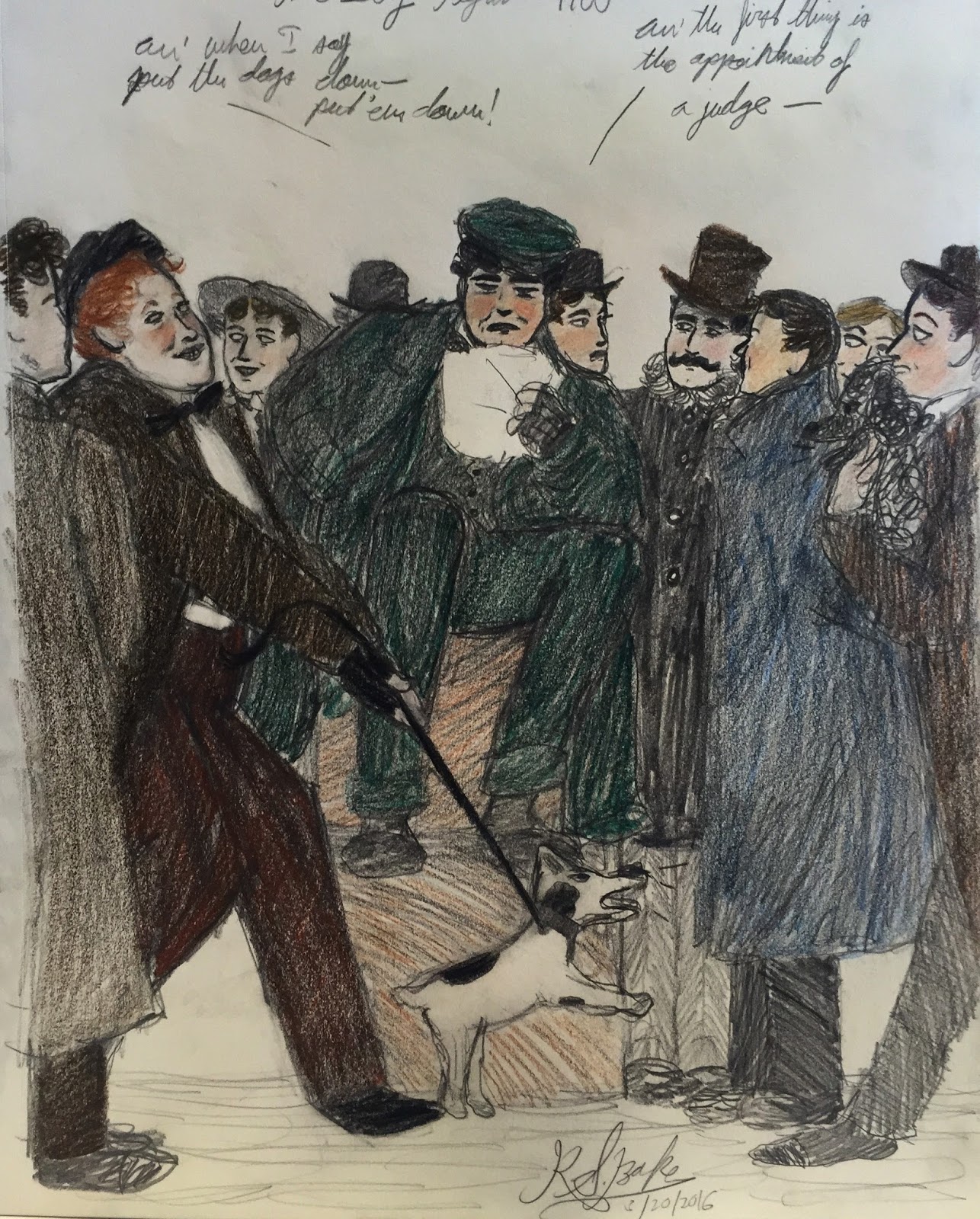
I haven't heard the earlier take of "The Dog Fight" in a long while, and it's very interesting to compare the two takes. The older one has many more people involved, and it's much more casual. By this, it is meant that there's much more talking throughout, and you can hear these two things when they're all talking at the beginning, and when they all cheer. I can pick out Hylands still, even if this one isn't as clearly transferred. I can't really point him out on the post here, because it really is pretty hard to, but I found him. All I can say here is, he can be heard at the beginning after the announcement by Spencer, and toward the end when they let go the dogs for the battle. He probably got all of his studio friends at Columbia together to do this one, more specifically, the older take. Heh, the only problem I have with hearing these "descriptive selections" is that I don't see what it meant to be by Spencer, I see what it actually looked like. I'm referring to how I see all of them in the studio making the cylinder, crammed in weird places and crowded around the horns, yelling and cheering from wherever they are. He must have placed them all over the room, sitting on tables, standing on chairs, and Hylands probably sitting on the edge of the piano's raised platform. Ryan Wishner and I don't see "The Dog Fight", we see them making  "The Dog Fight". 
Here's a sketch of kind of what I see:

Imagine about twenty-five or so people crowded into this room:
And yes, both takes of "The Dog Fight" were made in that room. And also the other two "Scenes from Life" listed. 

Back to some of those fascinating titles and visualizing of them. I'd love to hear "The Cock Fight", though it makes me cringe seeing it alone, as I know that it would be another fantastic "descriptive selection" by Len Spencer. Now, some other interesting titles that are all over this catalog include "The Dime Museum Lecturer", which sounds fascinating, as it's probably by Harry Spencer. Both the Spencer's had been to Huber's Dime museum, as that's most likely the inspiration for that cylinder. Another is "The Talking Machine Exhibitor". Now, that one I have actually heard before! In fact, to share the knowledge, you can hear it here:
Does anyone know who that is?  I have not an idea! This one could be really anyone on the Columbia staff, Russell Hunting, Harry Spencer, George Graham, Len Spencer, or someone even as exclusive as Victor Emerson. It's fascinating nonetheless, filled with some quick comedic lines, and very truthful statements having to to with how Columbia exhibitions were done. Now they didn't have that at Edison! This cylinder is just very bizarre, as I cannot exactly figure out what the purpose of this cylinder was. Was it to advertise(not really)? To describe a scene from life? Well, whatever was its intended purpose, it's a fantastic look into the fun that went on at the Columbia exhibitions. 

Some more fun titles seem to be "The Bureau"(which was by Russell Hunting undoubtedly), and also Hunting's "Hamlet's Soliloquy", which must have also been fantastic. Now to move to the list of the 15000 series, which was the list of the Columbia orchestra. We know of many of the strange descriptive selections that the rowdy Columbia orchestra did in 1898, but what about some of the obscure songs they did in that time? Well, among those included:

 "The New Bully Medley", "The Jolly Coppersmith", "Pomona Waltz" ,"The Jealous Blackbird", "The Alabama Walk-Around", "A Trip on the Broadway Cable"(which is probably a "Descriptive selection"), "Sambo At the Cake-Walk", "Mexican Dance--La Media Noche", "The Village Orchestra", "Poor Jonathan Waltz", "The Darkey Volunteer(s) March"(though it's actually a Rag in a sense),"Charge of the Rough Riders", "The Bugler's Dream"(a descriptive selection), "Hello, Ma Baby", " "On the Midway","My Honolulu Lady", "The Oriental Coon", "Dewey's Return", and of course "You Don't Stop the World from Going 'Round".

Wow, what a list! That's not even close to everything that was listed. For fun, here are a few of those listed above:
"The Jealous Blackbird", recorded mid or late-1897
"The Jolly Coppersmith" recorded in the middle of 1898(with coppersmith effects by Len Spencer)
"The Village Orchestra", recorded in early 1899(featuring Fred Hylands as mister leader man)
"On the midway" recorded in earlier 1898
"The Bugler's Dream" recorded in earlier 1898(featuring bugle calls by Tom Clark)
"Charge of the Rough Riders", recorded in the middle of 1898(featuring bugle calls by Tom Clark, and vocals by Fred Hylands)

By the repertoire that the Columbia orchestra had, it is certain that they reflected the mindset of those who worked there. Not exactly the management, but the employees. Edison was a reflection of its management. The list that I had a link to at the beginning of this post is an amazing way to discover more about the forgotten files of the Columbia phonograph Company, even though the specifics are missing. The long lists of titles by Dan Quinn and George Gaskin are just as interesting, as they are full of comic songs, and popular love songs of the day. There are plenty of these "descriptive selections" that we all hope exist in someone's collection, as every one of them are very weird, complicated in balancing, and full of 1890's mirth! 


I hope you enjoyed this! 


Monday, February 29, 2016

Delving into Hylands' personality and etc.

It has been a very joyous weekend for all who attended the first Santa Cruz Rag Time festival, and it was certainly a great success. Thanks go all to Kylan who ran this whole thing, and did an amazing  with herding all of us cats(musicians). It was such a fun but exhausting weekend! 
Now I gave a seminar on Fred Hylands on Saturday, though only six people came, but luckily, those people who came were very interested in the subject and very much enjoyed themselves. I used some sheet music as examples, and some of my cartoons of Fred and Marie as images for the seminar, as no electronic devices were able to be used when doing this. The night before I gave this speech, I went through it in order with my grandparents, and that turned out just finely, but after that, we got to talking in-depth about Fred and Marie. It started out just as a single question from my grandma, but then it stemmed outward into something much more complicated. 
Since I am still a little bit stumped in trying to figure out Hylands' personality and why many refused to speak of him later, this conversation helped quite a lot more in trying to understand this whole jag. We discussed how wild and obviously unstable Hylands was, and that any kind of alcohol or deadly drugs could have been responsible for not only his spontaneity and varying characteristics. She had told me that she read something recently on George Gershwin, and most of us know about him. Though when she explained what she read in this book, she spoke of how the key to Gershwin's success was a sort of imbalance, and by this she meant some thing like ADD, or something of that type. That made me think about that for a moment, as it was so often said that Hylands had very winning and charming ways when meeting people, however, he was not mentioned by those who worked with him later. Well, scratch that, he was mentioned by these people, but those who caught them in this way of words did not, as keeping with the politeness of Victorian tradition, speak of Hylands wrongfully. From this, it would seem a trifle suspicious that the interviewers refused to speak of him, to say nothing at all about him. What row of words they must have kicked up when speaking of Hylands! Hmm. It's just very strange. She also brought up the fact that Marie might have been the same way, or similar somewhat. By this, I mean whatever it was that those who remembered him said, might have been a similar story for her. Now that would make sense, as only someone like Fred could be with him. Heh, that must have been something that was an ongoing pun with recording staff at Columbia...

Since he was complicated, and tangled up in a mess of music and emotions, we can look to his music for another bundle of clues. Such as these two things here:
Yep, that one. Sorry I mention it so often. 
And also this one here:
Ooh! Thirty-second notes..... oh boy! 

No, I mean that in a sarcastic way, just look at that! It's very complicated for majorly published music in the late-1890's. 
I'm surprised that Will Rossiter was alright with publishing this, as it's tangled up and complicated(like that cat who wrote it) and this is just the first page of it. Who knows what's next... What you see directly above is actually a great example of how complicated Hylands was, and the same thing can be said about his Darkey Volunteer, as it's just the same amount of crazy.
In fact, you can hear Hylands' orchestra arrangement here.(do excuse the abrupt ending of the sound file, the one first listed is the one I mean). 
There's so much going on here. He expected them to read this:
Yep. What a mess of wonder it is. They read it easily, as they were professional musicians in their day, but Hylands was just a few steps ahead of them always. The orchestra members were all standing on their lily pad a few feet away from Hylands who was constantly thinking elsewhere and ahead. He was like that with everyone he worked with, no matter who they were. Heck! If he was working with stars like Ben Harney or Ana Held, he'd still be his vain and eccentric self. 
Now something that I just confirmed this evening is that one of Hylands' pseudonyms in the early teen's was  Fred Whitney. Why? Well, I learned what Fred's mother's maiden name was, and guess what it was...Whitney(Mary was her first name by the way). Just to prove my point fully, on the back of his The Rag-Time Boardinghouse from 1912, there are two tunes listed on the top of the back page. These tunes are "The BootBlack Rag" and "Trifling", the name listed as the composer is Fred Whitney, and I had the feeling that Hylands wrote these pieces, because of their complexity and interesting melodic choices. Now that I know "Fred Whitney" was certainly one of his pseudonyms, that is out of the way in needing evidence. Now the fact that he used his mother's maiden name is pretty interesting actually. That shows a possible deep mourning for his mother who died when he was 21. It must have effected him for as long as he lived, in some way or another. 

I am still rather unsure of Hylands' personality, but one thing is for sure, he was very intricate chap, and was extremely intelligent. He was so quick when talking with people, that he would point out the smallest of things in everyone's words. Similar to when someone says something quick as a sort of sarcastic joke or just to move along a conversation, Hylands would laugh a little, but then call out the statement, asking deeper questions about it, though that was not the speaker's intention at all. It's very annoying to the person who said it, but Hylands was so bright that he could analyze someone fully in a split second. Adding to his wild mind, and intelligence, he was a strategic manipulator, and when he was drunk, he must have been a nightmare to those around him, though his mind must have still been rather sharp, but not as intense or anxious when he was either sober or on cocaine or opium. How he must have been a real character, even from what we have written about him that still exists to-day. 

Yesterday was actually the birthdate of Fred Hylands, and I played plenty of his wonderful renditions of Rag-Time at the second day of the Santa Cruz festival. 


I hope you enjoyed this! 


Tuesday, January 19, 2016

More on Columbia Rag-Time vs. Edison Rag-Time

Since the UCSB website is working again, I will continue my post from yesterday evening. I meant to showcase these two records by the Peerless Orchestra yesterday:
here's "Ma Tiger Lily" by the Peerless Orchestra, 1900

It was also intended that I use their version of "Whistling Rufus" from 1899(with an introduction by Arthur Collins)

These are both very tasteful selections of Rag-Time chosen by Frank Banta. The renditions(there's two takes on the page!) of "Whistling Rufus" are especially fantastic, because of the very syncopated melodies paired with the straight march melodies of the song. That was something that the Columbia orchestra didn't do too often, as much as Banta did with the Edison orchestra. Also what I meant to share yesterday were a few more of Banta's and Collins' brown wax cylinders. 
This first one is one that Len Spencer also recorded with Fred Hylands around the same time(if not in the same month or so!)and on the list of Columbia cylinders from my last post, you can actually see it listed. 
Here's "All I Wants Is My Chickens", from late-1898(by Collins with Banta)
It's just about as good as Rag-Time on cylinders could get from pre-1900, and Banta's playing can be very well dissected on this one, more than usual. You can actually hear him hit a fifth on the last chord(which was something that was characteristic to his playing!), and you can actually hear all of those bass notes, more so than many brown wax Edison cylinders. 
I would like to hear Spencer and Hylands' version of the song though, that would certainly make for a fascinating comparison. If anyone has the brown wax Columbia of "All I Wants Is My Chickens" by Len Spencer, comment on this post!(the catalog number is 7446). 

This next Collins and Banta selection is a fantastically hot Rag number entitled "Lam Lam Lam", recorded in 1901*just a nerdy Rag-Time note, this song was written by  Benjamin Jerome, the composer of the "A Bunch of Rags" medley in 1898, and it's not Ossman's!*. 
Banta really plays his tail off on this one! Not every note is clearest, but you can certainly hear how he's playing everything! This is just about how hot Banta could get on Edison's piano, and all his musical traits are present. I have heard this record countless times, and am still hearing things I didn't hear before. Just as I'm writing this, I just noticed this audible deep note at about 2:05-06. Banta hits the deeper note of the octave first, then the higher note, almost like Hylands did on hundreds of Columbia records. There's so much to hear on this cylinder, and it takes a few listens to really get the gist of what Banta plays. 

Meanwhile, at Columbia--- Collins began working there in 1901, starting with working with 
Yes, that guy. Aside from working with Natus, Collins made some fantastic Rag-Time records with Fred Hylands, in 1901 and 1902. 
It's when you can hear records like this one:
Collins singing Cole and Johnson's "My Castle on the Nile" in 1902
That's pretty wild for Hylands, but not the most he'd been before that. He did show off his style on this cylinder by playing lots of broken walking octaves. It's somewhat amazing really, the way Hylands plays on this one is nothing less of genius. 
Hylands must have been showing off on the last one, like he usually did, but a little more so that usual on that one. In 1901-1903, Collins and Hylands did turn out some excellent Rag-Time records. There are one's like this from 1901. 
Like this one,
and of course, this one.
There's not a way to choose which one if better than the others, as they're all perfect examples of genuine Rag-Time. Yes, I know, you get a white singer, and a white pianist, but you do get "Chicago Professor" playing Rag-Time freely as he would, with not much changed from his "very 1896" Rag style(if you know what I mean...). As I mentioned in my last post, I mentioned that Hylands also was at Leeds in 1903. In bringing Leeds back to the picture, you get records like this one, from 1903. Now this is a weird one. It's Collins with the "Leeds Orchestra", which could have composed of many known or unknown musicians. One thing is for sure, Hylands was their pianist. There is not a doubt that Hylands would have been dragged in to Leeds rather than Banta, only because Banta was leading the Metropolitan orchestra still in '03, and was still Edison's regular pianist. Having him work for Leeds would have been far too much work than he already bore. This Leeds record has a fantastic piano part, and for some odd reason, it's pretty much the loudest instrument in the whole ensemble(other than the flutes). That's one thing that also indicates Hylands on the piano, also because the tempo for the song and the sense of rhythm are far too good to be anyone like Banta or Albert Benzler(it couldn't be Benzler anyway, but he's an option because he was Banta's sub at Edison in 1903.)  Columbia's house orchestra in this time was also a great source for Rag-time, as they turned out tunes like "Dixie Girl"(which you can hear here.)"Peaceful Henry", "Virginia Skedaddle", "HoneySuckle and the Bee"(you can hear it on a Climax record here!) and many more great Hylands arrangements. 
Hylands led the orchestra every time they made recordings, no matter who it was who did the arrangement, as he's loud, pushy with tempo, demanding of attention. That could certainly he said with the record of "HoneySuckle and the Bee", as for some reason, they go into a little bit of a tango time section at the end, that had to be of the devising of Fred Hylands(because it's not in the written music!).
Now I meant to share this cylinder yesterday, and it's that cylinder with this piece on it:
Yep, that's it. I wish I owned a copy of the original sheet music, but I don't ,and I haven't any friends who might have it. Anyhow, enough explaining, here's Hylands' almost mess of arrangement of his own, self-published, "Darkey Volunteer(s)" recorded in mid-1898(excuse the home recording just after the music ends...). 
There's so many weird things that went into the making of this piece of music, and the creation of this recording. 

One: Hylands hadn't had the means to publish the tune until 6 months after he wrote it.
Two: He didn't have anyone who wanted to publish it, so in order to solve that problem, he had  to do it all himself, EVERYTHING. 
Three: He found that after he recorded this with Ossman in about July of 1898, he dedicated it to Ossman, as seen above^^
 Four: He hand-wrote all the arrangement parts for all the members of the orchestra, and they must have just LOVED(sarcastically), having to read those...
It's a hell of an arrangement, and there's  so much going on at the same time that it's hard to keep up with the amount of sounds that are going. But that's the beauty of Hylands and his music, it was all exquisitely tangled up in his mind, until he found a way to make it somewhat less perplexing to the musicians who had to read it. It's still very hard and strange music to read, and to listen to. That's Hylands for ya. 

I'm not really sure it you'd consider "The Darker Volunteer" a Rag-Time piece, but it must have been considered that in its day, and perhaps by the composer himself, who hadn't a title(or a written score) of it until about a month after he had the idea sprouting. Banta was a little less scattered. 

Banta was one who had his idea, and then got to writing it down the night after it came to mind, not letting it linger and somehow recollecting the melodies, after a multitude of harsh drinks. Banta had more music written out, and more arrangements full and ready for the musicians to read. They didn't always fall together so well with the Metropolitan orchestra, such as on this mess here. Yes, that record is pretty much the definition of the music falling apart, but it's still interesting, because if you're listening close enough, you can hear Banta count them off at the beginning, like he did so often.  The problem with Banta leading an orchestra is that he was rushy, and pushed the rhythm sometimes, so that can be uncomfortable to some of the other band members. But minus the tangled up ones like "The Sleighing Party", there are also fantastic Rag/Cakewalk arrangements by Banta, such as his great and very "tight" arrangement of Kerry Mills' lesser known Cake-Walk "Impecunious Davis" recorded in 1901. That is an outstanding early recording of Rag-Time, enough said, Banta did well on that one. 

Well, there's so many more great examples, but I would need to save them for other posts, as I've exhausted much of the material I know of off-the-top-of-my- head, more will come soon! 


I hope you enjoyed this! 


Sunday, September 13, 2015

From Sheet music

It's uncommon to find the old early recording stars on covers of sheet music, as this has become an important area in my collecting, but it's a very hard thing to come across, but once one is found, it's an immediate find. I know that the earliest artists of the 1890's all wrote music here and there, so it's not uncommon to find their names on covers, whether it's a song they wrote, or a song that was dedicated to them. I have mentioned this odd ball "Coon Song" on this blog auite a while back, but I just found it again:
Yep, that one. With this thing on the top of it:
Ha! That's just wonderful. Since this was written by one of Spencer's composer friends(of which included Monroe Rosenfeld, May Irwin, the composer of the song above, Barney Fagan, Fred Hylands, and probably Max Hoffmann). So there must have been several pieces of music from 1893-1899 that had this sort of recognition to Spencer on it. I would not at all be surprised to find another one of these. I have found things like this dedicated to Dan Quinn and especially Russell Hunting. Speaking of Russell Hunting, I have come to the thought that Hunting must have become a big figure generally in the whole New York scene after his whole "bust" with those indecent cylinders, as he was on several pieces of sheet music(not pictured unfortunately...) and was recognized in several communitites other than the recording community. By this, I mean something like this:
The thing at the very top is what I'm referring to:
Yep, that's it. This piece was composed and published the year after Hunting went through all of that commotion with the law, so it's interesting to think that it was alright for the composers to still be friends of his. Hunting was considered "esteemed" by Rosenfeld because of his bravery in the courts and against Comstack's laws, and continuing his "Casey" records after the fact. But in 1898, the idea that recording artists and publishers should try to group as one became a fad. By this, we have the firm of:
There it is. Under the ink pen of Len Spencer, came this beautiful logo. 
This firm was incorporated by Fred Hylands in March of 1899, as can be read here from that edition of The Phonoscope:
That's basically saying that Hylands' last two firms were a failure, so he used the extra money from those two to start this firm with simlar people he already knew. This firm was a much more successful one though. He published music to endorse the records they made and sent the recording artists advance copies of the music. Yous can see that he did this because I saw a song Spencer recorded listed in the "New Records for Talking machines" section the month before Hylands published it. That's a dead giveaway. I'm pretty sure that Hylands did this with many more of his songs, just like his "Darkey Volunteer" of which the manuscript he had been carrying around with him for at least five months before he published it. And by the time he published the song, had had already handed written arrangments to the Columbia orchestra and to Vess Ossman.  
This idea of recording artist and publisher always seemed like an easy deal, where both sides of the business would get their share with ease, and some of the money from the record sales went to the publisher, it seemed like the perfect idea, and this is why Hylands wanted this to happen. From what I have found, this firm was even set up in two out-of-country places as well, just like the Columbia company. You can see this here:
closeup of logo:
See it? Toronto, Canada and London, England. I don't know the story about the Toronto setup, but I have this thing here about the London setup:
Yep, that guy. I have only heard vague little things about him here and there, but I guess that he was one of the small empire under the dictatorship of Fred Hylands. Even with all this endorsing of recording artists, such as these two examples:
Hylands was still losing tons of money from this firm, and it was mostly him who was, due to his irresponsible spending, and anxious means to branch out to other countries, which was certainly a pricey venture. All the other members of the firm were wealthy from their inheritance or from recording, and they were mostly "partying" themselves, without Fred. When this firm collapsed, Fred was broken up, and had to sell all of his stock out to other publishers, further slipping him into debt and depression. Even with this failure, the idea of publisher and recording artist stayed with the music business, as you can see this on music published in the 1910's and 20's, even later than that as well. I have a piece of music from 1904 with Arthur Collins' picture on it, here you go:
Sorry the picture isn't very good, but you get the point, it's one of Collins' mst popular songs of 1904 and he's pictured on the cover, for a reason that's pretty obvious. So Hylands' idea wasn't all that bad, but the firm just didn't work out to well. I know of tunes from the 1900's and 1910's with Byron Harlan on the cover, Vess Ossman, Dan W. Quinn,Henry Burr, Harry Tally, Will F. Denny, and of course Billy Murray. So if you're looking for great reference for these songs just turn to the music, for the artists' picture, and maybe for changed lyrics, because it did happen.
To close off, here are a  few tunes with the sheet music:
This song is from 1890! 
https://ia902302.us.archive.org/18/items/JoeBelmont/JoeBelmont-WhistlingSusannaCoonSong.mp3
By Dan Quinn and Frank P. Banta:
https://ia800300.us.archive.org/17/items/edbw-6950/edbw-6950.mp3
I haven't the sheet music for this, but this is Hylands and Spencer's famous "Negro Song Success":
https://ia800300.us.archive.org/9/items/LenSpencer/LenSpencer-YouDontStoptheWorldFromGoingRoundCoonSong.mp3


I hope you enjoyed this!