When looking through a listing of Columbia cylinders, there are always some very fun and interesting-looking titles all over the page, but of course, not all the needed specifics are given, for reasons I have explained before. Last evening, I was looking through the listing you can find here:
All of the brown wax listings are amazingly helpful, with many titles listed would make record geeks want to go right out and search for in their collections of brown wax, and check on Ebay if any of them are for sale somewhere. Really, what I'm saying is that there are listings of cylinders that we all hope are still out there in some way, shape, or form. In conditions good enough to play, is what is really what is needed. Of the many fascinating sections of listings, the 11000 series is always an interesting one, because that was the number system that had all of their special talking records, which, not surprisingly included the "scenes from life" series put out by the Spencer brothers. There are even more that are listed on this page than in the 1900 catalog that had the section of "scenes from life". As you can see only three of them here:

Yes, all of these are hilarious, but gruesome and morbid in their own special ways. Yes indeed, very much akin to the late-1890's doings of these strange Columbia employees. But of course, as expected from the Spencer's, Steve Porter, Roger Harding, Russell Hunting, and Fred Hylands, the "scenes from life" records didn't end with only the above three. You may notice that the numbering of these three cylinders are scattered, and are not exactly numerical, as they weren't exactly beside one another in the catalog. What was 11022? Well, a little something called "The Cock Fight". Ooh. That must be a gruesome one. When I saw that one, I cringed a little, as Spencer always went for "descriptive selections" that were realistic in all the ways they could be. Cock fights were always said to have been brutal(not that "The Dog Fight" isn't a similar story) in a way that dog fights weren't. Think of Spencer describing a fight to the death between two chickens, and getting many of his friends in the studio involved(much like on "The Side Show Shouter").
Just to get an idea, here are all three of the selections listed above:
and No. 11024(featuring Collins and Harlan!)
I haven't heard the earlier take of "The Dog Fight" in a long while, and it's very interesting to compare the two takes. The older one has many more people involved, and it's much more casual. By this, it is meant that there's much more talking throughout, and you can hear these two things when they're all talking at the beginning, and when they all cheer. I can pick out Hylands still, even if this one isn't as clearly transferred. I can't really point him out on the post here, because it really is pretty hard to, but I found him. All I can say here is, he can be heard at the beginning after the announcement by Spencer, and toward the end when they let go the dogs for the battle. He probably got all of his studio friends at Columbia together to do this one, more specifically, the older take. Heh, the only problem I have with hearing these "descriptive selections" is that I don't see what it meant to be by Spencer, I see what it actually looked like. I'm referring to how I see all of them in the studio making the cylinder, crammed in weird places and crowded around the horns, yelling and cheering from wherever they are. He must have placed them all over the room, sitting on tables, standing on chairs, and Hylands probably sitting on the edge of the piano's raised platform. Ryan Wishner and I don't see "The Dog Fight", we see them making "The Dog Fight".
Here's a sketch of kind of what I see:

Imagine about twenty-five or so people crowded into this room:
Here's a sketch of kind of what I see:
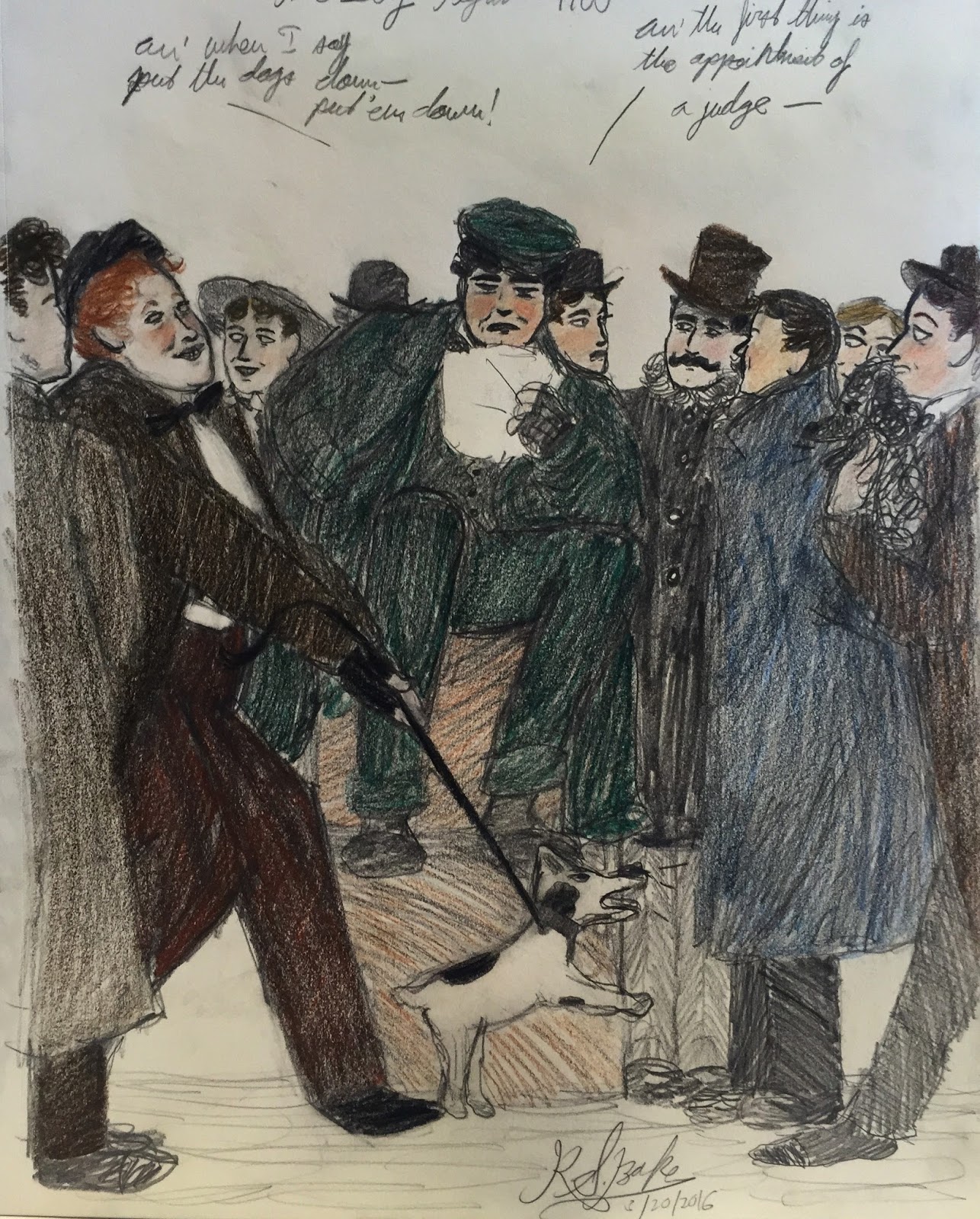

And yes, both takes of "The Dog Fight" were made in that room. And also the other two "Scenes from Life" listed.
Back to some of those fascinating titles and visualizing of them. I'd love to hear "The Cock Fight", though it makes me cringe seeing it alone, as I know that it would be another fantastic "descriptive selection" by Len Spencer. Now, some other interesting titles that are all over this catalog include "The Dime Museum Lecturer", which sounds fascinating, as it's probably by Harry Spencer. Both the Spencer's had been to Huber's Dime museum, as that's most likely the inspiration for that cylinder. Another is "The Talking Machine Exhibitor". Now, that one I have actually heard before! In fact, to share the knowledge, you can hear it here:
Does anyone know who that is? I have not an idea! This one could be really anyone on the Columbia staff, Russell Hunting, Harry Spencer, George Graham, Len Spencer, or someone even as exclusive as Victor Emerson. It's fascinating nonetheless, filled with some quick comedic lines, and very truthful statements having to to with how Columbia exhibitions were done. Now they didn't have that at Edison! This cylinder is just very bizarre, as I cannot exactly figure out what the purpose of this cylinder was. Was it to advertise(not really)? To describe a scene from life? Well, whatever was its intended purpose, it's a fantastic look into the fun that went on at the Columbia exhibitions.
Some more fun titles seem to be "The Bureau"(which was by Russell Hunting undoubtedly), and also Hunting's "Hamlet's Soliloquy", which must have also been fantastic. Now to move to the list of the 15000 series, which was the list of the Columbia orchestra. We know of many of the strange descriptive selections that the rowdy Columbia orchestra did in 1898, but what about some of the obscure songs they did in that time? Well, among those included:
"The New Bully Medley", "The Jolly Coppersmith", "Pomona Waltz" ,"The Jealous Blackbird", "The Alabama Walk-Around", "A Trip on the Broadway Cable"(which is probably a "Descriptive selection"), "Sambo At the Cake-Walk", "Mexican Dance--La Media Noche", "The Village Orchestra", "Poor Jonathan Waltz", "The Darkey Volunteer(s) March"(though it's actually a Rag in a sense),"Charge of the Rough Riders", "The Bugler's Dream"(a descriptive selection), "Hello, Ma Baby", " "On the Midway","My Honolulu Lady", "The Oriental Coon", "Dewey's Return", and of course "You Don't Stop the World from Going 'Round".
Wow, what a list! That's not even close to everything that was listed. For fun, here are a few of those listed above:
"The Jealous Blackbird", recorded mid or late-1897
"The Jolly Coppersmith" recorded in the middle of 1898(with coppersmith effects by Len Spencer)
"The Village Orchestra", recorded in early 1899(featuring Fred Hylands as mister leader man)
"On the midway" recorded in earlier 1898
"The Bugler's Dream" recorded in earlier 1898(featuring bugle calls by Tom Clark)
"Charge of the Rough Riders", recorded in the middle of 1898(featuring bugle calls by Tom Clark, and vocals by Fred Hylands)
By the repertoire that the Columbia orchestra had, it is certain that they reflected the mindset of those who worked there. Not exactly the management, but the employees. Edison was a reflection of its management. The list that I had a link to at the beginning of this post is an amazing way to discover more about the forgotten files of the Columbia phonograph Company, even though the specifics are missing. The long lists of titles by Dan Quinn and George Gaskin are just as interesting, as they are full of comic songs, and popular love songs of the day. There are plenty of these "descriptive selections" that we all hope exist in someone's collection, as every one of them are very weird, complicated in balancing, and full of 1890's mirth!
Some more fun titles seem to be "The Bureau"(which was by Russell Hunting undoubtedly), and also Hunting's "Hamlet's Soliloquy", which must have also been fantastic. Now to move to the list of the 15000 series, which was the list of the Columbia orchestra. We know of many of the strange descriptive selections that the rowdy Columbia orchestra did in 1898, but what about some of the obscure songs they did in that time? Well, among those included:
"The New Bully Medley", "The Jolly Coppersmith", "Pomona Waltz" ,"The Jealous Blackbird", "The Alabama Walk-Around", "A Trip on the Broadway Cable"(which is probably a "Descriptive selection"), "Sambo At the Cake-Walk", "Mexican Dance--La Media Noche", "The Village Orchestra", "Poor Jonathan Waltz", "The Darkey Volunteer(s) March"(though it's actually a Rag in a sense),"Charge of the Rough Riders", "The Bugler's Dream"(a descriptive selection), "Hello, Ma Baby", " "On the Midway","My Honolulu Lady", "The Oriental Coon", "Dewey's Return", and of course "You Don't Stop the World from Going 'Round".
Wow, what a list! That's not even close to everything that was listed. For fun, here are a few of those listed above:
"The Jealous Blackbird", recorded mid or late-1897
"The Jolly Coppersmith" recorded in the middle of 1898(with coppersmith effects by Len Spencer)
"The Village Orchestra", recorded in early 1899(featuring Fred Hylands as mister leader man)
"On the midway" recorded in earlier 1898
"The Bugler's Dream" recorded in earlier 1898(featuring bugle calls by Tom Clark)
"Charge of the Rough Riders", recorded in the middle of 1898(featuring bugle calls by Tom Clark, and vocals by Fred Hylands)
By the repertoire that the Columbia orchestra had, it is certain that they reflected the mindset of those who worked there. Not exactly the management, but the employees. Edison was a reflection of its management. The list that I had a link to at the beginning of this post is an amazing way to discover more about the forgotten files of the Columbia phonograph Company, even though the specifics are missing. The long lists of titles by Dan Quinn and George Gaskin are just as interesting, as they are full of comic songs, and popular love songs of the day. There are plenty of these "descriptive selections" that we all hope exist in someone's collection, as every one of them are very weird, complicated in balancing, and full of 1890's mirth!
I hope you enjoyed this!


