Thursday, November 12, 2015

Character Studies-- W. H. Krell(1868-1938)


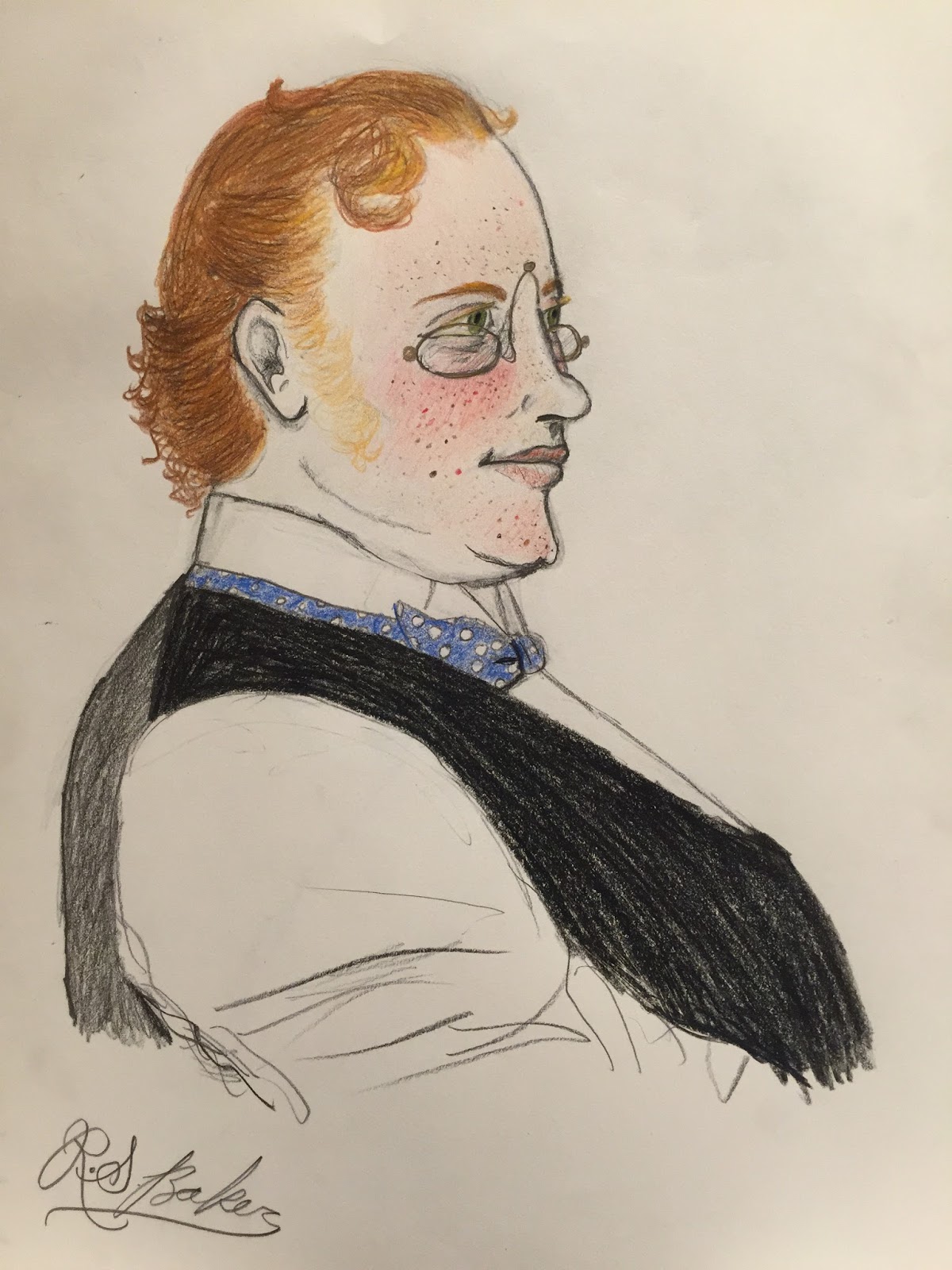
Yes, I know Mr. Krell wasn't a recording star, but he had connections with two recording stars of the 1890's and 1900's, and he's a fascinating character to illustrate and describe. Krell was born in Pennsylvania in May of 1868, to two German immigrants, who were not involved in music at all, but knew from an early time, that their son was. He first took up brass instruments, learning low the brass, trumpet, as well as a little piano. He wasn't primarily a pianist, which is a contributor to the fact that the first version of "Mississippi Rag" was only a band arrangement. It took a little while for the collection of melodies to become a piece published for piano. By the late 1880's, Krell was playing in local bands, but he wanted to move somewhere else, somewhere larger than his home town, where he could make a name for himself. He decided that Chicago would be the place to go. So by 1889, he was living out in Chicago, and beginning his own band. In 1890, he had formed "Krell's Band" and he was beginning to make a name for himself as a local bandleader and cornetist. The local eccentrics ran into him at the big World's Fair of 1893, and this is why he wrote a bunch of music in '93. This is where he ran into Silas Leachman, Ben Harney, Fred Hylands, Bert Morphy, possibly Byron Harlan, and a host of others. Krell's first known piece is a remembrance to the former Chicago Mayor who died in 1893, with the music primarily composed by Silas Leachman, as well as the lyrics. He wrote the "Cake Walk Patrol" in 1895, and then by the end of the next year, had written out his arrangements for "Mississippi Rag", only to get them published in January of the next year, 1897. He remained conducting his band until the beginning of the 1910's, and from there faded into complete obscurity.

Willie Krell was a classic German bandleader. He not only had the looks, but the competitive and organized means of a Germanic brass player and bandleader. He was about 5 foot 8, strongly built, had small blue eyes, and hair that was golden, very light, and seemed like the lightest gold that a person's hair could be. He was a short-tempered man, much like Sylvester Ossman, and wouldn't take any "B. S.", from anyone. If something wasn't done his way, he would speak out against the opposition and make them think his way, and abolish all others who thought otherwise. He was determined to have the best band in  Chicago, at any means possible, even if it meant beating up some members of his own band. He was the most determined and destructive bandleader Chicago ever had before the Jazz age, only because he was desperate for the best band he could possibly have, and have the best Chicago music-makers by his side, which at his height in the mid-90's, he certainly had. He was also a drinker, some one too, not a terrible one, but one who went out and drank after those "society shows", and maybe took a few band members along with him. The record managers of Chicago avoided him, as he was too much like banjoist Ossman, and that wasn't always the best thing, also because nothing would be able to be done his way in a recording studio. He probably had offers, as the Chicago talking Machine company was gaining a reputation by 1895, and was looking for better staff members. Of course, he refused this, even though it would have been interesting if he had accepted. With the help of the few Rag-Time performers he knew left in 1898, he wrote his third rag, "The Piccaninny Rag", this Rag was much more true to the actual style of the pianists he heard around him in Chicago, even if it was composed after many of them had left for New York. He had become especially evil toward his band members by 1900, as a few incidents of injured band members and filed arrests really showed that he was even more determined by then, as the business was becoming very crowded and full of competition. He was great at what he did, but a terrible man at rehearsals and after shows. By 1905, he was starting to wind down a little bit, and somehow, he knew that he hadn't too many years left in the music business. How he knew it, by the one-step era(or just before the starts of the Jazz age) he was out of the business completely. It was good that he did that, since he was going to end all of that inevitably, so no more of that competitive atmosphere could kill him. He lived out in Florida for the last few decades leading up to his death in 1938, where he died in complete obscurity. He was remembered for decades afterward as just that bandleader from Chicago who won that music-writing contest with his "Mississippi Rag" in 1897.


I hope you enjoyed this! 

Wednesday, November 11, 2015

Character Studies---Frank P. Banta(1870-1903)


Frank P. Banta, the silent piano man of Edison's company. He was a very hard worker, who cared very greatly about the quality of the records he was on, and wanted to be known as Edison's pianist. 

He did indeed achieve this goal, as to-day, he is the most well-known accompanist on records of the acoustic era. When record collectors hear Rag-Time piano behind any singer on a Victor, Edison cylinder, or even sometimes Columbia records, they immediately turn to Banta. Without considering the full evidence or facts, they turn to Banta, as he was everywhere on Victor records and Edison cylinders. This is true, but he was never on Columbia records---ever, period. This is something that needs to be known by record collectors who think it's always Banta who played the Rag-Time, which is partially true. Banta did indeed play wonderful Rag-Time, and he was a better overall musician than Fred Hylands. 

Mr. Banta was a quiet and solemn worker. He never had the means to complain about the obviously terrible working conditions he endured at Edison. The Conditions in which Fred Hylands worked were much better than the ones that Banta worked. Somehow, having Columbia stationed in an office building made working conditions better. Banta had to endure the rough and unsanitary world of working under old man Edison and Walter Miller. He came in every morning at about 8, with a case full of music, and dressed very modestly. He never wore the finest clothes, but he certainly had money, and was good with that money he had. He hid his alcohol and drugs deep in his case, so not even the nitpicky Walter Miller could find them if he dug through the case. He always had a nasty cough, and with that, he always had a rag with him to quiet himself as best he could. He enjoyed working with the singers and instrumentalists, and had some laughs with them here and there throughout the days. He was a very kind a soulful man, who had the easiest temper and personality to deal with of all the recording stars. He would always take that long trip back home each evening half walking, and half in a cab, which was one of the ways he kept to that slim figure of his. Many of the Edison staff wondered what the man was really like, as his piano playing was light and airy, even if he was playing rather "rough" Rag-Time behind some singers. The staff had rumours about him spread around, such as things related to him possibly being a Jew, and other things that would get him kicked out had Old man Edison found out himself. He was too good of a man for the manager to fire him, and he never caused any trouble or harm. Since he was always quiet, he wasn't really a big name on their staff, and other pianists under Edison, Fred Bachman and Albert Benzler, found him to be too meek on the piano, and that he wasn't ever meant to be a Rag-Time pianist. Banta was a silent and "behind-the-scenes" figure in the late-1890's at Edison, as well as Victor. He was a popular accompanist in vaudeville and for popular instrumentalists, not as popular as Fred Hylands and Burt Green, but to some degree, he was a better pianist. Banta's hands were not too long, probably able to just reach a tenth, and wasn't really a comical sight to watch when he played. When he played, he looked very intense, focused, and serious. Even when he played Rag-Time, his demeanor still had this feeling to it. When he played something gentle and slow, that was what he looked like, and his expression was still serious, but full of soul. He was easy to work with, and this is why all the instrumentalists liked him so much, as they wouldn't ever have to argue with him, unlike Fred Hylands(where the musicians would sometimes argue with him!). This easiness with him was the main reason why Vess Ossman liked him so much, and is why he stayed with him for so many years. Banta was always a worrysome character for the other staff members however, as he was so slight in figure, constantly had that horrible cough, and wasn't vocal with his true feelings about working at Edison. It worried some of the staff members occasionally, not all the time, but a select few would feel the need to chat with him kindly for recognitions that he was all-right. It took a while for Banta to really be known by the record buyers that he was a regular pianist at Edison, and that he was even playing sometimes. His playing was still quiet and light, which was unfortunate, because it really took away from really hearing him play with all his stylistic details. He very often played in the higher register of the piano, and more often he did this after 1901, why? That is something all the staff could never know. His Ragged style was loved greatly, both at Edison and Victor, and his light and out-of-the-way piano accompaniments were favored by the cornet and banjo players, as they would not need to tell him "BE QUIET!", or tell him to change anything about what he was playing. It wasn't all great that he was a stalwart worker, determined to get as much work done as's he could. This ethic started to get to him in 1902, juggling shows with recording very frequently for Victor and Edison, it began to wear him out much more often. He began to really feel the pain that Fred Hylands had been dealing with for years, Banta just hadn't learned of it earlier because he was healthier, and wasn't as heavy. By 1903, he made his only piano solo, "Violets", which was a beautiful rendition of the popular ballad of the same name. Only six months after this piano solo was made, Banta died of a mixture of all his ailments. He left a seven-year-old son, two year old daughter, and a widowed corset maker. Months after he died, the Edison staff all realised that is was them who forced him to work so much, to the point of where it killed him by the end of 1903. They took the blame and all went to his funeral, leaving a "trail of tears" along the dark march path in the cold of early December. 
Every time his Irish wife Elizabeth (Riley) Banta, heard his record of "Violets" she must have wept every time she heard it. 


I hope you enjoyed this! 

Tuesday, November 10, 2015

Character Studies-- George W. Johnson(1846-1914)

The only man of African descent on the Columbia staff---George W. Johnson. 

He was a jolly man, very pleasant and mild-mannered most of the time. But had the unfortunate disposition of being the only black man on their staff. With all so-called the white "rulers" of the studio, they wanted to keep their importance high in the studio. Len Spencer was kind enough to advocate for Johnson and help him along if he got into any trouble, which was in some ways one of the most generous things he did. More so than him giving $500 to various charities when he died. Helping Johnson became one of Spencer's duties starting in 1894, when he first found him and took him in to make minstrel records. Spencer gave much of his profits made from these well-selling records to Johnson, which was a kind thing for him to do, but he could have done more. Having Johnson there did bring some discomfort to some of the highly conservative members of the staff, and had him treated as an inferior oftentimes in the studio, which can be disappointing to historians who first learn of this. It makes sense really, and gives a truthful reality into the time period that this all took place. 

Johnson was a kind and amiable man, with a somewhat troubled personal life, he tried to make up for it as best he could by being kind to everyone in the studio. His personal life had become a subject of many a rumour in 1898 and 1899 among the Columbia and Edison staff, but many of them were just trying to spread mush about him, only because of his race. Many of the staff members were harsh on him, which was wholly not needed, entirely. Certain staff members were harder on him than others, and of course whenever one of the Spencer's were in with him, a sense of comfort immediately alleviated any tension that had built up. Spencer was a kind chap to Johnson, much more so than some of the other "regulars, as Spencer really wanted to help out Johnson, and make sure that he could live a reasonable life. Spencer did what he could really, as he was all over the place, having to "put out fires" and such. Johnson was just trying to get by, only singing four songs for the phonograph. In 1898, Columbia had him set. He worked mostly for Columbia in 1898, which was partially because of Len Spencer's wants from him and from the record sales. Dan W. Quinn disliked Johnson,  as well as Edward Favor, Vess Ossman , George Gaskin, J. W. Myers, and especially Fred Hylands. They were open about their disregard for Johnson, though it's small observations that can be used to prove this. Whenever Johnson came in at Columbia, Hylands would already be there inevitably, smoking or drinking something, awaiting the next artist to come in. Johnson never came in the mornings, for reasons unknown by everyone on the staff. When Johnson came in to Fred Hylands, Johnson would always kindly greet him, and Fred would greet him with a feigned expression of kindness. Hylands owned the room when Johnson walked in, he took all liberties he could to own the room when Johnson was there to make records. He drank like a sailor, took in more drugs, and played his heartiest and roughest Rag-Time always, when Johnson came to sing(or laugh) for the phonographs. It was an unfortunate thing really, that Hylands would display his disregard for Johnson is such crude indirect ways, it would be considered cruel now. Johnson probably knew of Hylands's true thoughts of him, which must have made working with him troubling, and sometimes uneasy. Johnson wasn't in much luck after 1901, as his popularity on the phonographs and Graphophones dropped dramatically, only with his remakes of "The Laughing Song" selling by then. It wasn't looking too bright for him, and he was starting to become desperate for more work by 1904. Luckily, after he made a few more records in 1905 and 1906, dear old Len Spencer found him once more and took him in to his vaudeville house. Spencer had become a prominent booking agent and Lyceum owner by 1906, and in looking for employees, he went back to find Johnson. He provided for him just as he did in the late-90's, but he was a little less reasonable this time around, he employed him as his doorman. He was living there peacefully and quietly,where Spencer never acknowledged him again. He was careful with what he paid him, being that Johnson was supposedly a hard drinker, and would be gone for days at a time if he paid him more than usual. Spencer could have done more overall. A few weeks after Johnson had passed, Spencer finally learned of it and was surprised to hear of it. Upon hearing tell on it, he and a few other workers at the Lyceum went up to where his room was and Len must have said something like, 
"My god. He is gone..." and they then set to work cleaning up the remains of  Johnson's things, finding all sorts of vermin and trash. This must have set Spencer into a deep sorrow, deep in his soul, he felt a terrible pain about this, though his demeanor seemed only in disgust, just to keep his tears away. Just less than a month later, Spencer croaked, which in many ways seems almost like an ironic thing, that Spencer and Johnson died in the same month, of the same year. Johnson's story is still a hard one to listen to now, and will always be as so, with hope, his laughter will live on. 

And hopefully, nothing like this will break a person's life like Johnson's again. He deserved better. 


I hope you enjoyed this! 

Character Studies--Roger Harding(c.1858-1901)

 "I don't know Freddy, I'll join ya." is what Roger Harding must have said hesitantly when he became a part of Fred Hylands' first failed publishing firm.

Roger Harding was a funny little man, and must have been a real riot, since he ran with Fred Hylands' gang of publishers in 1899 and 1900. This group included(other than Hylands and his wife Marie), Len Spencer, Burt Green, Roger Harding, Steve Porter, Rollin Wooster, Barney Fagan, George Gaskin, and a few more of Fred's composer friends.  Harding was right in the mix of these wild young souls, but he must have wanted to be, since it was a real commitment to do this. Harding was one of the older members of the young staff at Columbia, being the same age as Billy Golden, it was not as easy to keep up with all the wild means of the young staff members, who were out partying and drinking almost every night. Harding was born in 1857 or 1858, out in Ireland, and where in that country has not ever been specified. As I have said before on this blog, Harding probably moved to the United States when he was very young, younger than George Gaskin when he came out here, which was between age 14 and 17. Harding's Gaelic dialect had completely faded by 1896, unlike Gaskin's. 

Harding was a peculiar little man. At just about five feet tall, he could sometimes be missed in the enormous crowds of the exhibitions, but surely you'd find him from his glasses, and dark eyes full of expression. He was always thinking of humor no matter where he was in the studio rooms of Columbia and Edison as well. He liked the Edison people, but made his best good with the Columbia crowd. For some reason, in 1896, Len Spencer took a liking to Harding, and wanted him to be featured on his "Imperial Minstrels" series. Once Spencer got him, Harding was part of the gang of recording fiends that Spencer was building up in 1896 and 1897. Unaware fully of the community he was getting into, Harding became a regular in the studios, and also in creating new small companies and writing music. Harding had a knack for writing music, as he oftentimes sat at the piano at home after the recording days and played to his singing for hours, playing old songs, and creating new ones. This interest got him curious about the music publishing business. He had to find someone in this crew of eccentrics who was also on this slight tangent. It took him a while of asking around from Vess Ossman to Cal Stewart, but it came to Fred Hylands. Harding and Hylands were also a duo for the ages, much like Hylands and Burt Green(or Len Spencer even), they went out to drink together, but also were addicted to the adrenaline rush of the risks involved in the music publishing business. It was a risky business, and this is why Harding must have been hesitant when he joined Fred Hylands in his firm of February of 1899. Harding, being the voice of full reason and focus in this firm, found Hylands' selfish and overly-ambitious means the reason that this firm only lasted two months. He was wild running that firm. Harding was desperately trying to keep Hylands tamed, and when the Hylands, Spencer and Yeager firm came along, Harding had to still tame the boys whose names are in the logo. Harding was basically the fourth name in this firm, after the three names came Harding, as he was in the most often to do the paperwork, manage exhibitions at his own phonograph parlour, and make records for the companies. He was a busy man in 1899, and Hylands didn't take this into consideration when Harding was all over the place, and was getting ill so often. Harding was often getting all sorts of maladies, varying from the winter grippe, to something as serious as influenza. He was often out for weeks at a time when he became ill, which was something that enraged Hylands, and got all the rest of the firm fired up. Harding wasn't a well built character, clearly he was plagued with those impulses to stay away from anything dirty, which can become a habit full of terrible consequences. Harding hadn't much hope, as by 1900, he was weary from the illnesses, and the friendship with Hylands and Spencer, which would certainly wear out any normal person if they had to deal with them for two years. Harding still wrote some music, and without Hylands, he got it all published by the bigger firms that Hylands hated with all his heart. He also turned out some great records in 1901, including a fun batch of Victor records. Harding was still that funny and loud little man with a great sense of humor, and a great mimic still. His skills of mimicry had improved greatly since he entered in that community of eccentricities in 1896. He got another one of those maladies in later 1901, just months after he made those Victors, but he never returned. All the staff at Columbia were in tears, and mourned him almost just as much as the many who came to Frank Banta's funeral in 1903. 

Here are some of Harding's records:
 His great and hilarious sketch "A Coon in Love" from 1901 on a Victor.

His sketch and song with Fred Hylands, "Ive Been Down in Old Kentucky", also on a Victor from 1901.

And here's his big solo here on one of Spencer's Imperial Minstrels records, it has him singing "Upon the Golden Shore" and also being the minstrel of focus. 

Harding could have been a wonderful executive of any of the big record companies, which I have a feeling he would have become if he'd have lived longer. Those wild men Hylands and Spencer were too much for him. 


I hope you enjoyed this! Sorry it's been quite a few days, I've had many projects tap this week.

Thursday, November 5, 2015

Character Studies-- Freddy Hylands(1872-1913)


"I am hired to play and draw my salary for playing, but still this company insists on making me work." said Freddy Hylands as he shook himself over after a day of recording, with a wilted collar unbuttoned.

He was constantly exhausted while working for Columbia, and his rather wide figure didn't seem to help with the amount of work he endured. He hated all the scorching hot days of the warm year of 1898, and he hated the freezing cold winters of 1899 and 1900. The varying weather always made for a cold or hot studio, there was no in-between. He was what held all the records together, and kept the singers up-to-date and on track, always. He wasn't just "that pianist" he was "THE pianist". He believed very highly in his role at Columbia, and his role when the people heard him play with the singers live.  He always played the melodies of all the songs, and added all sorts of other things to call attention to himself for the listener.  Since he was on their staff, he was on salary there, unlike the singers who were paid by the records they made. That was a good thing and a bad thing, as he would get paid at a designated time, but not always when the artists were. 

Freddy was a queer and musically superior chap. His ear for music was freakish, and his ability to modulate keys in a second was truly amazing, and very helpful to the picky singers on Columbia's staff. He was vocal about his complaints however, when something was deemed unjust to his liking, he would immediately yell out to someone near about it, though nothing would be done, he still did it anyhow. His voice was not one to be expected when only seeing him and hearing hims at a piano alone. His voice was loud, deep, like a rasp, and haunting. His tone of voice seemed to fit his figure and size, and those few times he spoke betwixt the takes, his voice would boom through the rooms, and resonate on the walls and the fragile glass diaphragms of the graphophones. Not a soul on the staff and recording talent knew how he got so fat, at such the young age they found him, at only 25 when they first dragged him in, he did not look a man of his age. Only his face and hands looked his age. His legs were long and shapely, with long flat feet at the ends. His red hair looked almost of an unnatural hue, and it shook around like mad whenever he played, adding to the comedic affect of watching him play. When he played, his light blue eyes were always focused, he jolted forward at every large and powerful chord, he stomped his right foot whenever they weren't recording, and whenever he got into playing, sweat ran down his face, no matter if it were cold or warm. His hands seemed effortless, as though the amount of notes he was playing was completely normal, and that his talent was nothing special. At the exhibitions Columbia held almost every night of the week, the few people who payed their attention to him were always in awe of what they saw before their eyes. He always knew when the crowds were looking to him, and he smiled contently to acknowledge them and whipped around his hair, acting as the very Narcissus he named his Gavotte after. He was the epitome of the Rag-Time pianist he was, only that he never spoke of the negro greats who created the music itself. His figure and ego filled the room when he came in, even if he came in all broken up and hungover from the evening before, his voice still boomed, and his playing was still the pride of the young staff at Columbia in 1898 and 1899. His personal life was a fascination to many of the artists he accompanied, and the management of the studios as well, he wasn't one as daring and wild as Len Spencer, but when he had his publishing firm in 1899, that was when he really began to live the way that Spencer did. At his firm, he took in some wild and adventurous performers. He brought on many parties and gatherings that were taking a slow but lethal toll on their bodies, as these so-called "gatherings" involved terrible drugs and throat-rotting alcohol, which most of the time was provided by Fred and his wife Marie. All the staff always wondered what Fred's marriage was like, as to many, it was hard to imagine a woman who could go together with him, but the few times she came out to the exhibitions and performances, she enjoyed herself. It was odd to all the staff, she was a gorgeous woman, tall, shapely, and had a sutler face than George Watson's Margaret, and far more attractive. She seemed to resemble Fred ever so slightly, which is something Fred himself probably never thought of. Her voice was wonderful to hear as well, it wasn't like May Irwin's voice, but she had a knack for Rag-Time just as much as her man did. She did all the dancing for Fred, he wasn't one to skip around on the stage, so she did all of that for him, as he would surely complain about having to do any sort of footwork. It would break his ankles sure. Fred was no Ben Harney dancing wise, but his piano playing was certainly worthy of being compared to his, and at times, could be better than Harney's. Fred wasn't too empathetic as a person, even though he would be hearing all the sorrows and cries of the distressed singers every time he came in, he just acted curious and kind to them, which added to his widely acknowledged fun personality. Really all the man did in the studio was drink his booze, shoot up on some drugs here and there, played until he dropped every day, and got his money when payday came around. Who knows what that wife of his cooked for him! It certainly kept him healthy, and it certainly didn't help that he sat at a piano all day, six days a week, for just about 8 years. He often became sick, and became a burden to the recording process when he was sniffling and sneezing in the fall and winter. He would get stomach bugs(durr...of course...), and sometimes things related to the usually unsanitary studio rooms. He was well-built, but was a fragile figure somehow. He was six feet tall, with long legs, long hands and fingers(hands that hit tenths all over the piano with ease), and long feet, usually enclosed with flat shoes. It was more than likely to find him wearing shoes that hadn't heels at all, as shoes with heels surely would have brought pain to his already suffering knees and ankles. He probably rarely walked to the studio, thinking of his stature, he probably took a cab every morning to Columbia, as working there gave him a substantial income, but not enough to suffice him clearly. This is where his first ideas of having his own union are rooted supposedly, this would very much make sense. If only there were types of medicine in that time to keep him to be a stronger figure, as he would not have been ill so often and would have lived more than 40 years. In the years toward the end of his term at Columbia, he had slimmed down a little, but that was only because of him being ill for so many a time before, and also beginning to perform more by 1904, getting out of the sedentary and sometimes confining studio. He was beginning to decline by the time that Messrs. Easton and Emerson said their final and emotional good-bye to him in 19'5. Many of the staff knew somewhere deep in their souls that he hadn't another ten years left, that soon they would be going to his funeral, by how much they worked him, and beat him up. 

I pretty much just exhausted all of my ideas about Fred Hylands. Many of these the things I said above are assumptions and theories I have had about him working at Columbia. But one thing is for sure, he sure had a hell of a time working there, and he sure as hell influenced all the singers he accompanied. Even if many of the singers he played behind were interviewed years later and never spoke of him, they remembered him for sure, whether they wanted to admit it or not. Marie also remembered him well, even decades into her second marriage. 


I hope you enjoyed this! 

Wednesday, November 4, 2015

Character studies--Len Spencer(1867-1914)

"Who Got up this party!" said the life the party Len Spencer in 1898. 

That was who he was, "the life of the party", and I'm not just saying this because he said this in his own sketch from 1906 "Peaches and Cream". Spencer actually said " But I'm the party!" in that sketch, you can hear a 1910 version here. How he wasn't lying, that's who he really was back in the late-1890's. He was born into wealth, and just got even more from working as one of the most popular singers of the 1890's. He was one of the singers who took advantage of every new gadget and idea that was coming on the spot, which at the time was what to did if you were well-to-do like he and his brother Harry. He was just a curious young engineering type who experimented with all sorts of devices in the late-1880's, until the boys at the newly-formed Columbia phonograph company found him coming to them very frequently, and taking parts from them(or stealing to be more accurate...). They took an interest to him, and hired him to work for them as a repairman, and also an engineer, not yet making records himself. It wasn't until 1889 that they decided he could make his own records, but he had to do all the work, and get paid very little for it. It was a terrible process, and since had had worked at this for a few months, he experimented with the process, and tried to get a better idea of how the system worked, and improve upon it greatly. He eventually got it to work better, and the recording studio workers officially found him to be a keeper in their studio. By 1891, he was doing engineering work, and sound effects as well. He announced for the U.S. Marine band, the Sousa Band, and even those few records from 1892 that P. S. Gilmore is likely on leading his own band! You can hear one of these rare cylinders here, called "The Grover Cleveland March", from 1892. That was indeed Spencer, when he worked at the U. S. Phonograph company until 1897 when it collapsed and became part of Columbia. He was literally the "King of the Coon songs" in the 1890's recording business, as not any other singer in that time recorded as many as he did, in such a short amount of time. 

Len was a real character, among the most weird and eccentric of the early phonograph artists. One look into his eyes was rather frightening, as his eyes were almost a blue green, and his jet black hair made his skin look white as snow. Both his eyes were never identical, as is so with every human, but with Len this was especially evident. The difference in Len's eyes stuck out as though they were different colours, but weren't . He sometimes would have to lean over when walking in a room with a short door, as his height was very much more than the average worker at Columbia back in 1899. His hair always looked different every few weeks or so, with different sections of hair going a different direction, or just a slight variation on the previous styling. He must have straightened his hair to some extent, as sometimes when he came in, his hair was a mess of curls, seemingly disorganized and wild. He would come in very early every morning, with a case full of music, and a bottle of alcohol or a bottle of near-toxic drugs. The drug would usually be cocaine, unless something new came his way from some of his friends outside the studio. He loved working as much as he did somehow, even if it nearly killed him by each Saturday evening after a full week of rounds,  adding exhibitions, and adding all the things he would have done in the few hours he had after being at the studio during the day. He was some drinker, and from his prematurely aged eyes, and scratched face, he was clearly one who would get into fights. He wasn't one anyone would want to tangle with however, being at his height, and especially with his intimidating physique! He certainly could be compared with those sculptures of the ancient Romans depicting Hercules, and that was his intent. He was said to have been an inch or two taller than Fred Hylands, and weighed more than he did, with that superior figure of his. It certainly was something fit well with how he sounded on the records, and how his harsh deep voice hit the walls with fierce penetrating power when he sang. He didn't need to sing loudly when he made all those records, as he was far from the whimpering Irish tenor George Gaskin(who had to shout when he made records). It was hard to know what his personal life was like, he was easily one who had lavish parties with all his recording friends and and made his "rounds" going to many brothels around. He was one who told the naughty tales to his close friends, and the mutters around afterward were never written down, but spoken of for a while. It is truly amazing to fathom the amount of work he endured, and that he decided to do more than needed. When he found Fred Hylands, he immediately fell in love with that man. Not at all by his looks, but his piano playing, and his sense of humor. Len and Fred had a similar sense of humor, with Len being a little more rude than Fred, but an overall identical mindset in that area. They shared the alcohol habit, the want for trying anything new, love for Rag-Time, and similar vocal ranges. They were also both great mimics, more so Len though, but Fred was pretty good at this. It would seem that genuinely enjoying Spencer's voice is an acquired taste, as his was so rough and jarring. He would sing at a normal volume, as it was not needed that he sing loudly, with his many queer expressions paint is face. Faces of comical smiles, moving around his thick eyebrows, flicking his black hair around, and letting his eyes skip around, while sometimes looking back at Freddy Hylands with a contented smile. Freddy always smiled back, showing off his broken up and begrimed teeth, along with a narcissistic jolt swaying his glossy red locks. Len was a kind and interesting character to speak with when he was sober, and a real riot outside the studio and with his recording friends. 


He and Hylands were perfect together on the records, more so than the management could have ever thought, as they were two seemingly completely different people who just happened to both like Rag-Time. Here are some of the records that I was referring to in the section above:
http://cylinders.library.ucsb.edu/search.php?queryType=@attr+1=1020&num=1&start=1&query=cylinder15435

http://cylinders.library.ucsb.edu/search.php?queryType=@attr+1=1020&num=1&start=1&query=cylinder10662

https://ia800300.us.archive.org/9/items/LenSpencer/LenSpencer-YouDontStoptheWorldFromGoingRoundCoonSong.mp3(this tune was written by Fred Hylands!)


I hope you enjoyed this! 


Tuesday, November 3, 2015

Character Studies-- J. W. Myers(c.1862-1917)


"Damn!" is what Fred Hylands would yell amid his broken breath after a take with J. W. Myers.

That's a good way to sum up how Myers worked in the studios. He wanted specifics, power, and finger-tangling accompaniment always. The attention was always intended on J. W. Myers, by J. W. Myers, not really on the pianist, even though he allowed for some freedom in the accompaniment, which whether he liked it or not, screams attention to the accompaniment. Myers is also a mysterious character in the early recording business, as he wasn't born in the United States, and he never really spoke of his personal life, nor his background. He came from Wales, around the year of 1874 is the time he moved here, and once he was here, got some typical laboring jobs here and there; similar to mining, and working as a tailor. It is not known how he got interested in music, but it was probably while he was working in the early 1880's that he began to take an interest in music. He became a recording star by 1891, making records very often, while also performing in theatrical troupes and singing at regular "gigs" around the east coast. He also wanted to try to start his own record company in late-1896, one of these few records he sold can actually be heard here. Myers' "Globe Phonograph Company" was a very small success for him, as it only lasted from late-1896 to the middle of 1897. That bust didn't keep him from recording like a fiend, which by 1898, he was surely doing. 

Myers was a real sight in the studio, with his appearingly anxious expressions when he sang, they were not to be expected upon seeing him only on a cover of sheet music. He would flip around his black hair when he sang something vigorous, much like the poor Freddy Hylands behind him inevitably at Columbia's rooms. Myers always came in with a pile of music, ready to throw around at Freddy and scrutinize every note played beforehand. He was always ready for each take that came along, and always wanted to own the room when he walked in, which in many cases, this was actually true.  His voice bounced off the long tall walls of Columbia, but didn't have such the power and length of Len Spencer's, or even Fred Hylands for that matter! His voice was not one that was deep, in the sense that is was like a chasm in his throat, his tones never had that ability. This made for a pleasing sense to his voice, not like the harshness of Len Spencer's freakish voice. He always fixed his whiskers after each take, as his hair would get out of place after anything he did, no matter if it be"Will O the Wisp" or "Violets" he sang. He wasn't too much of a drinker, at least he barely ever did so in the studio, it was a very special week if he brought in any kind of alcohol. But for all we know, he could have been just as terrible a drunk as George Graham outside the studio. He wasn't one to speak of his personal life, or past, somehow, he was just anxious to get his music work done, and do whatever he did outside Columbia's rooms. He was one of the few on Columbia's staff who treated Hylands' Rag-Time abilities as a novelty or a a freakish curiosity, he always did, even when is became more "updated" by 1902, as that was when styles were starting to change. That was also a year that Captain Myers began to sink, with his career dropping in popularity and significance year by year. He still enjoyed doing the recording work, and this was probably why he stayed in the business for a few more years, even if he must have known that it would end very soon. After 1907, he vanished, probably staying in the states for a few more years, but after that, he was probably back to Wales, where remained to his death, forgotten.

Not many who were interviewed later recalled Myers too much, but Dan Quinn remembered him a little in his letters here and there. Other than that, there really isn't any information on Myers out there. He is, in many ways, just as mysterious as George P. Watson. It's unfortunate really, as he was one of the most popular early recording stars, and certainly recorded some of the biggest hits of the time, some that other's skipped, or just left to Myers.

Here are two records that I referred to in the section above describing Myers:
http://cylinders.library.ucsb.edu/search.php?queryType=@attr+1=1020&num=1&start=1&query=cylinder13285

http://cylinders.library.ucsb.edu/search.php?queryType=@attr+1=1020&num=1&start=1&query=cylinder6821
Hylands playing beautifully, what a concept! He had it in him. 

I hope to be doing more of these "Character Studies" within the next few days, and I hope you're all liking them so far! 
I hope you enjoyed this!