Showing posts with label "The Knickerbockers". Show all posts

Tuesday, July 12, 2016

Digging into the Workings of Columbia(1892-1901)

(Spencer advertising his Columbia devotion, The Phonoscope March, 1898)


and the very address that Spencer advertises from around the same month and year. 

It has been stated before that the majority of collectors out there brush Columbia aside from the other record companies in study, since their ledgers are gone, and there's almost nothing set in stone from this fact. Almost nothing can be found in the LOC from Columbia's late-1890's setup at 27th and Broadway, and pretty much everywhere else as well. It's a lost cause to most collectors, but we need to make it so that this isn't so, as from what is left, it was a very complicated system that had many layers to its management. 


Famed Legal Invincibility

Whenever a legal battle came over the horizon for Columbia, that was when their strongest weapons were set up. Their lawyers and attorneys were among the best that any bad-luck-stricken company could ever dream of. Since the company began on the intention of keeping themselves safe in the courtrooms, they intended to have this remain, and how they did. From the legal battles in their beginning, they were determined to keep only the best legal staff, and to also govern the affairs of their talent staff. This especially became important as the recording stars were beginning to run off and start businesses of their own in 1897, 1898, and 1899. Pretty much every one of these studio artists had one of the attorneys on their side, to manage their out-of-studio affairs. For example, Fred Hylands' attorney was Rollin Wooster, the infamous silent man in the George W. Johnson vs. The people case of late-1899. Since Fred had no experience in law, Rollin was the one who took care of all of that, as well as Len Spencer, who had been taught enough law to understand the inner workings  from his father and other law professors at their family's Business college.  Every one of these businesses begun by the studio performers had a legal advisor of some kind. Since Hylands Spencer and Yeager was such a large operation, it needed Rollin Wooster to keep the thing running well, and this firm was after all, an extension of Columbia's so-called "clan". The prime era of their legal invincibility ended when Master Edward Easton died, as he was not only the founder, he was the man who kept the legal aspect of their business the way that it was for so many years. The whole prime of Columbia ended at Easton's death, also since many of the earliest staff members were dying off by that time as well. 


The "Clan" (1892-1902)

This so-called "clan" was founded in 1892 by Russell Hunting, the infamous man of smut in the early recording business. Hunting was a progressive, the most vocal one of all the early Columbia staff, and unintentionally created a small sort of club of performers and technicians that was centered around Columbia's management. This group was, in its beginning, a clan of technicians who were a group in the first place to invent new and more efficient means of recording, and later film. This groups looked very different when it began, and it was a force for good in the studios, which is why Dan Quinn was part of it, as we know about his "good" Christian views. The "clan" of Columbia staff members faded away by 1896, as that was one of two painful transition years for Columbia. It mainly was this way for the clan since their leader, Russ Hunting, went on trial and was thrown in prison for his smut cylinders in the middle of that year. It took until the middle of 1897 for the clan to re-boot themselves by purging old members and bringing in new ones. They broke up for a brief period when Hunting was in prison, but regrouped when The Phonoscope was started in November and December of that year. Hunting was still their leader in 1897, and new members entered in that year, such as Steve Porter and Roger Harding, both of which would become important members later on. By the later months of 1897, this clan was becoming something that it wasn't in the beginning, a force for necessary good. Since more of the technicians and electricians were being thrown out of the clan by this time, it was becoming an exclusive club of elites rather than inventors and studio geniuses. With Steve Porter's yacht races, Roger Harding's phonograph parlor, the Universal Phonograph company, it was without a doubt that this clan was becoming something that the founder did not intend for to be. By early 1898, this group was shaken by a new member, the warmest there was after Len Spencer owned that spot since 1895. This was Fred Hylands. He was more consuming of a member than Hunting could ever have been. After the initiation of Hylands in early 1898, Hunting's reputation as the leader of this clan was fading, even though he was still a very popular member by that time. Spencer was beginning to take this spot, since Hunting was making more time for writing in The Phonoscope and for many more business affairs with his records. With Spencer taking Hunting's place, this officially changed the purpose of this group, as it was certainly no longer the intended force for good. It was in 1898 that the exhibitions took place and further established an elite class that was Columbia's talent staff. With more recognition from the record-buyers, this meant that the clan members could go off and enjoy the more money they were being paid. This allowed for more Yacht gatherings hosted by Steve Porter, parlor parties from Roger Harding, and gatherings at the Waldorf hosted by Master Easton himself.  It took until early 1899 for Fred Hylands to grab everyone, so they were insured that he was the leader of the clan. With the creation of "The Knickerbockers" publishing firm, Hylands' intentions were clear. This firm did not last as we know, but the next one he started from the embers of that one was what prompted corruption and Hylands' leadership of the clan. Hylands Spencer and Yeager, or the clan in this case, was a force for selling Hylands' music, and the music of the studio artists as well, which is a good thing in itself, but Hylands and Spencer being the ones running it did not exactly promote the most good. Their records made during this period are all that need to explain this fact. Everyone involved in this firm was associated daily with Hylands, and he was the somewhat-bipolar circus master at this time, who essentially ran all the music coming in and out at Columbia, which gave him high power over the record talent. Since Burt Green was his sideman, the Rag-Time was inevitable and, to a point, overwhelming. With all the gatherings, wealth, drinking, smoking, and everything else, this firm collapsed by November of 1900, leaving Fred almost broke, the clan in pieces, and the leaders bitter toward each other. Russell Hunting was long gone out in Europe, and could not at all help to repair the damages that Hylands and Spencer caused to the clan. Even if all the members still occasionally made records together after November 1900, it was clear that this group was no more by the beginning of the moulded cylinder era, and the end of the brown wax era. The clan was no more as the newer artists came along in 1902 and 1903, such as Billy Murray, Arthur Collins, Fred Van Eps, and even Ada Jones.  


The Management(1889-1905)

From their beginning, Columbia's management was an interesting mix of non-musical born leaders.  After Columbia got settled in 1889, their first studio manager was a man who looked like this: 
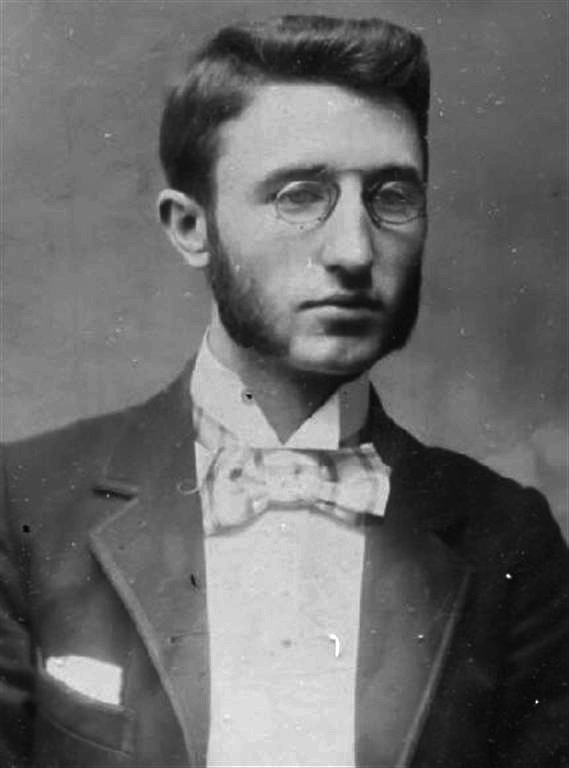
That, is Frank Dorian. 
He was their first studio manager and paymaster, who was a record technician and blunt leader, in the Columbia tradition. He was part of a clan of three brothers who ran different aspects of early Columbia, though he was the Dorian with the highest position for the longest time. His term as manager was a turbulent time, as he was studio manager during their painful transition year of 1896 and very early 1897. He left his position right in the middle of their big transition, as in March 1897, he was officially given the job as the manager of Columbia's new Paris office. With him gone from 27th and Broadway, a new face was elected as studio manager... ... 
One of the Emerson brothers, in this case, Victor Hugo. 

Just like the previous studio manager, Victor was part of a clan of brothers who were involved in different aspects of Columbia. This time, there were four of them: Ralph, Clyde, Victor, and George. Clyde, Victor and George were the ones who took Columbia by storm in the early 1890's with their technical genius. Victor particularly shone as a bright young man to Columbia clan leader Russell Hunting. From there, Vic Emerson rose up the ladder of management at Columbia, until 1897, when he was made their studio manager succeeding Frank Dorian. He quickly became someone that the studio stars did not like. As to those who had worked with him before knew that he was really only good for being a studio engineer and fix-it man. He and Georgie Emerson(as they called his younger brother) took turns being the engineer in the studio and just being present to manage daily recording activity. Emerson was not preferred by the Columbia staff, even if he was praised so highly often in The Phonoscope, they still did not enjoy how he ran that studio. His demanding and illogical commands were impossible for some of the studio workers to fulfill. The way he ran the studio made the artists kick him out of the clan in the first place, as it was doing injustice to many of the staff members. He was the manager of Columbia in the unstable times of the George W. Johnson trial, and was the man who began that immense pit of money for the innocence of Johnson, which did work with all of the great legal people Columbia had at the time. He also witnessed all of Hylands Spencer and Yeager, thought he only watched from a high perch, not really being able to fully understand under-the-table deals going on with Spencer and Hylands. He knew of that venture just as a publishing firm begun by their everyday Rag-Time studio pianist, nothing more.  After the fall of the firm, he had the Climax/Zon-O-phone/Victor affair of the next year to deal with, which almost got everyone at Columbia thrown out of the record business...again. It was amazing that after this feud, Emerson got through all-right, and still remained to manage some recording sessions, still being hated by many of the regulars at Columbia. Around 1905, he disappeared from much of Columbia's activity, even though he was still somewhere close to them, as there were some artists after 1902 who recalled him being in the studio on occasion, throwing around his demanding comments. After that, the classic dynasties of Columbia management ended. As has been explained before, Columbia's management was the reason that they had such an "anything goes" atmosphere in their studio for so many years. Edward Easton was the first of their management to promote this democratic atmosphere, and since he ran the entire thing, this mindset spread to all aspects of Columbia. The volunteering was encouraged, and surprisingly, free enterprise of the studio talent was as well, which is why we see all of these small record businesses begun by the studio stars. None of that was so at Edison. 


I would love to do a section on their ledgers... ... but we know why that won't happen. 


Hope you enjoyed this! 

Sunday, November 15, 2015

Character Studies-- Steve Porter(1864-1936)

"You're all invited! Whether Senorita Chiquita wins or loses!" 
that was Porter's attitude toward his yacht races of the late-1890's.

Porter was always a wealthy man, for reasons unknown. He had expensive habits, and was a friend of the frivolous and financially irresponsible Fred Hylands. This profitable and risky business didn't help that fact. Porter was a very innovative and creative man in the early recording business, as he was one of those non-Edison film-makers who tried to blend sound and film together as one. He made many new gadgets for the recording business, and much later after his recording career, he had the first commercial hearing aid patented.


Porter was the best risk-taker Columbia ever had. He would try things that literally had three quarters of possibility that they would fail, but he had the means and money to take these terrible gambles. Other than Len Spencer, Porter helped along Fred Hylands in his publishing firms, and in general as well, as Hylands was oftentimes in need of extra dough. Porter had first gotten into the recording business from knowing Russ Hunting. Like all the other friends of Liberal Hunting, Porter found Hunting's "smut" cylinders a terrible idea, and was bound to bust. After Hunting got out of prison, he and Porter reunited, and began an experimental film business. This quickly failed, and a month or so later, Hunting began the magazine The Phonoscope. This was where Porter began to actually make records. In early 1897, Porter became one of the Columbia crowd, though he was more conservative than some of his fellows. He wasn't a "Rag Time'' singer, nor was he a true Irish Tenor, he was similar in many ways to the already popular S. H. Dudley. Porter was a singer of all the sacred songs, quartette material, and popular songs. He wasn't something too special when he sang solo, but when he was in a quartette, he was a perfect blending voice. How Porter decided to work with Fred Hylands is lost, but it must be the nature of Hylands being risky with his money, and that Porter wanted to help out Fred who was always short of cash. Porter had gotten into Yacht races in 1897 and 1898, which was a big thing for the Columbia staff, as when a race came up, everyone on the talent staff would be out of work that day for the race. It was a big thing for Porter, even if his boat wasn't in the best of luck. Everyone would throw in some money for bets, some more than others, and they would either lose or win, just like the horse races the Spencer's went off and played at(also Porter not surprisingly...). His schooner was The Chiquita, and she was a pretty successful boat, winning several big tournaments in 1898 and 1899, which made Porter even richer by 1899, which is probably where Hylands took an interest to Porter. In march of 1899, Porter finally joined Hylands and Roger Harding in his "Knickerbocker Publishing" firm, which didn't last too long under that name. This later became "Hylands, Spencer and Yeager", in which Porter was still involved greatly, under the lording leadership of Fred Hylands. Porter was out of this firm a little bit before it collapsed, and before all of Fred's stock was sold in 1902, it left Fred almost broke for a little while, but Porter was going on to better things that pitying Fred Hylands' sorrow. Porter was off to Europe, where he must have run into his old friend Russ Hunting. Porter was  a recording manager for Nicole records in 1902 to 1906, which was a London based record company. In this time away from western shores, Porter went all over India, and Burma as well, running record affairs in those companies. He returned to his old friends refreshed, and ready to record quick. He began making records with Len Spencer right away, as he was still going strong in the recording business. He saw who was still recording and who wasn't, pitied those who weren't, but was right back to making records. This was the time that began making those really popular and numerous "Flannigan" records, much to the likeness of his friend Russ Hunting's "Casey" records of the 1890's. He was not working nearly as much with Spencer after he and Ada Jones began to collaborate again(notice I said again...). Porter was making popular Irish sketch records before 1910, and after he met up with Byron Harlan again, they started making records like mad. Porter was a kind and amiable man, short, dark blond, always well-dressed, this way after learning of the true sins of the music business from working with Len Spencer and Fred Hylands. He really truly enjoyed working in the studios, and always had a passion for making records, and creating new things. His patents of the late-1890's can truly show for it. He still invented, and made records into the 20's, when most of his old friends had either died, or were almost dead. It's surprising really, that the yacht racing sacred song singer of the 1890's made the first commercially sold hearing aid, in 1926. His sales were broken by the crash of 1929, and he lived terribly for the next few years after that, dying in the same year and under the same despair that Byron Harlan did.


 I hope you enjoyed this! 

Tuesday, November 10, 2015

Character Studies--Roger Harding(c.1858-1901)

 "I don't know Freddy, I'll join ya." is what Roger Harding must have said hesitantly when he became a part of Fred Hylands' first failed publishing firm.

Roger Harding was a funny little man, and must have been a real riot, since he ran with Fred Hylands' gang of publishers in 1899 and 1900. This group included(other than Hylands and his wife Marie), Len Spencer, Burt Green, Roger Harding, Steve Porter, Rollin Wooster, Barney Fagan, George Gaskin, and a few more of Fred's composer friends.  Harding was right in the mix of these wild young souls, but he must have wanted to be, since it was a real commitment to do this. Harding was one of the older members of the young staff at Columbia, being the same age as Billy Golden, it was not as easy to keep up with all the wild means of the young staff members, who were out partying and drinking almost every night. Harding was born in 1857 or 1858, out in Ireland, and where in that country has not ever been specified. As I have said before on this blog, Harding probably moved to the United States when he was very young, younger than George Gaskin when he came out here, which was between age 14 and 17. Harding's Gaelic dialect had completely faded by 1896, unlike Gaskin's. 

Harding was a peculiar little man. At just about five feet tall, he could sometimes be missed in the enormous crowds of the exhibitions, but surely you'd find him from his glasses, and dark eyes full of expression. He was always thinking of humor no matter where he was in the studio rooms of Columbia and Edison as well. He liked the Edison people, but made his best good with the Columbia crowd. For some reason, in 1896, Len Spencer took a liking to Harding, and wanted him to be featured on his "Imperial Minstrels" series. Once Spencer got him, Harding was part of the gang of recording fiends that Spencer was building up in 1896 and 1897. Unaware fully of the community he was getting into, Harding became a regular in the studios, and also in creating new small companies and writing music. Harding had a knack for writing music, as he oftentimes sat at the piano at home after the recording days and played to his singing for hours, playing old songs, and creating new ones. This interest got him curious about the music publishing business. He had to find someone in this crew of eccentrics who was also on this slight tangent. It took him a while of asking around from Vess Ossman to Cal Stewart, but it came to Fred Hylands. Harding and Hylands were also a duo for the ages, much like Hylands and Burt Green(or Len Spencer even), they went out to drink together, but also were addicted to the adrenaline rush of the risks involved in the music publishing business. It was a risky business, and this is why Harding must have been hesitant when he joined Fred Hylands in his firm of February of 1899. Harding, being the voice of full reason and focus in this firm, found Hylands' selfish and overly-ambitious means the reason that this firm only lasted two months. He was wild running that firm. Harding was desperately trying to keep Hylands tamed, and when the Hylands, Spencer and Yeager firm came along, Harding had to still tame the boys whose names are in the logo. Harding was basically the fourth name in this firm, after the three names came Harding, as he was in the most often to do the paperwork, manage exhibitions at his own phonograph parlour, and make records for the companies. He was a busy man in 1899, and Hylands didn't take this into consideration when Harding was all over the place, and was getting ill so often. Harding was often getting all sorts of maladies, varying from the winter grippe, to something as serious as influenza. He was often out for weeks at a time when he became ill, which was something that enraged Hylands, and got all the rest of the firm fired up. Harding wasn't a well built character, clearly he was plagued with those impulses to stay away from anything dirty, which can become a habit full of terrible consequences. Harding hadn't much hope, as by 1900, he was weary from the illnesses, and the friendship with Hylands and Spencer, which would certainly wear out any normal person if they had to deal with them for two years. Harding still wrote some music, and without Hylands, he got it all published by the bigger firms that Hylands hated with all his heart. He also turned out some great records in 1901, including a fun batch of Victor records. Harding was still that funny and loud little man with a great sense of humor, and a great mimic still. His skills of mimicry had improved greatly since he entered in that community of eccentricities in 1896. He got another one of those maladies in later 1901, just months after he made those Victors, but he never returned. All the staff at Columbia were in tears, and mourned him almost just as much as the many who came to Frank Banta's funeral in 1903. 

Here are some of Harding's records:
 His great and hilarious sketch "A Coon in Love" from 1901 on a Victor.

His sketch and song with Fred Hylands, "Ive Been Down in Old Kentucky", also on a Victor from 1901.

And here's his big solo here on one of Spencer's Imperial Minstrels records, it has him singing "Upon the Golden Shore" and also being the minstrel of focus. 

Harding could have been a wonderful executive of any of the big record companies, which I have a feeling he would have become if he'd have lived longer. Those wild men Hylands and Spencer were too much for him. 


I hope you enjoyed this! Sorry it's been quite a few days, I've had many projects tap this week.