Showing posts with label "The Narcissus Gavotte". Show all posts

Saturday, September 30, 2017

Records for Sale with commentary and troubles for the "whistling coon"

Looking at record auction lists can get us down...but at least by doing this we know what's out there. Recently(this past week) I looked through Kurt Nauck's auction list for this month. I was told that there was some unbelievable stuff for sale, and didn't believe that comment until seeing the listing! 
What a group of brown wax for sale!
That was really the most surprising thing I had seen, on page 119 of the list where the brown waxes are for sale. 
You can see the list here:
I just couldn't believe the amazing selection of records under the brown wax category. Starting with Hunting's original "Bureau" sketch? Come on. We all want to hear that one. But 500 dollars for a single record? No. of course not. 
I love these records more than many collectors probably ever have, and personally don't think that 500 dollars is worth two plays of a historic cylinder. If you're a reasonable collector of brown wax, the least you would do once owning such a cylinder is play it once to get a decent transfer, and never play it again until you have someone special over or are doing a demonstration. Is that in the end worth 500 dollars? Maybe. I've bought a dress in perfect condition from the same time period as that Hunting cylinder for less than that. 

Is two plays of Edward Favor singing "Sweet Rosie O'Grady" worth 250 dollars? Who knows. But generally I will say not. 
Okay, the one David Bangs Columbia is practically priceless, due to the odds against its existence. Generally records with unlikely survival stories do well in terms of collecting a ridiculous pile of money. 
I've been lucky to hear even a single record by Bangs, and he is not a lost cause in terms of continuing to search for records. He made enough recordings of curious selections to keep us looking(also, he was really good-looking!). Enough Shakespeare and coon songs to keep us sustained! 
Indeed, Bangs bantering on "A stump speech on Love" would certainly seem priceless to us poor but passionate collectors, but of course, those who have money will always win in the end, with that 1000 or whatever more money they have to spare just for a single recording with unlikely odds for survival. 

Let me elaborate on why this certain Bangs record really is a miracle for survival. One, it was recorded in 1894. That's a year that was deep in a recession, so generally records from 1894 and 1895 are hard to come by(even though there seem to be a lot of them transferred on the internet...). Two, this record is by David Bangs, a name we never normally see, like EVER. I only know of him because I saw his picture in a Berliner catalog, and saw what he recorded for them between 1894 and 1896. Oh, and he recorded for a short period of time as well, that usually lowers the odds of survival an awful lot. That's just two years of the entire brown wax era, and that era lasted from 1887 to 1901. Three, this is a Columbia record, and Columbia's from this period of 1894 to 1896 are sketchy and very few. Columbia almost went under in that recession period, and had death scares from every year 1889 onward to 1897. The fact that the record contains an attractive number paired with the record company, and the artist, and the year, makes this record an extraordinary example of the brown wax era. Okay, 1000 dollars is a lot, but actually, when considering the odds against it, and how attractive the artist and selection just happen to be. It's a powerful combo that will end up costing someone over 1000 dollars. go for it, whoever you are, with your plenty extra throw away money for a single cylinder...

Record pricing really gets to me, if you haven't already noticed. I have a hatred toward Ebay at the moment because of all the ridiculous bidding wars that have happened recently over sheet music. Of course, only one thing interested me more than anything could...Hylands' "You don't stop the world from going round" was for sale. But not only that! It wasn't just any edition of that coveted sheet, it was the one with his face on the cover!
Yes indeed. I was hoping it was some obscure picture of him that we'd never seen, but it was this one:
So it was at a reasonable 50 dollars for a few days, I checked it a few times a day(0f course). Remember that this is the fabled sheet, the one that was advertised in The Phonoscope with great pride and attention. This was the dream sheet, the only one(0ther than a certain "narcissus" by a certain composer) I would have paid no matter how much it went for. So I kept checking it, until the last night for bidding came. I even teamed up with one of my friends and made a deal where I would have gotten the music from him. So came the war, it soon rose over my first limit, over 100, then it went to 150, then to 175, then to 200, then back down to the winning bid of 189. Never had I felt such a loss in terms of sheet music. come to find out later, the hours after the fact, all the people I thought watched it saw it when it happened, and it was much to the likeness of a sporting event. We were all cheering and howling at the price changes as they were sent in. It was really quite a scene, and the frustration that cam about afterward perplexed us all. 
The week before that night, I convinced many potential bidders off of the music, since they knew I'd be all over it. After all, it was the "dream sheet", and I would have been complete had I gotten it. 

nope. Some rich collector had the money to burn to spend the absurd amount of 189 dollars on a single piece of sheet music. This person probably won't go out and do lectures on Fred Hylands or Len Spencer using this piece as an example of their curious Rag-Time work together. 


Whoever you are who got it, please disclose your identity to all of us  in the Rag-Time community.

So that's why I have given up on Ebay for records and sheet music. All of you rich collectors are too much. I just can't handle all these bidding wars over such dream items like Spencer brown waxes and coon song sheet music. 
yes, I still check Ebay every once in a while just to see what's out there, but usually there's not anything as good as that Hylands music. 


Now to move on...
The past two weeks or so, I went digging through the archives of newspapers on this website:
http://fultonhistory.com/Fulton.html
I dug through specifically the papers kept on the murder trial of George W. Johnson, which indeed I have dug through in great detail before, but I came across two particularly interesting articles that I had not previously seen before. One provided a very detailed description of a bout I had not heard of previously. Of course, as expected, while digging through these various papers, Johnson's common-law wife's name was spelled a variety of at least 5 different ways. I have always seen it as Roskin, but I saw Roxana, and Ruskin, and it seems we're at a point of uncertainty. The most reliable and detailed article called her Roskins, but let's not get into a fight over what her name was an how it was spelled, lets just stick with Roskin Stuart. 
It seems a few months before Creole Roskin met her end in later 1899, she and Johnson had an awful fight, and not just one of those usual quarrels that they had in their flat(according to testimonies of the neighbors). This seemed to have turned out much like one of those very "coon songs" we hear from Len Spencer or Quinn, which is always ironic to read these realistic stories. 
So, the "whistling coon"(Johnson) was minding his own business whistling on the front steps of their building, this was on the night of March 23,1899, he was just about to go inside...
but of course, there comes Roxana(as she's called in this one) with a black gentleman friend. He continued to whistle various tunes,(including "a new Coon In town"!), and she got very frustrated with him quoting various tunes, the last being "after the ball"(hahaha!). The article then goes on to say something very interesting to us who know somewhat about the relationship between these two:
"In fact, Johnson's general attitude was a riddle to her[Roskin]. She would rather he would speak instead of whistling with his head on one side like a pert sparrow, and she said as much emphatically."
That's a curious statement, something that we wouldn't often hear from the background of these two. It's certainly something I hadn't heard before. It is important when building our point of view of this whole murder trial to understand the relationship between these two in the months before she died. 
To move on in the story...
Finally Johnson gets to "the Mockingbird", and Roxana's man friend just isn't having it at this point. The other guy soon neared Johnson with clenched fists, making Johnson back off slightly. At his speechless whistle-talk, Roxana at last had enough and had burst into tears with frustration at him, and the man friend had run off at this point. All the speech quoted in this article is fully in dialect, so I won't quote it directly for the sake of readers...She says amid her emotional panic that she's only with him because he's " lined wif' five-dollar bills." Just after her hate speech to him, Johnson whistled up(hilariously...)
"You can go when you gets your trunks pack'd-
I don't Care it you never comes back!"
She had had enough, and with that, she pulled out a little revolver and shot at Johnson a few times. One of the shots hit Johnson in the calf, but luckily when the police arrived, an ambulance surgeon was able to tie up the wound for Johnson, and the policemen were able to get Roskin to the police station. All of that passed over quick, and everyone seemed to be back to normal after all of that craziness. 
But of course, as we know, that was only the beginning of their troubles. 

Another article from just after Roskin was killed(dated October 1899)provided very much needed background into the two of them that's also very detailed and brought up some curious theories. This article detailed the background to Roskin and what led to her immediate downfall. The article states that just two weeks before she died, she met her end with going out and singing at clubs.

WAIT what? Singing? at clubs? This article details how Roskin was a singer at Tenderloin clubs and underground black gathering places. She was said to have been called "The blackbird", which is curious, because around this time we can see a certain piece of music with a similar title...
hmm mm...what's this? 
Could that be a reference to Johnson's Roskin?
I mean, just like any theory of mine, there's always the possibility that it could be true. Of course, there's almost nothing to prove such a thing, but Hylands did indeed work with Johnson, rather often I might add. It must be noted that in 1899 was when Hylands was there at Columbia pretty much every day, since he lived at the address that is indicated on the sheet music above, and that is a block away from 1157 Broadway(notice how I used the present tense here...)
So of course with all of that, there's the possibility that this piece above was titled in honor of Johnson' common-law wife, though we can't know for sure, it's just interesting to point that out. 

Evermore we are reminded that Hylands was like a hawk watching everything go on at Columbia from his high perch at 33 W. 27th street, and occasionally getting into the mess going on below and almost getting in trouble or killed with each swoop down. He may have been part of it, but he seems to have been on the edge of the mush pit his entire time at Columbia. 

With all that, "the Blackbird" two weeks after getting at last thrown out of the final saloon, she was found dead by Johnson(0r whatever happened...). The article then goes along to tell the story of what happened the night(or morning) that she died, the same old story that we know. 
Johnson was minding his own business at the flat, and she came in an awful racket, and seeing that she was in trouble, Johnson went to a policeman near his flat and called him down to investigate. After Johnson told him what was wrong and how he came to find her in such a condition, Johnson was arrested. All the rest is history. 
Okay, you all know my opinions and theories about this touchy subject matter, but you know, I'm serious about this subject matter. This whole murder trial is one of the most complicated legal battles of the brown wax era, it's certainly more interesting than all the pointless patent battles that every company went through before 1903. Columbia didn't see this coming at all, and must have sent everyone in a scramble when it happened. Everyone must have been in panic, even though they might have been wary of Johnson before she died, since he was a guy with a troubled life, unfortunately scattered with awful women who didn't like him, but stayed with him because of his money. once we start digging into the names associated with the lawyers who went to the actual courtroom on trial day, that's when it gets complicated and deeper. I still think it's really strange how Hylands' legal associate Rollin Wooster(or whatever he was for Hylands...) was thrown in to learn everything about the trial and stayed completely silent on trial day. His comments after the trial will remain infamous to us. Let me remind you all of Wooster's comment right after the madness ensued in the courtroom at Johnson's acquittal:

Johnson is what you would call a good coon, he is too good-natured to have ever killed that woman. We're going to take him to a hotel tonight or to Mr. Emerson's  home and give him a good dinner, sitting down at the same table with him. I am glad I was the first to shake hands with him after he was discharged. He can earn 35 to 100 dollars a week singing and whistling.
This was taken from Lost Sounds by Tim Brooks.

Oh Wooster. That comment resonates with me well. I can almost see Hylands patting him on the back just after he shook hands with Johnson, as he said he did. What a relief it must have been for all of them. And as expected, the most uncomfortable one of the crew was most certainly Spencer. Spencer always gives me mixed messages with Johnson, since he clearly was nice to him and respectful, but thinking of how internalized racism was, and how passive aggressive it probably was with Spencer(in considering his privileged upbringing), his feelings about the ethics surrounding the trial must have been out of control. The prejudice was probably passive aggressive with all of them, since they all praised Johnson so highly just as soon as the trouble came around, and after that we don't hear much. The only thing we really hear is Spencer being yet again passive aggressive with Johnson while also housing him, soon forgetting about him, then a few years later finding him dead and the white guilt smacked him right in the face, harder than he could have ever expected by just going up to clean a forgotten room in his Lyceum. 

Again folks, this is why the trial is so complicated, and why it really was a landmark event for Columbia,since it was one of very few legal battles that didn't have to do with patents. Eventually I will have the time to do a super long report on this matter, with my unusual and rare point of view on it. 


Hope you enjoyed this! 


Wednesday, January 25, 2017

Revised: Character Studies--Fred Hylands(1872-1913)

After learning a whole lot more about Hylands, it seems fit to essentially re-post the Character Studies post on him. Just like anything I post on Hylands, it's often to aid the kind descendants of him, and to make sure that all collectors are aware of his presence on early Columbia records. 

The amount of information that has been collected on Hylands since this time last year has been phenomenal, and it all makes his life not only more interesting, but a whole lot more complicated. Just a few small facts and observations made by Charlie Judkins and I changed much of what we thought of Hylands, and came as a surprise. If I ever get the chance to give my seminar on Hylands once more(which I hope to!), it will be even more complete than when I gave it for the first time last November! Yes, there are still gaps that perhaps we will never fill, but those gaps at least have been filled to some extent in the last few months. Well, we've still got a long way to tread with the whole Hylands thing, but that is exactly why it remains ever interesting to search.
 There's not a way I could have expected that that unknown, obscure name "Frederic Hylands" written in the pages of The Phonoscope would become such a monumental and long-term project. But no matter, it's still a joy to dig, and eventually I'll find that unmarked grave in New York and at last get it marked if needed. 


Hylands in 1897,


and in 1898.

Here we go...

Hylands was a beaming star amid Columbia's night sky of glowing white stars, with a personality and figure that always consumed a room he entered. Sometimes this was intentional, other times not, but more often than not it was wanted by him. This desire, or demand, for attention is rooted in his past, like most things are with people. Being the older child, and a boy, it seemed inevitable for him to be treated better of the two children, the other being his sister Etta. He was born at about the last week of February(remember that we're not really certain of this just yet), and that would make him older than most of the early Rag-Time pianists, including Ben Harney oddly enough. It didn't take long for his parents, Charles and Mary, to take to the talent and genius of their son, as well as to realize that Fred was not going to be a respectable locomotive engineer like his father. By age 7, Fred was beginning to show interest in playing the fiddle, and with that curiosity took a liking to the banjo on the sly, since that wasn't exactly the most classical of instruments for earning a living. After messing with the fiddle, and becoming rather proficient with it, he began at the piano, playing whatever it was he played early on. Soon he was traveling all around Indiana and Ohio as a child prodigy, hence his sense of importance and need for attention later on. By 1886 and 1887, he was a local celebrity around Fort Wayne, being mentioned in the papers pretty much almost every week, with some new antics and gossip. In 1887 was not only when his father opened a grocery/saloon, but it was also when he went to the local business college(at 15 mind you!). He got into all sorts of trouble in and around Fort Wayne, from cable car bouts to driving a wagon and almost getting killed by a suddenly terrified horse(much like the whole Spencer cable car incident). All of this built his character, and providing entertainment at his father's saloon did so as well. He continued this interesting and well-known life until 1893 when the family moved out to Chicago, in overwhelming interest in the World's Fair. Unfortunately, Mary Whitney Hylands died not long after the move, leaving Charles with Fred and Etta. Etta married off the month after her mother died, with Fred and Charles the only ones at home then. Fred as working out a local outposts for Keith's and Pastor's theaters, playing accompaniments, and managing shows there, but also playing at less-then respectable places that Chicago was infamously ridden with. Places where syphilis and violence ruled the essence. This is where the final touches were set on his playing style, as by this time he had fully settled with playing the piano. His style was finalized when out in Chicago, as all of these other famous "rag" pianists were playing at the same clubs and venues as he, and without a doubt he took from them, despite already possessing a style that was the zenith of Rag-Time's early days(like Ben Harney's). In September 1895, he conveniently married British singer/actress Maria Stevens, possibly due to pressure set on them by both of their parents. Not long afterward, Charles, Fred and Marie moved out to Milwaukee for a short period, most likely because Fred had been asked to work for one of the theater chains at which he was employed to manage. By mid-1896, Fred and crew were finally out in New York. Fred immediately resumed working at the theaters he was already empolyed, only this time it was where the original managers and theaters were, not the chains. Fred earned a reputation in New York, though at first he was seen as a hapless Indiana rube of a sort(not entirely...) to the society Rag pianists such as Max Hoffmann and Burt Green. He was no rube, in fact his smarts were far higher than most thought at the beginning, but this didn't always prove him well. By very early 1897(or late-1896...), he caught wind of the advertisements of recruitment the newly local Columbia Phonograph Company, and that they were holding auditions and tests. Not long afterward, he went off to 27th and Broadway to await his turn before Easton, Emerson, and Issler. Soon he was declared an employee of Columbia, on staff, almost full time. This came about around March-April 1897, according to auditory study of Columbia recordings made around this time. Soon Hylands began to realize why Issler had become bitter about working in Columbia's studio, or any studio for that matter, though at least in the beginning of Fred's term there, and the end of Issler's, the two of them got along rather well, but this did not last into the next year. Of course, with this new job, Fred had no idea how this was going to impact him, assuming it wasn't a horrible occupation to be a studio musician. How he was wrong. In mid-1897 or so, Hylands seemed like anyone else who worked at Columbia, young, sweet-faced, well-rested, and fit. As can be observed from the images of him at the top of this post, none of these things remained as such. He was still relatively good-looking into 1898, though the temptation of the benefits he received from working at Columbia for got to him faster than anyone could have expected. He came in to Columbia in early-ish 1897 at just over 200(keep in mind that he was freakishly tall), and by the middle of the next year, was at over 300. That was unexpected. Also, he seemed to have aged ever so slightly in that timeframe, seeming like heaps alcohol and drugs carved lines and exacerbated his quick gaining of weight. Like many of us would think to-day, that couldn't have been good for him, gaining that much weight in a relatively short period of time. Well, it's likely that in the early half of his time at Columbia(which incidentally was the last quarter of the brown wax era), is where the diabetes he had began to slowly suffocate him, little by little each coming year. It was because of this unexpected spell of suffering and stress that we get quotes from him like this one: 

That was still not too long after he began working for them, a little over a year perhaps. Of course, by the middle of 1898, his rag-time piano accompaniments were becoming a signature for Columbia's records, as they were openly advertised and described in editions of The Phonoscope and they soon became an indicator for what Columbia's records sounded like. His accompaniments in Rag-time behind those singers were superior, perhaps outdoing Edison's own Frank Banta and Fred Hager  by a mile or more. Not always, but the musical ideas and folk background of his made the style more distinct, and interesting to listeners of the era and of to-day. Since Fred was had become so popular at Columbia, he used this to his advantage in selling his music, since anything he wrote while there was certain to get him some decent mileage. it was just at the height of the infamous exhibition season that he wrote his famous "national success"(not really) "The Darkey Volunteer", for Vess Ossman, and when he sent out advertisements highly praising his piece from his first few months at Columbia "The Narcissus Gavotte". This got far, with a handful of takes of "The Darkey Volunteer", and many encores of his fantastic playing at the wearisome, hot and sticky exhibitions, it seemed all-right for him. It must be noted that on the the 1898 cylinder of this by Ossman and Hylands, that it seems the composer didn't even bother to practice his most prized piece, or just bother to play it to the best of his ability(there are many mistakes scattered all around throughout the piece, not on Ossman's part). That just goes to show how Hylands felt sometimes, even in the presence of tightly strung and intense natured Ossman, who probably tediously practiced the piece till he couldn't anymore.  Hylands could clearly be frustrating sometimes, and this is just one example of perhaps many aggravating little things he pulled with other recording stars. 
1899 turned out to be an even more pivotal year for Hylands, and this was because of his forceful will in beginning an official publishing firm with Roger Harding and Steve Porter. He threw the idea at them as well as setting aside some stocks for the firm, all before the firm could ever get anywhere, only publishing one piece successfully in February. After Fred's angry break down from the "Knickerbockers" firm blowing to bits, he stepped right in again to begin another publishing firm, this time with his good studio friend Len Spencer and his booking agent.
This time it seemed Fred had the Columbia Lady's hair in his grasp, by then owning an amount of authority over Columbia's flow of music in the studio. This allowed him to publish music of the studio stars, to further their fame, and this time just not on recordings, but also in print! It was ingenious, until the notion fell through after a year and a half, since Burt Green couldn't manage his flat during the days, and Len Spencer had pretty much dropped out by then, due to his constant recording activity, and Fred himself had grown heavier and weary of the managing he'd done for everyone. Hylands Spencer and Yeager fell through completely in October 1900, and by the month afterward, he had sold all his stock, further throwing him into deeper melancholy from the failure. He still had Columbia to keep him employed, though it was around the time of ending the firm and the last true year of the brown wax era(1901) that he began to form his somewhat rebellious, Socialist viewpoint that later proved him well for a short while. He continued to work regularly at Columbia, thought reluctantly, and worried he was more susceptible to fights and abuse from the other staff members, due to his fooling with them during the publishing firm, which unfortunately for him included everyone he worked with regularly. To escape this, and return to his roots, he began performing in minor shows on and just off Broadway, as well as performing in straight vaudeville, singing songs and playing that signature piano style he seemed to have been known for. By 1902, he had a fling with Columbia finally, almost getting him thrown out, other than the whole Climax feud doing just the same thing. This time, it was more of his own fault, feeling agitated and abused by Columbia's treatment of him, he had enough, though they didn't, and couldn't fire him right then and there. His protest included going off and working for Columbia enemies, such as Zon-O-Phone and Leeds. The other companies welcomed him with open arms, with no previous notion of how vexing working with him was. Of course, like anything he involved himself in, his association with these other companies didn't last long, and by early 1903, he was back at Columbia, working there until the middle of 1905,when at last he was dropped. After 8 years, he was finally freed from them, and able to do what he wanted. Despite mild successes on Broadway in 1905 and 1906, he still was dissatisfied with the little recognition he received from this, and not being able to lived as comfortably as he wanted. Being one of the founding leaders of the White Rats Actors' Union, he had some protection and leverage to keep him and Marie out of poverty. He slowly drifted away from what he was supposed to be doing as a chief at the White Rats, becoming solely a musician with each coming month, refusing to be seen on the stage(Wish we knew why this is...) and becoming disloyal to the union he helped found and organize. He did continue to perform onstage regularly during his period where the other union members became suspicious of him. By 1910, he was living in a boardinghouse not too far away from where the old Columbia building was still standing tall. He and Marie came in and out of the boardinghouse, going on various tours and trips for the stage, and it seemed that Marie was busier than Fred, not even being present for the 1910 census, and her performances scattered all over stage magazines with Belle Farmer were taking over Fred's spotlight by a mile. In 1912, after being thrown out of the White Rats for good, Fred teamed with Wilbur Held as a duo in vaudeville. Keep in mind that by this time, Fred was slimmed out once more, similar to when he first began working at Columbia, but this time it was because of traveling and sickness, not like before. The touring he did from 1906 to 1909 wore him out, and probably exacerbated the downfall of his health. By 1912, especially early 1913, he was especially not well, perhaps any night of a show could be his last by then. Of course, he didn't think that way, so he refused to let this notion bother him. In the early part of 1913, Fred and Held were signed to tour in England in the summer, which by June, is where they sent off to. Once over there, they got to touring almost right away, with Fred and Wilbur being the headliners of many shows, and Marie being in some of them as well. After about a few weeks of touring, once the troupe had gotten to the northwestern coast of England, Fred dropped dead, of something related to the crippling diabetes he had for years. Oddly enough, Marie and Held continued to perform for a few more weeks after Fred died, since their contract had been extended, to two years it's said, but of course, it could not be fulfilled without Fred. 


After a few more weeks, the troupe finally disbanded and went back to the U. S., to have Fred's funeral. It was held by the White Rats union, despite their bitterness toward him in the end, he was still a founding member, and deserved the respect. It is not certain where in New York he was buried, or if his grave it marked in any way, it's unlikely to be. Marie spent two years in mourning for Fred, in the typical Victorian tradition, but just then and there in 1915 she went back to where she and Fred met in Chicago to marry a Dutchman named Sam Gelder, it is uncertain how long they were married, but it was into the 1920's. 


I don't think I need to exhibit a bunch of recordings Hylands was on because they are scattered all over the posts of this blog, and there's really no way to decide on only three or four with him. This is exactly why he's ever interesting! 

Sorry about not posting for over a week, it's been hard to make the time for a post in the past week. 

Keep your spirits up out there! 

Hope you enjoyed this! 

Saturday, September 24, 2016

The Sporting Club, and the Imperial Minstrels

The first part of the title seen just above it a little mis-leading as far as connotations go, if you know the double meaning to the term as far as 1890's slang goes. The context in this case of the term "sporting club" is more literal, meaning a club for sports enthusiasts. The reason of mentioning this is because of one small newspaper section I found within the past week or so. It was published in The New York Daily Tribune, dated June 21, 1898. This section was not really too significant, but it pointed something out that proves that Hylands was out playing other "gigs" while working at Columbia in his early days there. This gathering was held by the Knickerbocker Athletic Club, which was essentially a clan of sport enthusiasts who held many sport events, like Football and Baseball. It seems that in the summer of 1898, this club began hosting social gatherings that just happened to have entertainment. On Wednesday June 20, 1898, it seemed that the accompanist for the evening was Fred Hylands, plucked by the sportsmen from Columbia's exhibition parlor for that evening. He probably went to make records at Columbia's studio from the morning to the afternoon, only to leave and go off to the Athletic clubhouse. I wonder if things like this were common with Hylands. They must not have been in most of 1898, though after 1901, they seemed more common since he was performing in shows occasionally, and doing other things like that. I still have yet to learn and read more sections that prove this. 

Speaking of Hylands, there hasn't been any luck yet in the search for his "Narcissus Gavotte", though I will continue to look extensively for it. It is certain that the LOC owns a copy of the piece somewhere in its vast collection of sheet music. All we have still is that tantalizing first page from the back of Hylands' "The Darkey Volunteer":
It seems like Hylands is playing tricks on us by making the piece very hard to find! 

In fact, I will do some more digging to-day and tomorrow for the piece, since I've got my mind to it now.  Hope I can find it before giving my seminar on Hylands in November...

Now, onto the Imperial Minstrels. I don't know many collectors who really enjoy the records that were made by the Imperial Minstrels, but I really like them. There's something about them that makes me think they had so much fun making those records. This especially was so when Hylands became Columbia's pianist. If you know of the history of this group, it stems back to 1894 with this chap:
Dandy Len Spencer. 
He began this series of minstrel recordings because he had a new member for his envisioned minstrel troupe. This new member was George W. Johnson,  who was actually a black man! Having an actual black man on his minstrel recordings was a very big deal to the other record companies, and made Edison's staff jealous from the amount of profits and attention these records received. He began this series for the U. S. phonograph company, since that's where he worked at the time.  It has been recently discovered that a handful of these original 1894 recordings are held in a few collections, which means that the theory of those recordings being gone is not true at all. None of them have been transferred for all collectors to hear on the Internet, but hopefully they will be sometime soon, since many of the jokes and songs have been transcribed from these records. 
The second installment of this minstrel troupe involved Steve Porter and Roger Harding, two new Columbia staff members in 1896 and 1897. The pianist on these relatively few 1896 and early 1897 recordings would either be Ed Issler or George Schweinfest(if it was 1896, probably even Fred Gaisberg for that matter...), it's unclear if this one just below is one of these earlier installment records, since both Harding and Porter are on it, but the piano playing isn't very distinct in some way:
http://cylinders.library.ucsb.edu/search.php?queryType=@attr+1=1020&num=1&start=1&query=cylinder9969
It's definitely recorded in 1897 though. 
The terrible sounding piano really gives the date away. 

Remember what Spencer did to that piano. 

This incident in italics above happened in earlier 1897, so that essentially made the piano sound awful for half of, if not more of, that year. When Hylands took over that piano chair in 1898, their records became even more fun to make, since Hylands was the perfect pianist for the minstrel series. He seemed a better fit than any of the other previous pianists, which is pretty strange when thinking that he was a generation younger than Issler, and that Issler would have grown up in the first wave of the Minstrel era(the 1850's and 1860's mind you). Hylands seemed better for the wild and quick bones playing of Len Spencer, even if Issler had used Spencer for the same reason on his orchestra records in the years before that. The great opening overtures by Spencer and Hylands were very fast, and full of their great partnership skills. 
Such as the opening overtures on these records:

http://cylinders.library.ucsb.edu/search.php?queryType=@attr+1=1020&num=1&start=1&query=cylinder13296

https://www.youtube.com/watch?v=ZPNJeybjZxU
(this record is played way too fast, but it's a great one nonetheless, with a fantastic closing song as well!)
These fun records with Hylands on piano only were only done in 1898, as the next year, Spencer decided to have the entire Columbia orchestra get involved. These records are the most common ones as far as the Imperial minstrels go, as they were a spectacular of modern recording technology. 
You can hear four of these in the links below
(listen for Hylands' awful laughter on them, also Spencer's... they're loud and obnoxious)
http://www.tinfoil.com/cm-1312.htm
(note Steve Porter's awful singing at the end on this one...)
http://www.tinfoil.com/cm-0011.htm#c13000

http://www.tinfoil.com/cm-1203.htm

http://www.tinfoil.com/cm-1602.htm
This one is particularly interesting, since the piano in the orchestra(by you know who) is not really playing in sync with the rest of the orchestra. 

These records must have taken to much time and organizing to get done, since there would be twenty or more squeezed into a room to make these records, and all the balancing of everyone must have been awful, and maintaining the balance when they were recording. These records must have taken a few rehearsals to perfect, and thinking of Spencer being that very strange perfectionist, he managed these sessions very well it seemed, save for a few weird things that weren't supposed to be there, such as random yelling, like on this one here:
http://cylinders.library.ucsb.edu/search.php?queryType=@attr+1=1020&num=1&start=1&query=cylinder15483
hear it at 35-36 seconds in
(the title of this one by the way is "Good Bye Dolly Gray")

One of the records by the Imperial Minstrels I would love to share but can't has a fantastic weird thing at the beginning that I think is probably from Hylands. The loud whistling that usually is at the cheering in the beginning, there's a weird descending whistling thing that is about piano distance, and it's something that I haven't heard on all the other ones listed. The piano on the closing overture is also a little out-of-sync as well, so that means Hylands is there. 
In 1898 and 1899, this minstrel group was so popular, that Spencer had them all go out on a tour, which was reported in many newspaper sections, more than expected in fact. It seems that great tour(advertised in The Phonoscope below)
was indeed a huge success by early 1899(which may or may not have been part of the reason why Spencer and Hylands grouped together as publishers...think about that for a moment). It was because of this tour that the records had orchestra accompaniment rather than the previous piano. Many New York newspapers reported performances of this tour, and it seems that every one of them was a success, save for a reports of beastly weather, which every section on it said something about that it seems. The weather must have been really awful if they mentioned it that often! The Newspaper reports seem to last into early 1899, which makes sense, since it was in February that Hylands roped Spencer in to become an associate in his "Knickerbockers" firm, even though he wasn't really one of the three names running the function, as we know, that came the month after. 

By the way, September 20, 1897 was when Hylands' Narcissus Gavotte was copyrighted. I missed the day, but thought it should be noted. 


Hope you enjoyed this! 


Monday, February 29, 2016

Delving into Hylands' personality and etc.

It has been a very joyous weekend for all who attended the first Santa Cruz Rag Time festival, and it was certainly a great success. Thanks go all to Kylan who ran this whole thing, and did an amazing  with herding all of us cats(musicians). It was such a fun but exhausting weekend! 
Now I gave a seminar on Fred Hylands on Saturday, though only six people came, but luckily, those people who came were very interested in the subject and very much enjoyed themselves. I used some sheet music as examples, and some of my cartoons of Fred and Marie as images for the seminar, as no electronic devices were able to be used when doing this. The night before I gave this speech, I went through it in order with my grandparents, and that turned out just finely, but after that, we got to talking in-depth about Fred and Marie. It started out just as a single question from my grandma, but then it stemmed outward into something much more complicated
Since I am still a little bit stumped in trying to figure out Hylands' personality and why many refused to speak of him later, this conversation helped quite a lot more in trying to understand this whole jag. We discussed how wild and obviously unstable Hylands was, and that any kind of alcohol or deadly drugs could have been responsible for not only his spontaneity and varying characteristics. She had told me that she read something recently on George Gershwin, and most of us know about him. Though when she explained what she read in this book, she spoke of how the key to Gershwin's success was a sort of imbalance, and by this she meant some thing like ADD, or something of that type. That made me think about that for a moment, as it was so often said that Hylands had very winning and charming ways when meeting people, however, he was not mentioned by those who worked with him later. Well, scratch that, he was mentioned by these people, but those who caught them in this way of words did not, as keeping with the politeness of Victorian tradition, speak of Hylands wrongfully. From this, it would seem a trifle suspicious that the interviewers refused to speak of him, to say nothing at all about him. What row of words they must have kicked up when speaking of Hylands! Hmm. It's just very strange. She also brought up the fact that Marie might have been the same way, or similar somewhat. By this, I mean whatever it was that those who remembered him said, might have been a similar story for her. Now that would make sense, as only someone like Fred could be with him. Heh, that must have been something that was an ongoing pun with recording staff at Columbia...

Since he was complicated, and tangled up in a mess of music and emotions, we can look to his music for another bundle of clues. Such as these two things here:
Yep, that one. Sorry I mention it so often. 
And also this one here:
Ooh! Thirty-second notes..... oh boy! 

No, I mean that in a sarcastic way, just look at that! It's very complicated for majorly published music in the late-1890's. 
I'm surprised that Will Rossiter was alright with publishing this, as it's tangled up and complicated(like that cat who wrote it) and this is just the first page of it. Who knows what's next... What you see directly above is actually a great example of how complicated Hylands was, and the same thing can be said about his Darkey Volunteer, as it's just the same amount of crazy.
In fact, you can hear Hylands' orchestra arrangement here.(do excuse the abrupt ending of the sound file, the one first listed is the one I mean). 
There's so much going on here. He expected them to read this:
Yep. What a mess of wonder it is. They read it easily, as they were professional musicians in their day, but Hylands was just a few steps ahead of them always. The orchestra members were all standing on their lily pad a few feet away from Hylands who was constantly thinking elsewhere and ahead. He was like that with everyone he worked with, no matter who they were. Heck! If he was working with stars like Ben Harney or Ana Held, he'd still be his vain and eccentric self. 
Now something that I just confirmed this evening is that one of Hylands' pseudonyms in the early teen's was  Fred Whitney. Why? Well, I learned what Fred's mother's maiden name was, and guess what it was...Whitney(Mary was her first name by the way). Just to prove my point fully, on the back of his The Rag-Time Boardinghouse from 1912, there are two tunes listed on the top of the back page. These tunes are "The BootBlack Rag" and "Trifling", the name listed as the composer is Fred Whitney, and I had the feeling that Hylands wrote these pieces, because of their complexity and interesting melodic choices. Now that I know "Fred Whitney" was certainly one of his pseudonyms, that is out of the way in needing evidence. Now the fact that he used his mother's maiden name is pretty interesting actually. That shows a possible deep mourning for his mother who died when he was 21. It must have effected him for as long as he lived, in some way or another. 

I am still rather unsure of Hylands' personality, but one thing is for sure, he was very intricate chap, and was extremely intelligent. He was so quick when talking with people, that he would point out the smallest of things in everyone's words. Similar to when someone says something quick as a sort of sarcastic joke or just to move along a conversation, Hylands would laugh a little, but then call out the statement, asking deeper questions about it, though that was not the speaker's intention at all. It's very annoying to the person who said it, but Hylands was so bright that he could analyze someone fully in a split second. Adding to his wild mind, and intelligence, he was a strategic manipulator, and when he was drunk, he must have been a nightmare to those around him, though his mind must have still been rather sharp, but not as intense or anxious when he was either sober or on cocaine or opium. How he must have been a real character, even from what we have written about him that still exists to-day. 

Yesterday was actually the birthdate of Fred Hylands, and I played plenty of his wonderful renditions of Rag-Time at the second day of the Santa Cruz festival. 


I hope you enjoyed this! 


Thursday, November 5, 2015

Character Studies-- Freddy Hylands(1872-1913)


"I am hired to play and draw my salary for playing, but still this company insists on making me work." said Freddy Hylands as he shook himself over after a day of recording, with a wilted collar unbuttoned.

He was constantly exhausted while working for Columbia, and his rather wide figure didn't seem to help with the amount of work he endured. He hated all the scorching hot days of the warm year of 1898, and he hated the freezing cold winters of 1899 and 1900. The varying weather always made for a cold or hot studio, there was no in-between. He was what held all the records together, and kept the singers up-to-date and on track, always. He wasn't just "that pianist" he was "THE pianist". He believed very highly in his role at Columbia, and his role when the people heard him play with the singers live.  He always played the melodies of all the songs, and added all sorts of other things to call attention to himself for the listener.  Since he was on their staff, he was on salary there, unlike the singers who were paid by the records they made. That was a good thing and a bad thing, as he would get paid at a designated time, but not always when the artists were. 

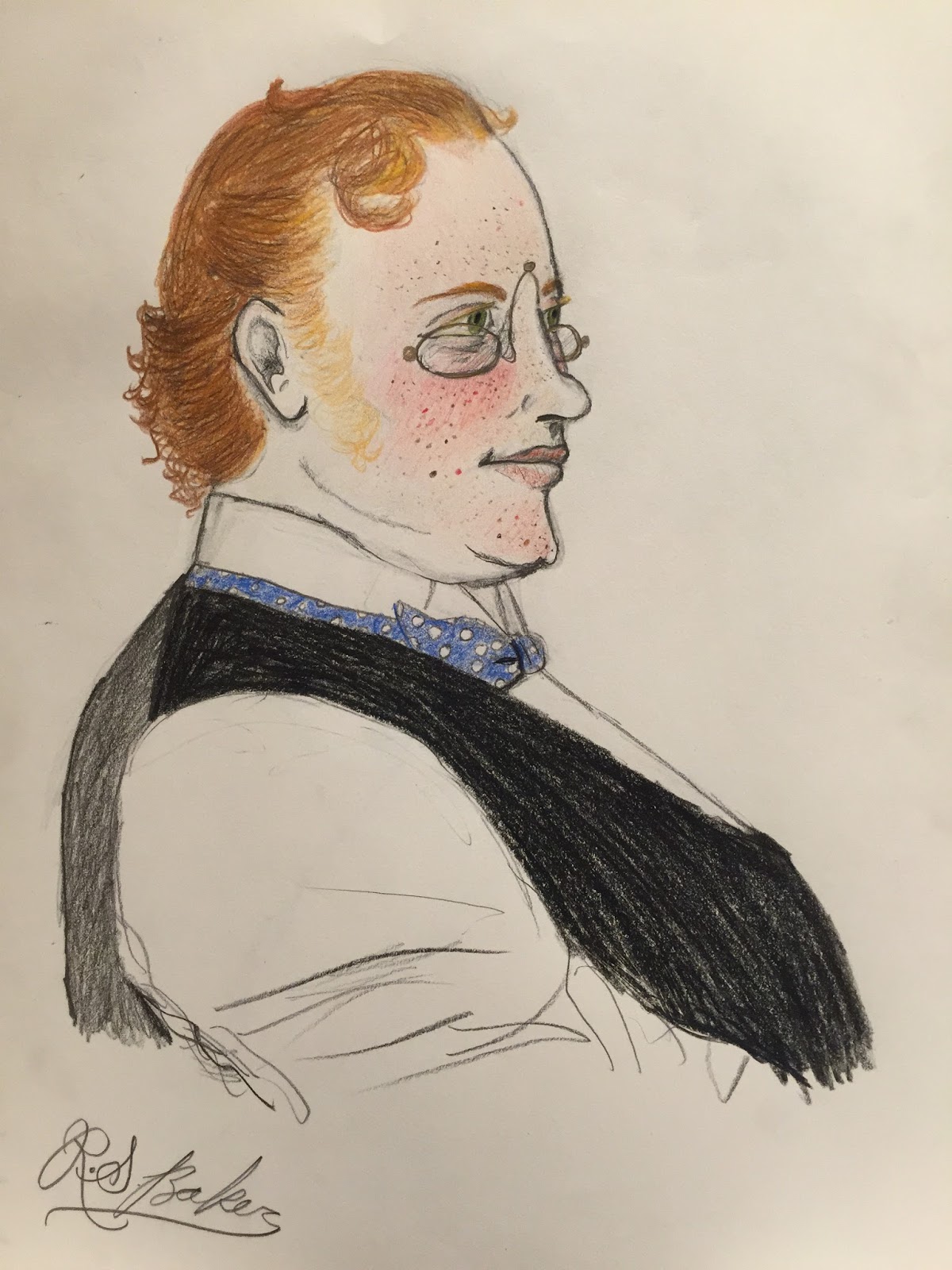
Freddy was a queer and musically superior chap. His ear for music was freakish, and his ability to modulate keys in a second was truly amazing, and very helpful to the picky singers on Columbia's staff. He was vocal about his complaints however, when something was deemed unjust to his liking, he would immediately yell out to someone near about it, though nothing would be done, he still did it anyhow. His voice was not one to be expected when only seeing him and hearing hims at a piano alone. His voice was loud, deep, like a rasp, and haunting. His tone of voice seemed to fit his figure and size, and those few times he spoke betwixt the takes, his voice would boom through the rooms, and resonate on the walls and the fragile glass diaphragms of the graphophones. Not a soul on the staff and recording talent knew how he got so fat, at such the young age they found him, at only 25 when they first dragged him in, he did not look a man of his age. Only his face and hands looked his age. His legs were long and shapely, with long flat feet at the ends. His red hair looked almost of an unnatural hue, and it shook around like mad whenever he played, adding to the comedic affect of watching him play. When he played, his light blue eyes were always focused, he jolted forward at every large and powerful chord, he stomped his right foot whenever they weren't recording, and whenever he got into playing, sweat ran down his face, no matter if it were cold or warm. His hands seemed effortless, as though the amount of notes he was playing was completely normal, and that his talent was nothing special. At the exhibitions Columbia held almost every night of the week, the few people who payed their attention to him were always in awe of what they saw before their eyes. He always knew when the crowds were looking to him, and he smiled contently to acknowledge them and whipped around his hair, acting as the very Narcissus he named his Gavotte after. He was the epitome of the Rag-Time pianist he was, only that he never spoke of the negro greats who created the music itself. His figure and ego filled the room when he came in, even if he came in all broken up and hungover from the evening before, his voice still boomed, and his playing was still the pride of the young staff at Columbia in 1898 and 1899. His personal life was a fascination to many of the artists he accompanied, and the management of the studios as well, he wasn't one as daring and wild as Len Spencer, but when he had his publishing firm in 1899, that was when he really began to live the way that Spencer did. At his firm, he took in some wild and adventurous performers. He brought on many parties and gatherings that were taking a slow but lethal toll on their bodies, as these so-called "gatherings" involved terrible drugs and throat-rotting alcohol, which most of the time was provided by Fred and his wife Marie. All the staff always wondered what Fred's marriage was like, as to many, it was hard to imagine a woman who could go together with him, but the few times she came out to the exhibitions and performances, she enjoyed herself. It was odd to all the staff, she was a gorgeous woman, tall, shapely, and had a sutler face than George Watson's Margaret, and far more attractive. She seemed to resemble Fred ever so slightly, which is something Fred himself probably never thought of. Her voice was wonderful to hear as well, it wasn't like May Irwin's voice, but she had a knack for Rag-Time just as much as her man did. She did all the dancing for Fred, he wasn't one to skip around on the stage, so she did all of that for him, as he would surely complain about having to do any sort of footwork. It would break his ankles sure. Fred was no Ben Harney dancing wise, but his piano playing was certainly worthy of being compared to his, and at times, could be better than Harney's. Fred wasn't too empathetic as a person, even though he would be hearing all the sorrows and cries of the distressed singers every time he came in, he just acted curious and kind to them, which added to his widely acknowledged fun personality. Really all the man did in the studio was drink his booze, shoot up on some drugs here and there, played until he dropped every day, and got his money when payday came around. Who knows what that wife of his cooked for him! It certainly kept him healthy, and it certainly didn't help that he sat at a piano all day, six days a week, for just about 8 years. He often became sick, and became a burden to the recording process when he was sniffling and sneezing in the fall and winter. He would get stomach bugs(durr...of course...), and sometimes things related to the usually unsanitary studio rooms. He was well-built, but was a fragile figure somehow. He was six feet tall, with long legs, long hands and fingers(hands that hit tenths all over the piano with ease), and long feet, usually enclosed with flat shoes. It was more than likely to find him wearing shoes that hadn't heels at all, as shoes with heels surely would have brought pain to his already suffering knees and ankles. He probably rarely walked to the studio, thinking of his stature, he probably took a cab every morning to Columbia, as working there gave him a substantial income, but not enough to suffice him clearly. This is where his first ideas of having his own union are rooted supposedly, this would very much make sense. If only there were types of medicine in that time to keep him to be a stronger figure, as he would not have been ill so often and would have lived more than 40 years. In the years toward the end of his term at Columbia, he had slimmed down a little, but that was only because of him being ill for so many a time before, and also beginning to perform more by 1904, getting out of the sedentary and sometimes confining studio. He was beginning to decline by the time that Messrs. Easton and Emerson said their final and emotional good-bye to him in 19'5. Many of the staff knew somewhere deep in their souls that he hadn't another ten years left, that soon they would be going to his funeral, by how much they worked him, and beat him up. 

I pretty much just exhausted all of my ideas about Fred Hylands. Many of these the things I said above are assumptions and theories I have had about him working at Columbia. But one thing is for sure, he sure had a hell of a time working there, and he sure as hell influenced all the singers he accompanied. Even if many of the singers he played behind were interviewed years later and never spoke of him, they remembered him for sure, whether they wanted to admit it or not. Marie also remembered him well, even decades into her second marriage. 


I hope you enjoyed this! 

Sunday, September 20, 2015

Hylands, his stage partners, and other things

It's been a while since I have been able to use this odd picture. 
I still think it's comical and queer, just as I did when I found it. 
I was looking through one of the many sheet music websites I use as sources for many of these great picture I use on this blog, and I found a small picture of someone that I recognize:
Hmm, I think I know him from another piece of sheet music...
Yep, that's Hylands' last vaudeville partner, as seen in the first picture above with Hylands. This picture is a good 7 years older that the other one, but it's still the same guy, before he got entangled with Hylands. Now, I don't really know anything about him, but I do know that he was three years younger than Hylands and that he came from Kentucky, also that he was a popular singer and minstrel man. That's about it, I don't really know anything else about him. 
He was one of the few who went on that tour in England with Hylands though, so he saw him in his last days. He can be found listed with Hylands here:
Hylands is listed first, as deceased, probably at the explanation of Marie. 
This was the log of the passengers aboard the ship that they came back on from England. 
It was so sudden, Hylands just croaked quick while they were over there. The small troupe that came along with them were planning on staying over in England for two years, but how that was severed short. They were all forced to come back to the US after only three months or so of traveling around, and as I know now, Marie was broken by this. I do think it's interesting that she and the others of the troupe did a few more shows after Fred passed before they came back to America. That was either a little bit hard to configure or it was hard for them to even get through with. 

Enough of Hylands' death(it gets me all blue!), I found a piece of music just after I began this post that Hylands arranged back in 1896. I had only found his "Narcissus  Gavotte" from 1897 his oldest piece, but now that I did a little digging on the LOC website, I found this here:
I wish they had it digitized just as much as you probably do. It really got me frustrated, because who knows what it says on the cover about Hylands! It would certainly have all the usual things on the cover just like any piece of sheet music from 1896, but it could label him something "Rag" related for all I know! It will certainly say he is the arranger, and if we ever get to see the music, it will unlock many things about his pre-1897 piano style. I really want to see it, and if any of you can help me do that, it would be wholly appreciated! 
I do have the feeling that Hylands may have been mentioned on some Chicago sheet music from the mid-1890's, just like Silas Leachman was, and W. H. Krell. Someone like Trebor Tichenor would probably get stuck on this also, as he did particularly know Hylands too well, but he had certainly been aware of him, and his relatively few Rag-Time compositions. 

Since I found a picture of Burt Green, I can finally put him and Hylands together, and picture them together reasonably well, at least better than before. 


These two must have been really something to see together. I can see that Burt Green had some interesting hair, and wasn't very tall. That's quite a contrast to Hylands' 250 pound weight and 6 feet of height. It's similar to the contrast between Ben Harney and Hylands, Harney was about 5 foot eight, and had the perfect build for an athletic dancer, whereas Hylands was almost near a freak compared to Harney. It wasn't this way with Len Spencer though. When Hylands was with Spencer, it seemed as though it was meant to be that way. Having roots in neighboring states, Spencer and Hylands were both hicks at heart and had the same love for music, the kind that had broken time that is. I have yet to know how the two met first, but it may have just been a studio encounter, or something more unexpected. 
However they first decided to be recorded together, their records were great nonetheless, and are among the best examples of recorded Rag-Time prior to 1900, both vocally and musically. Such as this one here from 1899(the music starts at 6:00!).
Proves the point enough. I cannot get over his playing on the one in the link above! It's such a perfect example of Indiana Rag-Time, and vaudeville piano as well. 
This final thing I would like to speak of is a record that I have plucked through on this blog before, but would like to bring back. It is that record where you can hear Hylands singing among the crowd of brass players and sound effects. There are many cylinders from 1898-1903 where you can hear the boys in the band yelling and clapping, but there are few where you can hear them all sing. When they cheer, it's harder to pick out single voices, but when they sing, you can easily pick out more voices. Here is that record from 1898.
Did you hear it? There's this one voice that really sticks out when they all sing at the end, and I have a notion that this voice is probably you know who(Hylands). There are several pieces of evidence I have to back up my theory here:
1. Hylands would be the only one who would be able to sing while he played his instrument, other than Harry Spencer and maybe a few more engineers.

2. Hylands did in fact sing, and since he did, considering his build other obvious feature of him, he would have been a baritone, and that is the range of the one voice that sticks out here
3. The volume at which the one voice is would indicate being about the length away from the horn that the pianist would be, and it slightly indicates the height of the piano chair as well, if your ears are good enough to notice

4. I hear a slight dialect in the voice as well, which would indicate one of only two people in that studio I am certain are present

5. Only Tom Clark would be doing the calls, and playing coronet, so he can't be singing at the end

I have more ideas on this theory, but I don't need to list all of them, as I think I got the point across with these few ideas. I hope you can hear that voice I'm referring to! It's still a fun record nonetheless. This record is similar to this one here, recorded also in 1898. This record is played too fast though, so the cheering and yelling does not sound the same as the last one. This one is much more wild though, by the whole "Commence firing!" thing goes. Hylands hits the piano keys fiercely(probably with his elbow) and everyone else is swinging those wooden things that make a big Click! when you swing them around in a circle, and yelling and etc. Those "descriptive selections" were really fun things to do I bet, which makes them so fun to listen to.


I hope you enjoyed this!