Showing posts with label "Will O' the Wisp". Show all posts

Thursday, June 22, 2017

A Quest

I really do apologise for not writing blog posts frequently...

Using Facebook has consumed much of my time, as it tends to do...
While out on hiatus, I went out to the UC Santa Barbara recorded sound archive, which was an eyeopener! if you know anyone in association with the archive, I would highly recommend going there to dig through cylinders and 78's, and everything else they've got stored there. I really should share a few pictures from the tour! Thanks to knowing people there, I got a full tour of the place, which was endlessly interesting...
It began with a Bell and Tainter machine...
 What a nice picture of that seal!
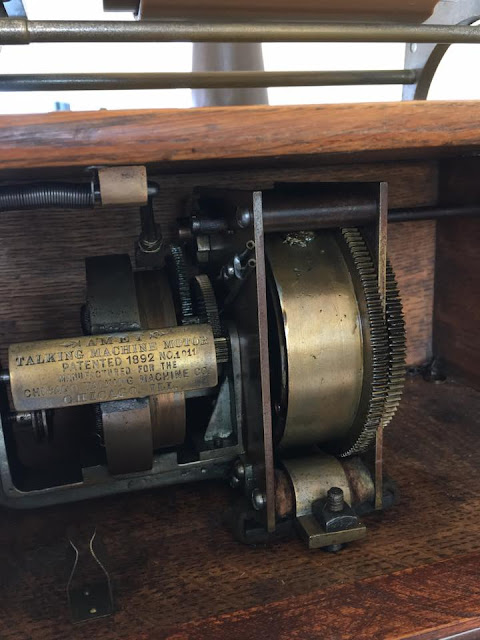
The inside bits, with a date indicating c.1893 as the date on this scarce machine.
What an amazing way to start!
I got to see the Zon-O-Phone project in process as we began our tour, with a guy taking those high quality pictures of the labels that can be seen on the LOC  website, such as the one below!
This guy was taking those fancy pictures of Zon-O-Phone records right before our eyes! He was taking a picture of a few Zon-O-Phone orchestra records as I recall. For those of you wondering about the Zon-O-Phone project, it's going strong, and making progress every day. 
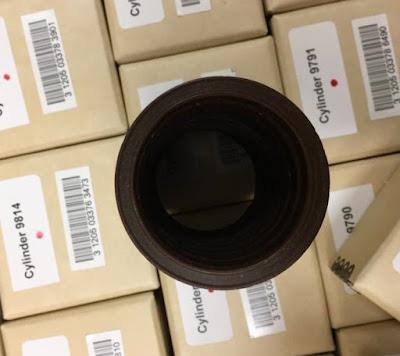
We then were taken to where the good stuff was---the cylinders! 
Oh yes, that's what it looked like. It's heaven for sure.
Where do we start? it was hard to make decisions of what I wanted to see, since pretty much half the records I've listened to for the past 6 years have been from this very place. The kind young man giving us the tour was really into the Pathe cylinders, so he showed us where most of those are kept, and he was also really into the newly transferred Mexican and Cuban cylinders they recently acquired. 
There are some of those Pathe Concert cylinders. Most of them have the original boxes and record slips, which is really nice.
The guy who was supposed to give us the tour was out of town, so one of his skilled young assistants did the tour, that's why there wasn't as much Columbia digging as there usually would be(that would have kept me there all day...). We soon got to some Columbia's! Of course we did. That's the good stuff.
Since i had for years hear Myers sing "The Bell Buoy", I asked to go see it and hold it. 
What a life-changing little thing! I had never seen or held a North American before. It felt less fragile than the usual brown waxes we usually see and hold. It felt sturdy and ready to be played. A feeling that doesn't usually come when holding brown wax. 
That beautiful, but empty channel rim.
Couldn't believe I was holding that in my hands. It's in beautiful shape for its age, but it looks just as great as it sounds.
Absolutely beautiful, especially after holding it. 
The cylinder was also much darker than I thought North American's were. They could easily be mistaken for Columbia records from c.1902, if you didn't notice the channel rim. 
Later I also spotted a few Len Spencer cylinders...(knowing the Columbia block for him helps...)
You can hear this here:
This one looks how it sounds for sure.
I also requested to hold that infamous cylinder "Will O' The Wisp" by Myers, just to see if it's worth getting transferred...
and how it is!

It's in gorgeous condition, and fully worth getting transferred! Hopefully the tale of Hylands playing this piece till he dropped is fully demonstrated with this cylinder. I had assumed it would he the same shade of brown as "Little Yaller Coon" by Spencer, but it's comparable to the North American's shade, which was unexpected. There were also some newly acquired editions of Hobbies written by Jim Walsh, but they were poorly patched together and not in good shape in the first place(they were rather brittle and yellowing). Those were interesting, since I had never seen these famous articles in their entirety, nor had I held any of them in my hands. That was some thing there it was...
That was all nice, with record catalogs we dug through, saw some piano rolls, piles of disc records, record encyclopedias, and miscellaneous stuff related to records stacked in shelves and we saw the boss' office! Mr. Seubert's office was especially nice, with some of the most interesting books about records and recording, and a few machines on shelves and scattered catalogs. 


Enough of that...since it's certain I will be visiting again very soon...


Now for the main reason of this post, referring to the title listed above.
This "mission" is something I've been piecing together for a while now, and it's beginning to take form now. In just over a year from now, I will be trekking to the Eastern U. S. to tour the North East to write a book. This book will be a journal of my travels in historical documentation, which will include tracking down and visiting all of the studio locations, recording artists' homes, publishing firms, theaters, and anything else related of interest. On this quest, I will go all of these places and write a day-to-day journal of thoughts and connections, as well as documentation of where and if things are still in place. 
Among these places that I will visit will include the following:

1155 Broadway(Columbia), 33 W. 27th street, most of E. 14th street(where all the theaters were and where musicians lived), where Frank P. Banta lived, stroll down 28th street(Tin Pan Alley), Columbia's headquarters in Washington DC, Sousa's house in DC, The site of the Berliner studio in DC, the street corner where Gaisberg indicated he discovered George Graham, where the Spencer Business college was in DC, find where John Yorke AtLee lived in DC, find all the famous theaters where the big early Broadway shows premiered, visit the Edison recording studio address in NYC(on 5th avenue), visit the very house that Russell Hunting and Charlie Carson lived and were arrested in(!), find where Vess Ossman lived,  Spencer's Lyceum, visit all the places where Hylands lived in New York, go to where this picture was taken:
(and maybe even get a few rag-time friends to pose similarly here if this place is still there somewhere...)
Of course, I intend to do some of this journey with my good friends on the East coast, like Charlie, who almost every day walks by some of these historic places. I will go inside all of these places(the ones that are left...) and dig around for any remnants of the history that happened there. I'd be especially curious about what might be hidden in the house Russell Hunting was arrested in. That could be very interesting and fruitful all the same, since he had to have hid things in that house somewhere... This also goes for the places where Hylands lived, since he was very unorganized it seems, he may have left some stuff occasionally while moving. The boardinghouse he lived in around 1910 would also be curious, since that was a house full of actors. Finding all of these places where the recording stars lived will be a chore...since I know where only a few of them lived at a certain point while they were recording. Certainly I will visit the fabled Dyker Heights where Spencer and Porter lived so highly around 1899 and 1900. I'll find all the musicians too, Issler, Schweinfest, Tuson, Dana, Hager, Geib(he played tuba for Edison early on), Banta, Chris. Booth, Arthur Pryor, Albert Benzler, Gaisberg, etc. The recording stars homes will remain a priority, because as soon as I get to the east coast, I ought to track down as many addresses as I can and notify them that I will be doing all of this "snooping" around if you will, for historical research. Luckily their addresses(some of them) are scattered around in recording magazines and theatrical papers. After getting the home addresses, I will start with the recording studios, and luckily, this will mean passing by Columbia at 27th and Broadway many times ,which is perfect for writing often about the amount of historic things that occurred there in such a short period of time. Many entries will refer to the Columbia studio, as well as the Edison studio(in NYC), and it helps that both of these places are on the way to other places of interest. I will also make many commutes that the recording stars once made, such as Gaskin, Spener(wherever he lived from 1897-1900...), Porter, Banta, Hylands(of course), Roger Harding, Issler(to where the U.S. Company was, and to Columbia), Schweinfest, Tuson, and the rest of the studio musicians we can track down. Of course, this quest wouldn't be complete without visiting the graves of everyone! 
I already visited and cleaned up Vess Ossman's grave, so one down... a whole lot more to go. I got to go find everyone on the east coast(if they didn't end up anywhere else). Luckily, Victor Emerson didn't end up there, he ended up not too far from me actually, in the valley of California..(what a coincidence). Unfortunately, one of my favourites to visit, Fred Hager, is in Florida, and there's no way I'm going to Florida just for that. 
As much as I love you Hager, you're in an awfully inconvenient place for me to visit so soon. Sometime along the line when I'm in Florida I will go pay a visit to him with a huge bundle of blood red roses tied in old silk with a bow, and a lot of kind sweet words to say for him. 
Also, when I go an do the grave visiting, I will have bundles of specific flowers to place on them. For Banta of course, will be a bunch of pretty violets. For Hylands, a few pink carnations, sunflowers, yellow roses and a single blood red rose. For the rest of these performers, I will have to make a key to what certain flowers represent, and make sure to match what I feel about them and what they were like. Of course, there will be mixed messages in many of these bundles, like Hylands' I just listed. The pink carnations are more disdainful, sunflowers haughty and flamboyant, yellow roses for infidelity, and the red for passion and devotion. This will go on and on as I piece together the bundles for everyone...

Anyhow, that's all I got for now. I pretty much explained this quest fully. 

Hope you enjoyed this! 


Thursday, April 21, 2016

The Mystery and search for "Violets"

That's the other pianist I mention often on this blog, and the man who was a true victim of his time. I had a chat with my dear friend Ryan Wishner this evening, and we spoke briefly of the search for Frank Banta's record of "Violets". The only reason that this rare record is an on-going pun with us is because it is so hard to find the original Banta take, as most of the time you see it, it is the Albert Benzler re-make from 1905. Banta's original 1903 take is only very hard to find because of the fact that it was so popular just after it was released, and more so after Banta died. After Banta died in 1903, it was a major tragedy in the recording business, more so than any other death in the business actually. It was really the first casualty of the early recording business, caused by the environment in which he worked. This is why it was such a big thing when he died. 

Banta's "Violets" is one of the most tragically beautiful records of the piano accompaniment era, as far as I have studied in that era. Why? Well, it's very deep and full of emotion, unlike most of the solos of that time. It's very tragic in the sense of the fact that Banta died literally six months after the record was made, and that this record was really what made all the record buyers fully recognise him as a world-class pianist and accompanist. After this record was issued, that was really when Banta became well recognised, and became more popular than he already was. If he hadn't died in November of 1903, he would likely have become more popular than Fred Hylands. Banta had so much potential in him, and it was all lost too early. 

I know I have said this before, but Banta was said to have made a brown wax of "Violets", probably in 1901, just at the end of the Brown wax era. To think of all the brown waxes that exist out there, any of those unidentified brown waxes could be Banta playing "Violets". That is another record that many piano-accompaniment mad collectors would be drooling over to have, or at the least, just to hear it once through. It is just like the original 1903 copy that he made, but on brown wax which would be even more uncommon and valuable, as it's older. I'm hoping that the brown wax version of it sounds halfway decent, as brown wax piano solos are the closest thing to impossible to find in record collections anywhere. From how good piano accompaniment sounds on brown wax records, I am not putting anything past the balancing skills of the late-1890's(into 1901 mind you), for the piano to sound reasonably good. Those studio workers knew how to record the piano, regardless of what all those ignorant collectors say about the piano being almost impossible to record in the acoustic era. Then why did they stay with the piano accompaniment for such a long time? Heh? It's something that is said far too often by collectors, to where it makes me sick sometimes, because of how untrue that notion is. 

The reason that Banta's "Violets" is so valued to a variety of collectors is because of all the good ideas that surround Banta from the artists who recalled him. Since they were all good things, the love got passed on through the generations of collectors, therefore keeping a certain amount of information on Banta in the light constantly, which makes any solos of his worthy of being collected by any early record nerd. Even those who aren't the biggest piano accompaniment buffs would find Banta's beautiful solo and kind personality too charming to pass up if they are encountered by a copy of his "Violets". 


Now another record that has caused some doings around in the early record collector community lately is Banta's "Hello Ma Baby" piano solo from 1900. This is a record that I have heard about for almost as long as I've been a collector, and has been an item of interest upon first hearing of its likely existence. When you look up the record on this link here:
You may notice that it states only 346 copies were made of this record, and as might be said, that's not very many to go around. Even in the case of Victor records just under 350 copies is not very many. That doesn't make it impossible though, there are some Silas Leachman records that I have held in my hands where less than a hundred were made, such as his mess-up of a record "My Maid from Hindoostan"(if you want to see it yourself, look it up on the website in the link above). Banta's solo of "Hello Ma Baby" has been confirmed to at least exist in one collections somewhere, indicating that someone is sitting on that one extraordinarily historic piece of Rag-Time. In very few situations does this matter, but it doesn't matter at all if that one copy is a mess or not, the condition doesn't matter in such a desperate matter as this, as it's so valuable, that it repeals all needs and wants for a clean-sounding take. That is how I feel about J. W. Myers' "Will O the Wisp", though it wouldn't hurt if I could hear it pretty well. It is listed here:
How I want to hear that cylinder awful badly...
A song about a man who hold people in a prison to torture them paired with amazing piano accompaniment is just too good to pass by. I really hope they digitize this one, of all the cylinders on their website, this is the one I would pay good money to hear. 

Anyhow, I hope to gather some more information on that "Hello Ma Baby" record soon, and as soon as I receive more news, I will report it here. 

Hope you enjoyed this! 

Thursday, March 31, 2016

Some Phonoscope sections, and picture guesses

From going back through many of my record books, books on recording, and Rag-Time books, I have come to really wonder how some of these things we know of were passed on through generations of record collectors. Many of these yarns are very hard to track correctly, as some were just told to me through geeks I know who aren't exactly record collectors, and just friends of mine. I wonder where some of those Hylands stories came from...
It's one of the major problems with The Phonoscope, you don't really know what to believe or not. Toward the beginning of the magazine, it was very candid about everything it had in its issues, but as the months went on, it began to change slightly, with new people in the business coming from everywhere, and strange things happening all around. What should we fully believe? Take this thing for example:
Hmm. I have always had suspicion around this one. It sounds like typical Spencer, truly, being one of the most highly educated members of any recording staff at that time(but not exactly naturally intelligent if you know what I'm getting at). Hmm, a lady friend? What slight scandal... It's a very odd thing really, that we want to believe everything we read in The Phonoscope because it's by all definition a primary or first-hand source, just as much as Len Spencer's notebook is. It's a very unusual specimen of primary source though. If you know anything about the people who began this magazine, you know why I'm saying this. Of course, there are also sections like these here:
(still makes me laugh every time I see it ^ )


Well, we get a sense of how they thought of and how they treated their pianist. Some words from the man himself certainly helps. These sections were specifically put in there for comedy, as they were both sections in their General News column. Well, one of them was actually the third thing listed on the news page after the beginning column. Well, they made me laugh when I read them, so that means they do exactly what they're supposed to, even 118 years later. Though of course, it needs to be noted that the first section above was the first thing about Fred Hylands mentioned in The Phonoscope, and it would seem that the last section about him is here:
That's fantastic, but who was there while he was gone? Hmm(he was probably gone for only two weeks). Clearly it's the Phonoscope people reporting this, so he clearly was still working for Columbia, but not as often, as I had expected from him around 1900. Though as we know, he returned to working there much more often in 1901 to 1903(especially 1902 and 03!). Now among the travels I have been having in looking through the 1900 issues of The Phonoscope(which the May, 1900 issue is where that section above came from), I found this curious thing here from the same page:
Oh! the terrible fights! How they were real.
That is pretty much the funniest thing I have found in The Phonoscope. It really doesn't get any better than this. Imagine it! It's fantastic. I can see any three of these studio stars fighting for them, either slyly or openly. 
 I can see Hylands coming in to the exhibition hall, looking around for one, and rather quickly taking one, dragging the wire on the stairs, hoping Len Spencer is not anywhere. But just as soon as he gets up the stairs to the big room----there's Len.  No fan for Fred. 
It's one of the best things to imagine really, you can think of any one of these studio regulars, and it would work regardless. There are times where not all of these situations would apply to all the artists, but this one does! Especially since there was this thing here:
(some of you might have caught that the scene being described here is an exhibition at their big hall on the ground floor)

107 degrees! whew! Yep, that sounds about right. 
It actually is a very good thing to know, because I was often wondering about this sort of thing after reading that 1898 section just above. But as Ryan Wishner and I have discussed before, we wonder about any sort of heater or furnace in the winter, which they did have, but it is not really likely they would have used it very much, due to any sort of racket it made. That was not wanted when making records. 

Now to move onward to the second part of this post, some guesses for that amazing picture from last evening. Here is that picture once again:
(I'm going to be using this picture an awful lot now...)
Still amazing. 

Now I had some guesses as to who I thought that man might have been when I first took a look at the picture, but it's not like the exhibition picture where everyone can be identified reasonably well. I still cannot believe that this is that  street corner that was so highly spoken of in The Phonoscope and in local newspapers. Of all the Columbia stores and headquarters, this is the one where all of those brown wax cylinders were made from January 1897 to about the end of 1905. One of the many questions I have about this picture is:

Where is everyone? This place was said to have been one of the busiest places in New York in 1898(around the time that this was taken obviously). If they're all crowded behind the camera, I swear....
Who is that there? Is that one of the studio artists? It looks like someone with the body type of Billy Golden, or maybe even one of the Spencer's(or Fred Hylands? Ooh, I hope not). I swear, if that's Fred Hylands...


There's so much to ponder when looking at this stupendous picture, though it would have been better if they took the picture like the 42 Edison artists picture here:
(Banta's no. 35!)
That very picture of the Columbia studio could easily have been taken in a similar fashion to the Edison picture from 1900 just above. That would have been amazing. Think of all the forgotten faces that would be seen there. 
They easily could have gotten everyone to stand in a long row in front of the building(because it was an immense structure!). Don't know how many people would be there, but somewhere a little less than 42 would sound about right. I bet we could pick out people really quick just like in the Edison picture above, if Columbia took one of those pictures on their street corner. What's funny is that you'd see a lot of the same people, you'd see Quinn, Denny, D'Almaine, Watson, Albert Campbell, Marguerite Newton(Watson), Geo. W. Johnson, J. J. Fisher, William Tuson, and Fred Hager. Wait a minute! I just noticed a mistake in identification here!  You see numbers 10 and 11:
Yep, them. 
I just noticed that the list of identification states this:
10; M. Guiarini, Tenor
11; Wm. Tuson, Clarinet
Wait, that can't be right. No. 10 is Tuson, not 11. Here's my evidence:
That's Tuson! Damn.  Never noticed how tall he was...The person who wrote out the identification mixed them up. The thing that really gives it away is the whiskers, the ears, and the intense and expressive gaze. Wow, did not come to notice that before. 
Anyhow, if Columbia took a picture like the "42 Edison artists picture", many faces we don't normally see would be there. These include; George Schweinfest, both Spencer's, Vess Ossman, Steve Porter, Tom Clark, David Dana, Edward Issler,  Charles Prince, Fred Hylands(notice I put three pianists here), Minnie Emmett, Russ Hunting, George Graham, Roger Harding, Edward Easton, Victor Emerson, J. W. Myers, Will C. Jones, George Gaskin, Charles P. Lowe, John Yorke Atlee and who knows who else. 
Well, I can't really figure out who that chap is standing there in that picture, but it was certainly not John Atlee, Vess Ossman, Dan Quinn, or George Watson. i am leaning more toward Will F. Denny, Billy Golden, or Fred Hylands. *Leave comments on this post on who you think it might be!*


I hope you enjoyed this! 


Tuesday, November 3, 2015

Character Studies-- J. W. Myers(c.1862-1917)


"Damn!" is what Fred Hylands would yell amid his broken breath after a take with J. W. Myers.

That's a good way to sum up how Myers worked in the studios. He wanted specifics, power, and finger-tangling accompaniment always. The attention was always intended on J. W. Myers, by J. W. Myers, not really on the pianist, even though he allowed for some freedom in the accompaniment, which whether he liked it or not, screams attention to the accompaniment. Myers is also a mysterious character in the early recording business, as he wasn't born in the United States, and he never really spoke of his personal life, nor his background. He came from Wales, around the year of 1874 is the time he moved here, and once he was here, got some typical laboring jobs here and there; similar to mining, and working as a tailor. It is not known how he got interested in music, but it was probably while he was working in the early 1880's that he began to take an interest in music. He became a recording star by 1891, making records very often, while also performing in theatrical troupes and singing at regular "gigs" around the east coast. He also wanted to try to start his own record company in late-1896, one of these few records he sold can actually be heard here. Myers' "Globe Phonograph Company" was a very small success for him, as it only lasted from late-1896 to the middle of 1897. That bust didn't keep him from recording like a fiend, which by 1898, he was surely doing. 

Myers was a real sight in the studio, with his appearingly anxious expressions when he sang, they were not to be expected upon seeing him only on a cover of sheet music. He would flip around his black hair when he sang something vigorous, much like the poor Freddy Hylands behind him inevitably at Columbia's rooms. Myers always came in with a pile of music, ready to throw around at Freddy and scrutinize every note played beforehand. He was always ready for each take that came along, and always wanted to own the room when he walked in, which in many cases, this was actually true.  His voice bounced off the long tall walls of Columbia, but didn't have such the power and length of Len Spencer's, or even Fred Hylands for that matter! His voice was not one that was deep, in the sense that is was like a chasm in his throat, his tones never had that ability. This made for a pleasing sense to his voice, not like the harshness of Len Spencer's freakish voice. He always fixed his whiskers after each take, as his hair would get out of place after anything he did, no matter if it be"Will O the Wisp" or "Violets" he sang. He wasn't too much of a drinker, at least he barely ever did so in the studio, it was a very special week if he brought in any kind of alcohol. But for all we know, he could have been just as terrible a drunk as George Graham outside the studio. He wasn't one to speak of his personal life, or past, somehow, he was just anxious to get his music work done, and do whatever he did outside Columbia's rooms. He was one of the few on Columbia's staff who treated Hylands' Rag-Time abilities as a novelty or a a freakish curiosity, he always did, even when is became more "updated" by 1902, as that was when styles were starting to change. That was also a year that Captain Myers began to sink, with his career dropping in popularity and significance year by year. He still enjoyed doing the recording work, and this was probably why he stayed in the business for a few more years, even if he must have known that it would end very soon. After 1907, he vanished, probably staying in the states for a few more years, but after that, he was probably back to Wales, where remained to his death, forgotten.

Not many who were interviewed later recalled Myers too much, but Dan Quinn remembered him a little in his letters here and there. Other than that, there really isn't any information on Myers out there. He is, in many ways, just as mysterious as George P. Watson. It's unfortunate really, as he was one of the most popular early recording stars, and certainly recorded some of the biggest hits of the time, some that other's skipped, or just left to Myers.

Here are two records that I referred to in the section above describing Myers:
http://cylinders.library.ucsb.edu/search.php?queryType=@attr+1=1020&num=1&start=1&query=cylinder13285

http://cylinders.library.ucsb.edu/search.php?queryType=@attr+1=1020&num=1&start=1&query=cylinder6821
Hylands playing beautifully, what a concept! He had it in him. 

I hope to be doing more of these "Character Studies" within the next few days, and I hope you're all liking them so far! 
I hope you enjoyed this!