Showing posts with label Max Hoffmann. Show all posts

Saturday, January 18, 2020

A trip to the City

A few days ago, I got back from a five day trip to New York City. For many years i had been wanting so badly to visit New York to seek out all the important recording history locations that I write about so often here on this blog. This trip had been planned for a few months, and that gave me time to plan out what I was to do while there. 
In the weeks before leaving, I made a handwritten list of all the addresses to go and visit, to cross them off as I went. There were nearly 30 addresses on this list, and many of them got crossed off. 
Going to all these places was emotionally, and ultimately physically taxing for me. My first day there I was overanxious to start walking down Broadway to 1155 where the 1890's Columbia studio and offices were. I was trembling with excitement, all dressed up in a simple black and white dress dated to around 1901, and could hardly believe I was walking down this famous street, surrounded by all this history. 

Along the way to 1155 I saw a few other addresses on the list, one being 1180(1),where Roger Harding set up his short lived publishing firm in 1900-1901. When I got t0 1155, it was overwhelming. The address had changed so much, yet the number remained the same, and somehow the exterior of the building remained somewhat intact. It wasn't difficult to picture the place in its original state when all the recorders made their way in. 

Wanted to make sure I took a picture in front of the address with something that was sold there. I stood there for awhile, and after mustering up some courage, I approached two security guards standing by the front door. I commenced to lecture these young men about the unbelievable amount history that occurred right where we were standing. Showed them the supplement pictured above, and the several pictures taken inside the building in the 1890's. These young men were unusually curious about this history, and they seemed quite amazed that the columns on the inside of the building are still standing to this day. After lecturing for about 20 minutes, I headed to 28th street where the original "Tin Pan Alley" was. I heard of a recently finalized proposition to make these five or so intact buildings a historical landmark and have them somewhat restored. 
It was so nice to see these buildings, even though they are a bit beat up and sketchy looking as of now, thankfully that is scheduled to change soon. Here on this block and the next included the Witmark publishing, W. B. Gray, Hylands Spencer and Yeager, Helf and Hager, and several more over time. The one specific address I was most curious to see on this block was 55. 55 was where Ring and Hager published together in 1904, and where Helf and Hager first set up the next year. 
After  going to cross off a bunch more addresses in Tin Pan Alley, I set out to Hell's Kitchen where Frank P. Banta grew up. I wrote down the address that the Banta's lived in according to the 1880 census, so this is most likely where Frank and his siblings grew up. As I approached the number, my eyes started to tear up, as I was walking along the street that little Banta once did to go and tune pianos in the surrounding area. 
This building looks very much intact, and probably didn't look too much different when Banta lived there. The house number is even the same as it was in 1880. 


The next morning I returned to 28th street. I was waiting for some friends to meet with, was stupidly early, so I decided to sit on the steps of 55 until my friends showed up. 
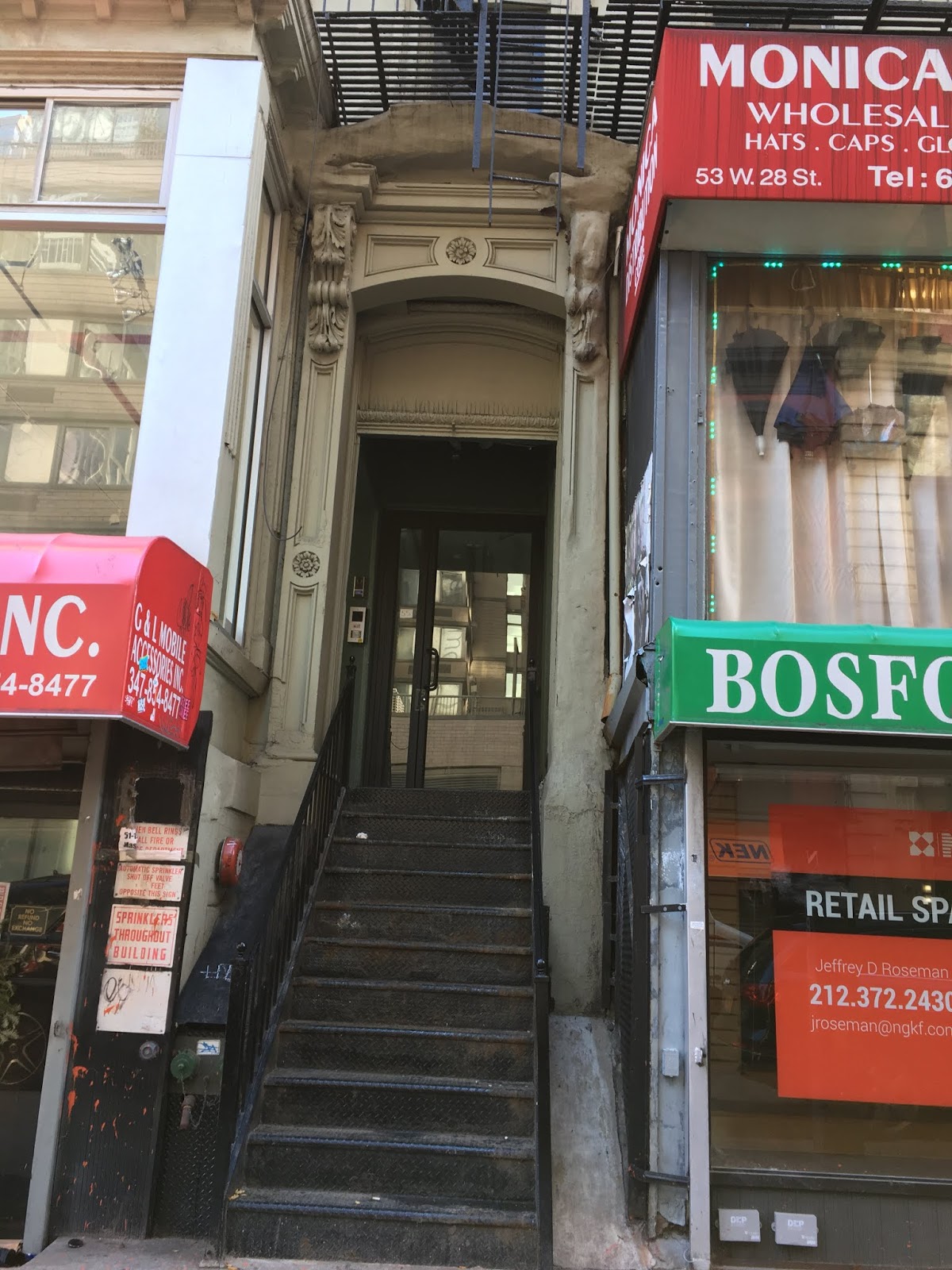
Sat there for over two hours, meditating on all the music that was first conceived there. Sat there in the cold and damp with my gloved hands running over the iron bars once held by so many musicians and writers, Ring and Hager being only two of perhaps hundreds. 
When my friends arrived we headed to 27th street where Hylands Spencer and Yeager were. This building appeared to be intact, though it was being worked on, so we couldn't get inside to poke around. Then we passed through where Dan W. Quinn lived in the late 1890's, and later where he lived from 1906 to his death in 1938. The later Quinn address is the one that he lived in when he was writing to Jim Walsh in the 1930's, and where he also operated a booking office. This address was also very nicely preserved, with lots of pretty marble carving and ceiling decoration. 
After we went by there, we headed to 14th street where all the 1880's and 90's theaters were. Before Tin Pan Alley reigned in the late-1890's and beyond, 14th street was where all the publishers and performers lived. Here we walked by the original site of Pastor's theater, where Ben Harney first introduced Rag-time, and where countless other performers played. Just two blocks farther along was 223, where Fred Hylands lived from 1896 to 1898. We were lucky enough to sneak in behind a resident, which just happened to be the first time any of us had gotten inside. The inside of the building looked to have been remodeled in the 1920's, but we could definitely tell it was an old seedy building that Hylands could easily be seen in. 
This apartment was definitely seedy, but in a charming sort of way. 
The stairs of this building were kind of awful, so I could see Hylands complaining about them often going and coming from work at the record lab or Pastor's. This building was where the "Darkey Volunteer" was published, and where Hylands trod in night after night of performing at Columbia's exhibitions. Performers like Burt Green, Max Hoffmann, and Mike Bernard likely also went up and down those stairs. 
As we started to head to a friend's house near Queens, we passed by where Antonin Dvorak lived in the 1890's. Thankfully there is a plaque dedicating the history of this address. On the plaque it states that he wrote his New World Symphony here in this apartment, which is pretty nice to see. 

The next morning I went to visit a famed broadway and vaudeville historian. This man's house is packed on the walls with posters of all kinds, dating from 1816 to the 1940's. Two examples:
There are hundreds more in this guy's collection. It really was a feast for the eyes to see all these gorgeous colorful posters. He told me that every few months he switches out the posters so there are different ones hanging on the walls. While I was there he pulled out two beautiful posters he had gotten from a recent trip to Paris, which included early art nouveau artwork much like the first poster pictured above. Next I went out with this collector/historian to find Frank P. Banta's grave. We got on the subway and headed to near Wall Street where I assumed it was, but ultimately wasn't able to find his grave there. It was way up in Harlem. I didn't want to spend another two hours going there and back to find his grave, that, as the cemetery directors stated, was in a very large cemetery. So with that I split with my new friend and headed to the Bowery to walk along the neighborhood of so much lore and history, and where Justin Ring grew up. 

After a decent trip on the subway, I turned a corner of Canal Street and was finally walking along the Bowery. The weather was perfect for setting the solemn mood I was in as I walked, it was 45 degrees and damp, with a blanket of clouds ready to drop rain at any moment. As I kept walking, I could really feel the intense weight of history on me, all the struggle and suffering of the many thousands of souls who lived in this area, all of it seemed to congregate as I scuffed the sidewalks. Had never felt such an intense feeling of unbelievable history before, everywhere I looked some image of the past seemed to appear. So much music, so much life, so much suffering, it seemed that walking along here was really where the spirit of the era I study came out. As I neared the street I was looking for, the area seemed to get a little seedier than where I got off, but that added to the atmosphere of the old Bowery I was immersing myself in. When I got to the short street where the Ringleben family once lived, it started to rain. The address looked very much reminiscent of the late-19th century, with so much of its original interior intact. The facade  of the building appeared to have been redone after the Ringleben's had moved out, but much of the older inside was perfectly intact. The building itself would have looked like the one next door when the Ringleben family lived there. 

My hand on one of the walls. 
There was even a beautiful mosaic tile floor still intact. 
I walked all the way up and down the stairs, and looked out a few of the windows to see such a lovely view. 
As I trod around the building I could almost hear the violin of young Justus as he was being taught, and his angry father writing out stock arrangements as his children learned how to write music. It was a lot to take in. 
It was getting dark by the time I started walking back to the subway, and it was raining. Another thing that so charmed me about being in New York was the subway. Lots of folks threw me mixed opinions about the subway before I went, but I was determined to witness the intense history of this old system. It felt like a time capsule, with all the mosaic tiling intact, and every time I stood on a platform the smell of 120 year old pneumatics filled my throat. That smell is entirely unique and old-fashioned. It's like being at an old train station but with no steam to be found. The inside of the subway is truly the smell of the past, with little change since its opening in 1904. There's nothing quite like the smell of 120 year old pneumatics that still heave and work every day. 

Well, wish i had more to say on this trip, but as I'm writing this I am still processing the emotional toll it took on me. Visiting all these places was very moving to me, as it was where all this history happened, and few few people know about it. Despite few knowing of these places, it seems that those who live and work around these places are somewhat curious, and that is hopeful. 
I apologize for not including any recordings in this post, as I usually like to do so. 
Within the next week I hope to start a project on Voss' 1st regiment band. This band has been a sources of mild interest for a few years now, after learning that all of Issler's orchestra performed in this band for many years. Based on this, it seems that this band gave us many of the earliest and most prominent studio orchestra musicians of the 1890's and 1900's. So with this in mind, it seems important to see what I can find on this group.

Before I close out here, I must say that some big news has come down! In the last few months I mentioned Hager's scrapbook and papers, well folks...
Now I have these things in my collection! 
Since they arrived in the mail a few weeks ago, it has been a lot of process, and I have been holding off doing a major post dedicated to this matter. Just to give you a sneak peek into what's in there, here's one of the more unusual pages from the scrapbook:
That's supposed to be Hager's orchestra in the background I guess, that's why he saved it. 
More to come! 

Hope you enjoyed this!


Friday, November 9, 2018

A Few Edits and Mr. Michaelis

Okay, to start, scratch all of that I said in the last post regarding the American Record company. Just a few days after I posted that thing, a few friends went on the dig for proving whether this was true or not, and well, as it turns out Hager was nowhere to be found. 
However! 
It is important to note that Hager may have indeed had a hand in it at some point. Though he may not have had his entire orchestra there at American, it's likely that he handed their bandleader some of his own arrangements, and likely a few musicians of his own in the process. The director of the regimental band of the republic was said to be a guy named Fred Wood. I know nothing of this Mr. Wood, and haven't done any digging just yet. It almost seems like Mr. Wood just popped up out of nowhere, as usually with these house orchestras we would usually see someone we know as the leader, a familiar face from a previous orchestra. It's a lot like how toward the very end of Zon-O-Phone's days(1909-1912) it has been said that Arthur Pryor led the orchestra. 

Since we know now that Hager wasn't responsible for the American record company's orchestra, what was he doing instead? Well, when I spoke with one of my friends about the matter, I felt terribly absent-minded when the reason was brought up. In mid-1906, Hager left Zon-O-Phone to go and work with J. Fred Helf in publishing. 
Durr...Of course, I have so many Helf and Hager sheets, I should have known! I am not entirely sure when Hager returned to recording, but it's likely that before the Rex endeavor he was associated with the other earliest American vertical cut labels. He and Justin Ring were likely introduced to the Vertical recording method very early on, possibly as early as 1910. 

So anyway, do excuse much of what I said in the last post about those blue American records. That orchestra was still outstanding, whoever they were. 


Well then!
It's been quite a month for my sheet music collection. In the last month I have sifted through two sheet music collections, both of which were fantastic, full of great valuable stuff. The first collection I went through got me copies of many Coon songs we know and love, including my very favorite of them: 
Yes indeed! It's also in really good shape too, which is nice. 
I also got these from this collection:
So here's something trippy about that Roger Harding piece. I have no idea who that is on the cover, and it's certainly not Harding. So some of you may have seen a different cover of that Harding piece, and about that you'd be right. 
Okay, so what the hell happened here?
Well, I guess that in 1896, Harding got the piece published as he did, and it was a hit with the recording community he'd just integrated into, but something went a little whacked when Fred Hylands scooped up the Columbia staff with the publishing firm. I would guess that the reason it was re-published was because Hylands wanted so desperately to grab the rights to Harding's work. I have no idea why it was published by different people two different times, but there is something whacked about Hylands putting his name on it in 1899. On the original edition, it even says "words and music by Roger Harding", which I would firmly believe. The 1899 edition is really strange, now that I can compare it with the original 1896 edition. 
Also, I finally got a sheet with a picture of Dan W. Quinn on the cover. I had seen so many of them in the decade or so I've been doing this and have always wanted to have one of them. The piece I got is titled "The musket and the sword", which is a tune Quinn did not record, but there was a very fine portrait of him on the cover:

All-right, that's officially the clearest portrait of Quinn I've ever seen. 
It's even better that the other versions I've seen online of this same picture. It's unbelievably crisp. What's curious about this particular sheet is that the very same cover was featured in the CD Archeophone put out on Quinn's records. I wonder if it's the exact same sheet? 

So, almost a month later, I was offered to sift through another collection of sheet music. Last week I went to a friend's house and sifted through around 500 pieces of sheet music, only about a quarter of them were the older large format sheets, or the good stuff. There were plenty of rare San Francisco and Los Angeles published pieces in this pile. I was able to grab a large pile of SF published music that I had never seen nor heard of, but other than the California rarities, there was one particular sheet that has caused a bit of buzz amongst the Rag-Time community. 
As I kept picking out all the good coon songs from this pile, there were lots of generic looking sheets from the early 1910's, some I took, some I put back, but there was this one that caught my eye.

Wait a second, is that who I think it is? Let me zoom in a bit...
There he is! Ben M. Jerome. Jerome wrote some hot rag medleys in the late-1890's, and continued to write better than average coon songs after 1900, such as "Melancholy Mose". In case you aren't aware of his rag medleys, here they are:
https://www.youtube.com/watch?v=2G4RoWQJrTE
https://www.youtube.com/watch?v=g_BE-UOe0Zk
So after the word got around that I have this sheet, I decided to try a little bit of digging on this mysterious early rag pianist. Since the beginning of my time studying rag-time, I have always wondered about Jerome, since his "A Bunch of Rags" medley is definitely one of the best of those early rag medleys. Clearly Jerome had something right in his style for it to sound so accurate. In fact, many of us Rag-Timers thought that Jerome was a black man, as his rags were so accurate to the black pianists of the era. But all of that was debunked when I saw that picture. 
So with all of that in mind, i attempted to do some digging on Jerome. When I looked him up on the NYPL, looking for some of his pieces, I saw that his profile stated that he lived from 1881 to 1938. Well that's nice and all, but if he were truly one of those early rag pianists, as he was, he would have to have been born at least as late as 1875. I just cannot fully believe that he would have been 17 writing his slamming medley "A Bunch of Rags". Only someone with quite a few years of experience and study in the rag-time community would have written out the longest rag medley of the era. So as it turns out, as I did some digging, some of these things became a bit clearer. 
First of all, it was unreliable to search Ben M. Jerome on Ancestry. So the initial start of the dig was no help. It took a few more days until one of my friends sent me a newspaper clipping containing some curious information. This clipping stated that he was divorcing his wife Florence and having issues with the custody of their two children, Jesse and Sanford. Not only was this there, but it also stated that his name was Bernhardt Michaelis. 
Heh?
What a name! So of course when I looked up that name on Ancestry it became very clear which one was him. I found him in the 1900 and 1910 census, which was exactly what I was hoping for. In 1900 he was working as a musician, but in 1910 he's listed as a composer, which entirely makes sense. Also, the most itching thing I wanted to know about Mr. Michaelis came to the light, the fact that he was born most likely in 1876. Okay, that's a much more reasonable date for one of these hot early rag pianists; being 20 at the beginning of the rag fad must have been quite the time! Considering Jerome's lady issues, I am getting some Mike Bernard vibes from him, if you know what I mean...

So on my newspaper dig for Jerome, I found some curious stuff. As I kept digging, I found lots of sections that mention him in Variety, usually related to songs and musicals he was writing and directing. So basically he was a less aggressively weird version of Hylands, and was certainly more popular. His name is on a lot of musical folios, similarly to Max Hoffmann who hung around  Broadway doing the same thing. 
Damn, he was a good looking guy, even in this crappy newspaper clipping...
I found a little clipping that confirms the 1938 death date, which is great! In that clipping, it becomes clear that he was known mostly as a composer, not as a pianist necessarily. Despite that, he must have been a hell of a pianist, as he's got those extremely detailed rag medleys to prove that. Surely he was an outstanding pianist, aside from all the popular musicals he wrote for. 
So now that I have a basic outline for Ben Jerome, I can now use his style for comparison between all these early rag pianists. That was ultimately the goal of all this digging on him, because his medleys sound so much like Fred Hylands' playing and Max Hoffmann's as well. 


I hope all's well with you folks! It's been a hard few weeks for me emotionally, despite all the goodies I've been snagging from old clothing to Spencer and Ossman brown waxes. I really wanted to do this post editing the things I said about those blue American records days after I learned all that new stuff, but couldn't get myself up to it. 

Hope you enjoyed this! 

Sunday, August 7, 2016

"Hiding in the Bushes"

The title of this post is a phrase that I use for those involved in this line of study who disappeared after their prime careers. Some who would be part of this include Max Hoffmann, Russell Hunting, George Schweinfest, and J. W. Myers just to name a few. Many of these recording stars(more particularly the earlier ones), disappeared after their recording career's were over, and some of them stayed in the business vaguely, but were not really heard of after their years in the studio ended. One that I did not mention, but certainly is one of these disappearing stars, is Harry Spencer. 
Haven't seen this sketch I did of him in a while, so I thought it be a good time to use it again. 
The thing about Harry Spencer is that we actually know what happened to him, and I have been able to track him in census records from 1910 to 1940. What's interesting about him is that he outlived pretty much all of the other earliest recording stars, even Dan Quinn and Fred Gaisberg. He didn't outlive George Schweinfest and Edward Issler though, that's really astonishing. Harry was living much different from his brother Len, and after Len died, he took over his brother's massive endeavor as a Lyceum owner, which was too much for him, and by the middle of 1915, the business had fallen. After all of this, Harry was on his own, and didn't make any more records, and it seems that after 1905, he wasn't making records anymore. The new Charles Prince's Columbia orchestra rid of him in that period of transition. After 1915, Harry lived in various boardinghouses with his dusky Italian wife Gazella, working as a local investigator after the whole recording jag passed over. No recording came for him after all of this, even though some collectors still speak of him maybe being a behind-the-scenes worker in the early days of radio. The only good account of what Harry was doing many years after recording is from Joe Belmont, who stated that he was a train-caller, which is not inaccurate considering that his voice was so well-praised and perfect for anything. I wonder how Belmont came to know that... He knew a lot about where everyone left ended up in the 30's and 40's. He had stories about practically everyone, well, who was left in this case. There weren't too many of the original "clan" left by the 1920's and 30's. Harry Spencer was not interviewed by Jim Walsh for a few very obvious reasons:
1. He was hard to track, as he was living from boardinghouse to boardinghouse in the 1930's.

2. Joe Belmont didn't exactly know where or what he was doing, someone probably told him that he was a train-caller. But who?
That's not the point here...

3. By the early 1940's, he was living at a mental hospital, which kept Walsh from him for certain.

It's frustrating that he didn't get to Harry, because it was within his reach to go find him. He did find Quinn, and Harlan, which is why I'm saying this. 

Another one of these recording stars who vanished and "hid in the bushes" so to speak, was Russell Hunting. 

As much good as he did for the early recording business, being the most liberal and progressive of all of them, he did essentially vanish from the business by the late-1920's. Hunting was still working for Pathe by the mid-1920's, but after that, he handed the management to someone new, officially ending one of the most important eras even in Pathe's history(they still exist to-day!Thanks Hunting!). He didn't leave the U. S. or anything, but he did just what Max Hoffmann did, and enjoyed his retirement doing whatever the devil he did. This is exactly what I mean! We don't know what he did for the last twenty years of his life, as he lived into the mid-1940's, and Walsh didn't bother to look around for him. The kind of stories he would have told would be like none of the others, and would, without doubt, be more interesting and complicated than any of Quinn's or Murray's. We would, essentially, understand the 1890's recording business a whole lot more if Hunting were interviewed in the 1930's or 40's. Our view into this history would perhaps be very different if this happened, and certainly it wouldn't be a subject that all collectors would approve of as well. 

There's a reason that Hunting is my favourite of these early recording stars, and I don't care a rap about what you all think. 


Max Hoffmann is a great example of someone who "hid in the bushes" after his prime passed over, even if he wasn't a recording star. 
Now he seemed to fade away gradually by 1910, as he wasn't really writing too much music after then. As I have said before, he allowed his wife Gertrude to do all of the work for him, and take the spotlight for the next fifteen years or so. Not much is generally known on him as of now, which is surprising since he was really one of the few to truly "kick start" the rag craze of the late-1890's. It continues to shock me how little every one of the famous Rag-Time enthusiasts have refused to study him more. His impact was larger than Ben Harney's in a way, in the means of published music that is. Harney was more influential as a performer than a composer. Hoffmann was influential and important as a composer. He was essentially the first composer to write down the early Rag-Time style in the most excruciating of detail. He really analyzed how to play and write out this style, he perfected how to do this from being a pianist in mid-1890's Chicago. He really did write out much of the strange Rag style that we hear on records, just not purposely relating them to records at all. He began writing out these so-called "rags" in c.1895, and became known for it in chicago at that time, only to later take it with him when he went to New York. 

This cover has dates that are hard to trace, as it says 1891 inside the cover, but has photographs from 1896, other than that, this is one of the earliest mentions of "rag" in the sense we know of on a cover of sheet music. 
Here ya go Rag-Time freaks!
It seems that Hoffmann was famous for arranging "ragged" interpretations of popular coon songs as early as c.1895, as the music just above indicates. 

With all of this amazing history to Hoffmann, he went and completely faded away from the public eye by the 1920's. After that, his amazing musical endeavors seemed to have become largely forgotten. He outlived pretty much everyone he worked alongside in the early "rag" scence, living until 1960 beats everyone in his generation of the "rag" scene. Nothing is known of what he did after 1920, we just know that he lived out in Hollywood(I hope he's buried here in California! I want to go find him!), because his son worked in Hollywood in the 1930's. His son's films are still trying to be tracked by many of us Rag-Time freaks, but none of us have come to discover them just yet. We all just want to see if Junior looked like his father. 


The final performer I would like to mention who "hid in the bushes" is Edward Issler. 
(from Tinfoil.com)
Just recently, a treasure trove of information on Issler was presented to me from Charlie Judkins. We not only found how long he lived, which was much longer than thought for perhaps seventy years. As it turns out, Issler was still living when Walsh was contacting all of these recording stars. Talk about someone who outlived everyone...Issler is the perfect example of this. He was 86 when he died, and he lived pretty far into the 20th century for someone born literally in the middle of the 19th century. It's funny to put into perspective that he was the first studio pianist, but he outlived all of the ones that came after him in the era. Now he would have had some amazing stories, that no one else would have, since he was in the business in 1888-89, and he witnessed all of the 1890's madness at the U. S. Phonograph company and at Columbia. Issler and Schweinfest had similar stories after they ended recording(though Schweinfest ended later as we know), where they were not making records, but they were still performing in military bands all over the place in New Jersey and New York. They were separate for the most part in the decades after recording, but I have always had the feeling that they regrouped for occasional performances, since they were such good musical friends. Issler remained performing in military bands into the early 1920's, and left the business by 1930. He didn't remain a popular bandleader in the 1900's and 1910's, but he still performed in bands at that time. He was never heard of again after 1900 with the recording business though, which is surprising, since he was so popular in the 1890's, and around the time he retired, the "nostalgic" look back to the 1890's had started to come in as a fad. I'm surprised that he wasn't interviewed on any sort of radio program in that time, as he would have known the music business in that time like no one else still living at that time. After 1900 or so, Issler hid in the bushes, and a few years after that, Schweinfest joined him, to keep the old deep-running friendship going. 

The two of them did make piano duets together in 1889, do take that into consideration when analyzing their obvious friendship. 


Hope you enjoyed this! 

Thursday, July 28, 2016

14th Street Swells--Some popular New York Rag pianists

A cartoon I did poking fun at Burt Green and Fred Hylands as being "swells" who both lived and worked on 14th street in the late-1890's. 

Back in 1897 and 1898, East 14th street in New York City was a hub for several theaters, and where many of the pianists who played there lived. Among these swells included Burt Green, Mike Bernard, Ben Harney, and Fred Hylands. Pretty much the entire New York "rag time" scene lived either on 14th street, or somewhere around it. Much of these old buildings where the pianists resided still stand to-day on 14th street, including Fred Hylands' old flat while he worked at Columbia in his early era there. 

It seemed inevitable for all of these pianists to know one another, as they all worked at the same theater, and Hylands was their manager at one hot point. First, in 1896, Ben Harney broke the old traditions of vaudeville music by performing his "ragged" interpretation of his own "Mister Johnson Turn Me Loose", which really started a craze for music that was ragged in "Ethiopian songs" as they were often called at that time(that was actually a very old minstrel music term, that had been around since the 1830's). From there, all of these younger performers began taking up Harney's act and creating their own spin on it, adding all sorts of new and interesting things to it. Burt Green was considered among one of the best Harney imitators around, which believe it or not, was stated in an obituary for Harney in 1938. What was special about Green was the fact that he not only took up the piano playing style, but he also did some of the dancing that Harney was so well-known for. 
His dances included things like these:
There were so many more things he did, these are only two of several more that were photographed in 1911. Green did these dances well, as he was known for it it seems, and he sometime parodied them as well. From what we can hear on those handful of records Green made from 1911 to 1915, it is certain that he was one of those early rag pianists, and took much of his style from those other famous early performers. 
There he is around 1908. 

From the few pictures I've seen of Burt Green, I can easily see him being one of Fred Hylands' publishing associates, and since he was one of Fred's income sources, he remained a valuable asset for him for many years, even after the publishing firm. They met probably not long after Fred first came to New York, as they worked at the same theater in 1897, and Fred was at one point the music director there, so it's inevitable that they became friends early on. Their friendship worked so well in many ways, as what they were missing in their lives were fulfilled with one another, and they were easily both just as strange and eccentric. As I've said before, Burt's looks made up for Fred's, and it helped that most of the stars they endorsed on their music covers would encounter Burt first rather than Fred. Fred came next. The first impressions Burt made must have been much better than if Fred were there during recording days. During the publishing firm, Burt still worked on 14th street, at Huber's museum, and occasionally filled in at Tony Pastor's theater for Mike Bernard. But as could be expected, Fred and Burt learned early on not to mess with Bernard, and Fred knew him best, since he was his director for a short but busy time. 
Bernard must have been one of the 14th street swells who was auditioned for Columbia in 1897, as they probably tried all of these famous theater accompanists. Knowing how much of a peach Bernard was, he must have hated the idea of being almost quite literally a slave to the singers and performers who entered the studio. Harney was not very versatile, and would probably done well on all of those coon songs, but everything else wouldn't work. Burt must have been one of their second decisions, but he probably turned the studio job down. Of all these theater pianists other than Hylands, Green would have been another great studio pianist, and since he was so much like Hylands, he  was probably considered something like "Freddy's double" if they needed another pianist for something. In reality, the one who took that place was Ed Issler, and Issler was not a show-biz insider like Hylands, which meant for an immediately different approach. 

While Burt worked at Huber's, he met many of the famous faces pictured on Hylands' music covers, including these two:
(Fun fact! Spencer probably wrote her name on this picture!)
(These both came from sheet music covers in my collection)

I'm sure you all recognise these faces, especially the first one. Green probably found them first, and soon went to Hylands and Spencer about his latest findings. Where Harlan came from in this case it is not certain, but Ada Jones was a regular at Huber's 14th Street museum, and it is almost certain that he met her there. Wherever of whomever introduced Harlan to Hylands, that friendship lasted a long time, and it was randomly revived in 1901 when Harlan began recording at Columbia. Other performers like Barney Fagan and Sallie Stembler must have been Hylands and Spencer findings. Burt working at Huber's not only got him an immense amount of money, but it earned Hylands and Spencer some very important friendships, such as the Ada Jones and Spencer duo that made hundreds of records from 1905 to 1913. 

No Billy Murray, you did not find her first. Damn lie...

Anyway, you understand what I'm getting at here, 14th street was a fantastic place to live and work in the late-1890's. There were more famous stage pianists who came from 14th street, but that comes later in the era, around the gaudy time of Tin Pan Alley, of which none of these early pianists were officially part of. These great pianists were too good to be part of that mess. 
Max Hoffmann was another one of these pianists I did not mention, as he was performing all over those theaters on 14th street in 1897-98, which logically works since he was such a famous "rag" pianist. Hoffmann remained pretty well-hidden considering that all of these other pianists were not really writing all of this music, but they were playing it in that same Hoffmann-like style. He remained hidden because he wasn't exactly a show-biz character out front, he was a sort of behind-the-scenes type, since he married a dancer who made up for this. His slim and pretty wife was scandalous enough to keep everyone's hands off of him, so they could scrutinize her. 
Something like this is what I mean. 
That's his wife in the center by the way. 
Funny to think that Hylands was director at the theater where this was taken. Hehe...
Hoffmann's marriage was brilliant, in so many ways, and it really is funny to think of it as a strategic show-biz marriage, far more than just the typical Hylands and Green marriages of pianist and singer. Chronologically, Hylands' marriage came first of all these famous pianist-singer ones, with the intention of an act being created from it. It wasn't as famous as the others that came after it, like Burt's marriage to Irene Franklin, but it was the same sort of thing. Fred married a singer who was not really well known, and she became a little more well-known after being married to Fred for ten years, since it took that long for him to finally put her in one of his Broadway shows. 
(that's her! on his music of course)
Took him long enough...
 It would be interesting if he dragged her in to Columbia to make some records. Probably didn't happen, but we can well assume that he considered it early on. We know that he was desperate for attention from the Columbia staff in 1898, and something like this was probably laughed upon by the long-time studio stars. It helps that he lived on 14th street in 1898, though he was not within walking distance of the studio. The bouts with cable cars were inevitable!


Anyhow, I'm just going to keep rambling on about all of this, so that's where I'll end it. 

Hope you enjoyed this! 

Tuesday, June 7, 2016

Yarns from Missouri and fascinating new discoveries

Well, after being in Missouri since last Tuesday, I have been having a lot of catching up to do, as well as organizing the new discoveries I made along the way. I flew in to St. Louis with my dearest friend Virginia on Tuesday afternoon, and we stayed at the historic home of Trebor Tichenor, which is, since his death, still being organized and sorted through. This house had amazing artifacts around every corner, from piano rolls, to sheet music, to Rag-Time era posters! That can be expected from any of those out there who are aware of Trebor's collection in any sort of way. 

Once we got there, Virginia gave me a tour of the house, and everything looked like something historic there, I could barely watch where I was going because there were so many things to look at on the walls and piled into shelves. There was even a room fully dedicated to piano rolls upstairs! It had shelves of rolls with very tantalizing titles to any Rag-Time collector, even to one who isn't exactly a piano roll fanatic. The ground floor is filled with many rolls and cabinets filled with great books on Rag-Time and things related. I got to crack open a book I had only heard about there! This was a book that was written by  vaudeville manager Tony Pastor called They All Sang. 
(that's Tony Pastor) The section that I had read before was about Victor Emerson and Russell Hunting finding a new way to make duplicate records in 1892. It turned out that there was an entire section on the recording artists who began their own companies and publishing firms(but Hylands Spencer and Yeager was not mentioned...). Not much of it had information I didn't already know, but it was interesting getting it from the manager himself, and reading through it at Trebor's house of course! 

The basement of the house was the most amazing thing I had ever seen, with piano rolls stacked in shelves to the ceiling, everywhere I looked, there revealed precious titles of Rag-Time rarities, from an original of Max Hoffmann's "Rag Medley", to "Campin' on De Ole' Swanee", to Ben Harney's "Mister Johnson Turn Me Loose". I just kept naming titles I saw, and many of them were early Rag-Time songs that I did not know were ever made on piano rolls, some recorded, some not. I wish I could remember more of what I saw, but there were some amazing things there, it was entirely overwhelming...
The one thing that was hidden in that cavernous basement was the fabled door to the Rosebud Saloon. I had heard mutters around of Trebor getting a huge crowbar and prying out that door just as soon as he heard that the historic place was going to be torn down, back in the mid-1960's. There it was, sitting up against one of those shelves, with its faded green paint and small brass handle. I stood there with my hand on it for at least ten minutes, thinking of all the amazing hands who met with that door. Just to name a few, here are some:
Tom Turpin, Scott Joplin, Louis Chauvin, Otis Saunders, James Scott, Scott Hayden, and dozens more. I just could not believe what I had my hand on, and it was slightly overwhelming just thinking of how much history that door had seen. 

That was only the first day being there, was staying at Trebor's house. We stayed the night there, in the heat and humidity of Missouri. The next day, we began our drive out to Sedalia, and did some antique-ing along the way. There was this one place pretty much in the middle of nowhere that allowed for a great haul of sheet music. Of course, since we were in the middle of Missouri, much of the music there came from that state or from those surrounding it. Much of the music came from either Chicago, St. Louis, Kansas City, or Indianapolis. With that, the pickings were great, as in California, one won't find that sort of thing for sure. Once we got to Sedalia, the music began. It was like we were thrown into the middle of a cutting contest, the music quite almost literally smacked us across the face. 

The highlight of the Thursday night concert was Terry Waldo's slot. He played one of his own compositions, which was full of hilarity and mirth, but then he played his specialty of Euday Bowman's "12th Street Rag", which ended with a fantastic whack! The final C on the piano broke clear out of the piano! The spring went flying, and the string could easily have slashed someone's face. Just after he played was the intermission luckily, so a bunch of people got up to go and fix the string, though it was not fixed until the next day. A few performers still played that piano at the concert regardless. Terry unfortunately had to pack everything and leave on Friday morning, so he left the after hours rather early that night, after a few drink and duets of course! 

Friday was a similar story, with some of us walking around town and enjoying our time in the town. It was on Friday that I got to play a square piano for the first time, which was a fascinating and curious experience. My friend Ryan Wishner has been wanting to play one of these strange things, and now I must report back specifically to him(because he will be reading this at some point). This piano was very odd, no pedals, not 88 keys, and it was tuned down a whole step. If you were to play in A on this piano, the key that it came out to be was F. How it was just a mess, but once you get going, it sounds decent. The hardest thing about it was just getting going on playing something. Well, Ryan, hope you're still anxious to play one of these! 

The Saturday shows were fantastic, as they were the finale of this festival, and the last spectacle of the day was the huge production of "Shake That Thing", where almost every one of the performers were invited up to play along on the stage. With this format, the song seemed to go on for twenty minutes! Not everyone even played, and it still went on that long. All the musicians were scattered around town who didn't play in that finale. Once the evening concert began, we were all confronted with a strange yet playful way of programming for this concert. All of our names were thrown into a hat(a straw boater to be more specific!), and the previous performer was to pick another name from the hat, and someone was given the specific job to go and fetch them when they were called. It sounds like a fun idea at first, but really, it became stressful and complicated rather quick, though it went well through the entire show.  
Anyhow, I was driven back to St. Louis with Virginia and the Boogie legend Carl Sonny Leyland, which took fully three hours, but was a very pleasant ride back. 

The next part of the day was enjoying the hospitality and history of the Scott Joplin home in St. Louis. The place was very well restored, considering all of the damage that had been done to the place before. This was pretty much the official end of the festival, there was one more place that a few of us went to after that, but that didn't involve most of the performers. 

After spending the night at Trebor's house once again, much more used to the room I was staying in. We dug through some sheet music, and attempted to play a few piano rolls(that did not go well...). We packed a large bag full of cleaning supplies, got all of our luggage, and sent for the Valhalla Cemetery in St. Louis. Why? Well, so we could find this:
There he is. 
The "Banjo king" himself. 
For at least fifty years, this stone has been covered in dirt and grass, and spiders, until my friend Marty and I cleaned it up. How Vess would be glad to know that someone cares just enough to want this done, and does it out of full will. Now, when we found the stone, I was surprised by how simple it was. I was expecting a little banjo somewhere, and his full name, but none of those were there, as you can see. It's funny, he would have wanted something more frivolous than this, and probably more than just "Pop" there, though it was his son Vess Jr. doing this, so it's not really that surprising. Vess hadn't made any plans for his death anyhow, so this kind of proves that, as he died quick, and his oldest son had to deal with this. His son, Vess Jr. is buried at the same cemetery, but across the street. 
I was half-expecting his wife to be there, or at least somewhere near him, but she was nowhere to be found unfortunately. He would have hated that for sure. Unfortunately, we were in a slight hurry to get to the airport to depart, so I couldn't really give a long monologue praising Vess, as much as I wanted to. I said a short emotional thing, then set the roses in place. 
One down, a whole lot more to go...

I wanted to pick out a bundle of specific flowers corresponding with the man's character, but again, we were on a tight schedule. I will do that with everyone else I visit(especially with Banta!). Now that this is done, I plan to track down his lovely Eunice, and put the same arrangement of roses on her grave. I chose roses honoring the man's lovely youth, and beauty, though he was short tempered, ridden with thorns. 

Before I close out this post, I must share a rare image that Charlie Judkins sent me while I was absent. 
Here you go: 
Anyone recognise that face?
Well, if you don't right away, it's Silas Leachman! 

Finally, another decent picture of him. This picture would have to be dated about 1899 or 1900, judging by his suit jacket and tie, and also that his hair pretty much looks about the same as it did in that other picture of him that I use on this blog. This picture came from a newspaper advertisement, as that's why it looks the way it does, though there could be the original image buried out there somewhere...


Anyhow, that's my whole spiel about going to Missouri, and with all of this, going next year is certainly a possibility. Thanks John Reed-Torres for all the adventures we had! 


H ope you enjoyed this!