It's uncommon to find the old early recording stars on covers of sheet music, as this has become an important area in my collecting, but it's a very hard thing to come across, but once one is found, it's an immediate find. I know that the earliest artists of the 1890's all wrote music here and there, so it's not uncommon to find their names on covers, whether it's a song they wrote, or a song that was dedicated to them. I have mentioned this odd ball "Coon Song" on this blog auite a while back, but I just found it again:

Yep, that one. With this thing on the top of it:

Ha! That's just wonderful. Since this was written by one of Spencer's composer friends(of which included Monroe Rosenfeld, May Irwin, the composer of the song above, Barney Fagan, Fred Hylands, and probably Max Hoffmann). So there must have been several pieces of music from 1893-1899 that had this sort of recognition to Spencer on it. I would not at all be surprised to find another one of these. I have found things like this dedicated to Dan Quinn and especially Russell Hunting. Speaking of Russell Hunting, I have come to the thought that Hunting must have become a big figure generally in the whole New York scene after his whole "bust" with those indecent cylinders, as he was on several pieces of sheet music(not pictured unfortunately...) and was recognized in several communitites other than the recording community. By this, I mean something like this:

The thing at the very top is what I'm referring to:

Yep, that's it. This piece was composed and published the year after Hunting went through all of that commotion with the law, so it's interesting to think that it was alright for the composers to still be friends of his. Hunting was considered "esteemed" by Rosenfeld because of his bravery in the courts and against Comstack's laws, and continuing his "Casey" records after the fact. But in 1898, the idea that recording artists and publishers should try to group as one became a fad. By this, we have the firm of:

There it is. Under the ink pen of Len Spencer, came this beautiful logo.
This firm was incorporated by Fred Hylands in March of 1899, as can be read here from that edition of The Phonoscope:
 That's basically saying that Hylands' last two firms were a failure, so he used the extra money from those two to start this firm with simlar people he already knew. This firm was a much more successful one though. He published music to endorse the records they made and sent the recording artists advance copies of the music. Yous can see that he did this because I saw a song Spencer recorded listed in the "New Records for Talking machines" section the month before Hylands published it. That's a dead giveaway. I'm pretty sure that Hylands did this with many more of his songs, just like his "Darkey Volunteer" of which the manuscript he had been carrying around with him for at least five months before he published it. And by the time he published the song, had had already handed written arrangments to the Columbia orchestra and to Vess Ossman.
This idea of recording artist and publisher always seemed like an easy deal, where both sides of the business would get their share with ease, and some of the money from the record sales went to the publisher, it seemed like the perfect idea, and this is why Hylands wanted this to happen. From what I have found, this firm was even set up in two out-of-country places as well, just like the Columbia company. You can see this here:
 closeup of logo:
 See it? Toronto, Canada and London, England. I don't know the story about the Toronto setup, but I have this thing here about the London setup:
 Yep, that guy. I have only heard vague little things about him here and there, but I guess that he was one of the small empire under the dictatorship of Fred Hylands. Even with all this endorsing of recording artists, such as these two examples:

 Hylands was still losing tons of money from this firm, and it was mostly him who was, due to his irresponsible spending, and anxious means to branch out to other countries, which was certainly a pricey venture. All the other members of the firm were wealthy from their inheritance or from recording, and they were mostly "partying" themselves, without Fred. When this firm collapsed, Fred was broken up, and had to sell all of his stock out to other publishers, further slipping him into debt and depression. Even with this failure, the idea of publisher and recording artist stayed with the music business, as you can see this on music published in the 1910's and 20's, even later than that as well. I have a piece of music from 1904 with Arthur Collins' picture on it, here you go:
 Sorry the picture isn't very good, but you get the point, it's one of Collins' mst popular songs of 1904 and he's pictured on the cover, for a reason that's pretty obvious. So Hylands' idea wasn't all that bad, but the firm just didn't work out to well. I know of tunes from the 1900's and 1910's with Byron Harlan on the cover, Vess Ossman, Dan W. Quinn,Henry Burr, Harry Tally, Will F. Denny, and of course Billy Murray. So if you're looking for great reference for these songs just turn to the music, for the artists' picture, and maybe for changed lyrics, because it did happen.
To close off, here are a few tunes with the sheet music:

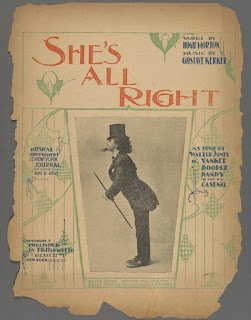 By Dan Quinn and Frank P. Banta:
https://ia800300.us.archive.org/17/items/edbw-6950/edbw-6950.mp3
I haven't the sheet music for this, but this is Hylands and Spencer's famous "Negro Song Success":
https://ia800300.us.archive.org/9/items/LenSpencer/LenSpencer-YouDontStoptheWorldFromGoingRoundCoonSong.mp3
This firm was incorporated by Fred Hylands in March of 1899, as can be read here from that edition of The Phonoscope:

This idea of recording artist and publisher always seemed like an easy deal, where both sides of the business would get their share with ease, and some of the money from the record sales went to the publisher, it seemed like the perfect idea, and this is why Hylands wanted this to happen. From what I have found, this firm was even set up in two out-of-country places as well, just like the Columbia company. You can see this here:


To close off, here are a few tunes with the sheet music:

This song is from 1890!
https://ia902302.us.archive.org/18/items/JoeBelmont/JoeBelmont-WhistlingSusannaCoonSong.mp3
https://ia800300.us.archive.org/17/items/edbw-6950/edbw-6950.mp3
I haven't the sheet music for this, but this is Hylands and Spencer's famous "Negro Song Success":
https://ia800300.us.archive.org/9/items/LenSpencer/LenSpencer-YouDontStoptheWorldFromGoingRoundCoonSong.mp3
I hope you enjoyed this!


