Showing posts with label David Dana. Show all posts

Saturday, April 8, 2017

Fascinating new Theories

After conversing with Ryan Wishner last evening, we came to some interesting conclusions and notions that had not previously been discussed. Before I get into all that, I must revise some of what I said in the last post, and add to it. It seems that with a little help, we've been able to find some more on these two:
 Dana 
and
All-right, so it seems that we've figured out the birthdates for everyone in Issler's orchestra! Now that's better than collectors have known for many a decade! So, lets list them in chronological order, birthdate and deathdate:

David Brown Dana(1850-c.1914)

Edward Issler(1856-1943)

George Schweinfest(1862-1949)

William Tuson(1864-1943)

Got it! It seemed really surprising to Charlie Judkins and I to find that not only was Dana older than the others, but he was older than everyone had expected, and than all the old recording sources gu-estimated. With his birthdate being 1850, Dana would have been 39 when he began recording with Issler. He would have been in his 40's when recording regularly with Issler which is very unusual for the time, and really puts it in to an interesting perspective. Also, something to correct from the last post, Dana was not originally from Patterson New Jersey, that's where he was in the 1880's, he was originally from Rhode Island. Something interesting to note, Dana's father John was a machinist. This fact further cements the strange connections of machinery/engineering and musicians in general. If there's an engineering mindset in a family, there's going to inevitably be a musician in the family somewhere, it's just how it happens. 
Think about it,
Ben Harney was a fantastic mathematician before he found music.

Hylands' father was a Locomotive engineer. 

Dana's father was a machinist.

Banta tuned and repaired pianos as a child

It's all starting to fit together. Finally was have somewhere to start with Dana, though we don't know when he died. The guesses that many sources online state are actually not too inaccurate, since from what we can find, he certainly died in the mid-1910's, but the exact year is what we can't find. Either way, he was in his sixties when he died, which was certainly better than average in the era. We found Tuson's dates, which were much more exact than expected, since these Issler members seem to be a real project in terms of piecing together. Tuson lived a long life like Schweinfest, at almost 80 when he died, that's nearing Issler and Schweinfest's age(they were both 87 when they died). Not much else was found on Tuson, though the dates were really what we needed to start, since no one seemed to have found them before then. 
Now that we got that out of the way...


Now back to the beginning of the post. 
So last evening, many of these new theories we discussed were some that need to be shared. Most of these seem as though they were completely wild and outrageous. To begin, we go back to that strange connection in the last post between Thomas Hindley and the Issler crew. 

It's likely that the only reason this piece was recorded so many times in the 1890's is because Hindley was a close friend of the studio musicians. By that, I mean the first studio musicians, Issler and his orchestra. The sole fact that Hindley was mentioned in a single section working in the same pit orchestra as Dana and Tuson suggests a direct connection between "Patrol Comique" and the earliest recording stars. It does seem a little strange that such a somewhat obscure piece like that was recorded so many times in a short period, by essentially all the popular studio musicians. 

This brings me to another theory, what about Hindley directly? What if...he  was in the recording studios? It wouldn't come as a shock if Hindley just happened to be one of those studio pianists for the more obscure record companies early on(1889-1894). Really think about this, what is the composition of "Patrol Comique" like? Well, if you were to ask me, I would say it sounds an awful lot like the style that was associate with Fred Hylands, and only Hylands in this matter, because it doesn't really sound like Issler as much as it does Hylands. Okay, here's the piece as written:
Not only do we see well founded syncopation, we see alternating an ever-interesting left hand playing. Hmm...
I'm not saying that Hindley is on any of those dozen or so takes of "Patrol Comique" out there, but with all of this being said, there's a slight possibility of this being so. Of course, the likelihood of this is so slight that it shouldn't be well-noted. However, the possibility of such a pianist as Hindley being a studio star is a little more than just a coincidence. After doing some digging on Hindley, he appears to have been the music director of the famous fifth avenue theater in New York in the 1880 in to the later-1890's. 
Here's a not-so-great drawing of him from a New York Theatrical Paper, dated 1891(though the picture's probably from c.1887)
It was stated that oddly enough, Hindley was from Manchester England, and he emigrated to the U. S. in 1870. Okay, so it seems he was probably around Dana's age, because it says that he got work in orchestras out in the U. S. by 1871. It seems that he was a cornet and piano player, which is an odd combination, but makes sense since he was mentioned as working with Dana, who was also a cornetist. He seemed to be mentioned in theatrical papers similarly to Hylands, since they were both music directors, and worked in various popular orchestra pits in vaudeville. Funny to think that Hindley was likely connected to the recording studios, as well as being a pit rival and director of Hylands, and even a musical writer! Wow. Seems we've kind of found a Hylands double! Well, he was doing all of this a little earlier than Hylands was, but the amount of parallels seem to be surprising. 
Wow! The similarities between Hindley and Hylands are astonishing!
It must be noted that Dana was in Newark NJ in the 1870's, as well as Issler, and Hindley just the same. So without a doubt it seems that these characters knew each other, and were likely friends from working in similar pits and with similar companies. While more unfolds about Hindley, I will report in coming blog posts, since this strange connection of him maybe being a studio pianist is not just a small crazy thing. We need to keep this in mind when listening to brown wax. There's not much we can do with this information as of now, but we need to save it for when more unfolds. 


Okay, now to another fantastic theory. 
We certainly know that freaky chap. Yes indeed, Len Spencer. So, his beginnings in recording may seem pretty clear on the surface, but in reality, they're missing a lot of the essential pieces of information. First of all, the dates are often a little fuzzy, some people say 1889, 1888, and even 1887. Why the hell does this matter? It's just a date.

Well, I'll tell you why it matters. 

This may seem a little outlandish, but think about this. I firmly stand on 1887 as the date he began working with the phonograph. Only because he must have started having to run errands for his father to fix the new-fangled machine(phonograph) owned by the college. The local company in Washington at the time(1887) was Bell and Tainter. Of course, during this time, the boys(Bell and Tainter) were working on all sorts of strange sound devices, though their latest triumph over Edison was the Graphophone. They also invented the idea of wax cylinders(Ha! take that Edison!). 

With this being said, young busy teacher Len Spencer had to run some errands for his old dad. Think of it like how young people now have to often help old people with their cell phones. Same thing. Len's curiosity soon boiled over for this graphophone thingy. But of course, since Len was curious, he soon got to a different idea. Doing something different from office dictation(what it was intended for). Spencer recorded sound effects like tapping a pen on a table, hitting a wine glass with a spoon, and soon wondered, "What do I sound like?"

There you go folks. In 1887, Len Spencer was likely one of the first to ever think that recording music was a good idea, and had public potential(NOT JUST AS EXPERIMENTS!!!) and therefore likely made the first commercial recordings of popular music. This is Len Spencer folks. Just before Columbia  was formed, he was already pitching the idea to Bell and Tainter that the future of the graphophone was music! Oddly enough, it was around 1888 that Bell and Tainter began experimenting with recording music for their contraption. Well, there you go, because of Spencer, Bell and Tainter(who in 1889 fell into Columbia) became the first commercial recording company. We know that Spencer recorded commercially by 1889, but it's likely that in 1888, he was doing the same he did for Columbia, for Bell and Tainter. Thanks to Frank Dorian, we know how Spencer started, at Columbia that is. 

See there's your issue. Dorian didn't know about his association with Bell and Tainter, which would HAVE  to have been what he was using if he was conducting all of those experiments in 1887 and 1888. Columbia was not selling their own machines under patent until 1889(ish). Spencer likely made trips to the Volta Lab several times in 1887 and 1888, until he learned of Columbia getting set up at their famous Lab on Pennsylvania Avenue:
Thinking of dandy Spencer, he probably rode a fancy bicycle to the Volta and early Columbia labs to buy and steal parts and pieces from them for his experiments. Of course sooner than later Master Easton took to the young man and allowed him to record and conduct his experiments under their roof rather than awkwardly doing so at the business college. It also must have been out of the fact that the slim management Columbia hired at the time were well-interested in Spencer's curious desire to promote recording music. We know that in 1889, that was when recording music took off for all the record companies. Spencer's influence was no longer present after that. 
We also know that 1889 was when studio musicians were hired for the first time, since recording music was the future at that point. In about early March of 1889, Ed Issler became the first studio pianist, and around the same time, Issler brought in his newly-formed parlor orchestra.


Whew! With all of that being said, I'll save the Rag-time theories for the next post. Those were just as important as these listed above, but will make this post too long. 

Hope you enjoyed this! 


Monday, April 3, 2017

Piecing together Issler and Issler's Orchestra

Issler.
After doing some digging on these fantastic musicians, a little more about their coming together is clear. of course, we have yet to fully understand how Issler joined all of them together, but some of the digging has proved well and is giving us hints, and opening more ideas. This is all fitting into place now, especially after having more information on Issler in the first place, finding the others has proved interesting just the same. 

Let's begin with the beloved George Schweinfest. We know him well as the premiere piccolo and flautist of the 1890's recording business, more specifically with Issler's orchestra. Similarly to Issler, Schweinfest was a first generation American in his family, with both his parents being born in Bavaria(also like Issler!), his father's name being Casper and mother being Barbara. With this being so, it's likely that young George spoke German growing up, which would have meant for a slight dialect reminiscent in his speech later. Though of course, the records that we know he announces are interesting when trying to analyze this, take this record as an example "Robin Adair" from c.1899. It's still hard to know, though I am convinced that the voice at the beginning of the record just above is indeed the voice of Schweinfest. From what I could find on Schweinfest, he seemed to have lived a rather normal-seeming life at home, much like Hager did. He had a wife and three kids by 1900, which wouldn't make his being a musician too strange. Unlike Issler, his family life seemed much smoother and care-free, as it should have been, since being a studio musician wasn't an easy line. It really is a relief when learning of these recording stars and their family life wasn't so horrid, since that paired with working in the studio couldn't have been easy on any of the family of the recording star. We know that Schweinfest lived much longer than the other studio musicians, in fact, he lived longest into the 20th century compared to the other studio musicians of the 1890's. Recall that he died in almost 1950! With that being said, he essentially outlived everyone. The digging I did on Schweinfest didn't provide much in terms of newspaper mentioning, which was a little surprising. Despite that, he left a fantastic and well spread family, which means there are likely descendants of him. 
Such a kind sweet face. He really must have been a great guy, since there is absolutely nothing suspicious with him, and he certainly was easily agreeable. Being able to take Hylands after working with Issler for ten years is admirable to the highest degree. Also the fact that he was able fully to transition to Rag-Time in 1896 is also a very respectable thing, since he wasn't trained to play such a thing for sure, only to later compose a full-fledged cake-walk. 
Respect levels for him are extremely high with me. 

Anyway, now to move to Dana and Tuson. These two seem to be paired together earlier than expected, which is why I'm putting them together. I hate to use this terminology but, Dana and Tuson were a sort of "package" to Issler, since they already had been playing in groups since as early as 1888. On my search for them(separately mind you), I found several sections where Dana was mentioned as being in the same orchestra with Tuson, which seemed strange, being that I wasn't expecting them to be together. What made this ever more unusual is the fact that I couldn't find any traces of them together with Issler. In speaking of this, it must be noted that Dana was born in Patterson New Jersey in 1855, which would have made him 33-34 when he began working with Tuson. Interestingly enough, where Dana and Tuson worked was in a pit orchestra for a theater, and in the same section from 1888 I noticed that Thomas Hindley was also mentioned as a musician in the same pit. Any one of you early Rag-Time enthusiasts would recognise that name somewhat, because he was the composer of this piece here:
Yes indeed, "Patrol Comique" composed by Hindley in 1886, two years before that newspaper section where he was mentioned with Dana and Tuson. Oddly enough, this connection with Hindley intertwines two completely different lines of the early history of Rag-Time, one is a composer of an 1880's cake-walk and the other contributed to the earliest recordings of syncopated music. So now that we know all of this, maybe it was Hindley that helped the Issler crew along with better understanding the essence of black music, or he was involved to some extent. Clearly the Issler crew understood how to play all of this new-fangled(so-called, remember it had been around for decades by the 1880's), syncopated music. This of course, like anything, makes me want to know more about Thomas Hindley, since he was clearly able to well catch the early essence of a cake-walk better than many composers in the 1880's. Of course, none of this Hindley banter has anything to do with Issler, because only Dana and Tuson worked with him as far as we know. All of this strange connecting just gives a better understanding of how there were multiple pianists who played what we would call cake-walks in the 1880's and earliest years of the 1890's.  This all illustrates that playing similarly to how Issler improvises on these two recordings below:
https://archive.org/details/GeorgeWJohnsonWhistlingCoonIssler1891
(remember! This is the oldest recording of genuine Rag-Time out there, as far as we know)

http://cylinders.library.ucsb.edu/search.php?queryType=@attr+1=1020&num=1&start=1&query=cylinder11728
just wasn't too uncommon in the late-1880's and early 1890's. This also goes for Dana and Tuson, especially since they were more directly connected with Hindley in the 1880's. 

Also, just a side-note about the 1891 "Whistling Coon", it may be the oldest example of recorded genuine Rag-Time(genuine because it's got written in syncopation, syncopated improvisation, and it's a former slave singing the song), and despite not having heard all of these fabled recordings from the years before 1891, such as the Issler and Schweinfest piano duets and solos, it's a safe bet to say all of this, because there's no recordings from before '91 of Johnson. Johnson really makes the recording genuine, more than any slight syncopation Issler or Schweinfest played for North American in 1889. 

Now onto some of the background about what I found on Issler. 
There he is, at Columbia's piano in 1897. 
Issler is turning out to be a little more complicated and interesting than expected. Unlike good Schweinfest, who lived a very normal family life under a light Catholic pledge, Issler lived more like a true musician. Of course, when I say this,  I don't mean that Issler was constantly in a state of suffering like Hylands. Issler lived more like a swell and stumbled into an interesting family life. Issler got married to Hannah Wade in 1880(puts into perspective how much older he was...) and had his first daughter Helen in 1883. As we know in the earlier days of his family life, he made a living as a general musician and music teacher(must have been a hard teacher as Charlie Judkins has jokingly stated!). Everything seemed all-right for the Issler's through the rest of the 1880's and the 1890's, until of course Ed began seeing trouble at work. 

Alright, this brings me to another subject that has rightfully resurfaced this week. We audibly and visually know that Issler remained at Columbia until at least the end of 1897, but after hearing all of those U.S. Phonograph records from those LP's, this notion has become in need of amendment.  After going back and listening to some odds and ends of 1898-99 Columbia, it seems the pianist is a little too stiff to be Hylands. Of course, these are records that are just slightly less like Hylands to where it's a little suspicious, here you go:
"The Laughing Coon" 1899

"How'd You Like to be the Iceman"(with Denny) 1899
One thing it for certain, these two records were not only recorded in the same year, but with the same pianist. The only reason these two takes sound more like Issler is the fact that they are just a little more stiff, sounding almost exactly the same as the pianist on "Uncle Jefferson" by Golden from 1897. The same stiff syncopation on "Uncle Jefferson" is present on both of these recordings, and despite the smoothness of Issler behind Johnson in 1891("The Whistling Coon"), it didn't turn out as nicely when he was seriously trying to play full-fledged Rag-Time at the height of the first half of the Rag-Time era(1896-1905). With all of this, it's finally seeming likely that Issler worked alongside Hylands for at least a few years longer than we thought before. So, as of now, Issler worked at Columbia until 1900 at the latest. But since we are doing a comparison here, listen to these two Johnson Columbia records from 1898-99, and compare them to the two listed above:
one of the best examples of Hylands accompaniment

and another take of the same thing
The first one is more likely Hylands than anyone else, and the other take has a similar story, especially since he ironically plays "Mister Johnson" at the end. 

So---with all of this, Issler was most certainly dropped from Columbia by 1901, because no longer after that do we hear that archaic style with all the 19th century embellishments and strictly perfect rhythm. After 1900, it seems that Issler saw some issues with his family life, as in the 1900 census, we can see Ed is living with his wife Hannah, daughter Helen, and brother-in-law Willie. In 1910, it's all different, he's listed as living with a woman named Jennie who was 16 years younger than he, still with Helen, but the brother-in-law is gone. Of course, we don't know what happened to wife no.1, but it's likely that she died. In 1900, it is stated that she and Ed had been married for 20 years, so it would seem a little strange if either one of them called for a divorce after that long, but that's always a possibility. Seems similar to how Hylands' wife dealt with being widowed to Fred, though she more light-heartedly ran off with another actor man, back where she started with Fred in Chicago(always seems a little funny to me).  According to the 1910 census, Ed had been married to Jennie for five years by then, and according to this as well, Ed is labeled as "M squared"(married twice), which is just kind of funny to say in terms of marriage. Even with whatever hit wife 1, Ed and Jennie made for a couple of swells, being mentioned in local papers often in the teen's for hosting gatherings at their house and Helen playing for the guests. Also, interesting thing to note, Helen was not yet married by 1920 by that point, and she was almost 40 by that point, just an interesting thing to note, also that she was a pianist(well, durr of course, if you were related to the first ever studio pianist, you'd be a musician too right?)
With all of that, Issler seems like a little more complicated a man than Schweinfest. I get the feeling that Issler was very intense, and a complicated, moody sort of man; so into his music that not much else mattered. He was a union type it would seem, but we cannot find him mentioned in connection to any musician unions. Being picky about pay was likely part of why he was dropped from Columbia, and refused some other jobs after 1900. Yep, it's seeming that the years after getting thrown out of Columbia and disbanding his original orchestra were hard times for him. Other than that, things seemed to have gone rather well for him after the 1900's passed by, as that was when they were being considered older swells from Newark(well, at least Ed was by that point), with Ed working in orchestras until the 1930's. 


Before I end here, here's a fantastic(not very well labeled...) transfer of a 1900 Columbia of "Dancing on the Housetops":
https://archive.org/details/colbwnyl-15025
There's some loud low notes in that piano accompaniment. Throughout the record this is so. Classic early Rag-Time!


Hope you enjoyed this! 


Saturday, March 25, 2017

Digging into early records and Spencer

Last Saturday, Charlie Judkins sent me a fantastic bunch of recordings that were from an LP of "North American" cylinders(this is in quotes because not all of them are from this company). This LP is essentially a compilation of interesting takes from 1892-1897 from a variety of early companies. The companies included are Columbia, Edison, U. S. of New Jersey, North American, and maybe even Bell and Tainter if we're that lucky. 

Many of the records that were in these two LP's would have borne this lovely logo on a slip or indigo rectangular box. The majority of the "good stuff" on the LP's were made by the U. S. Phonograph company, such as the Issler's orchestra records. The solos by piccolo and xylophone were made for North American as suggested by the LP. The amount of recordings that came along with this find can be considered a treasure trove, since there's so much to listen to all at once, and it's all good! Two of the LP's indicated North American cylinders, and another indicated Berliner discs, and those are all certainly as the title suggests. 

Since it's not completely full of interesting stuff, here's the link to the Berliner discs:
Where do I begin? 
Well, that recording of "The Charlatan March" by the Metropolitan orchestra is really great, especially since we know that orchestra was led by Banta. And yes, if you're wondering it is indeed the same group by the same name that recorded for Victor after 1900. 
"the Sidewalks of New York" by Gaskin is really nice as well, especially since I have friends who have been waiting for a good transfer of such a thing by Gaskin for a while. Well, here you go. 
We've all heard "The Streets of Cairo" by Quinn, and the transfer on this one is not the best oddly enough, there are better transfers of it out there. 

We know what the best record from this LP is. It's certainly Hunting's "Oh Uncle John". That's absolutely worth the wait to hear it. Since it's Hunting, it's more than likely that he's actually playing his own accompaniment. In fact, since the piano isn't very good, I would bet he's on piano. If you really want to hear this record, go to 24:31 for this specific transfer! It's fully worth it! 

The next record worth the buffering of the long video for is the fantastic transfer of "Thoughts of Home Polka" by Messrs. Stengler and McNiece. That is an exceptional Berliner in terms of sound! It sounds like an early Berliner(from 1893-96), but it's from 1899, in the period were Berliner records sounded notoriously awful. Take a listen!

The last interesting take on this LP is the strange "Imitation of Steam Calliope" by the Brilliant Quartette. wow! that really does sound like a calliope! It's really impressive how accurate that sounds. The things that these vocal quartets did in the 1890's never fails to impress. 

Alright, now for what this post is really meant to be on. 
So,to begin, here's the link to the first LP that was sent to me:

After having the chance to hear a bunch of very early Spencer records(not just announcing!), I have come to an interesting conclusion. Listen to that fantastic recording of "Laugh you Little Niggers" in the link above, skip to 9:48 for this record. It seems that in his earlier days of recording, Spencer was much more energetic, and in some ways, more accurate in imitating the early minstrel show performers. 
His imitation of that old black character seemed a little different from how it was in the late-1890's. From a wilder character to a calmer almost pimp-like figure. I know that seemed beyond a little kind to say, but really do a comparison of his 1895 U.S. phonograph record of "Laugh You Little Niggers"(again, excuse the racist title), to one of his classic late-1890's Columbia's with Hylands:
What a contrast! The 1899 cylinder is much looser(because of the piano accompaniment durr...), and the overall feeling of the music is completely different from the 1895 record. Another comparison can be heard on his 1894 Imperial Minstrels records, two of which you can hear on the other LP that goes along with the one in the link a little farther above in the post. 
Here's the link to the other one:
The Imperial Minstrels record is at 31:40.
This is one of those long spoken of records that Spencer spent so much time and money on as a sort of project. The song Spencer sings on this record is that great syncopated piece recorded by quartets in the late 1890's, "A High Old Time", with a small orchestra as accompaniment. Spencer's singing early on can be well summed up on this one recording, since it has all of the same aspects of the 1895 "Laugh You Little Niggers"(sorry again...) are present just the same. It seemed his earlier style of singing(much to the likeness of Arthur Collins)  was not only more energetic, but louder, and more inspired by the concept of "negro shouts" than his singing later in the 1890's. It's more antiquated, as well as more of what we'd expect from what we've heard about younger Spencer. Oddly enough, since I have perfect pitch, I can well notice that Spencer's tone overall early on was much better than it was later. Hmm... getting a little suspicious... There's not really a way to explain how this could have gradually happened, in fact I actually have no idea how that would have come about. The only thing to keep in mind here with this is that Spencer was an untrained singer, similar to Quinn, and it's possible that he just happened to have near perfect pitch, which is why his singing(at least early on) was near perfect as far as pitch goes. This is starting to open up some new theories about Spencer, some that couldn't have been formulated before hearing these earlier records. Here's a theory that's fitting into place just as I'm writing this:

Earlier on, Spencer was a little more high-strung(though it's clear according to how he died that he always was) than after the mid-1890's. With this, his nature for perfection began to gradually fade around 1897, as the end of the round era passed around that time, and the need for perfection and habits he had formulated with rounds were needed to be broken. It didn't help that Fred Hylands was constantly pulling at him in the studio beginning in 1897, and that further calmed his firey nature. Working with the young and temperamental Hylands forced Spencer to become more patient, while at the same time more daring. 

This seems to make more sense now, because there's clearly a distinct contrast between Spencer's earlier records and his later ones. This contrast had to be for some reason, and the theory above could be a possible explanation. Clearly Spencer read Hylands early on, and realized that working with him was one of the best things he would do, but also the most toxic. We know very well that Spencer working with Hylands was one of the best duos in the acoustic era, both in dynamics, but also in their strange business relationship(that still doesn't make much sense). As I've said before, this partnership(Hylands and Spencer) remains one of the most complicated of the early recording business, more so than Collins and Harlan, and Russell Hunting and Charles Carson. Though their partnership lasted only a few years, it was full of all sorts of strange things, and it's surprising how long it lasted with the types of personalities the two of them had. Spencer was restless and a perfectionist, Hylands was disorganized and spontaneous. Yet with all of this contrast, we still get fantastic recordings like these: 


This is exactly why Spencer never ceases to lose my interest. 


Now for some more early records! In the two links above(the links to the LP's), you can hear "The Wren Polka", and "Bobolink Schottische" both by George Schweinfest. These records very well represent the genius of Edward Issler, since he's on piano on both of them. You can also hear Issler on not only dozens of his orchestra recordings scatted all over the LP's(which seems to be over 50% of what's on them anyway), but also on those two cornet solos by Dana of "Ben Bolt" and the "Tit-Willow Song", also you can hear him on "The Wood Nymph Galop" by Charles Lowe, which is announced by Spencer, indicating a U. S. record. 
The "Wren Polka" by Schweinfest is likely a North American record, because it is not announced by Spencer, and it has a different studio and piano sound than the obvious U. S. records. That recording in particular sounds like potentially the oldest recording on the LP's, other than that one U. S. Marine band record from 1891. If I were to date that Schweinfest solo, I would give it a date of 1892. With all that being said, who thinks this record below is a North American record?
Hmm. it sounds like an early record, much like the others exhibited here. It's certainly likely, even if it's played too fast on the machine. 
Since we're on identifying of record companies, found something out this week that changes much about a few records we know very well. 
Those so-called "Independent" cylinders on the Santa Barbara website are actually older than expected, because they're actually from the U. S. Phonograph Company, not Columbia. 
Here are the links to the two main recordings that were mislabeled:


Wow! U. S. records sound really nice! Of course, these two records may be quiet, but they catch many notes on the piano that we never often hear, especially when the pianist(Issler) plays the final chord. The lowest note is always present it seems. To understand how closely related the Charles Lowe records are, listen to the second transfer on the red LP, "Dancing in the Sunlight", and the second to last transfer on the blue LP, "Wood Nymph Galop". They all sound the same, with the exact same balancing between the piano and xylophone. So with that being said, that FANTASTIC banjo imitation behind Ossman on "The Darkey's Dream" is not by Hylands, by Issler(as far as we can guess), because as we know about Ossman, there's always the chance Banta was on piano. 
Though after having a handful of listens to the "Darkey's Dream" with this new information present, the pianist is almost certainly Issler, since much of the quick playing he's doing can be compared to other records of his, such as his c.1891 North American of "The Bell Buoy" with Myers. You can also compare his style of waltz playing on "The Bell Buoy" to how he plays it on "the Carnival of Venice" as well as the second recording on the Red LP, "The Tit-Willow Song" by Dana on U. S. from 1895. Well, this is what you get from the one company who was infamous for their ridiculous amount of rounds. Recall that Victor Emerson ran U. S. before he did Columbia. 

This is all starting to fit into place! We can finally understand Issler's playing to a fuller extent now with all of these recordings. Issler is making out to be a fantastic pianist(not that he wasn't already!). Again, the first studio pianist was the best, which doesn't normally happen in a new business; the first of something being the best for many decades. Issler was hard to beat, with his technically superior playing, and perfect rhythm. These factors make playing along his his records much easier and less confusing, though his improvisations are something to keep track of. With all of this, Issler is essentially studio pianist god. I don't mean to make this seem a little strange, but he certainly was one of a kind, and there never was a studio pianist like him that came later, in all the history of recording. 
Issler, the first and the best studio pianist. 
It's a shame he was so picky and hard to work with toward the end of his recording career(this is why he was dropped from all recording by 1901).
After listening to all of these early records, other than my respect for Issler growing, my love for Schweinfest has grown just the same. We still have yet to hear him play a piano solo(same for Issler), but he certainly was a musician to admire, being just as competent as Issler, and being able to change with the times just as well as Fred Hager. Consider this, after working with Issler in and out of the studio since at least 1886, Schweinfest had to begin working with Hylands in 1897 at Columbia, and slowly saw his musical companion fade, eventually seeing his end in the studio(working with him to the end mind you), and agreed with no issues to work with Hylands, and we know how dramatically different Hylands was from Issler. Schwinfest even wrote syncopated pieces, such as his 1900 piece "Coon Jine"(which we have yet to hear), composed as a cake-walk. 
There you go. Published by Roger Harding because Hylands wouldn't. 
Hope to find a copy of that exceedingly rare music. 

Anyway, I could go on and on about all of this, I got to the point already. 


Hope you enjoyed this! 


Sunday, May 29, 2016

Character Studies--The Columbia orchestra(1897-1905)

That's half of the Columbia orchestra. 

I just know that doing a post on this group solely would be hard. Despite that, I will try my hand at it anyway. Now before I get into the describing, I must point something out that I did not notice until a few minutes before I began this post. 

See that chair the trombone player is sitting in? Right here:
(that's David Dana by the way!)
That chair looks like a familiarly queer-looking one from a picture I recognise:
 Which chair? 
That obviously miserable chair. 

Hmm, I wonder whose idea it was to give Fred that chair for the exhibition hall of all places at Columbia's Broadway address? There's a strong possibility that Fred obliged. That chair is very different from all the other ones, I wonder what its specific use was? It wasn't just Fred's chair, as David Dana can be seen in that picture(with Hylands!) sitting in that strange chair. 


Anyhow, sorry to get side-tracked, back to the Columbia orchestra. This group, as I have explained, was formed by all of the leftover musicians from the fall of the U. S. Phonograph company in early 1897, and unfortunately, Edward Issler was filtered out after this transition, which meant the end of Issler's orchestra at Columbia. Without Issler, the members of his orchestra blossomed in this new group of musicians. 


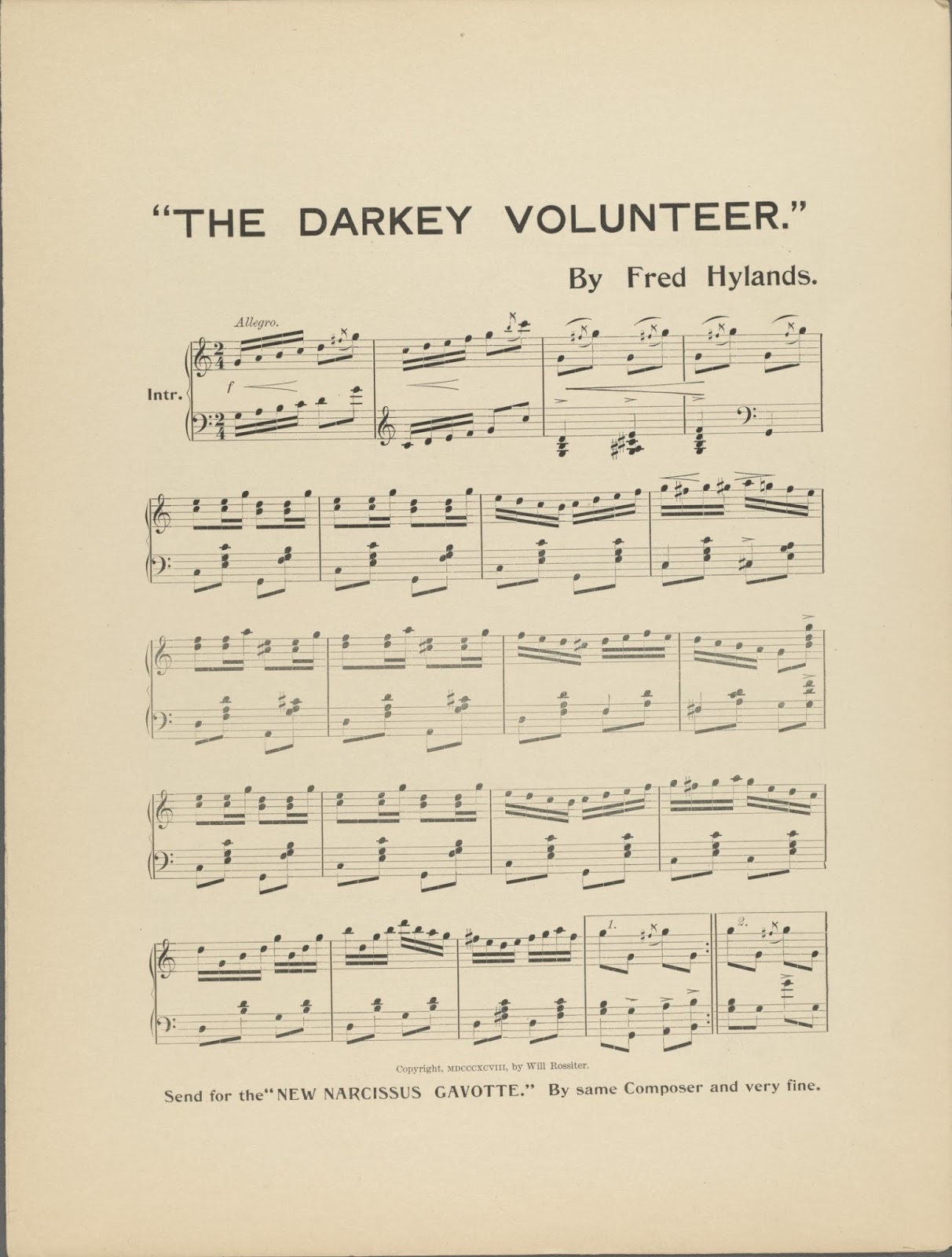
The Columbia house orchestra was a stew of musical misfits, from confident and classical William Tuson, to ragged and rough Fred Hylands. They were all selected by the bewitching hands of Master Edward Easton himself, each getting his approval one-by-one, so it's assured that they were well-liked musicians among the picky management. Most of them were Germans, with some odd sprinkles of English and Bohemian here-and-there, so they were a mix of European stew. Much of their repertoire before Fred Hylands came along was popular music, with the arrangements made by Tom Clark, and older ones that were handwritten by Issler. Many more soloists were recorded with the Columbia orchestra in their earliest days, as for some reason, this idea faded away as the years went on. Though Len Spencer was not one of the musicians in the orchestra, he was a member regardless, as he did all of the sound effects, many announcements, and even sung some choruses on the popular vocal selections they recorded in 1897-1899. Hylands was not the first pianist under this new orchestra in 1897, as it was originally Issler, but after about a month or two, they got their new trial-pianist some work, by playing in their house orchestra. Leader man Tom Clark found Hylands a complicated character, and did not like a lot of his habits, as did many who worked at Columbia during Hylands' term. Hylands made some of the arrangements they recorded in 1898, though Clark was the one who did the arrangements, Hylands still did many of them, and his arrangement of "The Darkey Volunteer(s)" was a real doozy. After an exhibition one night in July 1898, Hylands came in the next morning exhausted and hungover, but with something new written down for the orchestra. The first to see it was Clark, who at once got out his cornet to try and play this piece as written. It was fully of comical quotes, and had runs of notes practically spilled in long streams in the melodies. This piece was:
Yes indeed. 
Everyone else in the orchestra looked at it with unsure scowls, as when they got to practicing the piece, it sounded very strange to them, but Hylands yelled out to them and stopped them when something wasn't right. When they recorded Hylands' tunes, he owned the room, and all the people in it. There were few times when it was hard for the musicians in this group to stay together, but when recording this tune, this was very much a problem. 
Here's the band recording of it(with Hylands on piano): 
Recorded in 1898(not sure who the announcer is...)
It's like the man was messing with them. The tune is already hard enough to play on piano, then try to get twelve musicians to stay together playing it. He must have told Clark, "Oh no, it's not too difficult. It will sound perfect!" In the orchestra recording of it, George Schweinfest and William Tuson can be heard very well playing those ridiculous lines in unison. 1898 was the peak year for the Columbia orchestra, as they had all their best musicians playing great always, and they could play anything they Mr. Clark picked out from the old pile or created new ones. In many recordings of Rag-Time they did, oftentimes Hylands was wanting to play a different rhythm than the one chosen, so everything sounded all weird, such as on their take of Monroe Rosenfeld's "The Virginia Skedaddle" from 1898(begins at 8:05!). The rhythm sounds all out of whack at some points here. From what I can hear, it's the piano that's causing this. but of course, nothing was as bad as their 1899 take of "Smokey Mokes" from 1899(begins at 57:48!). I don't think it could get as bad as that one. At many points, Hylands is a measure behind them. He might have counted off wrong, or he wasn't paying attention to the rest of the orchestra. It's especially bad toward the beginning, but he remains a little out-of-whack throughout. The rest of the orchestra is fantastic though despite Hylands' strange ignorance. The problem is that the piano is so loud on this one, that it's hard to avoid. This was a problem that leader man Clark ran into when learning how to manipulate stubborn Hylands, and the evidence in clearly stated. After 1900, some special recordings with vocalists and the Columbia orchestra began to show up more, such as Dan Quinn singing "Pretty as a Picture" in 1900, and Spencer singing Hylands' "You Don't Stop the World from Goin Round". After 1901, they were recording many instrumental Rag-Time pieces, and re-recording some older takes as well, such as their 1902 recording of "The Darkey Tickle"(from 1892!), and their 1901 take of "The Darkey's Dream". They also took on the classic Rag-Time cake-walk "Creole Belles" recorded in 1902, and this strange recording of an oriental dance called "Obaja" recorded in 1904. They also recorded "Peaceful Henry" in 1903, but the people who put that up took it down from their site, which is really frustrating, because that was a masterful piece of early Rag-Time. By 1903, their specialty for "descriptive selections" was beginning to fade, as they were not as popular to record buyers by then, though they did come up with a few new ones, along with recording old ones. Here's Len Spencer's specialty with the Columbia orchestra called "The Levee Scene" from 1903. They ran out of time at the end, and this time is was a bad failure, before their last chord, the record cuts out. As we know, the Columbia orchestra had been known for their variety of fun "descriptive selections" since the formation in 1897, with a strange mix from "Charge of the Rough Riders"(hear Hylands sing!), to their "The Village Orchestra". The spark of playfulness that was had when they made these had faded by 1903 and 1904. They still had many of the same musicians, but they were not exclusively in the Columbia studio by that time, so these selections were not as much needed. By 1904, they were mostly recording popular dance numbers, such as many popular marches and songs such as "Hiawatha".  By 1905, the Columbia band led by Charles Prince was taking over the old orchestra spot. Only a handful of columbia orchestra selections were offered in 1905 and 1906, and with many of the original musicians dropped by the end of 1905, it was inevitable that the group would end by 1906. They were a unique and fantastic group of musicians who we now have the absolute pleasure to hear on hundreds of records from 1897 to 1905. Many of their selections were unique to only Columbia's orchestra, not any others, like the Peerless orchestra, or the Edison orchestra.

Here are two of their great selections from every year they made records:

1897:  "The Jealous Blackbird" with George Schweinfest
"I thought I Was a Winner" with Len Spencer

1898: "Jolly Fellows Waltz"
two takes of "Schubert's Serenade"

1899:a recording with the Imperial Minstrels(listen for that yell at 35 seconds in!)
"Upon the Golden Shore" with the Imperial Minstrels(Hylands is kind of out of sync again...)

1900:Ethelbert Nevin's " Narcissus" 
"The Santiago Waltz"
1901: "Kentucky Jubillee Singers Scottiche" announced by Dan Quinn
"The Sea Flower Polka" by Tom Clark and the Columbia orchestra

1902: their re-recording of "La Serenata Waltz"
"Smokey Mokes" played a little too slow on the trasnfer

1903: Their re-recording of "The Darkey's Dream"
a hot piece of Rag-Time called "The Dixieland March

1904: a hot "Slow Drag Cake-walk" called "Jovial Joe"
their re-recording of their famous descriptive selection "The Bugler's Dream"

1905: This is the last one I have found with Hylands still on piano in the orchestra, "Selections from 'The Yankee Consul'''
The other ones I have found from '05 don't have the piano accompaniment, and that was actually a very important aspect of their unique sound. 


Hope you enjoyed this! 


Saturday, May 28, 2016

Character Studies--George Schwienfest (c.1862-1949)

in c.1898
in 1894

This Issler "dropout" as I call Issler's orchestra performers who literally dropped out of that group for the Columbia orchestra, began working under the obliging of Edward Issler in 1889 for Edison's phonograph company, then in only a few months, he and the rest of the group were all working for North American, then later Columbia, and so forth. One of the first prominent things that Schweinfest ever did in ways of recording was making a handful of piano solos and duets with Issler in 1889. It's strange to think that they had so much trust and friendship in each other, but the fact that they specifically chose to make these duets shows an element of trust in them. 

To begin with Schweinfest, it is unknown where or what his origins were, but one thing is for sure, he had the same origins that Issler did, as they probably met around 1886, or many a few years before that. It must have been the ideas of Schweinfest and Issler that began their orchestra in 1888. Issler was a first generation American in his family, as both his parents were born in Germany, and he was the first to be born in the U.S., with this, Schweinfest probably had the same situation within his family. Schweinfest was a fantastic musician, with the ability to play at least five instruments; piccolo, flute, violin, piano, clarinet, and maybe more. It is not known what he began playing on first, though violin is a likely possibility. He must have been a very good man as far as the early recording stars go, very musically focused, cooperative, and patient. As from these traits, it earned him a long life, and many music directors wanting him. He was well-liked among the record staff, and Issler used him as an important tool of his, as on the many recordings by Issler's orchestra, you can hear Schweinfest playing different instruments, possibly changing in the middle of a take. With this cooperative nature, all the studio pianists liked him, but they all had to respect him, since he was one of their subs, and back-up pianist if one of them was out for a day, to a few days, to a week, or even if the inevitable happened--one of them died. He knew all the studio pianists, from Gaisberg to Bachmann, even if they didn't work at the same company, he still would have known them, and built kind relations with them, as he was no Fred Hylands. His times in the studio were always a breeze, save for the times when he apologized for his piccolo being horridly out of tune, as at Columbia it would be Hylands complaining about that of course. When he worked for Victor, his records were well made always, save for some times when the pianist was not playing the correct chords or just right notes. That, as we know was not Schweinfest's fault, that was Banta, Hylands or Bachmann's problem. He never missed a note, all of the notes he ever played on those solos were right, nothing was missed, ever. If you go through any multitude of his recordings, the conclusion might be made that he never missed any note anywhere. With that being said, it can amplify any mistakes the pianist makes behind him. Once Issler dropped his orchestra from Columbia's catalog, all his musicians weren't exactly sure of what he was going to be doing, so he told them that they were part of the Columbia orchestra from there onward. With this change, we get recordings like this one here:
"The Jealous Blackbird" by Schweinfest and the Columbia orchestra(1897)
As we know, Issler didn't disappear from there, though he wasn't leading his orchestra at Columbia anymore. 
That left Schweinfest, Tuson, and Dana under the rule of Thomas Clark, who was a different man than Issler. First of all, he wasn't German, and that immediately rid of many traditionally Germanic ideals and ways of musicality. Secondly, Clark wasn't a pianist primarily, so that also created differing viewpoints. Schweinfest was perfectly fine with this transition, as he quickly came to befriend the new director and pianist. Clark was fond of Schweinfest, as he was not only a great soloist, but also a fantastic player in a group, and  had that great sense of rhythm that must have come from working with Issler for so long. Hylands was a different tale. Schweinfest was on of the pianists that was replaced by Hylands, which created something there. He wasn't angered over this, as he was one who understood why Master Easton and Vic Emerson chose a low-life Rag-Time pianist to be their main pianist at that point in time. Despite all of this agreeing, he did have to get used to Hylands being there, with all his "baggage", and social issues. Being a member of the Columbia orchestra meant that Schweinfest had to attend things like this:
This is that section I use from The Phonoscope with the ridiculous amount of spelling mistakes. 
Anyhow, the Columbia orchestra is listed, Tom Clark is specifically listed as the orchestra director(of the few times he was!), and Fred Hylands is listed(love it!). As I have explained before, Master Easton held two of these gatherings, one in 1898 and the other in 1899, and considering the circumstances, they must have been very expensive to host, but at least the performers got to perform for their boss at the most expensive hotel in New York City at the time, and probably got some of the most exquisite courses of food they got for a while. Schweinfest had to go to both of these, as he is listed in both of them, not just inevitably part of the Columbia orchestra, but also as a soloist. Schweinfest remained making records as a soloist and with the Columbia orchestra after 1900, though his work outside of the studio remains a mystery to this date. He probably remained working with Issler after 1900, as there's not a doubt in my mind that the two remained friends until Issler died in 1942. He worked with Hylands primarily after 1900, as all of his solo records have Hylands still on piano behind him which probably was not an issue with him. Hylands was still Hylands, even if it wasn't 1898 anymore. It is not known what happened to Schweinfest after he ended recording solos, though he may have remained in some studio orchestra a few years after that. Which studio orchestra? I don't know, but I hope that it was Hager's orchestra! 
Whatever Schweinfest decided to do after he ended recording, it surely did him well, as he lived to be 87, and that's pretty much outliving everyone he knew in the earliest days of recording. He didn't out live Clark though, Clark was 89 when he died, and that makes him the oldest of the all the earliest studio stars, though Schweinfest lived the longest into the 20th century. 

It's amazing to think that Schweinfest outlived pretty much everyone in the Columbia orchestra(from Hylands to David Dana), and everyone in Issler's original ensemble. He also outlived most of the regular studio singers, Len Spencer, Edward Favor, Myers, Dan Quinn, Steve Porter, Russell Hunting, Edward Easton, Vic Emerson, and even Frank Dorian(who lived from 1869 to 1940). 

He even outlived all his managers and bosses. Heh, that's great. 


Hope you enjoyed this!