Thursday, January 18, 2018

A Mysterious Photographer

Not often do I speak historically of photography, but sometimes knowing something about period photography helps in understanding some of the mess I'm digging through. Recently, I was getting a few Ossman pictures together for a cartoon idea, but then I realized something about one of the pictures I was using. 
I opened this picture for the first time in a while, and noticed that it was not taken at the Edison studio in c.1898. I cropped this larger version of this crappy image from this:
Edison? What?
Nope. 
Okay, so the first thing that caught my eye and made me realize that this was not taken at Edison was that wallpaper. I've seen that wallpaper quite a few times in Columbia studio pictures. Just so you can all visually see that this wallpaper is most certainly Columbia's is through this picture here:
We know for certain that this group of musicians is the Columbia orchestra. Thanks to The Phonoscope, we can be assured that these are familiar musicians that we've seen before, such as the clarinetist and the piccolo player. Those two recognizable musicians are William Tuson and George Schweinfest, with any one of the cornet players probably being Tom Clark. The picture above is certainly Columbia's studio, as not only do we see familiar Columbia musicians, but we also see those distinct windows that were on that immense building that Columbia occupied in the late-1890's. You can't see those windows in that picture of the studio in 1898:
Unfortunately the picture was taken just so that you can't see those windows, but everything inside is the same as usual. You can see them here though:
There's those windows!
So anyway, now that we've got that sorted out, let's get back to that Ossman picture. 
We can now see that it was taken at the same place as this picture, according to the familiar wallpaper sheathing the background of every early Columbia picture:
there's that same wallpaper!
So with all of this evidence of Columbia being the location of that crude Ossman picture, what of it?
Well, it's not Edison as the note below it states. So, since I've gathered all of these early Columbia pictures from around the same time, this had led me to question something. 
What's with all these crude pictures?
It can seem curious to look through all these Columbia pictures and find a pattern. What I've noticed about these Columbia pictures is that they are nothing like the well composed Edison pictures from around the same time, and a little earlier. Even the earliest Columbia pictures have a period composition that were taken by a skilled photographer. The strange composition of these Columbia photographs is not typical to what I've seen in general from the time period. They're out of whack and uniquely composed. 

I mean, it would be hard to look at that Ossman studio picture and not see that it's weird. Just like the 1898 exhibition picture, it's clear someone was experimenting. Also, after doing some more digging through my studio pictures, I realized that the one picture of Estella Mann making records was also taken at Columbia...
That same wallpaper!
The composition of these photos is very strange, and I hope that you see why. Not often do we see in an 1890's photograph a picture like the Ossman one, likely taken down the hallway from the main recording room, leaving the door open and taking up half of the photo's composition. Being in an advanced placement art class, my teacher would give that image a funny look, since often photographers are advised to compose the image with balance, but that Ossman picture has not that at all. Even with my inner artiste talking, I love these strange Columbia photographs. They're especially unique, not just from the technical standpoint of noticing the same wallpaper, but also from the artistic standpoint of the weird composition. With all of Columbia's rotten corporate rules and atmosphere, they still had the most down-to-earth bunch of leaders on their recording staff. Another thing to keep in mind with these Columbia pictures is that they were all taken around the same time, within a two year time frame(or so). The time I mean here would be from 1897-1898. Even though I have not used the exhibition picture as an example, that picture also is included in this study. It be about time to use it again anyway:
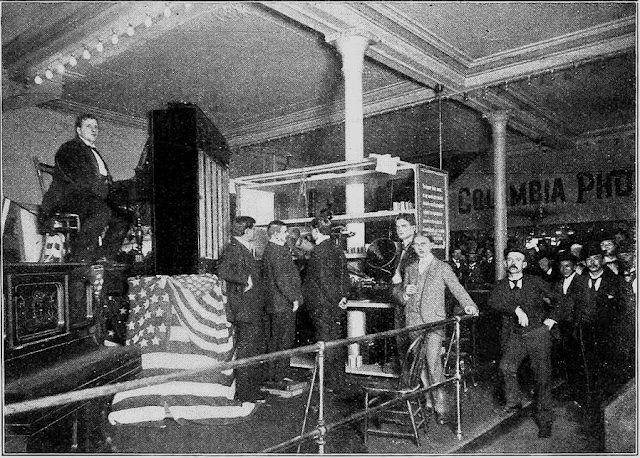
This image is composed similarly strange to the other ones. 
Really look at it. 
This image was likely taken at that rounded corner that we can see in the picture of the outside of the place in 1898. Since we can see all of this, here's the real question...
Who was taking all these pictures?
Of course since there's no "Columbia Archive" anywhere, we can't definitively see who took thee pictures, but we can have some good guesses. We know many of these Columbia recording stars were experimenting through their long recording careers, but the one specific guess I have would be Len Spencer. We know that in 1895-96, both Spencer's along with Steve Porter and Russell Hunting tried entering in the new film business. After that endeavor collapsed, Harry Spencer was left with all the equipment and connections they made, the remnants of this you can see in the earliest edition of The Phonoscope. Considering Spencer's relentless experimentation, it would be too surprising if he was part of the reason for those strange Columbia pictures. Since he did have an "artsy" side(being that he was naturally a lefty) he must have had an apt viewpoint when it came to taking photographs. Another reason I think it may be Spencer is because of who is missing in the exhibition photograph. We see Harry Spencer clearly identified, but no Len in sight. I'm not saying that I would always assumed the Spencer brothers to be together, but since the image above is of an exhibition, it would be very likely that Len was elsewhere in that chaotic scene. By elsewhere, I mean "experimenting" with a camera he had. When considering Spencer's nature to experiment, it wouldn't be surprising if he was responsible for that exhibition picture, or the strangely composed Ossman one from around 1897 or so. 
Let me reiterate that picture again, just so we can all see it again:
That's the stranger portion, where we're peeking into the recording room at Ossman while he makes records. It's a clever photograph really, even with the almost too wide door. 
The other seemingly random half of the picture here is this also interesting character:
Who's that?
When looking over this image once more, I almost immediately recognized that guy. He's got to be an Emerson brother. But which one exactly is the question...
Well, as I went to dig through all the pictures of those three brothers, I assumed first that it was the most obvious guess, Victor. We all know about Victor, with those intense eyes and red hair, with a stare that'll knock anyone cold(and not in a good way!). 
There he is...You can just see the evil in his eyes...
After looking at pictures of the three Emerson brothers, I saw that this figure was not Victor, but it was George. 
The handsomest of the Emerson boys, also the youngest. 
You can see that this mysterious engineer in the artsy Columbia picture is George for a few reasons. 
One...That's exactly the same mouth and lip structure.
Two...those distinct ears, that were slightly different from Victor's more pointy ones. 
Three...That curly, wavy hair. All three(there were four mind you) of the Emerson boys had this hair type, but it seems that George got the most prominent variation on this theme, and you can see it in the artsy picture, as can be observed in the picture directly above.

Another observation...if that's George Emerson in the Ossman picture(of whatever it is...), he looks older than his age. Lets say that picture was taken in 1898, so with that, Emerson would have been 22. He looks older than a young chap of 22. Thanks to The Phonoscope we know that he was the sporty one of the brothers. He got himself into tangles with wandering women, and it looks like he was a drinker as well, similar to Victor in a certain aspect. 


Anyway, it seems I've exhausted this topic for now, hopefully I can sometime see the originals of these images and get a much better scan of them, wherever they're kept hidden...


Hope you enjoyed this! 


Friday, January 12, 2018

A birthday with analysis

Well, since I did a post past year on Spencer's birthday, it would seem appropriate to keep with the tradition, since I so greatly admire Spencer and his work. 
Of course when I say "admire" in this context it's not at all in the more attractive context I use when regarding Fred Hager. I cannot enough emphasize how eyeopening those Walsh articles on Spencer. Seeing the sweet side to Spencer described in such vivid detail was heartwarming, and made me see him as a fully realized and complicated human. I'll not stay on that matter, as I described it in that post regarding that, almost moving myself to tears as I wrote it. 
Anyway...
After really reading through those articles a few times, Spencer makes so much more sense, but when I say that, I actually mean he's more complicated. Most of my critical questions regarding him have still not been answered, even after reading all of the articles in great detail. But one thing was evident, after reading the articles, it's clear that the idea of Spencer having two sides is certainly true. 

He had a good side, and a bad side. 

Unfortunately, we may never really know what his "bad side" was truly like, since it's only the other that is spoken of anywhere, and it's likely only what we'll see. This "bad side" was referred to in the articles, but not at all by the daughters(which is probably a good thing). Only from his second wife "Liz" do we get slight hints of something else within him that never showed to his beloved daughters. Of course, what we are teased with is what we crave to know most, and this is exactly what perpetually peeves me. Any time I get to thinking about Spencer, I am reverted to thinking of what his unspoken side was like. The only one who would have known about Spencer as a whole was his wife "Liz", but she fiercely remained silent regarding her affairs with Len. His daughters were all too young to remember him in the 1890's, and only saw him after he had seemed to have calmed down a little(after 1900). From thinking of how his records sounded in 1894-95 compared to 1898, and then to 1906, he  went from a wild youngster with an infectious laugh to a slicker type with perpetual wise cracks. He had all of these attributes throughout his recording career, but these specific characters he played became dominant in his recordings at certain periods of time. 
(he probably wrote this signature left-handed)
A lot of these changes in character must have corresponded with changes in his life, whatever they may have been. 
Other than typical standards of the time, there must have been a reason that Elizabeth was so quiet, and refused to speak of Len. Since she refused to do so around the girls, it must have something to do with Liz and Len's relationship. The suspicion I've always had around his quick and long separation from her seems to rightfully be there, since Walsh seemed a little weirded out by it when he described their marriage in detail. Just to refresh those who forgot exactly why their marriage was strange, they got married in 1892, but then after a few months they separated, and then they remarried in 1895. Since it's also evident that the studio staff gossiped like mad about Spencer, they most likely spread all sorts of stories around regarding this strange separation. Throughout most of his time working every day at the U.S. phonograph company, he was not having to go back home to see Liz. And as expected from Len, once they  remarried(for whatever reason), they got right to business. Just as a side note, the reason I implied that he got right to marital business is that he did that with his first wife, though to the disappointment of all the family, he was only 18. I hope you all know what I mean here with "getting to business", please, don't make me explain it...
When speaking of why Liz was so quiet and reserved(other than standards of the time), all sorts of theories come up. I have had long conversations detailing why this may have been so, some outrageous claims have been made, but some logical. It wouldn't be surprising at all if Len was a frequent cheat, or that Liz hated his gambling habit with a passion. Both of those are very likely true, but it seemed Len was never immune to the vices of a few Columbia staff members. Russell Hunting and Fred Hylands were particularly bad influences on Spencer, or maybe it was the other way around? 
Len's saintly mother knew he was a "wild child" and spoke often of how that was true. She must have resented him, and he must have felt the same. Another layer to Spencer's complexities, was his bitter relationship with his mother. Though some of The Phonoscope sections that mention her say otherwise, there was no way that she enjoyed hearing of her son's ramblings and capers from work. Since he clearly did not hold Liz to an equitable standard, without doubt his mother was cross with him. His mother must have approved of the kind atmosphere that he provided for his daughters, while at the same time scolding him about spending so much time away from the family. In one of the articles, Ethel recalled that her father didn't see the youngest daughter Clara until she was three weeks old. That alone says quite a lot about Spencer, as I would assume he did that sort of thing often. Of course, I'd assume that this was more common with him before 1900, especially in those days of the publishing firm with Hylands. I'm also sure that the family did not at all approve of Hylands, they probably saw him as insensitive "white trash"(excuse my terminology), and probably was kept out of the house. Many others of his co-workers likely had a similar status to Hylands in their home, though the more respectable ones like Steve Porter and Roger Harding were held to a different standard. 


So all of this brings to me the ever illusive question,
what was his bad side?

Of course there's no way to know at this point in time, but we can piece things together from outside sources(by this it's meant other than the family). Fred Gaisberg's accounts of Spencer remain the most questionable and tantalizing of them all, since they regard a side to him that we wouldn't see with the family. Fred Gaisberg not only described him as "particular pet", and specifically stated thus:

Perhaps because of his unsavory reputation, my particular pet and hero of this time was the handsome Len Spencer. 
Later on in the section, Gaisberg elaborates on the subject of his "hero" of his earliest days at Columbia in 1889. 

Later I was always to remember his handsome face disfigured by a scar, the result of a razor-slash in an up-river gambling brawl. he was said to have been an adroit poker-player.
(both of these sections came from A Voice in Time)
In so many ways I agree with what Gaisberg says here, but what's interesting is that many of these comments were contradicted by the accounts that Walsh collected. However, the accounts of managers and fellow co-workers have a sort of value to them that the family accounts do not. Though Gaisberg is not always the best source for these accounts, as many of them are twisted around and exaggerated, but his accounts of Spencer are very realistic, and help us better understand(to a certain extent) why he had this "unsavory reputation". This exact term that Gaisberg used is exactly what I mean by his "bad side". Long before I had the privilege of powering through that book(A Voice in Time) I got little bits of that reputation from all of the usual sources, such as The Phonoscope, even his fellows were hinting at it here and there. 
A perfect example is this infamous section from August or so of 1898: 
Ah yes, that one. 
This hints at another aspect of him that all of us can see in pictures of him, but have very little written evidence of it. 
We all see his rugged face illuminate any picture he's in. Just as Gaisberg described, his face seemed marred by something, and unlike the account, it didn't seem a razor slash was the culprit. By this, I mean that being a ravaging alcoholic may have been the answer. The evidence lies in pictures of him, and in that single Phonoscope section listed above. I'm sure this idea is nothing that Liz would have spoken of, even if directly asked the question. Being involved and rambling around with those Columbia "sports" must not have helped his case, though since he had so much status at Columbia, he was likely the leader of this group(or "fellowship" or whatever you call it...).

 With his clearly dominant influence at Columbia, he likely took a stand to lead the group whenever orders were given from the management, or some serious changes were made in the studio. At a certain point in time, Fred Hylands attempted to take over this role, since he did essentially have the power to do it when he was their house publisher, but he abused that power far faster than Spencer could have expected. 

Other than his addictive side(whether it be alcohol or drugs of any kind), I have pointed out before how he was also a "two-timer" for all of these record companies. He may have been a leader, but at the same time was a first class hustler who was ever loyal to record companies, at whatever costs. He would even do a midnight raid of one company to earn back trust. As we recall that story of him and the Emerson brothers raiding U.S. for Columbia, keep in mind that his gambling habit may have also forced more sneaky under-the-table deals with record companies. 
For the raid, that's how he covered his tracks...using The Phonoscope.
Other than that bust in 1897, and the one in 1894 or so with the North American lawsuit or that weird thing Columbia went through from 1893 to 1896. He clearly had his hands in that weirdness of Columbia around 1893, much like the second time Columbia almost died in 1896-97. Spencer's greed kept him in a smart place at all times in the early days, his hustling skills forced him to learn which companies were best to remain with. While it was a good thing in terms of remaining in the business, it also became part of the so-called "unsavory reputation" that Gaisberg described. 

So even with all of this information I've pieced together regarding his "bad side", I still have no candid evidence of this side to him, at least not from the most reliable sources(his family). But from what we can see, he was a wild man with lots of complicated layers to his soul. We often wonder about this so-called "unsavory reputation" regarding Spencer, with only bits and pieces of what it might actually be, though there is enough to slightly understand how his fellows at work saw and spoke of him. His friends at work often spread rumors about him, one of them was mentioned one of the Walsh articles, and it was kind of regarding his first wife(?), though the names were all out of whack:

...Margaret Agnes Kaiser, whose foster parents were named Allen, is the "Elizabeth Allen" that old-time Columbia officials thought Len married in a runaway match...

I still do not know for the life of me what "runaway match" means in this context, please, if someone knows please leave a comment on this post.
Okay, at least that kind of explains where Spencer got that strange pseudonym from on his early records. Luckily, someone put up one of those highly desired records by Spencer with that strange "Gary Allen" pseudonym, so now we can hear one of them!
here's the c.1891-92 Columbia with Spencer using that pseudonym
Even though the speed doesn't really sound right, it's still clear that he sounded much different before 1895. He most certainly became a better singer as the years went on. It would be interesting to hear an early "Ethiopian song" that Spencer recorded, as by 1895 he was already well-known for such songs. 
Allow me to zoom in to the little thing on the top of the cover...
This tune was published right before the term "coon song" was used to describe these early "rag" songs. 


At this point, it seems I've said all I really need to say about this matter, since you all know my opinions and feelings regarding Len Spencer. Since it's his birthday when I'm putting this up, everyone ought to get out all their Spencer records, and luckily, there's quite a lot of them out there. 


Still hoping day by day that I am contacted by the descendants of this fantastic family, with so many fascinating characters baring the name Spencer. 
https://www.youtube.com/watch?v=Nxo1FJev4G4


Hope you enjoyed this! 


Saturday, January 6, 2018

Some more studio politics

Now that the holidays are essentially over, hopefully I can get back to making more blog posts, since it's still been hard to find more interesting information to talk about. 

Recently while searching around for quartet records, I came across a very strange record that hadn't even a record number to be found. The performer listed in the announcement of the record was given by the familiar voice of this chap:
Steve Porter.
So the creation of this strange record seems to have been facilitated by Mr. Porter, though the leading voice in this so-called "Diamond Quartette" would most certainly be George Gaskin. This record is centered around a parody on the hit "I'd Leave my Happy Home for You", but on the record it is called "I'd Leave my Job to Vote for You"(haha). 
Porter's announcement begins with this, 
"republican campaign song..." 
after the announcement the lovely and unmistakable Ragged playing of Hylands lumbers through. 
Of course on this record, there's a mot more than just Hylands and that Quartette. It seems that in this quartette, there was Gaskin, Porter, Roger Harding, and George Hargraves. This witty parody is rallying for William McKinley's campaign in 1900, and throws William Jennings Bryan and the Democrats in the dust. Sorry, it's one of those records I can't share out of kind courtesy to the owner. 
So, in past digging, I had heard of such campaign songs and rallying done by a certain group at Columbia. Those "clan" members at Columbia(let's say Harding, Porter, Spencer, Gaskin, Emerson brothers, Hylands at this point in time) were most certainly prominent politicos in their time. And with that, it can further be proven by the first Phonoscope section I found regarding their prominence in the Republican Party of New York. 
I hate that these are so hard to read. What a politico Harding was! Harding did quite a lot of rallying. well there ya go, there's that exact group from that record I've described. It's amazing to see an actual written account regarding the group, and then later finding a rather "wild" record by the very same group. Of course when digging all of this up after listening to the record, this brought back the research I did on studio politics a little while ago. Also, while doing some random digging on something else last night, I stumbled across something else telling about a certain someone.
It's clear that I talk about Fred Hylands quite often, and finding new information on him has been very slim the past 6 months. One thing that's fascinating about Hylands however is that his political view and morals seemed to have changed somewhat after a certain point in time. This change was a gradual process, and it took a few years for him to transition. Luckily, that recording and Hylands' associations in the recording business can lead us to assume he was on the dominant Republican side of the Columbia staff(keep in mind not every one of the boys and few ladies was on the same political side). Despite Hylands' more popular relations, he(much like Scott Joplin believe it or not) around 1899-1900 began associating himself with some of the underground people's and political activists. By these terms, I mean Socialists. Those progressive outcasts that were dreaded by every factory and corporation, yes, Hylands began flirting with members of these groups. 
I've made it clear that Hylands switched to the other side by 1904-1905 by becoming a leader with the White Rats, but it seems that a few years before that he was pondering the ideas that his progressive friends told to him. I had assumed some of his actor friends like J. Grant Gibson would have swayed him over, but actually, come to find out it was someone else familiar. 
Well, this "ranting Bill" is Will J. Hardman. 
(cartoon by me!)
Just last night, I went digging for some early roots of Rag-Time on the Johns Hopkins sheet music website, but stumbled upon something fascinating. So what has Will J. Hardman to do with Hylands' socialist streak? Well it seems I found an indirect answer. 
(the date on this one is 1886)
There we go! It seems I found another source of influence for this transition. 
Of course! It makes so much sense now. Hardman was a gifted wordsmith, and now it seems that my hypothesis of his friendship with Hylands was in fact true! I had assumed by how many songs Hylands wrote with Hardman in such a short period of time that they had a bond outside of their music. So at a certain point, Hardman must have explained his world view to Hylands, and since Hylands was already somewhat fed up with Columbia, these new ideas from progressive Hardman must have been eyeopening. Unfortunately, I know nothing on Hardman at all, but because of the age of the other pieces I've dug up, he was most certainly older than Hylands, probably a decade older as far as I can guess. That would put him at around 38 by the time he met Hylands. Without a doubt, in 1900, Hylands was keeping his rebellion and disenchantment well hidden, since he had to participate in many of those political gatherings that Harding organized. By the time of the publishing firm with Spencer collapsed, Hylands was essentially outcasted from the tight pact that the Columbia staff had in the 1890's. With the shunning however, came Hylands' opportunity to go the way he desired, and head off to become a "Knight of Labor". We know his first try left all his old friends at Columbia a little frightened while also made him the laughingstock of Columbia and the Broadway community. This Socialist leaning left some of his old Columbia fellows concerned, and it must have made Len Spencer roll his eyes. 
Spencer after 1900 went a different direction as well, he was still a solid Roosevelt Republican, but his entering into the business aspect of vaudeville took something out of him. Spencer was unhappy with the progressives like Hylands and the other Union men, and this must have worsened over time when he had to deal with quite a few scrambles regarding union members and leaders. Of course, before his "falling out" with Hylands, Spencer would have seen bits of these progressives, as Frank P. Banta was part of a musicians' union, despite the contradictory nature of his employers. 
Since Hylands' relationship with Hardman was relatively close for enough time, it's likely that Hardman was part of Hylands' political transition. Another thing to note from that sheet music cover I found, notice the other titles listed under Hardman's name.
"For one day of Turkey there's six days of hash" 
well well Mr. Hardman, that's an amusing title certain. The words above the title are also interesting:
"an injury to one is the concern of all"
What a Socialist remark that is. Much like the cartoon above, I can envision Hylands being hypnotized by Hardman's ranting, since his lyrics were perfect with Hylands' weird often drug-induced Rag style.(think about the multiple meanings for "hash" in the title listed above). Keep in mind that Hardman's lyrics to Hylands' songs are very weird. They're strange even for the time period, and weirdly poetic all the same. 
Really listen to those lyrics, they're funny but really weird and have a few nearly unrelated lines. 
Of course one can wonder about how Hylands and Hardman became friends, and of course my mind goes directly to them both being den ramblers(essentially the opium equivalent to drinking buddies), who were both second grade musician/composers with unique talents. Hopefully, someone will dig something up on Hardman sometime soon, the suspense of learning little bits about him through his music is starting to get aggravating. 


Before I finish, I wanted to share the two record related finds I got for Christmas. The first thing I saw was an original Columbia box from 1897 or so, and when I opened the box, out popped a bunch of the soft fluff that record companies used to protect their records. I had always wanted one of those beautiful pre 1900 Columbia boxes, as they were colorful and elaborate, much like the late-1890's was in a nutshell. 
There's the pretty old box. 
Now the record on the inside was also really nice too, because it's Dan Quinn singing "put me off at Buffalo" from around 1898 or so. 
I'm looking forward to hearing the thing sometimes soon, as it will likely be a varied round of this take:
There's the record and the box. 
And my gloved hand holding it correctly. 
So far I've heard three different takes of Quinn singing this song all on Columbia brown wax. I wonder how many rounds he made of it for Columbia anyway. 
Other than that fantastic gift, I also unwrapped a piece of Hylands published sheet music. He did not write it, but it's another Hylands, Spencer, and Yeager piece, which is always worth my time and money. Of course it's not one with Dan Quinn or Spencer on the cover, but it's about the next best thing. 
there ya go. 
Another Hylands Spencer and Yeager piece is always welcome in my sheet music collection. Any time that certain lady is on a Hylands piece is always interesting to me. 
So I've seen her on three Hylands sheets now...the number seems to keep increasing, as does the evidence of a little fling there. I learned somewhat recently that she divorced her husband in 1900, the year that this piece was published with her picture on it. The charges of the divorce were impropriety. It's very tantalizing to read this, and it legitimately shocked me when I saw it. Maybe sometime I'll do a post on what evidence I have about this tantalizing coincidence....


Anyway...


Hope you all had an all-right holiday season!

Sunday, December 10, 2017

Detailing research and Arthur Pryor

Okay...who did it?

Who's been putting up all the less-than mediocre information on all these early recording stars? A few days ago I went online to dig up a picture of Charles P. Lowe for a friend,and for some reason I stumbled upon this picture:
The nice quality and the fact that it was more of the image than I had seen before caught my eye. But that's not all, the picture led me to a wikipedia page on Issler's orchestra. Okay, I would love to help someone out to get all of the information that I (with help)recently uncovered about Issler, including the basics. I don't want to mess with wikipedia, I find it important to keep independent research on its own, not in a place where it is less-than trusted. Independent researchers have much power, and I intend to keep it that way. However, the only time that I would step in, would be a time like now, since someone took many of my cropped images(from this blog!) and used them to accompany the less-than-mediocre articles on these giants like Len Spencer, Issler, and John Yorke AtLee. I am glad to see some of my research being used out there, but I don't like to see it misinterpreted and not used correctly. 
I promise to stay away from the generic(wikipedia), since that will take me out of this blog, and will frontload too much information to people looking for generic(BUT ACCURATE) information. 
I don't know who you are who did it, but stop taking pictures from here and writing less-than-mediocre articles about the earliest recording stars, and all I have to say is...

STAY AWAY FROM HYLANDS.

Let me handle that subject. I intend to use the research I have conducted, and make it accessible to everyone who is curious, but I don't like to see mediocre articles with my research either debunked or misinterpreted. 
I still think it's important to spread the word about Edward Issler though, since he is still very unknown in the record collecting world. Issler really should be one of the most important figures in the early recording world, and here's why this is evident:

-He was the first studio pianist there ever was(the first studio musician for that matter)
I'm sure the man himself would find it absolutely disgusting and depressing that no one remembers his work, which, at first glance seems an endless list. Of course, it will forever be a shame that Walsh didn't go find him, since Issler lived into the 1940's, and was still working into the 1930's. Though it may be evident that he was probably the most bitter old man, he still would have been the best source ever about the earliest days of early recording. 

-he knew literally everyone
This is the one reason why interviewing these studio musicians(not soloists) would  have been the most interesting and productive troves of information anywhere. Issler particularly knew everyone, since he worked for Edison , North American, U.S., and later Columbia the four earliest companies that were competitors. Luckily, Issler had the luck of working for all of them and essential times in their histories. So with that, he would have stories about everyone from Old man Edison to Fred Hylands to young Ada Jones. Think about it, think about all the people he would have known, in the recording studio and not. 

It's very hard to fathom at this point why Issler is forgotten, as he was all over catalogs, and his name was listed all over the place on actual ledgers. 
Look at that. There he is. Not only is he listed as a SOLO PIANIST but also as the accompanist for his clarinetist Willie Tuson. In this early book of ledgers, Issler is listed on almost every page doing something. This is why Issler is essential to studying the earliest recordings, in no matter what context, his name ought to show up almost anywhere. I hope to get to the point where we all know something about Issler and know how long he lived, since that is still a dead end when looking him up. Issler is still pretty mysterious to me, and I don't particularly know that much about him, though it may seem otherwise. 

We know he lived into the early 1940's, and would have been around 90 when he died, which is spectacular really. We still don't know what his relationship with Columbia was like, or any record company for that matter. 
Now I have a bunch of theories as to why he was kicked out of Columbia, or whatever they did. Of course, he may have been well used to how he was treated in the earliest days at Edison and North American, so when the business became much bigger and was becoming something very different, Issler must not have liked how he was becoming more of a wage slave than an orchestra leader. The way that Columbia treated their artists in the late brown wax era was less than mediocre, and this is very clear when examining the treatment of the studio musicians. He was used to being one of the sole managers of the studio, he was used to having much more power over the recording process. This couldn't have gone over well with the strict Emerson's. 
That is the face of Columbia's evil. 
He looks relatively harmless...Nope. 
I'm sure stubborn old Issler couldn't get along with Emerson. Even if Emerson was Issler's manager at U.S. from 1893 to 1896, Issler probably had enough of Emerson by 1898. His disappointment in Columbia must have been exacerbated by Hylands replacing him, who wasn't at all to the musical level that Issler was. Issler was likely the type similar to Hylands in the way that he was not only stubborn, but also intense and strident when it came to negotiations with booking agents and managers. Of course, under Emerson's rule, that wouldn't bode well. Emerson was stubborn and blunt, as we know from accounts of his former employees. Whatever they did with Issler, his recording stopped around 1899. And I really think more people should know about Issler, even if he's still mysterious and only a shadow of a figure in the history of early recording. 


Now to move to something else. 
recently, I have been digging into Arthur Pryor's rags, and I have come to a conclusion. Pryor should be regarded as one of the classic rag composers, on the same level as someone like Tom Turpin. I know that's saying an awful lot, but we often just think of Pryor on the context of his trombone playing. 
we often think of his amazing abilities that still astound trombonists and brass players today. Such as this record:
Amazing. 
All of his solos bring a voice to the trombone that has never been replicated since then. 

There's three of the Sousa band guys, with Pryor at the far right. 
That picture was likely taken in 1893 while they were on their tour at the World's Fair in Chicago. All of them look very young, Pryor would have been 22-23 in that picture. When we look past the pretty face and the blond hair, Pryor was a fantastic Rag-Time composer. 
Underrated is the perfect word to describe his Rag-Time pieces. We need to keep in mind that he had a style that was a mix of the two most essential regional styles of early Rag-Time. In this case, I am referring to Missouri and Indiana style. Missouri is where Pryor came from, so he had the foundation of one of the most important Rag-Tim communities from the start. Later when he had just joined the Sousa band in 1892, he was destined to pick up interesting styles and sounds, and that's exactly what he did. After playing tunes like "Banjo Twang"(the Sousa band is mentioned on the cover of that piece) at the World's Fair, Pryor by the mid-1890's had the right foundation for a great rag composer. This foundation made his Rag style very strange while at the same time very interesting and varied. When we look at his published pieces, we can see they are very different from most of the rags we see out there, and when you get right down to it, his style sounds more like a primitive type of Joplin's style mashed together with Frank P. Banta's style. The thing about his style that is most interesting is how he often put the syncopated rhythm in the bass notes almost as much as in the treble. 
His most outstanding rag can be hard to determine, but my favourites of his are his "Frozen Bill Rag" and "Razzazza Mazzazza". He wrote quite a few more rags, and some of us Rag-Time sheet music collectors are still digging ones up, which is a good sign that there's more to hear of Pryor's musical genius. of course, I haven't said anything about his arrangements yet. That's a whole other thing to delve into, since he was just like Fred Hager, who left hundreds of arrangements without his name on them, but we have outstanding records to learn from. 
Pryor's band was hard to beat in terms of sound and talent, since unlike most of the studio orchestras from 1895 to 1915, I cannot find a single bad take by Pryor, or his band too. They seemed like the indestructible band, and Pryor was lucky to have inherited some of the best possible musicians for his group. 
As I have slowly been becoming obsessed with Pryor, I am trying to decide on a seminar topic for WCRF next year, since the earlier I have an idea the better in this case. With this new found affinity for Pryor has begun manifestation, Pryor is most certainly an option for a seminar. Of course, I will stick to more of what people don't usually focus on with him, his Rags and arrangements. 

Something that we can notice in his trombone playing that corresponds with his rags, is how he had that same kind of smooth but also pushy style that Fred Hylands had, which is a strange connection to make, but makes sense if you think about it. Pryor was on the outside of the recording studio constantly, much like Fred Hager, so we can be assured that Pryor took from his fellow studio bums(that being Banta and Hylands, and even Justin Ring). We are lucky to be able to see what he took from them, as even rags like Banta's "Ragged William" sound like some of Pryor's rags. 
take a listen:
Banta's style was pretty similar to Pryor's, in the way that both their styles were naturally manifested.

what the %$#* does that mean?
(naturally manifested)

In this case it means that both of them had a style that was not strictly taught and fostered by traditional methods. They were naturally drawn to their styles by high musical abilities, like perfect pitch and perfect rhythm. We know Banta had perfect pitch(thanks Dan Quinn!), though we can't say for sure whether Pryor had either of those things, it's at least likely one of them had him. These two studio ramblers were not really that different, it's just that one(Banta) was confined to the studio for more reasons than just being contracted. Banta had the awful curse of being weakly built and having asthma, so there's another(more horrific and depressing) reason Banta seems to many of us like he was chained up to the studios. Pryor was more of a virtuoso of course, and had the Sousa band and his own to manage and go give frequent concerts, unlike Banta who didn't really do too much outside orchestra work(though he did do some). 

Anyway, I could go on and on, it seems my next post is beginning to take shape after comparing Hager with Pryor, and adding Banta in there. really get into some Arthur Pryor if you can, nothing is bad, ever, it's shocking really. 


Hope you enjoyed this! Sorry posts have become out of whack in frequency...


Thursday, November 2, 2017

Getting buried in Jim Walsh Articles Part 1

What a week it's been for discoveries! In the past few days, I have been reading as much as I can at any possible time of those famous articles by Jim Walsh. As being expected of me, I went directly for the much spoken of articles he wrote on Len Spencer and the Spencer family.  When I had the chance to read the Spencer articles, I could barely contain my excitement, since I had heard of these for 10 years, and had always wanted to read them, after seeing little bits of them quoted everywhere, and then I was finally able to. I was immediately sucked in. It became hard to pry me away from the screen that the pages were on, not even the calling of a teacher could get me away from it easily. Of course the Spencer articles have been the most intriguing so far, even though I have started a bunch more of the others. It's honestly very hard to choose where to start, and it's hard to stay in one place when there's so much to read.

This is one of the most overwhelming few days I've ever had in terms of being  buried in information. 

The Spencer articles are what I started with, and they got me glued to them immediately. Its hard to find a place to start among all of this information, also because Walsh was always going back and correcting information that was incorrect from before. 

I began on Monday with the first article that Walsh did on Spencer, which was in 1947. That article was full of strange mistakes, as he was going off of what he had hard from second and third-hand sources, which, as we well know, isn't always the best to do in this field. Walsh wrote in his first article that the Spencer brothers were twins, and a former student of the Spencer Business college wrote the following account of his time there:

Not even the other students could tell Len and Harry apart. They would go to the blackboard and go through a regular drill, making the same strokes together My father...sent me to the college in the hope that I would overcome my unfortunate left-handedness. Mrs. Spencer was also trying to cure Len of this "vicious" habit...In Len's case the desired result was obtained, for he afterwards wrote in the beautiful flowing hand of his family.

Wait a second, did he just say that Len Spencer was naturally a lefty? Hold on, that's amazing.
Being a lefty, I am very proud of this idiosyncrasy. While yes indeed is can sometimes yield itself a curse, but most of the time, it is something to certainly be proud of, as some of the most brilliant minds throughout history were naturally lefties, even though the ideas that surrounded religion wanted to kill this "curse". To be honest, knowing that Spencer was a lefty says an awful lot. We do think differently, lefties, and we're much more scattered, but certainly stranger. Now All I can see when I imagine Spencer writing anything in that beautiful script, is him writing it with his left hand, even though, as we know, he wouldn't have been seen writing with that "wretched" hand. 

While on this binge, I also grabbed hold of all the amazing images that Walsh used to accompany the Spencer articles. The best one of course was one of him just before he began recording for Columbia, if not around the same time. 
(taken around 1888)
What was so shocking to me about this picture(it's now my favourite of him!) was how innocent and harmless he looks. Never would I have thought to see Spencer so sweet and harmless, considering his wild and reckless nature while in his recording career. It's really kind of touching to be able to see Spencer before the vices of the recording business took a toll on him. With that, remember what I dug up in my last post about Spencer, which incidentally, seems to contradict what new information I've learned on him in the past week. Well, as I've gathered from my past writings  on Spencer, anything on him could contradict something else. Again,this is why he remains endlessly interesting. 
Reading these articles on Spencer and his family(from the perspective of his daughters) really has helped me see Len Spencer as more of a human figure, not just some otherworldly hypnotizing voice captured for eternity. To a collector such as I, before reading these articles, I could still only see him as an immortal voice with that wasn't fully human being, and even if I tried to envision such a thing, that was not possible without reading accounts from the only people who could paint him as human--his daughters. Never had I been so enlightened and touched than to read all of the little things that his daughter Ethel recalled from the relatively short time she knew him. She painted him to be a fully-realized human being, who loved his daughters as much as a parent ought to. Here's an adorable section that almost brought me to tears from how sweet it was:
"cousin Ethel" laughed as she recalled Len Spencer's fondness for peanuts. he liked to take the children to the beach at Coney Island in an old-fashioned open streetcar, and would sit on a street facing backwards, eating "goobers" and dropping the shells in the car. Occasionally for Clara, Myrtle and Ethel's amusement, he would toss one into his mouth and swallow it with exaggerated appreciation. 
He later goes on to write more of Ethel's fond memories. 
"on these occasions," Mrs. Yarbray[Ethel] said, "he wore a wide brimmed hat and relaxed. He went out after dark, fighting 'way out beyond the breakers, but coming in refreshed and vigorous. He preferred it that way. He also liked to stand on the porch, with his arms folded, watching a storm and appearing to defy the elements. His brother Harry was exactly opposite. Thunderstorms frightened him horribly. When one came up he would hide in the bathroom with the shades down until it was over."

That whole bunch of stories was preceded by this:

Her[Ethel's] eyes took on a reminiscent glow as she recalled her tired father's nightly homecomings from his work. He would get off a trolley car on the corner of the street opposite that on which the family lived. The little girls weren't allowed to cross the street, but they would run to the corner, attracted by a peculiarly distinctive whistle which their father always gave once he got off the trolley. Then they would be hugged and would happily trot home with the big, handsome father they idolized. 

Aww...so cute. 
The first time I read it through I could feel almost the urge to cry. This is exactly why this was so enlightening for me, to be able to put a face to that voice, and not just the one that we see in those pictures, but to be able to understand him better, and only begin to understand how complicated he was. Of course, there was plenty more cute stories, but telling ones as well that we'd sort of expect from Spencer.
Such as this one:
we were living in Washington, when sister Clara was born in 1902, and papa made trips and long stays in New York. I remember mother telling me one time that Clara was three weeks old before before papa even saw her...

Well there ya go, that's to be expected. I had assumed that this sort of thing happened, when considering how busy he was, and how frustrating is is for some us to even track him in public records. Again, we don't know why this is exactly, since he appeared to have stayed near Columbia(at 27th and Broadway) around 1898-1900, and luckily this is addressed in the articles, but we don't really know anything about it as of now. Before I move on to another story, here's a great picture of the family from around 1901.
Aww. 
There's Len, but it seems that his mother is also there. Well, that's nice to see. 
Those girls are just super cute, but they're also really intense. The intensity is clearly taking from their father. Also, I think it's important to note that Sara Spencer's hair was very short. In the article this picture came from, it was stated that she was "the original bobbed hair girl", and this can be made clear by the above picture. She supposedly bobbed her hair around the start of the 1870's. From an engraving I saw of her from 1874-ish, her hair appears to already look like Len's hair from around 1896(haha). It's also good to get an image of that fabled "Liz" that Len married in 1892 then split with, then remarried in 1895. Unfortunately, none of these articles have confirmed why all of that happened, and it's looking likely that we won't ever know. 
Speaking of "Liz", Walsh threw in a very interesting bit about her history, that is something we'd never expect:
Mrs. Yarbray surprised me by revealing that she is partly of Russian descent. Although her mother's family name had been Anglicized to Norris, it was originally Nowicki. Her father was a count in the court of the Czar of Russia. After being exiled, he came to the United States and married and American girl. He retained the Russian spelling until he died, but his daughter and two sons preferred Norris. 

Wow! A royal Russian, how interesting. She does look like she could be a blue-blooded Russian. In the paragraph just above came the most curious, and perhaps the most disturbing line of the entire article:

"Cousin Ethel" said, in remarking, that some of the details of her father's married life were obscure: "It has been over 35 years since I have lived near mother, and she was always reticent about discussing her affairs or papa's life, or anything for that matter. Mother was very quiet and felt that the less was discussed, the better for everyone."

What? Come again? That's a little disturbing. Okay, to be fully honest, when I saw that section a million things went through my head, and I was very rather shocked to read such a thing. 

A silent woman disturbs me...

Particularly in the situation here. Clearly Len was a very interesting guy, always doing something new and ever-curious, but to see that his wife was silent about their married life, and about him can spark all sorts of theories. She lived a long time, and could have been interviewed by Walsh, and I had always wondered why she wasn't interviewed, though now I see that such a thing wouldn't have happened in the first place. I can't, and really shouldn't, go on a rant about what theories I have now about why she was quiet, but there could be signs of impropriety on Len's part, since he was clearly a wild bull and stayed plenty of time away from his family. You are aware that I have stated in the past as a hypothesis that Spencer stayed with Fred Hylands often when he had that publishing firm, and that can at least explain 1899 to early 1900 kinda. But then again, that is only a theory, though it would make sense, since in the 1900 census(where we can't yet find Spencer) Hylands had a guest and his wife as boarders. Other than staying with "bad influence" Hylands, we know that the phonoscope and "guys from work"(fellow Columbians) had a dark and a not-so-serious outlook about what they heard around the studio. Speaking of that, one of the more disturbing sections from the same article regarding their married life read thus:
(this is regarding Spencer's unfortunate first wife, kinda...)
Mrs. Yarbray believes Margaret Agnes Kaiser, whose foster parents were named Allen, is the "Elizabeth Allen" whom old-time Columbia officials["guys from work"] thought Len married in a runaway match, and that the intervening years caused the name to become confused.
That sure does sound like the crude Columbia staff we know and love. I'm not sure what that means exactly, or which of his wives they were referring to(maybe Margaret? whatever...). These sort of stories are similar to the little puns that they would throw in The Phonoscope about Spencer, just like this one:
Gotta love playful alcoholic jokes!
Yes, this is exactly what I mean here. It seems obvious to us as collectors that he had some habit, just from seeing those pictures of him, and thinking of blurbs like the one above. Most of us can come to a consensus that he was an alcoholic, but of course, do we really know that? No. But! we do have subtle jokes like the above blurb to help us see how his friends from work(at U.S. and later Columbia) saw him, and how we can piece him together. Of course, I have tried my best to piece together his darker side, but of course, before I can know all of that, it's good to understand his soft side through the adorable recollections of his daughters. When reading these accounts, we only see that one side, and get little hints of another throughout. Though, after getting lots of time to think over this figure and his family(especially his saintly mother), I am ever more motivated to one day write a book detailing the fantastic life of this monumental human being. Now that I can see him as he truly was, he seems more human when his voice blares from a horn or through various kinds of eartubes. No longer, after reading Walsh's wonderfully insightful and well composed articles on Len Spencer, I see not as much a crook for wages under Master Edward Easton or Victor Emerson, I also see a flawed, but fully realized human being, who raised his daughters to be lovely and intelligent women with fascinating stories that will continue to be told by collectors from generation to generation, as long as Len's voice blares from phonographs and graphophones and anything else. 


Before I end off, here is a picture that really was touching to me to see:
That's baby Len Spencer, taken in December of 1867.
Even before he was a year on this earth, the sense of humor and love for life was already there, long before the innocence was lost and before recording corrupted his soul, but was able to make him save space for his daughters. 


Hope you enjoyed this!