
That's Collins and Harlan around 1916-17.
 (and that's a sketch, by me, of Hylands in 1898)
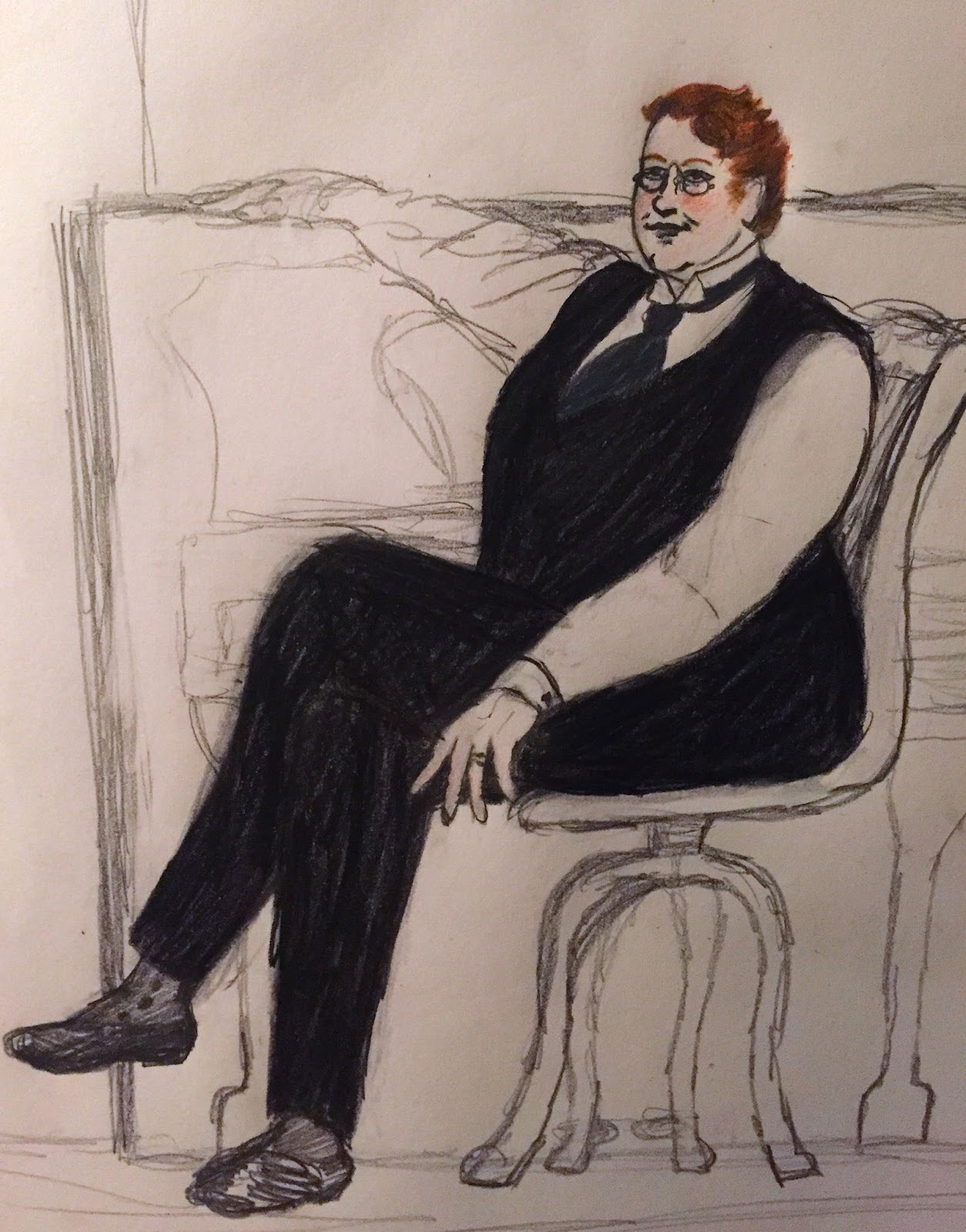
Now I think I have said this before, but the only reason I don't speak of Collins and Harlan very often is because of the amount of researching I had to do for my seminar on them back in 2014. It was so much information about them, it made me sort of "sick" of their records for a while. It was so much on them, so much listening, and all else about them. I had to take a break from their music for a while after that seminar.
I still have a deep liking for them regardless. Not exactly the same kind as before my seminar, but it's a more "enlightened" view, which is in a little bit more detail since then. It was much more complicated than I knew back at my seminar, more than I thought it was.
A subject that I have been digging into a little bit this evening is some thing that I have briefly mentioned on this blog, Collins and Harlan with Fred Hylands on piano behind them. It was a very convoluted thing really, with those three personalities in a single Columbia studio. From what has been said about all three of these characters, one could easily come to assume that these sessions were battles of not only music, but power, strength, and penetration on the records. At some odd times(many as a matter of fact), Hylands was the loudest sound on the recordings by these three, which was certainly not at all intended. Hylands ofttimes played very loudly and powerfully behind Collins and Harlan, usually playing them with his music, smiling and looking out to them with an expression intending to say, "Look at this boys!" Since they were all good friends, Hylands was very kind and comfortable being around them in the studio, even if he and Collins were at constant battle with their presence in the room.
On every record I have heard where Hylands is behind Collins and Harlan, he's showing off all his tricks, all over the place. That was a typical thing with Hylands on many records, but when he was behind Collins and Harlan, it was especially so.
Anyhow, here are some examples of Hylands behind them.
This first one was a popular number in 1901-02 that Collins recorded first with Joe Natus, but later with Harlan, as was the case with many selections of theirs. Here's Weber and Fields' "Tell Us Pretty Ladies" from 1902.
This is a prime example of Hylands "playing" with them, throwing in all sorts of trills and arpeggios everywhere, missing notes occasionally from looking away from the keyboard, and hitting some nastily loud octaves. There aren't too many records where you can really hear the pianist using the sustain pedal, but this is one where it's very prominent. This is so much so that it reveals some of the "wire" like aspects of Columbia's practically "dead" piano(well, it was beaten half to death by the man who's playing it on this record...). It's a great record in many ways, even if Hylands is much better recorded than Collins and Harlan for some reason. You can literally hear every note he plays here, no questions asked. There aren't many records from the piano accompaniment era(1889-c.1905) that have that amazing range(and sense of dynamics!).
This next one is a rowdy one! Now it's not really intended to be that way(hmm, starting to notice a pattern of Hylands making records not exactly as intended to be...) it's supposed to be a sort of dainty comic song, and that's what Collins and Harlan make it, but Hylands turns it into a rowdy vaudeville act. The one thing that he did on this cylinder that makes it that way is the elbow on the piano thing, which I don't think I need to point out, as it's loud and says for itself:
http://cylinders.library.ucsb.edu/search.php?queryType=@attr+1=1020&num=1&start=1&query=cylinder6868
This one really calls attention to Hylands. It's one of those records where someone who doesn't consider the piano accompaniment would hear it and think, "Who's that pianist?", mostly from hearing that loud and absurd smash!
It's very clever though.
I think I have explained previously what Hylands and Collins' experiences together in the Columbia studio must have been like, but just to refresh that idea, I will explain it again. Collins would come into the studio at Columbia after many other artists for the day, like Dan Quinn, Gaskin, Myers, or Ossman. Collins would come in after Hylands had had some drinks, and was tired of most of the day already. He would not just enter the room only physically, his presence would fill the room with him. Hylands would greet him with that charm he was known for, but reluctantly, seeming as though he were distracted somewhat by something else in his thoughts(in saying that, Hylands actually was like that most often when interacting with people, adding to his obvious narcissism, really ponder that for a moment, think back to the quote from Hylands that I use often on this blog...). Collins knew Hylands was a force in any studio, so he tried his best to manipulate him as best he could, though it was hard to, as Hylands was quick enough to catch any insidious behaviors at the right moments. Collins' sessions with Hylands must have been amazing battle really, very entertaining hours of word-play, foul language, and the wit of a Yankee and a Hoosier.
Times with Harlan were a little more kind-spirited. Harlan was not nearly as quick-witted and crass as Hylands, but they understood each other, and felt like they had a genuine connection. Their sessions had much more laughter, jokes, and small mistakes. Of course, Hylands didn't know that they were made a duo until December 1902(two months after they began as a duo), as when they both came in for that first Columbia session, Hylands must have been pleasantly surprised to see that they were that new duo the studio managers were talking about. That certainly must have made for an interesting session.
I have the feeling that Harlan never completely forgot Hylands, there's just not really any evidence of him mentioning him in his letters to Jim Walsh in the 1930's(unless I'm wrong and someone has read all of them and can tell me otherwise! If so, please do comment!). I have the feeling that it must have been like how Dan Quinn recalled Frank P. Banta fondly later in the same decade. At least I would hope so.
This is a prime example of Hylands "playing" with them, throwing in all sorts of trills and arpeggios everywhere, missing notes occasionally from looking away from the keyboard, and hitting some nastily loud octaves. There aren't too many records where you can really hear the pianist using the sustain pedal, but this is one where it's very prominent. This is so much so that it reveals some of the "wire" like aspects of Columbia's practically "dead" piano(well, it was beaten half to death by the man who's playing it on this record...). It's a great record in many ways, even if Hylands is much better recorded than Collins and Harlan for some reason. You can literally hear every note he plays here, no questions asked. There aren't many records from the piano accompaniment era(1889-c.1905) that have that amazing range(and sense of dynamics!).
This next one is a rowdy one! Now it's not really intended to be that way(hmm, starting to notice a pattern of Hylands making records not exactly as intended to be...) it's supposed to be a sort of dainty comic song, and that's what Collins and Harlan make it, but Hylands turns it into a rowdy vaudeville act. The one thing that he did on this cylinder that makes it that way is the elbow on the piano thing, which I don't think I need to point out, as it's loud and says for itself:
http://cylinders.library.ucsb.edu/search.php?queryType=@attr+1=1020&num=1&start=1&query=cylinder6868
This one really calls attention to Hylands. It's one of those records where someone who doesn't consider the piano accompaniment would hear it and think, "Who's that pianist?", mostly from hearing that loud and absurd smash!
It's very clever though.
I think I have explained previously what Hylands and Collins' experiences together in the Columbia studio must have been like, but just to refresh that idea, I will explain it again. Collins would come into the studio at Columbia after many other artists for the day, like Dan Quinn, Gaskin, Myers, or Ossman. Collins would come in after Hylands had had some drinks, and was tired of most of the day already. He would not just enter the room only physically, his presence would fill the room with him. Hylands would greet him with that charm he was known for, but reluctantly, seeming as though he were distracted somewhat by something else in his thoughts(in saying that, Hylands actually was like that most often when interacting with people, adding to his obvious narcissism, really ponder that for a moment, think back to the quote from Hylands that I use often on this blog...). Collins knew Hylands was a force in any studio, so he tried his best to manipulate him as best he could, though it was hard to, as Hylands was quick enough to catch any insidious behaviors at the right moments. Collins' sessions with Hylands must have been amazing battle really, very entertaining hours of word-play, foul language, and the wit of a Yankee and a Hoosier.
Times with Harlan were a little more kind-spirited. Harlan was not nearly as quick-witted and crass as Hylands, but they understood each other, and felt like they had a genuine connection. Their sessions had much more laughter, jokes, and small mistakes. Of course, Hylands didn't know that they were made a duo until December 1902(two months after they began as a duo), as when they both came in for that first Columbia session, Hylands must have been pleasantly surprised to see that they were that new duo the studio managers were talking about. That certainly must have made for an interesting session.
I have the feeling that Harlan never completely forgot Hylands, there's just not really any evidence of him mentioning him in his letters to Jim Walsh in the 1930's(unless I'm wrong and someone has read all of them and can tell me otherwise! If so, please do comment!). I have the feeling that it must have been like how Dan Quinn recalled Frank P. Banta fondly later in the same decade. At least I would hope so.
I hope you enjoyed this!

