Showing posts with label Frank P. Banta. Show all posts

Tuesday, November 17, 2020

The Tale of Milo and Rega

  In the last post I hinted at what I'd be writing for this one, and I will do so. 

I never thought I'd have the privilege to go through the prized photographs and papers Justin Ring kept, and after being able to do so, not a lot of what was there was quite surprising. Hager is an essential part of Ring's story, and this has become even clearer after seeing all this stuff. 

Two posts ago I quoted Ring's late-in-life essay, "Gift of Love", more specifically the portion where he mentions Hager, just as a refresher, I will quote it again to start this look into their relationship though photographs. 

Here is what he said of Hager throughout the essay: 


"I continued to play at Ebling's Casino where I met Fred Hager, another musician who was to play a very important role in my future life. Fred played violin. Some nights after work[the recording labs] we would gather the boys for a jam session and they would not go home until morning. 

...

In the summer of 1904[probably a few years earlier] Fred Hager, the promoter, I called him, decided to try the record business which was just coming into being...I saw Fred from time to time as he progressed in his song business. Each time we met, he would try to get me to come in with him and start a recording company."


And that is all he said about Hager. 

Despite it being rather minimal, it is essential to understanding their story. As with Hager's side of the story, Ring also downplayed the closeness of their relationship. He writes about Hager in a way that only suggests a business partnership, but the mere mention of him in this essay is noteworthy. The fact that he takes up almost an entire page on Hager speaks volumes. Ring wrote this essay to tell his story through only his family, yet he takes up significant space for Hager, who wasn't blood related. He didn't grow up with Hager. They would have met, based on Hager's writing(quoted two posts ago), at the end of 1898 or very early 1899. 

(Ring, c.1897, photo courtesy of Tricia Wentz SirLouis)

Ring was 22--going on 23, an assistant to the New York philharmonic, sent to work in the amateur cabaret halls of the lower east side. he had also much potential, and by that time it was likely that he was acquainted with the phonograph. he also likely knew musicians like Frank P. Banta and Edward Issler, who were prominent early members of the new musician's union(0f which Ring was one of the youngest members). It must have caught him off guard to suddenly feel a delicate hand on his back that one night at the casino. 

(Hager, around the time he met Ring)

Hager was 24, just married, and right out of music school. He was looking for talent, as he was assigned by Frank Seaman and the other founders of the Zon-O-Phone to pluck musicians out of their dives and put them into an orchestra he had been forming since at least 1896. He was considered the youngest competent bandleader at the time. He was just kicking around all the dives on the east side, and he just happened to come into Ebling's, likely for some nice dinner and entertainment---and there he was. 

Clearly there was something about that pianist, something about him was different than the other accompanists he knew(like Fred Hylands and Frank P. Banta). His attack was intense but somehow controlled. He could listen but also add on to the accompaniments perfectly. Something was special about him. 

From that moment that Hager came up to him, both of their paths changed forever. The long nights of jam sessions must have gone over well, and stuck so fondly in their hearts that the records they made proved to be exceptional. So much so that Hager kept his write up on them in his scrapbook until he died. Whatever it was between them, that at this point seems very likely to be more than professional as Ring implied, it blossomed in 1901 and 1902. Their relationship was so close and seemingly intimate by the middle of 1902 that they decided to take a few pictures together at a photographer a few blocks down from the Columbia lab. These pictures were so dear to both of them, they they both kept copies of them until they both died. 

Remember this picture? Well, the copy you are seeing here is the one that Ring kept for decades. 

On that same day, they took a few more pictures together, but only two 0f them survive. Ring kept another of the two of them that seems more intimate than the one above. 

 (The writing on the print is Ring's)

I nearly cried upon first seeing this picture. It is so perfect-- it captured their personalities quite well. Another thing I noticed about the picture just above is that they have matching collars and shirts. It is also rather uncommon to see the two of them looking right at the viewer, as the both of them were rather awkward in different ways. Ring's eyes were very bright(difficult to photograph correctly) and he was generally a bit reserved and awkward. Hager's eyes were uneven and the composition of his social skills was questionable. 

Based on the timing of these pictures, they were taken at what I've observed was the zenith of their relationship. They were writing many songs together, working together everyday in more than one recording lab, and spending weeks living together writing and publishing their own music. As Ring said in his essay, "life was good to me" and that it seems in this case.

With Hager gaining more success in the publishing and recording world, he could bring Ring up with him, and that is exactly what he did. They were promoted to publishing with a larger firm in the middle of 1902. This is where Ring's name for Hager, "The promoter" comes into play. Thanks to Ring being brought up as musical nobility, he hadn't much need to push his own talents to others, so such aggressive hustling wasn't part of his nature or vocabulary. If Hager was good at anything, it was his hustling skills. He got to where he was through charisma and manipulation. He wasn't necessarily the best musician, and a decent composer, but his true forte remained in his expert manipulation to rise up the musical food chain. This is also where the term "inseparable" could be implemented with their relationship. As Hager rose up and gathered all the recording lab contracts he could, he took Justus with him no matter what. It was guarantee that blond headed blue eyed Justus would be by his side, and everyone was becoming familiar with this. Naturally, their fellow orchestra men came to know this sooner than the other Tin Pan Alley writers. 

(half of Hager's orchestra, 1902)

"Inseparable" is how Jim Walsh described Ring and Hager in 1962, just weeks before Ring died. I still have yet to know whether it was Ring or Hager who described their relationship in that way to Walsh. After poking through both of what remains of their papers, it is difficult to tell which of them said the word. No matter who said it, they both handled the relationship very differently, and it impacted how they lived for decades. 

When Hager met Ring, he had been married since the end of 1897, and he had one daughter by early 1899. He was a respectable young father, with seemingly no funny business going on, and an already successful career. In mid 1900, his second daughter Florence was born, and by then it seemed he had cemented his normal family life, but something wasn't right. He was spending most of his time at two recording labs, and he was getting to know this mysterious Justus Ringleben. By the middle of 1902, Hager was spending barely any time with his wife and kids. He lived days and weeks at a time with Ring, who at this time wasn't married. These good times with Ring proved to be consequential in the years to come, as Hager's older daughters wanted nothing to do with their father's legacy. It was because of the youngest daughter Ethel that any of Hager's papers survive. Ethel was born after all the initial funny business with Ring had passed(late 1905). She got to see her father much more than Clara and Florence had. Hager made sure to pay much more attention to Ethel, as he wrote many child-themed and novelty pieces when she was growing up. When his daughters were in their teen's all three of them left the house for substantial jobs, giving Fred more time at work and more time with Ring of course. 

Amid some recent research, I realized that Ring and Hager may have reunited in the early 1910's. Ring married in 1909, and spent a few years out of sight of his old friends, occasionally writing songs with Ed Farran and making some records with Eddie King, but more often he was spending time getting to know his in-laws. His in-laws, the Patz family, lived in Fitchburg Massachusetts, and old father Gustav had been in the Boston symphony for years by then. He went to visit the in-laws often when he was getting to know Elsie better, likely spending holidays with them in Boston. 

(Elsie with her parents, sister, nephew, niece, and her daughter Vera, its likely that Ring took the picture. taken c.1911)

On these trips to visit the in-laws, Ring likely set aside some time to visit Hager at the phono-cut lab, or socialize with the Boston Symphony musicians that Hager hired to make records. 

After the Phono-cut disbanded, Ring spent more time with his wife, kid, and dog. He probably had little to do with Hager's operation at Rex, therefore not meeting up with him again until at least 1916. 

They were back together when the Okeh company was founded in 1918, and this time it seems they were going to stay together. The novelty and nostalgia of their time together nearly two decades before must have been part of the reason they got back together so quickly. Just as before, they were writing music and arrangements once again. Hager also had quite a good amount of disposable income at the time, so he had the bright idea to buy a very expensive motorboat. The first boat he purchased didn't work out so well:


 Well after almost killing all the Okeh management, he decided to get another one, as he apparently had the money to do so. 

He kept the second boat for much longer than the first. According to a 1936 local paper article, Hager named this boat Kathryn. Why? I do not know. Ring seemed to enjoy Hager's boat, as within the dozens of photos Ring kept, there were a few of them on that second boat. 


Never have I seen such a happy Ring. 

But of course, there's one picture that sums up everything I've said about them, and it seems quite fitting that it was taken on Hager's boat. 

Yes indeed folks. 
That's Ring and Hager out at sea in what looks like the middle 1920's. It's difficult to date, but it looks to be from before 1930. There's so much about this picture that is informative to their characters and relationship. Hager is wearing actual shorts, and Ring is wearing linen trousers neatly cuffed. They are wearing matching shirts, as I mentioned in the earlier part of this post with that other picture. Hager really looks like an old burnt out executive, but Ring happily has some life in him. There are so many little nuances about this picture that are important to note. Being an artist, this picture helps me understand a lot more about how they looked, from Hager's rounded shoulders to Ring's gentle but sturdy hands. Never have I laughed so much with joy about a picture as I did upon seeing this one. I am so grateful that Ring kept this picture, and that his descendants kept it intact. 


Anyhow, they remained close into the 1930's and 40's, continuing to write music together. They both headed to work on radio shows in the 1930's, as Hager wrote to a local reporter in 1936. Hager, being always ambitious and energetic, slipped on ice and broke his ankle in early 1936. Here is the local write up on it: 

Funny stuff. 
So of course with Ring's kind heart, he had the courtesy to come and visit Hager while he was stuck in bed. Justy as Hager called him. Even at age 60, they still cared for each other greatly. 

They wrote lots of music together in the 1940's, but after the war they both took some form of retirement. Ring officially retired around 1947, but Hager kept going with his paperwork in publishing into the 1950's. Being contacted by Jim Walsh reinvigorated old man Hager, and it might have done so for Ring a bit, but he was reluctant to attend the gatherings that Walsh and John Bieling hosted. Hager told perhaps hundreds of stories to Walsh and other young collectors at the time, and all he wanted to do was give them things from his past. Ring may have given Walsh a few things, but we have yet to find out exactly what he was willing to tell to Walsh, and if Ring even wrote back. 

They may have been split at Hager's death in 1958, but their time together remains set in stone by the many photos that Ring and his loving descendants preserved for decades. So that's the tale of Milo and Rega. 


Whew! Honestly I never thought I'd be able to tell their story in a way such as this. It seems much clearer now after thoroughly examining both their papers. Oddly enough, Ring's papers seem more complete than Hager's, though Hager's may have been extensive at one time. 

I know I promised I'd get back into some more of my new records in this post, So I'll post a few links to crappy transfers I did of the ones I didn't in the last post. 

https://drive.google.com/file/d/1H-Pp9dCyofDAepn2VBIlhmSY75y_J7kp/view?usp=sharing

This one is "uncle Jefferson" by Arthur Collins and Ring on a Zon-O-phone. For years I've had a transfer of this record for its phenomenal accompaniment, but never would I have dreamt I'd have such a pristine copy. 

Any version of this song is good to me, so naturally a Collins version is just as good as any of Billy Golden's. I appreciate that Ring played his accompaniment in a way that slightly imitates how Fred Hylands played it. Just to get the point across, here's Golden's 1897 Columbia of it with Hylands:

http://cylinders.library.ucsb.edu/search.php?queryType=@attr+1=1020&num=1&start=1&query=cylinder11728

This record here is still one of the best concrete examples of rag-time in its earliest form. It's rare that we can hear real live syncopation as it was actually played, and this record shows it to us clear as a bell. 


https://drive.google.com/file/d/19c5lO-VjPrWP84MWdxXKWR_CCwInVCfa/view?usp=sharing

I heard a Climax record of this piece last year and fell in love with it. I was hoping to come across a copy of that very Climax record someday, but this great little 7 incher will suffice for the moment. 

It features some classic very expressive and slightly frivolous Hylands accompaniment. Such is always welcome to my regular listening. It's quite unassuming, and I haven't much to say about it, as it's just a great record. 


Anyhow, I'll have to end it off here, just so the post isn't too long. I've also exhausted a lot of information and mind power on this post. Believe it or not, I actually have another topic in the pipeline for the next post, as I have been getting into more percussion on early disc records. In the next post I'll be exploring the bass drum effect on early discs and the connections between Frank P. Banta and trombonist Arthur Pryor, stay tuned! 


Hope you enjoyed this! 


Sunday, October 25, 2020

New perspectives and records

 Whew! 

It's been a hell of a month for research. I mentioned this in the last post, but now that I have spent time combing through what Justin Ring left behind, it's clear that there's a lot more to see than his 6 page essay!

In the last few weeks, I have been closely studying the photographs that Ring kept, and just as expected, Hager is all over the place! I may have to split up this post into more than one because there are so many pictures to study. In the next post I'll stick to the pictures where Hager is included, and in this one I'll go through the pictures that were of him and his family. 


So, it came unexpectedly to know that Ring became a family man later in life. Considering the kind of life Ring lived in his early recording days, I would have never expected that. In previous posts I mentioned his first wife Alice Davis, whom he divorced around 1906. This marriage was short, and it was likely seen as a shameful mistake to Justin as he aged. I have no idea why they divorced, and it could be any number of reasons why exactly. Considering how much he enjoyed Hager's company, it come as a surprise that he remarried by the end of 1908. Of course in the period between 1906-1912, Ring and Hager were split, so maybe they didn't enjoy each other's company so much at that time. 

According to Ring's own writing(as per the essay detailed in the previous post), he met a young girl named Elsie Patz who had black hair and brown eyes. He met Elsie in 1907 while playing piano with the rather famous show The Chocolate Soldier. This was a big thing for him, as he had finally been invited to perform with the orchestra of a famous broadway production, something he had been wanting to do for years(at least since 1902). According to his essay, Elsie was the understudy to the leading woman in the show. 

an example of one of the covers for a song in the show. 
Ring even kept a portrait of Elsie in her costume for the show. 
There she is! 
It's awfully nice to have several high quality portraits of her, as before I had only that one crappy large group photo of the Okeh dinner. Elsie wasn't just any girl, she came from a long line of prominent musicians. Her father, Gustav Patz, was a in Gilmore's original band in the 1860's, and later a conductor for the Boston Symphony. All of her siblings were musical as well, and thanks to pictures that Ring kept, we can be assured that his in-laws were judging his musical ability closely during the supposed "quick courtship" they had. To the delight of his in-laws and his own family, Ring became a father at the end of 1910.When their first daughter Vera was born, quickly he changed his tune, from a rambling rag-timer to a devoted dad. His daughters were very dear to him, even the beckoning relationship with Edgar Farran at the time wasn't as important to him. 


Of all the amazing pictures that Ring kept, none was as captivating as this one, a serious yet somewhat candid portrait of dad and his dear baby daughter in 1911:
There's something so remarkable about this portrait. I'm not quite sure exactly what it is. His magnificent hands, very stylish hat and tie, and those eyes. I could stare at this picture for hours. 
That picture above made it very clear that he had a change in pace in his life. He was still a dandy, but if a dandy could be a devoted dad, he did it. It makes sense now why he spent a few years away from recording. Not long after this portrait was taken, he moved from the Bronx out to a larger home on the edge of Queens(called Flushing at the time). 
More family portraits like the one above don't come up again until the middle 1920's, after his second daughter, Marion was born. 
As we know, he didn't return to recording until about 1915, and even at that he didn't really resume all the same work he had been doing until Okeh was founded in 1918. He resumed his relationship with Hager around 1916. 
Marion was born in 1919, and it turns out that she became very curious about her father's past, and was part of the reason that her dad wrote that 6 page essay about his life. She knew him when he was older, and became most familiar with him out of context of his friends like Hager and Eddie King. By the mid-20's, Ring had a new member of the family, and it wasn't another daughter. 
When I saw this picture I screamed with joy. I love dogs, so knowing that he had a sweet German Shepherd just warmed my heart. The dog looks so happy here! 
As you can see, there's Marion on the left, mama Elsie in the middle, and Vera on the right. It's difficult to date this picture exactly but I'd say based on the car it's probably late-1920's. One thing that's interesting about Elsie is that in almost every picture of her she's got that big smile. Ring kept portraits of her going back to when she was a little girl, and she still looks extroverted and fun even then. 
Little Elsie around 1891. 
There were portraits of little Ring too, but I'll save those for the next post. Little Ring was absolutely adorable, and serious as always. 
A lot more photos that Ring kept were from the middle 1930's to middle 1940's. Thankfully the cute doggie makes another appearance! 
They look like an interesting couple, and of course the dog is well behaved. There were also two very curious portraits of old man Ring in the middle 1930's. These were taken around 1936, when he was still working for Decca! 
I must admit, as a historian who studies body language in portraits, these two portraits of Ring are very interesting with that in mind. 
Not surprisingly, Ring looks very stylish for 1936, with the short pointed waistcoat and wide trousers and all. he looks like a friendly old man here, with the pipe and all. It's quite amazing that at that time he was still working as an executive for Decca, a very modern record label, at least to many collectors(to me for sure!). The other portrait of him from around the same time is where my interest in body language comes into play. 
There's something about that pose. He's got a sort of swagger that I wouldn't normally expect from a rather reserved man. One thing that has remained constant is the non-existence of a very genuine smile. Those two portraits above are the closest we're going to get to a sweet smile. After reading through his essay, I'd think that part of the reason he didn't smile so genuinely because he had rotten teeth. He and his younger descendants remembered his love of sweets very well, so who knows how broken up those teeth were. 

I'd like to close out this part of the post with a portrait of Justin and Elsie from the late 1930's or so, that seems to sum them up pretty well. 
They seem like a fun old couple. 
It's also curious to note that Ring smoked. Hager, as I found out from gathering his papers, did not smoke. 

So I hope to cover more on Ring's papers in the next post, as I will cover the pictures and artifacts related to him and Hager. Thankfully there were quite a lot! There's also a lot of new information to explore on that front. 


*Thanks so much to Tricia Wentz SirLouis for sharing all these amazing pictures and documents!*


So as I promised in the last post, I will share my winnings from the Nauck auction. I must say, this is one of the best batches of records I've gotten since the brown wax find at a local antique store. I ended up paying the most for a cylinder this time, which came as a surprise. So here's some pictures of the stuff I got:


What a set of beauties! As you might expect, I am most proud of the banta cylinder. When I played it on my phonograph it almost brought me to tears, as it was so loud and clear. There's nothing quite like hearing the playing of Banta right through eartubes on a phonograph. 

So first of all, the Metropolitan orchestra record is some of the hottest rag-time I've heard on a record from that era. It's classic black rag-time led by Banta. It may be a 7 incher, but it packs quite a punch for its size. For years I had been wanting to hear that particular song by Will Marion Cook, as it has such a strange and comical title. Boy how it didn't disappoint! 
Here's a crude transfer of it:
(hope the link works for you!)
So getting this record actually has raised a question. I noticed that the Metropolitan orchestra recorded several very unusual yet very hot rag-time songs on Berliner and later Victor. I'm wondering what gave Banta the liberty to do so, arranging such unusual and rather serious rags like the one above. What I'd like to know is why Banta was given license to do that at Victor, but Fred Hylands, a pianist known specifically for his rag-time, wasn't. Why didn't Hylands get the freedom to record instrumental versions of coon songs with the Columbia orchestra? They did a few songs like "Hello my baby" "My Honolulu Lady" and "I guess I'll have to telegraph my baby", but nothing as obscure and rare as "who dat said chicken in dis crowd" or "The Sun do move"(a cake-walk). 
Banta wasn't known by all for his Rag-time, though it was certainly part of his charm. Hylands was specifically hired by Columbia for his rag-time abilities, so wouldn't it seem strange that all the most authentic and serious rag-time was recorded under Banta's command? 

something to think about. 

So the Zon-O-Phone record of "recollections of 1861" is actually really interesting, more so than you might think at first. The reason I bid on that record is because of the trumpet calls. 
In Hager's scrapbook, there are a few pages that include pieces from Zon-O-phone catalogs, and on one of these pages he saved a write up on the above selection. 
This was taken from a page of Hager's scrapbook.
I'm not sure if I have said it on here before, but I'm pretty sure Hager wrote up all the short descriptions for the records in the early Zono catalogs, as they are very characteristic of his writing to Jim Walsh and in his own papers many years later. So based on that little write up, Hager is playing the horn calls on the record above! Someone told me awhile ago that Hager played a brass instrument, but I wasn't sure whether to believe it. Well, there's your evidence! After getting to listen to the record, I'd say that it really does sound like Hager playing the horn, as it oddly has the same sort of inflections that his violin playing and composition style possessed. His playing was very precise and pointed, through not entirely accurate tonally.

I'll highlight one more of these records before I close out, and I'll include the others in my next post. 
Hager was very proud of his violin playing, and his solo records especially. With this in mind, it's no surprise that he kept a page from a Zon-O-Phone catalog with his solo records listed. I got two of these records in the recent auction, both of which are outstanding examples of the superior recording quality that all major record companies possessed in the year of 1900. Hager's "Hungarian dance" Zono was surprisingly good musically, and in terms of piano accompaniment, it was phenomenal. Both Ring and Hager's playing comes through clear as a bell(though the piano is just a bit louder!). 

So here's the catalog page from his scrapbook: 
Oh how he was so very vain. 
I got his record of the "Pilgrim's chorus" and it is a very well recorded piece as he states above, but I find his description of it more interesting than the actual record! 

"a magnificent record; the violin being loud and sweet and the piano unusually loud to give the variation effect that is so well known in this piece."

Oh Hager, his magnificence! 

I wish he saved more pages from Zono catalogs, as these descriptions are just as entertaining to read as listening to the records themselves. 


With that I will end it here. I'm really glad to have lots to research, and each day I am realizing something new about Ring as I comb through what remains of his papers. More records and photos in the next post! 


Hope you enjoyed this, 
Happy halloween! 


Friday, February 7, 2020

The Scrapbook

In the last post I mentioned the recent news regarding the Hager scrapbook, so it seems fit to do a post solely on this matter. 

After spending several years of knowing about its existence, I had been so anxious to at least one day see what was in it. Never would I have expected to own it. Not only do I have Hager's scrapbook, but I also have what is left of his papers. 
When Jim Walsh contacted Fred Hager in the mid 1940's, he had no idea what he'd be getting himself into. Since the late 1930's, Hager had once again teamed up with Ring to write some music and do some radio work. When the war was over Ring finally decided to retire, and leave the intense side of the music business entirely. Hager didn't want to abandon his life's work just yet, though after the war it seemed dire. Luckily, not long afterward Walsh contacted him, and this sprung Hager back to life, giving him a sense of blossoming hope. With this correspondence with Walsh, Hager became determined to preserve his legacy as well as the other history that he had been part of. Walsh was mostly inquiring of Hager regarding Cal Stewart and of other recording stars he knew(of which he knew them all at some point). 
In the decades prior, Hager kept a scrapbook, with the little spare time he had to do so. He started it around 1900, and kept it pretty consistent until about 1907, from there he hadn't the time to keep it up. Despite not keeping his scrapbook from that point onward, he did keep lots of important papers on himself and of his friends, Cal Stewart and Byron Harlan being two. By the time Walsh was contacting him, Hager had amassed a very complete and vast collection of papers and other ephemera from his fifty years in the business. Hager's writings to Walsh were clearly very passionate and rosy, as you read some of Hager's writing to Walsh, one could easily picture him going on about the past as he looked for things through folders and bound booklets(of which I have a few). You could easily see Hager so fondly going through his scrapbook.  

So what about the scrapbook? Well, I mentioned how Hager was so excited about Walsh and other young collectors like Quentin Riggs being so interested in early recordings that he made, so Hager presented himself to be one of the most generous of the old guys. After a life of aggressive selfishness, Hager wanted to give it all away to those who would appreciate it most(because his family didn't), and for generations to come. With this in mind, he took out many pages from his scrapbook, and gave away dozens of other papers to Walsh and Riggs. So, what's left in the scrapbook is curious. Most of what Hager took out was related to recording, so what's left is everything else regarding his live performances and publishing from 1900 to 1907. 

Hager died in 1958. He moved out of NY to Florida in 1956, and it was at that time that he was forced to rid of a good majority of his papers, but he kept that scrapbook till the day he died. When going through the pages, there are very minor tears at the bottoms of most pages where he grabbed it with his fingers. So he definitely handled the book a lot. He must have gone back and fondly reminisced the past often, wishing that Justin hadn't left the business when he did. 
Remember how Ring didn't attend any of the gatherings hosted by Jim Walsh in the late 40's and 50's? Ring became secluded after 1946, and he refused to write to Walsh(and we know that Walsh wrote to him many times). 

So what exactly was it what Hager was so fond of to leave in the scrapbook?
Well here's an overview...
What the front cover looks like. It's pretty unimpressive. Unlike scrapbooks such as Louis Armstrong's, this one is quite messy and not professionally organized. It was likely better organized when Hager had it, but even then it wasn't anything too special(its literally just a small notebook from the late 1890's). 
The first page:
So...there are dozens of these programs in this scrapbook. Each one does give us a pretty good idea of what his orchestra was playing live, and that what they did play mirrored their Zon-O-phone and Columbia records of this era. 
There's no way I could list out all of these in the scrapbook, but each of them includes interesting selections. This one includes Banta's "Ragged William". At another one of these concerts they played Banta's "Halimar". 
Someone who unexpectedly shows up often in the scrapbook is Bert Morphy. 
(from my collection)
Bert Morphy was known for singing with Sousa's band, and apparently, Hager's as well. No one has any idea where he came from, but he started making records around 1895, and remained a somewhat popular baritone on records until about 1902, then he disappears from there. He didn't disappear from music however. He stopped recording in 1902, but he remained a popular attraction with Sousa and other bands as late as 1913. 
Here's one of his records: 
https://www.youtube.com/watch?v=E2R0wislt0Q
So he shows up often in the scrapbook. As he was a popular singer but his catch for the musicians was that he was an excellent and renowned cook. 
This is one of about 6 clippings where he is mentioned. 
Before I move on to more about the scrapbook, here's one of my absolute favorite cartoons of the period(from the 78 records wordpress blog)
I have drawn Sousa only this way after seeing this cartoon(because it's brilliant and just the right amount of grotesque). 
So, not surprisingly, there are many portraits of Hager in this scrapbook(which is nice for me). He was very much proud of his looks, so it doesn't come as a surprise that he kept several nice portraits of himself in this book. 
Here are a few:
(those beautiful eyes *faints*) As you could probably guess, I stared at this page an awful lot when I got it.
and here's the least flattering one:
Anyway, you get the point, the man was quite vain. If it wasn't clear before all this, it sure is now. 
Here are a few more great odds and ends from various pages:
There are many pages dedicated to clippings on "Laughing Water". 
Shared this in the last post, but it deserves to be shared again. 
Before seeing the scrapbook, I had seen this particular piece. In the near future I hope to do a post on "Handsome Harry", as in the last month and a half or so, I came to discover that this particular term means more than just a popular Hager hit. Stay tuned for that!
The very last page of the scrapbook includes some of Hager's scribbles from who knows when. A particular name is mentioned here that I am interested in. 

So this begs the question, is Ring all over the scrapbook? Well, the answer is yes. As I had suspected, Ring is everywhere in the scrapbook. The thing that is quite striking about what Hager left in the scrapbook is what little there is on anyone other than himself. So of course someone he so admired would be given a full two pages, and from the marks of wear on those two pages, Hager opened to it often. These two pages are this: 
 *rolls eyes*
Gee no surprise there. At this point in time I still stand by my opinions about the two of them, in fact, the evidence keeps piling up. This is no exception to the mound of evidence regarding their relationship. Hager couldn't let go of Ring, though Ring had moved on when he knew it was time to. Hager kept this portrait of Ring to the day he died, something about it must have especially captured Ring's personality and spirit, at least to what Hager thought. 

Anyhow, I'll leave it there for now. There is a lot more to discuss within the scrapbook, but I should split up the information to a few posts, as I'm still currently processing it all, even a month after getting it all. There are bits of Zon-O-phone and Columbia catalogs buried within the pages, which is especially nice. I had never seen an early Zono catalog before seeing the scrapbook, as they are so uncommon. If there is anything in particular you'd like to see or wonder if it's in Hager's papers, do contact me here in the comments, I'd be happy to dig it out. 


Hope you enjoyed this! 


Saturday, January 18, 2020

A trip to the City

A few days ago, I got back from a five day trip to New York City. For many years i had been wanting so badly to visit New York to seek out all the important recording history locations that I write about so often here on this blog. This trip had been planned for a few months, and that gave me time to plan out what I was to do while there. 
In the weeks before leaving, I made a handwritten list of all the addresses to go and visit, to cross them off as I went. There were nearly 30 addresses on this list, and many of them got crossed off. 
Going to all these places was emotionally, and ultimately physically taxing for me. My first day there I was overanxious to start walking down Broadway to 1155 where the 1890's Columbia studio and offices were. I was trembling with excitement, all dressed up in a simple black and white dress dated to around 1901, and could hardly believe I was walking down this famous street, surrounded by all this history. 

Along the way to 1155 I saw a few other addresses on the list, one being 1180(1),where Roger Harding set up his short lived publishing firm in 1900-1901. When I got t0 1155, it was overwhelming. The address had changed so much, yet the number remained the same, and somehow the exterior of the building remained somewhat intact. It wasn't difficult to picture the place in its original state when all the recorders made their way in. 

Wanted to make sure I took a picture in front of the address with something that was sold there. I stood there for awhile, and after mustering up some courage, I approached two security guards standing by the front door. I commenced to lecture these young men about the unbelievable amount history that occurred right where we were standing. Showed them the supplement pictured above, and the several pictures taken inside the building in the 1890's. These young men were unusually curious about this history, and they seemed quite amazed that the columns on the inside of the building are still standing to this day. After lecturing for about 20 minutes, I headed to 28th street where the original "Tin Pan Alley" was. I heard of a recently finalized proposition to make these five or so intact buildings a historical landmark and have them somewhat restored. 
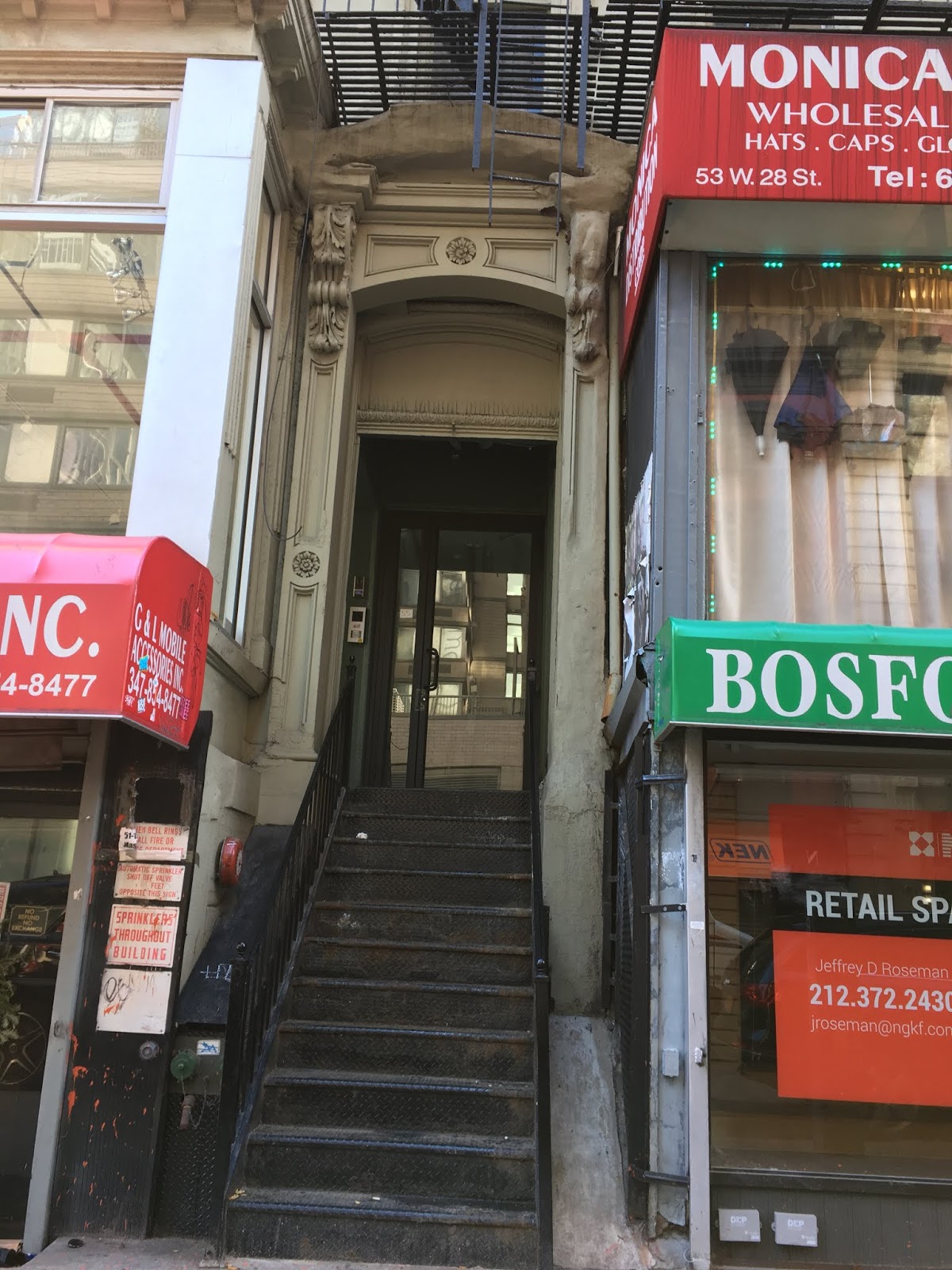
It was so nice to see these buildings, even though they are a bit beat up and sketchy looking as of now, thankfully that is scheduled to change soon. Here on this block and the next included the Witmark publishing, W. B. Gray, Hylands Spencer and Yeager, Helf and Hager, and several more over time. The one specific address I was most curious to see on this block was 55. 55 was where Ring and Hager published together in 1904, and where Helf and Hager first set up the next year. 
After  going to cross off a bunch more addresses in Tin Pan Alley, I set out to Hell's Kitchen where Frank P. Banta grew up. I wrote down the address that the Banta's lived in according to the 1880 census, so this is most likely where Frank and his siblings grew up. As I approached the number, my eyes started to tear up, as I was walking along the street that little Banta once did to go and tune pianos in the surrounding area. 
This building looks very much intact, and probably didn't look too much different when Banta lived there. The house number is even the same as it was in 1880. 


The next morning I returned to 28th street. I was waiting for some friends to meet with, was stupidly early, so I decided to sit on the steps of 55 until my friends showed up. 

Sat there for over two hours, meditating on all the music that was first conceived there. Sat there in the cold and damp with my gloved hands running over the iron bars once held by so many musicians and writers, Ring and Hager being only two of perhaps hundreds. 
When my friends arrived we headed to 27th street where Hylands Spencer and Yeager were. This building appeared to be intact, though it was being worked on, so we couldn't get inside to poke around. Then we passed through where Dan W. Quinn lived in the late 1890's, and later where he lived from 1906 to his death in 1938. The later Quinn address is the one that he lived in when he was writing to Jim Walsh in the 1930's, and where he also operated a booking office. This address was also very nicely preserved, with lots of pretty marble carving and ceiling decoration. 
After we went by there, we headed to 14th street where all the 1880's and 90's theaters were. Before Tin Pan Alley reigned in the late-1890's and beyond, 14th street was where all the publishers and performers lived. Here we walked by the original site of Pastor's theater, where Ben Harney first introduced Rag-time, and where countless other performers played. Just two blocks farther along was 223, where Fred Hylands lived from 1896 to 1898. We were lucky enough to sneak in behind a resident, which just happened to be the first time any of us had gotten inside. The inside of the building looked to have been remodeled in the 1920's, but we could definitely tell it was an old seedy building that Hylands could easily be seen in. 
This apartment was definitely seedy, but in a charming sort of way. 
The stairs of this building were kind of awful, so I could see Hylands complaining about them often going and coming from work at the record lab or Pastor's. This building was where the "Darkey Volunteer" was published, and where Hylands trod in night after night of performing at Columbia's exhibitions. Performers like Burt Green, Max Hoffmann, and Mike Bernard likely also went up and down those stairs. 
As we started to head to a friend's house near Queens, we passed by where Antonin Dvorak lived in the 1890's. Thankfully there is a plaque dedicating the history of this address. On the plaque it states that he wrote his New World Symphony here in this apartment, which is pretty nice to see. 

The next morning I went to visit a famed broadway and vaudeville historian. This man's house is packed on the walls with posters of all kinds, dating from 1816 to the 1940's. Two examples:
There are hundreds more in this guy's collection. It really was a feast for the eyes to see all these gorgeous colorful posters. He told me that every few months he switches out the posters so there are different ones hanging on the walls. While I was there he pulled out two beautiful posters he had gotten from a recent trip to Paris, which included early art nouveau artwork much like the first poster pictured above. Next I went out with this collector/historian to find Frank P. Banta's grave. We got on the subway and headed to near Wall Street where I assumed it was, but ultimately wasn't able to find his grave there. It was way up in Harlem. I didn't want to spend another two hours going there and back to find his grave, that, as the cemetery directors stated, was in a very large cemetery. So with that I split with my new friend and headed to the Bowery to walk along the neighborhood of so much lore and history, and where Justin Ring grew up. 

After a decent trip on the subway, I turned a corner of Canal Street and was finally walking along the Bowery. The weather was perfect for setting the solemn mood I was in as I walked, it was 45 degrees and damp, with a blanket of clouds ready to drop rain at any moment. As I kept walking, I could really feel the intense weight of history on me, all the struggle and suffering of the many thousands of souls who lived in this area, all of it seemed to congregate as I scuffed the sidewalks. Had never felt such an intense feeling of unbelievable history before, everywhere I looked some image of the past seemed to appear. So much music, so much life, so much suffering, it seemed that walking along here was really where the spirit of the era I study came out. As I neared the street I was looking for, the area seemed to get a little seedier than where I got off, but that added to the atmosphere of the old Bowery I was immersing myself in. When I got to the short street where the Ringleben family once lived, it started to rain. The address looked very much reminiscent of the late-19th century, with so much of its original interior intact. The facade  of the building appeared to have been redone after the Ringleben's had moved out, but much of the older inside was perfectly intact. The building itself would have looked like the one next door when the Ringleben family lived there. 

My hand on one of the walls. 
There was even a beautiful mosaic tile floor still intact. 
I walked all the way up and down the stairs, and looked out a few of the windows to see such a lovely view. 
As I trod around the building I could almost hear the violin of young Justus as he was being taught, and his angry father writing out stock arrangements as his children learned how to write music. It was a lot to take in. 
It was getting dark by the time I started walking back to the subway, and it was raining. Another thing that so charmed me about being in New York was the subway. Lots of folks threw me mixed opinions about the subway before I went, but I was determined to witness the intense history of this old system. It felt like a time capsule, with all the mosaic tiling intact, and every time I stood on a platform the smell of 120 year old pneumatics filled my throat. That smell is entirely unique and old-fashioned. It's like being at an old train station but with no steam to be found. The inside of the subway is truly the smell of the past, with little change since its opening in 1904. There's nothing quite like the smell of 120 year old pneumatics that still heave and work every day. 

Well, wish i had more to say on this trip, but as I'm writing this I am still processing the emotional toll it took on me. Visiting all these places was very moving to me, as it was where all this history happened, and few few people know about it. Despite few knowing of these places, it seems that those who live and work around these places are somewhat curious, and that is hopeful. 
I apologize for not including any recordings in this post, as I usually like to do so. 
Within the next week I hope to start a project on Voss' 1st regiment band. This band has been a sources of mild interest for a few years now, after learning that all of Issler's orchestra performed in this band for many years. Based on this, it seems that this band gave us many of the earliest and most prominent studio orchestra musicians of the 1890's and 1900's. So with this in mind, it seems important to see what I can find on this group.

Before I close out here, I must say that some big news has come down! In the last few months I mentioned Hager's scrapbook and papers, well folks...
Now I have these things in my collection! 
Since they arrived in the mail a few weeks ago, it has been a lot of process, and I have been holding off doing a major post dedicated to this matter. Just to give you a sneak peek into what's in there, here's one of the more unusual pages from the scrapbook:
That's supposed to be Hager's orchestra in the background I guess, that's why he saved it. 
More to come! 

Hope you enjoyed this!