Showing posts with label Mike Bernard. Show all posts

Saturday, January 18, 2020

A trip to the City

A few days ago, I got back from a five day trip to New York City. For many years i had been wanting so badly to visit New York to seek out all the important recording history locations that I write about so often here on this blog. This trip had been planned for a few months, and that gave me time to plan out what I was to do while there. 
In the weeks before leaving, I made a handwritten list of all the addresses to go and visit, to cross them off as I went. There were nearly 30 addresses on this list, and many of them got crossed off. 
Going to all these places was emotionally, and ultimately physically taxing for me. My first day there I was overanxious to start walking down Broadway to 1155 where the 1890's Columbia studio and offices were. I was trembling with excitement, all dressed up in a simple black and white dress dated to around 1901, and could hardly believe I was walking down this famous street, surrounded by all this history. 

Along the way to 1155 I saw a few other addresses on the list, one being 1180(1),where Roger Harding set up his short lived publishing firm in 1900-1901. When I got t0 1155, it was overwhelming. The address had changed so much, yet the number remained the same, and somehow the exterior of the building remained somewhat intact. It wasn't difficult to picture the place in its original state when all the recorders made their way in. 

Wanted to make sure I took a picture in front of the address with something that was sold there. I stood there for awhile, and after mustering up some courage, I approached two security guards standing by the front door. I commenced to lecture these young men about the unbelievable amount history that occurred right where we were standing. Showed them the supplement pictured above, and the several pictures taken inside the building in the 1890's. These young men were unusually curious about this history, and they seemed quite amazed that the columns on the inside of the building are still standing to this day. After lecturing for about 20 minutes, I headed to 28th street where the original "Tin Pan Alley" was. I heard of a recently finalized proposition to make these five or so intact buildings a historical landmark and have them somewhat restored. 
It was so nice to see these buildings, even though they are a bit beat up and sketchy looking as of now, thankfully that is scheduled to change soon. Here on this block and the next included the Witmark publishing, W. B. Gray, Hylands Spencer and Yeager, Helf and Hager, and several more over time. The one specific address I was most curious to see on this block was 55. 55 was where Ring and Hager published together in 1904, and where Helf and Hager first set up the next year. 
After  going to cross off a bunch more addresses in Tin Pan Alley, I set out to Hell's Kitchen where Frank P. Banta grew up. I wrote down the address that the Banta's lived in according to the 1880 census, so this is most likely where Frank and his siblings grew up. As I approached the number, my eyes started to tear up, as I was walking along the street that little Banta once did to go and tune pianos in the surrounding area. 
This building looks very much intact, and probably didn't look too much different when Banta lived there. The house number is even the same as it was in 1880. 


The next morning I returned to 28th street. I was waiting for some friends to meet with, was stupidly early, so I decided to sit on the steps of 55 until my friends showed up. 
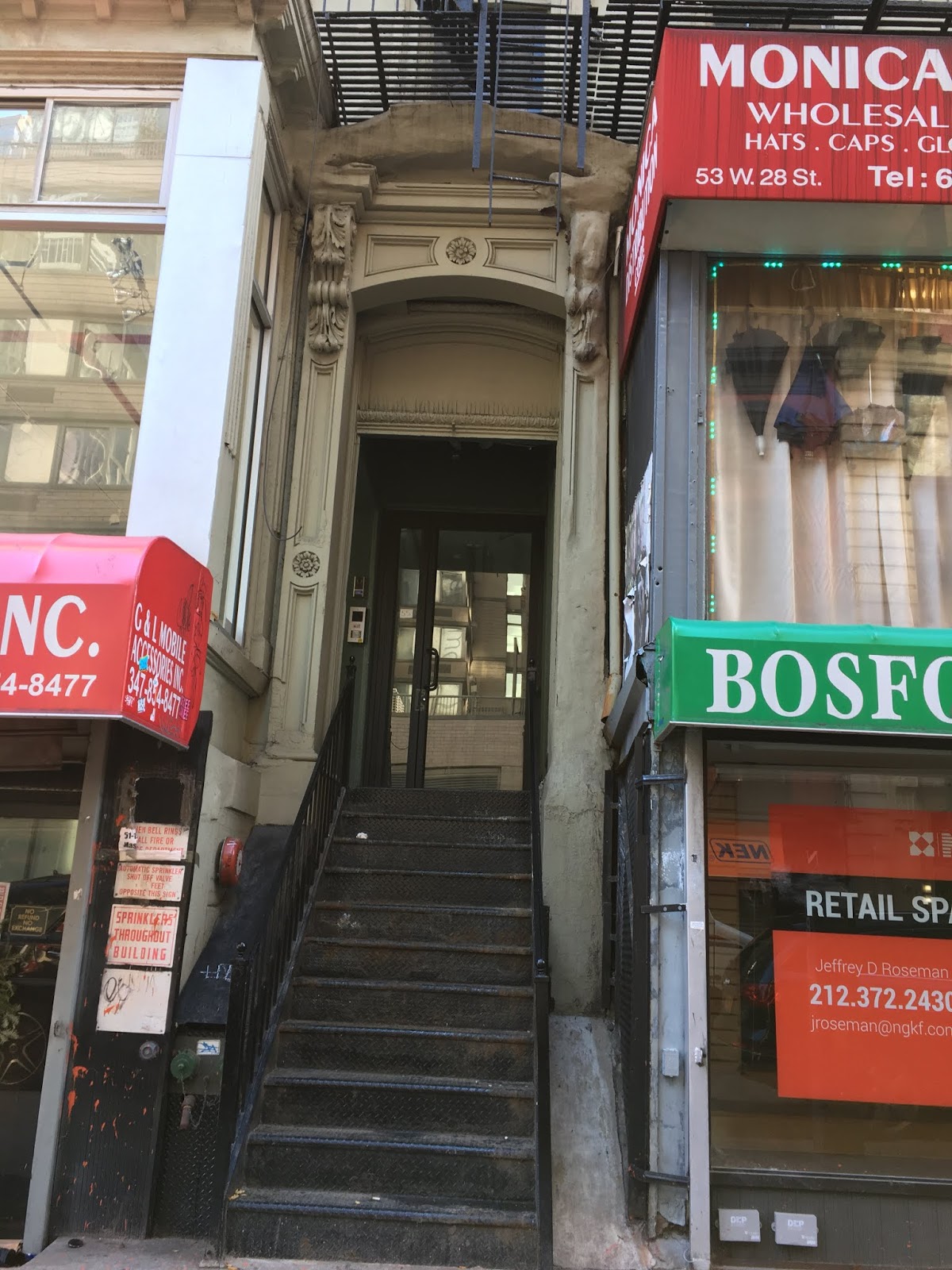
Sat there for over two hours, meditating on all the music that was first conceived there. Sat there in the cold and damp with my gloved hands running over the iron bars once held by so many musicians and writers, Ring and Hager being only two of perhaps hundreds. 
When my friends arrived we headed to 27th street where Hylands Spencer and Yeager were. This building appeared to be intact, though it was being worked on, so we couldn't get inside to poke around. Then we passed through where Dan W. Quinn lived in the late 1890's, and later where he lived from 1906 to his death in 1938. The later Quinn address is the one that he lived in when he was writing to Jim Walsh in the 1930's, and where he also operated a booking office. This address was also very nicely preserved, with lots of pretty marble carving and ceiling decoration. 
After we went by there, we headed to 14th street where all the 1880's and 90's theaters were. Before Tin Pan Alley reigned in the late-1890's and beyond, 14th street was where all the publishers and performers lived. Here we walked by the original site of Pastor's theater, where Ben Harney first introduced Rag-time, and where countless other performers played. Just two blocks farther along was 223, where Fred Hylands lived from 1896 to 1898. We were lucky enough to sneak in behind a resident, which just happened to be the first time any of us had gotten inside. The inside of the building looked to have been remodeled in the 1920's, but we could definitely tell it was an old seedy building that Hylands could easily be seen in. 
This apartment was definitely seedy, but in a charming sort of way. 
The stairs of this building were kind of awful, so I could see Hylands complaining about them often going and coming from work at the record lab or Pastor's. This building was where the "Darkey Volunteer" was published, and where Hylands trod in night after night of performing at Columbia's exhibitions. Performers like Burt Green, Max Hoffmann, and Mike Bernard likely also went up and down those stairs. 
As we started to head to a friend's house near Queens, we passed by where Antonin Dvorak lived in the 1890's. Thankfully there is a plaque dedicating the history of this address. On the plaque it states that he wrote his New World Symphony here in this apartment, which is pretty nice to see. 

The next morning I went to visit a famed broadway and vaudeville historian. This man's house is packed on the walls with posters of all kinds, dating from 1816 to the 1940's. Two examples:
There are hundreds more in this guy's collection. It really was a feast for the eyes to see all these gorgeous colorful posters. He told me that every few months he switches out the posters so there are different ones hanging on the walls. While I was there he pulled out two beautiful posters he had gotten from a recent trip to Paris, which included early art nouveau artwork much like the first poster pictured above. Next I went out with this collector/historian to find Frank P. Banta's grave. We got on the subway and headed to near Wall Street where I assumed it was, but ultimately wasn't able to find his grave there. It was way up in Harlem. I didn't want to spend another two hours going there and back to find his grave, that, as the cemetery directors stated, was in a very large cemetery. So with that I split with my new friend and headed to the Bowery to walk along the neighborhood of so much lore and history, and where Justin Ring grew up. 

After a decent trip on the subway, I turned a corner of Canal Street and was finally walking along the Bowery. The weather was perfect for setting the solemn mood I was in as I walked, it was 45 degrees and damp, with a blanket of clouds ready to drop rain at any moment. As I kept walking, I could really feel the intense weight of history on me, all the struggle and suffering of the many thousands of souls who lived in this area, all of it seemed to congregate as I scuffed the sidewalks. Had never felt such an intense feeling of unbelievable history before, everywhere I looked some image of the past seemed to appear. So much music, so much life, so much suffering, it seemed that walking along here was really where the spirit of the era I study came out. As I neared the street I was looking for, the area seemed to get a little seedier than where I got off, but that added to the atmosphere of the old Bowery I was immersing myself in. When I got to the short street where the Ringleben family once lived, it started to rain. The address looked very much reminiscent of the late-19th century, with so much of its original interior intact. The facade  of the building appeared to have been redone after the Ringleben's had moved out, but much of the older inside was perfectly intact. The building itself would have looked like the one next door when the Ringleben family lived there. 

My hand on one of the walls. 
There was even a beautiful mosaic tile floor still intact. 
I walked all the way up and down the stairs, and looked out a few of the windows to see such a lovely view. 
As I trod around the building I could almost hear the violin of young Justus as he was being taught, and his angry father writing out stock arrangements as his children learned how to write music. It was a lot to take in. 
It was getting dark by the time I started walking back to the subway, and it was raining. Another thing that so charmed me about being in New York was the subway. Lots of folks threw me mixed opinions about the subway before I went, but I was determined to witness the intense history of this old system. It felt like a time capsule, with all the mosaic tiling intact, and every time I stood on a platform the smell of 120 year old pneumatics filled my throat. That smell is entirely unique and old-fashioned. It's like being at an old train station but with no steam to be found. The inside of the subway is truly the smell of the past, with little change since its opening in 1904. There's nothing quite like the smell of 120 year old pneumatics that still heave and work every day. 

Well, wish i had more to say on this trip, but as I'm writing this I am still processing the emotional toll it took on me. Visiting all these places was very moving to me, as it was where all this history happened, and few few people know about it. Despite few knowing of these places, it seems that those who live and work around these places are somewhat curious, and that is hopeful. 
I apologize for not including any recordings in this post, as I usually like to do so. 
Within the next week I hope to start a project on Voss' 1st regiment band. This band has been a sources of mild interest for a few years now, after learning that all of Issler's orchestra performed in this band for many years. Based on this, it seems that this band gave us many of the earliest and most prominent studio orchestra musicians of the 1890's and 1900's. So with this in mind, it seems important to see what I can find on this group.

Before I close out here, I must say that some big news has come down! In the last few months I mentioned Hager's scrapbook and papers, well folks...
Now I have these things in my collection! 
Since they arrived in the mail a few weeks ago, it has been a lot of process, and I have been holding off doing a major post dedicated to this matter. Just to give you a sneak peek into what's in there, here's one of the more unusual pages from the scrapbook:
That's supposed to be Hager's orchestra in the background I guess, that's why he saved it. 
More to come! 

Hope you enjoyed this!


Thursday, December 8, 2016

Analyzing some fun records

While digging for recordings for the last post, I found some fantastic transfers on the way, which is usually what happens when doing that. Just before I finished the last post, I came across a fantastic and wild recording by these two:
Yes indeed. 
Their records are highly valued by record collectors, since in some ways, their harmony was better than Collins with Harlan, and they made fewer records. Of course, there isn't the same charm that Collins and Harlan had, but with Hylands behind either duo, the studio was always a hot time! 
The first record that really caught my attention was a curious 1902 Lambert of "McManus and the Parrot", and it was pretty wild to start! 
My god! Natus is a riot as a parrot! 
Wow, that was unexpected... 
Natus wasn't too often a hilarious and wild character, but sometimes it comes out, like it does when he's the parrot at the beginning of the cylinder. It must be noted that Natus was a minstrel performer in the early 1890's(in the same troupe as Byron Harlan strangely enough!), so it's not too strange to hear him do that, it's just a little out-of-place because he didn't do that on his recordings for some reason. The piano accompaniment is interesting on this Lambert as well, since it's pretty quiet for a Lambert, and it's a little strange, especially since it's one of those Lambert's where the piano was very out-of-tune. For whatever reason, some earlier Lambert's had some piano tuning issues, and sometimes the piano sounded unbearably awful. This one just happens to be one of those records. You can especially hear how awful the piano sounds at the solo at the very end. A great Lambert record overall!
Also, if you get a chance to hear the Collins and Harlan version of this on Columbia from later 1902, you really should listen! It's one of those especially fun Collins and Harlan records with Hylands as an added bonus!
This next one is also by the same duo, but it's an early one for them, in fact, it's got a very strange announcement by Collins, he's got their names reversed! Here's the record:
"Coon Coon Coon" by Collins and Natus from mid-1901.
It's not too often that fantastic Brown waxes like this one come across, but this one is exceptional for 1901. It's played a little too fast, but other than that, you can hear all the bass notes very clearly! It's not exceptional in the content, as i've heard better takes of this by Collins and Natus, but the quality of the recording it very much so, it would be better if it wasn't transferred so fast. 

To stay on Collins and Natus, another recording that is very interesting from this same batch this morning, there was a 1902 Victor of "I got Mine" by them. It's a very interesting recording in terms of piano accompaniment. As for the pianist, I'm pretty sure it's Banta, since it's got most of his characteristics, and I've heard a 1901 Brown wax of this by them, also with Banta, and it has a lot of the same characteristics. It's an exceptional example of early Rag-Time on a recording, and it's not with Fred Hylands. The quality of the piano balancing is better than other Victor's out there, but the accompaniment is not the most perfect, but of course, that don't matter here. Every version of this song is very interesting, even Collins and Harlan's early 1905 version(Hylands is on piano by the way, even if it was recorded in 1905!). Since it's pestering me, that one C octave at 19 seconds in on the Collins and Natus version above is really getting on my nerves! It reveals the out-of-tune piano, almost as bad as that Lambert farther up in the post...


Now to transition to George W. Johnson. Other than all the baggage that came along with Columbia employing Johnson, his recordings are still widely enjoyed, and used quite often by people who aren't experienced record scholars. That's a good thing! Of course, most people aren't going to sit there and wonder who that pianists all the time, but I can't just listen without wondering and sorting through my logic as to who the pianist might be. It has been established before on this blog that the original transfer Johnson's 1891 recording of "The Whistling Coon" was played too fast, and unfortunately, that was the transfer that went onto the CD Lost Sounds put out by Archeophone. Now that we've slowed it down, it seems that we can now use this recording as reference for slowing down other recordings of his, and it's just how Charlie Judkins and I are doing this now. 
We start with the newer transfer: 
https://archive.org/details/GeorgeWJohnsonWhistlingCoonIssler1891
Still an amazing recording. 
Now that we listened to that one, and took in the tone and range of Johnson's it can be used to slow down a record such as Johnson's famous "Laughing Song", so make it sound like this:
https://archive.org/details/JohnsonsLaughingSong1898
It was shocking to hear it at such a perfect and pure speed. It's at exactly the right speed according to the 1891 "Whistling Coon" record, and it brings out the idiosyncrasies of Hylands' playing, as well as his mistakes. This take has a whole lot more mistakes that you might think. Again, the more records we adjust to the right speed, the more we keep debunking old stereotypes and preconceptions of these old recordings. Just to put this into perspective, here's the original transfer:
https://ia802307.us.archive.org/20/items/GeorgeWJohnson/GeorgeWJohnson-TheLaughingSongCoonSong.mp3
It just sounds so much better, after hearing the newly slowed down transfer. 
For an interesting comparison, here's Denny's 1898 Columbia of "Time is money", and really what to listen for here, is the solo at the end. Not only is Hylands playing very good Rag-Time, but he's playing a certain inversion of the C7 chord in the left hand that he also plays exactly the same way on Johnson's "Laughing Song". You can hear the chord I mean in all of the interludes between chorus and verse on the recording. Also, that solo that Hylands plays at the end of the Johnson record no only falls apart almost completely, but he's playing the chorus to "Mister Johnson, Turn Me Loose"(Whoa, that's a very odd coincidence...). Hmm, think we've spotted another signature thing of Hylands'. That is something that he played behind Billy Golden on his 1899 Columbia of "Turkey in the Straw", it's the same end solo! How typical of Hylands, playing one of the most popular "rag" songs of the 1890's! It seems Hylands loved playing those 1896 rags! Hmm, maybe because he was performing them IN 1896(with a hint of sarcasm)...

The two songs that Hylands used as a default end tag are these:
"All Coons Look Alike to Me"
"Mister Johnson Turn me Loose"

Those are the two songs that were used in the Rag-Time competitions of the mid and late 1890's, which says that Hylands probably participated in them when they came around. They are the ones that Mike Bernard earned all of those awards from, and where he got the name "The Rag-Time King" from, it now can be assumed that Hylands joined in the contest, and played "All Coons Look Alike to Me" in that fantastic way of his, but of course was thrown out of the competition by Bernard's charm.That didn't matter of course when Hylands became the main pianist at Columbia in 1898. It is very interesting that Hylands used both of those songs as a default end tag, because I've heard many recordings that have this. It also is another way to help secure Hylands as the pianist on the recording, though there are other ways, it is a good place to start if it happens to be there. It's very interesting that Hylands just happened to choose that song of Harney's, it must raise some suspicion. We can well assume that Hylands was one of those many Harney "fanboys", that were also outstanding accompanists in the time. In this category would include Burt Green, Sidney Perrin, and many other popular early "rag" composers. Of course someone like Max Hoffmann and Dave Reed jr. are in their own category, because they didn't use Harney's melodies in their own songs. Hylands seems to have fit in the "fanboy" category now, especially after spotting another one of these recordings with that Harney end tag. 


Hope you enjoyed this! 

Tuesday, November 22, 2016

Vess Ossman and a little of Columbia's Transition period

At the West Coast Ragtime Festival this past weekend, I spoke with a very kind and knowledgeable Banjo historian named Peter Pardee. His plans for the future in studies of the banjo and the banjo in Rag-Time include a seminar about the subject in great detail, which seems exceedingly interesting. This got me thinking, after seeing a few rare images of the great Fred Bacon from his collection on his computer.

Among these recording stars, Vess Ossman remains an interesting one as far as the studio instrumentalists go. 
Cute and fresh-faced Vess in c.1893-94, looking very Germanic as he always did. 
Vess often could be interpreted as a small man, as before I knew any better, I had thought just that, but in reality, he was a tall and slim figure, appearing very fitting to play the banjo, with his long legs corresponding to the long neck of the instrument, and his long fingers gliding about gracefully on the harp-like strings. 
His skills on the banjo had been known to the masses since the late-1880's, and with that, he had authority in the community of legitimate banjoists that was sprawling all over the east coast. He was much like Mike Bernard, just that her played banjo rather than piano. Of course, just like Bernard, Ossman's success got to him rather quick, and its effects stayed with him for many years, which made some musicians refuse working with him more than once. He always had that notorious short temper of his, and often seemed helplessly in love with his Eunice, whom he married in 1891 when she was only 16 to his 21. Remember that he ran off with her the year before that, and couldn't legally marry her just yet, even if he already attempted to have a child with her before they had married. All of that was considered a mild scandal of course, since something like that was often looked down upon in that era. 

Ossman's story before recording is always interesting and fun to speak of, since it's more scandalous and eventful than the pre-recording stories of other early recording stars. 


One thing about Ossman's records that remains a mystery is the pianist on his 1895-97 Columbia records, as it seems likely that he dragged in Frank P. Banta for these sessions, since he was still working regularly with Banta. one record that has been recently transferred and put up on the Santa Barbara website is Ossman's c.1896 Columbia of "The Liberty Bell March":
http://cylinders.library.ucsb.edu/search.php?queryType=@attr+1=1020&num=1&start=1&query=cylinder13668
(the record is played too fast, so there will probably be a slowed down version of it pretty soon)
If you really focus on the music, you can hear how clear and dead the recording is. It practically sounds like and original recording, since the sounds that pantographing usually made are not present at all, even the sound of the long tube to make the copies is not present at all. The exceptional sound quality, minus the mold noise, is really what makes me think the date is c.1896. The sound of the recording room is nonexistent on this recording, which is very weird, since Columbia's rooms had a signature echo sound and fullness to them, that for some reason, this one hasn't whatsoever. After taking a few listens to the announcement at the beginning, it seems that the voice is that of Len Spencer, which is a little unexpected from such a strange recording. That fact makes the date little more speculative, and maybe a year or two later, though that's not likely, since the sound quality is that of an original "round" from the mid-1890's. With that being said, the pianist is probably either Edward Issler or Frank P. Banta. This recording is very similar to his January-February 1897 recording of "Stars and Stripes Forever", with Edward Issler on piano. Now that this recording has been studied extensively in terms of the piano accompaniment, we now know the pianist is Issler. It helps that this image:
was taken in 1897-ish, just around the time that Ossman recorded "Stars and Stripes Forever". The only thing about his recording of that that sets it apart from the strange "Liberty Bell" cylinder is the fact that the recording room can at least be heard a little better, and it helps that Issler(or Gaisberg) plays the piccolo part at the end so loudly. In fact, since I'm listening to the "Stars and Stripes" recording when writing this, it seems exceedingly anomalous how well that piccolo part was recorded in the piano accompaniment. It seems like they specifically did something different to the balance of the instruments to have that become the most well-recorded thing on the entire recording. That little characteristic right there is what leads me to believe that Issler is more likely on piano, since only he would have mastered how to record every note of the piano(even Spencer couldn't have surpassed his ability in doing this). Of course, like any of these transition era Columbia's(late 1896-1897), it's a bout on its own to try to dissect the piano accompaniment for any means of identification. It must be noted that both of these Ossman brown waxes are from the tail-end of the "round" era, and were recorded when Len Spencer was still bragging about making three hundred rounds a week. Here is the section from The Phonoscope that stated this:
This was from the August-September 1897 issue, which is very late for the round era, and it is taken from a section on the duplication machine, of which Hunting credits his friend Frank Capps for inventing. Spencer went on boasting of his stamina to sing three hundred rounds or more a week, and before 1896 probably more than that, including his placement as the sound effects man and announcer for Issler's Orchestra. Since he had done all of these rounds, he had among the highest authority of the studio stars by 1898, even though Issler was at the one who really had done the most rounds by 1898, no matter what unfathomable number Spencer bluffed or bragged. 


That's about all I got to say for now, in the next post I will get in-depth into Columbia's transition period and the fall of the U. S. Phonograph Company. 


Hope you enjoyed this! The West Coast Ragtime Festival was very fun, and all of "the squad" made it ever more enjoyable. Thanks everyone! 


Friday, September 9, 2016

Hylands' Union endeavors, and new findings

Yesterday evening, Tim Brooks sent me a link to a wonderful website where you can dig through and analyze thousands of newspaper and magazine  sections. Of course, the first thing that I searched for was anything having to do with Fred Hylands. Most of what I found had to do with him being a music director, of which most articles one will find on him will be. Of course, amid these many times of being a genius music director(as one of the pages actually stated), it seems that his place as one of the leaders of the White Rats Union, of which I have described in detail in previous posts, was of much importance. Before being one of the founders of this union's cause, he attempted to create a "union" a few years before this endeavor. This venture is something that I often highlight when speaking of his time working for Columbia, which is when this came along. This first failed venture of a union was called "Knights of the Footlights", which was similar to his publishing firm with Len Spencer a few years earlier. 

To really prove how similar the two businesses of his were, here's the letter that was published in the September 19 issue of The New York Telegraph:
Love that so much. If you'll recall, the Hylands advertisement from The Phonoscope  read just this exactly:
(I can't really get a decent screenshot of the page, so I'll write it out exactly as it says)


RECORD BUYERS NOTE
Don't fail to place an order at once


[insert popular song titles here, four of them in fact]


TO PHONOGRAPH VOCALISTS:
You are cordially invited to make our office your headquarters when in New York. All mail cheerfully forwarded.

Our Mr. Fred Hylands and Mr. Burt Green will be on hand both day and evening to coach artists in our latest song successes. Every facility has been provided for your convenience. 
Professional copies free to performers enclosing programme. Send permanent address for future reference. 

TO PARLOR EXHIBITION MANAGERS [no colon here...]
Enclose stamps for our handsome title pages for display in automatic nickel-in-the-slot machines. They are nickel coiners. [Okay...]Records containing our new songs furnished free of charge when you handle our music. Write for our special terms and discounts. 

TO MUSIC DEALERS[no colon here either]
Send name and address and we will forward circulars descriptive of our special introduction plan.   It will pay you to handle our music

                             Yours fraternally, 
HYLANDS, SPENCER AND YEAGER


Damn it's so fun to pull apart and read it in detail like that. it's more fun than it should be. Now to return to the comparison. These two advertisements are very similar, and in fact, amid these travels of digging for more Hylands in newspapers, I found and ad for the publishing firm that succeeded Hylands Spencer and Yeager in 1901, which was Aldrich, Linton and Hylands. This partnership bought out the remaining music from Hylands' catalog, and had a very similar way of operation to his previous firm, but had a much more formal atmosphere it seems. The performer who was the instructor at this firm was Fred's sister! How about that for strange? 
Burt Green was basically Fred's assistant at Hylands Spencer and Yeager, and was their publicist, since that's another area he had expertise in surprisingly. This publishing firm lasted about as long as the previous one. 


Now back to the union thing. Hylands' begging(literal in this case), of performers, publicists, sporting performers(Yes! FINALLY EVIDENCE OF THIS!), realtors,Wall Street stock sharks, and general philanthropists. Pretty much everyone that you could think of with lots of expendable income at that time was what he was calling for--no, begging for. These high hopes and attractive offers that Fred was so good at presenting(after learning this art better from Spencer), were not fulfilled, and soon the "union" busted to bits, leaving him a laughingstock to the Columbia management, and the other musician's unions that existed at that time. I find it very funny that on both of the advertisements, Hylands wrote this closing statement before signing his name:

                      I beg to remain yours respectfully,
FRED HYLANDS.

Hilarious. I absolutely love that, it sounds almost like he caused someone trouble and was apologizing for it. HA! The irony is overwhelming! These sections truly reveal a whole lot more about Hylands than I have read before, as it helps that they were written by Hylands directly. Among the many sections I saw highlighting the doings of the White Rats Union, there was one that created a very queer crossover with Hylands and Spencer so many years after the publishing firm. It seems that in 1908, Len Spencer's famous Lyceum got in a scramble with a few White Rat members, which called for a lawsuit of the Lyceum. It was a fail that was caused by Spencer's bookkeepers, involving a lost contract and too little money being paid to the performers at his theater. Oddly enough, Fred Hylands probably had to be involved with this case, essentially going against his old publishing and studio friend! Amid the digging, I found many hundreds of advertisements for LEN SPENCER'S LYCEUM scattered all over theatrical magazines and newspapers from 1904 to 1913, which is really unexpected! It also seems from the amount of films being advertised under his Lyceum, that he was a photography and film freak just as we thought. It seems that his desire to work a camera didn't go away. This affinity of his seemed to last far beyond the 1890's, and since films were becoming a much more popular media of entertainment, he seized the chance and promoted showing films and song slides at his theater and wanted to book film showings. The lawsuit against Spencer's Lyceum must have been the most awkward thing, since Spencer was against Fred's management essentially, which he must have realised before the suit that it would be as such a time to meet Fred once again. As well as the hundreds of Spencer's Lyceum advertisements, it seems that in the late-1890's, Spencer's minstrels was a pretty popular attraction, much more than we'd think from reading The Phonoscope. They weren't lying there. The New York Clipper presents a few sections fro 1897-1899 advertising and describing the popularity of the troupe. That's a pretty big deal, since it was in that paper that Ben Harney and Mike Bernard were advertised as popular Rag-Time pianists. The main headliner of these performances was of course Billy Golden and the Spencer trio, but Spencer also found some other talent that wasn't exactly recording at Columbia, or at all in this case. Most of the performers were Columbia stars though, as expected. Hylands is not specifically mentioned in these sections, but since he was part of some of these performances as reported in 1899 and 1900, it is very likely that he was involved in at least some of these performances. They needed their token Rag-Time pianist anyway, so they wouldn't dig out Banta in this, as it was a specifically "Columbia" troupe, since contracted Columbia stars ran the troupe anyhow. 


All of this was really interesting, and this is not even close to everything that I found! I will have to split up these sections by the stars that they are connected to, as I found a whole bunch of sections on Russell Hunting, Vess Ossman, and Burt Green. I will continue to dig for more sections within the next few days, and will certainly find more at the rate it's been going. 


Hope you enjoyed this! 


Thursday, July 28, 2016

14th Street Swells--Some popular New York Rag pianists

A cartoon I did poking fun at Burt Green and Fred Hylands as being "swells" who both lived and worked on 14th street in the late-1890's. 

Back in 1897 and 1898, East 14th street in New York City was a hub for several theaters, and where many of the pianists who played there lived. Among these swells included Burt Green, Mike Bernard, Ben Harney, and Fred Hylands. Pretty much the entire New York "rag time" scene lived either on 14th street, or somewhere around it. Much of these old buildings where the pianists resided still stand to-day on 14th street, including Fred Hylands' old flat while he worked at Columbia in his early era there. 

It seemed inevitable for all of these pianists to know one another, as they all worked at the same theater, and Hylands was their manager at one hot point. First, in 1896, Ben Harney broke the old traditions of vaudeville music by performing his "ragged" interpretation of his own "Mister Johnson Turn Me Loose", which really started a craze for music that was ragged in "Ethiopian songs" as they were often called at that time(that was actually a very old minstrel music term, that had been around since the 1830's). From there, all of these younger performers began taking up Harney's act and creating their own spin on it, adding all sorts of new and interesting things to it. Burt Green was considered among one of the best Harney imitators around, which believe it or not, was stated in an obituary for Harney in 1938. What was special about Green was the fact that he not only took up the piano playing style, but he also did some of the dancing that Harney was so well-known for. 
His dances included things like these:
There were so many more things he did, these are only two of several more that were photographed in 1911. Green did these dances well, as he was known for it it seems, and he sometime parodied them as well. From what we can hear on those handful of records Green made from 1911 to 1915, it is certain that he was one of those early rag pianists, and took much of his style from those other famous early performers. 
There he is around 1908. 

From the few pictures I've seen of Burt Green, I can easily see him being one of Fred Hylands' publishing associates, and since he was one of Fred's income sources, he remained a valuable asset for him for many years, even after the publishing firm. They met probably not long after Fred first came to New York, as they worked at the same theater in 1897, and Fred was at one point the music director there, so it's inevitable that they became friends early on. Their friendship worked so well in many ways, as what they were missing in their lives were fulfilled with one another, and they were easily both just as strange and eccentric. As I've said before, Burt's looks made up for Fred's, and it helped that most of the stars they endorsed on their music covers would encounter Burt first rather than Fred. Fred came next. The first impressions Burt made must have been much better than if Fred were there during recording days. During the publishing firm, Burt still worked on 14th street, at Huber's museum, and occasionally filled in at Tony Pastor's theater for Mike Bernard. But as could be expected, Fred and Burt learned early on not to mess with Bernard, and Fred knew him best, since he was his director for a short but busy time. 
Bernard must have been one of the 14th street swells who was auditioned for Columbia in 1897, as they probably tried all of these famous theater accompanists. Knowing how much of a peach Bernard was, he must have hated the idea of being almost quite literally a slave to the singers and performers who entered the studio. Harney was not very versatile, and would probably done well on all of those coon songs, but everything else wouldn't work. Burt must have been one of their second decisions, but he probably turned the studio job down. Of all these theater pianists other than Hylands, Green would have been another great studio pianist, and since he was so much like Hylands, he  was probably considered something like "Freddy's double" if they needed another pianist for something. In reality, the one who took that place was Ed Issler, and Issler was not a show-biz insider like Hylands, which meant for an immediately different approach. 

While Burt worked at Huber's, he met many of the famous faces pictured on Hylands' music covers, including these two:
(Fun fact! Spencer probably wrote her name on this picture!)
(These both came from sheet music covers in my collection)

I'm sure you all recognise these faces, especially the first one. Green probably found them first, and soon went to Hylands and Spencer about his latest findings. Where Harlan came from in this case it is not certain, but Ada Jones was a regular at Huber's 14th Street museum, and it is almost certain that he met her there. Wherever of whomever introduced Harlan to Hylands, that friendship lasted a long time, and it was randomly revived in 1901 when Harlan began recording at Columbia. Other performers like Barney Fagan and Sallie Stembler must have been Hylands and Spencer findings. Burt working at Huber's not only got him an immense amount of money, but it earned Hylands and Spencer some very important friendships, such as the Ada Jones and Spencer duo that made hundreds of records from 1905 to 1913. 

No Billy Murray, you did not find her first. Damn lie...

Anyway, you understand what I'm getting at here, 14th street was a fantastic place to live and work in the late-1890's. There were more famous stage pianists who came from 14th street, but that comes later in the era, around the gaudy time of Tin Pan Alley, of which none of these early pianists were officially part of. These great pianists were too good to be part of that mess. 
Max Hoffmann was another one of these pianists I did not mention, as he was performing all over those theaters on 14th street in 1897-98, which logically works since he was such a famous "rag" pianist. Hoffmann remained pretty well-hidden considering that all of these other pianists were not really writing all of this music, but they were playing it in that same Hoffmann-like style. He remained hidden because he wasn't exactly a show-biz character out front, he was a sort of behind-the-scenes type, since he married a dancer who made up for this. His slim and pretty wife was scandalous enough to keep everyone's hands off of him, so they could scrutinize her. 
Something like this is what I mean. 
That's his wife in the center by the way. 
Funny to think that Hylands was director at the theater where this was taken. Hehe...
Hoffmann's marriage was brilliant, in so many ways, and it really is funny to think of it as a strategic show-biz marriage, far more than just the typical Hylands and Green marriages of pianist and singer. Chronologically, Hylands' marriage came first of all these famous pianist-singer ones, with the intention of an act being created from it. It wasn't as famous as the others that came after it, like Burt's marriage to Irene Franklin, but it was the same sort of thing. Fred married a singer who was not really well known, and she became a little more well-known after being married to Fred for ten years, since it took that long for him to finally put her in one of his Broadway shows. 
(that's her! on his music of course)
Took him long enough...
 It would be interesting if he dragged her in to Columbia to make some records. Probably didn't happen, but we can well assume that he considered it early on. We know that he was desperate for attention from the Columbia staff in 1898, and something like this was probably laughed upon by the long-time studio stars. It helps that he lived on 14th street in 1898, though he was not within walking distance of the studio. The bouts with cable cars were inevitable!


Anyhow, I'm just going to keep rambling on about all of this, so that's where I'll end it. 

Hope you enjoyed this! 

Sunday, March 6, 2016

The Mystery behind Seymour Furth, and the best Vaudeville accompanists

I don't think I've ever mentioned Theodore Morse on this blog before, but he was a fascinating character of early Tin Pan Alley and had an odd influence on early recordings. Morse was considered one of he best stage accompanists in his day, along with Seymour Furth, Fred Hylands and Mike Bernard. The evidence is here:

Who was Seymour Furth exactly? Well, that's a hard question to answer directly, as looking through a bunch of popular sheet music from 1901-1909, one can certainly find "Seymour Furth" listed as the composer on quite a lot of this music. Seeing that alone can get someone curious. Just out of coincidence, most of you early sheet music collectors probably have a bunch of music by Seymour Furth anyhow, as he did write a whole lot of very popular show tunes in the era just before Tin Pan Alley. 

From what I have noticed, Furth was essentially the same thing Fred Hylands was. By this, it is meant that he was a stage pianist, music director, composer, and publisher all in one. In fact, I would bet that they were competitors once Hylands got thrown out of Columbia in 1905. Though they probably were competitors starting in the late-1890's, this competition would have become more prominent by the time Columbia wasn't having to deal with Fred. I did some "digging" this evening to see if I could find anything on Furth, and at this didn't get really far, but I found a list of Broadway shows that he directed and did the music for, which certainly says something. He did more shows than Hylands did, so that also in some sort of indicator. 

I have the feeling that Furth was less complicated, calmer, and musically weird than Hylands or Mike Bernard. Which must have added to the fact that Furth was considered the best stage accompanist out there in 1900. He must have been a much easier person to deal with than Bernard or Hylands(as they were both full of themselves, especially Bernard). We still don't really know too many details about Furth though, which is very odd, because clearly he was brilliant and beloved, more so than Bernard was. He was clearly a great composer, as here you can hear one of his Rags:
He had some very creative musical ideas, that were very stylish and probably changed slightly with the times just like Hylands did. He was writing music in 1898 and 1899, so at this, his style probably sounded reminiscent of Max Hoffman or Ben Harney, as did many of the "Rag" pianists of the late-1890's. Hoffman's amazing skill at writing music was really what made him so famous in the Rag-Time community, as all of the other greats in the "New York Rag Time Community", didn't exactly know how to get all of their ideas written out to the exact syncopation and rhythmic ideas. 
I would guess that Furth was someone similar to this as well, since his music was all over the place, that says something.  Yes, I know, Harney wrote out all of those great songs he did, like "Mister Johnson Turn me Loose" in 1896 with the syncopated patterns that he played (kind of), but think about that for a moment. He had to go to John Biller in Louisville back in 1895 to get him to write out "You've Been a Good Old Wagon", because no one knew how to write out how he played the song. Biller didn't even get it exact. The fact that Harney had to go to someone else who was proficient in writing music to write out his piece really can probably apply to many of the earliest popular "Rag" pianists. 

Refer to Hylands' "Darkey Volunteer". That piece is a perfect example of the wild nature of Hylands, as it's got lots of notes, and speckles of Rag-Time everywhere. There aren't too many of the early "Rags" out there that were that scattered. Even most of Bernard's music makes sense, though we well know that his playing is very hard to understand, both back then, and even now. 
Yes indeed. Bernard had the fastest fingers in vaudeville in the pre-Tin Pan Alley era. And I thought Hylands was fast! Nope, that is exactly why Bernard won all of those Rag-Time contests in the late-1890's. Bernard was among the best accompanists according to the managers on broadway, though his rhythm was terrible, and he was the most terribly vain of all the pianists the managers wanted. Since Hylands was Pastor's music man(music director at Pastor's theater) in 1896(?)-1897, he knew Bernard well, and probably had his share of bouts with him. 

There were a few of these "Rag" pianists who were left out from being called best of the best, and this includes Burt Green and Ben Harney. More specifically Burt Green, because he was certainly good, and was used at Huber's museum/theater, which was certainly a real feat. Green was a friend of Hylands, and as we might expect, was not really the best thing for him, being an imitator of Harney, that went very well with the people, but being a close friend of Fred Hylands' was not exactly with the same connotations. Did he know Seymour Furth? Probably. It might have been distant, like Hylands and Max Hoffmann. All these pianists must have been aware of each other's styles, as when we hear Mike Bernard play in those Columbia's, it is clear that his inspirations are present. By this, I mean those like Max Hoffmann, Fred Hylands, and Ben Harney. 
Such as this one here:
https://www.youtube.com/watch?v=yWZMqNf15ws
Now, for a comparison, listen to Hylands' "Turkey in the Straw" with Billy Golden from 1898. It literally almost sounds like Bernard is behind Golden on this. Yep, I definitely hear those similarities. Also, there were some things that Hylands plays here that can be heard in Furth's "Pinochle Rag" from many years later. 
The one thing that can be easily compared between Hylands playing "Turkey in the Straw" to Bernard playing "The 1915 Rag" is that they have the same amount of frantic-ness toward the end of the records. If you listen, it's exactly the same kind of frantic on both recordings. Bernard tried not to really trip himself over with all the notes, which he kind of does anyway. Hylands is trying to avoid this as well, but since he was just enough controlled, he was able to keep it all there(just about). Bernard was not accustomed to studio playing though, none of the stage accompanists knew what that was like truly, other than Hylands of course. He probably thought he was much better than everyone because he lived a horrid eight years working as a studio pianist, and none of those other pianists had any idea of what a horror that was. 
The only other one of them who would have any idea of how terrible being a studio pianist was, would be Burt Green. Green worked as Hylands' "gopher" if you will, for that short period of time he was a publisher in 1899-1900. As Fred's "gopher", he was the one who tended to his firm(his flat) while his master was gone the whole day until late in the evenings, more often than not, drunk or drugged. 
That's another thing. All of these other stage pianists lived longer than Hylands. Even Burt Green outlived Hylands by a few years(he died in 1921). Hmm... that's odd to ponder, but it's true. Hylands was probably the most brilliant, but did the most damage to his body in such a short period of time. Theodore More died in 1924, which meant that he was fifty when he croaked. That's much better than Hylands' 41. But of course, Max Hoffmann outlived pretty much everyone, dying in 1963 pretty much says everything. 

I wish Jim Walsh interviewed him.


I hope you enjoyed this!