Showing posts with label Victor. Show all posts

Saturday, October 14, 2017

A Death date and Spencer's relationship with Columbia

well, I'm still here everyone, those fires are far enough away. But you know, it's been a disaster that's really got me depressed and unmotivated to do any work I usually do and and am assigned. The one thing I for some reason have the motivation to do is a blog post. It seems the death date of this weekend is so important to motivate me to write a post. In honor of such dates as always, I wore all black and burnt incense. 
of course, some of you may already know whose death date it is, those of you who follow my Facebook page know this. 
104 years ago today, Fred Hylands died in a suburb of Liverpool in Britain. For some reason he left a pile of obscure sheet music while spending his final weeks in Britain. It seems strange that this is so, but there's a bunch of his music at a library in Britain, and it's either because of his investments there while a publisher with Len Spencer, or he had a bunch of sheets with him on his tour when he died. It will forever be strange to me why a bunch of very rare(some not copyrighted) pieces of his music. 
However that happened, hopefully I will sometime be able to see those sheets. 

Hopefully we all understand the circumstances and sequencing that led up to his death, and I have explained it in many previous blog posts. Of course it's hard for us to really know about all of that that led to his death, but one thing is for sure, he was sickly before he died. 
Here's three images of him in various years to compare, and so you'll see what I mean here: 
Early 1897.
Mid-1898.
1913. 
Contrary to what some might assume, Hylands became rather sickly and looked similar to how he did in 1897(kinda). But we know it's obvious that he didn't take care of himself, and it comes through rather well when just looking through the few images we have of him (so far). as expected, some are still shocked to see such the change, or transformation rather, he went through at the beginning of his time at Columbia. i still can't really believe it too well, but that unknown pianist in that 1897 Columbia picture can't be anyone else. Also keep in mind that he was 41 when he died. That's less than ten years older than the age that Banta was when he died. when calculating and analyzing the median age these recording stars died, Hylands was on the low end of the spectrum(the median age seems to be 56). Uunfortunately, it seems he forced himself to live a hard life, even with all the supposed good money coming in from working at Columbia between 1897 and 1903-1904 ish(notice that we are beginning to debate the time he was dropped from Columbia again, this has returned as an item of discussion). By this, I mean that he didn't make his life any easier, he stuck his already injured foot into every snake pit he encountered. He joined in toxic partnerships(like with Len Spencer), and messed with unstable and risky communities and endeavors, this including his job at Columbia. His job at Columbia was risky, even if it was relatively stable the first few years, the Climax/Zon-O-Phone/Victor feud proved a death scare for everyone. After all of that, he toyed with the Socialist community, and that was never proved to be stable, nor was it well-organized. By that, I mean the usual friendly neighborhood socialists, but also the mean and bitter union leaders and crowd. He joined in and helped to better organize the White Rats Actors' Union, since Columbia had been mean to him(they actually were...no joke or pun intended), and his first attempt at becoming socialist failed miserably. He soon rose up the ladder real quick and became a leading member of the White rats, and from 1905 on that's what he pledged his allegiance to. of course being the way he was he couldn't keep all those commitments and was soon breaking rules that he pledged to in the first place. In 1912, he was thrown out for being defiant and disloyal to the rules he helped to create and enforce. Hylands was dragged into court for his defiance, and was forced to testify, as indicated in a few papers I've read on the very trial, it seems that a few members of the union were tried in court that day for similar perpetrations. 
With this trial, Hylands was no longer a "chief rat" as they called him, and he was no longer able to speak at gatherings of the union. And just after then, he joined with Wilbur Held, with whom he performed until his death supposedly caused directly by diabetes. There's probably more that went into his cause of death, since it's obvious that he didn't take care of himself while at Columbia. That directly led to his issues years later, and it can easily be seen, this is not just some wild theory. 

So for the honoring of his death date, I not only wore black, but I also did something else that I will have become a ritual from now on. 
I first got some incense, then wrapped a picture of Hylands with a little note on it around the incense, lit it on fire, let the two things burn, and once it was burnt down, I grasped all the ashes and blew them into the breeze, then out in the world. 
I took pictures in sequence. 
Someone suggested that I do this, and I found it a really sweet and thoughtful way of remembering. From now on, this is going to be my ritual on important death dates. Next month comes Banta's, so that will be another good time to do this, and hopefully I can get my symbolic violet incense for him. 

Anyway...
Rest well Fred. You are not forgotten.


Now to move onward...
Last weekend I got to discuss some interesting matters with Charlie Judkins, and with that, we got into something that I had not previously considered. We discussed the interesting relationship that Len Spencer had with Columbia and U.S., and it appears to be more complicated than most of us might think. 
It's starting to become clear that Spencer was a common face amongst the men in blue all over New York and in Newark. 
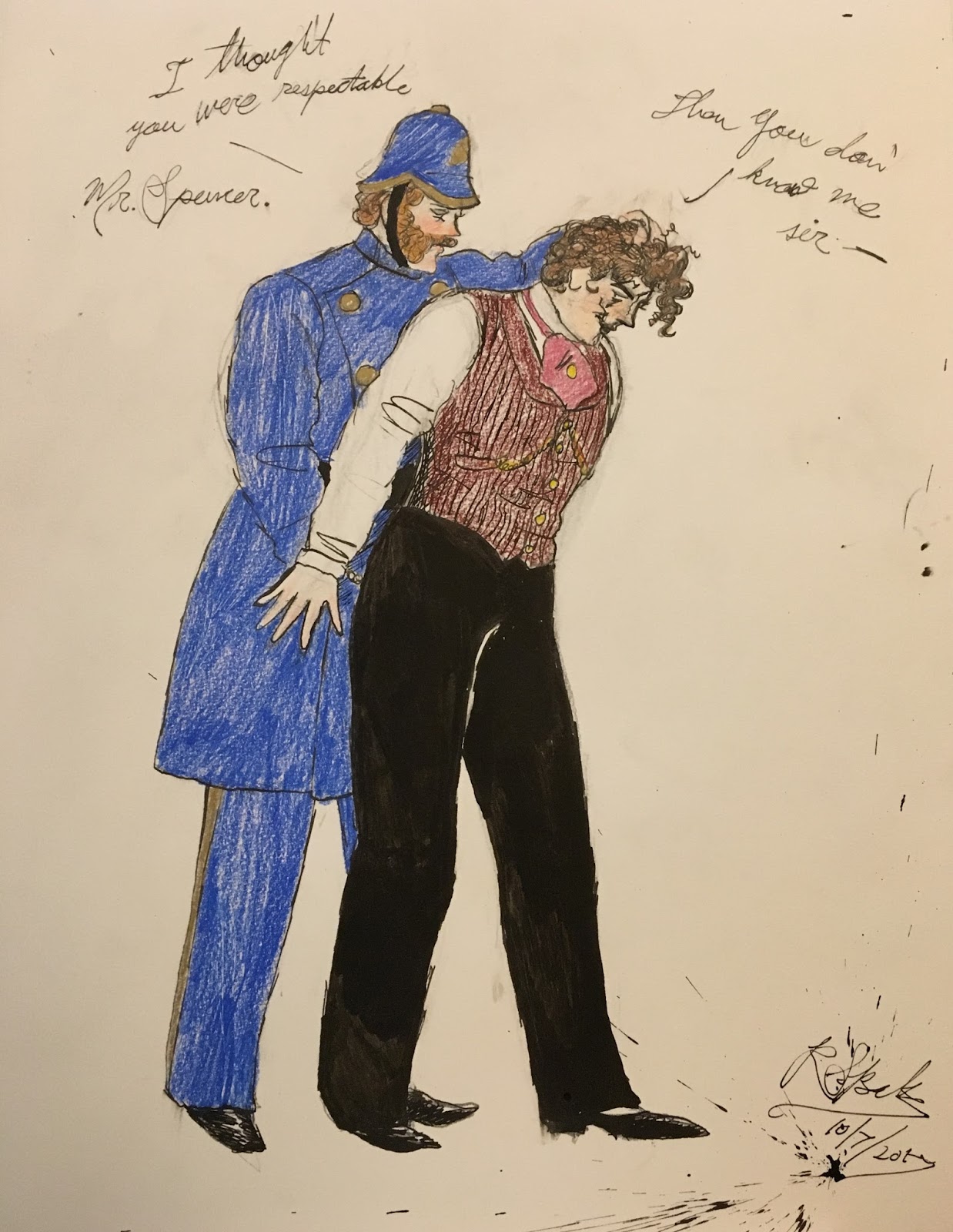
Yes indeed.
Many policemen probably knew his face, or had heard his name as a "deadbeat" or something of that type in social terms. 
Now what has this to do with anything? 
well...It seems his relationship with Columbia and U.S. wasn't all peaches and cream(haha, Spencer and Jones pun). We all want to assumed that he was on great terms with Columbia, which is true without a doubt, but there were strange aspects to his relationship with U.S. and Columbia. We know that he began with Columbia in 1888-1889, and soon rose up the ladder from just a local dork with a golden ticket of a surname. He was soon a well-respected money maker for Columbia, even though in 1893, he was forced into some sketchy business with them...
Okay, so it seems that we may have a hypothesis as to why he used that strange pseudonym of "Gary Allen" on early Columbia and U.S. records. He was involved in some patent and law breaking activity with Columbia and U.S., and this can be proven through newspaper digging. In 1894, Spencer was tried in court for doing essentially the same thing he did while at U.S. in 1897(remember a few posts ago when I talked about the "midnight crooks"?), for stealing records from one company and bringing them to the next, and for doing who knows what else... 
tsk tsk Mr. Spencer...
So he was dropped from Columbia almost entirely in that sketchy period from 1893 to 1897, but after pledging to U.S. under Victor Emerson, he made some deal with Columbia under the table, and hence the reason that we get that jarring headline of him getting at last arrested for stealing those records with Georgie and Clyde Emerson. The second time it was the reverse, he was stealing records from U.S. to smuggle to Columbia, rather than stealing records from Columbia and smuggling them to U.S. Now what can we analyze from this? well, after discussing this recently, we can see Emerson(Victor) had those expected intentions with Spencer. He and the Management at Columbia, like Master Edward Easton, thought of Spencer as a so-called(excuse my language) "attention whore", and by this, I mean that Spencer was always wanting attention from the public for his work in the studio, and was pretty cocky about it. Hmm, from all this, we're getting a better image of Spencer for certain. Emerson and Easton as they were all getting Columbia set up in New York were looking for talent to hire with their new fresh start, and who was likely one of their first thoughts--Spencer. Right, he's nair-do-well, how about we get him to do some of our bidding. And so that's exactly as Spencer did, some deal was made, and he with the "lesser" Emerson brothers raided U.S. for the sake of pledging alliance secretly to Emerson at Columbia, though they weren't yet allowed to, since U.S. had not completely decimated at that point. All of this is making Columbia seem even more sleazy and like pirates. Edison called them "pirates" for a reason, and it may or may not be because of Spencer(well, now there's that possibility, so that makes this even more hilarious). 

So to sum up this about Spencer, it seems that Columbia saw him as a privileged deadbeat who could do anything for money and cocky bragging rights, so that's why we see him getting into trouble more than once with both of the companies he worked for before 1897. Now we can see why he used that strange pseudonym too, that's good to have cleared up. Hopefully we get to actually hear records from this fabled era sometime.


Hope you enjoyed this!


Saturday, November 5, 2016

Studio Politics and New Leachman cylinders

Ah yes, the week prior to election day, and this time around, it's the most frantic one for many decades. To remain on the subject of politics, this brings me to the first part of this post. Much of the studio politics are hard to track as far as these documents go, but if you're looking into the outside activities of these recording stars, many assumptions and theories can be formulated. Sometimes it's a little misleading, such as someone like Len Spencer, who followed many ideals of the Democrats of that time, but embodied most of the mindset of Lincoln, as well as James Garfield(remember that Garfield was his godfather, and is where his middle name came from). Other than all of this, Spencer was a harshly standing Republican, and this is clear after reading some of those sections from The Phonoscope that he was a Roosevelt man, also McKinley for that matter. Other than Spencer's beliefs being primarily republican, most of his fraternal friends of the publishing firm were Roosevelt/McKinley supporters, and at that progressive Republicans, though with the rise of new ideas circulating at that time, some of these "brothers"(referring to the "fraternal" atmosphere that Hylands specifically promoted for the publishing firm)  later entered in the other, Socialism. That came around after 1900 though, even if the ideals existed before then. 

That one section from the May, 1900 issue of The Phonoscope very well illustrates the devotion to Roosevelt/McKinley that some of the Columbia staff had, more specifically Roger Harding and Len Spencer. With two sections in the General News section about the upcoming election, it seems that there's more than just a little devotion to politics there, even after Hunting was settled in out in England, and had been gone for almost two years by then. To add to this, Harding had his own republican club out in New York, and hosted performances of Spencer's minstrels there in 1900 as well, as it was in May of that year that a few performances can be tracked in local newspapers. Since Harding was such a politico, it seems that he ran most of the politics of the "Clan" at Columbia, and kicked aside those who weren't republican, or progressive. This would immediately eliminate Silas Leachman from any of the "clan" activity. 

That brings me to Leachman, who was a Democrat and it's clear that he was, as that's the party he ran for as a Chicago Alderman around his time of making Victor records(1901-1903). Leachman was from Kentucky though, so it isn't too surprising that he was a Conservative politician in Chicago. Take into consideration that the Democrats were the party of the trusts, and the barons of railroads and corporations. Leachman was part of no studio clan though, he just had local politicians and some local characters in his circles. There didn't seem to be a clan of recording studio performers out in Chicago, even if there kind of was in the mid-1890's, Leachman wasn't one of them. This group would have included Bert Morphy, Banta's orchestra, the North American outpost employees, and some more who recorded for the Chicago Talking Machine Company.

With all of these conflicting views of politics, it would seem strange to think where some of the "clan" member went after it broke up around 1903. Len Spencer remained firmly on Roosevelt's side, and when Wilson was put in office, he must have had none of it. It seems Fred Hylands became more progressive than previously thought, as he had begun to associate himself with not only strange and sassy actor folk(like J. Grant Gibson) , but also with Union leaders and workers' rights activists, and of course with this spreading like disease all over New York, it would seem inevitable for him to get roped in to the rough gangs of Socialists that were sprouting up. The friendly local Socialists must have found Fred to be a great example of someone that could make real change in their cause. He must not have been sure if joining them was a good idea, but since they were the ones for beginning all of these unions, it's not surprising that hard standing Socialist like Art Young would take an interest in Hylands' advocacy. Of course, now we have evidence of this happening, as this cartoon says everything about it:


Yes indeed, that fantastic and very accurate portrayal of Hylands. 

If you haven't already guessed, I will be using this cartoon of Hylands rather often now, since it really does personify everything about him that I draw and have pieced together. These union acts from Hylands certainly not only had him lose friends, but gain some that had nothing to do really with performing, like Art Young for example. I'm not saying that Hylands was solely socialist, but there must have been hints of it here and there, but remember, this is around the time that Columbia dropped him is when this was beginning. I would say that his socialist side began to kick in around the earlier part of 1902, when he was almost thrown out of Columbia because of the Climax/Victor/ZonOphone/Columbia feud, and it had nothing to do with him whatsoever, even if he was technically working for all of those companies when it happened(which was not really okay as you might have guessed). Of course, that's just typical Hylands, committing for a little while, then seeing more opportunities along the way and taking them, not regarding pre-existing animosity, legal stability, or company names. That, as we know, got him into trouble, and out of the Union that he helped kickstart in 1905(the White Rats that is). Spencer might have liked Hylands' hints of Socialism here and there, but when he began the owner of a Lyceum with many valued workers, maybe not so much, and especially since it's clear that Spencer hosted White Rats performances at his theater, he must have had enough of it by that contract fail in 1908. 

Spencer had another reason to be bitter toward is old accompanist by then.

Anyway, time for some music! While searching around in the Santa Barbara cylinder website, doing my daily checking for new transfers, I stumbled across three of the Leachman cylinders they have, and they're finally transferred! 
Yay! More Leachman cylinders! 
These transfers were messy, which is unfortunate, but one of them stands out more than the others in that respect. More than half of the cylinder can be heard very well and clearly, with almost no mold, but the other two are plagued with the spores. 
Here's the best one:
http://cylinders.library.ucsb.edu/search.php?queryType=@attr+1=1020&num=1&start=1&query=cylinder15987
This is a fantastic example of authentic Chicago Rag-Time, and all of the playing is made more interesting by the great sound of the piano! It sounds a lot like Columbia's piano after Spencer flipped it over back in 1897. Since it's not balanced the same way that normal studios were balanced, it sounds a little weird and out-of-whack, and that's really why the piano sounds the way it does. However, the piano really does sound great from my strange standpoint of what historically accurate pianos sound like, in fact, that little interlude he plays at about 1:21 is one of the best examples of what a studio piano from that time should sound like, and it's not a studio piano! it's just the piano that Leachman had at his home, as it is one of those cylinders, that he made at home with four cylinder players set atop the piano, recording them "white wax style"(or like Spencer did when he began making records in 1889). 
Here's the one that's second best as far as mold goes:
http://cylinders.library.ucsb.edu/search.php?queryType=@attr+1=1020&num=1&start=1&query=cylinder16000
The piano certainly sounds better on this one, more well-recorded and tuned. It's a great cylinder, even if it's really messy. That can't compare in mold to the third one:
http://cylinders.library.ucsb.edu/search.php?queryType=@attr+1=1020&num=1&start=1&query=cylinder15986
From what can be heard, it is a fantastic cylinder, that would sound really good if it wasn't moldy. It's also a really good song on it, which certainly helps to make it better to listen to. It must be noted that Leachman plays the final chord of the piano accompaniment exactly the same way that Hylands did, which is very strange, yet makes sense, since Hylands was a Chicago pianist when Leachman was making records in the mid-1890's. After listening to these, I see why Vic Emerson always said Leachman was not really the best musician, but he only said that because he was comparing him to the pianists he had at Columbia, which isn't really a fair comparison. Of course, those Victor that Leachman made in 1901-1903 are better examples of his singing and his absolutely phenomenal vocal range, but since no one really said who was on piano, all guesses are essentially off for his Victors, as they could be any one of the early studio pianists, or even Leachman himself. Maybe there's a reason that some of his Victors sound a little unbalanced as far as piano goes...
It's not impossible that he would have been playing his own accompaniment, as that was his act, and the Victor people might have seen past Emerson's ignorant claims to Leachman's musicianship. A particular Victor of his that comes to mind is "I need the money" from 1901, not only can we hear the piano extremely clear, but also hear Leachman change his voice from his normal tone to a Hebrew dialect, and then Irish, all on the same recording. Really listen to when he changes from his regular voice to the others, it's really extraordinary, and ingenious. That's something you don't get to hear too often on these early records, the change from normal tone of voice to something completely different. Someone who also did that often was Roger Harding, and he sounded pretty different once he did, but not nearly as different as Leachman. It's that about Leachman that is so ingenious, that most people don't realise, that his range and versatility was in reality more so than all the other early recording stars, and yes, even Len Spencer. 

There's probably no way we'll ever know for sure if Leachman played piano on his Victors, but that's something to keep in mind when listening to them. Maybe try to envision them being recorded that way if you're someone who can do that when listening(that's what I do usually).

For a good comparison, here's a 1901 Victor by Roger Harding:
http://adp.library.ucsb.edu/index.php/matrix/detail/100002593/Pre-matrix_B-3450-Ive_been_down_in_old_Kentucky_
Damn I love Roger Harding. This record is exactly why. 
Listen to how the piano is recorded, with the distance, and tone.
Now compare it to the first and second takes of "Whoa Dar Mule" by Leachman:
http://adp.library.ucsb.edu/index.php/matrix/detail/100002500/Pre-matrix_B-3357-Whoa_dar_mule#
There's a dramatic difference in the sound of the piano, and it's a little suspicious. Alright, I'm a little more convinced that Leachman played his own accompaniment on at least some of his Victors. If this is true, we've got some listening to do Rag-Time pianists, because he sounds an awful lot like the earliest Rag composers, out in Chicago that is. 


Maybe that's why I thought Hylands was on some of his Victors... ...


Hope you enjoyed this! 


Sunday, September 18, 2016

Newspaper findings and more pianist analyses

The more infrequent posts on this blog I must apologize for, since it's been busy having school, and doing projects and such, spending the time to work on a post for several hours has been hard to do with this. Other than that, all of the newspaper travels I've had have been great, finding all sorts of things mentioning those characters that we know and love so well. The last two posts I have done were almost solely on some of the findings I had amid these newspapers, as the Hunting and Charles Carson section I did was actually based on an article from The New York Clipper, and The Albany Express, both from 1896. The section from the latter had much more detailed information on the arrests of them, though each one had information that the other didn't. 

Surprisingly, sections on Hunting date back to the mid-1880's, which is really interesting! He's listed in many 1888 editions of The New York Dramatic Mirror. It's not that often that we see these recording stars mentioned in Newspapers so early on, even though if they were older than the average age of these boys, they are more likely to be mentioned earlier on somehow. Among this expedition,  I found many sections that reprinted that article from The Chicago Tribune detailing Leachman's recording process, and what he does every day with his recording. That section seems to have been reprinted more times than expected, which says a lot about how amazing and interesting Leachman was to the public, not just to recording fiends like The Phonoscope writers and readers. His process and eccentricities seemed to have been a great interest to the general public, more so than could have expected. Other than his fascinating recording processes, he owned a pet fighting monkey, and a freak horse that went on vaudeville tours with him in 1901-1903. It seems the more we learn about Leachman, the more weird he becomes. But that's great!

The way we're learning about Leachman reverts me back to Hylands, since that's a similar story, as i mentioned in my last post the fantastic and very entertaining letter that was published about him begging for performers to join his "Knights of the Footlights" endeavor. Of course, we know that this was published as a joke in the magazine it was in, because there was really no way that he would fill the promises he made(hmm...). It was just like Hylands Spencer and Yeager, except that it didn't really work the way that Hylands Spencer and Yeager did. The fact that he had a stable crew of financial support was what made working with Len Spencer and Harry Yeager important, and made it last(somewhat)

In reality, the job he was able to keep the longest in his life was working at Columbia. 

Other than that, his ventures lasted a year, or maybe two or three years if it was decent to him for longer than a few months. 

See, Frank Banta wasn't like this, this is why he remained a valuable asset for Edison and Victor, and if he had lived longer, he would have worked for them at least into the middle of 1905, if not later. Hylands hadn't a chance, even if he was still coming in occasionally in 1905, which is still very strange to me, since he obviously hated working there... It doesn't make much sense really. All of the contradiction stems from this here:
Ah yes, that quote. 
So important to Columbia huh? 
Yeah, no. 
If they thought this was a joke(which they did, as it was published in the Our Tattler section of The Phonoscope), they would have documented it. I wonder who told the correspondents of this? Maybe Spencer? It's hard to know. Someone like that probably told them. It's still funny regardless, since George Schweinfest or Edward Issler would have had a good laugh from this, since it's so unreasonable and selfish of him to say that, after only a handful or so of months working there. Issler must have gotten a kick out of Hylands once he began his term there. Since he was so immature and selfish, like a teenager in many aspects. 

Speaking of Hylands, I just received a record in the mail from my dear friend Craig two days ago, and here's the record:
It's a fantastic mess of a record! 
After I cleaned it, it was still pretty scratchy, but that don't matter since the music is so good and interesting. It sounded an awful lot like another Spencer record I had heard from the same year, which was his cylinder of "Since the Fortune Teller Told me"(which is an amazing record by the way!). It is a mess of a recording in a similar way as that record, though it's a little more so. I would love to share the cylinder of "Since the Fortune Teller Told me", but it is one of those records I cannot share the link to. Without it, I can say that it is a very clear and loud brown wax with the typical Columbia setup of Hylands on piano and Spencer singing, and Hylands pretty much plays syncopation for the entirety of the record, and plays very frantically just the same. It's not on-the-surface a mess of a record, but after really focusing on the piano accompaniment, you can hear how frantic and shaky Hylands' playing is on it, though it's still a prime example of early the Rag-Time style, even if was recorded after 1900. 
Just to give an example, Hylands begins the record with the same crazy thing that he plays at the beginning of this cylinder here. That was recorded in 1899, and he played it then, just to certainly place the same pianist on these two records made in different years. 
Without further ado, here's the record pictured just above:
https://www.youtube.com/watch?v=qbKpAwcvISk Again, apologies for how scratchy it is, and for the awful speed fluctuation. This is the worst Columbia I have heard in terms of speed inconsistency, as the machine seems to have started very fast, and slowed down dramatically, making the record sound very strange. This record is just as bad as an early Berliner disc, and that's saying a whole lot! With this comparison, here's an early Berliner:
Fred Gaisberg's 1893 Berliner of "Honeymoon March"

Well, it's not that bad, but it's pretty well close to it on these terms. 
That Berliner just above has been a subject of comparison in terms of Gaisberg's playing, since it's really the only widely known solo of his, though I have heard mutters around from Charlie Judkins that there's another one out there, and it's not just of a stereotypical late-Victorian march. The title has been said to be "The Tickler", and it's supposed to be a pre-ragtime piece, with actual syncopation! That would be great to hear, much like the infamous solo Banta made in 1900 of "Hello My Baby", that no one has been able to find a copy of yet.

Back to the new record I received, now before getting the record, I had heard a different take of the same record a while back, though it was the ten inch of it. With that, here's the ten inch of it from the same year. Among the many weird things about these takes of "On Emancipation day", you may have noticed that the record company was not announced at the beginning, which is very strange. Hearing no company in the announcement made me assume that they were Victor records, but as it turns out, they are two Columbia's. These records were made during the awful battle with Climax in 1901, so that might explain the absence of the label being mentioned on both takes. Other than that, I don't really know why the company is not announced. The piano is definitely more wild on the 7-inch take, without doubt, since they were running out of time, the final chorus is a mess, with Hylands not hitting the right bass notes, and playing frantically, almost getting ahead of Spencer. 


Within the last week or so, I have found a batch of fun Issler's orchestra recordings, which all sound exceptionally clear for the mid-1890's. 
(a cartoon I drew of Issler in marching hussar attire)
We all know Issler, and his gang of virtuoso musicians: George Schweinfest, William Tuson, David Dana, and Len Spencer. These records have all of the crew, including Spencer! 
Here 's the first one:
(there's a lot of chatter at the beginning! Which is very weird for something that wasn't recorded in 1888-1891)
Being a fan of Hungarian march music, this piece really highlights how authentic Hungarian marches were played in the same century that most of them were written! This is for the most part a typical Issler's orchestra, with the amazing sound quality from an original record(directly recorded on the record, made without pantographing or duplication). The piano was also recorded very well, just as usual, since Issler was really the first one who learned how to record the piano, with all ranges loud and clear. I don't see why the record managers and engineers didn't ask Issler for help when it came to recording the piano. Again, this is why I am still under the impression that Columbia didn't rid of Issler after Hylands began working there, since they would have needed all the pianists available after Hylands began, also, George Schweinfest would have made his arguments to keep Issler there as a pianist. 

Here's the next one:
This one is a great example of a Victorian Mazurka in 4/4, rather than in 5/4 or waltz time. It's a really nice recording, just a great one to listen to, with not too many things so point out here other than it being authentic Victorian music played in the era itself. 

This next one is a fantastic example of the selections from Verdi's Carmen played as an arranged march. 
Here you go: 
Once again, the piano sounds very good, loud, and clear, with the bass notes coming through very well. This one appears to be a dubbed cylinder though, which is strange, considering how early it is(1896 probably, it's a little later for Issler it seems). 

This final one is a cylinder that seems to mark the oldest improvisation in syncopated time. 
Here's the 1896 recording of "Dixie" by Issler's orchestra(announced by young Len Spencer. This is one of the clearest records I have ever heard from pre-1897, if not the clearest. About halfway through is when Issler begins playing trill like things in the right hand, far up in the treble, but then after that comes the syncopation, very well heard, coming through to clearly place the ragged rhythm. This record is an historic piece, regardless of it being a stereotypical mid-19th century minstrel song. The fact that this was probably recorded before 1897 really gets the point across that the rag-time fad began before 1897 better than anything else I have heard so far, even though Gaisberg's playing on this Gaskin Berliner here from November of 1896 is pretty hard to beat. What makes Issler playing syncopation like he does on the cylinder so amazing is that he would have grown up musically in the 1870's, and was willing to even try his hand at playing music of the generation after him. The fact that he recorded it is what's really amazing here. He's not great at the syncopation, but you can tell it's there, and that he's trying his best at it. Keep this in mind when listening to Issler's orchestra records. 


*Thanks for the record Craig!*


Hope you enjoyed this! 


Sunday, September 11, 2016

Russell Hunting and Charles Carson--Columbia's criminals

It's clear that I find Russell Hunting the most interesting of all of these early recording stars, with all of the controversial ideas and messes he made. 
All of Hunting's genius and off-colour ideas and doings come from his days as a Shakespearian actor in the 1880's. He was one who loved going onstage in multi-coloured tights and long blond wigs to replicate the Venetian Renaissance; this sort of thing was what he did often as a performer. This was so not just in the 1880's, it seems that someone like Fred Gaisberg found Hunting's willingness to perform as the devil character in a show not the most respectable thing. It's ironic to think of that, but Hunting was personifying the very character that he was seen as to the recording managers. 

The few early recording stars who clung to the Christian movement despised Hunting's mindset and would have tried their best to remain far away from him. Someone like Dan Quinn or J. J Fisher would have kept their distance from him. Doing that must have been somewhat hard to do since they saw Hunting rather often at the studio, before and after the whole Comstock scandal. 

Charles Carson was a member of the original"Columbia clan" that was formed by Hunting in 1892, and he was a small figure when it began. Carson began as an electrician at Columbia's still relatively small headquarters around 1892, but soon was integrated into the exclusive circles of Russell Hunting. He knew not what he was in for when Hunting only was inventing new ways of making copies of cylinders, and only recording comical "Casey" sketches. Not long after then, the idea of recording smut stories struck Hunting's mind, as the saloonkeepers needed new ways of getting people to attend the saloon, and not just for drinking. To satisfy this need, Hunting provided the solution of slot machines, with his naughty recordings dwelling just under the curved glass. It was a brilliant idea, and it got him more business than all of the rest of the "clan" would have thought. His home at 45 Clinton place in Manhattan was a hotspot for saloonkeepers and general customers to call and get their crates full of Hunting's smut. It took a few years for the New York Society for the Suppression of the Vice to take notice of this selling of smut, and they began as early as 1894 trying to track down the sources of these recordings, which seems like it was harder than is should have been. the issue with trying to track down Hunting in this long investigation must have been the fact that he used several pseudonyms, probably to purposely cause the law trouble in finding him. 
One of these sections from The New York Telegram was where I found a really interesting article highlighting the arrests of Hunting and Carson. Carson was Hunting's chief clerk when selling the smut records to the public, and kept track of where everything went to, also kept the lawmen away. Of course, once the Comstock crew went out to Coney Island to raid the slot machines upon hearing that some of these recordings were out there, the records were destroyed, the the source of them was finally found. At this, one of Comstock's detectives went out to the address, 45 Clinton Place, and posed as a kind patron of these obscene recordings. After witnessing Hunting make two of these records, he was then arrested, along with Charles Carson, who was Hunting'g clerk and kept track of the records bought and sold. Of course, with that status, the Comstock team had to arrest him as well. According to the papers, their bail was set at 2,000 dollars, though they only went to prison for three months. The impact that Hunting made on the new recording business was so monumental that there was really no way to reverse it, even if Comstock's detectives went out and destroyed what they thought was all of these records. It really wasn't as we know. There were still bunches of them stored in collections of the studio stars, and the managers. 

That's what's the most mysterious and fascinating about this whole thing, the fact that the studio managers and performers had some of these records in their collections. We know that Edison's manager Walter Miller had a vast collection of records that have been extremely well-preserved over the years. Most of the remaining Hunting smut cylinders came from Miller's collection, which is the strangest thing in so many ways. Victor, Georgie(as the Columbia staff called him), and Clyde Emerson would more likely have kept a collection of these recordings, since Victor and George were known for have not been the most "good" of people, according to Dan Quinn's Christian beliefs that is(dig through The Phonoscope, you'll find what I mean here). I'm surprised that Victor's collection didn't remain as is, unlike Miller's, which remained intact and well-preserved for decades. I'm not sure what happened to Emerson's collection, but it was likely split up when all of Columbia's ledgers were destroyed, since no one really had any use for it in that time anyway...
It's great to wonder what sort of records the Emerson's had stashed away in their collections, or any of the studio stars for that matter. 

Imagine the kinds of records that the Spencer's kept. 

Just putting that out there, since the two of them probably kept the widest variety of recordings, and also films as well. They probably kept all of those supposedly lost films made by the Columbia staff in the mid to late 1890's. We still have yet to know if these films exist, as it would be amazing if they did. Looking to the story of the few Hunting smut cylinders that survive, there are plenty of things that aren't supposed to exist, but still do somehow. Anything's possible. 


Speaking of films and photographs, in my last post I mentioned that Spencer's Lyceum was advertised in hundreds of newspapers and theatrical magazines as a place to show films, and that this seems to reveal that his love and fascination for films and photography didn't go away. A while ago, I was speaking with my friend Ryan Wishner, and we seems to theorize that there's a possibility of Len Spencer taking this very photograph:
It's a stretch, but something about it makes it seem like a full Columbia effort, since only Harry Spencer's in the picture, and it can be well assumed that brother Len was at almost every one of these exhibitions. With that, he might have taken this picture, and that would give this an insurmountable value. It was published in The Phonoscope after all, and that is also another clue as to who might have taken this picture. Also, if Spencer took this picture, he decided to do so a night when Fred was there, keep that in mind. 

Before I close off, I must share some of the amazing new recordings that Ryan Wishner and I slowed down in order to get the correct pitch, and to hear the piano better. 

Here's a newly pitch corrected 1899 cylinder of "Turkey in the Straw" by Billy Golden:

Pretty much everything in the piano accompaniment can be heard clearly here. I was able to hear things I hadn't before, and was able to clearly catch Hylands' playing characteristics much better. By the way, for you music geeks out there, it was originally pitched too fast in A, and now it's at a just a tad flat A Flat, which it historically accurate, considering the age and tuning norms. When I need Hylands referencing, I will be reverting back to this record, this slower transfer in fact. 


This next one is the corrected early-1898 recording of "The Bob White Polka" by George Schweinfest:
(Hylands is on piano here by the way, and it seems not one of his good takes)
This one was played frustratingly fast on the Santa Barbara cylinder website, and now you can hear it slower and at the correct tempo and pitch(excuse the speed fluctuation...). Now that it can be heard better, you can really hear how awful the piano sounds. If you're looking for that stereotypical piano sound usually associated with Rag-Time pianists, this record gets the point across(and it's not even Rag-Time!). the room this was recorded in even distorts the sound a little bit, making it sounds even more like  19th-century piano. The thing is, I like that sound, even if it is out-of-tune and wirey, it's charming and actually historically accurate! This record proves that point. 


This final one is another great Golden and Hylands collaboration, with Len Spencer doing the announcement. This record had always to me, and some of the Rag-Time scholars, to be one of the most authentic examples of recorded folk Rag-Time from pre-1900. My friend John Reed-Torres even made the point that this was recorded a year before Joplin's "Maple Leaf Rag" was published, and it already sounds the way that is does. 
(Hylands threw in some fun diminished chords if you're listening closely! much like "Maple Leaf Rag")
Just throwing this out there, but there are some great and rarely heard blues riffs hidden in Hylands' playing on this record, and remember, this was recorded in 1898, and Hylands was IMPROVISING. 


Hope you enjoyed this!