Showing posts with label "Columbia Clan". Show all posts

Thursday, June 22, 2017

A Quest

I really do apologise for not writing blog posts frequently...

Using Facebook has consumed much of my time, as it tends to do...
While out on hiatus, I went out to the UC Santa Barbara recorded sound archive, which was an eyeopener! if you know anyone in association with the archive, I would highly recommend going there to dig through cylinders and 78's, and everything else they've got stored there. I really should share a few pictures from the tour! Thanks to knowing people there, I got a full tour of the place, which was endlessly interesting...
It began with a Bell and Tainter machine...
 What a nice picture of that seal!
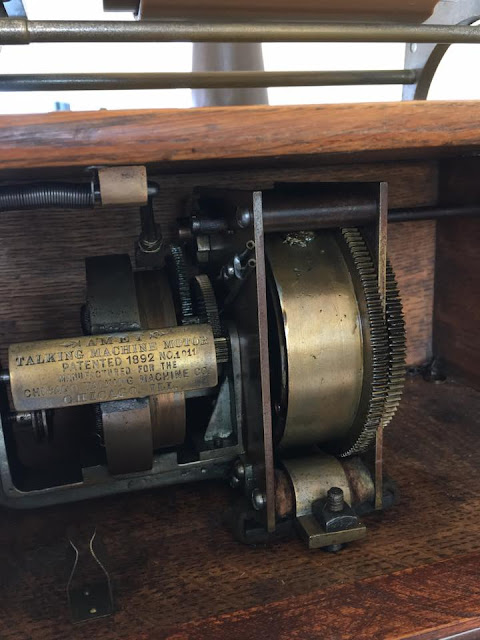
The inside bits, with a date indicating c.1893 as the date on this scarce machine.
What an amazing way to start!
I got to see the Zon-O-Phone project in process as we began our tour, with a guy taking those high quality pictures of the labels that can be seen on the LOC  website, such as the one below!
This guy was taking those fancy pictures of Zon-O-Phone records right before our eyes! He was taking a picture of a few Zon-O-Phone orchestra records as I recall. For those of you wondering about the Zon-O-Phone project, it's going strong, and making progress every day. 
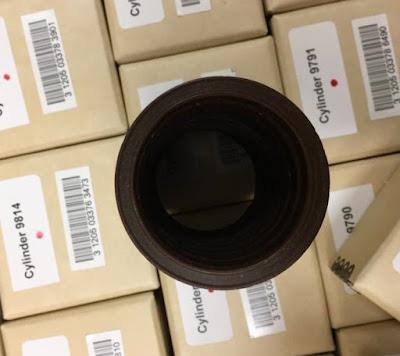
We then were taken to where the good stuff was---the cylinders! 
Oh yes, that's what it looked like. It's heaven for sure.
Where do we start? it was hard to make decisions of what I wanted to see, since pretty much half the records I've listened to for the past 6 years have been from this very place. The kind young man giving us the tour was really into the Pathe cylinders, so he showed us where most of those are kept, and he was also really into the newly transferred Mexican and Cuban cylinders they recently acquired. 
There are some of those Pathe Concert cylinders. Most of them have the original boxes and record slips, which is really nice.
The guy who was supposed to give us the tour was out of town, so one of his skilled young assistants did the tour, that's why there wasn't as much Columbia digging as there usually would be(that would have kept me there all day...). We soon got to some Columbia's! Of course we did. That's the good stuff.
Since i had for years hear Myers sing "The Bell Buoy", I asked to go see it and hold it. 
What a life-changing little thing! I had never seen or held a North American before. It felt less fragile than the usual brown waxes we usually see and hold. It felt sturdy and ready to be played. A feeling that doesn't usually come when holding brown wax. 
That beautiful, but empty channel rim.
Couldn't believe I was holding that in my hands. It's in beautiful shape for its age, but it looks just as great as it sounds.
Absolutely beautiful, especially after holding it. 
The cylinder was also much darker than I thought North American's were. They could easily be mistaken for Columbia records from c.1902, if you didn't notice the channel rim. 
Later I also spotted a few Len Spencer cylinders...(knowing the Columbia block for him helps...)
You can hear this here:
This one looks how it sounds for sure.
I also requested to hold that infamous cylinder "Will O' The Wisp" by Myers, just to see if it's worth getting transferred...
and how it is!

It's in gorgeous condition, and fully worth getting transferred! Hopefully the tale of Hylands playing this piece till he dropped is fully demonstrated with this cylinder. I had assumed it would he the same shade of brown as "Little Yaller Coon" by Spencer, but it's comparable to the North American's shade, which was unexpected. There were also some newly acquired editions of Hobbies written by Jim Walsh, but they were poorly patched together and not in good shape in the first place(they were rather brittle and yellowing). Those were interesting, since I had never seen these famous articles in their entirety, nor had I held any of them in my hands. That was some thing there it was...
That was all nice, with record catalogs we dug through, saw some piano rolls, piles of disc records, record encyclopedias, and miscellaneous stuff related to records stacked in shelves and we saw the boss' office! Mr. Seubert's office was especially nice, with some of the most interesting books about records and recording, and a few machines on shelves and scattered catalogs. 


Enough of that...since it's certain I will be visiting again very soon...


Now for the main reason of this post, referring to the title listed above.
This "mission" is something I've been piecing together for a while now, and it's beginning to take form now. In just over a year from now, I will be trekking to the Eastern U. S. to tour the North East to write a book. This book will be a journal of my travels in historical documentation, which will include tracking down and visiting all of the studio locations, recording artists' homes, publishing firms, theaters, and anything else related of interest. On this quest, I will go all of these places and write a day-to-day journal of thoughts and connections, as well as documentation of where and if things are still in place. 
Among these places that I will visit will include the following:

1155 Broadway(Columbia), 33 W. 27th street, most of E. 14th street(where all the theaters were and where musicians lived), where Frank P. Banta lived, stroll down 28th street(Tin Pan Alley), Columbia's headquarters in Washington DC, Sousa's house in DC, The site of the Berliner studio in DC, the street corner where Gaisberg indicated he discovered George Graham, where the Spencer Business college was in DC, find where John Yorke AtLee lived in DC, find all the famous theaters where the big early Broadway shows premiered, visit the Edison recording studio address in NYC(on 5th avenue), visit the very house that Russell Hunting and Charlie Carson lived and were arrested in(!), find where Vess Ossman lived,  Spencer's Lyceum, visit all the places where Hylands lived in New York, go to where this picture was taken:
(and maybe even get a few rag-time friends to pose similarly here if this place is still there somewhere...)
Of course, I intend to do some of this journey with my good friends on the East coast, like Charlie, who almost every day walks by some of these historic places. I will go inside all of these places(the ones that are left...) and dig around for any remnants of the history that happened there. I'd be especially curious about what might be hidden in the house Russell Hunting was arrested in. That could be very interesting and fruitful all the same, since he had to have hid things in that house somewhere... This also goes for the places where Hylands lived, since he was very unorganized it seems, he may have left some stuff occasionally while moving. The boardinghouse he lived in around 1910 would also be curious, since that was a house full of actors. Finding all of these places where the recording stars lived will be a chore...since I know where only a few of them lived at a certain point while they were recording. Certainly I will visit the fabled Dyker Heights where Spencer and Porter lived so highly around 1899 and 1900. I'll find all the musicians too, Issler, Schweinfest, Tuson, Dana, Hager, Geib(he played tuba for Edison early on), Banta, Chris. Booth, Arthur Pryor, Albert Benzler, Gaisberg, etc. The recording stars homes will remain a priority, because as soon as I get to the east coast, I ought to track down as many addresses as I can and notify them that I will be doing all of this "snooping" around if you will, for historical research. Luckily their addresses(some of them) are scattered around in recording magazines and theatrical papers. After getting the home addresses, I will start with the recording studios, and luckily, this will mean passing by Columbia at 27th and Broadway many times ,which is perfect for writing often about the amount of historic things that occurred there in such a short period of time. Many entries will refer to the Columbia studio, as well as the Edison studio(in NYC), and it helps that both of these places are on the way to other places of interest. I will also make many commutes that the recording stars once made, such as Gaskin, Spener(wherever he lived from 1897-1900...), Porter, Banta, Hylands(of course), Roger Harding, Issler(to where the U.S. Company was, and to Columbia), Schweinfest, Tuson, and the rest of the studio musicians we can track down. Of course, this quest wouldn't be complete without visiting the graves of everyone! 
I already visited and cleaned up Vess Ossman's grave, so one down... a whole lot more to go. I got to go find everyone on the east coast(if they didn't end up anywhere else). Luckily, Victor Emerson didn't end up there, he ended up not too far from me actually, in the valley of California..(what a coincidence). Unfortunately, one of my favourites to visit, Fred Hager, is in Florida, and there's no way I'm going to Florida just for that. 
As much as I love you Hager, you're in an awfully inconvenient place for me to visit so soon. Sometime along the line when I'm in Florida I will go pay a visit to him with a huge bundle of blood red roses tied in old silk with a bow, and a lot of kind sweet words to say for him. 
Also, when I go an do the grave visiting, I will have bundles of specific flowers to place on them. For Banta of course, will be a bunch of pretty violets. For Hylands, a few pink carnations, sunflowers, yellow roses and a single blood red rose. For the rest of these performers, I will have to make a key to what certain flowers represent, and make sure to match what I feel about them and what they were like. Of course, there will be mixed messages in many of these bundles, like Hylands' I just listed. The pink carnations are more disdainful, sunflowers haughty and flamboyant, yellow roses for infidelity, and the red for passion and devotion. This will go on and on as I piece together the bundles for everyone...

Anyhow, that's all I got for now. I pretty much explained this quest fully. 

Hope you enjoyed this! 


Wednesday, January 25, 2017

Revised: Character Studies--Fred Hylands(1872-1913)

After learning a whole lot more about Hylands, it seems fit to essentially re-post the Character Studies post on him. Just like anything I post on Hylands, it's often to aid the kind descendants of him, and to make sure that all collectors are aware of his presence on early Columbia records. 

The amount of information that has been collected on Hylands since this time last year has been phenomenal, and it all makes his life not only more interesting, but a whole lot more complicated. Just a few small facts and observations made by Charlie Judkins and I changed much of what we thought of Hylands, and came as a surprise. If I ever get the chance to give my seminar on Hylands once more(which I hope to!), it will be even more complete than when I gave it for the first time last November! Yes, there are still gaps that perhaps we will never fill, but those gaps at least have been filled to some extent in the last few months. Well, we've still got a long way to tread with the whole Hylands thing, but that is exactly why it remains ever interesting to search.
 There's not a way I could have expected that that unknown, obscure name "Frederic Hylands" written in the pages of The Phonoscope would become such a monumental and long-term project. But no matter, it's still a joy to dig, and eventually I'll find that unmarked grave in New York and at last get it marked if needed. 


Hylands in 1897,


and in 1898.

Here we go...

Hylands was a beaming star amid Columbia's night sky of glowing white stars, with a personality and figure that always consumed a room he entered. Sometimes this was intentional, other times not, but more often than not it was wanted by him. This desire, or demand, for attention is rooted in his past, like most things are with people. Being the older child, and a boy, it seemed inevitable for him to be treated better of the two children, the other being his sister Etta. He was born at about the last week of February(remember that we're not really certain of this just yet), and that would make him older than most of the early Rag-Time pianists, including Ben Harney oddly enough. It didn't take long for his parents, Charles and Mary, to take to the talent and genius of their son, as well as to realize that Fred was not going to be a respectable locomotive engineer like his father. By age 7, Fred was beginning to show interest in playing the fiddle, and with that curiosity took a liking to the banjo on the sly, since that wasn't exactly the most classical of instruments for earning a living. After messing with the fiddle, and becoming rather proficient with it, he began at the piano, playing whatever it was he played early on. Soon he was traveling all around Indiana and Ohio as a child prodigy, hence his sense of importance and need for attention later on. By 1886 and 1887, he was a local celebrity around Fort Wayne, being mentioned in the papers pretty much almost every week, with some new antics and gossip. In 1887 was not only when his father opened a grocery/saloon, but it was also when he went to the local business college(at 15 mind you!). He got into all sorts of trouble in and around Fort Wayne, from cable car bouts to driving a wagon and almost getting killed by a suddenly terrified horse(much like the whole Spencer cable car incident). All of this built his character, and providing entertainment at his father's saloon did so as well. He continued this interesting and well-known life until 1893 when the family moved out to Chicago, in overwhelming interest in the World's Fair. Unfortunately, Mary Whitney Hylands died not long after the move, leaving Charles with Fred and Etta. Etta married off the month after her mother died, with Fred and Charles the only ones at home then. Fred as working out a local outposts for Keith's and Pastor's theaters, playing accompaniments, and managing shows there, but also playing at less-then respectable places that Chicago was infamously ridden with. Places where syphilis and violence ruled the essence. This is where the final touches were set on his playing style, as by this time he had fully settled with playing the piano. His style was finalized when out in Chicago, as all of these other famous "rag" pianists were playing at the same clubs and venues as he, and without a doubt he took from them, despite already possessing a style that was the zenith of Rag-Time's early days(like Ben Harney's). In September 1895, he conveniently married British singer/actress Maria Stevens, possibly due to pressure set on them by both of their parents. Not long afterward, Charles, Fred and Marie moved out to Milwaukee for a short period, most likely because Fred had been asked to work for one of the theater chains at which he was employed to manage. By mid-1896, Fred and crew were finally out in New York. Fred immediately resumed working at the theaters he was already empolyed, only this time it was where the original managers and theaters were, not the chains. Fred earned a reputation in New York, though at first he was seen as a hapless Indiana rube of a sort(not entirely...) to the society Rag pianists such as Max Hoffmann and Burt Green. He was no rube, in fact his smarts were far higher than most thought at the beginning, but this didn't always prove him well. By very early 1897(or late-1896...), he caught wind of the advertisements of recruitment the newly local Columbia Phonograph Company, and that they were holding auditions and tests. Not long afterward, he went off to 27th and Broadway to await his turn before Easton, Emerson, and Issler. Soon he was declared an employee of Columbia, on staff, almost full time. This came about around March-April 1897, according to auditory study of Columbia recordings made around this time. Soon Hylands began to realize why Issler had become bitter about working in Columbia's studio, or any studio for that matter, though at least in the beginning of Fred's term there, and the end of Issler's, the two of them got along rather well, but this did not last into the next year. Of course, with this new job, Fred had no idea how this was going to impact him, assuming it wasn't a horrible occupation to be a studio musician. How he was wrong. In mid-1897 or so, Hylands seemed like anyone else who worked at Columbia, young, sweet-faced, well-rested, and fit. As can be observed from the images of him at the top of this post, none of these things remained as such. He was still relatively good-looking into 1898, though the temptation of the benefits he received from working at Columbia for got to him faster than anyone could have expected. He came in to Columbia in early-ish 1897 at just over 200(keep in mind that he was freakishly tall), and by the middle of the next year, was at over 300. That was unexpected. Also, he seemed to have aged ever so slightly in that timeframe, seeming like heaps alcohol and drugs carved lines and exacerbated his quick gaining of weight. Like many of us would think to-day, that couldn't have been good for him, gaining that much weight in a relatively short period of time. Well, it's likely that in the early half of his time at Columbia(which incidentally was the last quarter of the brown wax era), is where the diabetes he had began to slowly suffocate him, little by little each coming year. It was because of this unexpected spell of suffering and stress that we get quotes from him like this one: 

That was still not too long after he began working for them, a little over a year perhaps. Of course, by the middle of 1898, his rag-time piano accompaniments were becoming a signature for Columbia's records, as they were openly advertised and described in editions of The Phonoscope and they soon became an indicator for what Columbia's records sounded like. His accompaniments in Rag-time behind those singers were superior, perhaps outdoing Edison's own Frank Banta and Fred Hager  by a mile or more. Not always, but the musical ideas and folk background of his made the style more distinct, and interesting to listeners of the era and of to-day. Since Fred was had become so popular at Columbia, he used this to his advantage in selling his music, since anything he wrote while there was certain to get him some decent mileage. it was just at the height of the infamous exhibition season that he wrote his famous "national success"(not really) "The Darkey Volunteer", for Vess Ossman, and when he sent out advertisements highly praising his piece from his first few months at Columbia "The Narcissus Gavotte". This got far, with a handful of takes of "The Darkey Volunteer", and many encores of his fantastic playing at the wearisome, hot and sticky exhibitions, it seemed all-right for him. It must be noted that on the the 1898 cylinder of this by Ossman and Hylands, that it seems the composer didn't even bother to practice his most prized piece, or just bother to play it to the best of his ability(there are many mistakes scattered all around throughout the piece, not on Ossman's part). That just goes to show how Hylands felt sometimes, even in the presence of tightly strung and intense natured Ossman, who probably tediously practiced the piece till he couldn't anymore.  Hylands could clearly be frustrating sometimes, and this is just one example of perhaps many aggravating little things he pulled with other recording stars. 
1899 turned out to be an even more pivotal year for Hylands, and this was because of his forceful will in beginning an official publishing firm with Roger Harding and Steve Porter. He threw the idea at them as well as setting aside some stocks for the firm, all before the firm could ever get anywhere, only publishing one piece successfully in February. After Fred's angry break down from the "Knickerbockers" firm blowing to bits, he stepped right in again to begin another publishing firm, this time with his good studio friend Len Spencer and his booking agent.
This time it seemed Fred had the Columbia Lady's hair in his grasp, by then owning an amount of authority over Columbia's flow of music in the studio. This allowed him to publish music of the studio stars, to further their fame, and this time just not on recordings, but also in print! It was ingenious, until the notion fell through after a year and a half, since Burt Green couldn't manage his flat during the days, and Len Spencer had pretty much dropped out by then, due to his constant recording activity, and Fred himself had grown heavier and weary of the managing he'd done for everyone. Hylands Spencer and Yeager fell through completely in October 1900, and by the month afterward, he had sold all his stock, further throwing him into deeper melancholy from the failure. He still had Columbia to keep him employed, though it was around the time of ending the firm and the last true year of the brown wax era(1901) that he began to form his somewhat rebellious, Socialist viewpoint that later proved him well for a short while. He continued to work regularly at Columbia, thought reluctantly, and worried he was more susceptible to fights and abuse from the other staff members, due to his fooling with them during the publishing firm, which unfortunately for him included everyone he worked with regularly. To escape this, and return to his roots, he began performing in minor shows on and just off Broadway, as well as performing in straight vaudeville, singing songs and playing that signature piano style he seemed to have been known for. By 1902, he had a fling with Columbia finally, almost getting him thrown out, other than the whole Climax feud doing just the same thing. This time, it was more of his own fault, feeling agitated and abused by Columbia's treatment of him, he had enough, though they didn't, and couldn't fire him right then and there. His protest included going off and working for Columbia enemies, such as Zon-O-Phone and Leeds. The other companies welcomed him with open arms, with no previous notion of how vexing working with him was. Of course, like anything he involved himself in, his association with these other companies didn't last long, and by early 1903, he was back at Columbia, working there until the middle of 1905,when at last he was dropped. After 8 years, he was finally freed from them, and able to do what he wanted. Despite mild successes on Broadway in 1905 and 1906, he still was dissatisfied with the little recognition he received from this, and not being able to lived as comfortably as he wanted. Being one of the founding leaders of the White Rats Actors' Union, he had some protection and leverage to keep him and Marie out of poverty. He slowly drifted away from what he was supposed to be doing as a chief at the White Rats, becoming solely a musician with each coming month, refusing to be seen on the stage(Wish we knew why this is...) and becoming disloyal to the union he helped found and organize. He did continue to perform onstage regularly during his period where the other union members became suspicious of him. By 1910, he was living in a boardinghouse not too far away from where the old Columbia building was still standing tall. He and Marie came in and out of the boardinghouse, going on various tours and trips for the stage, and it seemed that Marie was busier than Fred, not even being present for the 1910 census, and her performances scattered all over stage magazines with Belle Farmer were taking over Fred's spotlight by a mile. In 1912, after being thrown out of the White Rats for good, Fred teamed with Wilbur Held as a duo in vaudeville. Keep in mind that by this time, Fred was slimmed out once more, similar to when he first began working at Columbia, but this time it was because of traveling and sickness, not like before. The touring he did from 1906 to 1909 wore him out, and probably exacerbated the downfall of his health. By 1912, especially early 1913, he was especially not well, perhaps any night of a show could be his last by then. Of course, he didn't think that way, so he refused to let this notion bother him. In the early part of 1913, Fred and Held were signed to tour in England in the summer, which by June, is where they sent off to. Once over there, they got to touring almost right away, with Fred and Wilbur being the headliners of many shows, and Marie being in some of them as well. After about a few weeks of touring, once the troupe had gotten to the northwestern coast of England, Fred dropped dead, of something related to the crippling diabetes he had for years. Oddly enough, Marie and Held continued to perform for a few more weeks after Fred died, since their contract had been extended, to two years it's said, but of course, it could not be fulfilled without Fred. 


After a few more weeks, the troupe finally disbanded and went back to the U. S., to have Fred's funeral. It was held by the White Rats union, despite their bitterness toward him in the end, he was still a founding member, and deserved the respect. It is not certain where in New York he was buried, or if his grave it marked in any way, it's unlikely to be. Marie spent two years in mourning for Fred, in the typical Victorian tradition, but just then and there in 1915 she went back to where she and Fred met in Chicago to marry a Dutchman named Sam Gelder, it is uncertain how long they were married, but it was into the 1920's. 


I don't think I need to exhibit a bunch of recordings Hylands was on because they are scattered all over the posts of this blog, and there's really no way to decide on only three or four with him. This is exactly why he's ever interesting! 

Sorry about not posting for over a week, it's been hard to make the time for a post in the past week. 

Keep your spirits up out there! 

Hope you enjoyed this! 

Monday, January 2, 2017

Organizing some of Hylands and Professor Burt Green

One thing I really hate to do on this blog is to make things seem to repetitive, and with this, I really hope that speaking so much of Hylands recently hasn't been too much for some of you. This new image of the Columbia studio has really been something that has plagued my thoughts since I found the image. Yes, the night of finding it I even lost some sleep over it. This is what happens folks, those of us who care so much about the most minute of details in this overarching subject matter can lose sleep over just a single image. It's not healthy at all, but it happens. It's just as bad as the amount of work the studio stars we study had to endure during the "round" era. 

Of course, with the discovery of this image, there has been much discussion over who that pianist might be. I've gotten Percy Grainger, Gaisberg, and of course the unknown studio pianist. Everyone who has discussed the image has had differing opinions of who it looks like to them. In many ways, this debate is more intense and important than the glasses debate, because that got settled. 

We know Hylands wore glasses, case dismissed. 

But just like anything related to early Columbia, nothing is that easy. This image is proving to be the hardest of any so far as far as face identification.
Yep. 
Seems to be haunting still, and it will continue to be as such. 
That handsome face seemed to most who I asked too much so to be Hylands, though really if you look at the exhibition picture from 1898, you will see that it's the same face. The only thing that seems to be throwing everyone off is how slim the pianist in the picture is, that's all. Oddly enough, when I was in Missouri back in June, I had a conversation with John Reed-Torres about a similar subject on Hylands. I explained to John that Hylands seems like the type who was slimmer when he was younger, but John couldn't believe it. Now something has come along to prove this point clear to him. This image could very well prove this point. As weird as it seems, I really do think it's Hylands, despite the conflicting opinions received from the image. Only two of  the people asked about this image believed that it was probably Hylands. Luckily, those who thought this were using the artists' logic here, and with that I will explain. 

Being a cartoonist, I study faces all the time, and especially faces of these recording stars. This is an important part of my study of these widely forgotten faces, and luckily, I've studied Hylands' face just a little more than others. This is only because of the fact that we haven't found a decent photograph of him yet. As far as decent, this image is about as good as it gets until we find something better.

 One of the first things I turned to in trying to figure this out was that image of Fred's sister Etta on his music. Using that is actually a better source than some might think at first. 
Now when looking at this image, you can easily see that her lips are exactly the same as those of the pianist in the image:
Same structure. Also, the nose is similar, but not the same. Her profile would look similar in this case. If you really study the image of Etta, you can see that this "unknown pianist" looks related to her, and would therefore be her brother Fred. Her eyes don't look nearly as bright as Fred's because the lighting makes Fred's eyes look bright blue or green, which is not too surprising, since this seems to run in their family yet. Her eyebrows are also a little thicker, which is again interesting to note in terms of differences between them. Much like her brother, Etta was rather tall, but not freakishly tall like Fred. 

Just to put this into perspective, Fred would be a foot taller than me. 

Of course, that's just comparing this wildcard image to something that seems completely unrelated to Columbia and recording. The next step would be to use what we've got in the exhibition picture. 

Really seems strange to go back to this after seeing the other picture...
Now this image was the best of help in solving this mystery, since this was the best example of how Hylands looked before this new image. Of course the one thing that threw everyone off was the fact that the new image is probably from 1897, and that the exhibition picture is dated to September 1898. That's a relatively short period of time. Hmm, it seemed strange to Charlie Judkins when I inquired him of the image, because of this specific point. It seemed strange to both of us that he would gain so much weight in a rather short period of time. But with Hylands, Charlie noted that this seemed to be a pattern with him, something not just coincidental to when he began working at Columbia. Though, it is important to note that this dramatic change came about about the time he began working there, at the lost supposed time that he began, in late-1897. Since this new image is from more likely 1897, that whole notion of him working there that early is finally inching closer to being proven. 


But why would Columbia cause him to change so much in such a short period of time?

Well, it was a mix of many things. The first thing to consider is that he was no longer constantly running around from place to place in a theater. All of that ended when Columbia took him, really think about what he'd be doing all day at Columbia. Not much moving around. Unlike Georgie Emerson or the Spencer's, Hylands would be stuck in his piano chair the whole day for the most part. He'd only be playing for the singers all day, take after take. It's certain that he hadn't had a sort of job before then that was so tiring and stressful, so without a doubt this didn't help his disposition. Stress and lack of sleep really got to him not long after beginning his term at Columbia, and therefore, he gained an unhealthy amount of weight after beginning to work there. It took less than a year for him to be called "the heavyweight pianist" by the Columbia staff. How he had some unfortunate genes if that could get him so quickly...


(a cartoon I did mocking this dramatic change)
With all of this, I will have to go back and re-do my character studies post on Hylands, since this single image changes much of what we know of him, and leads us to more theories and such. The newly redone post will come up within the next few days. 


Now to move to a friend of Hylands'. 

We know of Burt Green as Hylands' "gopher", or sideman under the Hylands Spencer and Yeager venture in 1899 and 1900. When Hylands snatched him by the collar out of the orchestra pit in 1899, it happened to be at Huber's Museum/theater he took him from. Other than working at Huber's he was known as the chief imitator of pianists at Pastor's theater, which was no small thing. It was said that when he took the place of Mike Bernard or Fred Hylands one night of regular performances, he WAS the orchestra pit. By this, they meant that he was such a good mimic that anyone would mistake him for any of the other usual pianists, and that he was a piano freak, with wild abilities on the piano. This is a similar story Mike Bernard, though Green was not nearly as widely known for such a thing. It seems he was known as an imitator in his days before leaving Ethel for Irene in 1907. 

Burt Green was not considered one of the best accompanists, but that don't mean that he wasn't a good pianist. Unfortunately, on the few recordings with his piano accompaniment, we can't hear him play at his best, or play that Rag-Time style that he was known for in the late-1890's. This is the reason that he and Hylands were such good friends. 

It must be noted that in 1907, Green wrote a column in Billboard, which consisted of gossip about vaudeville stars. The column was called Vaudeville Happenings around New York. If you ever have the chance to read through the column, it's certainly worth it! He not only judges performers he had recently seen or performed with. Many of the names are familiar to us, such as Marie Dressler. 
One of these hilarious sections read thus:

It must be lovely to own one of those suburban homes just now. Imagine those poor actors who have to drill through all this snow. Give me the flat in New York, even though I can not save as much money, but nevertheless what I do save draws interest, and when I want to move, it's lots easier. It's a good safe bet that seven-tenths of the artists who have "stung" on those "home" propositions would sell out at half price, if you could get them with a little ready money just now. 

Wow, that's so true Burt. How funny is that? It's great to read these. One thing that really surprised me when reading through these is the amount of slang he used. Of course, Burt Green was the most dandyish of the characters in this early Rag-Time study, but it's ever more interesting to read his column. All the slang comes through just as it did in The Phonoscope. One of the statements that really caught my attention is this:

...Some actors are so stereotyped that they can not put a new gag in their act without having nervous prostration--and these are the kind that stand on the sidewalk and enviously roast their more successful brothers. It's the hustler who gets the plum, the fellow who spends his money for new material and keeps himself in front of the agent and manager at all times. 

The one thing that really was surprising was the fact that he used "roast" in the modern terms. That was rather interesting, and really funny in fact. It is really starting to make sense why Hylands was attracted to Green(not in that way), and why he was Fred's assistant, also probably helping with the advertisements.  Since Green did this column, wish I could find more of his writing! He seems to have been a great gossip writer. It's unfortunate, he would have done great as a Phonoscope correspondent. It didn't matter though, those correspondents for Hunting were just as subliminal and comical. This is why in many ways, Burt Green seems like the honorary member of the "Columbia Clan". 


Before the finish, I would like to share a recording with some aggressive piano playing on it! There is indeed such a thing as this, and in fact, this recording is the only one that could be classified with that. 
Here's the record:
(it's the first take listed)
That pianist is aggressive! 
Wow, you don't need to play that harsh...
Also, something to note about this recording is the sound of the piano behind him. It's got a strange sound, that's wirey and out-of-tune, which sounds similar to a certain piano that Len Spencer flipped over. Of course, it's not that badly out of tune, but it's noticeable for sure. Every note in the piano accompaniment can be heard clearly, which is unusual, and the loud fifths in the left hand help this to happen. 


Hope you enjoyed this! 


Thursday, December 29, 2016

A mystery Pianist and Columbia's Nonexistent Censorship

Who's that?
Exactly. 
That's all we know as of now. Hopefully by the end of this post, some of the mystery here will be sorted out. 
Now, while searching around the pages of Antique Phonograph Monthly this evening, I stumbled across this image:
Now it looks like any old studio picture that was made into a lithograph of some kind, much like those pictures from The Phonoscope. At first, the pianist I had assumed to be Hylands, just like most of the time, especially since the singer whose face we can see is Steve Porter. But that doesn't seem to look like Hylands... not nearly as... ...eh...stout as he was... 
But that profile... ... ...
That looks suspiciously like some other picture we know of:
Hmm... ... 
This is a real hard one. More so than any previous photographic findings. One thing that is for sure--that's Hylands' profile(the picture at the very top of this post).COME ON! This are his lips, they are both the same in that picture and the exhibition picture immediately above, same slicked back hair, chin and neck, intensely bright and reflective eyes, that distinctly nose, the overall height--it's all the strangest thing. I have not any idea of what to think of this, since it really does look like Hylands, but the weight is not there. It almost seems to me like the lithographer who drew out the image fixed around Hylands' figure, which seems unthinkable, but isn't impossible. Remember that retouching was a very common practice in photography in this time period, particularly in show business and entertainment. Of course, this seems just completely like a  far-fetched, outrageous, inconceivable theory, since most people who know of my almost obsession over Hylands would know that I'd chuck this sort of possibility immediately upon looking at the image. This is a special situation however. It seems weird of me to go off an say that this:
is Fred Hylands, but really, since it's a Lithograph, anything's possible. Also, if you really study the look of his clothing, you can kind of see a little more of Hylands in it. That's still not enough to prove it, it still seems laughable for me to even think that's Hylands. 
Come to think of it, it looks a little disproportionate if you really study the body structure of the figure, as well as the size of the upper arm.Who am I kidding, this is just a crazy theory, that probably none of you reading this believe. If you do think it's Hylands, PLEASE COMMENT ON THIS POST! I would love to hear other voices in this conversation, because there's no way I can figure this out on my own. 

Do note that the pianist is VERY tall. 

Whatever becomes of this, I REALLY  hope that's Hylands, because if so, he was better-looking than I thought!
*Again, PLEASE share your thoughts about the pianist in this image, they are mightily appreciated in this circumstance, more so than any other time I've asked for feedback*


Now to move to something also Columbia related! It's clear that Columbia had their own sort of "Clan" in the 1890's, with Russell Hunting as its leader and founder. Hunting was the king of the crass humor and little censorship that makes many early Columbia records charming and attractive to younger listeners, even in the modern terms. Many things slipped out on these early Columbia's, not only countless mistakes from the distracted piano player(Hylands), but well-hidden obscene humor, such as that of both Spencer's. Someone like Dan W. Quinn refused to let any of these things cause him trouble in the studio, and with that, many takes of his must have had to be redone. However, when we move to figures like Gaskin, that's a different story.
Gaskin is becoming an ever more interesting character than previously thought. Not only was he an advocate for George W. Johnson, but since he dealt with oppression of the Irish, he had time to become self-aware and wise about suffering and discrimination. Gaskin was poor Irish scum. Roger Harding was well-to-do Irish. That right there says everything about Gaskin's outlook, and how he was viewed by even his colleagues in the business. Gaskin pretty much personified all Irish stereotypes, from the weird and crooked speech with a thick dialect, to the firey red hair and steel blue eyes. Gaskin also didn't care a rap about messing up often on recordings, which seems strange to say since his records seem all fine when thinking that over at first, but there are a few recordings that could change our preconceptions of Gaskin. One record in particular caught my attention, and it was posted just this week. 
Before the analysis, here's Gaskin's 1898-ish recording of "Drill Ye Tarriers Drill"(with Hylands). This recording is very interesting(despite the fact that it's played too fast). Now this seems like just any crazy Columbia record from the late-1890's, with all of the aspects loud and clear, especially the piano! Not only is Hylands' playing really great, especially at the end when he plays his whole Irish jig thing that he used to do on many records by Quinn and Gaskin, but one thing Gaskin says really caught my attention. If you know about Gaskin's routine with this song, you'll know that he did the usual protocol when the singers said "hell" on recordings. Quinn exemplified this by always saying "h-well!", and Collins and Harlan never said the word flat out. You may notice that Gaskin on this take just above actually says the word. 

Oh--the boss was a fine man all around,
but he married a great big fat fall down.
She baked good bread, she baked it well,
---she baked it hard as the hearts of hell.

Yes folks, that is what Gaskin sings on this recording. That is what makes this take so unique, as the other takes by Gaskin have him not even saying "Hell" in the lyrics. On his famous Berliner you can hear this. 
He says on the Berliner:
she baked good bread, she baked it well,
she baked it hard, well I won't tell!

This small thing really says a whole lot about Columbia compared to other record companies. It backs up the fast that Columbia was a much more liberally run company that others of the time, and that Emerson didn't care about small ticks like this, despite the fact that Edison would overreact to things like this. A few recordings were deleted almost immediately from the Edison catalog because someone at the playback thought they heard "hell" in the lyrics, but really that's not what the singer(Will F. Denny by the way) actually said. Emerson probably couldn't care less about Gaskin or anyone saying that on recordings. It must be noted that Columbia released something called their "tough series" in 1899-1900, which included "The Side Show Shouter" and early takes of Spencer's "The Dog Fight". These recordings were along the lines of Gaskin carelessly saying "hell" on a recording, from around the same time. Even after Hunting went to prison, and went out overseas, the boys back at home still held on to the humor he helped influence. 


I hope you enjoyed this! 


Saturday, November 5, 2016

Studio Politics and New Leachman cylinders

Ah yes, the week prior to election day, and this time around, it's the most frantic one for many decades. To remain on the subject of politics, this brings me to the first part of this post. Much of the studio politics are hard to track as far as these documents go, but if you're looking into the outside activities of these recording stars, many assumptions and theories can be formulated. Sometimes it's a little misleading, such as someone like Len Spencer, who followed many ideals of the Democrats of that time, but embodied most of the mindset of Lincoln, as well as James Garfield(remember that Garfield was his godfather, and is where his middle name came from). Other than all of this, Spencer was a harshly standing Republican, and this is clear after reading some of those sections from The Phonoscope that he was a Roosevelt man, also McKinley for that matter. Other than Spencer's beliefs being primarily republican, most of his fraternal friends of the publishing firm were Roosevelt/McKinley supporters, and at that progressive Republicans, though with the rise of new ideas circulating at that time, some of these "brothers"(referring to the "fraternal" atmosphere that Hylands specifically promoted for the publishing firm)  later entered in the other, Socialism. That came around after 1900 though, even if the ideals existed before then. 

That one section from the May, 1900 issue of The Phonoscope very well illustrates the devotion to Roosevelt/McKinley that some of the Columbia staff had, more specifically Roger Harding and Len Spencer. With two sections in the General News section about the upcoming election, it seems that there's more than just a little devotion to politics there, even after Hunting was settled in out in England, and had been gone for almost two years by then. To add to this, Harding had his own republican club out in New York, and hosted performances of Spencer's minstrels there in 1900 as well, as it was in May of that year that a few performances can be tracked in local newspapers. Since Harding was such a politico, it seems that he ran most of the politics of the "Clan" at Columbia, and kicked aside those who weren't republican, or progressive. This would immediately eliminate Silas Leachman from any of the "clan" activity. 

That brings me to Leachman, who was a Democrat and it's clear that he was, as that's the party he ran for as a Chicago Alderman around his time of making Victor records(1901-1903). Leachman was from Kentucky though, so it isn't too surprising that he was a Conservative politician in Chicago. Take into consideration that the Democrats were the party of the trusts, and the barons of railroads and corporations. Leachman was part of no studio clan though, he just had local politicians and some local characters in his circles. There didn't seem to be a clan of recording studio performers out in Chicago, even if there kind of was in the mid-1890's, Leachman wasn't one of them. This group would have included Bert Morphy, Banta's orchestra, the North American outpost employees, and some more who recorded for the Chicago Talking Machine Company.

With all of these conflicting views of politics, it would seem strange to think where some of the "clan" member went after it broke up around 1903. Len Spencer remained firmly on Roosevelt's side, and when Wilson was put in office, he must have had none of it. It seems Fred Hylands became more progressive than previously thought, as he had begun to associate himself with not only strange and sassy actor folk(like J. Grant Gibson) , but also with Union leaders and workers' rights activists, and of course with this spreading like disease all over New York, it would seem inevitable for him to get roped in to the rough gangs of Socialists that were sprouting up. The friendly local Socialists must have found Fred to be a great example of someone that could make real change in their cause. He must not have been sure if joining them was a good idea, but since they were the ones for beginning all of these unions, it's not surprising that hard standing Socialist like Art Young would take an interest in Hylands' advocacy. Of course, now we have evidence of this happening, as this cartoon says everything about it:


Yes indeed, that fantastic and very accurate portrayal of Hylands. 

If you haven't already guessed, I will be using this cartoon of Hylands rather often now, since it really does personify everything about him that I draw and have pieced together. These union acts from Hylands certainly not only had him lose friends, but gain some that had nothing to do really with performing, like Art Young for example. I'm not saying that Hylands was solely socialist, but there must have been hints of it here and there, but remember, this is around the time that Columbia dropped him is when this was beginning. I would say that his socialist side began to kick in around the earlier part of 1902, when he was almost thrown out of Columbia because of the Climax/Victor/ZonOphone/Columbia feud, and it had nothing to do with him whatsoever, even if he was technically working for all of those companies when it happened(which was not really okay as you might have guessed). Of course, that's just typical Hylands, committing for a little while, then seeing more opportunities along the way and taking them, not regarding pre-existing animosity, legal stability, or company names. That, as we know, got him into trouble, and out of the Union that he helped kickstart in 1905(the White Rats that is). Spencer might have liked Hylands' hints of Socialism here and there, but when he began the owner of a Lyceum with many valued workers, maybe not so much, and especially since it's clear that Spencer hosted White Rats performances at his theater, he must have had enough of it by that contract fail in 1908. 

Spencer had another reason to be bitter toward is old accompanist by then.

Anyway, time for some music! While searching around in the Santa Barbara cylinder website, doing my daily checking for new transfers, I stumbled across three of the Leachman cylinders they have, and they're finally transferred! 
Yay! More Leachman cylinders! 
These transfers were messy, which is unfortunate, but one of them stands out more than the others in that respect. More than half of the cylinder can be heard very well and clearly, with almost no mold, but the other two are plagued with the spores. 
Here's the best one:
http://cylinders.library.ucsb.edu/search.php?queryType=@attr+1=1020&num=1&start=1&query=cylinder15987
This is a fantastic example of authentic Chicago Rag-Time, and all of the playing is made more interesting by the great sound of the piano! It sounds a lot like Columbia's piano after Spencer flipped it over back in 1897. Since it's not balanced the same way that normal studios were balanced, it sounds a little weird and out-of-whack, and that's really why the piano sounds the way it does. However, the piano really does sound great from my strange standpoint of what historically accurate pianos sound like, in fact, that little interlude he plays at about 1:21 is one of the best examples of what a studio piano from that time should sound like, and it's not a studio piano! it's just the piano that Leachman had at his home, as it is one of those cylinders, that he made at home with four cylinder players set atop the piano, recording them "white wax style"(or like Spencer did when he began making records in 1889). 
Here's the one that's second best as far as mold goes:
http://cylinders.library.ucsb.edu/search.php?queryType=@attr+1=1020&num=1&start=1&query=cylinder16000
The piano certainly sounds better on this one, more well-recorded and tuned. It's a great cylinder, even if it's really messy. That can't compare in mold to the third one:
http://cylinders.library.ucsb.edu/search.php?queryType=@attr+1=1020&num=1&start=1&query=cylinder15986
From what can be heard, it is a fantastic cylinder, that would sound really good if it wasn't moldy. It's also a really good song on it, which certainly helps to make it better to listen to. It must be noted that Leachman plays the final chord of the piano accompaniment exactly the same way that Hylands did, which is very strange, yet makes sense, since Hylands was a Chicago pianist when Leachman was making records in the mid-1890's. After listening to these, I see why Vic Emerson always said Leachman was not really the best musician, but he only said that because he was comparing him to the pianists he had at Columbia, which isn't really a fair comparison. Of course, those Victor that Leachman made in 1901-1903 are better examples of his singing and his absolutely phenomenal vocal range, but since no one really said who was on piano, all guesses are essentially off for his Victors, as they could be any one of the early studio pianists, or even Leachman himself. Maybe there's a reason that some of his Victors sound a little unbalanced as far as piano goes...
It's not impossible that he would have been playing his own accompaniment, as that was his act, and the Victor people might have seen past Emerson's ignorant claims to Leachman's musicianship. A particular Victor of his that comes to mind is "I need the money" from 1901, not only can we hear the piano extremely clear, but also hear Leachman change his voice from his normal tone to a Hebrew dialect, and then Irish, all on the same recording. Really listen to when he changes from his regular voice to the others, it's really extraordinary, and ingenious. That's something you don't get to hear too often on these early records, the change from normal tone of voice to something completely different. Someone who also did that often was Roger Harding, and he sounded pretty different once he did, but not nearly as different as Leachman. It's that about Leachman that is so ingenious, that most people don't realise, that his range and versatility was in reality more so than all the other early recording stars, and yes, even Len Spencer. 

There's probably no way we'll ever know for sure if Leachman played piano on his Victors, but that's something to keep in mind when listening to them. Maybe try to envision them being recorded that way if you're someone who can do that when listening(that's what I do usually).

For a good comparison, here's a 1901 Victor by Roger Harding:
http://adp.library.ucsb.edu/index.php/matrix/detail/100002593/Pre-matrix_B-3450-Ive_been_down_in_old_Kentucky_
Damn I love Roger Harding. This record is exactly why. 
Listen to how the piano is recorded, with the distance, and tone.
Now compare it to the first and second takes of "Whoa Dar Mule" by Leachman:
http://adp.library.ucsb.edu/index.php/matrix/detail/100002500/Pre-matrix_B-3357-Whoa_dar_mule#
There's a dramatic difference in the sound of the piano, and it's a little suspicious. Alright, I'm a little more convinced that Leachman played his own accompaniment on at least some of his Victors. If this is true, we've got some listening to do Rag-Time pianists, because he sounds an awful lot like the earliest Rag composers, out in Chicago that is. 


Maybe that's why I thought Hylands was on some of his Victors... ...


Hope you enjoyed this!