Showing posts with label Issler's Orchestra. Show all posts

Saturday, January 18, 2020

A trip to the City

A few days ago, I got back from a five day trip to New York City. For many years i had been wanting so badly to visit New York to seek out all the important recording history locations that I write about so often here on this blog. This trip had been planned for a few months, and that gave me time to plan out what I was to do while there. 
In the weeks before leaving, I made a handwritten list of all the addresses to go and visit, to cross them off as I went. There were nearly 30 addresses on this list, and many of them got crossed off. 
Going to all these places was emotionally, and ultimately physically taxing for me. My first day there I was overanxious to start walking down Broadway to 1155 where the 1890's Columbia studio and offices were. I was trembling with excitement, all dressed up in a simple black and white dress dated to around 1901, and could hardly believe I was walking down this famous street, surrounded by all this history. 

Along the way to 1155 I saw a few other addresses on the list, one being 1180(1),where Roger Harding set up his short lived publishing firm in 1900-1901. When I got t0 1155, it was overwhelming. The address had changed so much, yet the number remained the same, and somehow the exterior of the building remained somewhat intact. It wasn't difficult to picture the place in its original state when all the recorders made their way in. 

Wanted to make sure I took a picture in front of the address with something that was sold there. I stood there for awhile, and after mustering up some courage, I approached two security guards standing by the front door. I commenced to lecture these young men about the unbelievable amount history that occurred right where we were standing. Showed them the supplement pictured above, and the several pictures taken inside the building in the 1890's. These young men were unusually curious about this history, and they seemed quite amazed that the columns on the inside of the building are still standing to this day. After lecturing for about 20 minutes, I headed to 28th street where the original "Tin Pan Alley" was. I heard of a recently finalized proposition to make these five or so intact buildings a historical landmark and have them somewhat restored. 
It was so nice to see these buildings, even though they are a bit beat up and sketchy looking as of now, thankfully that is scheduled to change soon. Here on this block and the next included the Witmark publishing, W. B. Gray, Hylands Spencer and Yeager, Helf and Hager, and several more over time. The one specific address I was most curious to see on this block was 55. 55 was where Ring and Hager published together in 1904, and where Helf and Hager first set up the next year. 
After  going to cross off a bunch more addresses in Tin Pan Alley, I set out to Hell's Kitchen where Frank P. Banta grew up. I wrote down the address that the Banta's lived in according to the 1880 census, so this is most likely where Frank and his siblings grew up. As I approached the number, my eyes started to tear up, as I was walking along the street that little Banta once did to go and tune pianos in the surrounding area. 
This building looks very much intact, and probably didn't look too much different when Banta lived there. The house number is even the same as it was in 1880. 


The next morning I returned to 28th street. I was waiting for some friends to meet with, was stupidly early, so I decided to sit on the steps of 55 until my friends showed up. 
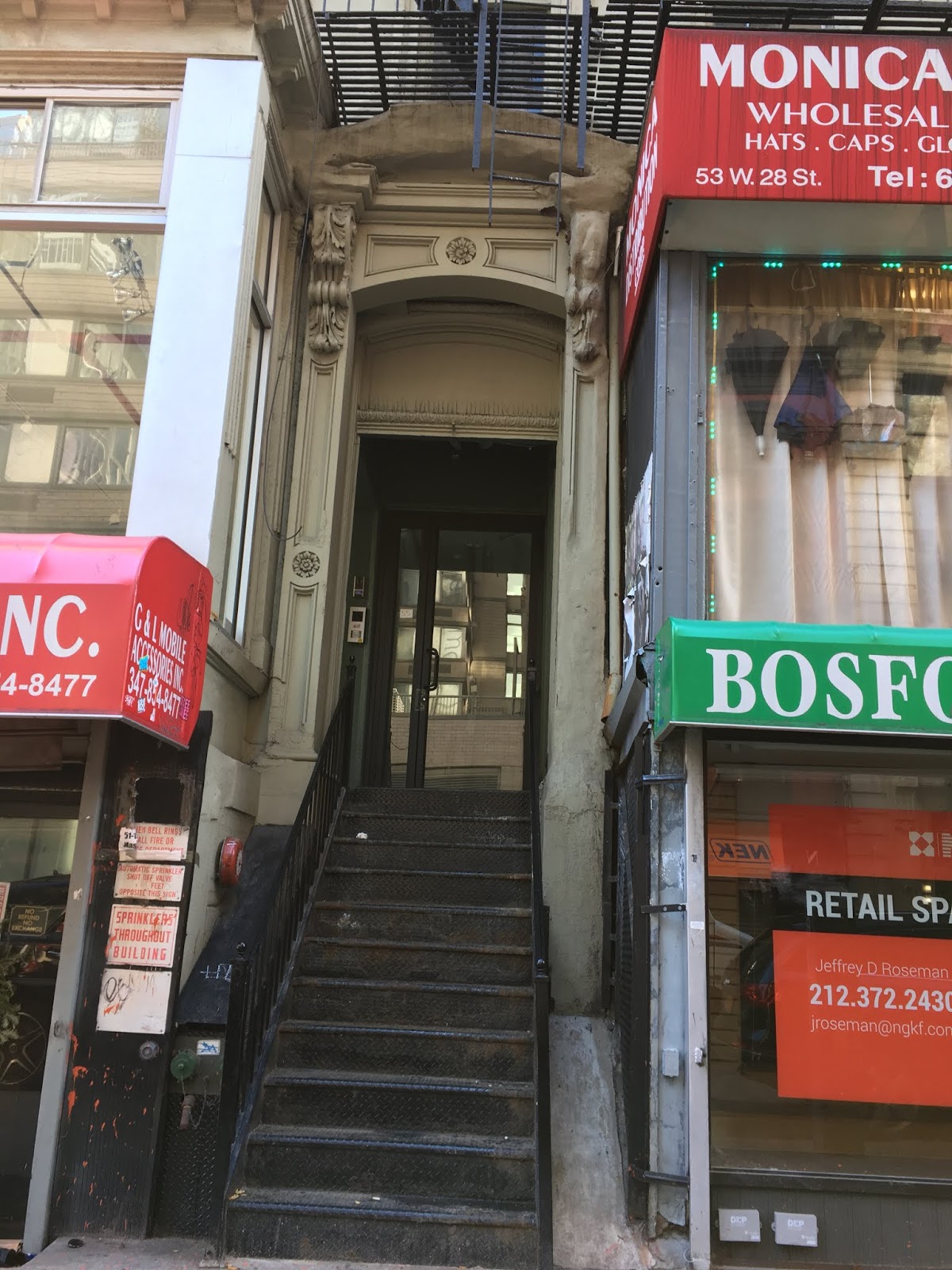
Sat there for over two hours, meditating on all the music that was first conceived there. Sat there in the cold and damp with my gloved hands running over the iron bars once held by so many musicians and writers, Ring and Hager being only two of perhaps hundreds. 
When my friends arrived we headed to 27th street where Hylands Spencer and Yeager were. This building appeared to be intact, though it was being worked on, so we couldn't get inside to poke around. Then we passed through where Dan W. Quinn lived in the late 1890's, and later where he lived from 1906 to his death in 1938. The later Quinn address is the one that he lived in when he was writing to Jim Walsh in the 1930's, and where he also operated a booking office. This address was also very nicely preserved, with lots of pretty marble carving and ceiling decoration. 
After we went by there, we headed to 14th street where all the 1880's and 90's theaters were. Before Tin Pan Alley reigned in the late-1890's and beyond, 14th street was where all the publishers and performers lived. Here we walked by the original site of Pastor's theater, where Ben Harney first introduced Rag-time, and where countless other performers played. Just two blocks farther along was 223, where Fred Hylands lived from 1896 to 1898. We were lucky enough to sneak in behind a resident, which just happened to be the first time any of us had gotten inside. The inside of the building looked to have been remodeled in the 1920's, but we could definitely tell it was an old seedy building that Hylands could easily be seen in. 
This apartment was definitely seedy, but in a charming sort of way. 
The stairs of this building were kind of awful, so I could see Hylands complaining about them often going and coming from work at the record lab or Pastor's. This building was where the "Darkey Volunteer" was published, and where Hylands trod in night after night of performing at Columbia's exhibitions. Performers like Burt Green, Max Hoffmann, and Mike Bernard likely also went up and down those stairs. 
As we started to head to a friend's house near Queens, we passed by where Antonin Dvorak lived in the 1890's. Thankfully there is a plaque dedicating the history of this address. On the plaque it states that he wrote his New World Symphony here in this apartment, which is pretty nice to see. 

The next morning I went to visit a famed broadway and vaudeville historian. This man's house is packed on the walls with posters of all kinds, dating from 1816 to the 1940's. Two examples:
There are hundreds more in this guy's collection. It really was a feast for the eyes to see all these gorgeous colorful posters. He told me that every few months he switches out the posters so there are different ones hanging on the walls. While I was there he pulled out two beautiful posters he had gotten from a recent trip to Paris, which included early art nouveau artwork much like the first poster pictured above. Next I went out with this collector/historian to find Frank P. Banta's grave. We got on the subway and headed to near Wall Street where I assumed it was, but ultimately wasn't able to find his grave there. It was way up in Harlem. I didn't want to spend another two hours going there and back to find his grave, that, as the cemetery directors stated, was in a very large cemetery. So with that I split with my new friend and headed to the Bowery to walk along the neighborhood of so much lore and history, and where Justin Ring grew up. 

After a decent trip on the subway, I turned a corner of Canal Street and was finally walking along the Bowery. The weather was perfect for setting the solemn mood I was in as I walked, it was 45 degrees and damp, with a blanket of clouds ready to drop rain at any moment. As I kept walking, I could really feel the intense weight of history on me, all the struggle and suffering of the many thousands of souls who lived in this area, all of it seemed to congregate as I scuffed the sidewalks. Had never felt such an intense feeling of unbelievable history before, everywhere I looked some image of the past seemed to appear. So much music, so much life, so much suffering, it seemed that walking along here was really where the spirit of the era I study came out. As I neared the street I was looking for, the area seemed to get a little seedier than where I got off, but that added to the atmosphere of the old Bowery I was immersing myself in. When I got to the short street where the Ringleben family once lived, it started to rain. The address looked very much reminiscent of the late-19th century, with so much of its original interior intact. The facade  of the building appeared to have been redone after the Ringleben's had moved out, but much of the older inside was perfectly intact. The building itself would have looked like the one next door when the Ringleben family lived there. 

My hand on one of the walls. 
There was even a beautiful mosaic tile floor still intact. 
I walked all the way up and down the stairs, and looked out a few of the windows to see such a lovely view. 
As I trod around the building I could almost hear the violin of young Justus as he was being taught, and his angry father writing out stock arrangements as his children learned how to write music. It was a lot to take in. 
It was getting dark by the time I started walking back to the subway, and it was raining. Another thing that so charmed me about being in New York was the subway. Lots of folks threw me mixed opinions about the subway before I went, but I was determined to witness the intense history of this old system. It felt like a time capsule, with all the mosaic tiling intact, and every time I stood on a platform the smell of 120 year old pneumatics filled my throat. That smell is entirely unique and old-fashioned. It's like being at an old train station but with no steam to be found. The inside of the subway is truly the smell of the past, with little change since its opening in 1904. There's nothing quite like the smell of 120 year old pneumatics that still heave and work every day. 

Well, wish i had more to say on this trip, but as I'm writing this I am still processing the emotional toll it took on me. Visiting all these places was very moving to me, as it was where all this history happened, and few few people know about it. Despite few knowing of these places, it seems that those who live and work around these places are somewhat curious, and that is hopeful. 
I apologize for not including any recordings in this post, as I usually like to do so. 
Within the next week I hope to start a project on Voss' 1st regiment band. This band has been a sources of mild interest for a few years now, after learning that all of Issler's orchestra performed in this band for many years. Based on this, it seems that this band gave us many of the earliest and most prominent studio orchestra musicians of the 1890's and 1900's. So with this in mind, it seems important to see what I can find on this group.

Before I close out here, I must say that some big news has come down! In the last few months I mentioned Hager's scrapbook and papers, well folks...
Now I have these things in my collection! 
Since they arrived in the mail a few weeks ago, it has been a lot of process, and I have been holding off doing a major post dedicated to this matter. Just to give you a sneak peek into what's in there, here's one of the more unusual pages from the scrapbook:
That's supposed to be Hager's orchestra in the background I guess, that's why he saved it. 
More to come! 

Hope you enjoyed this!


Saturday, October 5, 2019

The genius of Hylands and recording gods

Well, I promised I wouldn't let a month pass by before my next blog post, but I did anyway. For that, I apologize. After that last post, I got a lot of correspondence from various sources regarding Ring and Hager. Before I move forward, I must say that I still remain passionate and rightful in my thoughts on them in the last post. 

Anyway...Time to move on! This November, I am going to be giving a seminar at the West Coast ragtime festival. In the last month I have been consolidating a lot of the information I will use for this. This seminar will address the importance of why rag-time and music historians should study the studio pianists of the early acoustic era. I don't think I can explain this enough on my blog, as I have written so much on them, and keep spending more time thinking about them and their distinct styles. In recent weeks, I have spent a lot more time going back to my Hylands research, as I have been so buried in the Ring and Hager project. I often forget how visceral a reaction I get from hearing Hylands' accompaniments, more than all the others. There's just something about his playing that was so special and oddly emotional. 
(Hylands in 1912 and c.1892 , from the author's collection)

Recently, the UCSB website posted a fascinating transfer that I will most certainly use for highlighting Hylands' style. 
The second transfer listed here is the new one. I cannot fathom how perfect Hylands plays on this record. It is so loud and clear, fully exhibiting his rag-time accompaniment that was so highly praised right around 1898. Every important aspect to his playing is present on this one record, and with the rhythmic perfection of Billy Golden, it really doesn't get much better than this. When I heard this transfer for the first time, I just about fell out of my chair. It was unbelievable. Such loud and clear accompaniment, and a constant cut of Golden's time. 
So this got me thinking, what is it exactly about Hylands' playing that's so attractive? 
Other than the authentic Rag-time, what is it? 
It got me thinking...Hylands was technically the best accompanist the record labs had at that time, as his sole job outside of the labs was to accompany performers. He had been doing this since age 10, and was revered for it. When you hear his accompaniments, it's almost as though he knew what was coming next. He was a step ahead of everyone else, and could anticipate and follow at the same time. It's really an extraordinary thing to ponder. Someone like Banta often made mistakes in this matter, often vamping for a bar too many and throwing off the pulse of a record. Hylands never did this. He made more mistakes than the other studio pianists, but one thing Hylands never did was throw off rhythm or lose the performer. He was an accompanist, but as I have said before, he often led the record. A good example of this can be heard here: 
Even in 1897 when he just started working for Columbia, he was already doing this. Even while he was buried in an orchestra he could still push through. Here's a good early example: 
(you can hear him at the end song here)
That's some really hot accompaniment there! Funny story about this record...I asked the (former)owner of this record about the date. I asked if the "New York City" announcement could be applied to dates from 1896, and of this he was skeptical. He stated that these announcements prove 1897 dates. Later he went on to tell me how difficult it was to part with this record, due to the extraordinary early rag-time accompaniment. Understood!

Hylands may have been weird, and somewhat disliked by the recording staff and bandmen, but they knew he was the best accompanist they could ever have. This is why it's really a shame that he wasn't spoken of in the decades afterward. Well, he probably was mentioned, but not taken lightly I'd think. 

Just imagine it, listen to this record here:
This is an absolutely wild record, and not just because of Quinn or the song itself. That accompaniment is ridiculous! It constantly runs, and becomes relentless at times. Whenever I hear wild Hylands accompaniments like this, I always envision looking back there from the mouth of the horns and seeing those creepy dilated blue eyes downcast below a veritable afro of red hair. It must have been a sight many had planted in their minds till death. Certainly Hylands must been a sight in the recording lab, with a stare that many dreaded, but ability that was so unique and unequalled. There is certainly a reason that the Broadway media considered him one of the best accompanists you could get in the theaters. They considered him this right alongside Mike Bernard and Theodore Morse. 
So considering all this tragedy Hylands went through, I'd think that when Justin Ring came along it was a saving grace. 
(detail of Hylands and Ring c.1902-03).
It is still quite funny to me that there was substantial crossover between Hylands and Ring's terms in the Columbia studio. As I have explained before, it is very clear that Hylands had some influence over Ring and Hager. As Hylands was on his way out, there was Ring and Hager, young and green enough to take some lessons in recording and accompaniments from Hylands. The two of them would have been unassuming of Hylands' rotting reputation(Ring was probably at least). So that's where the Ring and Hager research comes in. 
So now when I listen to Columbias from 1900-1904 with piano accompaniment, I really need to be listening carefully. The pianist could be either Hylands or Ring. Thanks to many years of research, we know that Hylands left working at Columbia regularly in mid-1903, and for the rest of the year he was working at the majestic theater in Boston. 

So here's a good example, this recent transfer is very difficult for me to tell who the pianist is exactly. Other than the pianist difficulty, this record is outstanding, and has an oddly attractive piano sound. 
http://cylinders.library.ucsb.edu/search.php?queryType=@attr+1=1020&num=1&start=1&query=cylinder16336
The accompanist sounds more like Hylands, but it's so weird and wonky that it should technically be Ring. In fact, at the beginning solo, the pianist adds a few beats. Of course, this record is outstanding, aside from all the weirdness. Columbia's from 1901 particularly have this deceiving accompaniment sound. Right at the end of the brown wax era, Columbia went through more changes, a lot like they did back in 1896-97. 

So anyway, this has been a lot of my Columbia listening and research recently, and luckily I have been returning to my appreciation of Hylands' accompaniments. To this day I still do not know why Hylands was never spoken of by those who most certainly worked with him. 


Now moving on! 
So, a few posts back, I talked about the musician's club that Ring and Hager were part of for half of their lives, and I mentioned some of their fellow club members. One of the most important of their fellows is undoubtedly Edward Issler. 
I mentioned how Issler was one of their most respected members. So I was thinking back to this recently, pondering how extraordinary he really was, and how all the recording folks really looked up to him. As record collectors and scholars(who know about him), a lot of us acknowledge Issler as basically the father of orchestra recordings, and this he certainly was. What's fascinating to me is that we think of him this way now, and from what I have found, the so-called "second generation" recording folks thought of him the same way. They all were coming up hearing and hearing of his highest quality records, and the absolute precision of them. 
Isslet began recording in 1888, and he wasn't a youngster. Issler already had a career and a life by that time, he was 33 with a 6 year old daughter at home and a prominent music man in Newark(Banta was 22 when he started making records) . And unlike the studio pianists than came after him Issler had to take on recording as a project. He was part of the experimentation process, something that made him unique. Along with his sideman George Schweinfest, they were required to help learn the technology and techniques that went into making solid records, along with making hundreds of rounds a week. A great and historic example of this is the batch of piano solos and duets Issler and Schweinfest made in 1889. These records were obviously experimental, but they were made, and quite a few of them were. 
Issler led his orchestra better than any other studio band men that succeeded him, as he had to do everything. Everything from adjusting the machines to writing the arrangements, these were required for Issler to do. 
With all this in mind, it's no wonder that the younger recording folks of the late-1890's and post 1900 thought so highly of this man. 
Another thing to consider is what happened to Issler's musicians. I have written about this in the past, as I did a small project on tracking the members of Issler's orchestra, though all of it is still unclear. 
The particularly fascinating member of his orchestra is one of my favorite musicians of the entire era:
(George Schweinfest in 1898)
Schweinfest was arguably just as respectable as Issler, with enough talent to make all the NY conservatory boys jealous. When Issler started to fade from recording in 1897, Schweinfest stepped in to replace the position that Issler was in. With the management changes at Columbia and the fall of U.S., the Columbia folks were looking for a new musical director. I am almost certain their fist choice was Issler, but he likely very honorably turned it down, as he was just getting fed up with recording. At this time, I think that Issler had just joined the Newark musician's union and was quickly working his way up. He was getting wise to the entirely sinful ways of the recording labs. The studio managers chose Thomas Clark instead, a solid co-conductor and arranger for the Gilmore band(at that time the 22nd regiment band, being led in the public by Victor Herbert). Issler picked up and left, but Schweinfest had other things in mind and stuck around at Columbia. We know Schweinfest continued to make record for Columbia into the 1900's even when the brash and passionate Fred Hager took over in 1901. Schweinfest once again was forced to take a seat farther back from working his way up, but he continued to see it all play out. 

Now there's a man who would have been an outstanding resource, having borne witness to so many historic changes in recording. When Hager had finally calmed his climactic gasps with Columbia in 1904, that was when Schweinfest made his move. It is unclear exactly when he became one of Columbia's management, but it was mostly likely around the time Hager had left his high position there. Schweinfest was said to have remained in management until the mid-1920's, and it is likely that he also played in the studio orchestra or band along with his fellow Issler musician William Tuson. From there, Schweinfest lived a very modest quiet life, playing organ at the Catholic church he was part of. He lived this modest life until 1949, passing at the remarkable age of 87, outliving all of the earliest studio musicians(who began at the end of the 1880's). 
I believe that Schweinfest was contacted by Jim Walsh in the early 1940's, and I recall that he attended at least one of the John Bieling day gatherings(probably the earliest one in 1947). But other than that, I do not know much of his whereabouts after the 1920's. Considering his connections and interest in the recording business, he was probably interested in what was going in within the trade, I can see him thumbing through editions of Talking Machine World in the teen's and 1920's, sipping some strong tea, with his glasses tipped on his long straight nose. 
He knew everything, but he didn't talk much, a lot like how I've described an old wilting Justin Ring. 


So, before I close the post here, I'd like to share a really nice find while digging on Banta's family. A few days ago I went back and looked though the very detailed Banta family tree, just as a preliminary search, with no real intentions and focus. As I started digging I went through a lot of the same old stuff, and I saw a familiar looking cabinet card. 
It was unfortunately mis-labeled in the family tree, but I recognized that face before seeing the details. 
Oh my god! It's the clearest most beautiful portrait of Frank P. Banta!

Okay, if you ever wondered how passionate and emotional I am about all this stuff, how I reacted to seeing this picture really sums it up. 
When I saw it, I stared at it for a long while, and my my eyes got all teared up. I have no idea why it hit me so hard when seeing just a simple cabinet card as that(and one that I have already seen in newsprint). Seeing how he awkwardly knotted that tie, and gazing into those big black eyes almost makes me see the suffering he saw, and what little time he had left to see--that's what got me. Something is just captivating about seeing him in great detail like this. That black hair styled in a way reminiscent of his studio mentor(Edward Issler)--there's just something about Banta that makes him more intensely attractive than the other studio pianists(in terms if personality and appearance). You can see the intensity in him, but his kindness and wit seem to seep through in his sympathetic face, with that ever so slightly up-curled shadowed side of his mouth. 
Now I can firmly have that beady stare implanted in my mind when I hear his accompaniments. Those eyes will never escape my mind, and they will continue to haunt me, now in painfully sharp detail. 

http://cylinders.library.ucsb.edu/search.php?queryType=@attr+1=1020&num=1&start=1&query=cylinder17123


Anyway folks...I apologize for the kinda scattered writing this time around, I have had a lot of ideas in the last month, but I have been having trouble organizing them in a reasonable fashion. I really want to write another post within the next week, and with a article on Jimmy Hager to be published soon, hopefully I will have more to talk about. I hope this is a substantial post for the time being, it's pretty out of whack. I did not want to leave you all without some writing for more than a month. I must say, it was a bit difficult to follow up on the last post, but I appreciate all the feedback I received regarding it! 


Hope you enjoyed this! 


Friday, March 29, 2019

A Portrait of Frank P. Banta

Today we celebrate the birthday of Frank P. Banta, perhaps the most beloved studio musician of the entire acoustic era. 
It's hard to begin with this guy. 
I guess I could just write out an affectionate bio on him, just because I have gathered more information about him since the last biographical post on him. Well, here goes. 


Frank P. Banta was born on March 29th, 1870, the middle child of five. His father John was a woodcarver, a noble profession in Victorian New York, but perhaps more interesting is his mother's story. His mother  Fannie Darrow married first around 1863, but her first husband died quick, so she remarried an old man named John(Frank's father). Fannie was a rich girl, from a prominent old Dutch family of New Amsterdam. Her many sisters married prominent New York men of money, but she married a poor woodcarver in his middle age. Frank was the only musical child in the family, and it began to show quite early in his life. As a young child, Frank began to take up piano tuning, as his perfect pitch rendered him a skilled tuner. He started tuning pianos in factories, before they were sent off for sale. It was in this line that he began to develop a talent for playing the piano. His mother likely took notice of this tendency soon afterward, and got him some piano lessons. Though, it is likely that he didn't remain under the rule of a teacher for long, as his distinct style developed later proves for little training and more natural ability. 

Frank likely kept tuning pianos in his teen's to get some extra money, and also played some gigs here and there too. By 1888, his name was starting to appear in the papers as a specialty accompanist and arranger. His praises were already being sung before he was even 20. By 1890, he was playing in vaudeville houses all over New York, accompanying singers and instrumentalists of all kinds. Around 1892, Banta became associated with banjoist Vess L. Ossman. 
Ossmand and Banta advertised together, 1893. 

Somehow, in that same year, Banta was plucked out of the vaudeville houses to work for the three year old North American Phonograph Company. It's possible that Edward Issler recommended Banta to the North American/Edison management. Banta spent a few months of 1892 getting the training of phonograph accompaniment. Likely under the rule of Issler, Banta learned the phonograph ropes, and by 1893 was ready to work for them regularly. Other than working regularly with singers and other performers, Banta was often brought into the studios by special request of Vess Ossman, as they were still engaged together as an act at that point. Ossman as many recalled, was a very difficult man to work with. Someone as quiet and modest as Banta likely clashed with him often. Despite that, some of Ossman's best recordings have Banta's accompaniment, as they worked together perfectly in spite of their extreme differences. Banta likely learned how to work with these sort of performers by touring with Ossman, and it would inevitably come in handy as his years in the studios went on. 
Around 1895, Banta formed his own orchestra, a small parlor orchestra of about 6 musicians at most. Considering his close partnership with Issler, he formed this group to the striking likeness of Issler's orchestra. Banta's orchestra even recorded many of Issler's arrangements, such as "The virginia skedaddle", and "Her golden hair was hanging down her back". You can hear one of them below:
Banta is of course the announcer and the pianist. 
Banta' orchestra faded away from record catalogs by 1896, but at that point Banta was secured with Edison. 
By 1896, Banta was with Edison all the time, playing accompaniments for all who worked there, but of course it didn't take long for other companies to jump at him. As his praises continued to be sung by all, the Berliner gramophone company grabbed him in 1897 to replace the increasingly absent Fred Gaisberg. Berliner promised Banta more variety, and his own orchestra again. At Berliner, Banta led the Metropolitan orchestra, or at least sometimes. 
Banta was working for Edison and Berliner at the same time in 1898, seeming to equally balance his time at both. 
He had left the majority of his performing behind at this point, slaving away in two studios seemingly day and night. Some say that during his time recording, Banta was on half the recordings that Edison issued. Half. 

Half would mean thousands, perhaps more than that considering how early he started. 
In 1900, Banta, Arthur Pryor, Christopher Booth, Noble McDonald, and a few more Berliner musicians joined the newly formed Victor company. Each of these musicians made a piano solo for them in 1900 or in the few years afterward. Banta replaced his engagement with Berliner with that of Victor, working at Victor almost as much as he was at Edison. His distinct and steady accompaniments can be heard extremely well on Victors and Edison records during this time. he played everything from classical accompaniments to red hot rag-time. Here are two contrasting examples both from 1901:
His accompaniments are unmistakable, very steady, dynamic, and full of self taught eccentricities. 
His accompaniments influenced many of his fellow jealous recording pianists. Fred Hager and Justin Ring took especial liking to his pieces. 

This oddity of Banta's was only recorded by Hager's orchestra as far as I can find. 
Hager and Ring even mimicked Banta's smooth style of syncopation and dense chord choices in their own accompaniments. 
He continued to somehow balance all that work for Edison and Victor until 1903, where he had nearly completely exhausted himself with this work. 
During his later time at Edison, it was said that Banta's wife Liz worked in the studio as well. Liz was a studio secretary while Frank played accompaniments until he dropped. Frank and Liz married in late 1895, and their first child was the later famous novelty pianist Frank Edgar Banta. Somehow Frank was able to fit in time for another child in 1901, a daughter named Prudence(maybe that's somewhat related to that illusive middle initial of Frank's). 
Frank's children did not get to know him too well. As he was gone more than most men even in that time. Working for two record companies at once wasn't a family friendly concept in those days. 
Only when he became physically weak and ill from all that work did Frank realize this. In mid 1903, Frank was very weary of all this work, but his constant and determined personality dictated his place in the studios. he continued to show up to work every day he could, even though his asthma was getting worse, and time had already aged him quick, even at merely 33. 
Banta at one of Edison's Shoninger pianos, c.1899.

Banta came into work at Edison until the very day before he died. The day before he died in November of 1903, everyone expected him at work the next day as usual, not giving it much thought. But he died early the next morning. 
His absence rendered the piano at Edison silent that day. Legend has it at the Edison studio that no one came to work that day to mourn his death. 

But his story doesn't end there. When Jim Walsh corresponded with Dan W. Quinn in the 1930's, Quinn continued on to praise Banta. It seemed no one was so fond of Banta than Quinn. Quinn even named his youngest child after him. Now that's respect! 
It's Quinn's kind words and recollections about Banta that kept his reputation around, and it was carried on when Frank Edgar Banta was interviewed in the 1940's. Frank Edgar did not know his father well, he regretfully admitted this when asked about it. He recalled little of his father, but he did remember that his father was very humorous, rather quiet, and unfortunately ardent with work. He did recall his father inviting over many friends from work to play new songs(he didn't drop any studio names, but Quinn was almost certainly one of them, as was Ossman). His father would also sit with him at the piano to show him a few things, but these barely made it into his later developed style. 

Frank Edgar was 7 when his father died, and his sister Prudy only 2. 
Liz did not remarry after Frank died, but she continued to work into her old age. 


Well, with that, how about a few records he's on? His story is quite dramatic and somewhat depressing toward the end, so maybe some of his records could lighten the mood a bit here. 


(remember, Banta's name is on the original "Laughing song", he's listed as the arranger)
Banta was likely also responsible for this piece too. 


Happy listening! 


Hope you enjoyed this! 


Friday, February 15, 2019

Recent Research Travels

In the last week and a half, I have been on quite a journey, to Southern California. 

Just over a week ago, I returned from a 5 day trip via train to Santa Barbara and then to Los Angeles proper. I mentioned at the very end of my last post that i would be visiting UCSB, and that's exactly what I did. In the weeks leading up to my visit, I spent hours combing through the lists of what Santa Barbara's library holds in terms of early disc records, picking out things I wanted to see when I visited. The requests kept piling up, until I had about 40 records to listen to when I called. The amount of records were astounding, so many things that ought to be beautiful, and how they were. After a day of frustrating but in the end pleasant train travel the previous day, I finally found my way to where the special collections are kept on campus, I was led to their modest reading room overlooking the beautiful mountains. I was entirely at peace, sitting there in the quiet listening to these 40 or so records, and writing notes down on each one, it was heavenly. 
I don't want to share every single image I
took of these records, as it's quite a few, but these are a few of the standouts from the little collection I requested:
(yes I took pictures of every record I requested, just for my personal reference)

(Keep in mind that this is nowhere near everything else I heard from the stack)
So...why did I go through so much to do this? What would be the point of doing this if i couldn't take the transfers with me? Well, as I stated above, I took very detailed notes on each record, more particularly the Zon-O-Phone's. The reason I went though as much as I did to come and see these records was to study two dozen early Zon-O-phone's to try and build a better foundation for the 2(or three) pianists that worked for Zon-O-phone from 1899-1907(or so). For example, when I picked out the records to listen to, I specifically chose a few doubles of the same song by different artists, but on the same label. The most telling example I chose were 2 versions of "strike up the band, here comes the sailor". The versions I chose were both recorded on Zon-O-phone in the same year, but by Edward M. Favor and Billy Heins(I posted a picture of the Heins version above). One thing that became very evident about these takes was that it was certainly the same pianist on both of them. But what does that mean?
Well, I am recalling now how I described one of the takes in my notebook, one take was much more precise and took stranger risks at the times for solos. The take I was previously more familiar with was the Heins take, with the familiar and extremely well executed "sailor's hornpipe" at the very end, the Favor take had this ending also, but somehow they found the time to place the same tag in the middle of the record!(very hastily and sloppily I might add). You can hear a not too great transfer here: 
This take is the better one overall, much better composed and thought out, the accompaniment anyway, Heins was always great. The two choruses of "sailor's hornpipe" seemed very improvised on the Favor take as I'm recalling now. But it's assuring to know that it's the same pianist on both, which isn't entirely surprising, but good to know. 

So did I come to any conclusions? Well, not really. I was hoping that hearing 35 more early Zon-O-phone's would solve my issues with Zono's accompanists, but it really didn't in the end. But there were some interesting things I observed about two records in particular. 
These two were particularly fascinating. I went back and listened to them perhaps half a dozen times each because of the accompaniments. The first one i would immediately assume to have the so-called Hager style accompaniment, and the second to have the Justin Ring accompaniment, and yes they did. But what about them made them so fascinating? 
Well, the first one is definitely the most unusual Zon-O-phone I've ever heard in terms of accompaniment. Denny sings the song very slow, and the accompanist follows in the most unusual and playful way, here are the notes I wrote about it:

Record 16--Goo Goo eyes by Denny, 1901 etched Lyre Zono. very funny and exaggerated intro and very playful as well as dynamic accompaniment. sung very slow by Denny, definitely an outstanding accompaniment...That pianist has got to be Hager: so dynamic, playful, humorous, adventurous, and full of odd syncopation as well as fifths and chords in the left hand for extra emphasis. rolled ending chords, can't forget the absolute precision and daintiness! 

So you can probably observe that I think that pianist is Hager. I am really starting to think that that strange and very distinct early Zon-O-Phone pianist is Hager, and thanks to a few passed down accounts of Hager's accompaniment, I am becoming increasingly certain of this. All of these characteristics seem to fit perfectly with what I gather of his personality, which is also quite nice. So, what about the second one above? That one was also just as good as the Denny from 1901, despite it being from the very end of the piano accompaniment era(1904). Already, the song proves for some good accompaniment to be expected(that's why I chose it!). If you haven't already heard it, here's a 1904 Columbia of it also by Bob Roberts:
This song is already bluesy and well composed, so the accompaniment on the Zon-O-Phone I heard was no less. This record especially stood out because of the repeated use of many different early blues motifs(and this was recorded in 1904). It was definitely not the same pianist as the 1901 Zono I paired with it. The pianist is very similar, but it's not the same person. This pianist is the other familiar Zon-O-phone pianist, with the less dynamic and more aggressive touch that was common on many later Zono's with piano accompaniment. For this 1904 Zono, here were my notes:

Record 17--Wouldn't it make you Hungry by Roberts, 1904 brown 9-inch Zono. Very bluesy accompaniment exaggerated syncopation, every core blues motif present. This is likely Justin Ring! There are also bits of walking bass, very similar syncopation to that of Ring's "sweet potatoes" and "jovial Joe". 

Yeah, that pretty much sums up the pianist on later Zon-O-phone's. So I think that pianist is Ring, just logically, and considering his own rags and arrangements written around the same time. When I got back, I made sure to cross reference all the Zono's I had heard before with the corresponding labels, and pianists I think are the same. 
For the Denny record, I used these for cross reference:

And for the Roberts I used these: 

The accompaniments pretty much line up quite well with the assumed accompanists. The different styles fit pretty solidly into the periods that I associate them with. Occasionally I have heard standouts from this pattern, as I have heard a Zon-O-phone from 1901 where the pianist really sounds like the Justin Ring pianist, and I have heard teal label Zono's from 1902-03 that have that Hager accompanist on them. Naturally this would not be the case all the time, just thinking of this logically. Of course Hager and Ring would cross over often, it wouldn't always be Ring at a certain period of time, or vice versa. 

So aside from the majority of Zon-O-phone's I studied at UCSB, the few Berliners and Columbia's I chose were beautiful as expected, I listened to George Schweinfest play "Sand Dance" a dozen times, as it was so loud and clear, as well as catchy as hell. The melodies are so nice in that seemingly modest piece, but they are haunting. I have bits of that record run through my head still. I should say in referring to a popular 1890's song, "her smile haunts me still", Schweinfest's playing haunts me still. To keep an even amount of space to tell the gist of this long tale, I will move along to the next phase of my travels. I will come back to some more of these records I saw and heard at UCSB in the next few posts. 


The following day, after another 3 hour train ride, I got into LA proper, met with a friend that evening and was beyond excited for the day ahead. The next day I went to visit John Levin. I listen to brown wax every day, and a large percentage of these brownies are from the collection of Mr. Levin. So with this in mind you could imagine the overwhelming anticipation and excitement this brought me. I can barely describe the amount of extraordinary things I saw in his collection. I am still remembering little details of my 8 hour visit over a week removed. I only took two pictures from this visit, as it seemed I had no time to take out my phone, and out of kind courtesy I remained disciplined and intensely focused on the cabinets full of priceless brown wax. When he gave me the tour, there was drawer after drawer of every shade of brown, channel rims, and handwritten slips of every kind. he has two cabinets and three drawers full of Issler's orchestra records. There was a drawer of Kansas City Talking machine records, dozens of original wooden cases of U.S. records, and record boxes of every kind, some I could have never even conceived of existing. 
Here's the one crappy picture I took of any brownies he had. Look at that beautiful channel rim!
he allowed me to choose any bunch of records I wanted to hear, and those records I chose were:
"Echoes from the Snowball club" by Issler's orchestra(1898)
"La Paloma" by Issler's Orchestra(c.1895)
"Dora Dean" by Leachman(1898)
"The Cocoanut Dance" by Ossman(c.1893)
"The Cocoanut Dance" banjo solo by James Dunn of Kansas City(c.1897)
"African Wedding Dance(cake-walk)" by Issler's orchestra(c.1894)
"The Cat Came Back"(The singer's name escapes me now) North American record(1893)

That's quite a bunch! I had always wanted to hear Issler's "african wedding dance", as I assumed it to be a cake-walk or negro dance of some kind, an important thing to look for in studying early rag-time. To add to the significance of that particular record, Len Spencer does the calls as usual, and at the beginning Spencer states, "all ready for the cake walk!". 
There ya go folks, that's one of the earliest authentic references to the cake-walk on a record as far as I've heard. Why is it not surprising that it comes from Spencer? 
In keeping with my formula for studying pianists through cross referencing, I naturally chose two versions of the same song by different banjoists, I'm referring to the takes of "The Cocoanut Dance". Recently this particular piece has become especially interesting to me, as it's a great example of a dynamic and well composed negro dance, the direct predecessor to Rag-time. This piece was written in 1891 by Andrew Hermann, and was recorded countless times since that year, recorded as late as 1907. The Ossman version was interesting because it was a very early take, recorded almost certainly before 1895. I have been wanting to study more of Ossman's early recordings, as I would like to think that he dragged Banta into the studio to make them. Also, I think that Ossman played very slightly differently in his earlier days, his playing seemed a bit smoother and technically more odd. 
But the Kansas City "Cocoanut Dance" was something very different. I had never heard of James Dunn, but of course the label and banjo playing was entirely attractive to me no matter what. Those Kansas City records were all originals, so each one sounded superior, and this particular "Cocoanut Dance" was nothing less. It was swung and ragged in a way that one could expect from a record made in Kansas City in the mid-1890's, pretty much already sounding like Rag-Time, despite the piece being published several years before. The accompaniment was quite modest from what I remember, but there were points where the pianist followed with the swing quite well, but others where it kind of broke down(in a bad way) and got out of whack. 

The Leachman was special. It was one of those so highly prized brownies he made at home in the 1890's, but this particular far surpasses even the "Wedding of the Chinee and the Coon'' that's transferred online. https://archive.org/details/ChineeandtheCoonLeachman99
Well, for one thing, this other Leachman wasn't nearly as messy as the one in the link above. I recall that his own accompaniment on this "Dora Dean" brownie was fantastic, eccentric, and ragged as usual. Despite Leachman's handicap of being barely able to read any music, his piano playing is about as close as we can ever get to hearing an authentic itinerant Chicago pianist of the pre-ragtime era. Aspects of his playing are reminiscent to those of the rags of William Krell and even the accompaniments of Fred Hylands. I cannot stress enough how significant Leachman's accompaniments are, if you could hear how I would be passionately speaking about this it might help. 
Soon I will be able to very well dissect and study Leachman's accompaniment on his "Dora Dean". For now his odd humming chorus is forever going to reappear in my mind. That song is awfully catchy. 


After we got a few things transferred, he took me downstairs to see his disc record collection. Several hours earlier I spoke to him of my mission to dissect those two(0r three) Zon-O-Phone pianists, he took note of this as we poked around in the basement. As he began searching for a stack of Zon-O-Phone's, I was standing by attentively hypnotized on all the records surrounding, and he ever so modestly handed me a stack of about 15 5-inch Berliner's, like it was nothing.
"Here--look through these while I find the 7-inch Zon-O-phone's"
5-inch Berliners! The first commercially made disc records in history. 
Soon I spied an oddly shaped green box I had never seen before. 
The box looked like this:
(of course on the 12 hour train ride back I drew a cartoon that included this little box)
Yep, that's what it was, a Zon-O-phone record case. This case was intended for 9-inch records, and it was a nice shade of green. 
In this case, there were a handful of Zon-O-phone's that we listened to, including the one below:

Of course, pandering to my odd feelings about Hager's violin playing. But that aside, this record was fascinating, as it's quite upbeat compared to the other material Hager recorded violin solos of. So logically the pianist on that would have to be Justin Ring, right? Well yes, and actually, I must say that the accompaniment had similar aspects to that aggressive accompanist that I associate as Ring. 
In this bonus Zon-O-phone stack, there were a few Rosa Chalia records, despite those being operatic, I am very much interested in those, as I am almost certain that the accompanist on those(her Zono's that is) is Hager. It can't really be Ring, as Hager spent a few years in music school to study every kind of music, opera most certainly included. Keep in mind that I still do not know what Ring was doing in the late 1890's, but it's quite possible the two met while both in music school. 
Here's the best example I've heard so far:
It helps that Chalia was a great singer, and luckily since these ones I heard were on Zon-O-Phone, the piano was well recorded, but quiet as usual for them. 

There were a few Hager's and Zon-O-Phone orchestra records in this little stack, each one good as expected, and luckily all of his Zono's were in great shape, so each one sounded nearly new. 

When I got back to where I was staying, I was drained mentally and emotionally. It felt like I was recovering from an 8 hour long high, as it was so much to process. I'm still processing all that I saw that day. 


Anyway, there's a lot more for me to talk about from the last few weeks, but it's getting late as I'm writing this, and I would like to finish this post in one shot. In the next post I will speak of the illusive Eddie King, and how he's becoming a more significant figure in my studies each day. 


Hope you enjoyed this!