


Who are these three funny guys?
Well, we ought to know that first guy(Len Spencer), but the other two could stump some of us. The second is George Emerson, and the third is Clyde Emerson. These three rough-and-tumblers seem to have pulled off an interesting heist back in 1897, one that has been causing all sorts of buzz among the brown wax community this past week. This heist of a sort was pulled off in early 1897(just as the U.S. Phonograph company was collapsing), and in fact, speaking of the U.S. company, it seems that this was part of what led to their demise. So after reading the other record blog that was all read, it seems that Russell Hunting wasn't the only one of these studio stars who was arrested in the 1890's. Len Spencer and those infernal Emerson's were also taken out of that studio by the men in blue.
The three of them crooks went to their U.S. Company headquarters in Newark(I hope late at night!) and took a hundred records as it says(around 100 would be my guess, keep in mind that it's just three guys...) from that company and brought them to be sold to a company of "rival concern",which is probably Columbia at this point of time. The case was brought to court, with them three handed $2,500 in bail(hot damn that's a lot of money!), but were soon discharged upon having no strong stance on the case.
So that's it?
Yes, essentially with all the evidence.
But hold on! There's more to it...This is clearly an inside job, a very complicated story, much more so than it lends itself to be. This is one of those things that just can't be a small thing, with a bail set over the amount that Victor Emerson put aside for George W. Johnson, something ain't right to me...As with anything Emerson or Columbia related, there's some really tangled up backstory that involves several recording stars, as well as deals between rival companies. The U. S. Company was a sinking ship in 1896-97,and everyone had to get their way off into the water. Spencer was in an uncomfortable position for sure, since he had such strong and long lasting ties to U.S., but was being led on a string back to Columbia, since that's where he started, and that's where they wanted him. A similar story must have been attached to Edward Issler, though Issler was not nearly as valuable to the management(he would be the most valuable if managers really cared about musicians), however, he did have an important role at U.S. that succeeding pianists hadn't, the knowledge of the technical aspect. Everyone eventually were saved by Columbia, but it was a long and almost deadly process, as it always was with Columbia during any transition. Spencer just after this heist had pledged his services to Columbia, which is also a little fishy. Come on, you can't just see this as being a smoothly moving thing that just happened. Spencer got busted for it, and so did the two "lesser" Emerson brothers. Victor Emerson may not have been charged, but it's got to be for certain that he had some hand in this late-night raid.

(a cartoon I did parodying this heist)
Even with the lack of names(unlike the Johnson trial), there must have been at least a dozen other sleazy hustlers involved in this raid, they just sent out the best hustlers to go and steal the records themselves to be sold. I'm sure brother Harry(Spencer) had a piece of this too, since Harry at this point wasn't fully set as a recording artist solely. Recall that at this time (early-1897) Harry was more of a salesman and repairman than a recording artist. It would seem in this case that everyone we might think who would have a hand in this probably did. Considering Columbia's rampant legal squad, they were sure to brush this off quick no matter what happened. Hopefully we'll be able to learn more about his rather hilarious bust with Columbia. It's always fun to read about these stars getting into trouble like this, whether it has to do with recording or not.
Now to move to Fred Gaisberg!
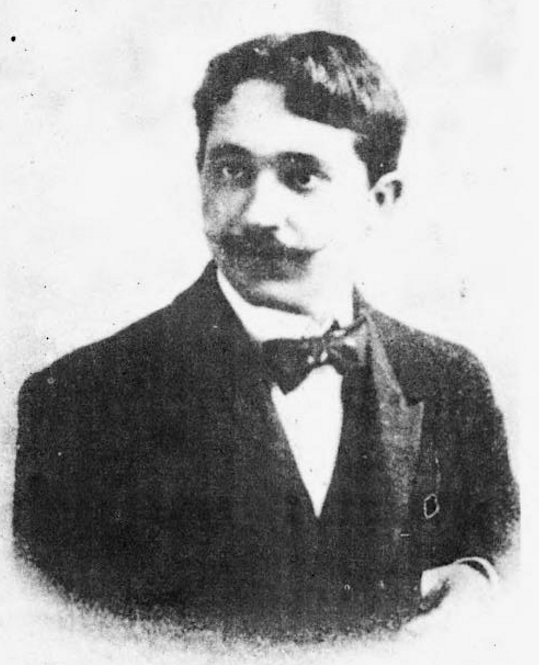
We all have grown to love this crazy guy, and I have most certainly done so, along the course of reading this lovely book:

(Thanks Charlie!)
At this point, I am over half way through the thing, and the first night I started reading it got through 90 pages. I already have written about the first two to three chapters in a previous blog post, but this time, since I've the book right here, I will get to quoting some of Gaisberg's priceless and utterly snobbish remarks about those he met places he went.
Here's one of the first lines from chapter three:
The man finally selected[to manage Berliner's London outpost]for this task was William Barry Owen, a legal assistant to Frank Seaman...
"Berliner could have selected no finer agent than Owen to exploit his invention. He was an opportunist of quick decision and a bold gambler...You would always find him sitting at the stiffest game of poker in the smoking room...and his eyes would bulge as he laid a full house on the table...He brought to London an infectious enthusiasm and energetic leadership which I believe was quite new to the conservative English city man of that day."
That's most certainly Gaisberg's writing at it's finest...his descriptions and diction were just fantastic to every degree. When he wasn't describing a type of foreign music with his European eye, the images he painted through words otherwise were unbiased and nicely structured, giving us a very real and somewhat raw vision into the early recording business.
His description of the old man Giuseppe Verdi was just as intriguing as his vibrant imagery of his first visits to Milan and Rome:
I often saw the venerable Verdi, who would regularly take an afternoon drive in an open landau drawn by two horses. People would stand on the curb and raise their hats in salute as the carriage proceeded down Via Manzoni to the park. A frail, transparent wisp of a man, but the trim of his pure white beard so corresponded with the popular picture of him that one could not fail to identify him.
That pretty much sums up Verdi. Gaisberg and Willie Darby were utterly overwhelmed by the culture and constant vigor of Milan the first and few times they went. Being ever surrounded by lovely art, music, and people seemed to overwhelm Gaisberg at first, though after a little while he grew used to the culture.
I hate to move a little out of chronological order, but this book keeps opening to other important pages with Gaisberg's unequalled descriptions, here is his rather cute description of Alfred Clark around 1897:
He was, I remember, a youth big an well-proportioned, perfectly dressed in a tailor-made suit which, in those days of "off-the-peg" clothes[what does that mean?] (which I and even Berliner wore) struck a note of distinction. Further, his dark eyes and curly brown hair set off by a boyish blush whenever he spoke, made him irresistible[hmm mmm...interesting choice of words there], quite apart from the shadow of the great Edison.[That's where he worked before then]
That's a lovely description, and makes me laugh, since he and Clark lived adjacent one another above Berliner's studio from 1896 to 1897, and went to all sorts of shows and got plenty of bonding time in, whilst also learning of the business and local culture in Washington and in Philadelphia.
Gaisberg's time from August 17th and 18th of 1899 is one of the absolute best two days in sequence throughout his entire years of travel. In these two days, he was traveling with Darby in Spain to France:
Thursday Aug. 17th 99. Plaza de Montesino, Valencia...
Here again the terrible uncertainty of whether to proceed to Libson or return to Madrid seized us, and for two hours we sat discussing the pros and cons. Our fate was decided when we discovered out luggage was already placed on the relief train and we sprung aboard...[then] the station-master informed us no connections for Libson would be made that day, but if we waited for Mañana('tomorrow') connections would surely be made.
Already knowing that a Spaniard's 'tomorrow' means 'never'[haha], we quickly had our luggage transferred to the Madrid train and at 7 o'c p.m. we re-journeyed over the same ground travelled last night--sad, tired and provoked. However, before starting we invested 9p. in a sausage three rolls, and a bottle of wine. This we tackled with great relish, as we were nearly famished.
The night was awfully close, and as these European railroad carriages give no draft9as there is no vestibule) we suffered awfully from the heat and thirst caused by the salty sausage
Friday Aug. 18th 99.
We entered Madrid at 8 in the morning...arriving at the station we finally accomplished the difficult task of registering trunks, and tried to find a place in the coach--but they were full. At last, finding an empty seat, I jumped in and sat down just as a fat matron with a bitter tongue claimed it. I refused to move, and she plumped down in my lap and there remained, while Darby on the outside frantically ram about looking for me. At last I gave her a push and slipped out from beneath her and she fell back into the seat with a jar. Then Darby got in, and as the fat woman got out of the car to give the seat to her daughter for whom she was preserving it, Darby slapped himself into it, and immediately two men and the old woman yelled and pulled and tugged and punched at him. Finally he had to give it up, and with a long face squeezed himself in a place opposite, and then it was my turn to laugh[indeed so Fred!].
Well, the ride was the worst I ever endured. This was our third successive night on a train--and that in a car so crowded that one had to sleep as in a strait-jacket.
What a trip! Hot damn that sounds absolutely awful, but it's genuinely a hilarious story that sums up most of their journeys together.
Many of us can get to wondering about Fred's love life, and luckily, there's a lot of it scattered throughout this book, and it seemed impulsive of him to be describing the women around him any time they were met. Of course, he knew that he's never actually settle with a lady, and with his constant state of moving from place to place, his status of bachelor seemed inevitable, no matter how long the traveling with Darby lasted. Here's a particularly interesting little affair from Feb. of 1900 while back at home base in London:
25th, Sunday...
I went to take Miss Waite's package to Miss Edell's, and there spent a delightful afternoon, at the same time taking tea with them. Returning to town. I dropped in at the Horse Show, and to my great surprise who should I see sitting there but Henrietta. I hardly recognised her at first. She looked entirely prosperous, and decked out in fine dressed an jewels. She tried to urge me to enter old associations with her, but I stoutly resisted the magnetism of her beautiful brown eyes. She waxed most furious. What an uncontrollable passion this spoilt beauty has!
26th. Monday
After work Henrietta met me at the office, where we had a short dance and singing[aww...what a cute picture...].Then after supper we went to the gallery of the Savoy theater to see The Rose of Persia on Newton's invitation. She followed me me all the way to my Kensington lodgings, where I abruptly left her.
How interesting. It really fascinated me to read such writings of his, since we would normally never hear this side of him. He seems confused in this whole love matter...but at the same time all mad about it. It's truly charming to gather his feelings about being kinda in love. He hadn't the best of luck with this matter it seems.
Here's an interesting picture from just a few months later. This was taken of the family when he visited for Christmas:

I'm sure you can guess where Fred is.
Their long and grueling trips to Russia were chock full of mockery for Gaisberg. He reveled in how ignorant the Russian opera audiences were, cheering madly at a single performer who wasn't even adequate(at least to what Gaisberg had experienced). But after a horridly busy week of recording and traveling in Russia, this horrid mess befell them in their room:
About 2 a.m...
We were awakened by a terrible battering on our door. The porter and three or four others wanted to know what terrible happenings were going on, the room below was all dripping with what might be blood or something deadly, and was falling on the face of the sleeping occupant. We went into our 'lab' and to our dismay found a bucket filled with old acid had sprung a leak, and the floor was flooded...The bright red fluid dripped through the ceiling on to the sleeping guest; when his body began to smart[interesting word choice there...]he roused the hotel. We had the disagreeable task of sopping it up in our nightshirts, and expecting the manager up every moment to pitch us out bag and baggage.
What a horrid thing! That would have freaked me out if I had been that other hotel occupant. Certainly I would have been convinced it was blood a-dripping on my face!
Oh how there's so much more to write here from this lovely book, but there's no way I could quote everything that was curious, since his descriptions of eastern music and instruments are very interesting, while at the same time also strongly judgemental. He wasn't easy with his words on eastern music and instruments. He didn't revel as much being in Japan as he ought to have. His time in India and the middle east especially was curious to him. It seemed he took a great fascination with these nations, and took many candid pictures of the street people and musicians. This book is an overload of information and quotes, since Gaisberg lived a fuller life than anyone I have ever studied. Such the amount of travel he did is more than anyone would hope to travel in an entire lifetime, and he did that much travel in 10 years, or even less. He seemed to have most enjoyed Milan throughout his time of travel, since he revisited the place very often, and spoke the highest of everything there. He seemed to have disliked the long grueling trips to Russia, and seriously disliked the music of Japanese opera. His tastes dramatically changed from his days back at Columbia in 1889! Never would he have guessed he'd be in the studio with the masters of Italian opera just 15 years later...
Over time, I will use quotes from this book, since there are so many more, and I have to finish reading it of course. Remember, I'm only just over halfway through!
Hope you enjoyed this!


