Wednesday, May 15, 2019

The Columbia Triangle and a first session

So, I returned from ARSC on Sunday, and there's an awful lot to report on. On the hour and a half flight back from Portland, I wrote eight pages of notes for future reference. Amid these pages, I highlighted a single conversation that I had with Tim Brooks. We spoke a good amount about the logistics of the 1900 to 1904 period at Columbia and Zon-O-Phone, and a few things came to light in this conversation. 

In reference to the last few posts, I recently uncovered from a Jim Walsh article that Hager himself stated that he was the musical director(or a director of some kind) at Columbia from 1900 to 1903. This proves that Hager worked at Columbia for certain, and also proves the cross pollination that happened between Columbia and Zon-O-Phone during this period. 
So what does this mean? Well, luckily I was able to discuss this with Tim Brooks, leading into the discussion with Hylands' role in the Columbia studio around 1900. 
So, Mr. Brooks observed that at Columbia during their early disc making days, oftentimes they would have different recording rooms for the disc takes and a different room for the cylinders. This would have been particularly so during the Climax period(1901-1902). So, this actually makes so much sense! Even if this wasn't necessarily so all the time, it would make sense that they would have different folks managing  the disc than the cylinder market at Columbia. So with the disc stuff at Columbia, this is where Hager fits in. Thanks to the large group portrait of Hager's orchestra, we know for sure that he worked at Columbia sometime in 1900 to 1903. 
So, again this begs the question, what does this mean?
Let's say Hager was the musical director at Columbia in this period, that would mean that his piano accompaniments are somewhere on Columbia in 1900 to 1903. Since this is probably so, this means there's a triangle here. 
The three being Hylands, Hager and Ring. This unusual trio would make up the Columbia piano accompaniments of this period. Well, that's great and all, but it makes the listening portion complicated. Despite the complication, I have noticed there's more than one pianist on Columbia in this period, and one of them was definitely a pianist on Zon-O-Phone in this period. So here's the issue, just as I explained in the previous few posts, I have gone back and listened to many dozens of Zono and Columbia records from this period back to back, and still the same triangle of pianists remains between the 2 companies. Nothing has changed about that, though I am still unsure of which pianist is hager. I know which one is Ring, and which is Hylands, but the Hager style is difficult to pin down. 
I still am leaning toward the idea that the smoother and looser style is Hager's, the one that sounds more directly related to Hylands'. A little while ago I wrote a detailed comparison between Hylands' and Hager's regional styles, and in the end it seems their styles of extraction aren't actually too different from one another. 
Hylands and Hager. 
The last time I compared their composition styles I used Hager's "Handsome Harry" and Hylands' "Darkey Volunteer". The first lines of both pieces are nearly identical. Hager clearly was listening to Hylands' accompaniments, whether it be in person or on the records he was studying. 
Just to refresh the memory of this, here are the two pieces played under the direction of the composers:


Now we know they were in the Columbia studio together for at least 2 years, most likely trading off as the pianist on discs and cylinders. I'm starting to think that Hager was the pianist who played the piccolo like flourishes at the very end of many Columbia records(as well as Zon-O-Phone's). This sort of signature ending was typical of bandleaders of the era, a good example being Arthur Pryor. So here are two good examples that illustrate that flourish at the end, one is a Columbia and the other a Zon-O-Phone:
(this is the Columbia)
(here is the Zon-O-Phone)
That same style is exactly the same as one of the three I've heard on Columbias from the same time, the Zono listed above is astonishingly similar to the Columbia. The rolled chord with the flourish, the likeness is mirrored. Unlike the Ring style, this particular one is more steady and constant, not swung and aggressive like Ring's. 

Well, this is still a work in progress, as it will continue to be until I see some actual ledgers for Columbia or Zon-O-Phone. 


Maybe Hager's scrapbooks and personal papers could hold answers...

Something is happening right now regarding these papers by the way...


Anyway, moving on! While at ARSC last week, I discussed a very important discovery regarding Banta's recording career. Believe it or not, I may have found Banta's very first recording date. Awhile back I wrote a bit on a newspaper article dated to 1893 regarding the new field of recording, which just happened to contain a perfect bit on Banta. So, in the original article from 1893, it stated that Banta had been working in the business for just about a year by then. And so now we have some hard evidence to prove that! 

July 30th, 1892. 

That is the date where Banta's name first shows up in any ledgers. So what were these ledgers exactly? Well, they were payment ledgers, not exactly the solid ledgers with titles and logistics, but it's the closest thing to it. This payment book wasn't necessarily from North American either, it was from the much smaller New York Phonograph company that didn't last to the patent battles of 1895. In these ledgers, it's fascinating to note that the pianists were paid equally and sometimes even more than the performers! Now that's satisfying, knowing the accompanists were paid well(at least in the earliest early days). Ever more unsurprising was who Banta was accompanying at his first session, Dan W. Quinn. Of course! Quinn was so very fond of Banta, so it makes sense that this connection goes back to the very beginning of both their recording careers. I would bet money that Quinn was the reason Banta got into the business in some kind of way. Quinn was a popular vaudeville performer in this period, so he probably came across the young hot Banta somewhere on the vaudeville circuit. 
So maybe it would be helpful to seek out some records of this company, or just that year more generally. If it's possible, it's likely that we could pick out a 22-23 year old Banta on some of Quinn's and Ossman's earliest records. A good start to this search would be looking for some of the earliest records by Quinn and Ossman that survive. The earliest Quinn record I have heard is from 1893, and here it is: 
So i have no idea what the company of this record is, and it's not indicated at the beginning, so who knows, it could be one of those early Quinn-Banta records. I'll have to spend some more time digging for early Quinn records, it's entirely possible to dig up a few of these record he made with Banta, and if they aren't Columbia's it's more likely to be Banta than Gaisberg(or Schweinfest, whoever they had there). Just on this one record though, I caught the clustered chords that mirror the right hand. That's a signature Banta characteristic, heard on hundreds of Edison's and Victors nearly a decade later. So the likelihood of Banta's presence on Quinn's earliest records is VERY likely. 
This is what a single page of ledgers can unfold. 
See how great it is to have ledgers?


I still have a lot to write about from the conversations I had at ARSC, but in this post here I stuck with the things I could easily write on without several hours of searching for. Soon I hope to dig into the Boston Symphony archives to see if I can trace Hager's relationship with the BSO director and musicians in 1911-1912. That search may be opening a can of worms, but if anything becomes of it the opening will be worth it. This is only one more thing that will likely become a project in the near future! I also have been told where to find Victor Herbert's scrapbooks, and searching for those may also open up and sort out a lot of the confusion I have been coming to regarding his mixed relationship with recording companies. So anyway, I'll get to these things in the future after I can spend more time searching around for them. 

I cannot thank the ARSC members enough, who encouraged me to go and helped pay for my trip this year! Had a great time this year and was honored to meet and converse with so many great recording minds. I plan on attending next year's conference, hopefully you will all get to hear my piano playing at the next conference.  


For those of you who get them, look out for my article on Eddie King in The Syncopated Times coming out this month! Much of the writing I did here was pulled together for this piece. 
Hope you enjoyed this! 


Wednesday, May 1, 2019

An Evolution and Mr. Helf

I hate to keep writing posts about Justin Ring, but he is becoming one of the most interesting studio musicians I've searched for. Ring is particularly fascinating because he stayed in the recording business for so long. In the last few weeks, I may have finally proven that Ring was a pianist at Columbia at the end of the brown wax era. Thanks to a single line in a Jim Walsh article, from the mouth of Hager himself, Hager stated that he was the director of the Columbia band and orchestra from 1901 to 1903. That simply means that Ring was certainly there as the orchestra accompanist and arranger. Therefore, Ring was a Columbia pianist. I didn't doubt this before reading up on it, as I was convinced he was in that Columbia orchestra group photo. 
Hager and Ring around 1901-1902. 
So now that we know Ring was a Columbia pianist, what can we do with this information?
Well, thanks to UCSB putting up a lot of Columbia's and Zon-O-Phone's, there's a lot more available for comparison. Since they've put those up, I have been studying these records very closely. Some of the comparisons are actually quite striking. One particular example caught my attention more than others. For years I've been familiar with the dozens of different takes of "The laughing song" by George W. Johnson, but I found a Zono from 1904 that really connects itself to the previous takes I've heard. 
In the past, I have heard these two takes often, particularly the first one listed here:

So these takes are by the same pianist as far as I know. 
So, now that you've heard those, listen to the 1904 Zono of this by Johnson and Justin Ring:
Everything is the same! Even the syncopated improvisation toward the end is copied!
This was especially fascinating to me. Because there's no way now that Ring didn't hear Hylands play the piece in person(or at least from the Columbia records he got from work). Also, it's good to note that on this Zono take, Johnson sings an extra verse that I haven't heard anywhere else. 
With that in mind, I compared a few more records from even earlier with Ring and Hylands accompaniments. Another good example I heard was this Zono from 1900 compared with an 1899 rendition by Quinn of the same song:
I cannot share the Quinn version out of courtesy for the owner, but I assure you, the similarities are striking. 
That distinct busy left hand thing that Ring plays at each chorus(that sounds rather like boogie woogie than early rag-time), is exactly the same as how Hylands played it on the Quinn record. Hylands of course had a better handle on the rhythm, as he played that sort of busy left hand often. Ring tried, and barely got it. 
So, keeping this in mind, it's fascinating to know that we can observe an obvious evolution. Justin Ring went from sounding like Hager and Hylands to something very different in the 1920's. Last week, I visited a collector and he played me an Okeh record from 1929 with Ring's accompaniment clearly listed on the label. Ring was very quiet, but played dynamically. he had clearly moved from his entirely aggressive and pounding style of the 1890's and 1900's. Ring still played those signature flourishes he lifted from Hylands' accompaniments, but in a much more controlled and sweeter way. With no other studio musician can we clearly observe this. This is exactly why I keep writing about Justin Ring, because we can observe him from a rough an tumble Bowery boy to the cultured and matured recording manager of the Okeh studio in the 1920's. 

So, what about Hager?
Just today, I went back and listened to a bunch of Columbia, Zono, and Climax records together. Well, it turns out I may have to backtrack on my original theory about the Zon-O-Phone pianist situation. For a little while I thought that there were two pianists who alternated playing accompaniments on Zon-O-Phone. So, after doing some more analysis(and now that I really know what Ring sounded like), I can see that this theory was actually a better place to be, even though it's more confusing and frustrating for me. 
So, once again I think that the Zon-O-phone pianists were Hager and Ring. 
Since I'm back in this mindset, which one is Hager?
Well, logically, he would have to be that pianist that didn't play nearly as aggressively and more smoothly. So, for example, take this Ring accompaniment record from 1903:
That's definitely the aggressive and swung style that Ring played even as late as 1925. 
But compare that now with a 1900-1901 Zono by Will F. Denny:
The accompaniment is much more straightforward, and the rhythm is much more constant. There are some interesting syncopated rhythms played in there as well, though it's not nearly as adventurous and wild as the signature Ring accompaniments. This accompaniment style is very agreeable, easier to follow, in a way similar to Banta's. It doesn't ruffle the feathers(in a good way) like many of Ring's accompaniments. This style seems very similar to Hager's composition style as well, so luckily that lines up. The sweet and sometimes odd harmonies, and occasional fun risks, these are reminiscent in Hager's pieces.  So, this ought to be applied to other Zon-O-Phone records, and so it shall. 
Luckily as I've heard more Zon-O-Phone's, I have noticed that the aggressive accompaniments are more commonly heard than the smooth and tame ones. Considering which style goes with which name, that actually makes a lot of sense. It's a given that Ring would be playing more accompaniments that Hager. Hager had a family at home, including a brother who was in need of employment, but Ring had nothing to watch over. Just a crappy little apartment below(or a loft above?) a Tin pan alley publisher two blocks away from the  Columbia studio, that's what Ring had to tend to other than work. 

So, now that I can hear plenty more Zon-O-phone records, I'll have to listen carefully to each one in order to know whether the pianist is the aggressive one or the smooth one. Notice that I am not exactly associating either of their names with the style just yet, I am only doing this just to not get too ahead of myself here. I don't want to run into too many issues with this later. Though, I am reverting to my previous analyses on what I assumed to be Hager's accompaniment style. I have returned to thinking that Hager was the better accompanist at Zon-O-Phone. He was that pianist who played on most of the early operatic Zono's, following each singer as though the singer was their own accompanist. Considering Hager's musically educated background, this wouldn't be too surprising to guess. So the educated yet rough accompaniments on Zono most likely were Hager's. With all this Zon-O-Phone research I do need to keep in mind that it has been general knowledge for decades that Hager was a Zon-O-Phone pianist, so I do definitely take that into consideration in this project. 


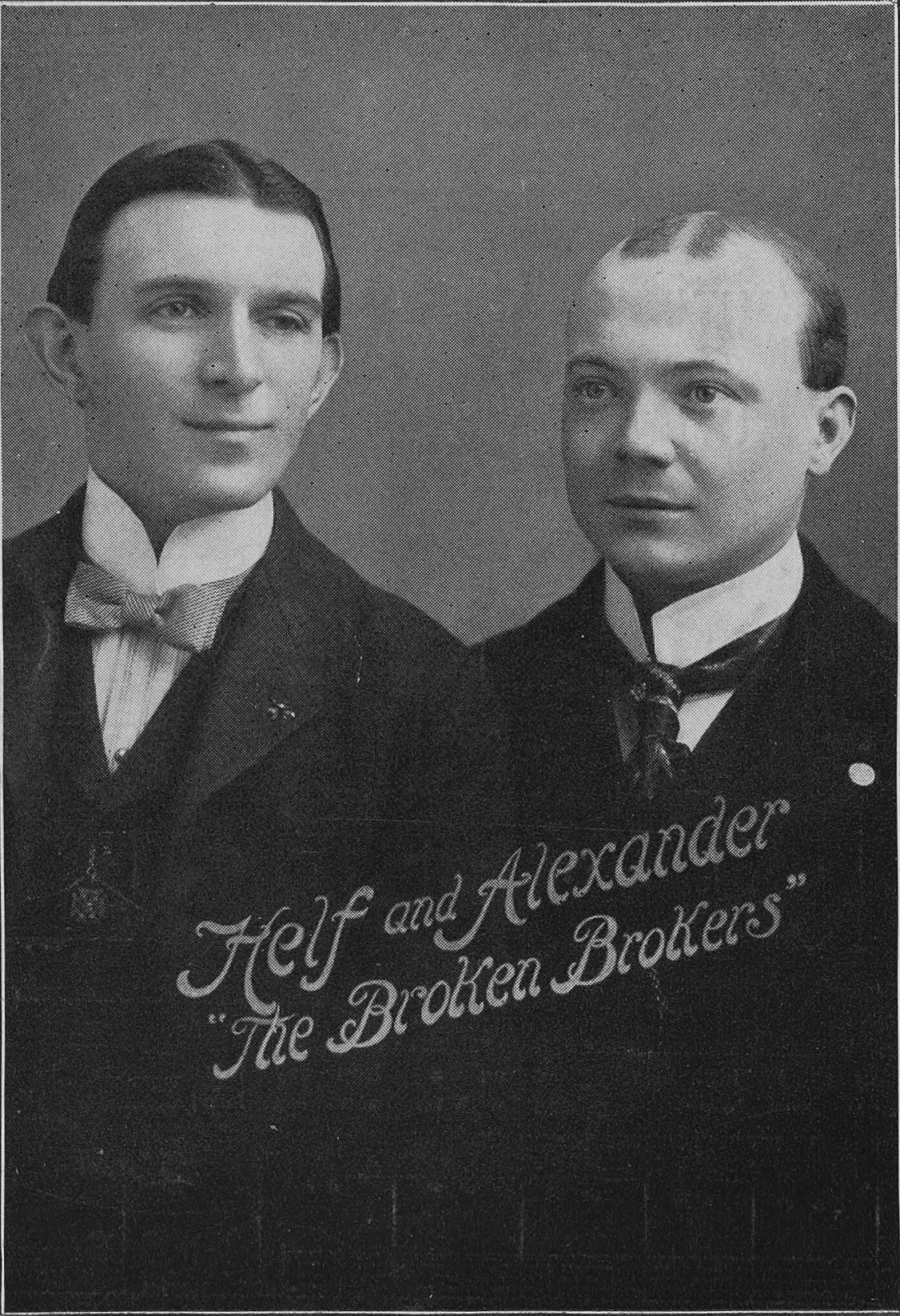
All-right then! Time to move on to something quite different, but not really. As I started writing this, I just finished doing some digging on J. Fred Helf. I became curious about Helf awhile ago when I noticed that one of his earliest pieces was published in Cincinnati in 1897. I did some digging and learned that he was born in 1872(the same as Hylands, as far as we agree upon now), and grew up in Kentucky(like Ben Harney!). 
Helf and later recording star George Alexander around 1899. 
So, another interesting this I found is that Helf lived not long, similarly to Hylands. Helf died in 1915 at age 43. That's never a good thing. So, clearly this guy had demons of some kind. That's a funny thing to consider when he wrote so many sweet songs. It makes sense, in all the pictures I've seen of him, he looks like a guy who had to work through some trouble. He looks rough in the same kind of way that Hylands did. 
Unfortunately, I didn't find much more on him just yet. Despite this, I am very interested, and will look for more. 


Before I finish here, I'd like to share a few new transfers of Hager's orchestra. 


Anyway, next week I will be heading to Portland Oregon to attend my first ARSC conference! I am very excited to get going out there, but of course that will probably mean some time off from writing a blog post here. Well, wish me luck!
Hope you enjoyed this! 


Tuesday, April 23, 2019

Recent Ancestry Digging

So...In the last week or so, I went back and refreshed my memory of many previous findings on ancestry. Since my last post on the Hager brothers, I had kind of forgotten a few things regarding James and Fred. 
While I went back and refreshed my memory, I found a few interesting things along the way. When I went digging for James Hager last time, I was able to find him in 1900, 1920, 1930, and 1940. Just like with Justin Ring(who I still have not found anything new on) there's a period where nothing shows up on him, but it just happens that the period I'm looking for is quite essential. Luckily on this last dig, I found Hager in the 1905 NY state census, and something very curious came up. Here's the record:
Look at that! 
Even by 1905 James was living with the family, Fred more specifically. That's quite hilarious to me for some reason. I was really hoping that by at least 1905 Jimmy was living on his own but still working for brother Fred at Zon-O-Phone. Well, I guess not. Furthermore, I'm sure Jimmy and his wife Isabelle couldn't have gotten much privacy with old Fred and Clara poking around in their business. So now we know that the Hager brothers remained together until at least 1906, which is interesting. That also makes it more likely that they were both working at Zon-O-phone at that time. That helps. 
I was hoping that Fred still employed Jimmy at Zon-O-Phone, even with the queenie Eddie King overpowering the percussion section in the orchestra, so that turned out to be true. 

So staying on the Hager matter, a few days ago I combed through the many issues of Hobbies that Walsh wrote in, just to see where I could find Hager. Well, well, that was a good idea! Just like Joe Belmont and Billy Murray, Hager was one of Walsh's most valuable sources of information. It was entirely heartwarming to learn this bunch of new information from and about Hager. According to the many letters that Hager wrote to Walsh, Hager was determined to go out and find any information about his buddies for Walsh. He was deeply concerned about his fellow recording stars, and made sure to get his information right. This really warmed my mood for the last few days, as there were so many of these folks who were too bitter and uncaring of their fellow studio workers, but at least one of the most major figures who led them all cared even in his fading years. 
Hager provided most of the viable information we have today on Cal Stewart, which is quite interesting. He just happened to work closely enough with Stewart to have a lot of information to share on him. He also had plenty of information on others close to him, proving himself a very valuable and industrious friend of Walsh. 
That really raised my respect levels for Hager(not that they weren't already high!). 


So after refreshing my memory with all that, I decided to take a shot at finding Charles Prince. 
I know in the past I have proven quite well that I am not a big fan of Mr. Prince and his band, but now that I have the chance to read more about him, I'm so intrigued that I have gained respect and interest in him. The only thing I knew about Prince before my recent dig was that he was born in 1869 in San Francisco(which is already appealing to me as I am partial to California born folks). So as I started digging, I found a few very interesting things. 
The first thing  I stumbled upon was a voter registration list from 1892, and he was still living in SF then! 


Soon I will go out to that address to see if anything Victorian is still there. 

So that's interesting. The fact that this was from 1892 and he was still living in SF means that he wasn't yet working for Columbia. It was around 1892 that most scholars conjugate that he began working at Columbia. So that got me curious, it made me confident that I could find when he moved back east, and maybe debunk the whole "early Columbia" ties altogether. Well, that didn't end up happening. I wasn't able to track when he left SF, but for sure his date of going back east would be around 1896 at the latest. At least I have a hint now, and it's looking promising to debunking the old idea. 
The man himself at the center. 
(I still think that clean shaven young buck in the right corner is Justin Ring)
So that was great to find, but the findings didn't end there. I found Prince in the NY state census in 1905, and something very interesting came up. I found Prince housing a familiar studio face:
What! Prince was housing Henry Burr? Well then! 
So this actually is a very significant find for me. For years I have theorized that these studio managers and musical directors took in some of their less fortunate fellows for say a few days or weeks. Well, seeing this exactly proves that this happened. Never would I have grouped together Prince and Henry Burr, but there ya go folks. So this is exactly what I've been saying about Hylands in the past with "33", where he lived in 1899-1902(or so). Hylands always had extra space for his fellows(though in 1900 we see that he chose to have some wayward young men staying over rather than fellows from work). And thanks to the recent findings on Hager, we know that he also had extra space for a similar purpose. Someone like Justin Ring probably rarely crashed at Hager's place though, as he lived(or at least I think he lived at a certain address) just a few blocks away from Columbia(and Zon-O-Phone, wherever they were in the same area). 
So maybe the Ring-Hager thing went the other way around more often. Hager crashed at Ring's place as he was very close by their work. 

So anyway, that's all I found on Prince really. I found a few more census records from later with his name there, but I didn't really learn anything new or surprising from them. I did find it interesting that Prince was divorced by 1920. Not very often do I come across these fellows who are listed as divorced in census records. Hopefully I will get to the point where I can definitively debunk the previous knowledge that Prince had early ties to Columbia. 


So before I close out here, I'd like to mention a funny anecdote from the article on Charles Prince that Jim Walsh wrote. As the Eddie King stories keep-a-coming, Walsh even had a handful of good ones to tell to add to the pile.

One story goes, that Eddie King was engaged to lead his Victor orchestra in a few pieces before a big baseball game in the mid-1910's. All the Columbia and Rex folks were also there, as they were all good friends and avid fans of baseball. Eddie got out there and did his job, and herded all the boys off the field quick in that insistent way of his. 
As they were marching out, Billy Murray stopped Eddie for a moment and asked why he was leaving so soon, and not sticking around for the game. 

Eddie replied thus: "I'm not a fanatic, like you fellows! I've got work to do."


Of course with that in mind, I drew a cartoon to illustrate this idea. 
Of course there he is with his Zon-O-phone buddies. Again, I have not yet seen a picture of King yet, but am hoping to sometime soon. 
Also, just one more point to make about the cartoon above, in that same piece on Prince, Walsh writes out that Billy Murray recalled Eddie King as "a saturnine person with what the non-smoking Murray calls a 'chronic cigarette cough'[and] was a zealot for hard work". 
So there goes that cartoon explained. 


Anyway, I was in Los Angeles last week and got about 20 interesting records ranging in date from 1902 to 1922. There wasn't anything too outstanding in the mix, though I am proud to own a copy of one of Eddie King's xylophone solos! His mallet playing was really something, quite odd and inconsistent, somewhat similar to his drumming on all those Victor's with Van Eps, so to close out here's one of them just because they're entertaining to listen to. 


Hope you enjoyed this! 


Monday, April 8, 2019

The Bowery boy

In the last few weeks, I tried once more to find any new information regarding Justin Ring. Well, just as last time, I didn't really find anything new on paper. well at least in the essential time frame that I am attempting to dig on. However! On my dig, I was curious to see if I could gather anything from seeing what neighborhood Justin Ring grew up in. I compared a few locations of some of these early recording stars, Banta, Issler, Eddie King, etc. The most curious thing I observed is where Justin ring grew up. 

Never could I have expected what I was to find. 
Justin Ring grew up right by the Bowery. 
Well there ya have it folks. So apparently what I had assumed prior to this research on Ring was entirely not true. I guessed that Ring was(based on his relationship with Hager for so long) a more reserved and focused character similar to Banta. I assumed Ring was the more quiet and obedient type, as he did so much work for Hager, Prince, Hylands, and who knows who else. 

Well, none of these could have been true considering where he grew up. 

This finding has completely changed my thoughts on Ring, and as I pointed out in the last post on Ring, maybe that bruise on his face was a common thing with him. There's almost no way he was a submissive obedient little pianist like Banta was, considering he essentially grew up on the Bowery. There's so much lore around those folks who grew up in the Bowery, so many songs, so many sayings and poems. And there's a reason for this. This neighborhood is where all the thugs and fallen folks lived, going way back. Many unfortunate tenement camps were out near there as well in the 19th century. Considering all of this is exactly what is so intriguing about learning that Justin Ring grew up there. 
So, now that I know this, what can we do with it? 
Well, we can place a little Justin Ring amid all the rough folks and lore that we hear on so many records from this era. 

Just as a side note, I observed this piece of information from the 1880 census. 

So, as expected, this has been on my mind a lot lately. As I still don't have any information about Ring in the 1880's and 1890's, though something clearly was intriguing and troubled about him. Observing his childhood neighborhood says a lot. 
(a cartoon I did illustrating my new discoveries on Ring)
But once again, what can we actually do with this information? 
This could be tied to his accompaniment style. I have always been wondering where in the world Justin Ring could have learned to play the rough and wild way that he did, but I guess we kind of have our answer. 
So without a doubt Justin Ring would have heard a lot of interesting music growing up in the Bowery. A lot of that uneasy and wild playing of his was developed from all the rough places he passed through in that area. It also couldn't be helped that he's hear all these things because his father was a musician, who likely played in venues in the area. 

But where else would he have heard such interesting music to develop that style?
It's certainly evident that Ring heard some really rough music. Based on the kind of things he often played on Zon-O-Phone records, he heard black and white musicians. 
Here are a few good examples that illustrate this well:
https://drive.google.com/file/d/0By7WuiOUrg7YUmpBODV5dXpxbHhjYzlGUmZKdEJDelZCQmtn/view?usp=sharing

https://www.youtube.com/watch?v=dVP33Ix8sp0

https://www.youtube.com/watch?v=qi8K8iKZyXM

So there's a lot to take in with Ring's accompaniments. I have been meaning to write a little bit on how I am almost certain which pianist is Ring. Thanks to a few people sending me transfers of records Ring was on in the 1920's, I have backtracked that style back to most Zon-O-Phone's. In fact, this record here was the one that made me realize which pianist was him:
https://www.youtube.com/watch?v=4EzduEIiVd0
It hit me like a slap in the face. It became instantly obvious which pianist is him on all those Zon-O-Phone records. He's that extremely pushy and aggressive pianist. I can hardly believe how anyone could keep up with his rush, I've tried dozens of times and always get lost. 

This didn't just mean I was checking all the Zon-O-phone records I knew of, I would be checking Columbia's from post-1900. Since that hit me, I have been listening to Columbia's and Zon-O-Phone records back to back so much more often. It all makes sense(kind of). When I did that post a little while ago regarding company crossover with Justin Ring, it turns out that it wasn't just a crazy idea. Ring may or may not be in that Columbia band(or orchestra) picture, but he's in that big group portrait of Hager's orchestra, that was taken in the Columbia lab.
That sweet young face up in the right corner might be him. I am still unsure, though I do think it is him. 
Despite that, we do know for sure that's him labeled as no.7, and that this picture was taken in the Columbia lab. 
So we know he was at Zon-O-Phone all the time, but what about Columbia?
Just this evening I went back and did some more Columbia-Zono comparisons, and noticed more striking similarities than I have before. In fact, I would wager that the fact Ring worked at Columbia is why he picked up so many Hylands characteristics in his playing.  This all makes sense now, as for a long time I thought I heard many similarities between the pushy accompaniments at Columbia and Zon-O-phone in a certain time frame. I was a bit timid to say anything definitive about it because I would have no ideas as to why these similarities would be present. After looking to see that Ring lived a short walking distance to Columbia, the likeliness of his employment there keeps-a-coming. 
I am not certain when he would have started at Columbia, but I'm thinking it goes as far back as 1900. In 1900, Hylands once again became engaged more often with Pastor's, and was still determined to keep his publishing firm with Spencer going. So this would mean that he'd be at Columbia less than the previous 3 years. So who would they have instead? That little, tanned, blonde headed Bowery boy of course! 
I mentioned in my last post about Ring that he would be the most likely pianist on Zono and Columbia around 1900 to 1905 because he had little responsibilities. Unlike Hager, Ring had no family at home, and was willing to take any money and work that was offered. He'd also be content crashing anywhere for the night where he could work(remember I still haven't found him in the 1900 census).  He kind of pulled a Banta, taking on multiple studio responsibilities, not realizing how tiresome it would become. 
Considering the amount of work he did between 1901 and 1908, I'm surprised he didn't drop dead like Banta, but anyhow, I'm really happy he got himself together and abandoned the double company life by the 1910's. 

Anyhow, that's all I got on Justin Ring since the last post I did on him. I am still determined to find the information I need!  

Anyhow, I would highly recommend digging around on the UCSB disc site, as they have finally added all the lovely Zon-O-Phone's and Columbia's. As expected, I have been quite busy listening to those, as i keep finding new one's every day! 
Just to give you an idea of what I went searching for first, here are a few that I have already saved:
https://adp.library.ucsb.edu/index.php/matrix/detail/2000261902/Zo_cat_C_5260-Little_Nell


https://adp.library.ucsb.edu/index.php/matrix/detail/2000135456/140-Ill_follow_thee

This is one of my favorites so far:
https://adp.library.ucsb.edu/index.php/matrix/detail/2000137335/1101-Turkey_in_the_straw

https://adp.library.ucsb.edu/index.php/matrix/detail/2000254687/5315-Reels_and_jigs_Selection

https://adp.library.ucsb.edu/index.php/matrix/detail/2000263984/Zo_cat_G9467-Melodie


Anyway, that's all I got, I have been engaged to write some more, so I haven't so much to write about here right now. Hopefully I'll find some more new stuff pretty soon. 


Hope you enjoyed this! 


Friday, March 29, 2019

A Portrait of Frank P. Banta

Today we celebrate the birthday of Frank P. Banta, perhaps the most beloved studio musician of the entire acoustic era. 
It's hard to begin with this guy. 
I guess I could just write out an affectionate bio on him, just because I have gathered more information about him since the last biographical post on him. Well, here goes. 


Frank P. Banta was born on March 29th, 1870, the middle child of five. His father John was a woodcarver, a noble profession in Victorian New York, but perhaps more interesting is his mother's story. His mother  Fannie Darrow married first around 1863, but her first husband died quick, so she remarried an old man named John(Frank's father). Fannie was a rich girl, from a prominent old Dutch family of New Amsterdam. Her many sisters married prominent New York men of money, but she married a poor woodcarver in his middle age. Frank was the only musical child in the family, and it began to show quite early in his life. As a young child, Frank began to take up piano tuning, as his perfect pitch rendered him a skilled tuner. He started tuning pianos in factories, before they were sent off for sale. It was in this line that he began to develop a talent for playing the piano. His mother likely took notice of this tendency soon afterward, and got him some piano lessons. Though, it is likely that he didn't remain under the rule of a teacher for long, as his distinct style developed later proves for little training and more natural ability. 

Frank likely kept tuning pianos in his teen's to get some extra money, and also played some gigs here and there too. By 1888, his name was starting to appear in the papers as a specialty accompanist and arranger. His praises were already being sung before he was even 20. By 1890, he was playing in vaudeville houses all over New York, accompanying singers and instrumentalists of all kinds. Around 1892, Banta became associated with banjoist Vess L. Ossman. 
Ossmand and Banta advertised together, 1893. 

Somehow, in that same year, Banta was plucked out of the vaudeville houses to work for the three year old North American Phonograph Company. It's possible that Edward Issler recommended Banta to the North American/Edison management. Banta spent a few months of 1892 getting the training of phonograph accompaniment. Likely under the rule of Issler, Banta learned the phonograph ropes, and by 1893 was ready to work for them regularly. Other than working regularly with singers and other performers, Banta was often brought into the studios by special request of Vess Ossman, as they were still engaged together as an act at that point. Ossman as many recalled, was a very difficult man to work with. Someone as quiet and modest as Banta likely clashed with him often. Despite that, some of Ossman's best recordings have Banta's accompaniment, as they worked together perfectly in spite of their extreme differences. Banta likely learned how to work with these sort of performers by touring with Ossman, and it would inevitably come in handy as his years in the studios went on. 
Around 1895, Banta formed his own orchestra, a small parlor orchestra of about 6 musicians at most. Considering his close partnership with Issler, he formed this group to the striking likeness of Issler's orchestra. Banta's orchestra even recorded many of Issler's arrangements, such as "The virginia skedaddle", and "Her golden hair was hanging down her back". You can hear one of them below:
Banta is of course the announcer and the pianist. 
Banta' orchestra faded away from record catalogs by 1896, but at that point Banta was secured with Edison. 
By 1896, Banta was with Edison all the time, playing accompaniments for all who worked there, but of course it didn't take long for other companies to jump at him. As his praises continued to be sung by all, the Berliner gramophone company grabbed him in 1897 to replace the increasingly absent Fred Gaisberg. Berliner promised Banta more variety, and his own orchestra again. At Berliner, Banta led the Metropolitan orchestra, or at least sometimes. 
Banta was working for Edison and Berliner at the same time in 1898, seeming to equally balance his time at both. 
He had left the majority of his performing behind at this point, slaving away in two studios seemingly day and night. Some say that during his time recording, Banta was on half the recordings that Edison issued. Half. 

Half would mean thousands, perhaps more than that considering how early he started. 
In 1900, Banta, Arthur Pryor, Christopher Booth, Noble McDonald, and a few more Berliner musicians joined the newly formed Victor company. Each of these musicians made a piano solo for them in 1900 or in the few years afterward. Banta replaced his engagement with Berliner with that of Victor, working at Victor almost as much as he was at Edison. His distinct and steady accompaniments can be heard extremely well on Victors and Edison records during this time. he played everything from classical accompaniments to red hot rag-time. Here are two contrasting examples both from 1901:
His accompaniments are unmistakable, very steady, dynamic, and full of self taught eccentricities. 
His accompaniments influenced many of his fellow jealous recording pianists. Fred Hager and Justin Ring took especial liking to his pieces. 

This oddity of Banta's was only recorded by Hager's orchestra as far as I can find. 
Hager and Ring even mimicked Banta's smooth style of syncopation and dense chord choices in their own accompaniments. 
He continued to somehow balance all that work for Edison and Victor until 1903, where he had nearly completely exhausted himself with this work. 
During his later time at Edison, it was said that Banta's wife Liz worked in the studio as well. Liz was a studio secretary while Frank played accompaniments until he dropped. Frank and Liz married in late 1895, and their first child was the later famous novelty pianist Frank Edgar Banta. Somehow Frank was able to fit in time for another child in 1901, a daughter named Prudence(maybe that's somewhat related to that illusive middle initial of Frank's). 
Frank's children did not get to know him too well. As he was gone more than most men even in that time. Working for two record companies at once wasn't a family friendly concept in those days. 
Only when he became physically weak and ill from all that work did Frank realize this. In mid 1903, Frank was very weary of all this work, but his constant and determined personality dictated his place in the studios. he continued to show up to work every day he could, even though his asthma was getting worse, and time had already aged him quick, even at merely 33. 
Banta at one of Edison's Shoninger pianos, c.1899.

Banta came into work at Edison until the very day before he died. The day before he died in November of 1903, everyone expected him at work the next day as usual, not giving it much thought. But he died early the next morning. 
His absence rendered the piano at Edison silent that day. Legend has it at the Edison studio that no one came to work that day to mourn his death. 

But his story doesn't end there. When Jim Walsh corresponded with Dan W. Quinn in the 1930's, Quinn continued on to praise Banta. It seemed no one was so fond of Banta than Quinn. Quinn even named his youngest child after him. Now that's respect! 
It's Quinn's kind words and recollections about Banta that kept his reputation around, and it was carried on when Frank Edgar Banta was interviewed in the 1940's. Frank Edgar did not know his father well, he regretfully admitted this when asked about it. He recalled little of his father, but he did remember that his father was very humorous, rather quiet, and unfortunately ardent with work. He did recall his father inviting over many friends from work to play new songs(he didn't drop any studio names, but Quinn was almost certainly one of them, as was Ossman). His father would also sit with him at the piano to show him a few things, but these barely made it into his later developed style. 

Frank Edgar was 7 when his father died, and his sister Prudy only 2. 
Liz did not remarry after Frank died, but she continued to work into her old age. 


Well, with that, how about a few records he's on? His story is quite dramatic and somewhat depressing toward the end, so maybe some of his records could lighten the mood a bit here. 


(remember, Banta's name is on the original "Laughing song", he's listed as the arranger)
Banta was likely also responsible for this piece too. 


Happy listening! 


Hope you enjoyed this!