Showing posts with label Billy Murray. Show all posts

Friday, June 19, 2020

Ancestry digging and understanding Ringleben

It has been a difficult few months for me.  Since the beginning of April I dealt with serious panic attacks and crippling anxiety...but finally I have come out the other side. 

Since being locked down here in Northern California, it's given me lots of time to think about things, and you'd think that I would have written more here, but I simply haven't been in the right mood to do so. 

For that month I was out of commission, I could barely think about old records and rag-time, that's how bad it was. After that blew over, I was back to drawing, sewing, and thinking. 

About two weeks ago, I decided to dive back into some ancestry digging. Usually I do so to check things I have already seen, and this time is proved to be a good idea. In the past, Hager's family history has been somewhat vague, with the basic information known but the specifics aren't present. Thanks to a descendant of Hager's sister Georgiana, a lot of information was added within the last few months and this has opened up a lot of new questions, and answered some I had. Fred's history is still vague, but Jimmy's is far more complete! 


There are those boys! 

So I am not sure if I've said in the past on here, but I'm pretty sure these boys didn't like each other so much. In Fred's papers(or what's left of it) I see nothing on Jimmy anywhere, though they worked and lived closely for so many years. In 1905, both Fred's and Jimmy's families lived together! 
So from what I've recently learned on Jimmy, he had the absolute worst luck. He married in 1902, at age 20, lost two kids in infancy before his only surviving son was born in late 1905. His son, Mel, was the only male grandchild in the family, a great accomplishment considering brother Fred hadn't any male children. Mel was killed in a NY transit accident at the mere age of 36. In a previous post I highlighted that Mel was the type of young man who lived at home always working different jobs when the census people came around. His young wife Alice(born in 1908) died in 1940. Based on census records, Mel had likely just married Alice only a few months before, because in the 1940 census he was still listed as single. Some terrible luck indeed! 

Jimmy had to witness so many deaths of his children, which really broke my heart to learn. He already had it hard enough trying to scrape by as his brother's underling for so many years, and all his unfortunate luck with married life just adds insult to injury. 
On the brighter side, it seems that longevity runs in Hager's family, as his mother Annie, lived to the age of 99! She was born in 1850, and died in 1949, which is a hell of a lifespan. She would have seen the full extent of her sons' careers, and died not even a decade before her first born did.  Jimmy's daughter Veronica died in 2010 at age 100! In clippings from Hager's scrapbook, there was some mention of their father Mel. According to one page, Mel was a musical guy who encouraged all his children to enter in the music world. He worked on the railroad in the woods of Pennsylvania until 1881 when he decided to move the family to Manhattan.  Just a side note, Annie was pregnant with Jimmy when they moved! 

So with all this new information on the extended family, I am more intrigued by the tragedy that surrounded Jimmy Hager. He was naturally gifted musically, but was forced into the recording business by his overbearing and successful brother Fred. He always looked bitter, like there was something constantly troubling him, and it seems that there was. His drumming on all those Zon-O-Phone's has a lot more meaning now. 


So while doing all this Hager digging on Ancestry, I did realize something essential in understanding Ring and Hager's relationship. For a long while I've been trying to sort out when they split up the first time, and it seems that I have finally figured it out! Before spending time really thinking about the circumstances, I assumed they split in the middle of 1906, as by that time Ring was working for Seminary music and running the Zono orchestra with Eddie King. Turns out I was a year off!  
The way I found out was simply this sheet here: 
(a 1905 Ring sheet, from my collection)
So this sheet here, you might notice, was published by Ring. This publishing firm didn't last more than a year, as it was a vanity project originally hatched by Hager for his and Ring's music. Ultimately the firm didn't present itself to be very productive, so it folded not long after the publication of the sheet above. So what has this to do with his relationship with Hager? Well, actually a lot. 
This sheet's composer is neither Ring nor Hager, rather unusual for the publisher. This piece is likely one of half a dozen sheets they published within that year. It appears to be disassociated form Hager in every way possible, until you get to the back page:
Ah yes, Handsome Harry, that infernal specimen of male temptation. 
So there are only two pieces really advertised here, Handsome Harry and Jovial Joe, which considering the circumstances isn't really surprising. But the mere fact that Ring published such an obscure composer than wasn't associated with either of them, or recording for that matter proves some kind of separation from Hager. Honestly I had no idea Ring was still publishing independently in 1905, I assumed that when Hager officially joined Helf in late 1904 that he bought up all of Ring's stock(kinda not a great thing to do to your companion I'd think). He and Helf eventually did that, but evidently, not right away, which is curious. Another thing to note about this sheet is that the publishing address is slightly different from that of Jovial Joe. when I went to New York in January, I sat on the steps of 55 West 28th street, the address listed on Jovial Joe, but it turns out that he had moved to Helf and Hager's address by early 1905, which is very strange, even though it does make sense. 

So there's actually another layer to this story, thanks to Hager's family I know now that Fred's youngest daughter, Ethel, was born November 7th of 1905. If you were thinking what I was thinking, that would put conception around the time that the Ring sheet above was published. 


Think on that for a moment. 


So there's that. Before I close out, I'd like to talk a little about Ring. He his still as mysterious as he's always been. Little bits about him show up here and there, but the majority of what we'd like to know about him is still unknown. 
Hager's special portrait of Ring in his scrapbook(from my collection)

In a future post I'd like to talk about the importance of studying body language in what few pictures we have of these recording folks. From what there is to be observed about Ring, his non-verbal speaks volumes. He was a quiet and industrious worker, speaking few words and always buried in music. With so little to say, and often a blank face, his body language speaks as much as we could understand. In all the pictures there are of him, he was awkward in some kind of way, sometimes more than others. He was definitely a dandy(as Hager was), but he didn't want to attract much attention as others like Hylands or Hager would. His eyes were always cast aside, his legs a little undecided, but his hands were always graceful. It's little things like this that can help us better understand these weirdos who made all these early records.
 In my next post I hope to do some of this non-verbal analysis. Believe it or not, you can actually gather a lot from pictures of these folks, even though they were taken in an era where we normally wouldn't associate such quirks. A great example for unlocking the core of Hager's personality comes from those home movies that Jim Walsh took at the John Bieling Day memorial in 1950. Just from a few short clips of Hager(although silent) interacting with old farts like Billy Murray and Eugene Rose, all the traits I've described him with come through perfectly. 


Anyhow, that's all I got for now. I have had lots of ideas for blog posts since getting over my weird attacks, but formulating one good idea has been difficult, as I've spent a lot of time thinking things over. Another idea I've had is discussing the evolution of Rag-Time in fashion, as this is something that has caught my eye in the last few weeks. There were specific styles that young men and women wore in the middle and late 1890's that quickly became associated with rag-time, some of which are part of the era's stereotype as we know it today. Anyway, I'll close it off there. 


Hope you enjoyed this, and are staying healthy! 


Wednesday, December 18, 2019

Prince and new records

All-right folks, I apologize for not writing so frequently. It's been difficult to sit down and write  single blog post, and as you know it's holiday time. Here I have been stuck at home often recently with all the rain we've been getting here in northern California. So with that in mind, it seems like a good time to get a post in. 

In the last post I promised I'd write about Charles Prince, and so I will. A little over a month ago, I started doing some preliminary digging on Prince, thinking that it wouldn't lead to much. Well, I was sure wrong there...
In the past I had heard from a few collectors and notes in Jim Walsh's articles that Prince was a difficult person, but I never would have expected the amount of difficulty to be discovered. 
Prince around 1904. 
On previous digs I found bits on Prince regarding his early days in San Francisco, as that was where he grew up. 
So here's a summary of what I found:
Prince was born most likely in December of 1867, in San Francisco. In 1870 his family was living in the small logging village of Santa Cruz(it was difficult to get to this town before 1872). Prince's family had relative status to old California standards, being in the fruit packing business. They also prided themselves on being married into the famous Adams family, descended from presidents John Adams and John Quincy Adams. This is where the Adams middle name comes from. By the mid-1870's, the Adams-Prince family had moved back into SF, settling nearer to the Barbary Coast than to the "slot"(where the cable cars were to be built in just a few years). It is unclear when Charles entered in the music business, but it was likely very early on, and he played piano to start. In his mid-teens' Charles was working as a lifeguard of some kind along the north shore of the city. At age 20(1888), he married a woman whose name I could not track down. he lived with his wife and father Henry in the northern part of the city(toward the top of Larkin street to be more specific for you SF scholars).In 1892 he decided to head east to New York for better music work. 

Somehow he got tangled in the new-fangled business of recording sound. It is possible that Prince knew the four Emerson brothers in SF before they all headed back east, and this may have been how he got into recording. However he got involved, he entered in the exclusive crowd with some of the major recording workers, such as Frank P. Banta and Dan W. Quinn. He made his first batch of records as an accompanist on July 30th, 1892. It's uncertain when he left recording, but it was likely within the next year or two after that first few sessions with Banta. Sometimes between 1890 and 1895 he likely divorced his mysterious first wife, and left New York to go and live in the Kansas City area. While in Kansas city he hastily married an 18 year old girl named Sadie(there is a chance she may not have been 18 when they married). By 1899, he and Sadie were back in New York, and he was working in the family business of packing fruit.  
From his first experience in recording, Prince stayed in touch with the media and press around the then fast growing recording business. he was likely one of those few outside figures who had a regular subscription to The Phonoscope. His friends from the previous decade probably knew of his return to New York, keeping at the back of their minds that he was around and could be a candidate for a director's job in a studio. It took until the end of 1902 for Prince to finally return to recording as an accompanist. When he returned, he accompanied the first operatic Columbia records issued. Prince just happened to join at a very touchy time for Columbia, as Fred Hager was leading the studio orchestra, playing a regular weekly park gig, composing popular pieces, and Hager and Justin Ringleben were being mentored by the then fading studio pianist Fred Hylands. So, in summary, there was little room for Prince when he initially joined the Columbia staff. In early 1903, Hager's name was still being aptly advertised in Columbia's catalogs and supplements. It took until the middle of that year for Hager's stronghold on the Columbia lab to collapse. As with all of Hager's other ambitions, the other record companies he had in his control all came crashing down at once(this includes Columbia, Victor, Lambert and Leeds). Amid Hager's lamenting, Prince made his way in, and with that he brought in many new musicians, but also kept many of Hager's still employed. 

Prince received an awfully warm reception from the old Columbia guard. Len Spencer and Henry Burr took an especial liking to him. Prince wrote out several descriptive pieces with Spencer in the first few years of his employment at Columbia, such as this one here:
You can hear Spencer's voice shouting throughout. 
Prince gladly employed Justin Ring as his chief arranger and assistant, much like Hager had. He also had Hager's brother Jimmy in the band as a percussionist. 
And as we know, in the next few years, Prince's band and orchestra became a respectable rival to Sousa's and Arthur Pryor's bands on records. While Prince was gaining fame in the record field, he tended to a few of the wandering record folks he employed. In 1905, Prince had Henry Burr boarding at his place, and it is likely that he also had Ring and Jimmy Hager stay there when they needed it. 
Once we get to the teen's this is when Prince's personal life gets complicated again. Between 1910 and 1925, he was married and divorced several times, and when I combed through each census and other public records in this period, he wasn't living with his wife most of the time. His daughter Catherine, from his marriage to Sadie, remained with him throughout these times, but the others living with him changed frequently, but all of these folks he lived with where strategic and somewhat related to his line of work, whether it be recording or performing in pit orchestras. 
In 1918, another orchestra director began making his way into the Columbia studio, much like Prince himself had nearly 20 years earlier. This new director was Robert Hood Bowers. It took until 1923 for Bowers to take Prince's place, but this didn't mean that he was gone from Columbia for good just yet. As his job at Columbia was fading out, he took a brief job at the company who made Paramount records. By the next year, Prince signed a somewhat brief contract with Victor. Prince conducted a bunch of sessions for the next year, and played piano accompaniments for singers such as Billy Murray and Ed Smalle. Prince may not have been at Victor for long, but he happened to be there at an essential time, amid the transition from acoustic to electric recording. 
By the end of 1925, he was out of recording for good. 
By the end of the 1920's, he was working in radio, likely due to his contact with Justin Ring, who at that time was getting steady work as a sound effects man on the radio. By the worst part of the depression, he moved back to California, settling in San Rafael with his daughter Catherine. In the years before he died, he conducted a community orchestra and worked as a music teacher. He died on October 11th, 1937. 
He is buried in Colma, California. None of his wives were buried near him.


Well there ya go. Never could have expected how fruitful that dig was. Adding all this to what Jim Walsh wrote about him creates a very solid story. Walsh described him as a sporty type, being very much into baseball and horse races. He was also a prominent member or sporting clubs, the Masons, and the Lamb's Club of new York. I guess this helps to paint the picture of why he was so difficult and couldn't keep a wife for many years. 

So after I did all this research and writing(this information was consolidated into an article for The Syncopated Times). I felt an aggressive obligation to pay my respects to Prince, so the day after all this digging I paid his grave a visit. 
His headstone even has the signature Columbia notes on it. 
So at least we know more about Prince now. 


Now moving on!

At the end of the last post I hinted at a record that was coming in the mail, and it has since gotten to me. The record was listed incorrectly, but it was definitely not a disappointment! This record came in a lot of three records I won in an auction, and all three of them are stellar copies. Here is that Climax record I was talking about:
That--is--a--beautiful--record.
It looks a bit rough, and its value was harpooned by a small crack, but these things do not take from the historical importance of the record. 
First of all, this is a 10-inch Climax record. Those are much more uncommon than the 7-inch Climax records. A collector told me that for every 50 7-inch Climax records, there is one 10-inch. The next thing that this record has going for it is the fact that the composer is specifically listed on the label. Only for very special occasions were the composers listed on the label. In the first few years of Columbia making disc records, they almost never credited composers on the labels. This record also has an announcer that sounds just slightly different from the usual Zon-O-phone-Climax/Columbia announcer(who I think is probably Hager). Anyway, here's a mediocre transfer of the record:
I had heard a 7 inch version of this record, but never the entire piece as it is played here. This is one of Justin Ring's very fist pieces, published in early 1902. This record was likely one of the unissued takes that was saved to be issued on the Climax label. When they recorded this, they recorded 7 take of this piece. Takes 1, 6, and 7 were overtly issued, but takes 2 to 5 are nowhere to be seen. This unusual take is likely take 2 or 3. Keep in mind that on all Climax records they left out the take numbers. 
This record is a great piece of history amid the depths of my Ring and Hager project. No less were the other two records I won in this auction. 
This record here, was recorded in 1900, and is basically the closest thing you an get to an E condition record of this era. It includes some of the loudest and clearest piano accompaniment I've heard of this era. 
Here you go:
Other than the loud piano accompaniment, one of the first things I noticed about this record is how similar it is to the 1901 Climax recording of it. You can hear that here: 
The similarities are astonishing. 
This Zon-O-Phone record did not disappoint, and it makes sense why it was so much more expensive than the other two I got. 
So here's the third one:
This record was made on the same day as the previous one. It has the number right after the last one. It looks to be in much rougher shape than the other, but it's actually not nearly as bad as it looks. In some ways it has a fuller sound than the other one. 
Here you go:
Before I got this record, I was only able to hear a crappy transfer of it online. 
Both of these Zon-O-phone records are exceptional examples of the height of their sound quality. Both of these are also prime examples of Ring and Hager's relationship, as well as their great chemistry musically. These were recorded before they really got into composing together, but you can see that the foundation for this decades long friendship was already there. 

Anyway, I was going to dive into a longer subject on Columbia matrix numbers, but I don't want to get into that just yet. This subject deserves its own post. 

Hope all your holidays are going well so far!


Happy holidays.


Tuesday, April 23, 2019

Recent Ancestry Digging

So...In the last week or so, I went back and refreshed my memory of many previous findings on ancestry. Since my last post on the Hager brothers, I had kind of forgotten a few things regarding James and Fred. 
While I went back and refreshed my memory, I found a few interesting things along the way. When I went digging for James Hager last time, I was able to find him in 1900, 1920, 1930, and 1940. Just like with Justin Ring(who I still have not found anything new on) there's a period where nothing shows up on him, but it just happens that the period I'm looking for is quite essential. Luckily on this last dig, I found Hager in the 1905 NY state census, and something very curious came up. Here's the record:
Look at that! 
Even by 1905 James was living with the family, Fred more specifically. That's quite hilarious to me for some reason. I was really hoping that by at least 1905 Jimmy was living on his own but still working for brother Fred at Zon-O-Phone. Well, I guess not. Furthermore, I'm sure Jimmy and his wife Isabelle couldn't have gotten much privacy with old Fred and Clara poking around in their business. So now we know that the Hager brothers remained together until at least 1906, which is interesting. That also makes it more likely that they were both working at Zon-O-phone at that time. That helps. 
I was hoping that Fred still employed Jimmy at Zon-O-Phone, even with the queenie Eddie King overpowering the percussion section in the orchestra, so that turned out to be true. 

So staying on the Hager matter, a few days ago I combed through the many issues of Hobbies that Walsh wrote in, just to see where I could find Hager. Well, well, that was a good idea! Just like Joe Belmont and Billy Murray, Hager was one of Walsh's most valuable sources of information. It was entirely heartwarming to learn this bunch of new information from and about Hager. According to the many letters that Hager wrote to Walsh, Hager was determined to go out and find any information about his buddies for Walsh. He was deeply concerned about his fellow recording stars, and made sure to get his information right. This really warmed my mood for the last few days, as there were so many of these folks who were too bitter and uncaring of their fellow studio workers, but at least one of the most major figures who led them all cared even in his fading years. 
Hager provided most of the viable information we have today on Cal Stewart, which is quite interesting. He just happened to work closely enough with Stewart to have a lot of information to share on him. He also had plenty of information on others close to him, proving himself a very valuable and industrious friend of Walsh. 
That really raised my respect levels for Hager(not that they weren't already high!). 


So after refreshing my memory with all that, I decided to take a shot at finding Charles Prince. 
I know in the past I have proven quite well that I am not a big fan of Mr. Prince and his band, but now that I have the chance to read more about him, I'm so intrigued that I have gained respect and interest in him. The only thing I knew about Prince before my recent dig was that he was born in 1869 in San Francisco(which is already appealing to me as I am partial to California born folks). So as I started digging, I found a few very interesting things. 
The first thing  I stumbled upon was a voter registration list from 1892, and he was still living in SF then! 


Soon I will go out to that address to see if anything Victorian is still there. 

So that's interesting. The fact that this was from 1892 and he was still living in SF means that he wasn't yet working for Columbia. It was around 1892 that most scholars conjugate that he began working at Columbia. So that got me curious, it made me confident that I could find when he moved back east, and maybe debunk the whole "early Columbia" ties altogether. Well, that didn't end up happening. I wasn't able to track when he left SF, but for sure his date of going back east would be around 1896 at the latest. At least I have a hint now, and it's looking promising to debunking the old idea. 
The man himself at the center. 
(I still think that clean shaven young buck in the right corner is Justin Ring)
So that was great to find, but the findings didn't end there. I found Prince in the NY state census in 1905, and something very interesting came up. I found Prince housing a familiar studio face:
What! Prince was housing Henry Burr? Well then! 
So this actually is a very significant find for me. For years I have theorized that these studio managers and musical directors took in some of their less fortunate fellows for say a few days or weeks. Well, seeing this exactly proves that this happened. Never would I have grouped together Prince and Henry Burr, but there ya go folks. So this is exactly what I've been saying about Hylands in the past with "33", where he lived in 1899-1902(or so). Hylands always had extra space for his fellows(though in 1900 we see that he chose to have some wayward young men staying over rather than fellows from work). And thanks to the recent findings on Hager, we know that he also had extra space for a similar purpose. Someone like Justin Ring probably rarely crashed at Hager's place though, as he lived(or at least I think he lived at a certain address) just a few blocks away from Columbia(and Zon-O-Phone, wherever they were in the same area). 
So maybe the Ring-Hager thing went the other way around more often. Hager crashed at Ring's place as he was very close by their work. 

So anyway, that's all I found on Prince really. I found a few more census records from later with his name there, but I didn't really learn anything new or surprising from them. I did find it interesting that Prince was divorced by 1920. Not very often do I come across these fellows who are listed as divorced in census records. Hopefully I will get to the point where I can definitively debunk the previous knowledge that Prince had early ties to Columbia. 


So before I close out here, I'd like to mention a funny anecdote from the article on Charles Prince that Jim Walsh wrote. As the Eddie King stories keep-a-coming, Walsh even had a handful of good ones to tell to add to the pile.

One story goes, that Eddie King was engaged to lead his Victor orchestra in a few pieces before a big baseball game in the mid-1910's. All the Columbia and Rex folks were also there, as they were all good friends and avid fans of baseball. Eddie got out there and did his job, and herded all the boys off the field quick in that insistent way of his. 
As they were marching out, Billy Murray stopped Eddie for a moment and asked why he was leaving so soon, and not sticking around for the game. 

Eddie replied thus: "I'm not a fanatic, like you fellows! I've got work to do."


Of course with that in mind, I drew a cartoon to illustrate this idea. 
Of course there he is with his Zon-O-phone buddies. Again, I have not yet seen a picture of King yet, but am hoping to sometime soon. 
Also, just one more point to make about the cartoon above, in that same piece on Prince, Walsh writes out that Billy Murray recalled Eddie King as "a saturnine person with what the non-smoking Murray calls a 'chronic cigarette cough'[and] was a zealot for hard work". 
So there goes that cartoon explained. 


Anyway, I was in Los Angeles last week and got about 20 interesting records ranging in date from 1902 to 1922. There wasn't anything too outstanding in the mix, though I am proud to own a copy of one of Eddie King's xylophone solos! His mallet playing was really something, quite odd and inconsistent, somewhat similar to his drumming on all those Victor's with Van Eps, so to close out here's one of them just because they're entertaining to listen to. 


Hope you enjoyed this! 


Sunday, October 9, 2016

Exceptional and awful takes

For the seminar on Fred Hylands I will be giving in a little over a month, I have to pick two records that exhibit two sides of Hylands' studio playing. One is to be a very good take, and another is the worst of the worst we know of. The good take will be decided later, as that will be harder to choose than the bad takes. Last evening, I listened to many of the bad takes I know of, which just happened to be all from pre-1900, even though I have heard some bad takes from after then. Some of Hylands' bad takes are hard to believe that they were issued, with mistakes that are unbelievable. Of course, the bad takes are just as interesting as the good takes, in fact they are more so sometimes, because the mistakes are unexpected. The first record that Ryan Wishner and I discussed as far as the bad takes go is one by Steve Porter:
Steve Porter---Columbia's richest gambler

After taking a few listens to a few records by Porter, it seems that he wasn't really a very good singer early on, in fact, he was worse than Dan Quinn was, which is really saying something. Porter was really only integrated into the "Columbia Clan" because he was rich, and he had befriended Russell Hunting before everyone else did(in 1895 in fact). His massive wealth did him well at Columbia, and it earned him a job singing for their Graphophones in 1897, even if he wasn't a very good singer. He always had weekends playing golf or sailing in his yacht to look forward to after singing so much in the studio during the week(this actually stated in an edition of The Phonoscope). The record by Porter than was suggested for the bad takes to choose was an 1899 take of "In the Baggage Coach Ahead". 
Here's the take:
It's not a very good take as far as Hylands piano accompaniments go...
The piano playing is really scattered and rushed, much like most of the bad takes I know of. Much like Hylands usually did, if he was out-of-sync with a singer, he was ahead of them most of the time, and this Porter record does indeed exhibit that, but it's not clear enough to prove the point with a bad take. It's pretty awful regardless. Another bad take by Porter and Hylands is their 1901 recording of "Carrie Nation in Kansas". It's hilarious, but the piano playing is very weird and full of mistakes, such as Hylands' signature triplet thing at 38 seconds in. Hylands' rhythm is not the best either, it's pretty steady, but gets out of sync with Porter's singing at some points. Also! Listen to the sketch at the very end, which sounds much like those crazy Spam-war(Spanish-American war) 1898 descriptive selections by the Columbia orchestra(such as this fun one here!).

Who's that howling back there?

Damn! Who is that?! That's sure as hell some howl! It's more prominent than all of the ones on the Columbia orchestra descriptive selections about field battles. I can't tell if the howl comes from piano distance, but it sounds like it does. Hmm... ... ... Maybe that's a clue... ... ... 

Yes, all of the bad takes in terms of piano accompaniment are more likely than not recorded when Hylands or the featured singer was intoxicated. Of course, it would have to be just that, and the types of wild playing vary in fact, there's the anxious and very quick playing, and there's the scattered and weird slower playing like on the 1901 Porter cylinder above. Maybe those two different types of playing mean different influences...

The possibly white-ish powdered influence on Hylands can be heard on records like this one: 
(skip to just over a minute in for the record to finally start...)

The playing I mean here is the solo at the end primarily. It's quick, rushed, and scattered. It's very hard to keep up with when attempting to play the solo by ear, which is exactly what I'm getting at. I have heard this type of solo from Hylands a few times, one is from a disc of "Bye Bye my Honey" by Billy Golden, and another is from a 1903 recording of "The whistling Coon" by Billy Murray, as well as a 1902 Murray recording of "Has anybody Seen our Cat"(this is a newly slowed down transfer by the way!). 

These two in the links above are not really bad takes necessarily, but they're strange enough for to take notice. When I say bad takes, I mean records like these:


These bad takes are either bad on the piano players' part, the singer's, or both. Now when I say good takes, I mean these:

Len Spencer's 1899 Columbia concert of "Warmest Baby in the Bunch"
(can't share the link, sorry...)


It must be noted that the last cylinder listed here is a newly-posted record on Youtube, that was posted just to-day, and turned out to be among the best examples of Rag-Time on early Columbia records. All of the 1903 to 1905 Columbia's Roberts made with piano accompaniment sound like that record, with pristine and top-liner Rag-Time piano behind him. I hope I have made it clear that it's hard to choose just one record of these good and bad takes, though as far as the bad takes go, Johnson's "Whistling Girl" is especially so compared to the others listed, so does Spencer's "On Emancipation Day". Those two exhibit a mix of all the bad things about Hylands' playing when it wasn't at its best. On the other end, the good takes are more hard pressed when trying to pick one that is better than the others. The first one listed(that isn't a link) is one that can be considered a good and bad take, as it's a fantastic example of late-1890's Rag-Time, but Spencer's singing on it is particularly awful. The piano playing is weird and scattered, to make matters better, which is certainly Hylands by all means. 


With this dilemma, I would like ideas from other collectors on this, choosing one good take and a bad take, please drop your ideas in the comments on this post! 

As Hylands once advertised:
All mail cheerfully accepted!

Hope you enjoyed this! 


Thursday, June 16, 2016

Mentioning of Hylands by Jim Walsh, and a mystery cylinder

Well, from what I was sent this morning by Charlie Judkins, it would seem that Jim Walsh mentioned Hylands a few times. FINALLY! It's about time we see that he mentioned Hylands...
I wanted to use this picture in my last post, but anyway, here you go:
If you read the "whip" analogy I used in my last post about Hylands at Hylands Spencer and Yeager, this makes full sense. 
I just saw this when I thought about that. It's kind of awful, but it's funny. 
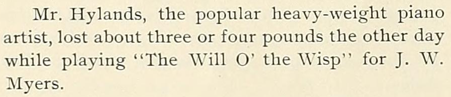
Since that picture just above is of Hylands, it fits the subject of this post to a high degree. 
It would seem that what Jack Stanley told me was true, Walsh did indeed know about Hylands being a pianist and publisher, but not much more, as there was nothing to be done in regards to Hylands when he was researching all these recording stars. As, by the 1960's, when he wrote these articles that mentioned him, most of Hylands' closest relatives were long gone. It was only his nieces and nephews who were still living by 1955 and 1962. His wife was long gone by then, and all those who worked with him were as well(they all died off in the 1930's and 1940's), Billy Murray was the last surviving recording star to have worked with Hylands in Columbia's studio. It's strange to think, but it's true. Walsh mentions Hylands in the context of his publishing firm ventures, as he was following the flow of The Phonoscope editions that mention him, probably just like this: 
(this is some of them in order)
(May, 1898)
(July, 1898 still makes me laugh...)
(also July 1898)
(this goes with that exhibition picture I use so often, which is from September 1898)
(Also September 1898)
(February 1899)
(March, 1899)
(Also March, 1899)


(May, 1900)

And so on, you get the point. Hylands was mentioned in many Phonoscope issues from 1898 to 1900, as he was a first-class character and eccentric at Columbia who rose his way up rather quick, just by becoming a publisher. He had more activity in The Phonoscope than many other famous recording stars did, just look through their issues, and you'll be surprised. 
Walsh noted all of the obvious sections, including all of the ones above, save for that one with the quote that we all know of. I guess it's because Hylands throwing out a narcissistic compliant means nothing to a researcher looking for information on other recording stars.
It's still unfortunate that Walsh didn't bother to dig deeper into Hylands to eventually do an article on him, but as I've said before, Walsh only cared about the singers and performers, not many accompanists made it into his articles, though Banta was mentioned often. Banta was a special case though, and we know why. 
I still wonder if it was a lack of information about Hylands or if it was that the surviving artists who were interviewed speaking of him in a not-so-easy way. It was probably a mix of both, since there weren't many resources out there to find him,  and he already spoke to the last surviving studio stars and workers who would have worked often with Hylands. It's really great to see Hylands mentioned in Walsh's articles anywhere, as it gives this whole Hylands thing much more credibility, as Walsh's writings are the go-to place for information about any of these recording artists. 


Now to change the subject slightly, just as I was writing the post, a very interesting record was sent to me. It's very mysterious, so some analyzing needs to be done to think it through. It's a very strange recording, with no company attached to it, and no performers either. Of course when a cylinder like this comes by, anything is possible! 

Before I dig into it, here's the record:
http://cylinders.library.ucsb.edu/search.php?queryType=@attr+1=1020&num=1&start=1&query=cylinder5303
Very strange indeed. 
There's no information given, so it doesn't help, though from what I can hear, it sounds like an "off-label" Columbia, maybe a pirated one? Now if it's affiliated with Columbia in any way, the Cornetist is probably Tom Clark or David Dana. The Clarinetist is probably William Tuson more than anyone. I am not usually one who can tell tones apart in wind instruments, but that Clarinet playing is definitely Tuson. It sounds like the piano gives away some hints. 
That piano sounds a whole lot like Columbia's awful out-of-tune piano of 1897, of which you can hear examples here: 
http://cylinders.library.ucsb.edu/search.php?queryType=@attr+1=1020&num=1&start=1&query=cylinder5303
(do excuse the home recording, most of what needs to be heard is here.)

http://cylinders.library.ucsb.edu/search.php?queryType=@attr+1=1020&num=1&start=1&query=cylinder7959

http://cylinders.library.ucsb.edu/search.php?queryType=@attr+1=1020&num=1&start=1&query=cylinder9969

As I have said, the cause for the awfully out-of-tune piano likely came from Len Spencer flipping the thing over in earlier 1897, as reported in The Phonoscope
Yep.(from the May, 1897 issue of you know what)
That^^ is why Columbia's piano sounded so damn awful for several months of 1897, thanks Len! 

One of the theories I have about this cylinder is that it was probably a pirated Columbia, or something along those lines, and that it was recorded in one of Columbia's recording rooms at 27th and Broadway. It sounds like it might be that room: 
But! Something about it makes me think it's the inevitable. Their exhibition hall! Seen below:
The room sounds very large and tall, more so than their upstairs room(in the orchestra picture). It be strange to think that this mysterious cylinder was recorded in their exhibition hall, but there's a possibility. I'm not saying that it's a cylinder souvenir from an exhibition(that would be amazing though!), but something's strangely familiar with the sound of that piano paired with that room. 
If more information was listed about it, then I could probably jump to pianist conclusions, but there's no way to do that here. The pianist has the power and heavy hands of Hylands when he played their awful piano early on in his term, but there's no reason it can't be Edward Issler either. Also, it must be noted that the announcer on Tom Clark's "Schubert's Serenade" is the same as on this mystery cylinder. 

**If you have any guesses as to what you think that cylinder is, make comments on this post! I'd love to read your guesses!**


Hope you enjoyed this!