After digging through some information about Burt Green, Ada Jones, and looking back at those 1900 Phonoscope sections, I have found some interesting items. I also looked through much of the issues available online of The New York Clipper, which also allowed for a good bounty of information and interesting advertisements. Of the many things I found about Fred and Etta Hylands, I did not see anything speaking of Hylands' clearly long time and important engagement as Columbia's house pianist from 1897 to c.1904-05. It's very strange how that whole Columbia thing just passed over everyone's heads, though it's clearly where his trouble started, and its effects haunted him for the rest of his life(If you've ever noticed, Hylands weighed the most while working at Columbia...). I guarantee it, if you look up Fred in any of those theatrical magazines, you won't find anything about him being a studio pianist. It's very bizarre, you'll find Frank Banta being known as a "phonograph pianist", but not Hylands. Take this for example:
 (from Professor Bill's website)
"By the consolidated pianist of Phonograph Fame"
Yep, that's what Banta was known for, even to all the big publishers(including Hylands when he became one!). But, wait a moment, there's this here:
 OH! He was on salary! That's right. Durr...
Jeez! Hope you're starting to see why it's very bizarre why you just don't see anything about his commitment to Columbia ANYWHERE. Wow, all the more reason for Jim Walsh to completely avoid writing about Hylands of his perhaps hundreds of fantastic articles. If Walsh was trying to be truly frank with the articles and notes he had, Hylands would have been mentioned hundreds of times. That's only if he mentioned that the pianist accompanied the singer(main subject of the article) was Hylands, and with that, he could have even done one of his specialty biographies on Hylands. That would have saved much of the headache I've had in trying to search around for any scraps of information on Hylands. Even in the November, 1913 issue of The Clipper, where they do a short section on him, there isn't at all any mentioning of the whole Columbia venture:
 This little section was a little important, as it provided the information that most people knew him for. As according to every source in that time(other than The Phonoscope) Hylands was known for being a music director, B. F. Keith's prized pianist(of many they had...), one of the best stage accompanists in vaudeville, and that eccentric vanity publisher(like that they mentioned that...). Nothing about his revolutionary publishing firm with Len Spencer and Harry Yeager, his love and adoration at Columbia, or that he was one of the first popular Rag-Time pianists. Now the fact that they didn't mention the Rag-Time part of Hylands is very surprising, as certainly, by 1913, those earliest Rag pianists were beginning to truly get recognition for the fad they helped begin, which, as we well know, was still on by 1913. Another thing that the section above indicates is that Hylands had been performing in vaudeville since about 1890, which we know is true, but it is indicated that he began as a B. F. Keith pianist, though of course, as expected, they would not dare to mention his lesser contributions that really were obviously the key to his playing style---playing in low-class clubs and saloons.
Some of the other sections I found included many indications of the openings for the shows that Hylands directed and wrote himself. One of these sections included this:

Ha! I have heard conflicting opinions about this show of Fred's. This one is, as seen, a much more positive and kind word to Hylands' fantastic talent with the parody. Two notable names in the above section other than Fred's, there are also the names of J. Grant Gibson, and Marie Hylands. J Grant Gibson was a long-time friend of Fred's from after being thrown out of Columbia and joining the White Rats Union in 1905. Hylands created a friendship with Gibson much like the one he had with Burt Green and Len Spencer back in 1898-1900. It was with Gibson that he began his second-to-last publishing firm, and wrote this piece here:
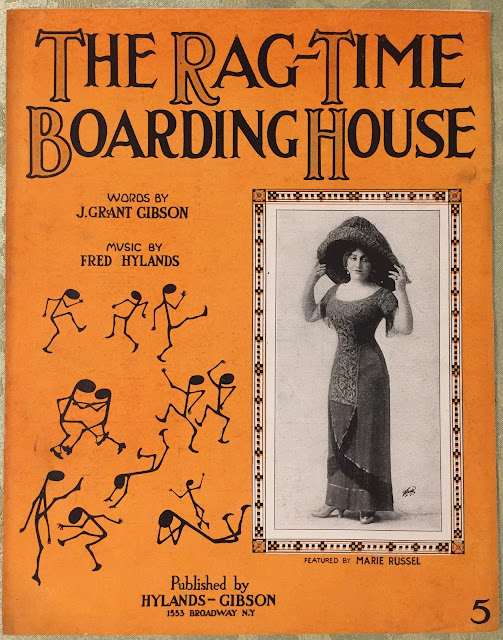
Yes indeed, both Hylands and Gibson were on this sheet music, and it's no coincidence that Hylands chose to write and publish with Gibson over everyone else he knew at that time. The other sections that I found this evening include these here:

 Something odd about these two sections is that they were both featured in the same edition of The Clipper in 1905. That must have brought on the competition factor between the two of them, not that it wasn't already present. These siblings were certainly in the same business at the same time, and this is clearly indicated by these two advertisements here. The other section I found is this one:
 Well, at least the cause of death is indicated, but it's pretty obvious that it was that what killed him. Though, of course, it can be very certainly assume that it was more than just diabetes that killed him. He certainly was some sweet piano man, I can tell you that! Pardon my very morbid pun. Anyhow, these sections were very interesting, and I stumbled upon them when I was just looking for all of those sections about Ben Harney in The Clipper from 1897 to 1900, but like a heap of the wonderful resources out there that we know exist, they are not yet on the Internet, for good researchers and nerds to freak out about.
 (Harney at left and John Biller at right)
Many of those sections included reviews of Harney's acts with his wife Jesse, and even some compared to Mike Bernard's playing where he imitated Harney. Of course, also I bet if someone was to digitize those for everyone to have a chance to see them , we probably would see reviews of shows at Huber's Museum by Ada Jones with piano accompaniment by Burt Green. Burt Green would probably be listed in many of them. And this would even be so in the 1900 issues speaking of the events going on at B. F. Keith's theater, that way, we'd see Hylands listed a whole lot more(as indicated by the section just above). This is also indicated by this section in The Phonoscope from May 1900:
 Yep. That's the one.
That must have been the time that he got the job there the second time. By that I mean that he had been there for at least one season before 1900, as said in one of the other sections here. The Phonoscope indicated in their July, 1898 issue though that he was also pianist at Tony Pastor's theater(probably in late-1896 or early-1897, though no exact date was given) but, Keith's was also indicated in that same section.
Something just came to mind, Edison's talent scouts didn't really get the best of the best when they went out to grab their staff members. Their dynamic was a little different from Columbia's. Edison's scouts hired performers who were somewhat amateur on the stage, and they took them in so they could become big stars. Columbia's dynamic was to stay with the handful of regulars they got, but only hire the best of vaudeville and dramatic performance. Think about it, Arthur Collins pretty much failed as an operetta and minstrel performer before Edison took him in to have him be an announcer for them in 1897. In 1898, Collins became one of the newest big stars of the recording business, one finally to combat Len Spencer's overwhelming monopoly in the area of the "Coon Song". Spencer fleetingly learned of this competition, and probably laughed at how much of a miserable failure Collins had been as a minstrel man, compared to his own extraordinary skills as a salesman and minstrel man. Collins proved him wrong, and Spencer's popularity began to significantly drop by 1906(the same year that he lost the sight in his right eye!). This Edison dynamic can also apply to Frank P. Banta, Byron G. Harlan, Harry MacDonough, and even Edward Meeker. Harlan wasn't really a failure exactly, but he was a very darn good amateur, as many of the early management staff there put it. Most of these Edison artists were under-appreciated before they got hired on to their staff, even someone like Frank P. Banta had the same sort of hard luck in the business, though I think that being Sylvester Ossman's pianist got him some much-deserved status in vaudeville, much earlier on than going off to Chicago to begin his phenomenal orchestra. Banta was no musical director with cute charisma(like Hylands) though.

"By the consolidated pianist of Phonograph Fame"
Yep, that's what Banta was known for, even to all the big publishers(including Hylands when he became one!). But, wait a moment, there's this here:

Jeez! Hope you're starting to see why it's very bizarre why you just don't see anything about his commitment to Columbia ANYWHERE. Wow, all the more reason for Jim Walsh to completely avoid writing about Hylands of his perhaps hundreds of fantastic articles. If Walsh was trying to be truly frank with the articles and notes he had, Hylands would have been mentioned hundreds of times. That's only if he mentioned that the pianist accompanied the singer(main subject of the article) was Hylands, and with that, he could have even done one of his specialty biographies on Hylands. That would have saved much of the headache I've had in trying to search around for any scraps of information on Hylands. Even in the November, 1913 issue of The Clipper, where they do a short section on him, there isn't at all any mentioning of the whole Columbia venture:

Some of the other sections I found included many indications of the openings for the shows that Hylands directed and wrote himself. One of these sections included this:

Heh, imagine him standing on that stage giving a speech to everyone, that's a fantastic thing to picture. Wonder what he said in those speeches...

(from my collection)
Without Len Spencer, that signature decorative footer was no more...

"A cyclone hit", gotta love 1900's slang.


Many of those sections included reviews of Harney's acts with his wife Jesse, and even some compared to Mike Bernard's playing where he imitated Harney. Of course, also I bet if someone was to digitize those for everyone to have a chance to see them , we probably would see reviews of shows at Huber's Museum by Ada Jones with piano accompaniment by Burt Green. Burt Green would probably be listed in many of them. And this would even be so in the 1900 issues speaking of the events going on at B. F. Keith's theater, that way, we'd see Hylands listed a whole lot more(as indicated by the section just above). This is also indicated by this section in The Phonoscope from May 1900:

That must have been the time that he got the job there the second time. By that I mean that he had been there for at least one season before 1900, as said in one of the other sections here. The Phonoscope indicated in their July, 1898 issue though that he was also pianist at Tony Pastor's theater(probably in late-1896 or early-1897, though no exact date was given) but, Keith's was also indicated in that same section.
Something just came to mind, Edison's talent scouts didn't really get the best of the best when they went out to grab their staff members. Their dynamic was a little different from Columbia's. Edison's scouts hired performers who were somewhat amateur on the stage, and they took them in so they could become big stars. Columbia's dynamic was to stay with the handful of regulars they got, but only hire the best of vaudeville and dramatic performance. Think about it, Arthur Collins pretty much failed as an operetta and minstrel performer before Edison took him in to have him be an announcer for them in 1897. In 1898, Collins became one of the newest big stars of the recording business, one finally to combat Len Spencer's overwhelming monopoly in the area of the "Coon Song". Spencer fleetingly learned of this competition, and probably laughed at how much of a miserable failure Collins had been as a minstrel man, compared to his own extraordinary skills as a salesman and minstrel man. Collins proved him wrong, and Spencer's popularity began to significantly drop by 1906(the same year that he lost the sight in his right eye!). This Edison dynamic can also apply to Frank P. Banta, Byron G. Harlan, Harry MacDonough, and even Edward Meeker. Harlan wasn't really a failure exactly, but he was a very darn good amateur, as many of the early management staff there put it. Most of these Edison artists were under-appreciated before they got hired on to their staff, even someone like Frank P. Banta had the same sort of hard luck in the business, though I think that being Sylvester Ossman's pianist got him some much-deserved status in vaudeville, much earlier on than going off to Chicago to begin his phenomenal orchestra. Banta was no musical director with cute charisma(like Hylands) though.
I hope you enjoyed this!

