Monday, July 22, 2019

Musician's Club and the Phono-Cut

Okay, to begin, scratch all of that I said in the last post about the OkeH record I bought recently. After speaking with a few collectors about the record, we have concluded that the speaker at the beginning of that record is Ernest Hare. 

I was wrong, and I apologize for getting any of you especially excited about it. Yes I am a bit disappointed, but that record is still a valuable artifact, as it features a celeste solo by Justin Ring that takes up about 90% of the side. The other side is equally as delightful. The other side features Hager's Concert orchestra, playing another piece by Ring and Hager. 


Anyway, time to move on. 
With the recent access of Hager's scrapbook, I have been really digging into the specific sources that Hager clipped his favorite bits from. This is my first instinct of course, to ask the question, where did this come from? 
And luckily with the help of an accomplished Rag-time researcher, I was able to thumb through one of the major sources that was scattered in bits in Hager's scrapbook. As I flipped through the bits in Hager's scrapbook, I noticed a specific term mentioned, and I had no idea what this was, but obviously I assumed it was something important to return to. 
So, then a respected Rag-Time researcher sent me this link:
So, this opens up a lot of information. This was that very book that Hager saved a lot of his clippings from. It made so much sense as I started flipping through. Hager was one of the major leaders of this inner community of the St. Cecile lodge. If you were to look up Hager's name in this book, he comes up quite often, both as musical director and as an assistant to ceremonies and meetings. Someone else who shows up a fair amount is his sidekick Justin Ring. 
(Ring in 1903, and Hager around 1895)
But that wasn't it! 
I started looking to see who else was mentioned in this book, and lo and behold, there were dozens more of important figures!
Just to name a few:
Frank P. Banta
Vess Ossman
Edward Issler
John W. Bratton(Rag and popular composer)
Ed Horatio King(Eddie King's father)
Percy Wenrich
Thomas Hindley(composer of "patrol comique")
Herbert L. Clarke
Isidore Witmark
Julius Witmark
Jacob Witmark
Nat Mann(Coon song composer)
William Lorraine 
Theodore Pusinelli(Hager's clarinet soloist)
Albert Von Tilzer 
Gus Williams 

So that's only a small fraction of who was mentioned in there. The mentioning of Issler got me intrigued, as I had heard of his significance in musicians' clubs and unions. One of the major times he was mentioned in this book, he is portrayed as a sort of grandmaster of the business and of recording. In a piece dated to 1913, many of the musicians of the lodge went to hold a large party in honor of Edward Issler in Newark. 
For the last few years, my research on Issler has proven him to be a literal hero to all the recording folks who came after him. It would be difficult to think otherwise when you know that he was the first studio musician and an advocate for musicians' rights. So I can safely say now that even in his era, Edward Issler was the oracle of studio recording. Issler's prominence is clear, and it was made clearer by this book. 

So what can we say about all of this? 
Well, it's fascinating to see hard evidence that a lot of these studio workers did indeed know each other outside of their competing studios. It is also interesting to note that Rag composers and band and orchestra members intermingled outside of the studios and publishing houses. This book also illustrates how interconnected these musicians were, and how well folks like Ring and Hager got around to making connections and deals. 
Keep in mind that this was only one community of musicians like this. There were dozens more in NY at this time. When flipping through the index at the end of the book, it can be intriguing to see who isn't mentioned. For example, there were quite a few of Sousa's musicians mentioned as being members if this lodge, but where were Arthur Pryor and Henry Higgins? 
To answer that question, they were members of the Elks lodge. A lot of these musicians were scattered(scattered in close proximity), though it is interesting to note which ones were together in certain communities. 
When I saw the list of members of this lodge, I knew almost immediately that I wouldn't see Hylands or J. Fred Helf. I recall seeing Helf listed as being part of the White rats, and we know the same is true for Hylands. So all of this digging illustrates that all of these musicians knew each other, and those who you think may have known each other and exchanged ideas, probably did. 


Before I move on to the information regarding Phono-Cut, I'd like to mention something on that Columbia band(orchestra) group photo. In the past I have gone on about this photo: 
We know which guy is Justin Ring(most likely) 

After I went back and stared at the picture some more, I noticed that the guy directly to Ring's left looks almost familiar. 
Who is that slightly familiar guy next to Ring? My first guess was Hylands. Well, I know it might seem a bit odd to guess that, but after I did some more staring, it started to look more like Hylands. The pointed out ears, sunken eyes, high cheekbones, distinct nose, bright hair, broad shoulders, and the distinct height difference--it all looks familiar. I can see those very specific slopes of the eyebrows. Up to the time i'm writing this, I have probably spent several hours of time looking at that picture, comparing the clear portraits of Ring and Hylands next to the group photo. And you know what, it is truly amazing to think that they are together in this photo, and right aside each other for that matter. So this makes it pretty solid that Hylands worked for Columbia after 1900. I cannot stress enough how much that looks like Hylands next to Ring there. Now this is a picture we NEED to find a better copy of. There are over a dozen more famous and important studio figures in that picture. Along with my mission to find the rest of Hager's paper materials and record collection, I am making it a mission to find a good copy of this photo, a print would be ideal. 
Just think, in this photo I have already identified Charles Prince, Frank Mazziotta, The Mygrants brothers, and Eddie King is hiding there in the back somewhere. 
Anyway, I will keep looking for a better copy of this important picture. I sure hope that Hylands and Ring are together in that corner. 


Time to move on!
In the last few months, I have been anticipating writing about this topic--Phono-cut records. 
There we go. These were among the earliest vertical cut records to be sold in the United States. Now why do I have such an especial fondness in these? Well, it's actually quite simple--Hager. Hager was one of the founders and directors of this small and short- lived label.
a nice article regarding this topic can be seen here, if you're extra curious! 
https://78records.wordpress.com/tag/phono-cut-78-records/
(I would highly recommend subscribing to this blog if you aren't already!)
This short but effective venture in vertical recordings gripped the recording media from 1910 to 1913, being mentioned all over the place in Talking Machine World and other media. This label was started in 1910 by a Boston Millionaire who invested a big chunk of money in this new independent vertical record company. Hager was called on as the first choice for director and ringmaster for this venture, and with that Hager was brought back into the recording business. It was that year that J. Fred Helf's publishing firm seemed to be winding down a bit, so the timing seemed perfect for Hager to jump at it. As it turns out, this venture allowed Hager to take a lot of suspenseful risks with recording. As Zon-O-Phone was winding down, Hager decided to re-ignite the sentiment and repertoire he had been so dedicated to a decade before. A good example being this one here:
https://www.youtube.com/watch?v=LSNSZPugf-A
And you know Hager is in that orchestra because the moaning violin comes through like a screech. 
Hager brought in performers like Bob Roberts and Collins and Harlan, which is definitely reminiscent of the early days of Zon-O-Phone. 
But why exactly was Hager's work with the Phono-cut so important? 
One of the ongoing stories throughout the 1911-12 editions of Talking Machine World was Hager's episodes with members of the Boston Symphony Orchestra. In 1910, Hager set out to use his symphonic connections and prowess to lure in many prominent members of the BSO to make recordings for the Phono-cut. Clearly it took some convincing, but as the press indicated, he soon became closely acquainted with them. The press made sure to keep up to date on Hager's actions at Phono-cut, which allows for a pretty good chronology of what happened with this unusual label. 
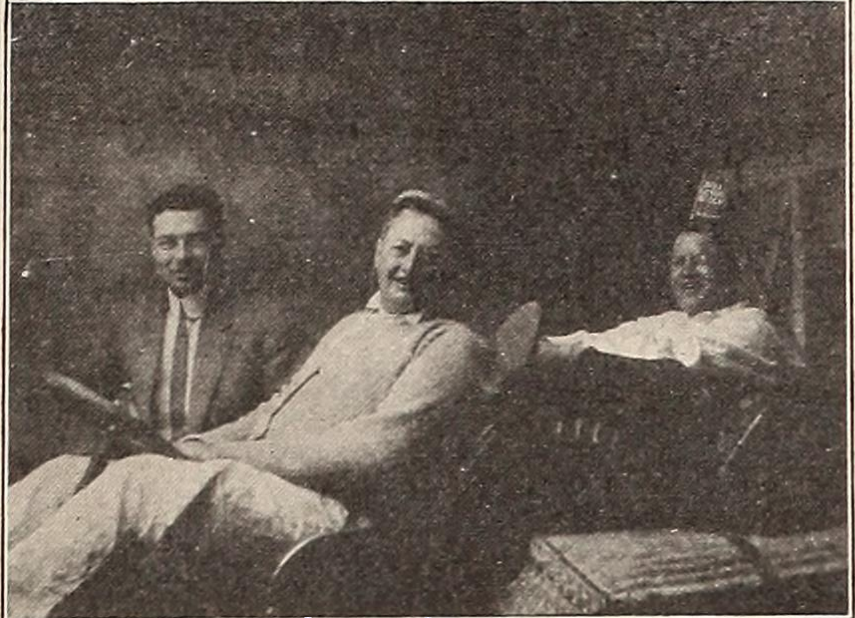
Hager(at center) and two of the Phono-cut fellows, dated 1911 from Talking Machine World. 
 Hager got an oddball group to record for Phono-cut, and they were called the Longy Club. This was no small potatoes, these were the woodwinds of the BSO, and it was the first time this was known to have happened, in terms of issued symphonic recordings(in the US). These records were the entire Longy Club with piano accompaniment. 
(sorry the picture is so small)
(this record is not in my collection, courtesy of a friend)
Furthermore, another place where I found some more hard evidence of Hager's courting of the BSO members, was this odd photo:

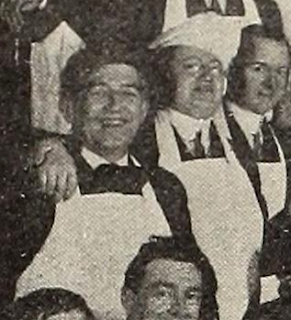
(detail of Hager)
A few of the fellows in this odd photo include Boston Symphony musicians, a few being part of the Longy Club. This photo was featured in Talking Machine World in early 1912. 
Starting in 1911(but probably before that) Hager began hosting these lavish gatherings of phonograph workers at beer garden type places for "beefsteak" parties, and by the end of 1912, Hager was known for these, being the organizer of them. I drew a pair of cartoons to illustrate this odd combination of ideas:
Hager and Georges Longy.
Hager and half of the Longy Club. 
(I used a high resolution print of the group to make sure I rendered everyone accordingly)
Yes indeed, Hager had evolved into something quite different by 1911. 
So I have only heard one of these Longy Club records, but I tell you what, it was fascinating enough to get me started on a secondary research project. I am wondering if any of this connection between Hager and the BSO has been written about in any history books about the BSO and symphonic recordings. As I keep learning more bits about Phono-cut records, I will write about them more in future posts. When I was at ARSC back in May I asked around for any information about the connection between the BSO and Hager at Phono-cut, but got no leads. In spite of that, I have been able to find just enough on this odd label to keep my curiosity peaked. These records did sound good, and they had some very interesting and diverse material recorded on them, with the addition of Hager, what could be better? 


Anyway, that's all I got for now folks. There's a lot more to write about but I don't want to keep going on about unrelated material. I'd rather stick to things that I can pull together in at least a kind of decent manner. 

With that,

Hope you enjoyed this! 

Sunday, July 7, 2019

The studio pianist speaks and more new transfers

In the last week, I got a few interesting items in the mail. I had some issues with Ebay a few months ago, so I spent a bit of a hiatus away from Ebay. The sheet music market proved quite fertile in my time away, as I kept hearing of wonderful pieces of sheet music and records for sale. Nothing soul shaking for me luckily. Nothing like a pristine copy of "The Darkey Volunteer" or "Handsome Harry". 

So, I finally have gotten back into getting things on Ebay, and this last few weeks' items are very interesting. For a little while now, there have been a few postcards from the 1900's featuring song lyrics floating around on Ebay. recently, it was brought to my attention that a few of these cards had a particular publisher's name at the bottom. 
A few of these cards were published by Helf and Hager!
(well yes of course I chose that one)
I had no idea that these were made! Imagine my surprise upon seeing this. So, with this new found knowledge, I am wondering which songs of theirs were used for these cards. Recently I went digging through copyright records to see what oddities could be found, and should keep the eyes peeled for. There were lots of interesting pieces present, including some unexpected names!

To go on a bit of a tangent for a moment, my theory of Hager always having an arranger is closer to being proven. Just from all the digging through copyright records, there seems to have been an arranger for at least 90% of his pieces I have seen so far. I still have more things to dig through to definitively prove this, but it's looking good so far. While on this recent dig, Herbert Clarke made a few appearances as Hager's arranger! That got me curious about Hager's connection with Victor. Thanks to bits of Hager's own scrapbook(I do not own it), he saved a few clippings regarding his special trips to Victor in Spring of 1903. So we know he stuck around at Victor until at least the late fall of 1903, but how connected did he really become with Victor? Maybe when he became a publisher all the record companies jumped at him. His already high status must have been heightened when he became Mr. Helf's secretary. 

Anyway, i hope to snag some more of those Helf and Hager cards. Now that I know they exist, I'll be looking through most piles of old postcards at antique stores until I find another. 


So what's the highlight of the recent finds? Well, it's definitely an OkeH record! Now that I have been studying bits of Hager's personal collection, I have been anxiously searching around for OkeH and Rex records. There's actually a lot of material I find interesting and fit for my collection on OkeH, especially now that I own the physical evidence of Hager's involvement in the field recording projects of 1923 to 1925. So what is this record I got? It's a record I have heard about for awhile actually. Before all the deeper digging into OkeH and such, I saw this record listed and wondered what it would sound like. Well here ya go:
Seems simple enough. 
I had no idea what to expect from this. The performer listed is what is most attractive here, as it is something that is uncommon, though it paints Ring out to be the star. Well, considering my ever growing love for Justin Ring, this record seemed a perfect addition to my collection. 
But holy crap! When I played this thing I just about passed out! I couldn't believe my ears. That voice...the voice at the beginning. It can't be...but it must be! 
The pianist speaks! Yes indeed folks, that is the voice of Justin Ring. 
(Ring in 1903 courtesy of Jason Sanders)
Now this record other than Ring's(quite pleasing I might add) voice at the beginning, isn't too special. Most of it is a celeste solo, which is pleasant, but not outstanding. But of course because this is my collection we're talking about, this record is invaluable. It holds the loud and clear words of Justin Ringleben, a significant rag-time pianist and composer, and important background figure on thousands of recordings. 

So how could this be used in relation to other records? 

The first thing that came to mind was that 1902-ish piano solo on Columbia. You know, that one I highlighted in a post a little while back? 
So after a few more months of studying Zon-O-Phone's and Columbias back and forth, I think I may have unlocked the mystery. When I did the post on this record awhile back I really was thinking the pianist was Hylands. But after more close examination of Hylands' whereabouts and Ring's invariable presence at Columbia, this is seeming more of a confusing mess. The most important thing to note about the 1902 record(0ther than the piano playing) is that announcer. In the post about this Columbia piano solo, I broke down the announcement, word by word, with the dialect dissected. 
Here's the record to refresh the mind of it:
That announcer really stands out. It's not someone recognizable to a collector of Columbia's of this period. It's not Harry Spencer, Joe Belmont, Tom Clark, or Quinn. Now that I have a very clear example of Ring's voice, I have been doing comparisons like mad to try and figure it out. I am really not sure what to say, as the announcer is almost definitely the performer. This has been itching at me or the last few days, as these two records should technically have the same voice at the beginning, but I am really not sure at all. This has been a great source of conflict, now that the perfect example of Ring's voice is in my hands. 

Anyway, if any of you have input about the comparison between the 1902 and the 1922 records, please comment! I'd love to read your input. 


After that OkeH came in the mail, I went searching for more example of Justin Ring's playing on that label. There's a fair amount of it that was issued luckily. The more I dig for them, the more I seem to find. It seems that later in his days in the studios, he became a better accompanist. He evolved, and that's a good thing. His odd sense of time became smoother as times changed. One particular record captured my heart. It's been awhile since I fell in love with a record in such a way, but this one did it. It seemed so generic, but it was heavenly. (I'm learning this is a pattern with the OkeH records I am going after).


Luckily they really had some of the best recording technology there, so the piano comes through astonishingly well. Ring's old sentimental style comes through on this one. Compare with this 1900 Zono:
His sweet playing remained the same, which is nice for me studying his accompaniment style. What's interesting is that his rhythmic playing was still just a little bit out of whack in the early 1920's. Not nearly as eccentric as his early records for the Zon-O-Phone, but the soul is still there. 


Anyway, before I close, I'd like to share another new transfer. This one is another Spencer and Hylands! Yes I have been face deep in Ring and Hager studies, but I still return to the classic Rag-Time pair of Spencer and Hylands when Ring's eccentricities prove too much for me. 
This particular record is an early one for Spencer and Hylands, 1897 in fact. These early ones are the most essential for pinpointing when Hylands began working for Columbia. 
The piano sound is that signature terrible tone of 1897-1898 Columbias. There are some interesting bits the accompanist plays here, including bass heavy inversions of chords in the left hand at the vamps. Naturally, I would assume that in itself to be a Hylands characteristic, and logically it would be, as I have heard him play that often. In my last post I highlighted a 1902-ish take of "the Laughing song" by Johnson, and how the vamps are lumbering, as they were on previous takes by Johnson, and this is similarly present on this 1897 Columbia. 
Here's that 1902-ish Columbia from the last post:
Similar accompaniment style overall. And I am CERTAIN that the pianist is Hylands on that 1902-ish "Whistling Coon". Despite all that I have been learning about Ring and Hager's involvement at Columbia around that time, Hylands was still there occasionally. Of course when that happened he thundered in and pushed aside Ring and Hager with a domineering heave, as they were slowly taking his place. 
Anyway, that 1897Spencer and Hylands is fascinating, even though there isn't a piano solo at the very end. 


Hope you enjoyed this! 


Tuesday, June 18, 2019

The OKeH mystery and new transfers

Well folks, It has been a hell of a month! 
Since my last post, it has been particularly difficult to sit down and write a decent blog post. A lot has happened in terms of research, so much so that it has been difficult to conjure a single thing into a decent write up, so hopefully this post goes somewhat well. If it's more scattered than usual, I do apologize. 


So...
Regarding Hager's collection...with the access to some of it, a whole lot of mysteries have risen. One particular thing has got me at a frustrating cliffhanger. In 1923, as many collectors know, the OKeH boys went out to the south to take on the earliest successful group of field recordings. From this trip there came about the start of the hillbilly record. When you look up these significant field recordings, the sole manager of these you see is a fellow named Ralph Peer. Mr. Peer is a familiar figure in the early jazz world, as he was the one who got King Oliver's first records on the market, and for dozens more things that more collectors of records care about(you know, who cares about records from before 1920?). 

So here's where the conflict begins.  
(Hager, second from left, and the Heinemann's and all, 1920. Notice the GENERAL PHONOGRAPH sign in the background.)

We know about Hager's high management role at OKeH in the 1920's, being the big kahuna(quite literally I might add!) in the studio. His prestige earned him lots of mentions in histories of the OKeH label, from Mamie Smith to Clarence Williams, but what about the Hillbilly records? 
According to every source I have checked, Hager had nothing to do with these field recordings. BUT! Hager's own writing proved otherwise. In some of Hager's writing dated to 1950, he states that he had something to do with these recordings, and more than once I might add. 
He claims that:

"Fred Hager[I], then the recording manager took his[my] recording crew to the South, where he[I] recorded many hillbilly troups..."


But this isn't the narrative that I've been led to believe. Hager a few lines before claimed that Vernon Dalhart's record of "Wreck of of '97" was responsible for the hillbilly record craze. 
And, he says all this more than once, almost as though he knew someone would be reading through his typo-ridden stories(typewritten) decades later. 

So this begs the question, why is it that we can't find Hager associated with these famous recordings anywhere but in his own private writing? 
In my past experiences of cross referencing the words of the stars themselves, oftentimes there are some serious issues. Like for example, Fred Gaisberg's writing. His writing was full of misinformation, so much of it that it took 50 years for a lot of scholars to finally set everything straight. He claimed outrageous things as George W. Johnson getting lynched for his murder trial, and so many more fallacies I won't take the time to list. 
In my experience with researching Hager's own words, he did get things wrong. He mixed things up, reversed orders and names. A good example is a piece that was written in Record Research  in 1973 by Jim Walsh. Walsh quotes a long letter from Hager received decades ago, and Hager went on about the details regarding his association with vertical labels. In this valuable letter, Hager gives a good idea of what the order of succession was, from Phono-cut to OKeH, but since this letter was published, scholars have proven otherwise. 
Hager reversed the order of a few things, and didn't at all consider the interference of the Starr piano company(later Gennett records) that was part of the deal done by Phono-cut, and later Keen-O-phone. Hager also claimed little responsibility for the Keen-O-Phone endeavor, though without doubt we can prove he was part of it somehow. Based on catalogs and supplements from these labels, Hager's words have been proven wrong. 

So there's that issue. Even with this in mind, why would Hager make this up? Why would he restate the matter in his writings(in two different places)? It wasn't really too far removed from the era in which he worked for OKeH, so it wouldn't seem too out of place. But okay, let's say that Hager was part of this trip, he went with Ralph Peer and the boys to the southern states. The thing that I am not comprehending is why didn't Hager mention Mr. Peer? In every source I've dug through so far, Mr. Peer is regarded as the mastermind and director of these trips. With his youth and vigor, Peer would be in the right place to direct these recordings, being a similar age to most of the performers they recorded. 
(OKeH group photo, taken in 1918. Hager is standing at center)
Hager was one of the oldest managers at OKeH in this period, nearly 20 years older than the very hip young Mr. Peer. As progressive minded as Hager was(as I have learned through reading through more of his writing, typewritten and handwritten), he could only go so far. This is why he left OKeH around 1926, but his buddy Justin Ring stuck around till the end. I don't imagine Hager had the means and physical strength to carry along all the way to New Orleans in 1923, but who knows. I'm judging by the fact that he had wildly spent much of his song hit money and ended up looking quite aged beyond his years by 1918(he was only 43 then). 

Something isn't right here. Something is amiss, and I have no idea what it is. Since there are so many collectors of OKeH records of this type out there, I ma hoping some of you can help in solving this tantalizing mystery. 

Why would Hager so fondly write about these field recordings, but is nowhere to be seen in every historical analysis of them? 
Is Hager wrong? Was there some kind of odd conflict? 


Who knows. if any of you can help, I'd be happy to cross reference with you and include any of your findings in a future post. 


Anyway, time to move on! 
UCSB has been quite busy as we know, they have been putting up all these lovely Zon-O-Phones, which have kept my ears busy. It is difficult to choose a few transfers to highlight here, as there are so many good ones to analyze. 
What's good about some of these new transfers is that they have gone back and taken on a lot of records I have been wanting to hear for years. Many really beautiful brownies! 
To begin, I'd like to highlight a new 1897 Columbia transfer. In my ever present research of Hylands, I am always searching for "...New York City" announced Columbias. Columbias from this period are essential for pinning down a more exact date of pianist style changes. These in particular were made in that period that Hylands was supposed to have been first employed by Columbia. This therefore would indicate the beginning of the hottest rag-time piano heard on records of the entire era(1896-1914). So here's the newly added 1897 "Whistling Coon" by George W. Johnson: 
Unfortunately, the piano is quite distant on this particular take. There is only one thing that stands out in the accompaniment here, and it is that one little addition at 1:25. However! I can tell that this pianist is Hylands. Even with so little distinctions, I am so aware of Hylands' accompaniment on this particular song that it's got to be him on this take. Thanks to a c.1902 Columbia take on UCSB's disc site, it's definitely the same pianist, even though the approach is more ragged. Here's the 1902-ish take:

Aren't convinced yet?
 Well, there's an 1898-ish Columbia of "The whistling girl" with that same accompaniment style, particularly that lumbering vamp:
So hopefully you are hearing that this is the same pianist here; one dating from 1897, 1898, and 1902. 
And these dates line up perfectly with my Hylands research. In 1897, 1898, and 1902, Hylands was free to work at Columbia with little outside work keeping him from them. These dates correspond well with his availability. 

The next pair of brownies are by John Yorke AtLee. We all love Mr. AtLee! 
I very much enjoy AtLee's records with Hylands. Something about combining the old world man AtLee with the hot young pansy Hylands makes for some brilliant records. AtLee was used to working with straight-laced Fred Gaisberg, so I always imagine that when AtLee walked into Columbia to see big redheaded Hylands there glaring down through his 'spects he must have been somewhat intimidated. The first record to listen to is their 1898 record of "The Mockingbird", which is almost an exact imitation of AtLee's c.1890 record of it with Gaisberg.
Clearly AtLee wanted to this to sound a specific way, but Hylands couldn't help but cut it ragged. This record illustrates Hylands' brilliant talent for split second improvisation. It is kind of a mess, as he plays a lot of the wrong chord changes at times, but manages to keep a confident swagger in his playing. 
To continue the AtLee and Hylands theme, they recently put up two very different takes of "Marchin thro' Georgia". Here you go:
(the first one is listenable, the second one is so messy I wouldn't try it if your ears are delicate)
It really is a damn shame that these records are so mess, as the first one is absolutely great! The tempo they agreed on is perfect. Hylands' variations on this piece have encouraged me to learn this piece in the way he played it. 
AtLee and Hylands worked oddly well together, even with the 18 year difference between them. 


So to close off, I'd like to leave you with a beautiful(but transferred too fast) take of a Latin piece "Pro Peccatis". This has a rough and heavenly piano sound that was often typical of early Zon-O-Phone's. Their piano sounded like a harp sometimes, particularly when Ring played it(that's who I think the pianist is on this particular record).

I have really built a love for Gogorza's voice recently. I really think he was one of the best singers to record in the 1890's and 1900's. He's up there with J. W. Myers, Silas Leachman, and Joe Belmont. The texture of the piano sound is so intense and precise, in that lovely way Zon-O-Phone records sounded. 
In a future post I will finally explain my recent findings on Ring. I am pretty sure he is the pianist on that Latin Zono based on recent findings regarding him. 

Anyway, 


Hope you enjoyed this! 


Wednesday, May 15, 2019

The Columbia Triangle and a first session

So, I returned from ARSC on Sunday, and there's an awful lot to report on. On the hour and a half flight back from Portland, I wrote eight pages of notes for future reference. Amid these pages, I highlighted a single conversation that I had with Tim Brooks. We spoke a good amount about the logistics of the 1900 to 1904 period at Columbia and Zon-O-Phone, and a few things came to light in this conversation. 

In reference to the last few posts, I recently uncovered from a Jim Walsh article that Hager himself stated that he was the musical director(or a director of some kind) at Columbia from 1900 to 1903. This proves that Hager worked at Columbia for certain, and also proves the cross pollination that happened between Columbia and Zon-O-Phone during this period. 
So what does this mean? Well, luckily I was able to discuss this with Tim Brooks, leading into the discussion with Hylands' role in the Columbia studio around 1900. 
So, Mr. Brooks observed that at Columbia during their early disc making days, oftentimes they would have different recording rooms for the disc takes and a different room for the cylinders. This would have been particularly so during the Climax period(1901-1902). So, this actually makes so much sense! Even if this wasn't necessarily so all the time, it would make sense that they would have different folks managing  the disc than the cylinder market at Columbia. So with the disc stuff at Columbia, this is where Hager fits in. Thanks to the large group portrait of Hager's orchestra, we know for sure that he worked at Columbia sometime in 1900 to 1903. 
So, again this begs the question, what does this mean?
Let's say Hager was the musical director at Columbia in this period, that would mean that his piano accompaniments are somewhere on Columbia in 1900 to 1903. Since this is probably so, this means there's a triangle here. 
The three being Hylands, Hager and Ring. This unusual trio would make up the Columbia piano accompaniments of this period. Well, that's great and all, but it makes the listening portion complicated. Despite the complication, I have noticed there's more than one pianist on Columbia in this period, and one of them was definitely a pianist on Zon-O-Phone in this period. So here's the issue, just as I explained in the previous few posts, I have gone back and listened to many dozens of Zono and Columbia records from this period back to back, and still the same triangle of pianists remains between the 2 companies. Nothing has changed about that, though I am still unsure of which pianist is hager. I know which one is Ring, and which is Hylands, but the Hager style is difficult to pin down. 
I still am leaning toward the idea that the smoother and looser style is Hager's, the one that sounds more directly related to Hylands'. A little while ago I wrote a detailed comparison between Hylands' and Hager's regional styles, and in the end it seems their styles of extraction aren't actually too different from one another. 
Hylands and Hager. 
The last time I compared their composition styles I used Hager's "Handsome Harry" and Hylands' "Darkey Volunteer". The first lines of both pieces are nearly identical. Hager clearly was listening to Hylands' accompaniments, whether it be in person or on the records he was studying. 
Just to refresh the memory of this, here are the two pieces played under the direction of the composers:


Now we know they were in the Columbia studio together for at least 2 years, most likely trading off as the pianist on discs and cylinders. I'm starting to think that Hager was the pianist who played the piccolo like flourishes at the very end of many Columbia records(as well as Zon-O-Phone's). This sort of signature ending was typical of bandleaders of the era, a good example being Arthur Pryor. So here are two good examples that illustrate that flourish at the end, one is a Columbia and the other a Zon-O-Phone:
(this is the Columbia)
(here is the Zon-O-Phone)
That same style is exactly the same as one of the three I've heard on Columbias from the same time, the Zono listed above is astonishingly similar to the Columbia. The rolled chord with the flourish, the likeness is mirrored. Unlike the Ring style, this particular one is more steady and constant, not swung and aggressive like Ring's. 

Well, this is still a work in progress, as it will continue to be until I see some actual ledgers for Columbia or Zon-O-Phone. 


Maybe Hager's scrapbooks and personal papers could hold answers...

Something is happening right now regarding these papers by the way...


Anyway, moving on! While at ARSC last week, I discussed a very important discovery regarding Banta's recording career. Believe it or not, I may have found Banta's very first recording date. Awhile back I wrote a bit on a newspaper article dated to 1893 regarding the new field of recording, which just happened to contain a perfect bit on Banta. So, in the original article from 1893, it stated that Banta had been working in the business for just about a year by then. And so now we have some hard evidence to prove that! 

July 30th, 1892. 

That is the date where Banta's name first shows up in any ledgers. So what were these ledgers exactly? Well, they were payment ledgers, not exactly the solid ledgers with titles and logistics, but it's the closest thing to it. This payment book wasn't necessarily from North American either, it was from the much smaller New York Phonograph company that didn't last to the patent battles of 1895. In these ledgers, it's fascinating to note that the pianists were paid equally and sometimes even more than the performers! Now that's satisfying, knowing the accompanists were paid well(at least in the earliest early days). Ever more unsurprising was who Banta was accompanying at his first session, Dan W. Quinn. Of course! Quinn was so very fond of Banta, so it makes sense that this connection goes back to the very beginning of both their recording careers. I would bet money that Quinn was the reason Banta got into the business in some kind of way. Quinn was a popular vaudeville performer in this period, so he probably came across the young hot Banta somewhere on the vaudeville circuit. 
So maybe it would be helpful to seek out some records of this company, or just that year more generally. If it's possible, it's likely that we could pick out a 22-23 year old Banta on some of Quinn's and Ossman's earliest records. A good start to this search would be looking for some of the earliest records by Quinn and Ossman that survive. The earliest Quinn record I have heard is from 1893, and here it is: 
So i have no idea what the company of this record is, and it's not indicated at the beginning, so who knows, it could be one of those early Quinn-Banta records. I'll have to spend some more time digging for early Quinn records, it's entirely possible to dig up a few of these record he made with Banta, and if they aren't Columbia's it's more likely to be Banta than Gaisberg(or Schweinfest, whoever they had there). Just on this one record though, I caught the clustered chords that mirror the right hand. That's a signature Banta characteristic, heard on hundreds of Edison's and Victors nearly a decade later. So the likelihood of Banta's presence on Quinn's earliest records is VERY likely. 
This is what a single page of ledgers can unfold. 
See how great it is to have ledgers?


I still have a lot to write about from the conversations I had at ARSC, but in this post here I stuck with the things I could easily write on without several hours of searching for. Soon I hope to dig into the Boston Symphony archives to see if I can trace Hager's relationship with the BSO director and musicians in 1911-1912. That search may be opening a can of worms, but if anything becomes of it the opening will be worth it. This is only one more thing that will likely become a project in the near future! I also have been told where to find Victor Herbert's scrapbooks, and searching for those may also open up and sort out a lot of the confusion I have been coming to regarding his mixed relationship with recording companies. So anyway, I'll get to these things in the future after I can spend more time searching around for them. 

I cannot thank the ARSC members enough, who encouraged me to go and helped pay for my trip this year! Had a great time this year and was honored to meet and converse with so many great recording minds. I plan on attending next year's conference, hopefully you will all get to hear my piano playing at the next conference.  


For those of you who get them, look out for my article on Eddie King in The Syncopated Times coming out this month! Much of the writing I did here was pulled together for this piece. 
Hope you enjoyed this! 


Wednesday, May 1, 2019

An Evolution and Mr. Helf

I hate to keep writing posts about Justin Ring, but he is becoming one of the most interesting studio musicians I've searched for. Ring is particularly fascinating because he stayed in the recording business for so long. In the last few weeks, I may have finally proven that Ring was a pianist at Columbia at the end of the brown wax era. Thanks to a single line in a Jim Walsh article, from the mouth of Hager himself, Hager stated that he was the director of the Columbia band and orchestra from 1901 to 1903. That simply means that Ring was certainly there as the orchestra accompanist and arranger. Therefore, Ring was a Columbia pianist. I didn't doubt this before reading up on it, as I was convinced he was in that Columbia orchestra group photo. 
Hager and Ring around 1901-1902. 
So now that we know Ring was a Columbia pianist, what can we do with this information?
Well, thanks to UCSB putting up a lot of Columbia's and Zon-O-Phone's, there's a lot more available for comparison. Since they've put those up, I have been studying these records very closely. Some of the comparisons are actually quite striking. One particular example caught my attention more than others. For years I've been familiar with the dozens of different takes of "The laughing song" by George W. Johnson, but I found a Zono from 1904 that really connects itself to the previous takes I've heard. 
In the past, I have heard these two takes often, particularly the first one listed here:

So these takes are by the same pianist as far as I know. 
So, now that you've heard those, listen to the 1904 Zono of this by Johnson and Justin Ring:
Everything is the same! Even the syncopated improvisation toward the end is copied!
This was especially fascinating to me. Because there's no way now that Ring didn't hear Hylands play the piece in person(or at least from the Columbia records he got from work). Also, it's good to note that on this Zono take, Johnson sings an extra verse that I haven't heard anywhere else. 
With that in mind, I compared a few more records from even earlier with Ring and Hylands accompaniments. Another good example I heard was this Zono from 1900 compared with an 1899 rendition by Quinn of the same song:
I cannot share the Quinn version out of courtesy for the owner, but I assure you, the similarities are striking. 
That distinct busy left hand thing that Ring plays at each chorus(that sounds rather like boogie woogie than early rag-time), is exactly the same as how Hylands played it on the Quinn record. Hylands of course had a better handle on the rhythm, as he played that sort of busy left hand often. Ring tried, and barely got it. 
So, keeping this in mind, it's fascinating to know that we can observe an obvious evolution. Justin Ring went from sounding like Hager and Hylands to something very different in the 1920's. Last week, I visited a collector and he played me an Okeh record from 1929 with Ring's accompaniment clearly listed on the label. Ring was very quiet, but played dynamically. he had clearly moved from his entirely aggressive and pounding style of the 1890's and 1900's. Ring still played those signature flourishes he lifted from Hylands' accompaniments, but in a much more controlled and sweeter way. With no other studio musician can we clearly observe this. This is exactly why I keep writing about Justin Ring, because we can observe him from a rough an tumble Bowery boy to the cultured and matured recording manager of the Okeh studio in the 1920's. 

So, what about Hager?
Just today, I went back and listened to a bunch of Columbia, Zono, and Climax records together. Well, it turns out I may have to backtrack on my original theory about the Zon-O-Phone pianist situation. For a little while I thought that there were two pianists who alternated playing accompaniments on Zon-O-Phone. So, after doing some more analysis(and now that I really know what Ring sounded like), I can see that this theory was actually a better place to be, even though it's more confusing and frustrating for me. 
So, once again I think that the Zon-O-phone pianists were Hager and Ring. 
Since I'm back in this mindset, which one is Hager?
Well, logically, he would have to be that pianist that didn't play nearly as aggressively and more smoothly. So, for example, take this Ring accompaniment record from 1903:
That's definitely the aggressive and swung style that Ring played even as late as 1925. 
But compare that now with a 1900-1901 Zono by Will F. Denny:
The accompaniment is much more straightforward, and the rhythm is much more constant. There are some interesting syncopated rhythms played in there as well, though it's not nearly as adventurous and wild as the signature Ring accompaniments. This accompaniment style is very agreeable, easier to follow, in a way similar to Banta's. It doesn't ruffle the feathers(in a good way) like many of Ring's accompaniments. This style seems very similar to Hager's composition style as well, so luckily that lines up. The sweet and sometimes odd harmonies, and occasional fun risks, these are reminiscent in Hager's pieces.  So, this ought to be applied to other Zon-O-Phone records, and so it shall. 
Luckily as I've heard more Zon-O-Phone's, I have noticed that the aggressive accompaniments are more commonly heard than the smooth and tame ones. Considering which style goes with which name, that actually makes a lot of sense. It's a given that Ring would be playing more accompaniments that Hager. Hager had a family at home, including a brother who was in need of employment, but Ring had nothing to watch over. Just a crappy little apartment below(or a loft above?) a Tin pan alley publisher two blocks away from the  Columbia studio, that's what Ring had to tend to other than work. 

So, now that I can hear plenty more Zon-O-phone records, I'll have to listen carefully to each one in order to know whether the pianist is the aggressive one or the smooth one. Notice that I am not exactly associating either of their names with the style just yet, I am only doing this just to not get too ahead of myself here. I don't want to run into too many issues with this later. Though, I am reverting to my previous analyses on what I assumed to be Hager's accompaniment style. I have returned to thinking that Hager was the better accompanist at Zon-O-Phone. He was that pianist who played on most of the early operatic Zono's, following each singer as though the singer was their own accompanist. Considering Hager's musically educated background, this wouldn't be too surprising to guess. So the educated yet rough accompaniments on Zono most likely were Hager's. With all this Zon-O-Phone research I do need to keep in mind that it has been general knowledge for decades that Hager was a Zon-O-Phone pianist, so I do definitely take that into consideration in this project. 


All-right then! Time to move on to something quite different, but not really. As I started writing this, I just finished doing some digging on J. Fred Helf. I became curious about Helf awhile ago when I noticed that one of his earliest pieces was published in Cincinnati in 1897. I did some digging and learned that he was born in 1872(the same as Hylands, as far as we agree upon now), and grew up in Kentucky(like Ben Harney!). 
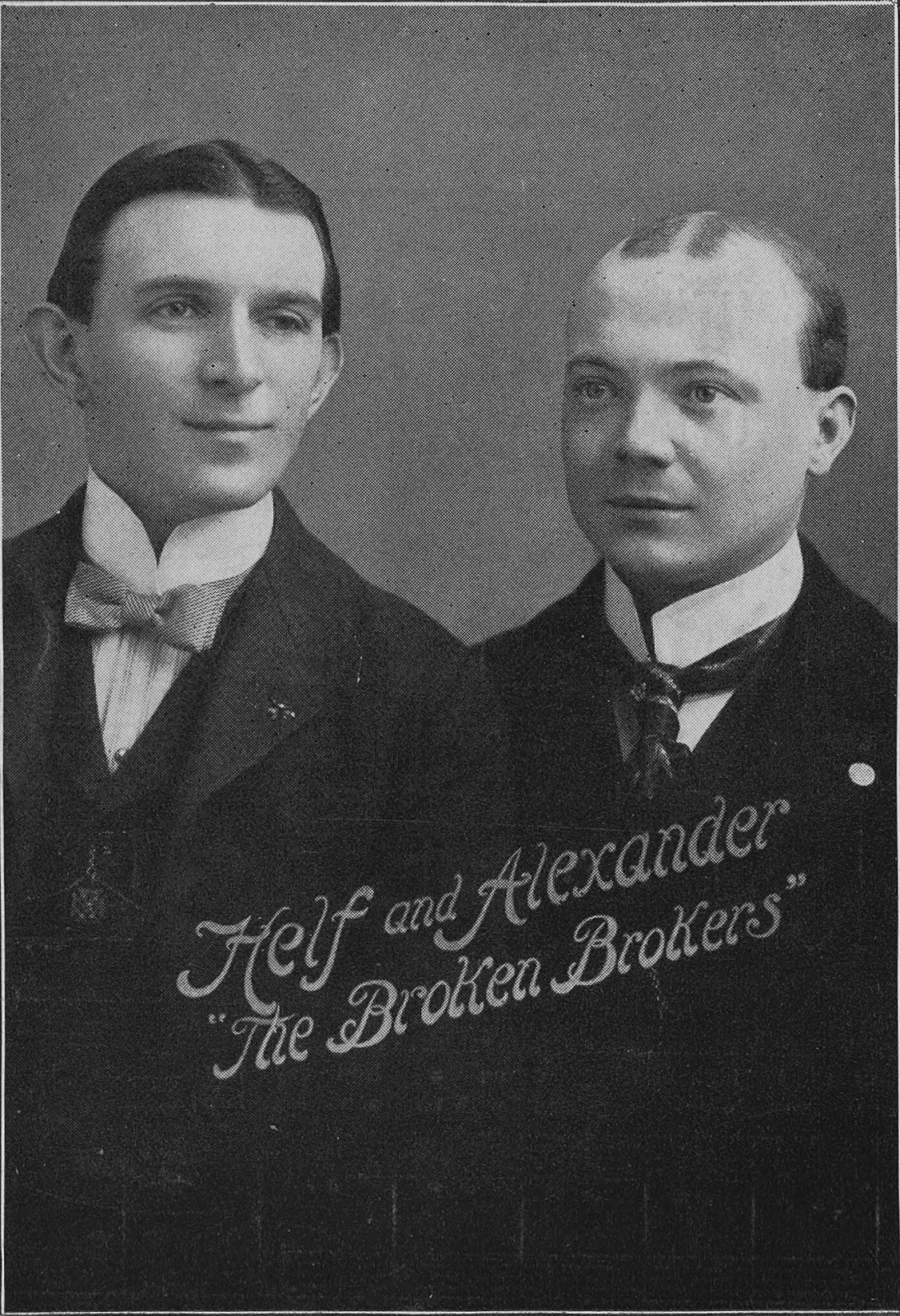
Helf and later recording star George Alexander around 1899. 
So, another interesting this I found is that Helf lived not long, similarly to Hylands. Helf died in 1915 at age 43. That's never a good thing. So, clearly this guy had demons of some kind. That's a funny thing to consider when he wrote so many sweet songs. It makes sense, in all the pictures I've seen of him, he looks like a guy who had to work through some trouble. He looks rough in the same kind of way that Hylands did. 
Unfortunately, I didn't find much more on him just yet. Despite this, I am very interested, and will look for more. 


Before I finish here, I'd like to share a few new transfers of Hager's orchestra. 


Anyway, next week I will be heading to Portland Oregon to attend my first ARSC conference! I am very excited to get going out there, but of course that will probably mean some time off from writing a blog post here. Well, wish me luck!
Hope you enjoyed this!