Sunday, July 10, 2016

Character Studies--Burt Shepard(c.1853-1913)

Burt. Shepard, c.1887-91

It's been a while since I've entered the mysterious realm of Burt Shepard, and since I have had a fascination with him and his records lately, it would seem to be time to finally do a character studies post on him. Not much is known on him, now and even back when he was performing and making records, and this is actually his fault, since he didn't want to talk much when people interviewed him back in the 1900's and 1910's. If he had spoken just a little more a whole lot of the mess of mystery would be nonexistent. He has the same sort of reputation that Silas Leachman has had over the decades. Leachman didn't talk much when reporters asked him personal questions, and had gone almost completely forgotten over the ages and only had a batch of Victor records for few record collectors to know about him. This is exactly the same for Shepard, save for the fact that recently a treasure trove of information has been found on Leachman, and this is still yet to happen for Shepard. Whenever this happens, I want to witness it, and grab everything I can. 

His background and upbringing is completely lost to history, since he refused to speak of it, and no one could get anything appertaining to it anywhere. One thing is for sure, he came from somewhere deep in middle America, as his dialect matches up almost exactly with Byron Harlan's, George Graham's, and even Fred Hylands'. All three of those performers came from different places in the midwest, Kansas, West Virginia, and Indiana. The state specifically where Shepard came from may never be known, but it's not New York or anywhere in the eastern U. S. His exact birthdate is also unknown, as that he also refused to reveal, and the date often given for this is just a logical guess, since he first began performing in a minstrel troupe in c.1874(might be earlier...) that came from New Orleans, which may or may not be an indicator of where he came from. From there, but the late-1870's, he was performing in women's clothing, doing singing and minstrel acts and gaining a reputation as a prime female impersonator. In this, I believe there's a photo of him from the same page as the picture above that looks like him almost certainly:
Really do a comparison, and you'll see why I think it's him. (that would mean that there was a typo in the book that this came from...)

This picture just above might either be from the early-1890's, or it's a much earlier image of him from the mid-1870's. The hairstyle looks like the 1870's, as well as the strange choker-necklace thing was a popular style of the mid-1870's. Hmm, after doing some good studying, I think this picture is from around 1875, according to the neckline of the dress, the hairstyle, and the weird choker thing. Really go and study fashion plates from that time, you'll see exactly why I have concluded 1875 as the date here. 

Anyway, with this talent, he became a popular minstrel show "middle man" who would, by tradition, not be in blackface. He did perform in blackface as well, and often did parodies of popular songs, that he created. This tradition of song parodies lasted and was luckily able to be caught on recordings in 1901 and 1902, which included his parodies of "Home Sweet Home", "The Swanee River" and even "The Honeysuckle and the Bee" which were all fantastic examples of vaudeville. By the late-1890's he was performing all over the world, performing in England, Paris, Australia, and even South Africa as well. By 1901, he was in the U.S. once more, performing his popular song parodies, doing general vaudeville, and of course, making records! Much of how people know him comes from these hundred or so Victor records from 1901 to 1906, which included many popular British songs that American artists had not yet recorded. Many songs he recorded were also ones that he made up his own lyrics that were parodies all themselves without being labelled as such. 
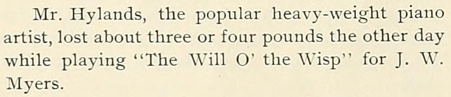
He went back for the crowds of London by 1912, and remained there until he died the next year. In the final time he was in England, he made a few recordings for Victor that was set up ten years before by Russell Hunting. After that, his name and reputation slowly faded off, with only those Victors to truly remember him and hear why he was so highly praised. His personality came through on his recordings, as the few surviving accounts describing him match much of the character that leaks into many of his famous Victor recordings. He was a similar figure to Fred Hylands in appearance, save for being well over six feet tall, Shepard was not Hylands height, but the weight and overall proportions appear to be the same. He was known by the studio pianists of the early days to have been a jolly and kind man, though sometimes complicated and indirect. His likable personality earned him many friends in the business, and didn't keep new people from him. 

It's unfortunate that almost none of the basic information on him is lost to history, as it we knew more about him, he's probably more complicated than we could ever have fathomed. 


Hope you enjoyed this! 


The Zon-O-Phone and Berliner Dilemma

It has been established before on this blog that the hardest recordings for pianist identification happens to be Zon-O-Phone records and Berliners, as they were the least known of as far as ledgers go, and they didn't bother to offer some of the best identification on their labels sometimes(this is more so with Zon-O-Phones). Berliner at least tried to make an effort to make their labels clear with all the ledger information that we all was to know, like specific dates, take numbers, the singer or performer, and the accompanist on the rarest occasion. Zon-O-phone's sometime were lacking in many of these, sometimes even the identification of the singer or performer. Oftentimes, they would just say "Banjo solo", or "Baritone". It doesn't at all help when that is all that's given. Since I have been listening to more Zono's lately, I have been able to find that the etched label ones are the harder to tell with the piano accompaniment. I had hypothesized that before, but now I have really started to notice it. 

The etched Zono's are harder to tell because they more often had varying pianists on them, which makes for always interesting listening, but more problems when trying to listen for a certain piano style. More styles are being thrown at the listener when digging through etched Zono's. It's not the same three pianists that we hear most often on Edison and Columbia. We can hear them on Zon-O-phone's though, you just have to find which ones. 

Most etched Zono's I've heard have pianists that are either Frank P. Banta, or have a similar style to his, which makes sense, since Hylands was working regularly at Columbia from 1900 to late-1901. As I have been hearing though, there are anomalies. I heard one that is an etched label Zono that clearly has Hylands on piano, as it has pretty much all of his stylings, from the walking octaves in the bass, to the sneaked fifths in the left hand. It really is strange to hear Hylands on an etched Zon-O-phone though, but it does make sense. 


Whomever was running Zon-O-phone from their beginning to 1903 really must have been all-right with anything from the pianists, since they really did play some of the best and most wild Rag-Time that was recorded in the second half of the piano accompaniment era. Columbia's late brown waxes cannot even top the amount of phenomenal examples of Rag-Time from Zon-O-phone records from 1901-1904. Even the band and orchestra Rag-Time was exceptional, since this chap was running their house orchestras:
youngster Fred Hager.
(from the September, 1898 issue of The Phonoscope)

Hager was an extraordinary bandleader, and remained in the business longer than any of his late-1890's colleagues. Since he was part of the "Rag-Time Generation", he understood the style of music very well, and this is why the recordings by his orchestra are almost always guaranteed to be good, especially the Rag-Time. He wasn't the one running that studio though, allowing that wild Rag-Time piano accompaniment to pass. Whatever manager that was at Zon-O-phone, they were just as up-to-date as Russell Hunting was in 1916! Along these lines, it would seem that Zon-O-phone had more of an "anything goes" type of atmosphere than Columbia did in 1899! That is really saying a lot in this case. 

One we get to 1902, the piano accompaniment is not as confusing on these Zono's. That is because we begin to hear a more distinctly and familiar style, one that is not from Banta, Issler, Bachmann or C.H. Booth. It's Hylands this time. I have explained before why Hylands was more frequently in Zon-O-phone's studio. I will go through it once more to clearly tie this together. 


In early 1902, Hylands had grown far too cross with the Columbia management, even if he had been this way since 1898 something must have made him snap one of these days. It took until early 1902 for him to become vocal about beginning a union. So that's exactly what he did, he began this union around March of that year, and the Columbia management were furious about this, and in their anger they told him to leave for a short while until this fire burnt out. While he was infrequently working for Columbia, he went to Zon-O-phone where they had welcomed him before, but this time it was for a more desperate matter. They took it to enjoy Hylands in their studio, as he was much more interesting than Banta was before. To their amusement, he was interesting both in his playing, and in his behavior that varied from day to day, so it was certainly a mirthful few months for studio workers there. During this period, we are given the most amazing examples of piano Rag-Time accompaniment, just as good as those late-1890's Columbia cylinders, well, since they're by the same pianist it helps. Just goes to show you that when those theater managers said Hylands was one of the best accompanists of the day, they really meant it. 
This period sparked by discontent gave us records such as these here: 
https://www.youtube.com/watch?v=TEI6K0esFj4

https://ia802300.us.archive.org/31/items/ArthurCollins_part2/ArthurCollins-TheManWhoPlayedtheTamborin.mp3

The piano accompaniment on these is phenomenal. Both of these recordings have Hylands playing the accompaniment, playing all sorts of his usual tricks that can easily be heard on Columbia records from the same time and a little bit before then as well. 

Of course, like everything Hylands got his hands into, it failed within two months, so the union thing didn't last, and he understood very well that it didn't work and was destined to from the start. Even after the union bust, he still worked for Zon-O-phone and Columbia, as he can be heard in 1903 still playing there behind Collins, Ossman, Denny, and everyone else that was featured there. 
There are still plenty of amazing Zon-O-phone's from 1902-04 with piano accompaniment that I have yet to hear, but after hearing some more lately, it is becoming ever more complicated with every new one I hear. 


Hope you enjoyed this! 


Tuesday, July 5, 2016

New Findings, exhibitions, and strange sheet music

Yes, it has been ten days since my last post, and this time, I have not been out on another music festival adventure, which usually a long hiatus such as this would indicate. It has been a time of learning new things from those of whom I spoke in my last post, though I will keep them anonymous still. One of the findings included information about the notebook that once belonged to this chap: 
Yes indeed, Len Spencer. 
I have spoken very highly and often of his notebook that is held at the Library of Congress, and still have yet to actually hold the thing in my hands. As far as I have heard of the "sacred" contents of this notebook, it would seem that it really was a piece of ledgers from late-1890's Columbia! It would seem that there are many record numbers listed in there, such as no. 7487, which happens to be his recording of "My Hannah Lady" from 1900 on Columbia. 

So, since that record is listed, that would mean that this notebook's timeframe literally splits right in the middle of his time working with Hylands at Hylands Spencer and Yeager. It was written in at a perfect time for Spencer! Not everything was told to me of course, as there's no way everything could be explained to me at one time, the only way to know that would be to actually sit down and read through it. Though I was told that most of it was written in ink pen with a thin and sharp nib, in that beautiful script that he practically created(to some extent).  
The one that we al recognise from the world-famous "Coke" logo, that is just like this: 
and this: 
Indeed, these works of art were just nicer versions of how the man wrote normally. I have more examples of Spencer's not-as-formal writing, and they aren't in pen either, but those cannot be shared just yet. Even without more examples, you get the point. All of the writing in that notebook looks like the examples just above. Once I hear more of what the contents of the notebook are, I will get to it and figure out more about it. What has been said so far is a good sign, and says that this notebook is not useless by any means. Some friends of mine a while back said that this notebook might be useless to recording information and might have nothing to to with Spencer's popular Columbia's from 1898-1900, but they were very wrong. 

Since yesterday was the 4th of July, I dressed like a familiar face...
That lady Columbia on their boxes! 

That be correct. It actually looked great for once, since it was a last minute decision. I looked like an exhibition piece from them in July of 1898!

 Speaking of exhibition piece, they must have had an immense gathering on July 4 of that year, since that was right in the middle of the period where the exhibitions were happening every night at their first floor hall. It was in the summer of 1898 that these exhibitions were a popular Broadway spectacle, with July through September being the most eventful of the months. Their July 4th exhibition(which was on a Monday night just like this year), must have not only had a feast for everyone, but also had some of the daring and confident young ones of the staff lighting off the fireworks out in the street, at a moment where no street cars were rushing down Broadway. Of course those lighting off the rockets would be the Spencer's, Roger Harding, Russell Hunting(who was still living in the U. S. at the time), Steve Porter, and probably Fred Hylands also among other familiar faces. We have seen how well-decorated their hall was in September 1898: 
but try to think of how extraordinary that room would have looked just fully two months before this picture...
It must have been an absolute zoo there on that night. How much fun it must have been! Master Easton and Vic Emerson probably came to witness it for once, since they never came to the exhibitions for some reason(even if they were the ones who decided to do this). 

The final thing I would like to discuss is a piece of music that I got in the mail last week or so, written by a familiar pianist mentioned often here...
Wow! What a cover! 

It did help that all of the covers on Hylands' music were unique and eye-catching... 

Yep, that's Hylands' 1912 composition, "The Lightning Rag". The first thing that made me slightly sad is the fact that the first thing under Hylands' name was guess what?
"You Don't Stop the World from Going 'Round"

That song was 13 years old by that time! Whew, they could have at least acknowledged that he was a Broadway show performer, or something between 1899 and 1911. Hmm, that was very strange to me, I guess that that tune of his really was popular, as much as they had described in The Phonoscope, as not everything in that magazine is completely true, or at least after Russell Hunting left them in November 1898, and as we know, everything on Hylands Spencer and Yeager came after that. This music was not published by Hylands' second-to-last vanity firm, which is what I was expecting, which might indicate that his "The Rag-Time Boardinghouse" came a little bit later in 1912. There were many interesting little things buried on the sheets once I got it open, but once I looked at the back, I found a little something strange:

What! Really? No foolin! 

That was unexpected. I didn't look at the advertisements on the back page until several days after I got the music for some reason, but how I was in for a surprise. I had not seem any written music of Etta's before, and was hoping to from the kind descendants of hers, but had not until last week. Of course, it's not a piece of Rag-Time for good comparison to her brother's, which really would be great though. Another thing to notice here is the fact that the publisher at the bottom states "Hylands and Hylands", which is fantastic. That can only be the siblings in this case, since Etta didn't know about being a publisher, and Fred had experience in the business(not the best one could get however).  It's just strange to see the two of them doing anything together, but apparently, it did happen! 

*This music is for you Ali and Anna!*


Hope you enjoyed this! Sorry about posting for so many days, hopefully there won't be as much of a break before my next post. 


Saturday, June 25, 2016

Organizing some of this pianist mess(or re-doing a guide to early studio pianists...)

Much of what I have said about all of those earliest studio accompanists on this blog are things that come directly from the recordings, and are based on their backgrounds, and more than half the time, these unfortunate artists are never mentioned in catalogs. It really is like untangling a huge ball of string, that will perhaps never be untangled completely. How frustrating this whole thing is... I cannot best express how much of a headache this entire studio pianist venture has become, and Columbia's lost/destroyed ledgers really don't help at all in this. Sigh...

 I have been advised to try and put together a list of four recordings for each of these pianists' styles, and I ought to think that the easiest and clearest place to start would be proving the studio term of Frank P. Banta. 

This picture came from an obituary of Banta in a newspaper from 1903. 

Banta at Edison's studio piano in 1902. 
The only reason that Banta is easier to pinpoint as a definite studio pianist is because he was mentioned later by many studio stars as an accompanist, and also that he was famous for his transcribed solo of "Violets". It also helps that he was in that picture of the 42 Edison recording stars from 1900:
here's a closeup of Banta:
No. 35 he is. Love that look on his face! 

Now that in itself secures the fact that Banta worked for Edison, seeing him in that picture has higher advantages than a catalog(it helps that he was very distinct-looking in this case...). 
Now as for identifying his style, which is the hard part. 
Banta's musical background has been debated over the last eighty or so years, and even back in the era in which he lived there were conflicting statements, and misleading connotations. One source(one of those who worked with Banta), claimed that he was self-taught and learned from a very young age. Whereas another source stated that he was very well-taught and learned theory, tuning, and sight-reading. One thing is true however from these claims, Banta had perfect pitch, and was able to play anything be ear, as several sources, including Dan Quinn's Walsh letters, stated that he was able to play something right off the spot if someone threw a title at him, as long as he had heard the song before(which, being a studio pianist, he certainly would have).To give Quinn's letters more credibility, he named his youngest son after Banta, and he worked with Banta the most at Edison in 1899-1902, from that, he certainly recalled those times with Banta fondly and full of detail. Banta was mentioned in a handful of catalogs from 1899 to 1903, since he made a few piano solos in that time, one being "Hello Ma Baby", and another being "Violets", though sadly, the latter was much more popular and common. That is very helpful in trying to figure out Banta's recording activity. 

Picking four recordings that illustrate Banta's style are hard to some extent, as he was reported to be on a few labels, and was liked by many recording stars, so he's behind many studio stars. It's not at all biased with Banta, unlike Hylands at some points...
The first one that I have here is 1901 Edison cylinder with Arthur Collins. It's a recording that has caused some buzz in the record collecting community for the Rag-Time piano accompaniment so early on. Here's "Lam Lam Lam" by Arthur Collins. It's a rather early example of Rag-Time, still with all sorts of tricks that were lost as the Rag-Time era went forth. The one trait in this piano accompaniment that really is distinct is that rollicking and rhythmically even improvisations in the right hand, also the choice of chords in the left hand rhythm. There are also some strange rolled octaves that can be heard at about 2:06 that was distinct about many Victors(that Banta also worked for, according to some of their ledgers). The improvisations are very easy to understand and are not out of the rhythm at all, unlike some Columbia's from the same time period. 

The next recording is Silas Leachman's famous recording of Ben Harney's "Mr. Johnson Turn Me Loose" form 1901. This is not only a fantastic early recording of Rag-Time, but it's also one of the best examples of Banta's Rag-Time style. It has pretty much everything that was distinct about those Edison cylinders, the gradual speeding up, improvisations free of mistakes, steady kept time, and the ending chord with the fifth. One item that came along with Banta's Rag-Time was a more "dotted" syncopation, which, if you know anything about music theory, means that it's very slightly syncopated and at times sounds a bit stiff and old-fashioned. It makes sense that this is so according to Banta's obviously trained background, and the fact that he grew up in New York, not anywhere in the midwest or far out in the Western states.  

This next one is an earlier example of Banta's style, which is still comparable to the other two above, even though the style is much more "dotted" and old-fashioned, yet still syncopated to some extent. Here's Billy Golden's 1897 Edison take of "Turkey in the Straw". It's a much more old-fashioned sound, but it's also got Ragged playing in there, which is dotted and stiff much like the playing on the other examples above, also, there are also some hidden and hard-to hear fifths in there, including one at 1:32-33, and also are audible occasionally throughout. Also, the record is ended with that same fifth and chord that the others had. This take is almost identical to Golden's 1903 re-recording of this on Edison as well. 

The last one I have in my immediate reach at the moment is a recording with Will F. Denny on Edison. Here's Denny's "Go 'Way Back and Sit Down" from 1901. This recording is also a great piece of Rag-Time by in many respects, and it has many of those lost traits that were on the recording of "Mister Johnson Turn Me Loose", some of those fifths, and stiffness. Banta was able to play pretty loosely by 1902 and 1903(take the later recording of "Medley of Coon Songs" with Golden for example), but earlier on, was getting used to the Rag-Time feel, though he really did have it in him, as we can hear recordings like these listed here that are great pieces of Rag-Time regardless of the stiffness. The stiffness could not easily be noticed by someone not really listening closely, as it's pretty easy to miss most of the time. 

The fifths paired with "dotted" syncopation are really what distinguish Banta's playing, and they are not just heard on Edison's, as he's in that picture for proof, they are also heard on many Victors from the same time as well. There are other recordings made for Edison and Victor that would be good examples, but these main four are what I will stick with for now. This style would definitely suit Banta for his background, regardless of the fact that he was trained or not, it fits him for the place that he grew up, and that he came into the Rag-Time fad later, he was no pioneer in this matter, even if he worked with Vess Ossman before he was a regular recording artist. 


Now for Fred. Hylands.
Hylands posed with the Columbia orchestra, at the piano in Columbia's "big room" in  mid-1898. 


Hylands in Columbia's exhibition room in August-September 1898. 

Hylands is still a controversial figure with pianist identification, as I still haven't been able to prove myself of my theory that Hylands was at Columbia for longer than just the entirety of 1898.  It's hard to know about Hylands, as the only suspicion that got my interest sparked in him was the amount of times he was mentioned in The Phonoscope, as that's where the two pictures above came from(he's not identified in the first one, but as we can see, it's most certainly the same figure, just one image has him with more stately posture). 

This character's background says everything about his style. He's a fascinating character, which is of much contrast to Banta. He was born in Indiana, and raised in Indiana as well. His first instrument was the fiddle, and he began to play the thing at about the age of 10, learning who knows what when be began. It's likely, considering his location, that he was playing old songs from the Appalachians and even precursors to Rag-Time. By age 12, he was beginning to play piano, and learning how to rather quick, possibly being self-taught in reading music. Not long after he began at the piano, his parents took notice of Fred's and Etta's talent, and decided to have them become performers. They traveled around the Fort Wayne area, and occasionally went into northwestern Ohio. By 1887, Fred was working alongside his father at a grocery store/saloon, as well as playing some music there on occasion. In 1893, he and the family moved out to Chicago for the world's fair, and after the fair, they remained there for a few more years. Almost as soon as Fred got there, he was working in local vaudeville houses, and learning the newest underground fad of the "rag", or in those days called "jig-piano". He learned from the best, watching Ben R. Harney play, black professors who came to the fair, and other well-known pianists in the local saloon communities. By 1896, he was becoming known as a "Rag" pianist by playing syncopated music, as his earliest published piece was from 1896 and it already anticipated the big "rag time" fad soon to come with strange melodic improvisations and syncopated rhythms. in early 1897, he was out in New York performing at various theaters on 14th street, and earning his fame as a music director and and authentic "rag time" professor from Chicago.  it took until the middle of 1897 for local record companies to decide that they needed a new pianist, in this case, especially Columbia.  
Around September 1897, Hylands was beginning to be used as a substitute pianist in their studio, as by the end of 1897, much more often very ragged and "hot" playing can be heard on their records, in a style that is the polar opposite to the pianists there before. 

Picking four recordings with the style described in the section above is a little more complicated than picking some for Banta's style, because there are many more examples of the unique style from late-1897 to as late as 1905. 

The first example is a record by George W. Johnson from early or mid 1898. It has one of the most ragged accompaniments I have ever heard on any brown wax cylinder, and it has some even more strange distinctions adding on to the uniform syncopation. Here's one of Johnson's many takes of "The Laughing Song" from 1898. The playing on this very unique, and it's very much different in feel and syncopation style than the previous style exhibited, and it sounds much more natural and not stiff at all, unlike the last ones. It's got many distinctly characteristics, such as the syncopation pattern throughout the record, and at the very end, also the bass pattern in the solo after the first chorus, which is something I have only heard on Columbia records. The main thing to take away from the style on this is that there is not only heavily syncopated improvisations here, but also the one quick bass thing at 0:59-1:00 or so, that little attribute is very important to this style. 

This next one is a popular take by Billy Golden from 1899, a year after the last one. Here's Billy Golden's 1899 take of "Turkey in the Straw". Now the first thing to be said here is that it's a dramatic contrast to the 1897 take of this by Golden on Edison. The first thing to note is that same syncopation that was on the last one, the same natural "feel", and those bass patterns(and lots of them...). This record most certainly has the same pianist on it as the last one, and they were recorded pretty far away from each other date wise. Another important attribute to this style is the walking broken octaves, which is very strange to hear, but was played often in this style heard on Columbia records from this time. Those walking bass octaves are heard several times on this Golden recording. That ending pattern is also something that is heard only on Columbia's, as it can be heard at the end of this 1903 record here, and the walking bass octaves can be heard at about 1:08 on this 1905 record here. All of these are also in that same style, just configured a little differently, but with the same distinctions. 
This next recording is a fantastic rarity by J. R. Johnson and Bob Cole, who were members of the "Frogs" Club, which included Jim Europe, Bert Williams, and George Walker. This one is actually two takes recorded on the same day in 1902. Here's one of the takes, and then for the other one. There are so many strange things in the piano accompaniment on these records, but most of the same attributes from earlier are present on these takes. One thing that is heard often on both of these takes that I did not mention is the swift trills of thirty-second notes in the intro and in the first verse. This attribute was also part of this style that was on Columbia records, you might have already heard it on the records just above, as every one of these records has it somewhere, such as this Cal Stewart rarity from 1905(it's the fourth thing listed on the page). This Collins record shows off all of the walking bass octaves that could fit in every place, much like this 1899 record here(music begins at 6 minutes...). The mix of "dotted" notes with very syncopated notes is also part of this style as well, and these two Collins takes exhibit it in perfect harmony. 

This final one is actually a Zon-O-phone from early 1903, also by Collins. Here's his Zon-O-phone of "Bill Bailey". This record almost exhibits every thing that was explained in the records above, but it gets one aspect across that very few of these other ones did. This one shows off the "feel" that I mean better than any of these records so far. This record exhibits many Columbia pianist specific traits, especially the syncopation, which is pretty much identical rhythmically to that of this 1898 cylinder here, and also at the solos on this 1901 record here, as well as most of the other records in this section listed. That quick run of right hand octaves beginning at the second chorus at 1:30 is also the same thing as some of the improvisations on this 1902 record here. 


You may have noticed that I did not at all use Hylands' name in any of these examples and explanations. The only reason I did that is to save all of that for this section of the evidence. I now have to tie the style to Hylands in a logistical way. Do all of these attributes match the background that Hylands had?

Yes. 

Why? Well, if you know anything about how the earliest published rags were written, you might have noticed that all of the composers of these tunes came from Chicago for the most part, Kentucky, Ohio, or Indiana. 
Just for full proof of the similarity, here are some examples:
 Max Hoffman's "Rag Medley" of 1897

Ben Harney's "Mister Johnson Turn Me Loose" from 1896

Max Hoffman's "Ragtown Rags" from 1898 

I know this is a lot later, but it's from rural Indiana, and it's in the same style, "The Stop Rag" from 1913.

Theodore Northrup's "Louisiana Rag" from 1896(published in Chicago in 1897)

Robert S. Roberts' "A Bundle of Rags" from 1897(published in Ohio!)
(this one even has the rare added bonus of left hand melodies like from the records!)

Robert S. Roberts' "Pride of Bucktown" from 1897

even really early Rag pieces exhibit this style to a high extent, such as:
Carl Lexhoizt's "The Ebony Funeral" from 1894
and even
F. Neddermeyer's "Opelika Cake Walk" from 1892


All of these published Rags exhibit much of the style that I spoke of above, and with the background Hylands had, that style would almost certainly be his. If you're looking for a published composer of early rags that has a writing style the most similar to Hylands' style, Max Hoffman is one, Ben Harney is another and actually, Robert S. Roberts is the closest to Hylands' style as far as I have come with this. His "Bundle of Rags" is very very accurate to Hylands' style on late-1890's Columbia records. This style of Rags did not last very far into the 20th century sadly, as by 1905-1906(with a few exceptions like "Pickles and Peppers" and others) that very syncopated and playful style began to fade, and didn't last throughout the rest of the Rag-Time era. 


To many scholars I have spoken with, this style of playing(Banta's and especially Hylands') is a much more real representation of Rag-Time, and what it was actually supposed to sound like. You may disagree with me you Joplin lovers, but only Joplin's early works were in this style in any sort of way, but as time went onward, that began to fade away from his compositions. 

I will soon do a post on Edward Issler's style and Gaisberg's as well, but I will have to do more studying of their playing and backgrounds in order for that to happen...


Hope you enjoyed this! 


Wednesday, June 22, 2016

Irony of Dan Quinn and more record slip observations

Sorry it's been a few days, I've been dealing with some important doings within the last week, and I cannot really share everything with everyone. Eventually, I'll be able to spread the treasure trove of information I have gathered over the last few days. The time will come. 

Anyway, within these eventful few days, I have listened to some fascinating recordings, none of which I will share just yet, but I will say some of the strange things I observed from these records. One of these things is the irony that surrounds Dan W. Quinn's notorious repertoire. 
We know of Quinn being the one who recorded "Glorious Beer", and "The Streets of Cairo", which were romping popular songs of the mid and late-1890's. If you know anything about the "Midway" at the Chicago world's fair of 1893, you certainly have heard of the "Hoochie Coochie" craze that originated from this affair. It was a scandalous dance that imitated popular dances of the middle east, and was danced originally at the fair by authentic Arabian dancers. As expected somewhat, the song "Streets of Cairo" was about a country girl going out to the place out in Coney Island with the same name. This song also popularized that "oriental" motif in music that is still often used not so politically correct nowadays in reference to Egyptian or middle eastern context. This motif I mean can be heard on this 1898 cylinder here, toward the end.
Now to further this "Streets of Cairo" tune, the lyrics to the second verse are really interesting: 

She was engaged,
as a picture for to pose.
To appear each night,
in abbreviated clothes.
All the dudes were in a flurrie, 
for to catch her they did hurry.
One who caught her now is sorry,
poor little maid. 

The song in its entirety is really great, especially since it's pretty raunchy for 1895, similar to Russell Hunting's sense of humor from the same time! 

Now for the irony. We know of Dan Quinn:
Yes indeed. 
Quinn was part of the "Columbia Clan" in the late-1890's, though he must have had some shame in being part of this group's despicable doings of 1899 and 1900. Of that we know is true, as he certainly would have denied that sort of thing if he was asked about it, according to what he said to Jim Walsh in his letters. The irony of Quinn is that he was a devout Christian, yet he followed the crowd at Columbia who went against most of his good beliefs. The most ironic of these being that he was a strong member of the temperance movement. While this is admirable, it's ironic since he was known for singing "Glorious Beer", and other popular songs about the liquor habit, particularly many of his Irish songs(go figure...). I can always imagine Quinn in a situation much like this one: 
(Drawn by the author)
Quinn would give a scowl to any of his drunk friends, though here, it be Hylands. 
He did contradict himself a little bit when writing to Jim Walsh in the 1930's, as he said that he was not too fond of comic songs, and thought of them as just frivolous and unnecessary, and that he preferred hymns and religious songs.  That is very strange, from the first time I read that, it did not seem true to me. He sang literally every comic song that was popular in the 1890's, and he learned everything that was new, since he was a sight-reader. How ironic that all is, since he considered himself a good Christian family man in the letters to Jim Walsh. This must also have been why he god along so well with Frank P. Banta, since they were men of the same vein and respect. He was most likely one of those recording stars who were friends of Russell Hunting, and wholly disliked his "smut" cylinder idea in 1892. That would say a whole lot in this irony. All of this might mean that Quinn was a little more complicated than we've been led to believe, as his writings to Walsh are a mix of truths and fixed tales. 


Now for the second part of this post. Record slips for brown waxes are a mixed bag usually, and most of the time they don't even come with one. I have explained before that Edison's record slips all look the same, and when one is seen, a specific time frame can easily be assigned to it. The thing about Columbia's is that none of them looked the same, with varying styles, prints, colours, and means of identification. I saw another one within the last few days, and found it very strange. It was a Columbia slip of course, with a similar format to others, but very different in appearance. It had the record number written in faded pencil at the very top. This is pretty much the order:

7375 -V

Vocal Solo
By 
Len Spencer.

Warmest 
Baby. 

It was very strange, as Spencer wrote the title(well, half of it that is...), in his pretty hand of ink. It was written rather quick though, as though he was rushed to get to another take or record. Also, I noticed that the ink was smeared as well, which is really funny, just to think that Spencer probably had to shake out his hand and pen to write out the title. it's so funny, because unlike other slips I have seen, this one really gave a great image of Spencer actually signing it. There was this other slip that I used on this blog, one of these in fact:
 I mean the one in the center and on the right, as they were both signed hastily by Quinn. 
The middle one is a Columbia, though it looks very different from the one I saw recently. The shortened title is the same though, and is still funny that they did that. Just to prove that Quinn signed the two slips, here's an example:


Yep. That's the same signature alright, this one is just not rushed like the other ones. 
Some of the other record slips I saw had a similar format to the Columbia's above, and it seems that having the recording engineer identified was very important to the identification of the records. It's really frustrating that the accompanist didn't sign the slips. Most of the time, they easily could have, it was just not found important to the engineers for some reason. The exact dates are stamped on many of the slips I have seen, which does help me understand to some extent what months Hylands just happened to be at Columbia, and as I see more of them, I will hopefully be able to figure out what months and weeks exactly in 1899 that Hylands was in their studio. It's frustrating how they didn't put exact dates on Columbia slips in 1897 and 1898, that would really be helpful then. 1899 will just be a place to start. 


I will speak more of these discoveries in the future, for now that's all I have. More will come. 


Hope you enjoyed this! 


Friday, June 17, 2016

More on the Mystery cylinder

After some brief comment section discussion this morning and telephone conversation last evening, it would seem that this mystery cylinder from my last post has some more interesting theories about it. After listening to this cylinder many times, it would seem that this cylinder might be the inevitable possibility that I spoke of yesterday. Of the many possible theories, this cylinder could be an exhibition souvenir, which would date it to 1898 exactly, and that would make sense considering the song the was recorded, and the musicians possibly involved. 

Here's the cylinder just to refresh:

It's still very strange to me, as there's so many things that aren't right about this cylinder. The balance is really awful on it, the room sounds very strange and unusual for recording, and the announcer is very far away. Also, the fact that there isn't any identification of a company anywhere is also very weird. It really sounds like the setup seen in these two pictures: 

The setup is a little harder to see in the first picture, but it's the same as is in the latter. It's just very strange and amazing that any sort of exhibition-made cylinder would survive, but anything is possible. I have held records from this period in my hands that aren't supposed to exist, so if that just happens to be what this cylinder is, well, there ya go! 
The balance of the piano sounds like it is in the second picture just above, as it's not on the same side as it usually would be at Columbia. Usually, if you're in the perspective of the horn(s), the piano would be left, with it tilted at an angle similar to the picture just above, just reversed. The balance on this record sounds like it is just above, with the piano on the right and tilted the other way, also higher up off the ground. Hylands is at least four feet from the floor in the picture above, whereas in usual sessions, he would be at about three feet up. 

It must be noted that the announcer is at least six or seven feet away from the horns, which is very far away for an announcer, and that the piano is much louder than the announcement, which is very strange. 
I now have the feeling that Hylands might be at that piano, and the only reason is because of how pushy the rhythm is in that odd minor section(which is in none of the other 1890's recordings of this song...), and also by the overall rhythm, which is too good for it to be Fred Gaisberg. It has a sort of Hylands "feel" to it, even if it's the farthest thing from Rag-Time. 

The rhythm at the minor section of this is really where that "feel" comes through very well, and the sound of the piano is very "1890's", as pianos in studios after 1900 just didn't have that sound for some reason. This record has a very distinctly Columbia sound, and does not at all sound like an Edison cylinder to me. 
The slight fading at the end of the cylinder also makes me think it's a Columbia of some kind, as Tom Clark often did that fading thing at the end of his cornet solos with the Columbia orchestra in the late-1890's, such as on their 1898 takes of "Schubert's Serenade". Notice! The sound of the piano on the takes, it's similar to the mystery cylinder, though it's more so on the second one listed. 

Well, there's not much more I can say here, but I am still looking out for some guesses! This is really an interesting and strange recording, that maybe we will get to the bottom of it some day! 


Hope you enjoyed this! 


Thursday, June 16, 2016

Mentioning of Hylands by Jim Walsh, and a mystery cylinder

Well, from what I was sent this morning by Charlie Judkins, it would seem that Jim Walsh mentioned Hylands a few times. FINALLY! It's about time we see that he mentioned Hylands...
I wanted to use this picture in my last post, but anyway, here you go:
If you read the "whip" analogy I used in my last post about Hylands at Hylands Spencer and Yeager, this makes full sense. 
I just saw this when I thought about that. It's kind of awful, but it's funny. 
Since that picture just above is of Hylands, it fits the subject of this post to a high degree. 
It would seem that what Jack Stanley told me was true, Walsh did indeed know about Hylands being a pianist and publisher, but not much more, as there was nothing to be done in regards to Hylands when he was researching all these recording stars. As, by the 1960's, when he wrote these articles that mentioned him, most of Hylands' closest relatives were long gone. It was only his nieces and nephews who were still living by 1955 and 1962. His wife was long gone by then, and all those who worked with him were as well(they all died off in the 1930's and 1940's), Billy Murray was the last surviving recording star to have worked with Hylands in Columbia's studio. It's strange to think, but it's true. Walsh mentions Hylands in the context of his publishing firm ventures, as he was following the flow of The Phonoscope editions that mention him, probably just like this: 
(this is some of them in order)
(May, 1898)
(July, 1898 still makes me laugh...)
(also July 1898)
(this goes with that exhibition picture I use so often, which is from September 1898)
(Also September 1898)
(February 1899)
(March, 1899)
(Also March, 1899)


(May, 1900)

And so on, you get the point. Hylands was mentioned in many Phonoscope issues from 1898 to 1900, as he was a first-class character and eccentric at Columbia who rose his way up rather quick, just by becoming a publisher. He had more activity in The Phonoscope than many other famous recording stars did, just look through their issues, and you'll be surprised. 
Walsh noted all of the obvious sections, including all of the ones above, save for that one with the quote that we all know of. I guess it's because Hylands throwing out a narcissistic compliant means nothing to a researcher looking for information on other recording stars.
It's still unfortunate that Walsh didn't bother to dig deeper into Hylands to eventually do an article on him, but as I've said before, Walsh only cared about the singers and performers, not many accompanists made it into his articles, though Banta was mentioned often. Banta was a special case though, and we know why. 
I still wonder if it was a lack of information about Hylands or if it was that the surviving artists who were interviewed speaking of him in a not-so-easy way. It was probably a mix of both, since there weren't many resources out there to find him,  and he already spoke to the last surviving studio stars and workers who would have worked often with Hylands. It's really great to see Hylands mentioned in Walsh's articles anywhere, as it gives this whole Hylands thing much more credibility, as Walsh's writings are the go-to place for information about any of these recording artists. 


Now to change the subject slightly, just as I was writing the post, a very interesting record was sent to me. It's very mysterious, so some analyzing needs to be done to think it through. It's a very strange recording, with no company attached to it, and no performers either. Of course when a cylinder like this comes by, anything is possible! 

Before I dig into it, here's the record:
http://cylinders.library.ucsb.edu/search.php?queryType=@attr+1=1020&num=1&start=1&query=cylinder5303
Very strange indeed. 
There's no information given, so it doesn't help, though from what I can hear, it sounds like an "off-label" Columbia, maybe a pirated one? Now if it's affiliated with Columbia in any way, the Cornetist is probably Tom Clark or David Dana. The Clarinetist is probably William Tuson more than anyone. I am not usually one who can tell tones apart in wind instruments, but that Clarinet playing is definitely Tuson. It sounds like the piano gives away some hints. 
That piano sounds a whole lot like Columbia's awful out-of-tune piano of 1897, of which you can hear examples here: 
http://cylinders.library.ucsb.edu/search.php?queryType=@attr+1=1020&num=1&start=1&query=cylinder5303
(do excuse the home recording, most of what needs to be heard is here.)

http://cylinders.library.ucsb.edu/search.php?queryType=@attr+1=1020&num=1&start=1&query=cylinder7959

http://cylinders.library.ucsb.edu/search.php?queryType=@attr+1=1020&num=1&start=1&query=cylinder9969

As I have said, the cause for the awfully out-of-tune piano likely came from Len Spencer flipping the thing over in earlier 1897, as reported in The Phonoscope: 
Yep.(from the May, 1897 issue of you know what)
That^^ is why Columbia's piano sounded so damn awful for several months of 1897, thanks Len! 

One of the theories I have about this cylinder is that it was probably a pirated Columbia, or something along those lines, and that it was recorded in one of Columbia's recording rooms at 27th and Broadway. It sounds like it might be that room: 
But! Something about it makes me think it's the inevitable. Their exhibition hall! Seen below:
The room sounds very large and tall, more so than their upstairs room(in the orchestra picture). It be strange to think that this mysterious cylinder was recorded in their exhibition hall, but there's a possibility. I'm not saying that it's a cylinder souvenir from an exhibition(that would be amazing though!), but something's strangely familiar with the sound of that piano paired with that room. 
If more information was listed about it, then I could probably jump to pianist conclusions, but there's no way to do that here. The pianist has the power and heavy hands of Hylands when he played their awful piano early on in his term, but there's no reason it can't be Edward Issler either. Also, it must be noted that the announcer on Tom Clark's "Schubert's Serenade" is the same as on this mystery cylinder. 

**If you have any guesses as to what you think that cylinder is, make comments on this post! I'd love to read your guesses!**


Hope you enjoyed this!